
VALUE PROPOSITION R D SISSON INNOVATIONS HOW TO
- Slides: 10
VALUE PROPOSITION R. D. SISSON
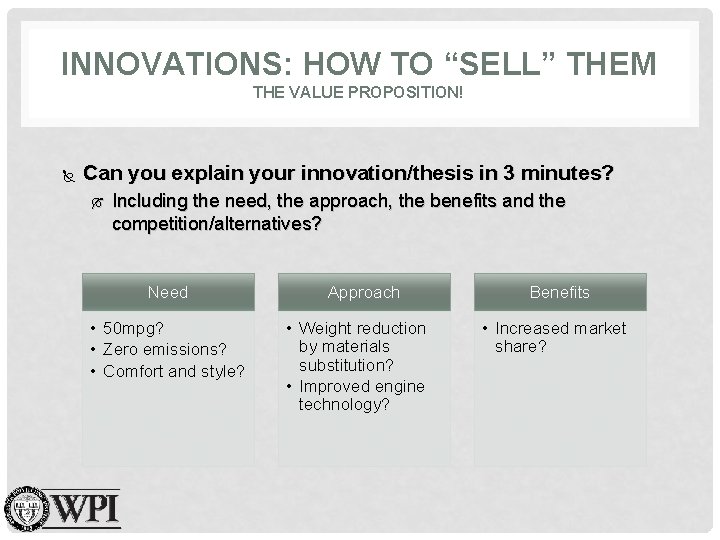
INNOVATIONS: HOW TO “SELL” THEM THE VALUE PROPOSITION! Can you explain your innovation/thesis in 3 minutes? Including the need, the approach, the benefits and the competition/alternatives? Need • 50 mpg? • Zero emissions? • Comfort and style? Approach • Weight reduction by materials substitution? • Improved engine technology? Benefits • Increased market share?
ELEVATOR PITCH EXAMPLES • http: //www. youtube. com/watch? v=Tq 0 tan 49 rmc • http: //www. youtube. com/watch? v=QK 3 Zdao. KXNQ&featu re=related • http: //www. youtube. com/watch? v=Edgz 93 EXKk&feature=related
THREE MINUTE THESIS EXAMPLES • http: //www. youtube. com/watch? v=Hah 0 Oq. K 7 D 8 M • http: //www. youtube. com/watch? v=s. Ud 33 k. REcx. E&featur e=related • http: //www. wpi. edu/Admin/Provost/GRAD/2011 ipc. html
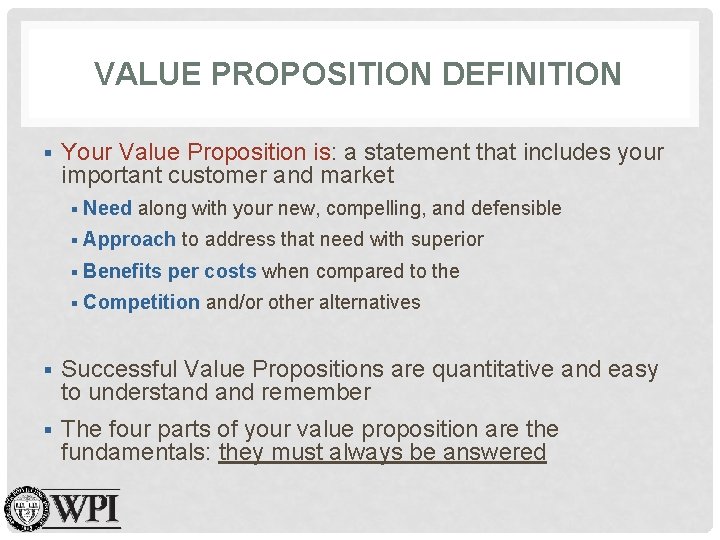
VALUE PROPOSITION DEFINITION § Your Value Proposition is: a statement that includes your important customer and market § Need along with your new, compelling, and defensible § Approach to address that need with superior § Benefits per costs when compared to the § Competition and/or other alternatives § Successful Value Propositions are quantitative and easy to understand remember § The four parts of your value proposition are the fundamentals: they must always be answered
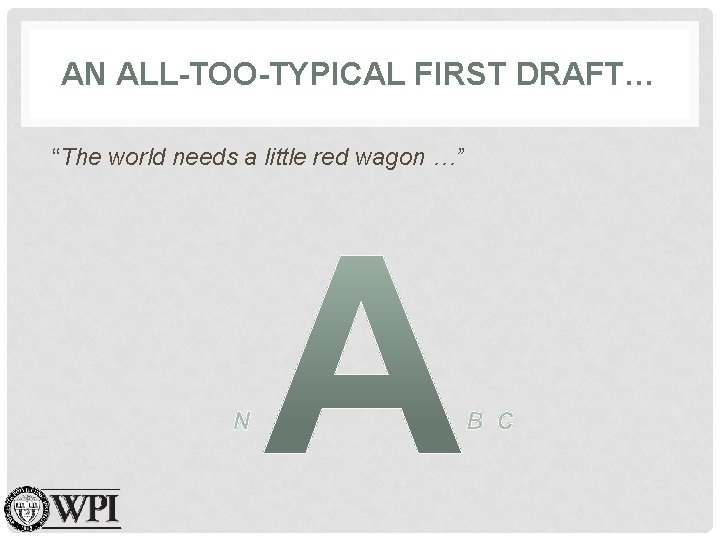
AN ALL-TOO-TYPICAL FIRST DRAFT… “The world needs a little red wagon …”
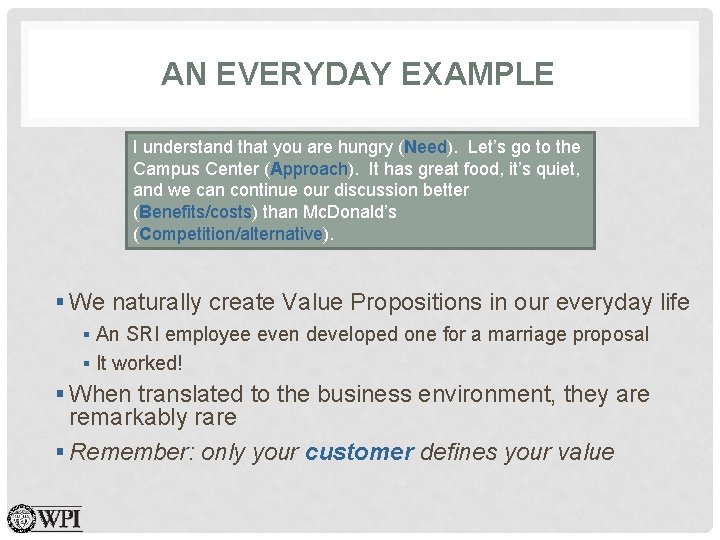
AN EVERYDAY EXAMPLE I understand that you are hungry (Need). Let’s go to the Campus Center (Approach). It has great food, it’s quiet, and we can continue our discussion better (Benefits/costs) than Mc. Donald’s (Competition/alternative). § We naturally create Value Propositions in our everyday life § An SRI employee even developed one for a marriage proposal § It worked! § When translated to the business environment, they are remarkably rare § Remember: only your customer defines your value
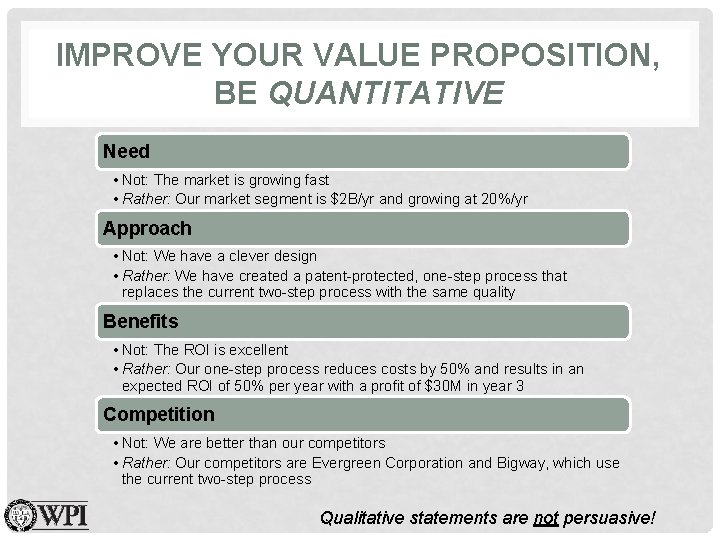
IMPROVE YOUR VALUE PROPOSITION, BE QUANTITATIVE Need • Not: The market is growing fast • Rather: Our market segment is $2 B/yr and growing at 20%/yr Approach • Not: We have a clever design • Rather: We have created a patent-protected, one-step process that replaces the current two-step process with the same quality Benefits • Not: The ROI is excellent • Rather: Our one-step process reduces costs by 50% and results in an expected ROI of 50% per year with a profit of $30 M in year 3 Competition • Not: We are better than our competitors • Rather: Our competitors are Evergreen Corporation and Bigway, which use the current two-step process Qualitative statements are not persuasive!
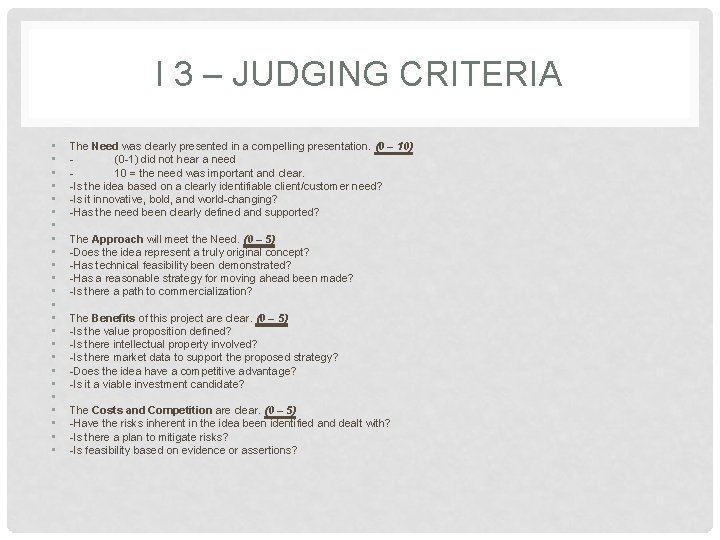
I 3 – JUDGING CRITERIA • • • • • • The Need was clearly presented in a compelling presentation. (0 – 10) - (0 -1) did not hear a need - 10 = the need was important and clear. -Is the idea based on a clearly identifiable client/customer need? -Is it innovative, bold, and world-changing? -Has the need been clearly defined and supported? The Approach will meet the Need. (0 – 5) -Does the idea represent a truly original concept? -Has technical feasibility been demonstrated? -Has a reasonable strategy for moving ahead been made? -Is there a path to commercialization? The Benefits of this project are clear. (0 – 5) -Is the value proposition defined? -Is there intellectual property involved? -Is there market data to support the proposed strategy? -Does the idea have a competitive advantage? -Is it a viable investment candidate? The Costs and Competition are clear. (0 – 5) -Have the risks inherent in the idea been identified and dealt with? -Is there a plan to mitigate risks? -Is feasibility based on evidence or assertions?
REFERENCES • SRI International • Slides – with RDS additions – from Curt Carlson – CEO SRI • Innovation by Curtis R. Carlson and William W. Wilmot, Crown Business, 2006.