
Value of Decision Making Advantages Disadvantages Process gain

- Slides: 10
Value of Decision Making Advantages Disadvantages “Process gain” “Process Loss” Encouragement/good decisions Communication problems Understanding Powerful group members Side-tracked- leads to disorganization Shooting down ideasdiscouraging Overuse
Approaches to Decision Making group decisions Consultative Democratic Consensus decision making Quality, speed, acceptance
Normative Decision Making Theory Addresses the problem & helps to make the best decision Quality & Acceptance is important Management skills Questions for Analyzing a Problem 1. Is a high quality decision required? 2. Do I have enough information to make such a decision ? 3. Is the problem structured? 4. Is it crucial for implementation that subordinates accept the decision? 5. If I make the decision alone, is it likely to be accepted by my subordinates?
Nominal Group Technique Allows group to focus on completing one task while avoiding any social relations. Does not require a true group. Leader presents problem to group, group brainstorms privately. Each member publically states answer, answers are recorded This technique is relatively quick Discourages the pressure to conform Requires a trained facilitator Only capable of addressing one narrowly defined problem.
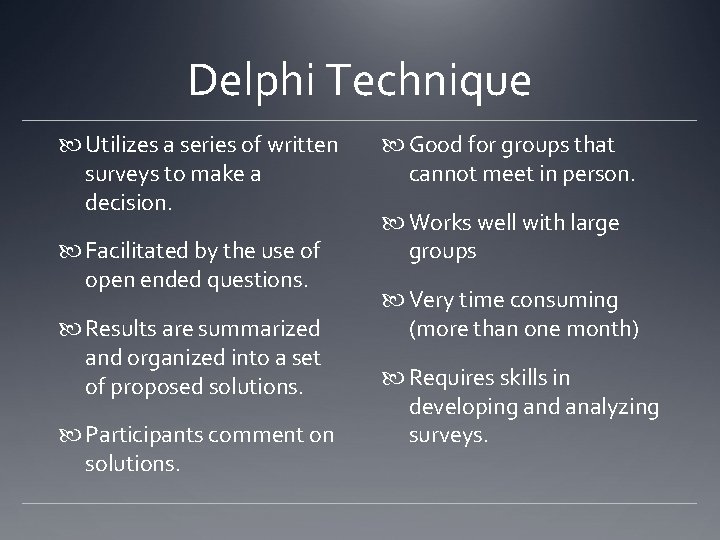
Delphi Technique Utilizes a series of written surveys to make a decision. Facilitated by the use of open ended questions. Results are summarized and organized into a set of proposed solutions. Participants comment on solutions. Good for groups that cannot meet in person. Works well with large groups Very time consuming (more than one month) Requires skills in developing and analyzing surveys.
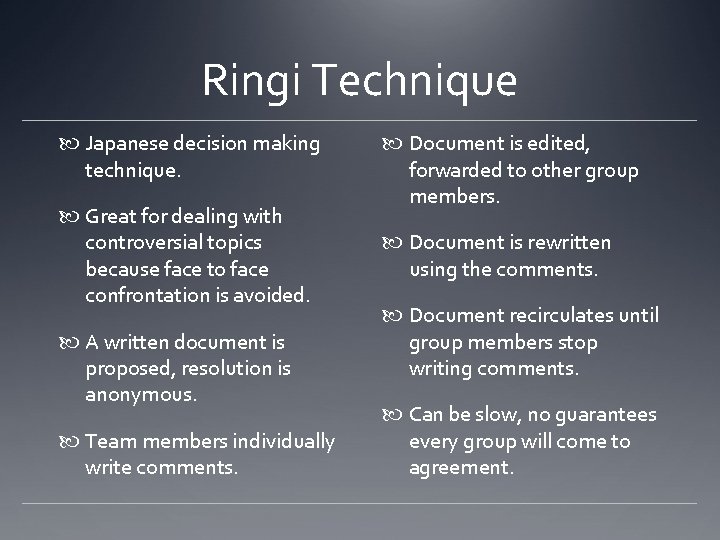
Ringi Technique Japanese decision making technique. Great for dealing with controversial topics because face to face confrontation is avoided. A written document is proposed, resolution is anonymous. Team members individually write comments. Document is edited, forwarded to other group members. Document is rewritten using the comments. Document recirculates until group members stop writing comments. Can be slow, no guarantees every group will come to agreement.
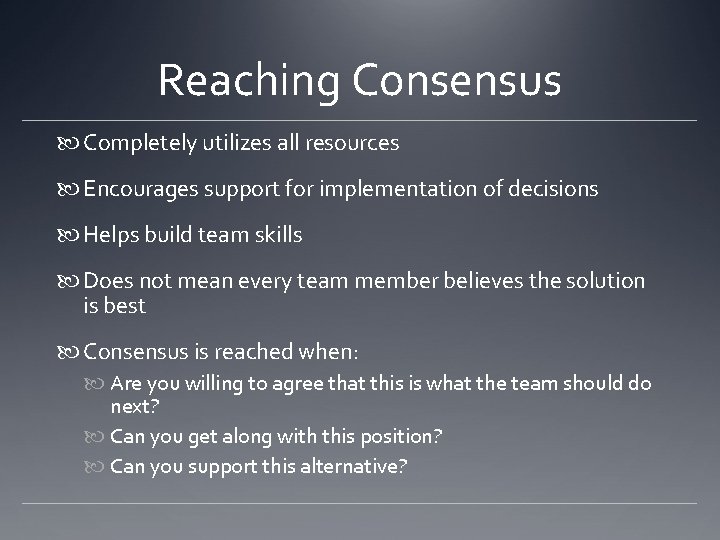
Reaching Consensus Completely utilizes all resources Encourages support for implementation of decisions Helps build team skills Does not mean every team member believes the solution is best Consensus is reached when: Are you willing to agree that this is what the team should do next? Can you get along with this position? Can you support this alternative?
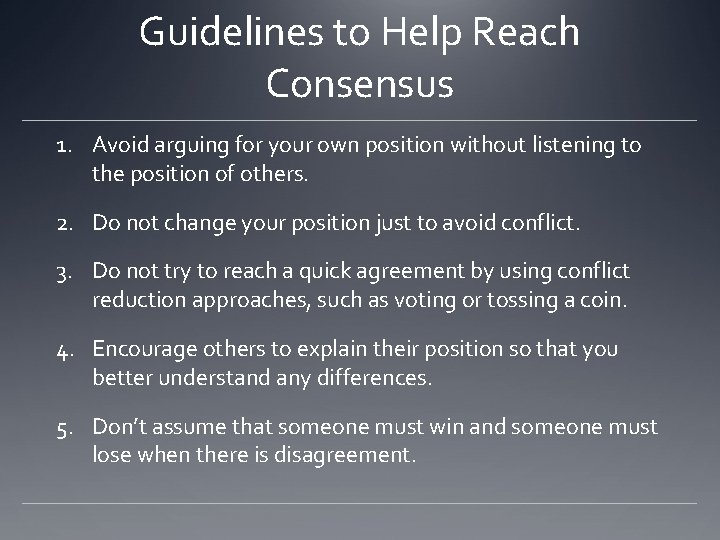
Guidelines to Help Reach Consensus 1. Avoid arguing for your own position without listening to the position of others. 2. Do not change your position just to avoid conflict. 3. Do not try to reach a quick agreement by using conflict reduction approaches, such as voting or tossing a coin. 4. Encourage others to explain their position so that you better understand any differences. 5. Don’t assume that someone must win and someone must lose when there is disagreement.
Guidelines (continued) 6. Discuss the underlying assumptions, listen carefully to one another, and encourage the participation of all members. 7. Look for creative and collaborative solutions that allow both sides to win, rather than compromises where each side only gets some of what it wants.