
Value of Component Commonality in Managing Uncertainty in

- Slides: 30
Value of Component Commonality in Managing Uncertainty in a Supply Chain Northern Illinois University Department of Technology Shun Takai
Role of Safety Inventory in a Supply Chain
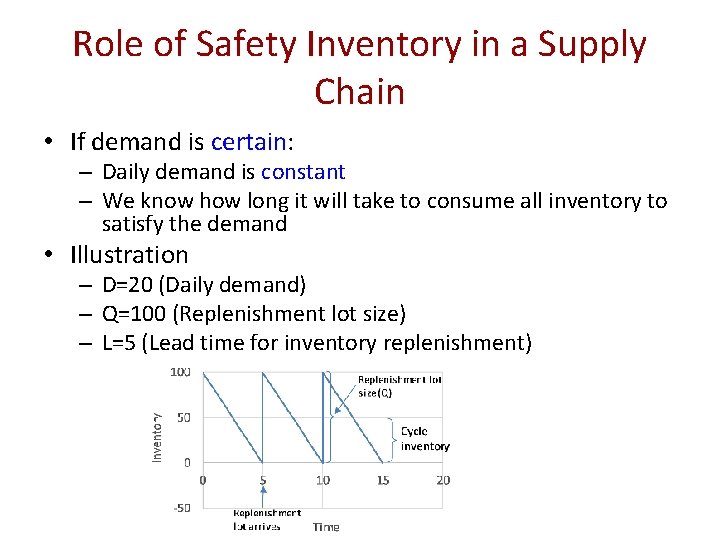
Role of Safety Inventory in a Supply Chain • If demand is certain: – Daily demand is constant – We know how long it will take to consume all inventory to satisfy the demand • Illustration – D=20 (Daily demand) – Q=100 (Replenishment lot size) – L=5 (Lead time for inventory replenishment) •
Role of Safety Inventory in a Supply Chain • If demand is uncertain: – Demand may be larger or smaller than the average – If the demand is large than the average, all inventory may be consumed before next replenishment lot arrives • Illustration – D=20 (Average daily demand) – Q=100 (Replenishment lot size) – L=5 (Lead time for inventory replenishment) •
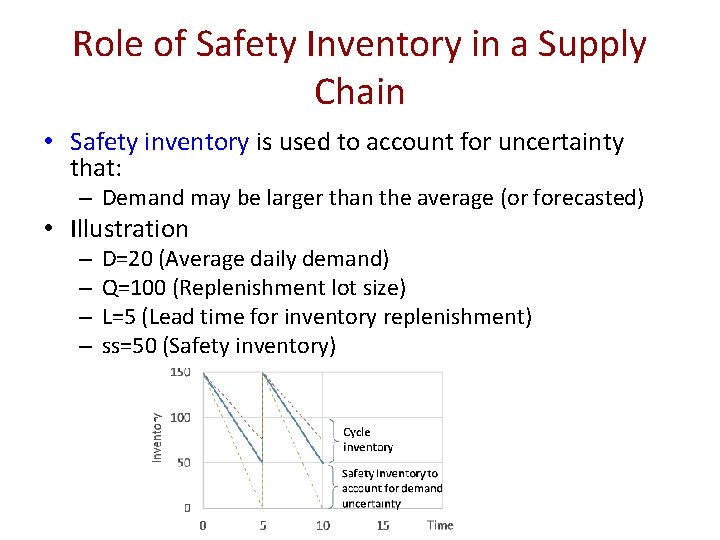
Role of Safety Inventory in a Supply Chain • Safety inventory is used to account for uncertainty that: – Demand may be larger than the average (or forecasted) • Illustration – – • D=20 (Average daily demand) Q=100 (Replenishment lot size) L=5 (Lead time for inventory replenishment) ss=50 (Safety inventory)
Determining Appropriate Level of Safety Inventory
Trade-Off in Safety Inventory Decisions • Large amount of safety inventory – Increases product availability (reduces product shortage); thus increases profit – Increases inventory holding costs; thus reduces profit • Key questions in safety inventory decisions are: 1. What is the appropriate level of safety inventory? 2. What actions to take to reduce safety inventory while maintaining product availability? (Reference) Supply Chain Management: Strategy, Planning, and Operation. Sunil Chopra and Peter Meindl. (2013) 5 th Edition. Boston, MA: Pearson Prentice-Hall.
Determining Appropriate Level of Safety Inventory • Safety inventory is determined by: – Demand supply uncertainties – Product availability • If uncertainty of demand or supply increases: – Safety inventory increases • If product availability increases: – Safety inventory increases (Reference) Supply Chain Management: Strategy, Planning, and Operation. Sunil Chopra and Peter Meindl. (2013) 5 th Edition. Boston, MA: Pearson Prentice-Hall.
Demand Uncertainty
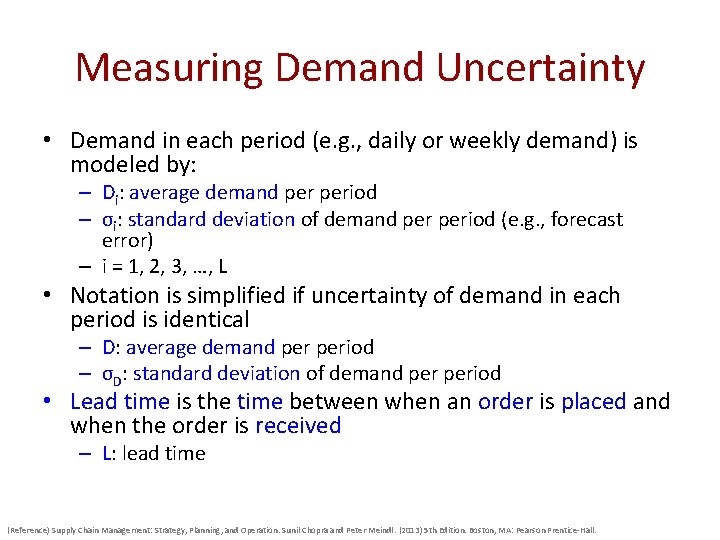
Measuring Demand Uncertainty • Demand in each period (e. g. , daily or weekly demand) is modeled by: – Di: average demand period – σi: standard deviation of demand period (e. g. , forecast error) – i = 1, 2, 3, …, L • Notation is simplified if uncertainty of demand in each period is identical – D: average demand period – σD: standard deviation of demand period • Lead time is the time between when an order is placed and when the order is received – L: lead time (Reference) Supply Chain Management: Strategy, Planning, and Operation. Sunil Chopra and Peter Meindl. (2013) 5 th Edition. Boston, MA: Pearson Prentice-Hall.
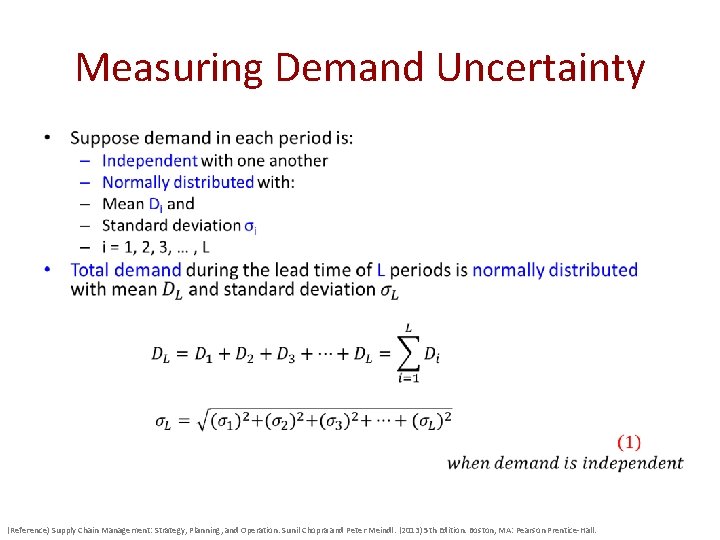
Measuring Demand Uncertainty • (Reference) Supply Chain Management: Strategy, Planning, and Operation. Sunil Chopra and Peter Meindl. (2013) 5 th Edition. Boston, MA: Pearson Prentice-Hall.
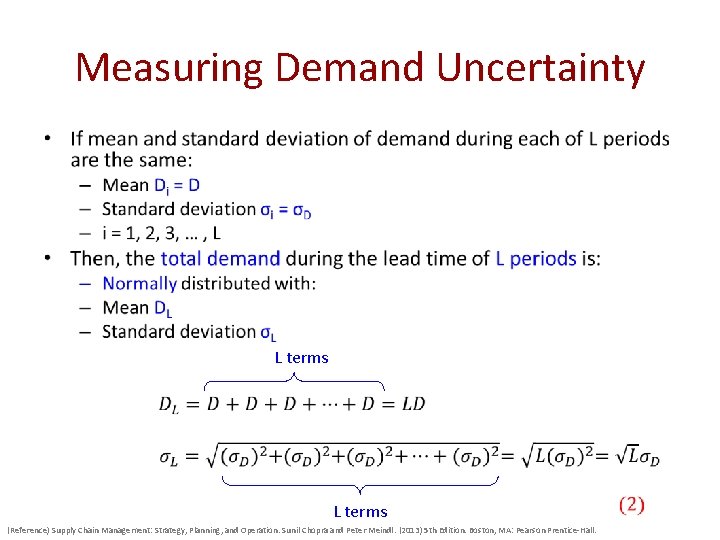
Measuring Demand Uncertainty • L terms (Reference) Supply Chain Management: Strategy, Planning, and Operation. Sunil Chopra and Peter Meindl. (2013) 5 th Edition. Boston, MA: Pearson Prentice-Hall.
Product Availability and Replenishment Policy
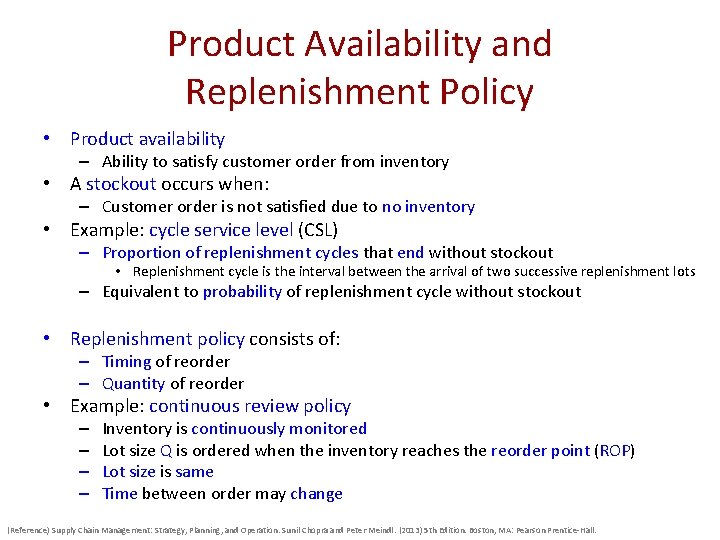
Product Availability and Replenishment Policy • Product availability – Ability to satisfy customer order from inventory • A stockout occurs when: – Customer order is not satisfied due to no inventory • Example: cycle service level (CSL) – Proportion of replenishment cycles that end without stockout • Replenishment cycle is the interval between the arrival of two successive replenishment lots – Equivalent to probability of replenishment cycle without stockout • Replenishment policy consists of: – Timing of reorder – Quantity of reorder • Example: continuous review policy – – Inventory is continuously monitored Lot size Q is ordered when the inventory reaches the reorder point (ROP) Lot size is same Time between order may change (Reference) Supply Chain Management: Strategy, Planning, and Operation. Sunil Chopra and Peter Meindl. (2013) 5 th Edition. Boston, MA: Pearson Prentice-Hall.
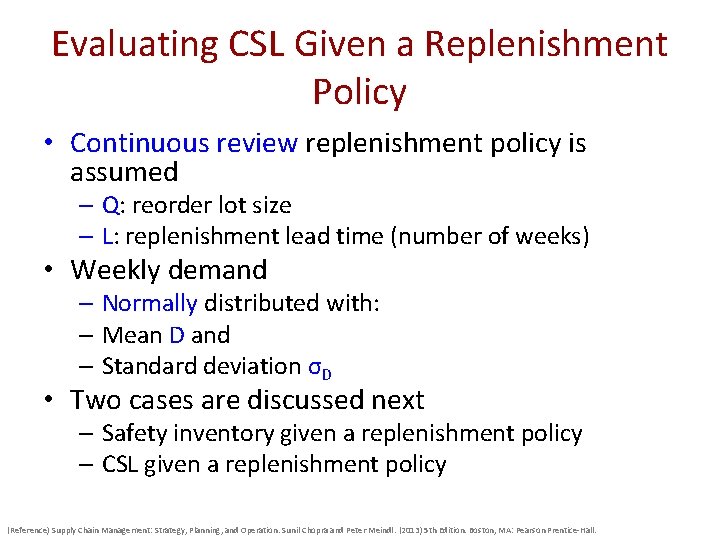
Evaluating CSL Given a Replenishment Policy • Continuous review replenishment policy is assumed – Q: reorder lot size – L: replenishment lead time (number of weeks) • Weekly demand – Normally distributed with: – Mean D and – Standard deviation σD • Two cases are discussed next – Safety inventory given a replenishment policy – CSL given a replenishment policy (Reference) Supply Chain Management: Strategy, Planning, and Operation. Sunil Chopra and Peter Meindl. (2013) 5 th Edition. Boston, MA: Pearson Prentice-Hall.
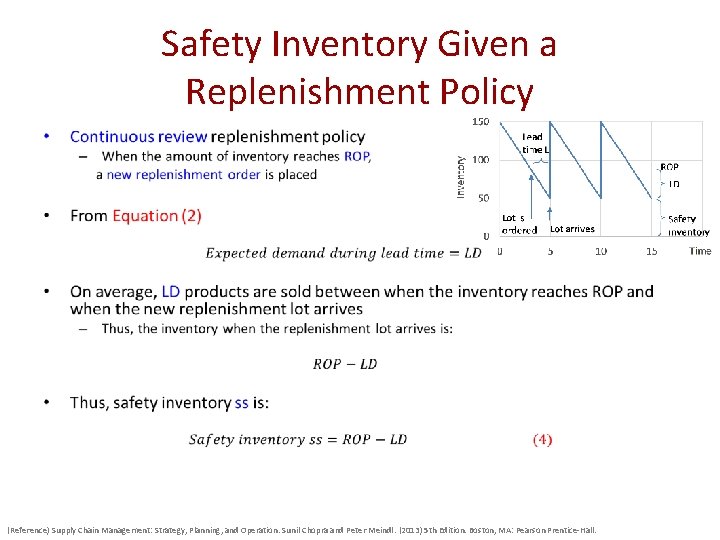
Safety Inventory Given a Replenishment Policy • (Reference) Supply Chain Management: Strategy, Planning, and Operation. Sunil Chopra and Peter Meindl. (2013) 5 th Edition. Boston, MA: Pearson Prentice-Hall.
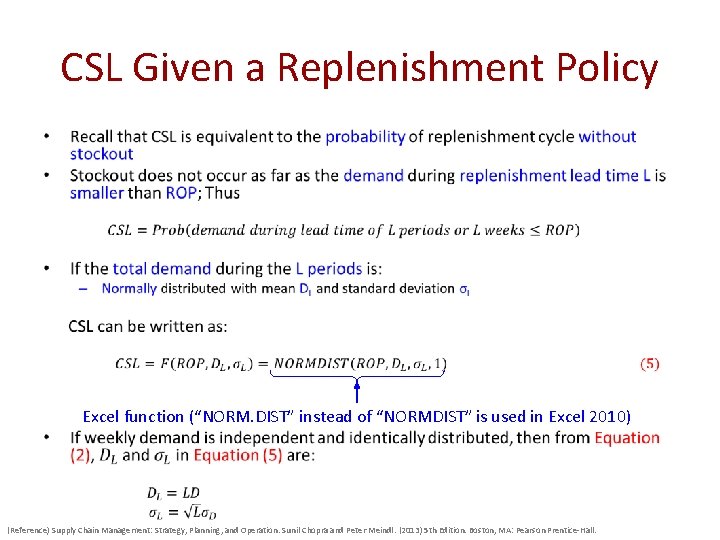
CSL Given a Replenishment Policy • Excel function (“NORM. DIST” instead of “NORMDIST” is used in Excel 2010) (Reference) Supply Chain Management: Strategy, Planning, and Operation. Sunil Chopra and Peter Meindl. (2013) 5 th Edition. Boston, MA: Pearson Prentice-Hall.
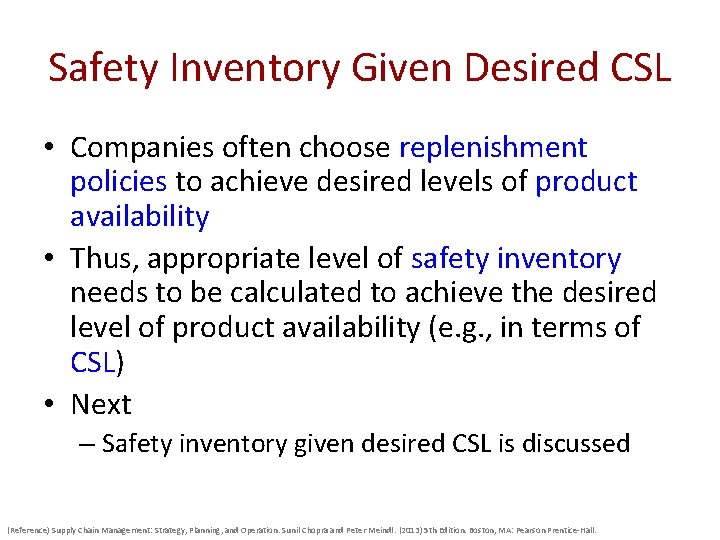
Safety Inventory Given Desired CSL • Companies often choose replenishment policies to achieve desired levels of product availability • Thus, appropriate level of safety inventory needs to be calculated to achieve the desired level of product availability (e. g. , in terms of CSL) • Next – Safety inventory given desired CSL is discussed (Reference) Supply Chain Management: Strategy, Planning, and Operation. Sunil Chopra and Peter Meindl. (2013) 5 th Edition. Boston, MA: Pearson Prentice-Hall.
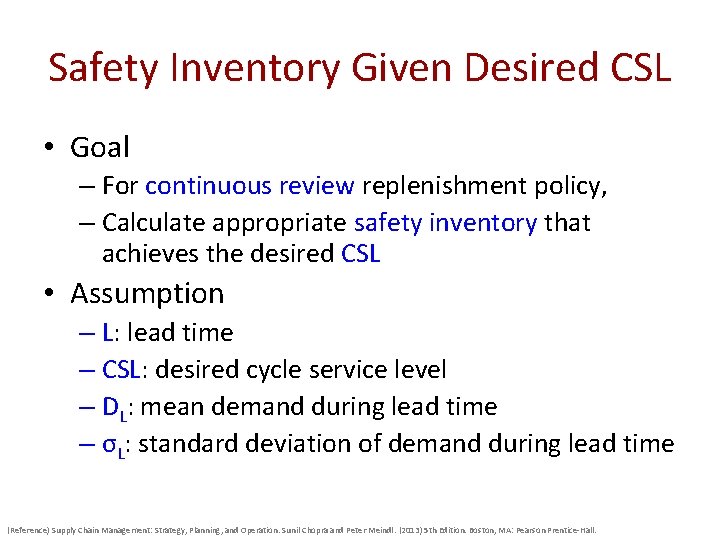
Safety Inventory Given Desired CSL • Goal – For continuous review replenishment policy, – Calculate appropriate safety inventory that achieves the desired CSL • Assumption – L: lead time – CSL: desired cycle service level – DL: mean demand during lead time – σL: standard deviation of demand during lead time (Reference) Supply Chain Management: Strategy, Planning, and Operation. Sunil Chopra and Peter Meindl. (2013) 5 th Edition. Boston, MA: Pearson Prentice-Hall.
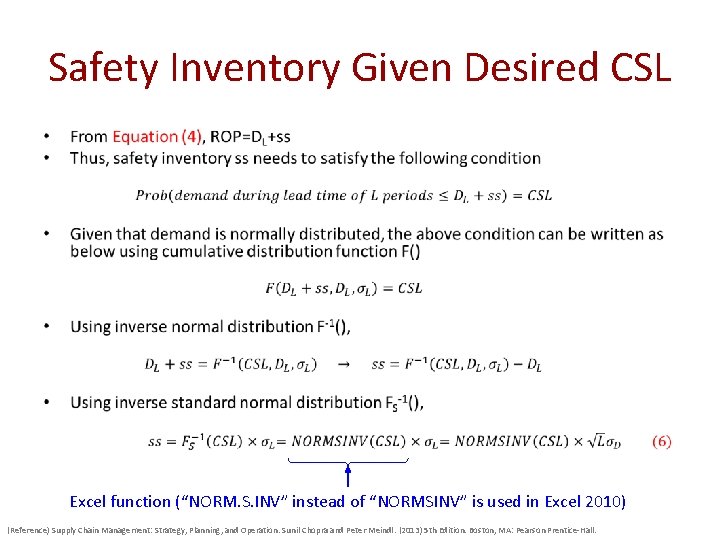
Safety Inventory Given Desired CSL • Excel function (“NORM. S. INV” instead of “NORMSINV” is used in Excel 2010) (Reference) Supply Chain Management: Strategy, Planning, and Operation. Sunil Chopra and Peter Meindl. (2013) 5 th Edition. Boston, MA: Pearson Prentice-Hall.
Impact of Product Design on Safety Inventory – Value of Component Commonality
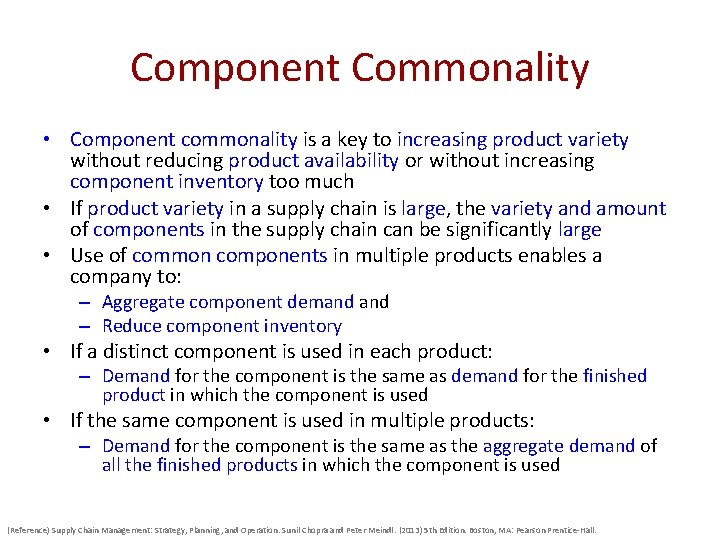
Component Commonality • Component commonality is a key to increasing product variety without reducing product availability or without increasing component inventory too much • If product variety in a supply chain is large, the variety and amount of components in the supply chain can be significantly large • Use of common components in multiple products enables a company to: – Aggregate component demand – Reduce component inventory • If a distinct component is used in each product: – Demand for the component is the same as demand for the finished product in which the component is used • If the same component is used in multiple products: – Demand for the component is the same as the aggregate demand of all the finished products in which the component is used (Reference) Supply Chain Management: Strategy, Planning, and Operation. Sunil Chopra and Peter Meindl. (2013) 5 th Edition. Boston, MA: Pearson Prentice-Hall.
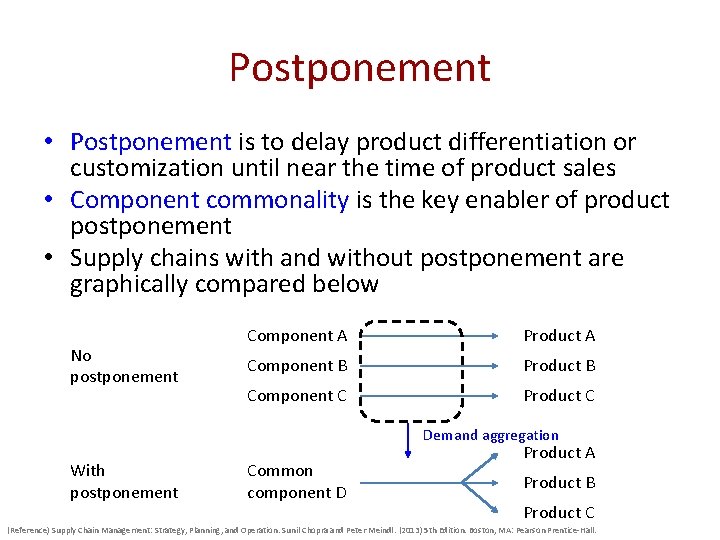
Postponement • Postponement is to delay product differentiation or customization until near the time of product sales • Component commonality is the key enabler of product postponement • Supply chains with and without postponement are graphically compared below No postponement • With postponement Component A Product A Component B Product B Component C Product C Demand aggregation Common component D Product A Product B Product C (Reference) Supply Chain Management: Strategy, Planning, and Operation. Sunil Chopra and Peter Meindl. (2013) 5 th Edition. Boston, MA: Pearson Prentice-Hall.
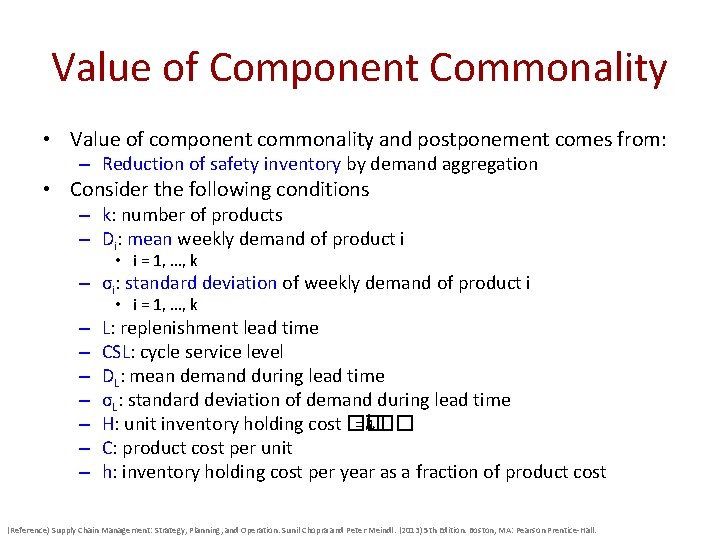
Value of Component Commonality • Value of component commonality and postponement comes from: – Reduction of safety inventory by demand aggregation • Consider the following conditions – k: number of products – Di: mean weekly demand of product i • i = 1, …, k – σi: standard deviation of weekly demand of product i • i = 1, …, k – – – – L: replenishment lead time CSL: cycle service level DL: mean demand during lead time σL: standard deviation of demand during lead time H: unit inventory holding cost �� =ℎ�� C: product cost per unit h: inventory holding cost per year as a fraction of product cost (Reference) Supply Chain Management: Strategy, Planning, and Operation. Sunil Chopra and Peter Meindl. (2013) 5 th Edition. Boston, MA: Pearson Prentice-Hall.
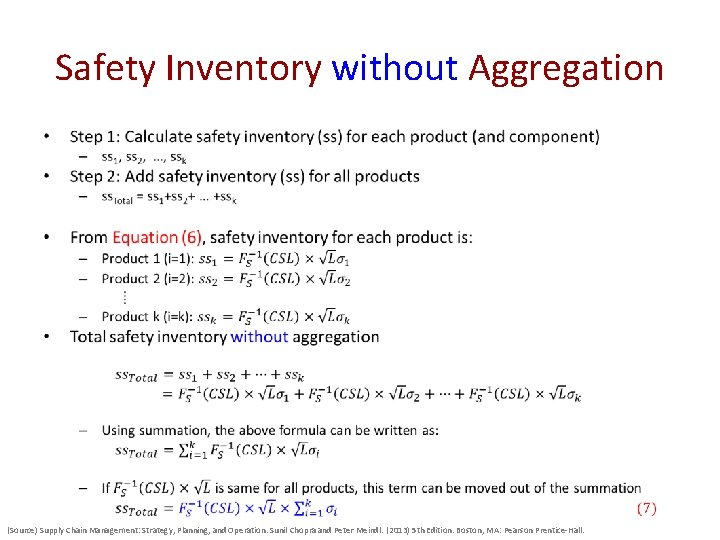
Safety Inventory without Aggregation • (Source) Supply Chain Management: Strategy, Planning, and Operation. Sunil Chopra and Peter Meindl. (2013) 5 th Edition. Boston, MA: Pearson Prentice-Hall.
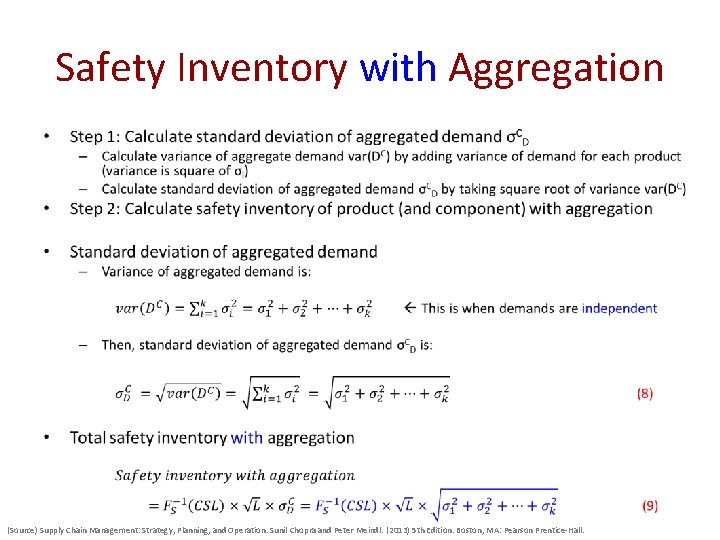
Safety Inventory with Aggregation • (Source) Supply Chain Management: Strategy, Planning, and Operation. Sunil Chopra and Peter Meindl. (2013) 5 th Edition. Boston, MA: Pearson Prentice-Hall.
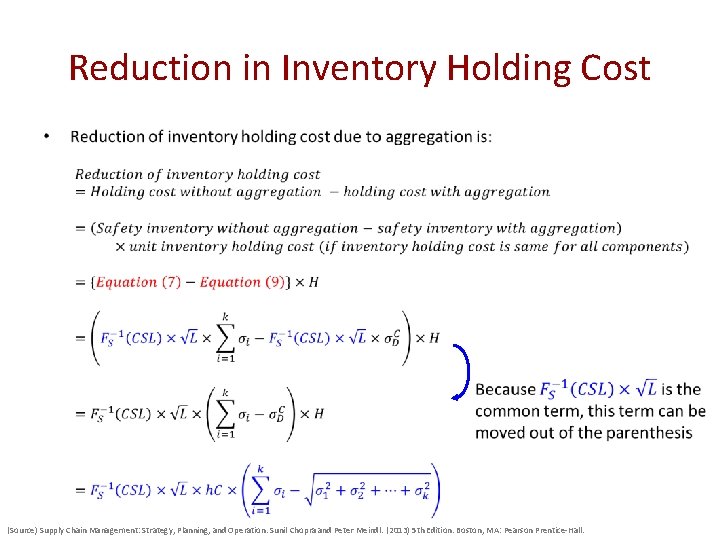
Reduction in Inventory Holding Cost • (Source) Supply Chain Management: Strategy, Planning, and Operation. Sunil Chopra and Peter Meindl. (2013) 5 th Edition. Boston, MA: Pearson Prentice-Hall.
Problem
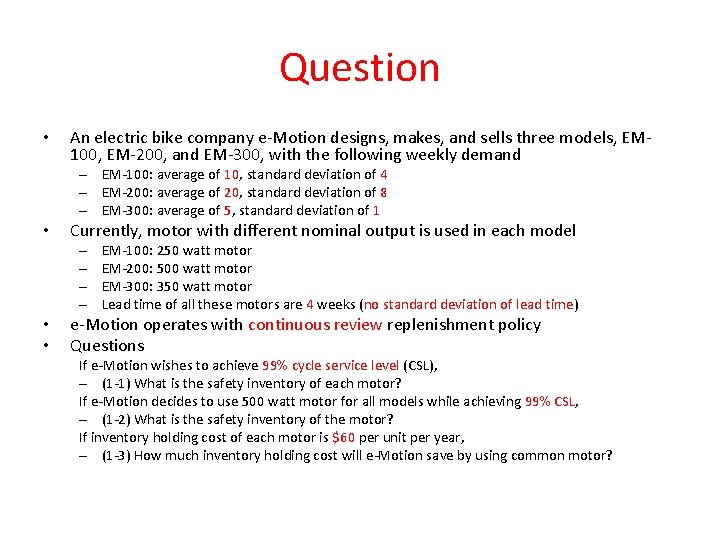
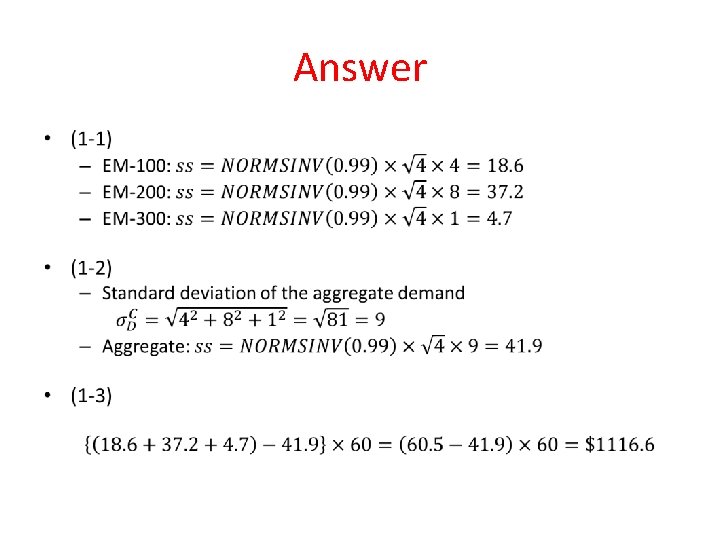
Question • An electric bike company e-Motion designs, makes, and sells three models, EM 100, EM-200, and EM-300, with the following weekly demand – EM-100: average of 10, standard deviation of 4 – EM-200: average of 20, standard deviation of 8 – EM-300: average of 5, standard deviation of 1 • Currently, motor with different nominal output is used in each model – – • • EM-100: 250 watt motor EM-200: 500 watt motor EM-300: 350 watt motor Lead time of all these motors are 4 weeks (no standard deviation of lead time) e-Motion operates with continuous review replenishment policy Questions If e-Motion wishes to achieve 99% cycle service level (CSL), – (1 -1) What is the safety inventory of each motor? If e-Motion decides to use 500 watt motor for all models while achieving 99% CSL, – (1 -2) What is the safety inventory of the motor? If inventory holding cost of each motor is $60 per unit per year, – (1 -3) How much inventory holding cost will e-Motion save by using common motor?
Answer •