
Value Chain Michael Porter in 1985 introduced in
- Slides: 8
Value Chain: Michael Porter in 1985 introduced in his book ‘ The Competitive Advantage: Creating and sustaining Superior performance’ the concept of the Value Chain. Michael Porter suggested that the organization is split into ‘primary activities’ and ‘support activities’. Primary Service, Support activities: Operation, Logistics, marketing, Activities: Procurement, Technology development, Human resource mgt, Infrastructure.
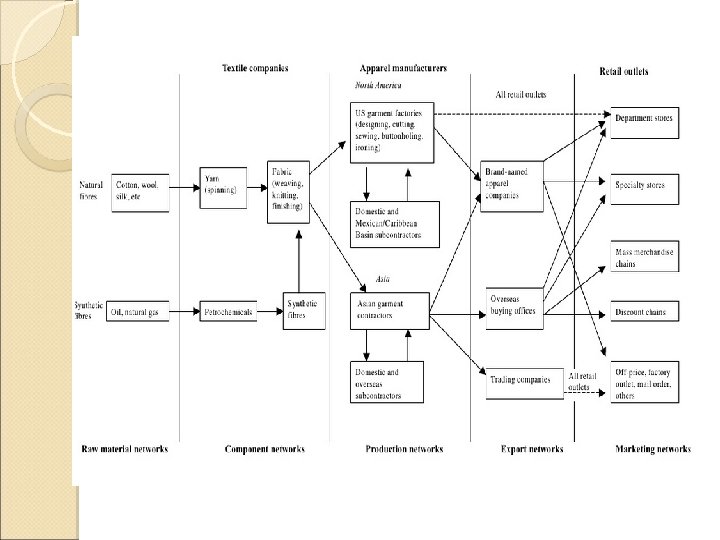
Value Chain: The apparel value chain is organized around five main segments: (1) raw material supply, including: natural and synthetic fibers (2) provision of components, such as the yarns and fabrics manufactured by textile companies; (3) production networks made up of garment factories, including their domestic and overseas subcontractors; (4) export channels established by trade intermediaries; and (5) marketing networks at the retail level Over time, there have been continual shifts in the location of both the most significant apparel exporting countries and regions, as well as their main end markets
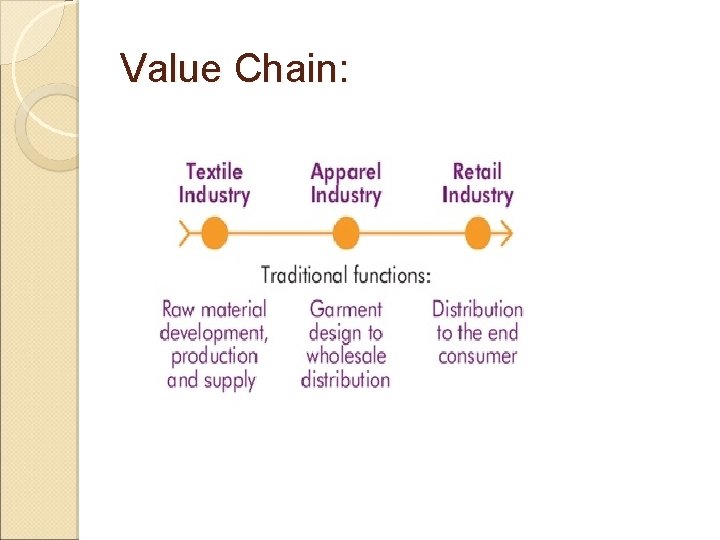
Value Chain:
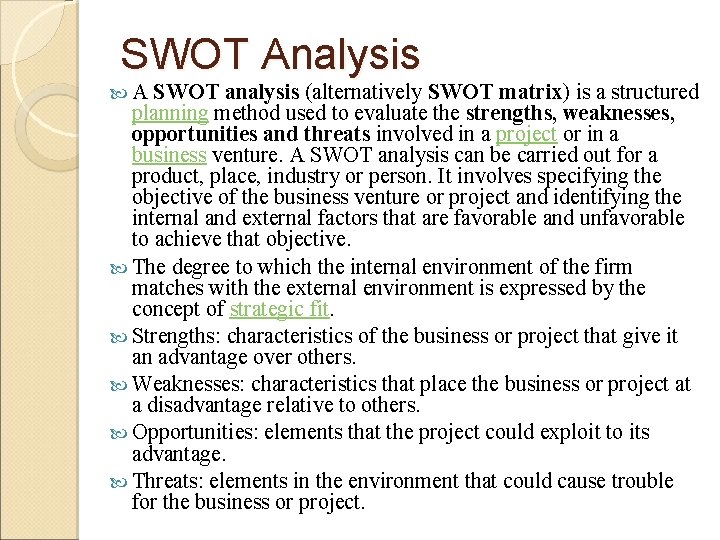
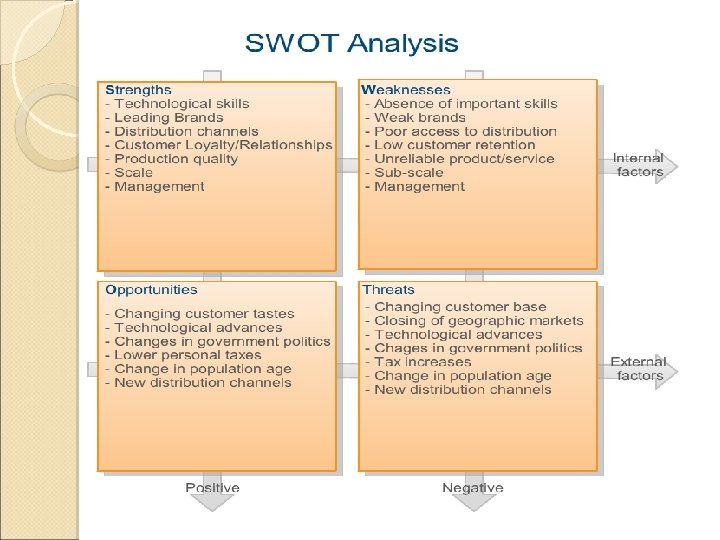
SWOT Analysis A SWOT analysis (alternatively SWOT matrix) is a structured planning method used to evaluate the strengths, weaknesses, opportunities and threats involved in a project or in a business venture. A SWOT analysis can be carried out for a product, place, industry or person. It involves specifying the objective of the business venture or project and identifying the internal and external factors that are favorable and unfavorable to achieve that objective. The degree to which the internal environment of the firm matches with the external environment is expressed by the concept of strategic fit. Strengths: characteristics of the business or project that give it an advantage over others. Weaknesses: characteristics that place the business or project at a disadvantage relative to others. Opportunities: elements that the project could exploit to its advantage. Threats: elements in the environment that could cause trouble for the business or project.
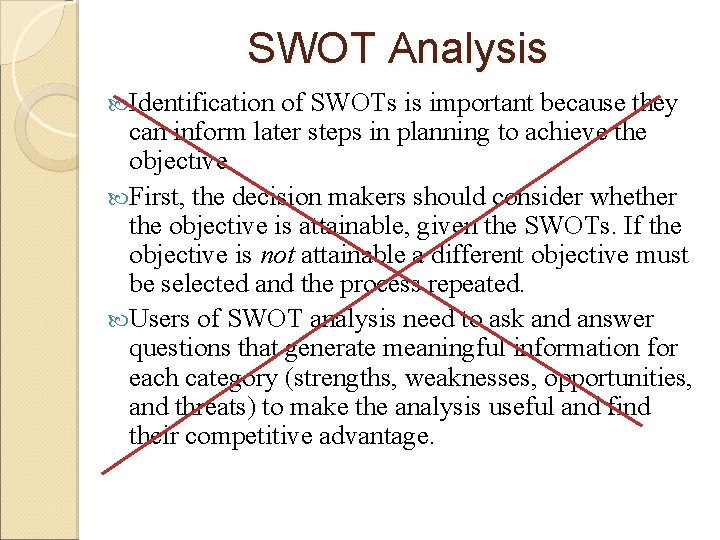
SWOT Analysis Identification of SWOTs is important because they can inform later steps in planning to achieve the objective. First, the decision makers should consider whether the objective is attainable, given the SWOTs. If the objective is not attainable a different objective must be selected and the process repeated. Users of SWOT analysis need to ask and answer questions that generate meaningful information for each category (strengths, weaknesses, opportunities, and threats) to make the analysis useful and find their competitive advantage.
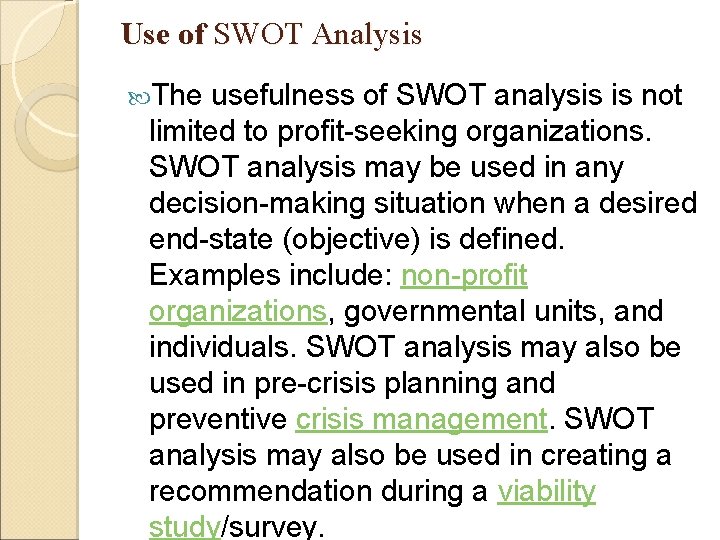
Use of SWOT Analysis The usefulness of SWOT analysis is not limited to profit-seeking organizations. SWOT analysis may be used in any decision-making situation when a desired end-state (objective) is defined. Examples include: non-profit organizations, governmental units, and individuals. SWOT analysis may also be used in pre-crisis planning and preventive crisis management. SWOT analysis may also be used in creating a recommendation during a viability study/survey.