
Value Chain Analysis of Free Range Chicken Presented

- Slides: 12
Value Chain Analysis of Free Range Chicken Presented by Sim Kong, General Director of CEDAC Agri based Enterprise Support Program June 2008 1
PRESENTATION OUTLINES 1 - Chicken Supply Chain 2 - Market demand/size 3 - Value Chain 4 - Information/ capital flows 5 - Enabling Environment 6 - Industry Coordination 7 - Conclusion 8 - Recommendations/Intervention Action Plan 2
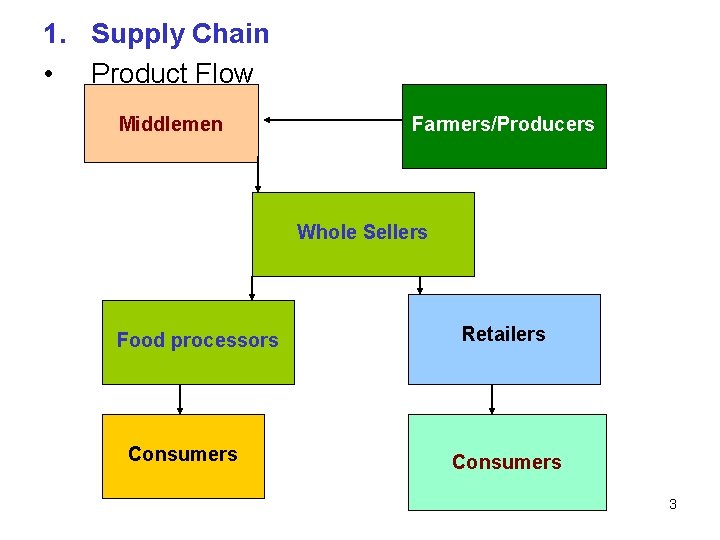
1. Supply Chain • Product Flow Middlemen Farmers/Producers Whole Sellers Food processors Consumers Retailers Consumers 3
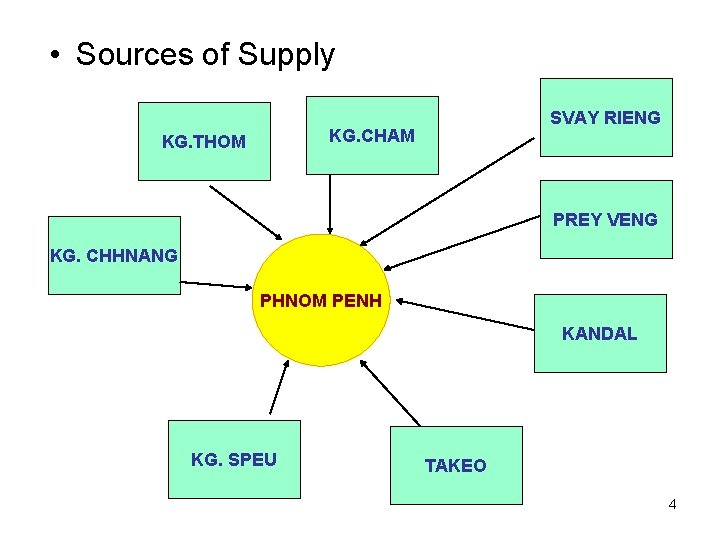
• Sources of Supply SVAY RIENG KG. CHAM KG. THOM PREY VENG KG. CHHNANG PHNOM PENH KANDAL KG. SPEU TAKEO 4
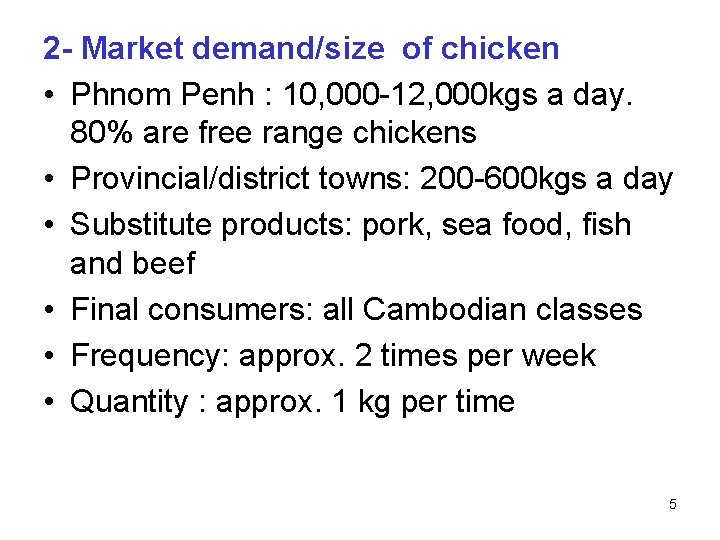
2 - Market demand/size of chicken • Phnom Penh : 10, 000 -12, 000 kgs a day. 80% are free range chickens • Provincial/district towns: 200 -600 kgs a day • Substitute products: pork, sea food, fish and beef • Final consumers: all Cambodian classes • Frequency: approx. 2 times per week • Quantity : approx. 1 kg per time 5
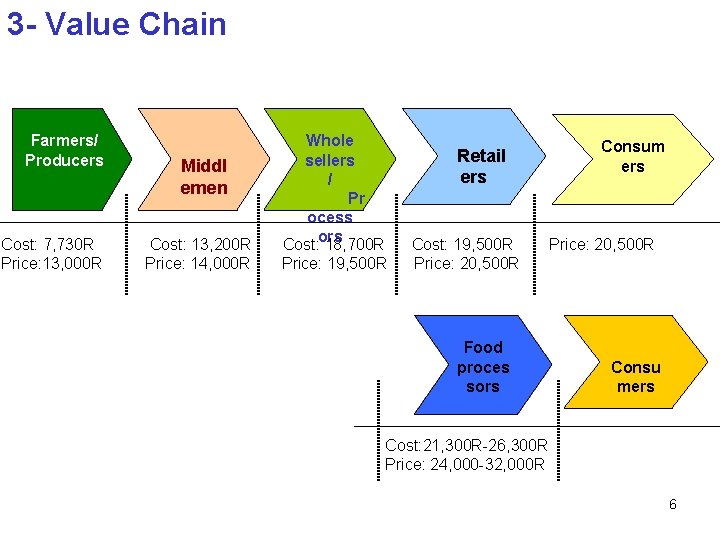
3 - Value Chain Farmers/ Producers Cost: 7, 730 R Price: 13, 000 R Middl emen Cost: 13, 200 R Price: 14, 000 R Whole sellers / Pr ocess Cost: ors 18, 700 R Retail ers Price: 19, 500 R Cost: 19, 500 R Price: 20, 500 R Food proces sors Consum ers Price: 20, 500 R Consu mers Cost: 21, 300 R-26, 300 R Price: 24, 000 -32, 000 R 6
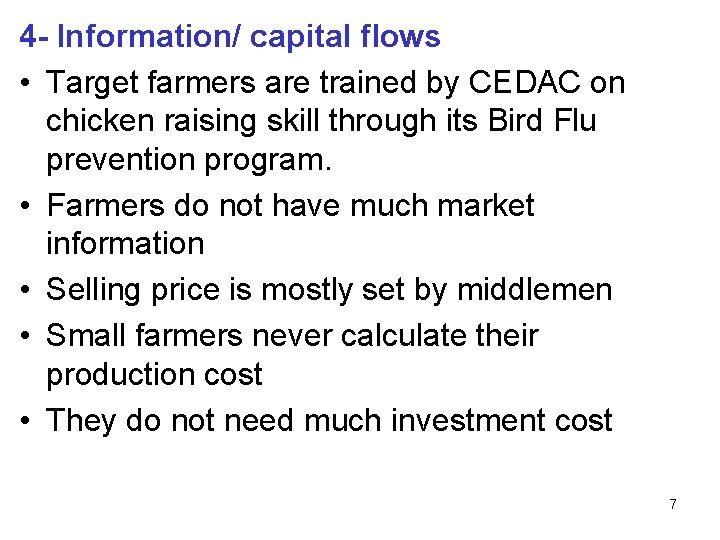
4 - Information/ capital flows • Target farmers are trained by CEDAC on chicken raising skill through its Bird Flu prevention program. • Farmers do not have much market information • Selling price is mostly set by middlemen • Small farmers never calculate their production cost • They do not need much investment cost 7
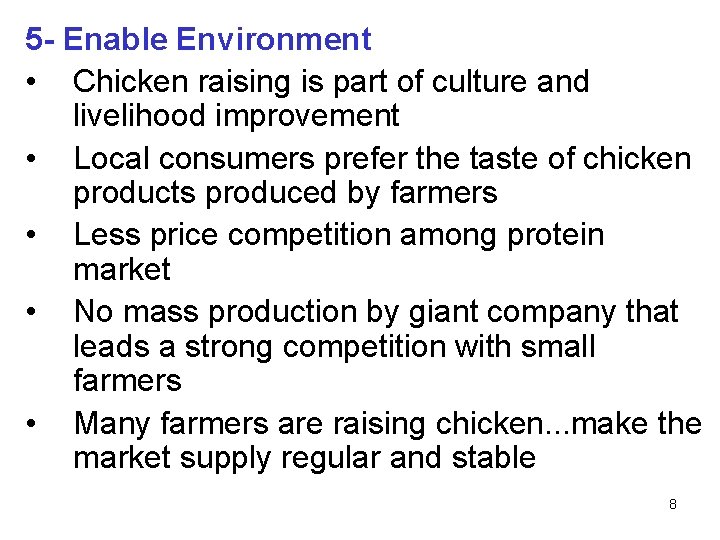
5 - Enable Environment • Chicken raising is part of culture and livelihood improvement • Local consumers prefer the taste of chicken products produced by farmers • Less price competition among protein market • No mass production by giant company that leads a strong competition with small farmers • Many farmers are raising chicken. . . make the market supply regular and stable 8
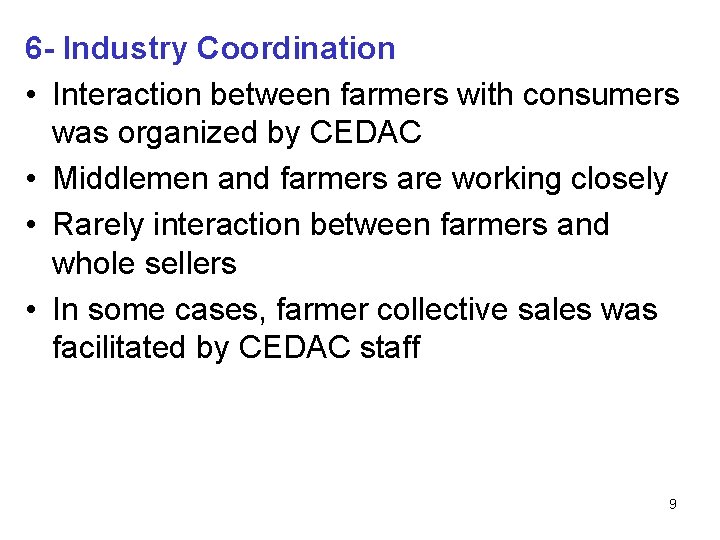
6 - Industry Coordination • Interaction between farmers with consumers was organized by CEDAC • Middlemen and farmers are working closely • Rarely interaction between farmers and whole sellers • In some cases, farmer collective sales was facilitated by CEDAC staff 9
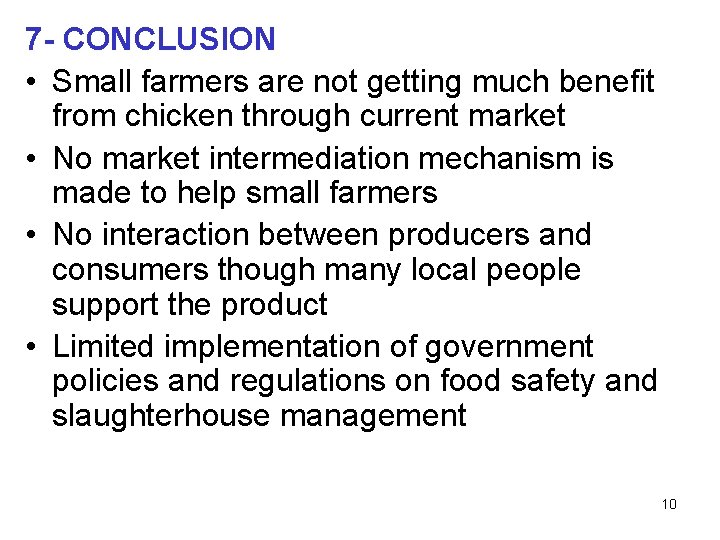
7 - CONCLUSION • Small farmers are not getting much benefit from chicken through current market • No market intermediation mechanism is made to help small farmers • No interaction between producers and consumers though many local people support the product • Limited implementation of government policies and regulations on food safety and slaughterhouse management 10
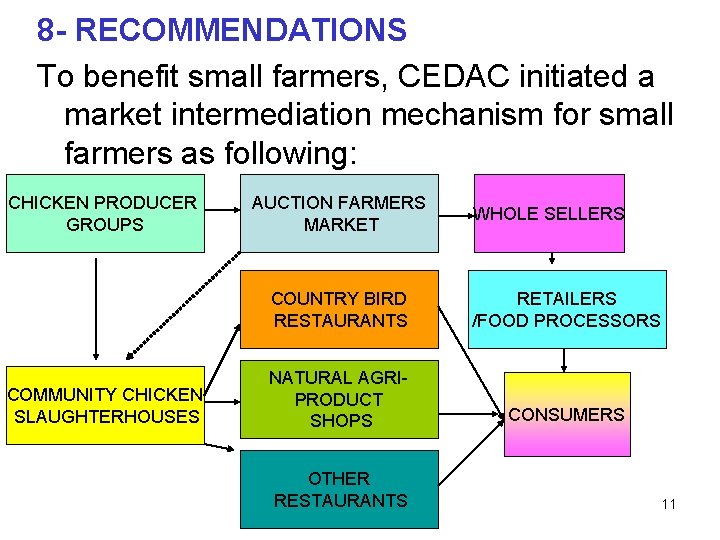
8 - RECOMMENDATIONS To benefit small farmers, CEDAC initiated a market intermediation mechanism for small farmers as following: CHICKEN PRODUCER GROUPS COMMUNITY CHICKEN SLAUGHTERHOUSES AUCTION FARMERS MARKET WHOLE SELLERS COUNTRY BIRD RESTAURANTS RETAILERS /FOOD PROCESSORS NATURAL AGRIPRODUCT SHOPS CONSUMERS OTHER RESTAURANTS 11
12