
Value Based Sourcing Private Sector Drivers for ValueBased
Value Based Sourcing Private Sector Drivers for Value-Based Sourcing and the Implications for Government Procurement Albert Sun, Principal, A. T. Kearney Session 1002 April 25, 2005 1: 30 pm – 2: 30 pm NCMA World Congress 2005 “Prime Time: Contract Management at the Core of the Enterprise” April 25– 27, 2005 Phoenix Civic Plaza/Hyatt Regency Phoenix, AZ 1

Agenda • Private Sector Trends – moving to Value-Based Sourcing • Implications for Government Procurement and Contracting Professionals • Questions NCMA World Congress 2005 “Prime Time: Contract Management at the Core of the Enterprise” April 25– 27, 2005 Phoenix Civic Plaza/Hyatt Regency Phoenix, AZ 2
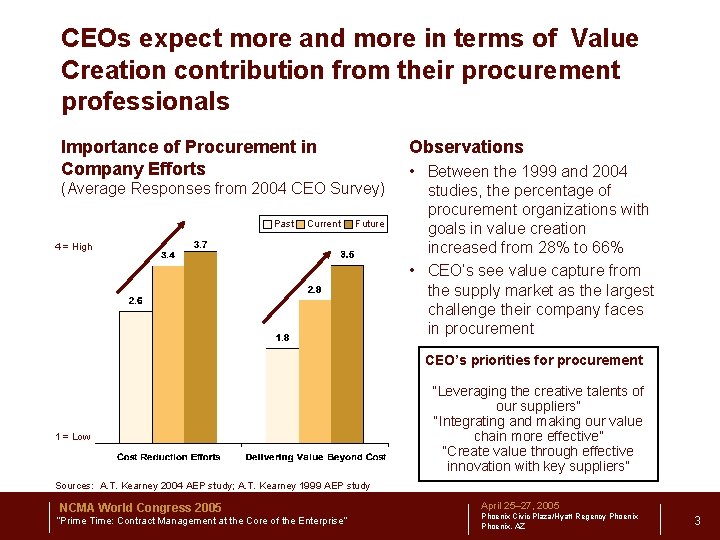
CEOs expect more and more in terms of Value Creation contribution from their procurement professionals Importance of Procurement in Company Efforts Observations (Average Responses from 2004 CEO Survey) Past Current Future 4 = High • Between the 1999 and 2004 studies, the percentage of procurement organizations with goals in value creation increased from 28% to 66% • CEO’s see value capture from the supply market as the largest challenge their company faces in procurement CEO’s priorities for procurement 1 = Low “Leveraging the creative talents of our suppliers” “Integrating and making our value chain more effective” “Create value through effective innovation with key suppliers” Sources: A. T. Kearney 2004 AEP study; A. T. Kearney 1999 AEP study NCMA World Congress 2005 “Prime Time: Contract Management at the Core of the Enterprise” April 25– 27, 2005 Phoenix Civic Plaza/Hyatt Regency Phoenix, AZ 3
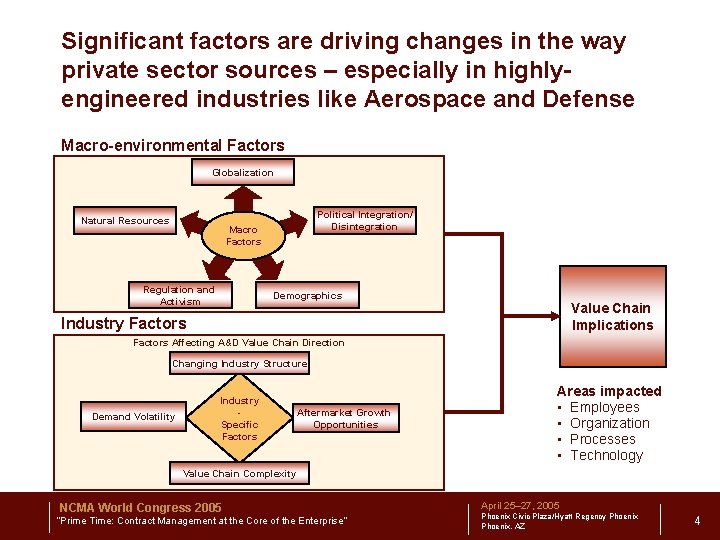
Significant factors are driving changes in the way private sector sources – especially in highlyengineered industries like Aerospace and Defense Macro-environmental Factors Globalization Natural Resources Political Integration/ Disintegration Macro Factors Regulation and Activism Demographics Value Chain Implications Industry Factors Affecting A&D Value Chain Direction Changing Industry Structure Demand Volatility Industry Specific Factors Aftermarket Growth Opportunities Areas impacted • Employees • Organization • Processes • Technology Value Chain Complexity NCMA World Congress 2005 “Prime Time: Contract Management at the Core of the Enterprise” April 25– 27, 2005 Phoenix Civic Plaza/Hyatt Regency Phoenix, AZ 4
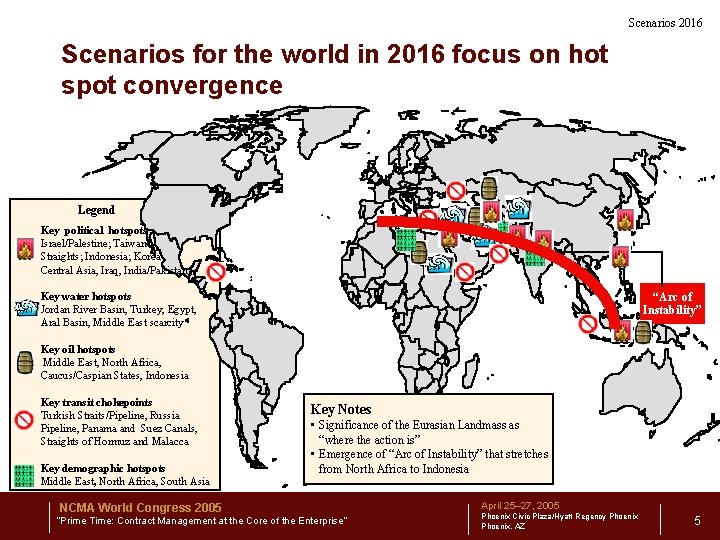
Scenarios 2016 Scenarios for the world in 2016 focus on hot spot convergence Legend Key political hotspots Israel/Palestine; Taiwan Straights; Indonesia; Korea Central Asia, Iraq, India/Pakistan Key water hotspots Jordan River Basin, Turkey, Egypt, Aral Basin, Middle East scarcity “Arc of Instability” Key oil hotspots Middle East, North Africa, Caucus/Caspian States, Indonesia Key transit chokepoints Turkish Straits/Pipeline, Russia Pipeline, Panama and Suez Canals, Straights of Hormuz and Malacca Key demographic hotspots Middle East, North Africa, South Asia Key Notes • Significance of the Eurasian Landmass as “where the action is” • Emergence of “Arc of Instability” that stretches from North Africa to Indonesia NCMA World Congress 2005 “Prime Time: Contract Management at the Core of the Enterprise” April 25– 27, 2005 Phoenix Civic Plaza/Hyatt Regency Phoenix, AZ 5
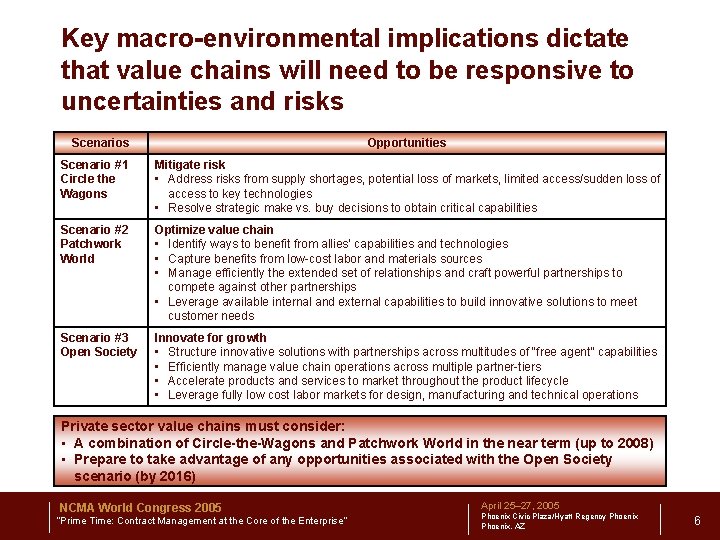
Key macro-environmental implications dictate that value chains will need to be responsive to uncertainties and risks Scenarios Opportunities Scenario #1 Circle the Wagons Mitigate risk • Address risks from supply shortages, potential loss of markets, limited access/sudden loss of access to key technologies • Resolve strategic make vs. buy decisions to obtain critical capabilities Scenario #2 Patchwork World Optimize value chain • Identify ways to benefit from allies’ capabilities and technologies • Capture benefits from low-cost labor and materials sources • Manage efficiently the extended set of relationships and craft powerful partnerships to compete against other partnerships • Leverage available internal and external capabilities to build innovative solutions to meet customer needs Scenario #3 Open Society Innovate for growth • Structure innovative solutions with partnerships across multitudes of “free agent” capabilities • Efficiently manage value chain operations across multiple partner-tiers • Accelerate products and services to market throughout the product lifecycle • Leverage fully low cost labor markets for design, manufacturing and technical operations Private sector value chains must consider: • A combination of Circle-the-Wagons and Patchwork World in the near term (up to 2008) • Prepare to take advantage of any opportunities associated with the Open Society scenario (by 2016) NCMA World Congress 2005 “Prime Time: Contract Management at the Core of the Enterprise” April 25– 27, 2005 Phoenix Civic Plaza/Hyatt Regency Phoenix, AZ 6
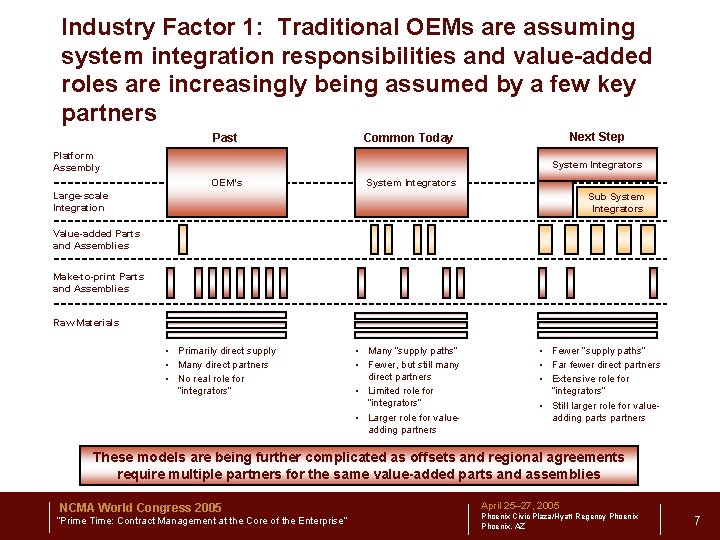
Industry Factor 1: Traditional OEMs are assuming system integration responsibilities and value-added roles are increasingly being assumed by a few key partners Past Next Step Common Today Platform Assembly System Integrators OEM’s System Integrators Large-scale Integration Sub System Integrators Value-added Parts and Assemblies Make-to-print Parts and Assemblies Raw Materials • Primarily direct supply • Many direct partners • No real role for “integrators” • Many “supply paths” • Fewer, but still many direct partners • Limited role for “integrators” • Larger role for valueadding partners • Fewer “supply paths” • Far fewer direct partners • Extensive role for “integrators” • Still larger role for valueadding parts partners These models are being further complicated as offsets and regional agreements require multiple partners for the same value-added parts and assemblies NCMA World Congress 2005 “Prime Time: Contract Management at the Core of the Enterprise” April 25– 27, 2005 Phoenix Civic Plaza/Hyatt Regency Phoenix, AZ 7
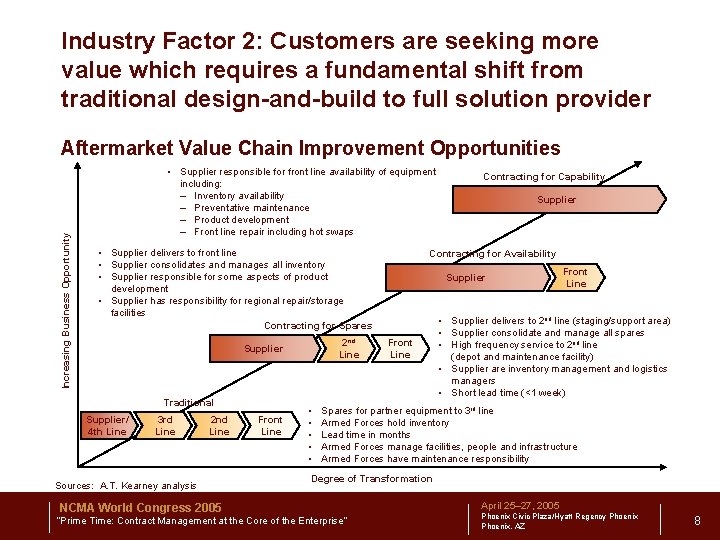
Industry Factor 2: Customers are seeking more value which requires a fundamental shift from traditional design-and-build to full solution provider Increasing Business Opportunity Aftermarket Value Chain Improvement Opportunities • Supplier responsible for front line availability of equipment including: – Inventory availability – Preventative maintenance – Product development – Front line repair including hot swaps • Supplier delivers to front line • Supplier consolidates and manages all inventory • Supplier responsible for some aspects of product development • Supplier has responsibility for regional repair/storage facilities Contracting for Spares 2 nd Line Supplier Traditional Supplier/ 4 th Line 3 rd Line 2 nd Line Sources: A. T. Kearney analysis Front Line • • • Contracting for Capability Supplier Contracting for Availability Supplier Front Line • Supplier delivers to 2 nd line (staging/support area) • Supplier consolidate and manage all spares • High frequency service to 2 nd line (depot and maintenance facility) • Supplier are inventory management and logistics managers • Short lead time (<1 week) Spares for partner equipment to 3 rd line Armed Forces hold inventory Lead time in months Armed Forces manage facilities, people and infrastructure Armed Forces have maintenance responsibility Degree of Transformation NCMA World Congress 2005 “Prime Time: Contract Management at the Core of the Enterprise” April 25– 27, 2005 Phoenix Civic Plaza/Hyatt Regency Phoenix, AZ 8
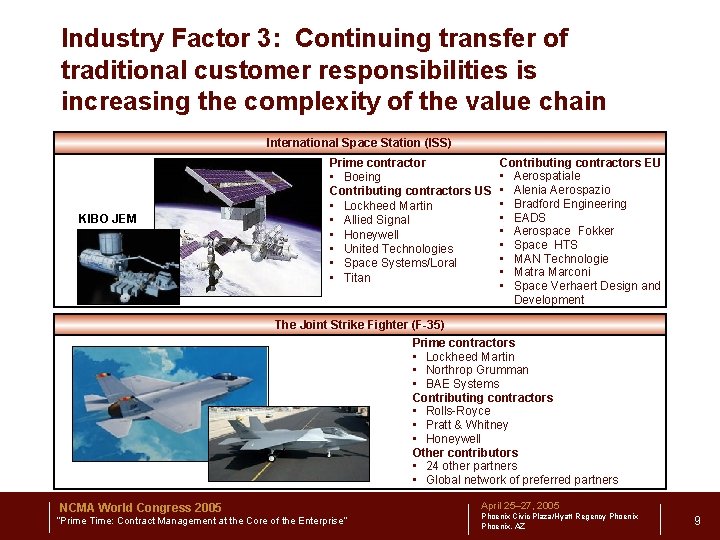
Industry Factor 3: Continuing transfer of traditional customer responsibilities is increasing the complexity of the value chain International Space Station (ISS) KIBO JEM Prime contractor • Boeing Contributing contractors US • Lockheed Martin • Allied Signal • Honeywell • United Technologies • Space Systems/Loral • Titan Contributing contractors EU • Aerospatiale • Alenia Aerospazio • Bradford Engineering • EADS • Aerospace Fokker • Space HTS • MAN Technologie • Matra Marconi • Space Verhaert Design and Development The Joint Strike Fighter (F-35) Prime contractors • Lockheed Martin • Northrop Grumman • BAE Systems Contributing contractors • Rolls-Royce • Pratt & Whitney • Honeywell Other contributors • 24 other partners • Global network of preferred partners NCMA World Congress 2005 “Prime Time: Contract Management at the Core of the Enterprise” April 25– 27, 2005 Phoenix Civic Plaza/Hyatt Regency Phoenix, AZ 9
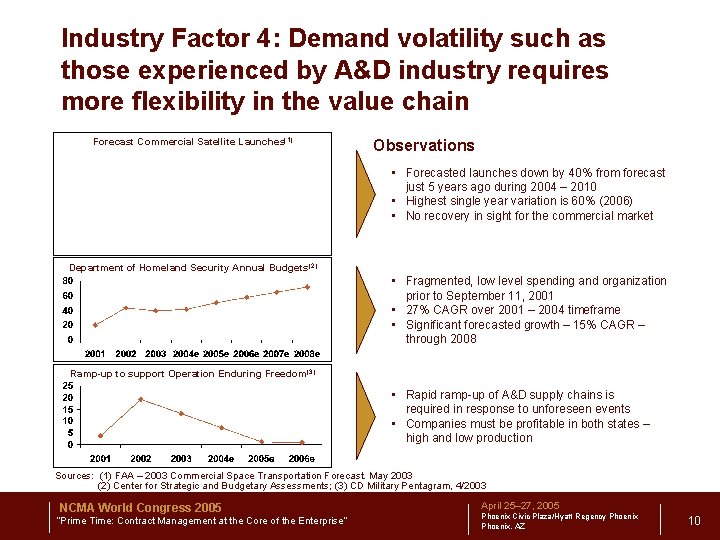
Industry Factor 4: Demand volatility such as those experienced by A&D industry requires more flexibility in the value chain Forecast Commercial Satellite Launches(1) Observations • Forecasted launches down by 40% from forecast just 5 years ago during 2004 – 2010 • Highest single year variation is 60% (2006) • No recovery in sight for the commercial market Department of Homeland Security Annual Budgets(2) • Fragmented, low level spending and organization prior to September 11, 2001 • 27% CAGR over 2001 – 2004 timeframe • Significant forecasted growth – 15% CAGR – through 2008 Ramp-up to support Operation Enduring Freedom(3) • Rapid ramp-up of A&D supply chains is required in response to unforeseen events • Companies must be profitable in both states – high and low production Sources: (1) FAA – 2003 Commercial Space Transportation Forecast. May 2003 (2) Center for Strategic and Budgetary Assessments; (3) CD Military Pentagram, 4/2003 NCMA World Congress 2005 “Prime Time: Contract Management at the Core of the Enterprise” April 25– 27, 2005 Phoenix Civic Plaza/Hyatt Regency Phoenix, AZ 10
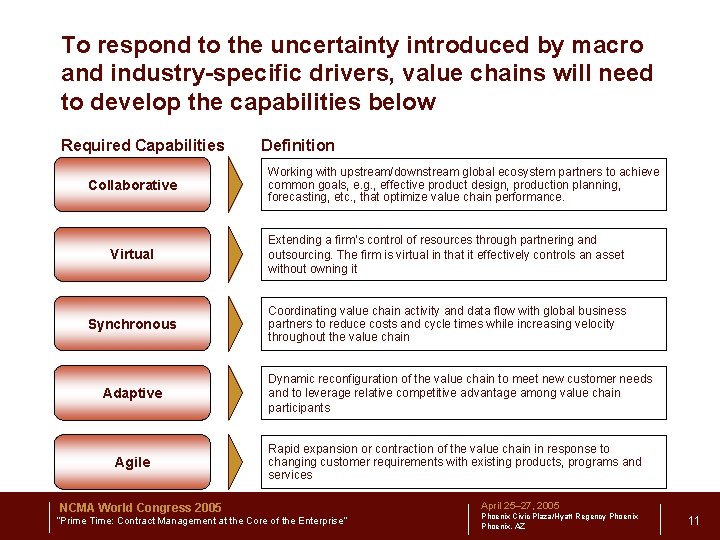
To respond to the uncertainty introduced by macro and industry-specific drivers, value chains will need to develop the capabilities below Required Capabilities Collaborative Definition Working with upstream/downstream global ecosystem partners to achieve common goals, e. g. , effective product design, production planning, forecasting, etc. , that optimize value chain performance. Virtual Extending a firm’s control of resources through partnering and outsourcing. The firm is virtual in that it effectively controls an asset without owning it Synchronous Coordinating value chain activity and data flow with global business partners to reduce costs and cycle times while increasing velocity throughout the value chain Adaptive Agile Dynamic reconfiguration of the value chain to meet new customer needs and to leverage relative competitive advantage among value chain participants Rapid expansion or contraction of the value chain in response to changing customer requirements with existing products, programs and services NCMA World Congress 2005 “Prime Time: Contract Management at the Core of the Enterprise” April 25– 27, 2005 Phoenix Civic Plaza/Hyatt Regency Phoenix, AZ 11
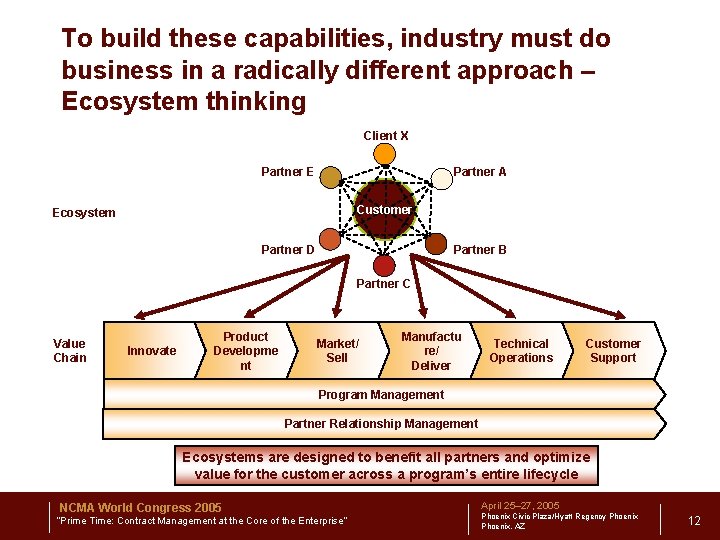
To build these capabilities, industry must do business in a radically different approach – Ecosystem thinking Client X Partner E Partner A Customer Ecosystem Partner D Partner B Partner C Value Chain Innovate Product Developme nt Market/ Sell Manufactu re/ Deliver Technical Operations Customer Support Program Management Partner Relationship Management Ecosystems are designed to benefit all partners and optimize value for the customer across a program’s entire lifecycle NCMA World Congress 2005 “Prime Time: Contract Management at the Core of the Enterprise” April 25– 27, 2005 Phoenix Civic Plaza/Hyatt Regency Phoenix, AZ 12
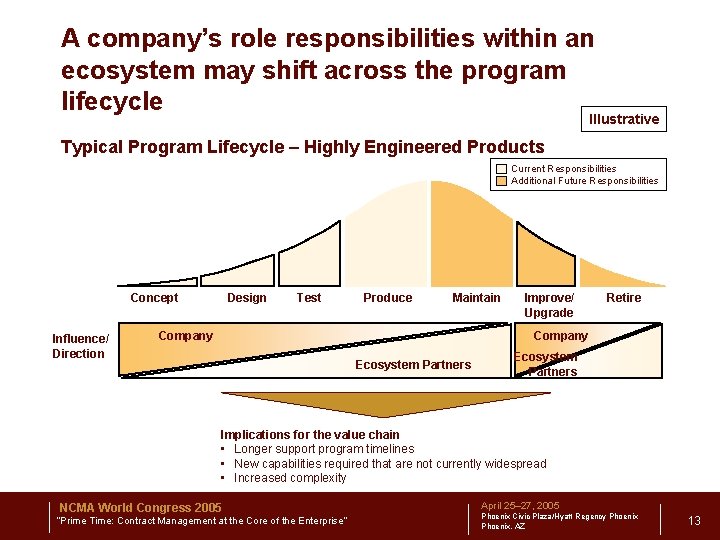
A company’s role responsibilities within an ecosystem may shift across the program lifecycle Illustrative Typical Program Lifecycle – Highly Engineered Products Current Responsibilities Additional Future Responsibilities Concept Influence/ Direction Design Test Produce Maintain Company Improve/ Upgrade Retire Company Ecosystem Partners Implications for the value chain • Longer support program timelines • New capabilities required that are not currently widespread • Increased complexity NCMA World Congress 2005 “Prime Time: Contract Management at the Core of the Enterprise” April 25– 27, 2005 Phoenix Civic Plaza/Hyatt Regency Phoenix, AZ 13
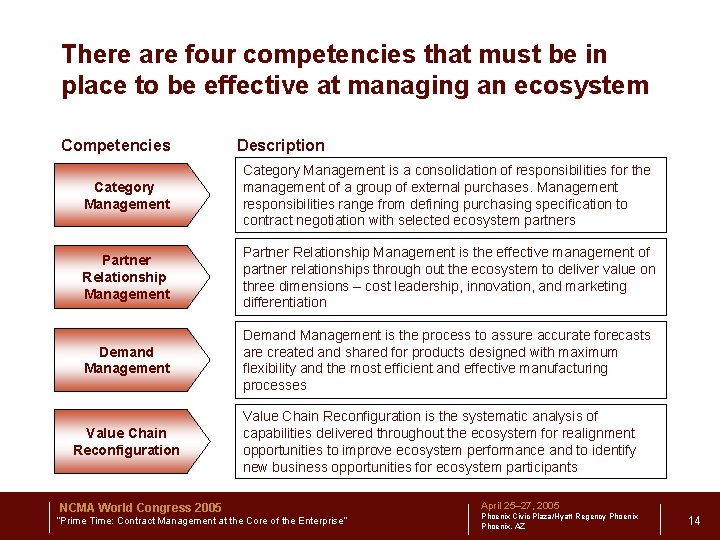
There are four competencies that must be in place to be effective at managing an ecosystem Competencies Description Category Management is a consolidation of responsibilities for the management of a group of external purchases. Management responsibilities range from defining purchasing specification to contract negotiation with selected ecosystem partners Partner Relationship Management is the effective management of partner relationships through out the ecosystem to deliver value on three dimensions – cost leadership, innovation, and marketing differentiation Demand Management is the process to assure accurate forecasts are created and shared for products designed with maximum flexibility and the most efficient and effective manufacturing processes Value Chain Reconfiguration is the systematic analysis of capabilities delivered throughout the ecosystem for realignment opportunities to improve ecosystem performance and to identify new business opportunities for ecosystem participants NCMA World Congress 2005 “Prime Time: Contract Management at the Core of the Enterprise” April 25– 27, 2005 Phoenix Civic Plaza/Hyatt Regency Phoenix, AZ 14
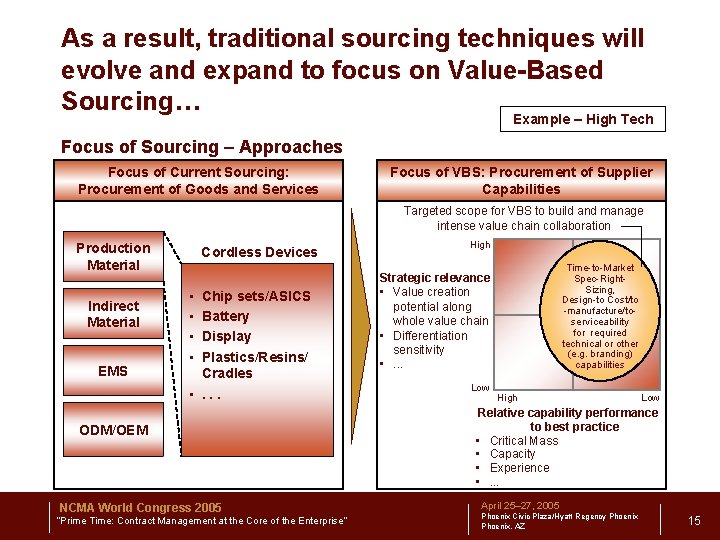
As a result, traditional sourcing techniques will evolve and expand to focus on Value-Based Sourcing… Example – High Tech Focus of Sourcing – Approaches Focus of Current Sourcing: Procurement of Goods and Services Focus of VBS: Procurement of Supplier Capabilities Targeted scope for VBS to build and manage intense value chain collaboration Production Material Indirect Material EMS Cordless Devices • • Chip sets/ASICS Battery Display Plastics/Resins/ Cradles • . . . ODM/OEM NCMA World Congress 2005 “Prime Time: Contract Management at the Core of the Enterprise” High Time-to-Market Spec-Right. Sizing, Design-to Cost/to -manufacture/toserviceability for required technical or other (e. g. branding) capabilities Strategic relevance • Value creation potential along whole value chain • Differentiation sensitivity • . . . Low High Low Relative capability performance to best practice • Critical Mass • Capacity • Experience • . . . April 25– 27, 2005 Phoenix Civic Plaza/Hyatt Regency Phoenix, AZ 15
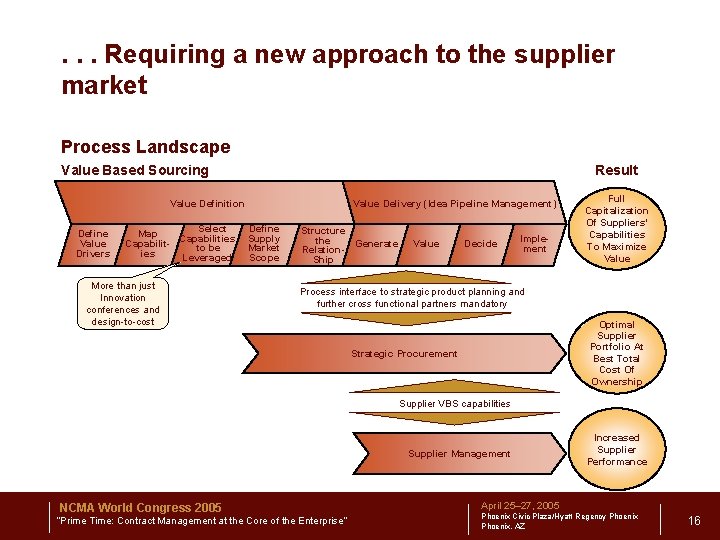
. . . Requiring a new approach to the supplier market Process Landscape Value Based Sourcing Result Value Definition Define Value Drivers Select Map Capabilit- Capabilities to be ies Leveraged More than just Innovation conferences and design-to-cost Value Delivery (Idea Pipeline Management) Define Supply Market Scope Structure the Generate Relation. Ship Value Decide Implement Full Capitalization Of Suppliers‘ Capabilities To Maximize Value Process interface to strategic product planning and further cross functional partners mandatory Optimal Supplier Portfolio At Best Total Cost Of Ownership Strategic Procurement Supplier VBS capabilities Supplier Management NCMA World Congress 2005 “Prime Time: Contract Management at the Core of the Enterprise” Increased Supplier Performance April 25– 27, 2005 Phoenix Civic Plaza/Hyatt Regency Phoenix, AZ 16
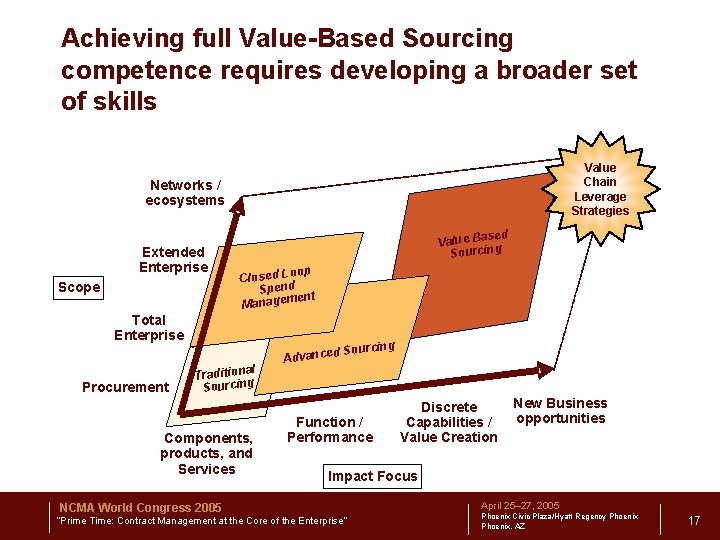
Achieving full Value-Based Sourcing competence requires developing a broader set of skills Value Chain Leverage Strategies Networks / ecosystems Extended Enterprise Scope sed Value Ba Sourcing oop Closed L Spend ent Managem Total Enterprise Procurement g d Sourcin al Tradition Sourcing Components, products, and Services Advance Function / Performance Discrete Capabilities / Value Creation New Business opportunities Impact Focus NCMA World Congress 2005 “Prime Time: Contract Management at the Core of the Enterprise” April 25– 27, 2005 Phoenix Civic Plaza/Hyatt Regency Phoenix, AZ 17
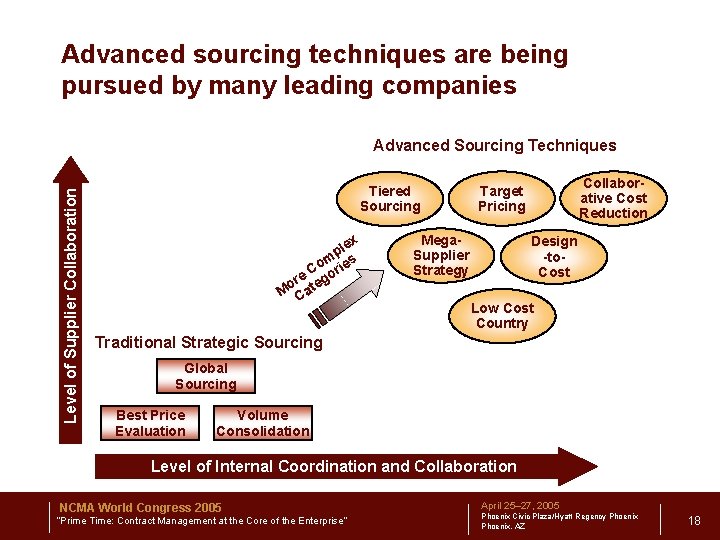
Advanced sourcing techniques are being pursued by many leading companies Level of Supplier Collaboration Advanced Sourcing Techniques Tiered Sourcing ex pl om ries C re ego o M Cat Collaborative Cost Reduction Target Pricing Mega. Supplier Strategy Design -to. Cost Low Cost Country Traditional Strategic Sourcing Global Sourcing Best Price Evaluation Volume Consolidation Level of Internal Coordination and Collaboration NCMA World Congress 2005 “Prime Time: Contract Management at the Core of the Enterprise” April 25– 27, 2005 Phoenix Civic Plaza/Hyatt Regency Phoenix, AZ 18
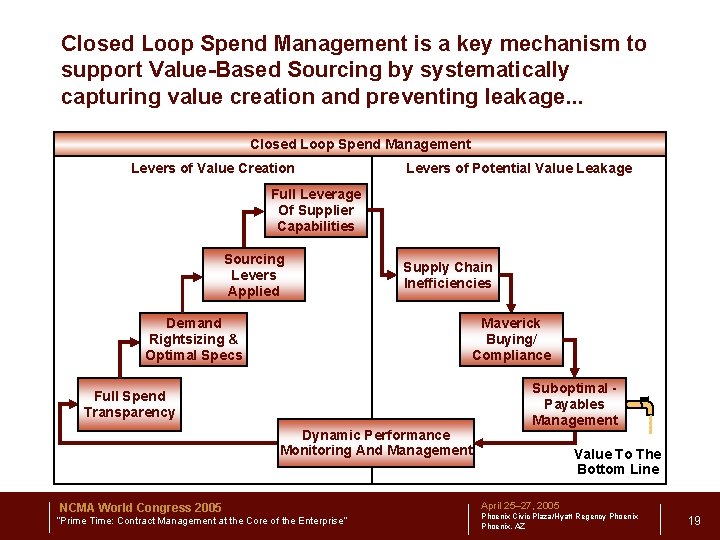
Closed Loop Spend Management is a key mechanism to support Value-Based Sourcing by systematically capturing value creation and preventing leakage. . . Closed Loop Spend Management Levers of Value Creation Levers of Potential Value Leakage Full Leverage Of Supplier Capabilities Sourcing Levers Applied Demand Rightsizing & Optimal Specs Supply Chain Inefficiencies Maverick Buying/ Compliance Full Spend Transparency Dynamic Performance Monitoring And Management NCMA World Congress 2005 “Prime Time: Contract Management at the Core of the Enterprise” Suboptimal Payables Management Value To The Bottom Line April 25– 27, 2005 Phoenix Civic Plaza/Hyatt Regency Phoenix, AZ 19
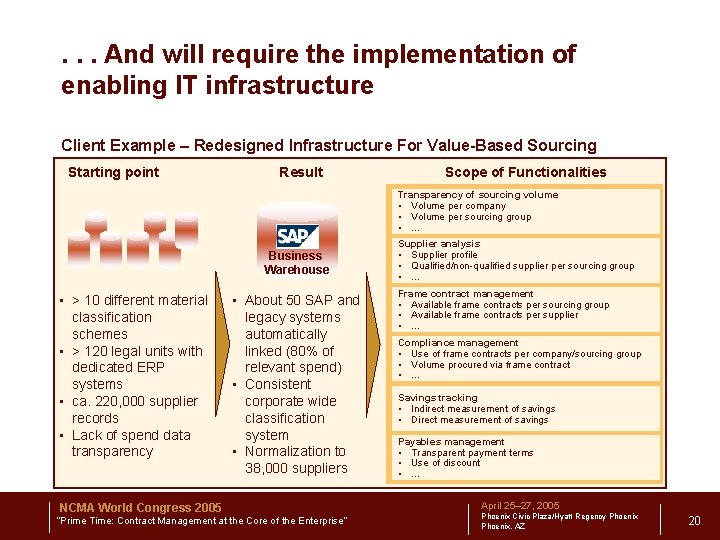
. . . And will require the implementation of enabling IT infrastructure Client Example – Redesigned Infrastructure For Value-Based Sourcing Starting point Result Scope of Functionalities Transparency of sourcing volume • Volume per company • Volume per sourcing group • … Business Warehouse • > 10 different material classification schemes • > 120 legal units with dedicated ERP systems • ca. 220, 000 supplier records • Lack of spend data transparency • About 50 SAP and legacy systems automatically linked (80% of relevant spend) • Consistent corporate wide classification system • Normalization to 38, 000 suppliers NCMA World Congress 2005 “Prime Time: Contract Management at the Core of the Enterprise” Supplier analysis • Supplier profile • Qualified/non-qualified supplier per sourcing group • … Frame contract management • Available frame contracts per sourcing group • Available frame contracts per supplier • … Compliance management • Use of frame contracts per company/sourcing group • Volume procured via frame contract • . . . Savings tracking • Indirect measurement of savings • Direct measurement of savings Payables management • Transparent payment terms • Use of discount • . . . April 25– 27, 2005 Phoenix Civic Plaza/Hyatt Regency Phoenix, AZ 20
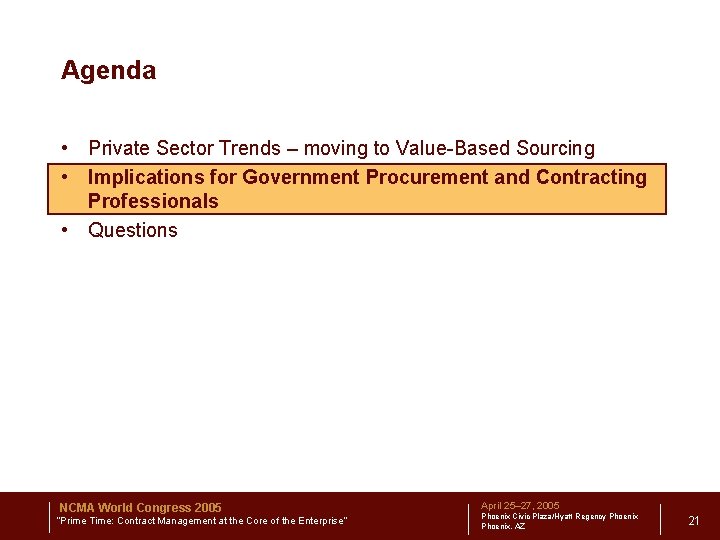
Agenda • Private Sector Trends – moving to Value-Based Sourcing • Implications for Government Procurement and Contracting Professionals • Questions NCMA World Congress 2005 “Prime Time: Contract Management at the Core of the Enterprise” April 25– 27, 2005 Phoenix Civic Plaza/Hyatt Regency Phoenix, AZ 21
Government procurement and contracting officials can help jump-start value-based sourcing thinking in both new and mature programs • Understand the supplier base and their overall procurement strategy • Recognize that as customers of these suppliers, government can drive the value creation through the solicitation process • Encourage value-based sourcing techniques that apply within each step of a product/systems product life cycle • Promote value-creating opportunities by building on partnership and preference practices such as MWBE, Small Business, etc. NCMA World Congress 2005 “Prime Time: Contract Management at the Core of the Enterprise” April 25– 27, 2005 Phoenix Civic Plaza/Hyatt Regency Phoenix, AZ 22
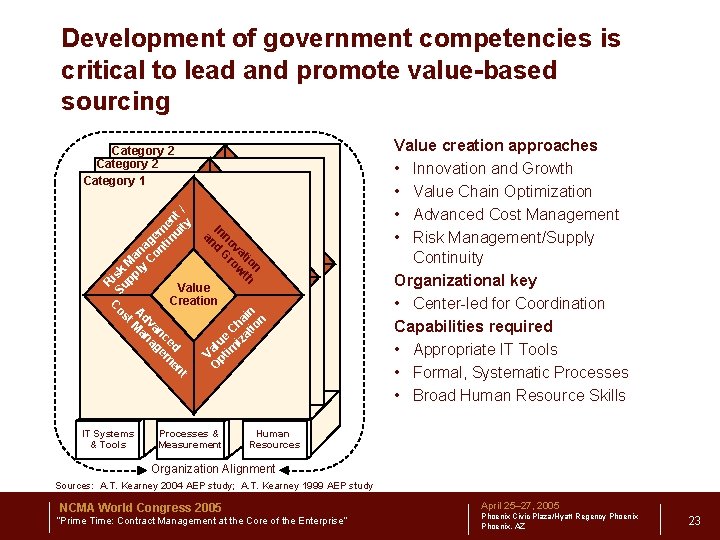
Development of government competencies is critical to lead and promote value-based sourcing n ion taito tthh ovav ooww nno rr )In. I GG (1 aanndd (4 R ) is SSuu Riks M pppp k M a llyy C naag Co nae onn gm en ttiinn em uuiit etn/ tyy t / Category 2 Category 1 IT Systems & Tools (2 V ) O O p Vaalu ptt lue iimm e. C iizza Chha att ain iioo in nn tt ded eenn cnec emm avna agge dvd n a A) A aan (3 stt. MM os CCo Value Creation Processes & Measurement Value creation approaches • Innovation and Growth • Value Chain Optimization • Advanced Cost Management • Risk Management/Supply Continuity Organizational key • Center-led for Coordination Capabilities required • Appropriate IT Tools • Formal, Systematic Processes • Broad Human Resource Skills Human Resources Organization Alignment Sources: A. T. Kearney 2004 AEP study; A. T. Kearney 1999 AEP study NCMA World Congress 2005 “Prime Time: Contract Management at the Core of the Enterprise” April 25– 27, 2005 Phoenix Civic Plaza/Hyatt Regency Phoenix, AZ 23
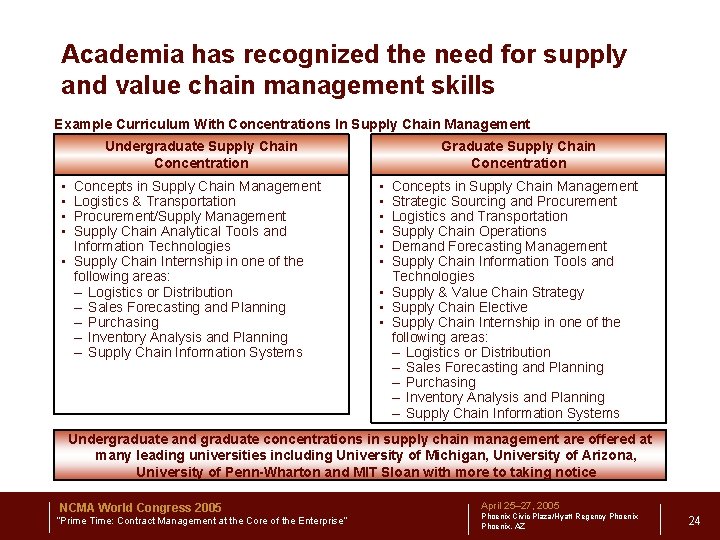
Academia has recognized the need for supply and value chain management skills Example Curriculum With Concentrations In Supply Chain Management Undergraduate Supply Chain Concentration • • Concepts in Supply Chain Management Logistics & Transportation Procurement/Supply Management Supply Chain Analytical Tools and Information Technologies • Supply Chain Internship in one of the following areas: – Logistics or Distribution – Sales Forecasting and Planning – Purchasing – Inventory Analysis and Planning – Supply Chain Information Systems Graduate Supply Chain Concentration • • • Concepts in Supply Chain Management Strategic Sourcing and Procurement Logistics and Transportation Supply Chain Operations Demand Forecasting Management Supply Chain Information Tools and Technologies • Supply & Value Chain Strategy • Supply Chain Elective • Supply Chain Internship in one of the following areas: – Logistics or Distribution – Sales Forecasting and Planning – Purchasing – Inventory Analysis and Planning – Supply Chain Information Systems Undergraduate and graduate concentrations in supply chain management are offered at many leading universities including University of Michigan, University of Arizona, University of Penn-Wharton and MIT Sloan with more to taking notice NCMA World Congress 2005 “Prime Time: Contract Management at the Core of the Enterprise” April 25– 27, 2005 Phoenix Civic Plaza/Hyatt Regency Phoenix, AZ 24
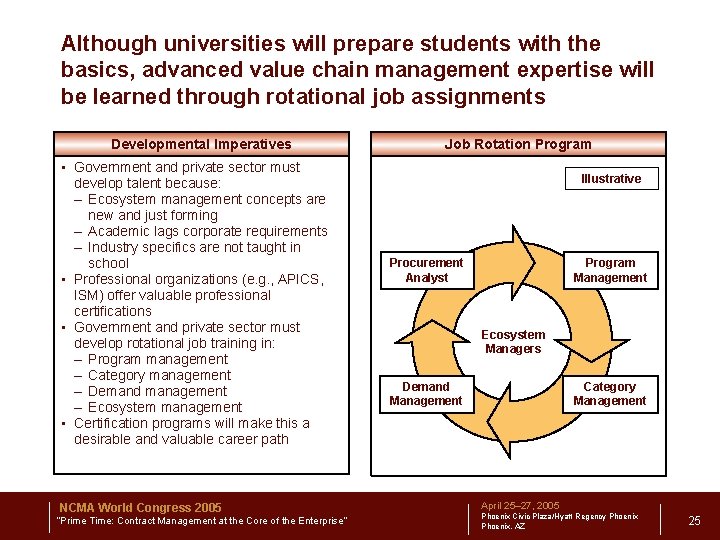
Although universities will prepare students with the basics, advanced value chain management expertise will be learned through rotational job assignments Developmental Imperatives • Government and private sector must develop talent because: – Ecosystem management concepts are new and just forming – Academic lags corporate requirements – Industry specifics are not taught in school • Professional organizations (e. g. , APICS, ISM) offer valuable professional certifications • Government and private sector must develop rotational job training in: – Program management – Category management – Demand management – Ecosystem management • Certification programs will make this a desirable and valuable career path NCMA World Congress 2005 “Prime Time: Contract Management at the Core of the Enterprise” Job Rotation Program Illustrative Procurement Analyst Program Management Ecosystem Managers Demand Management Category Management April 25– 27, 2005 Phoenix Civic Plaza/Hyatt Regency Phoenix, AZ 25
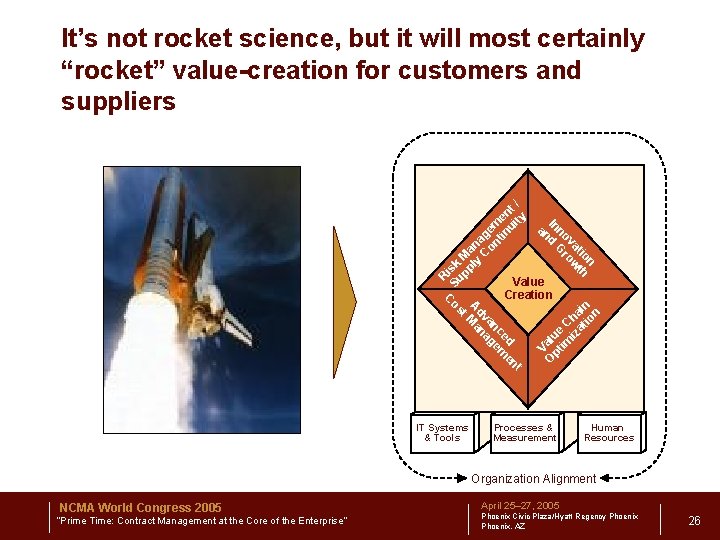
n ino taiot th voav ow non r I)n. I G (1 and (4 R ) SSu i. Rsik upp sk. M an pplly M y C aang Co ae onn gm en ttiinn em uuiit etn/ tyy t / It’s not rocket science, but it will most certainly “rocket” value-creation for customers and suppliers IT Systems & Tools (2 V ) OOp Vaalu ptt lue iimm e. C iizza Chha att ain iioo in nn tt ded eenn cnec emm avna agge dvd n a A) A aan (3 stt. MM os CCo Value Creation Processes & Measurement Human Resources Organization Alignment NCMA World Congress 2005 “Prime Time: Contract Management at the Core of the Enterprise” April 25– 27, 2005 Phoenix Civic Plaza/Hyatt Regency Phoenix, AZ 26
Agenda • Private Sector Trends – moving to Value-Based Sourcing • Implications for Government Procurement and Contracting Professionals • Questions NCMA World Congress 2005 “Prime Time: Contract Management at the Core of the Enterprise” April 25– 27, 2005 Phoenix Civic Plaza/Hyatt Regency Phoenix, AZ 27
- Slides: 27