
Valuation Models for a MNC and a Global

Valuation Models for a MNC and a Global Investor Combined with Observations on Exchange Rate Impacts

Objective of Lecture 1 • In order to understand appreciate the international forces which multinational firms and global investors face, we need to develop valuation models for global companies and investors. • The models which we will develop are patterned after the Anglo-Saxon model of corporate behavior and investment valuations.
Valuation Concepts • Anglo-Saxon Approach: – Firm Evaluation: Consider the value of the firm and corporate behavior in terms of (maximizing) the market value of the firm for shareholders. • Capital budgeting techniques evaluate projects and corporate investments on the basis of present value of their cash flows. – Financial Asset Evaluation: Consider the present value of the anticipated future income stream from a particular financial asset.
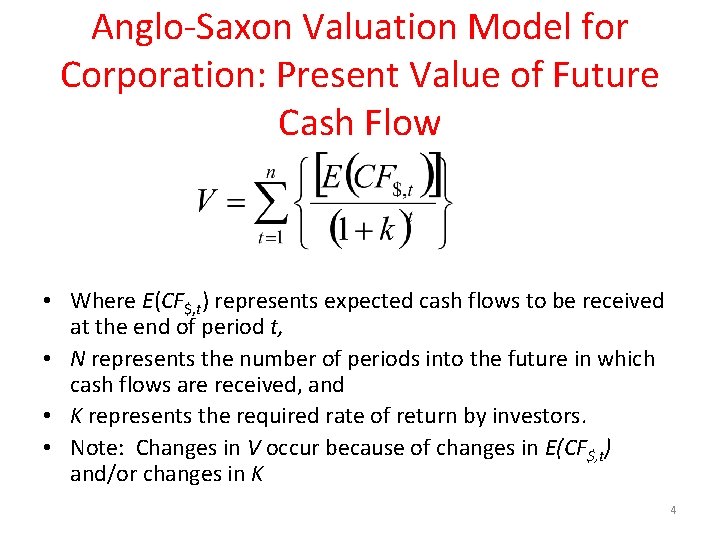
Anglo-Saxon Valuation Model for Corporation: Present Value of Future Cash Flow • Where E(CF$, t) represents expected cash flows to be received at the end of period t, • N represents the number of periods into the future in which cash flows are received, and • K represents the required rate of return by investors. • Note: Changes in V occur because of changes in E(CF$, t) and/or changes in K 4
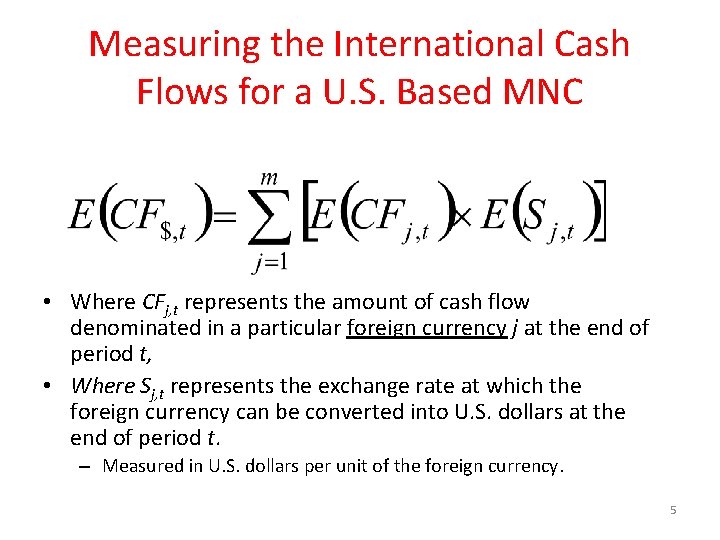
Measuring the International Cash Flows for a U. S. Based MNC • Where CFj, t represents the amount of cash flow denominated in a particular foreign currency j at the end of period t, • Where Sj, t represents the exchange rate at which the foreign currency can be converted into U. S. dollars at the end of period t. – Measured in U. S. dollars per unit of the foreign currency. 5
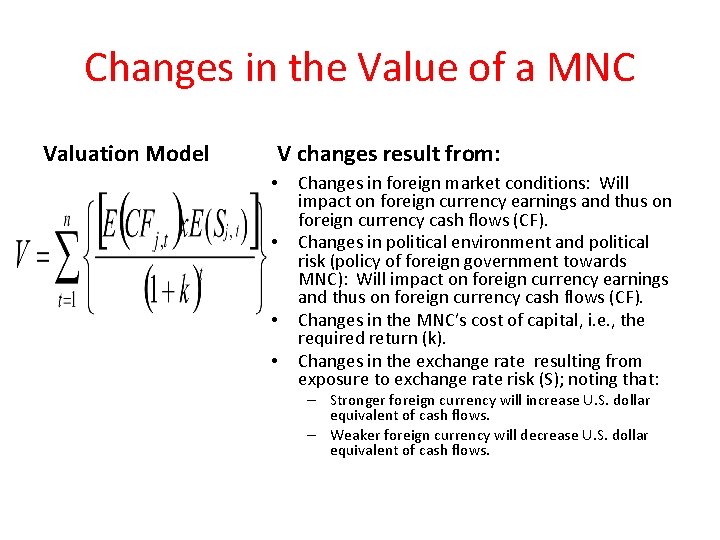
Changes in the Value of a MNC Valuation Model V changes result from: • • Changes in foreign market conditions: Will impact on foreign currency earnings and thus on foreign currency cash flows (CF). Changes in political environment and political risk (policy of foreign government towards MNC): Will impact on foreign currency earnings and thus on foreign currency cash flows (CF). Changes in the MNC’s cost of capital, i. e. , the required return (k). Changes in the exchange rate resulting from exposure to exchange rate risk (S); noting that: – Stronger foreign currency will increase U. S. dollar equivalent of cash flows. – Weaker foreign currency will decrease U. S. dollar equivalent of cash flows.
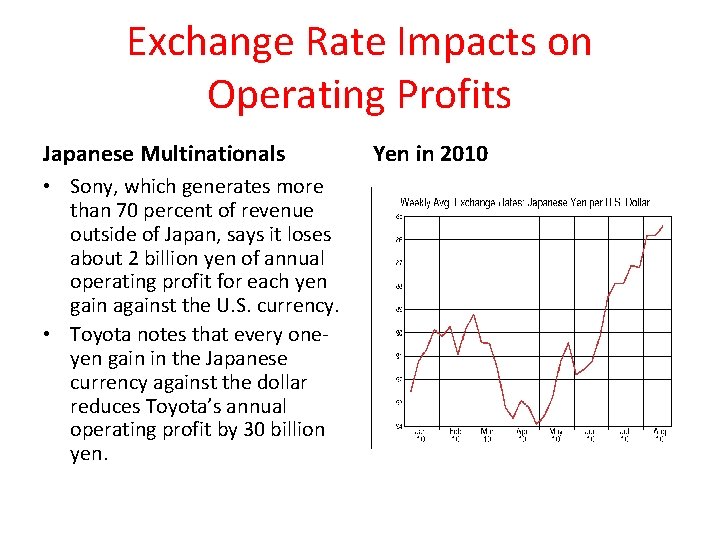
Exchange Rate Impacts on Operating Profits Japanese Multinationals • Sony, which generates more than 70 percent of revenue outside of Japan, says it loses about 2 billion yen of annual operating profit for each yen gain against the U. S. currency. • Toyota notes that every oneyen gain in the Japanese currency against the dollar reduces Toyota’s annual operating profit by 30 billion yen. Yen in 2010
Valuation Models for Financial Assets • Bonds: Present value of: – Coupon payments + Par Value (face or maturity value) • In U. S. , par value = $1, 000 • Discount rate (k) is adjusted for opportunity cost and risk adjustments. • Stocks: Present value of: – Future cash flow (Dividends, earnings) • Foreign currency denominated financial assets: Valuation model adjustment needs to be made for changes in exchange rates.
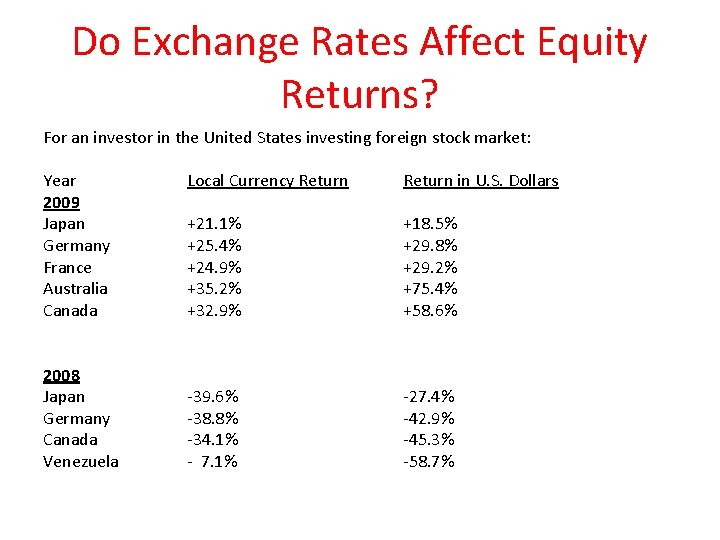
Do Exchange Rates Affect Equity Returns? For an investor in the United States investing foreign stock market: Year 2009 Japan Germany France Australia Canada 2008 Japan Germany Canada Venezuela Local Currency Return in U. S. Dollars +21. 1% +25. 4% +24. 9% +35. 2% +32. 9% +18. 5% +29. 8% +29. 2% +75. 4% +58. 6% -39. 6% -38. 8% -34. 1% - 7. 1% -27. 4% -42. 9% -45. 3% -58. 7%
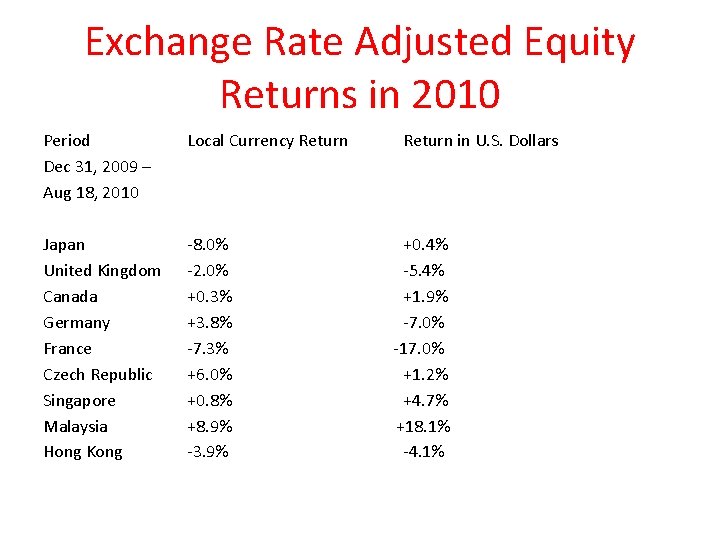
Exchange Rate Adjusted Equity Returns in 2010 Period Dec 31, 2009 – Aug 18, 2010 Local Currency Return Japan United Kingdom Canada Germany France Czech Republic Singapore Malaysia Hong Kong -8. 0% -2. 0% +0. 3% +3. 8% -7. 3% +6. 0% +0. 8% +8. 9% -3. 9% Return in U. S. Dollars +0. 4% -5. 4% +1. 9% -7. 0% -17. 0% +1. 2% +4. 7% +18. 1% -4. 1%
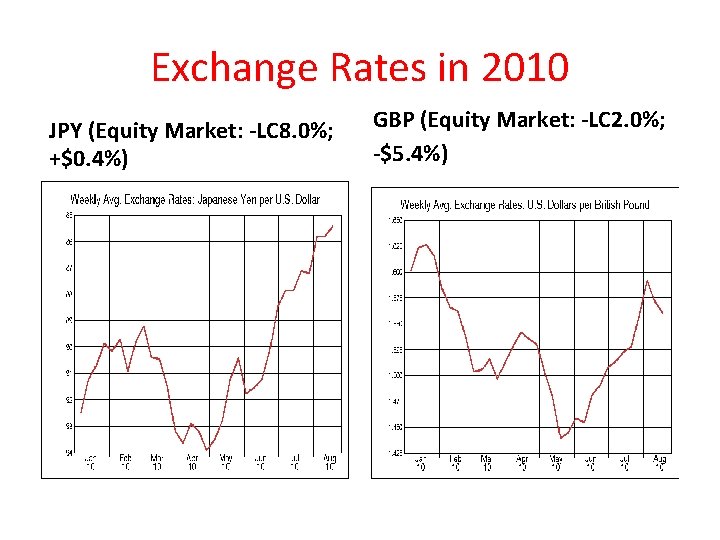
Exchange Rates in 2010 JPY (Equity Market: -LC 8. 0%; +$0. 4%) GBP (Equity Market: -LC 2. 0%; -$5. 4%)
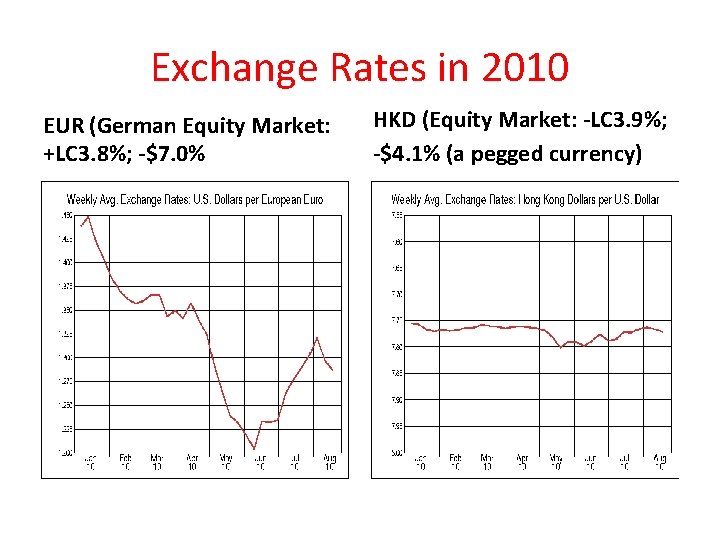
Exchange Rates in 2010 EUR (German Equity Market: +LC 3. 8%; -$7. 0% HKD (Equity Market: -LC 3. 9%; -$4. 1% (a pegged currency)
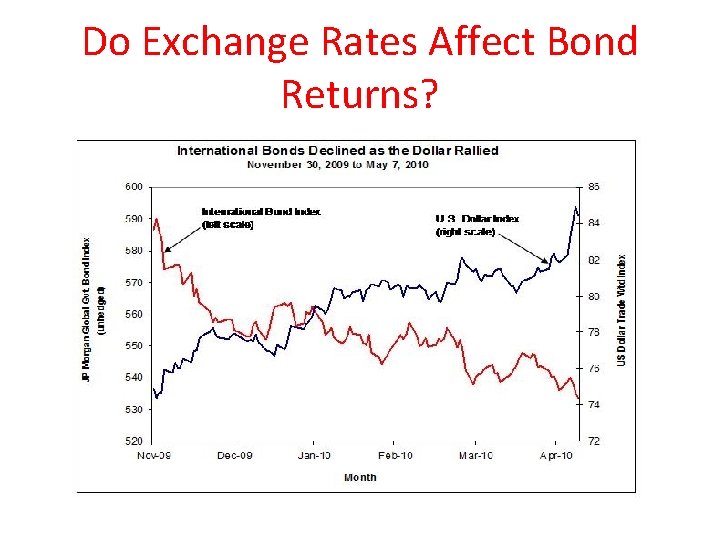
Do Exchange Rates Affect Bond Returns?
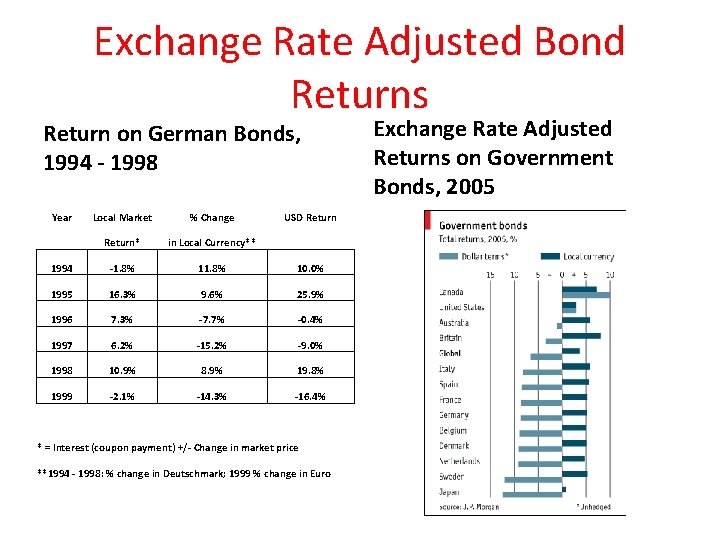
Exchange Rate Adjusted Bond Returns Return on German Bonds, 1994 - 1998 Year Local Market % Change USD Return* in Local Currency** 1994 -1. 8% 10. 0% 1995 16. 3% 9. 6% 25. 9% 1996 7. 3% -7. 7% -0. 4% 1997 6. 2% -15. 2% -9. 0% 1998 10. 9% 8. 9% 19. 8% 1999 -2. 1% -14. 3% -16. 4% * = Interest (coupon payment) +/- Change in market price **1994 - 1998: % change in Deutschmark; 1999 % change in Euro Exchange Rate Adjusted Returns on Government Bonds, 2005
- Slides: 14