
Valmet conductivity Alkali measurements for Continuous cooking process

- Slides: 20
Valmet conductivity Alkali measurements for Continuous cooking process Conductivity measurements for Brown stock washing
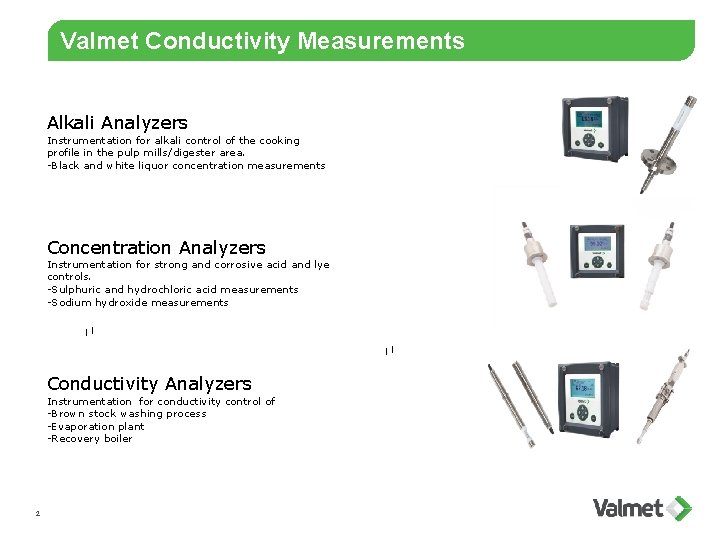
Valmet Conductivity Measurements Alkali Analyzers Instrumentation for alkali control of the cooking profile in the pulp mills/digester area. -Black and white liquor concentration measurements Concentration Analyzers Instrumentation for strong and corrosive acid and lye controls. -Sulphuric and hydrochloric acid measurements -Sodium hydroxide measurements Conductivity Analyzers Instrumentation for conductivity control of -Brown stock washing process -Evaporation plant -Recovery boiler 2
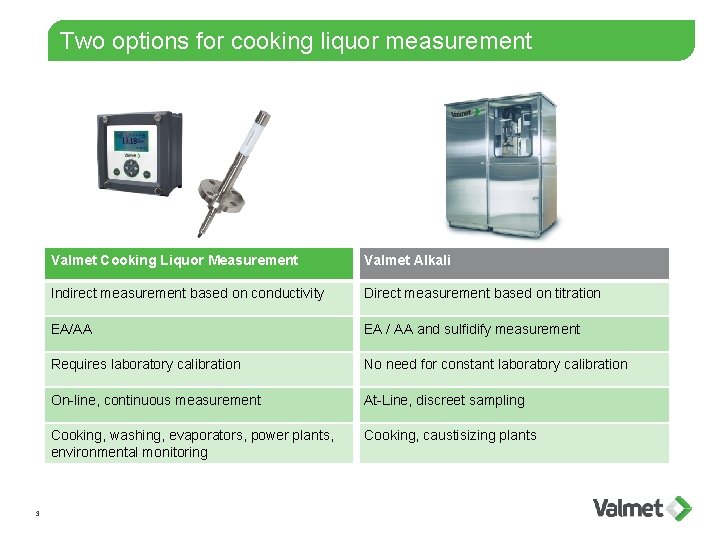
Two options for cooking liquor measurement 3 Valmet Cooking Liquor Measurement Valmet Alkali Indirect measurement based on conductivity Direct measurement based on titration EA/AA EA / AA and sulfidify measurement Requires laboratory calibration No need for constant laboratory calibration On-line, continuous measurement At-Line, discreet sampling Cooking, washing, evaporators, power plants, environmental monitoring Cooking, caustisizing plants
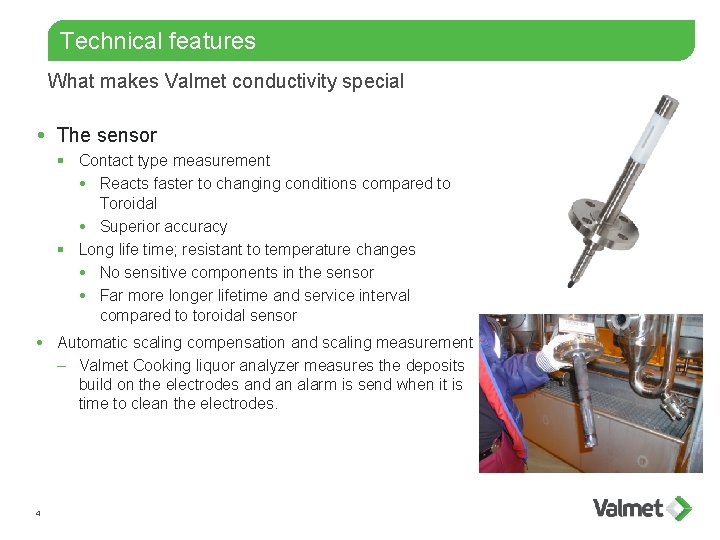
Technical features What makes Valmet conductivity special The sensor § Contact type measurement Reacts faster to changing conditions compared to Toroidal Superior accuracy § Long life time; resistant to temperature changes No sensitive components in the sensor Far more longer lifetime and service interval compared to toroidal sensor Automatic scaling compensation and scaling measurement – Valmet Cooking liquor analyzer measures the deposits build on the electrodes and an alarm is send when it is time to clean the electrodes. 4
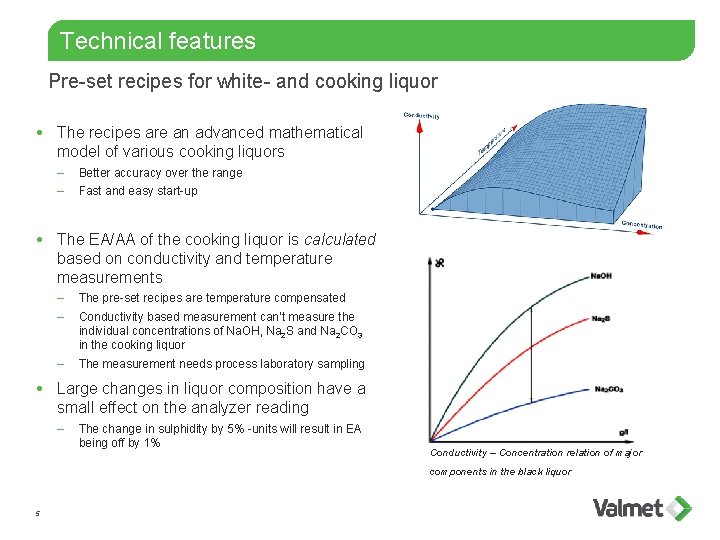
Technical features Pre-set recipes for white- and cooking liquor The recipes are an advanced mathematical model of various cooking liquors – – Better accuracy over the range Fast and easy start-up The EA/AA of the cooking liquor is calculated based on conductivity and temperature measurements – – The pre-set recipes are temperature compensated – The measurement needs process laboratory sampling Conductivity based measurement can’t measure the individual concentrations of Na. OH, Na 2 S and Na 2 CO 3 in the cooking liquor Large changes in liquor composition have a small effect on the analyzer reading – The change in sulphidity by 5% -units will result in EA being off by 1% Conductivity – Concentration relation of major components in the black liquor 5
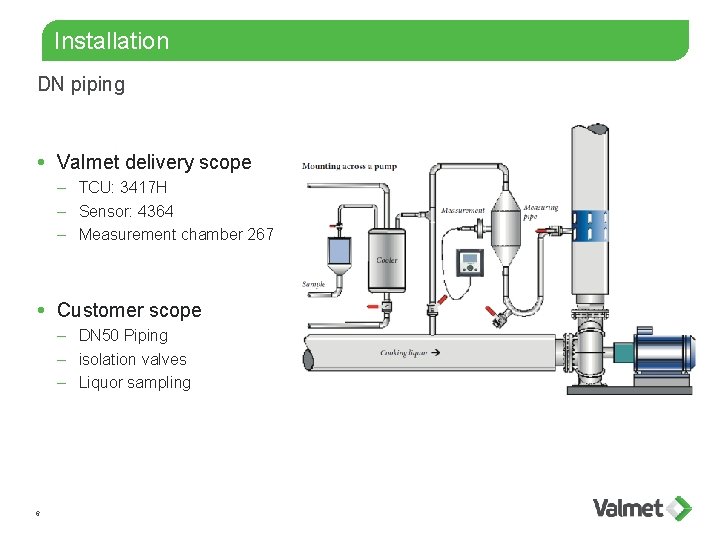
Installation DN piping Valmet delivery scope – TCU: 3417 H – Sensor: 4364 – Measurement chamber 267 Customer scope – DN 50 Piping – isolation valves – Liquor sampling 6
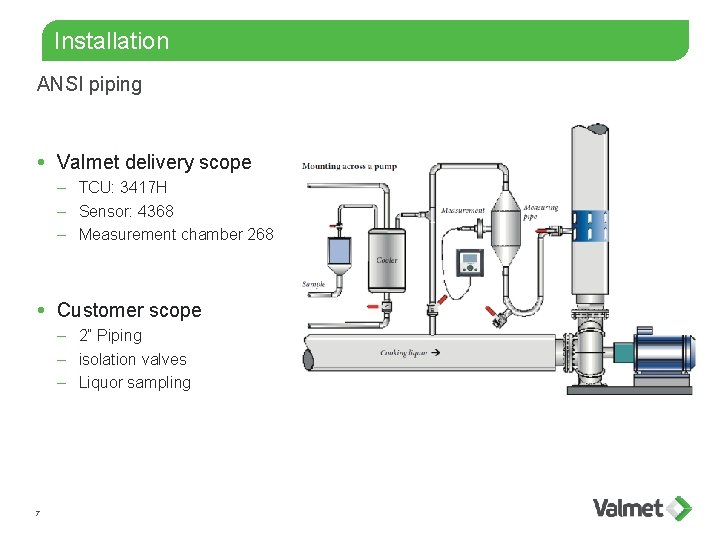
Installation ANSI piping Valmet delivery scope – TCU: 3417 H – Sensor: 4368 – Measurement chamber 268 Customer scope – 2” Piping – isolation valves – Liquor sampling 7
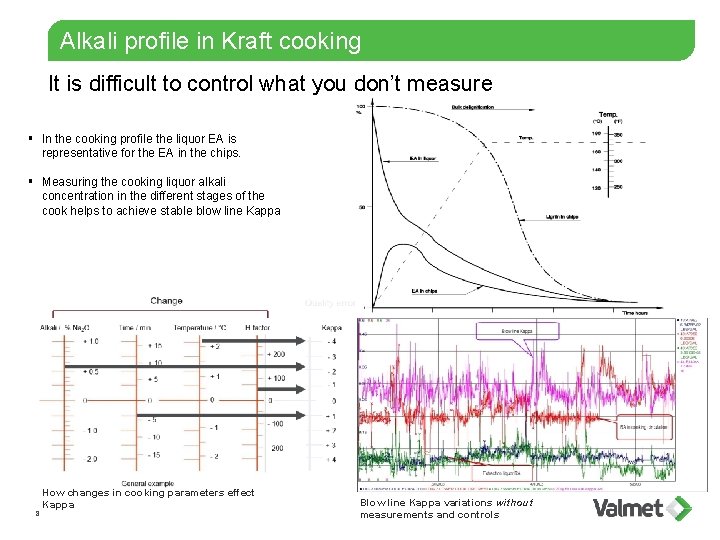
Alkali profile in Kraft cooking It is difficult to control what you don’t measure § In the cooking profile the liquor EA is representative for the EA in the chips. § Measuring the cooking liquor alkali concentration in the different stages of the cook helps to achieve stable blow line Kappa 8 How changes in cooking parameters effect Kappa Blow line Kappa variations without measurements and controls
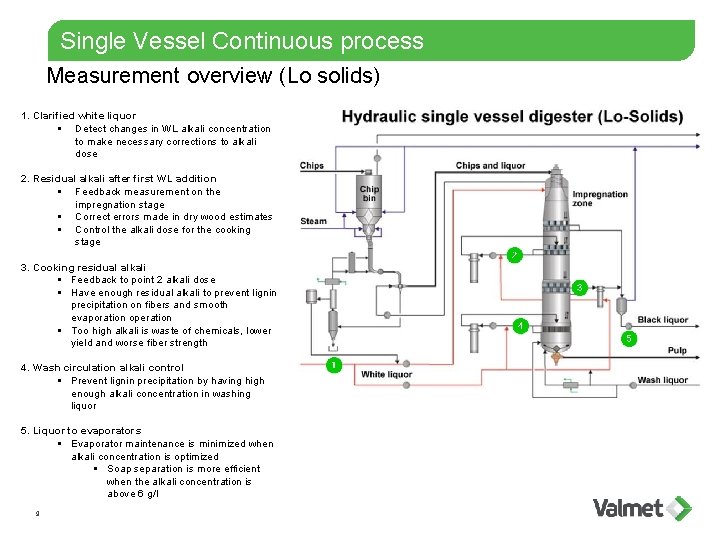
Single Vessel Continuous process Measurement overview (Lo solids) 1. Clarified white liquor § Detect changes in WL alkali concentration to make necessary corrections to alkali dose 2. Residual alkali after first WL addition § Feedback measurement on the impregnation stage § Correct errors made in dry wood estimates § Control the alkali dose for the cooking stage 3. Cooking residual alkali § Feedback to point 2 alkali dose § Have enough residual alkali to prevent lignin precipitation on fibers and smooth evaporation operation § Too high alkali is waste of chemicals, lower yield and worse fiber strength 4. Wash circulation alkali control § Prevent lignin precipitation by having high enough alkali concentration in washing liquor 5. Liquor to evaporators § Evaporator maintenance is minimized when alkali concentration is optimized § Soap separation is more efficient when the alkali concentration is above 6 g/l 9
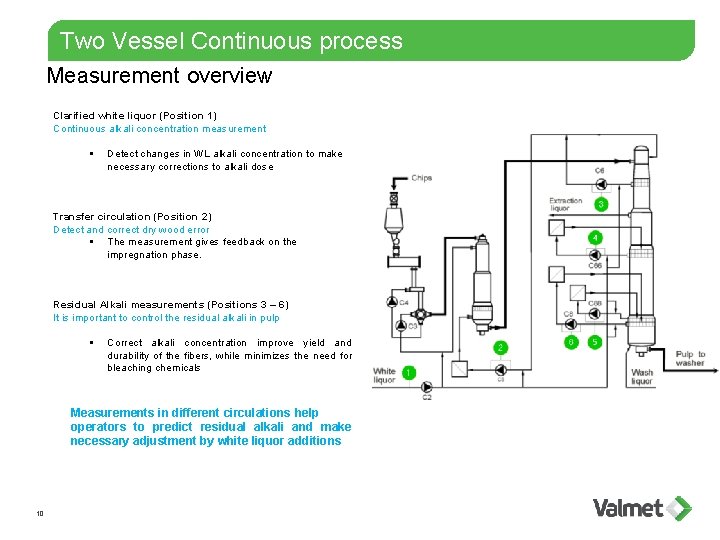
Two Vessel Continuous process Measurement overview Clarified white liquor (Position 1) Continuous alkali concentration measurement § Detect changes in WL alkali concentration to make necessary corrections to alkali dose Transfer circulation (Position 2) Detect and correct dry wood error § The measurement gives feedback on the impregnation phase. Residual Alkali measurements (Positions 3 – 6) It is important to control the residual alkali in pulp § Correct alkali concentration improve yield and durability of the fibers, while minimizes the need for bleaching chemicals Measurements in different circulations help operators to predict residual alkali and make necessary adjustment by white liquor additions 10
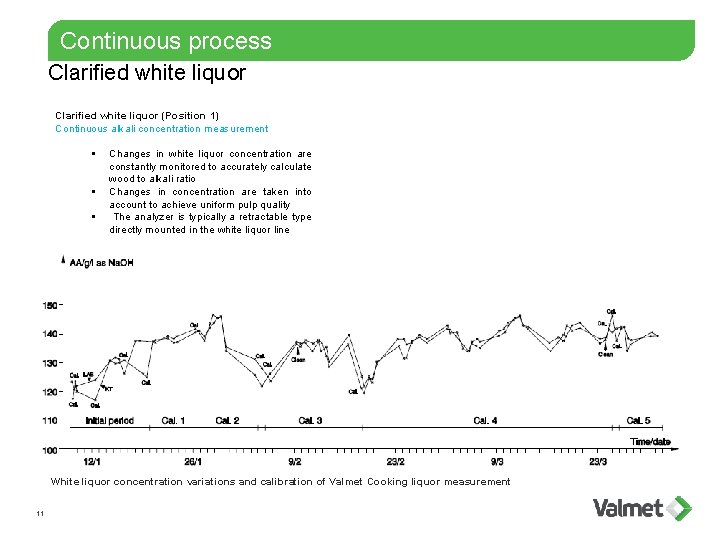
Continuous process Clarified white liquor (Position 1) Continuous alkali concentration measurement § § § Changes in white liquor concentration are constantly monitored to accurately calculate wood to alkali ratio Changes in concentration are taken into account to achieve uniform pulp quality The analyzer is typically a retractable type directly mounted in the white liquor line White liquor concentration variations and calibration of Valmet Cooking liquor measurement 11
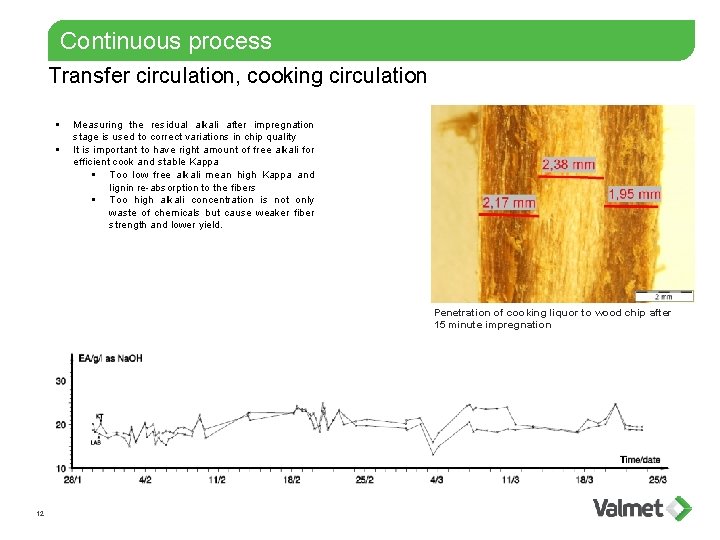
Continuous process Transfer circulation, cooking circulation § § Measuring the residual alkali after impregnation stage is used to correct variations in chip quality It is important to have right amount of free alkali for efficient cook and stable Kappa § Too low free alkali mean high Kappa and lignin re-absorption to the fibers § Too high alkali concentration is not only waste of chemicals but cause weaker fiber strength and lower yield. Penetration of cooking liquor to wood chip after 15 minute impregnation 12
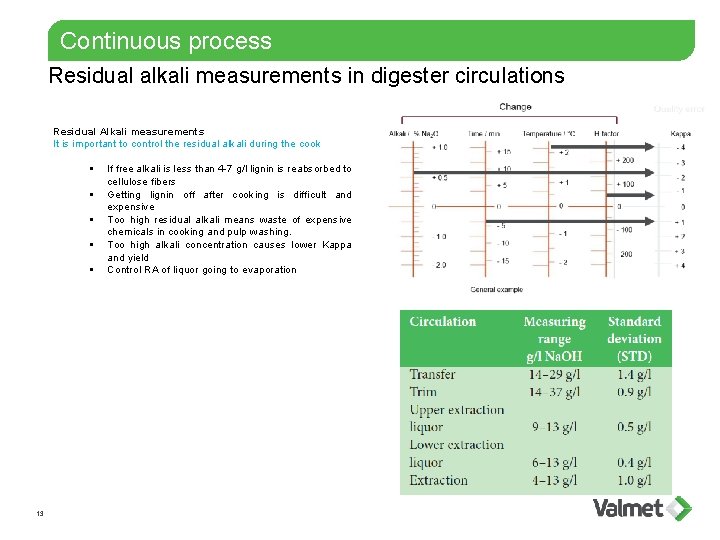
Continuous process Residual alkali measurements in digester circulations Residual Alkali measurements It is important to control the residual alkali during the cook § § § 13 If free alkali is less than 4 -7 g/l lignin is reabsorbed to cellulose fibers Getting lignin off after cooking is difficult and expensive Too high residual alkali means waste of expensive chemicals in cooking and pulp washing. Too high alkali concentration causes lower Kappa and yield Control RA of liquor going to evaporation
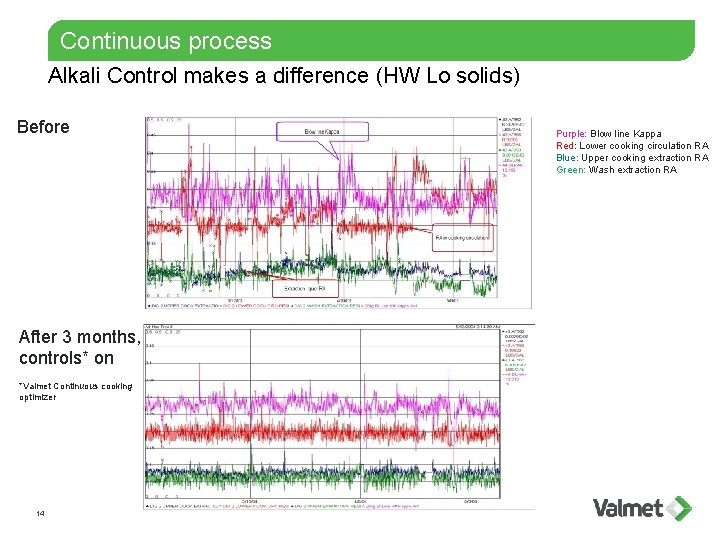
Continuous process Alkali Control makes a difference (HW Lo solids) Before After 3 months, controls* on *Valmet Continuous cooking optimizer 14 Purple: Blow line Kappa Red: Lower cooking circulation RA Blue: Upper cooking extraction RA Green: Wash extraction RA
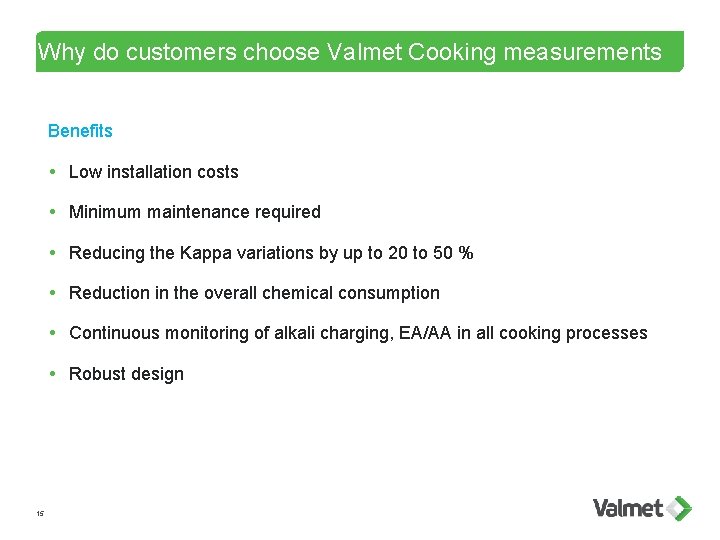
Why do customers choose Valmet Cooking measurements Benefits Low installation costs Minimum maintenance required Reducing the Kappa variations by up to 20 to 50 % Reduction in the overall chemical consumption Continuous monitoring of alkali charging, EA/AA in all cooking processes Robust design 15
Valmet Conductivity Brown stock washing
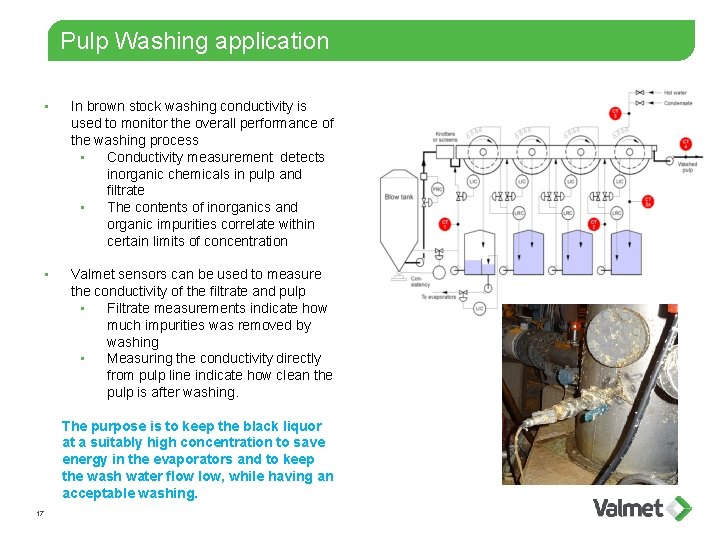
Pulp Washing application • In brown stock washing conductivity is used to monitor the overall performance of the washing process • Conductivity measurement detects inorganic chemicals in pulp and filtrate • The contents of inorganics and organic impurities correlate within certain limits of concentration • Valmet sensors can be used to measure the conductivity of the filtrate and pulp • Filtrate measurements indicate how much impurities was removed by washing • Measuring the conductivity directly from pulp line indicate how clean the pulp is after washing. The purpose is to keep the black liquor at a suitably high concentration to save energy in the evaporators and to keep the wash water flow low, while having an acceptable washing. 17
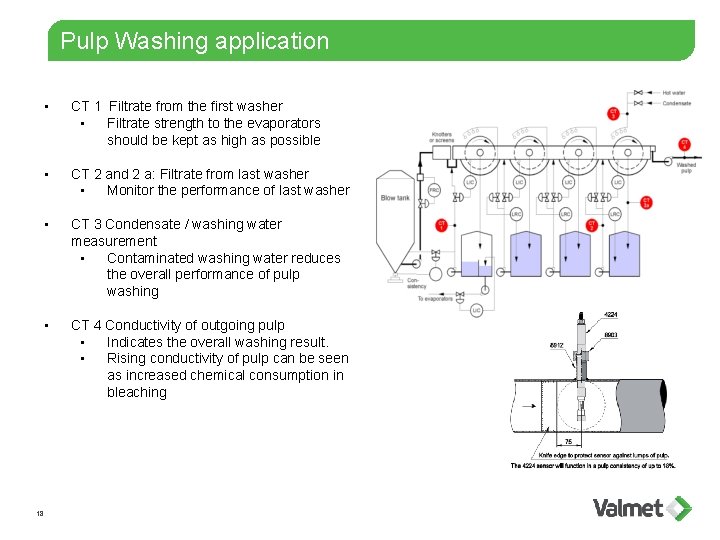
Pulp Washing application 18 • CT 1 Filtrate from the first washer • Filtrate strength to the evaporators should be kept as high as possible • CT 2 and 2 a: Filtrate from last washer • Monitor the performance of last washer • CT 3 Condensate / washing water measurement • Contaminated washing water reduces the overall performance of pulp washing • CT 4 Conductivity of outgoing pulp • Indicates the overall washing result. • Rising conductivity of pulp can be seen as increased chemical consumption in bleaching
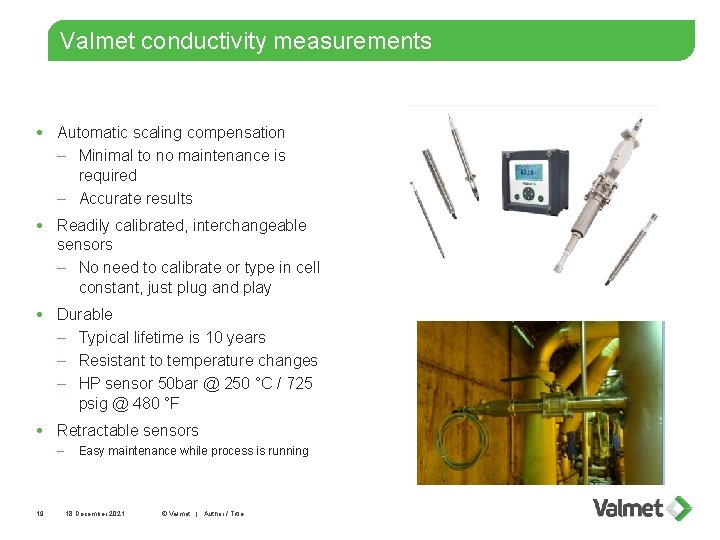
Valmet conductivity measurements Automatic scaling compensation – Minimal to no maintenance is required – Accurate results Readily calibrated, interchangeable sensors – No need to calibrate or type in cell constant, just plug and play Durable – Typical lifetime is 10 years – Resistant to temperature changes – HP sensor 50 bar @ 250 °C / 725 psig @ 480 °F Retractable sensors – 19 Easy maintenance while process is running 18 December 2021 © Valmet | Author / Title