
Vallejo Sequential Intercept Model SIM Mapping Project Coordinators
- Slides: 18
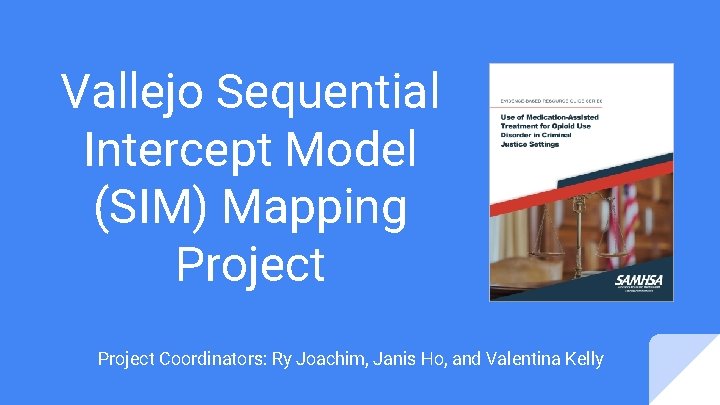
Vallejo Sequential Intercept Model (SIM) Mapping Project Coordinators: Ry Joachim, Janis Ho, and Valentina Kelly
Sierra Health Foundation Grant Northern California-focused funder Supports community-building, asset-based projects
Purpose of our project: Create a Sequential Intercept Model (SIM) for Vallejo which highlights the ways we can incorporate services for opioid-use disorder (OUD) to divert those who suffer from opioid-use disorder away from the criminal justice system
What is Sequential Intercept Model (SIM) Mapping ? ● A map that shows how people with behavioral health needs flow through the criminal justice system. ● SIMs have been used across the country at state, county, and city levels for mental health and substance use disorders.
The Sequential Intercept Model The SIM was originally created to address the over-representation of people with mental illness in the criminal justice system. The goal was to increase access to mental health treatment before, during, and after a person has interacted with the criminal justice system.
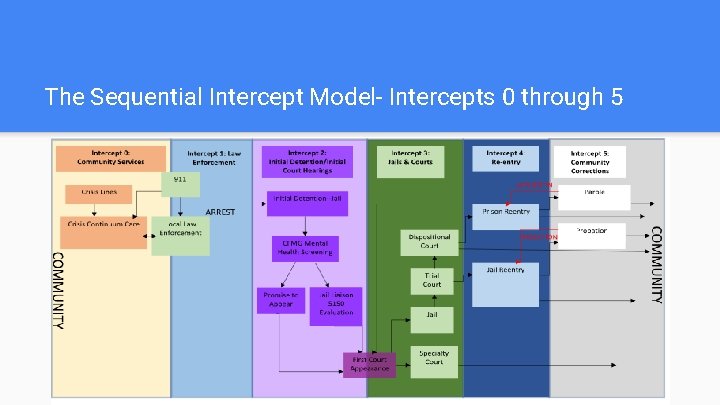
The Sequential Intercept Model- Intercepts 0 through 5
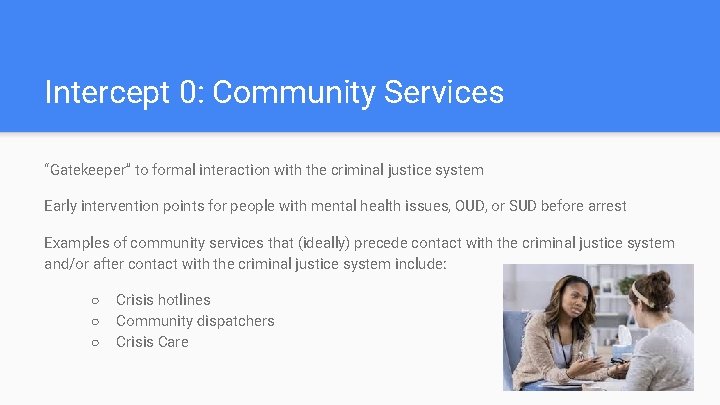
Intercept 0: Community Services “Gatekeeper” to formal interaction with the criminal justice system Early intervention points for people with mental health issues, OUD, or SUD before arrest Examples of community services that (ideally) precede contact with the criminal justice system and/or after contact with the criminal justice system include: ○ ○ ○ Crisis hotlines Community dispatchers Crisis Care
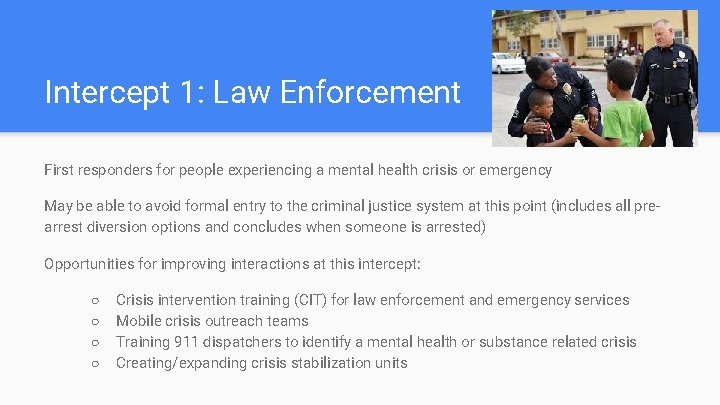
Intercept 1: Law Enforcement First responders for people experiencing a mental health crisis or emergency May be able to avoid formal entry to the criminal justice system at this point (includes all prearrest diversion options and concludes when someone is arrested) Opportunities for improving interactions at this intercept: ○ ○ Crisis intervention training (CIT) for law enforcement and emergency services Mobile crisis outreach teams Training 911 dispatchers to identify a mental health or substance related crisis Creating/expanding crisis stabilization units
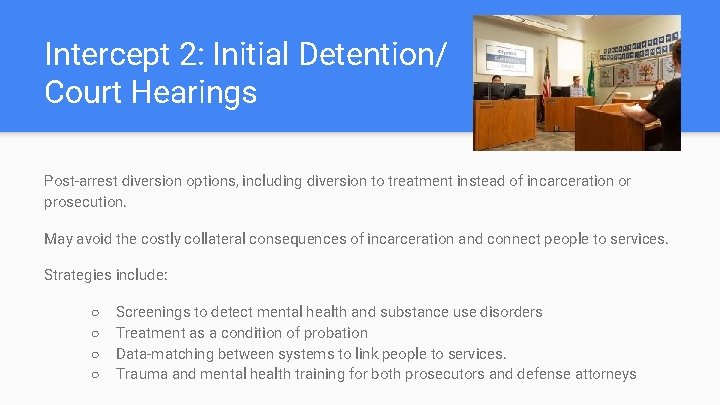
Intercept 2: Initial Detention/ Court Hearings Post-arrest diversion options, including diversion to treatment instead of incarceration or prosecution. May avoid the costly collateral consequences of incarceration and connect people to services. Strategies include: ○ ○ Screenings to detect mental health and substance use disorders Treatment as a condition of probation Data-matching between systems to link people to services. Trauma and mental health training for both prosecutors and defense attorneys
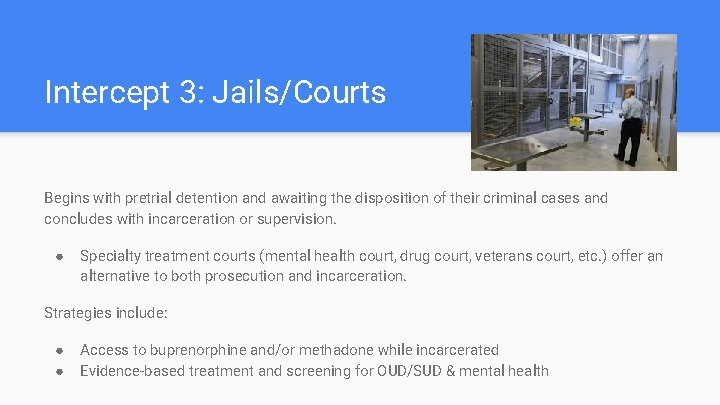
Intercept 3: Jails/Courts Begins with pretrial detention and awaiting the disposition of their criminal cases and concludes with incarceration or supervision. ● Specialty treatment courts (mental health court, drug court, veterans court, etc. ) offer an alternative to both prosecution and incarceration. Strategies include: ● ● Access to buprenorphine and/or methadone while incarcerated Evidence-based treatment and screening for OUD/SUD & mental health
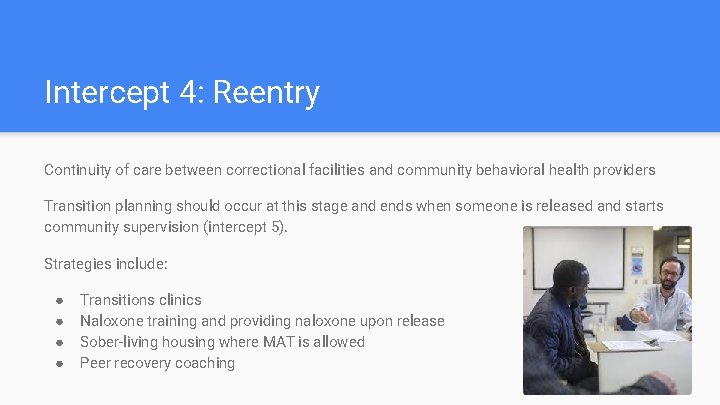
Intercept 4: Reentry Continuity of care between correctional facilities and community behavioral health providers Transition planning should occur at this stage and ends when someone is released and starts community supervision (intercept 5). Strategies include: ● ● Transitions clinics Naloxone training and providing naloxone upon release Sober-living housing where MAT is allowed Peer recovery coaching
Intercept 5: Community Corrections Probation and parole Strategies include: ○ ○ Specialized behavioral health caseloads Graduated responses as alternatives to technical violations for problematic behaviors that would traditionally result in jail time.
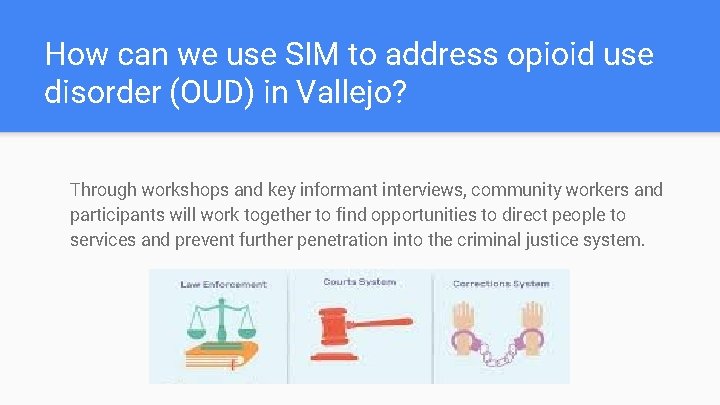
How can we use SIM to address opioid use disorder (OUD) in Vallejo? Through workshops and key informant interviews, community workers and participants will work together to find opportunities to direct people to services and prevent further penetration into the criminal justice system.
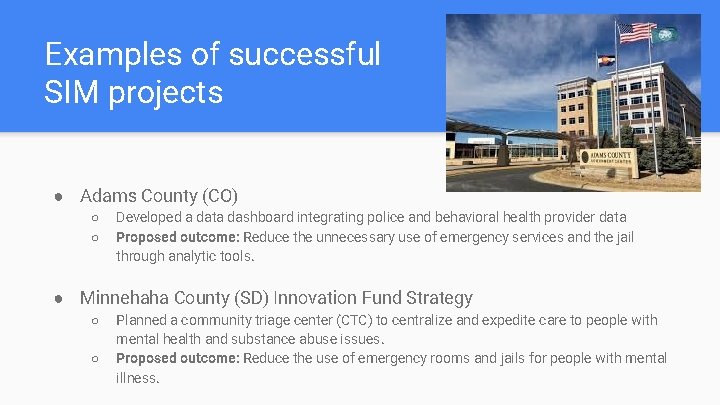
Examples of successful SIM projects ● Adams County (CO) ○ ○ Developed a data dashboard integrating police and behavioral health provider data Proposed outcome: Reduce the unnecessary use of emergency services and the jail through analytic tools. ● Minnehaha County (SD) Innovation Fund Strategy ○ ○ Planned a community triage center (CTC) to centralize and expedite care to people with mental health and substance abuse issues. Proposed outcome: Reduce the use of emergency rooms and jails for people with mental illness.
Group Discussion ● ● ● What population(s) does your organization work with? What is currently being done in our community and within your organization/intercept to address Opioid Use Disorder (OUD) or Substance Use Disorder (SUD)? Do you involve family or other supports when addressing SUD, OUD, and/or other mental health concerns? What training do people within your organization have regarding OUD, MAT, naloxone administration…? What collaborations/coordination is occurring between your organization and other intercepts if any? What strengths and challenges can you identify within your respective intercept? What gaps in communication between intercepts do you notice? Is communication happening between your organization and other organizations/intercepts? What do you think should be the priorities for reform within or between each intercept? What is one short-term goal that can be achieved now without additional resources? Medium-term goals? Long-term? What additional resources would you like/need to have in order to better address SUD or OUD?
Contact Information ● Project Coordinators: ○ Ry Joachim: jessie. joachim@tu. edu ○ Janis Ho: janis. ho 5@tu. edu ○ Valentina Kelly: valentina. kelly@tu. edu
References 1. California Department of Public Health. (n. d. ). Welcome to the California Opioid Overdose Surveillance Dashboard. Retrieved from https: //skylab. cdph. ca. gov/ODdash/ 2. Parker, T. , & Griffin, P. (2017). Sequential Intercept Model Mapping Report for Fulton County, GA. Retrieved from https: //www. fultonstepsup. org/sites/default/files/fulton_county_ga_sim_report_final_with_appendices. pdf 3. Policy Research Associates. (n. d. ). The Sequential Intercept Model: Advancing Community-Based Solutions for Justice-Involved People with Mental and Substance Use Disorders. Retrieved from https: //www. usf. edu/cbcs/mhlp/tac/documents/mapping/sim-handout-new. pdf 4. Willison, J. , Mc. Coy, E. , Vasquez-Noriega, C. , Reginal, T. , & Parker, T. (2018). Using the Sequential Intercept Model to Guide Local Reform an Innovation Fund Case Study. Retrieved from http: //www. safetyandjusticechallenge. org/wpcontent/uploads/2018/10/2018. 10. 11_Using-the-SIM_finalized. pdf
Materials for presentation/ workshop - Big Post-its that can stick to the wall Markers/ Pens USB with presentation on it as back up if internet not working- email presentation to Nancy Print sign in sheet (printed) Print slides for 80 ppl once receive feedback (printed) Printed SIM brochure ( Sharon has printed 100 copies)