
Validation of the plasticity models and introduction of

- Slides: 34
Validation of the plasticity models and introduction of hardening laws • October 25: Concepts • October 27: Formulations Lecturer: Alireza Sadeghirad
Contents: • Introduction of the concepts in 1 D. • Extension of the concepts to 2 D and 3 D. • Investigation of some special cases and important issues in 3 D. Assumptions: • I am talking about the rate-independent plasticity. It means loading/unloading is slow. • Temperature is almost constant. • I am talking about the associative plasticity, in which it is assumed that the flow direction (returning path to the yield surface) is perpendicular to the yield surface.
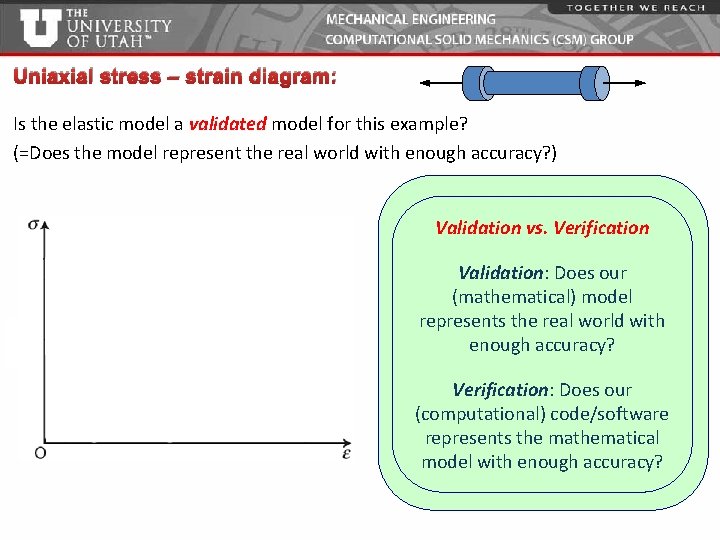
Uniaxial stress – strain diagram: Is the elastic model a validated model for this example? (=Does the model represent the real world with enough accuracy? ) An elastic material has a unique, Validation Verification natural, elasticvs. reference state to which it will return when the Validation: Doesforces our are deformation-causing (mathematical) model removed. The deformation between represents the real state worldand with this elastic reference the enough accuracy? currents state is reversible. There. Verification: is a one-to-one relationship Does our between stresscode/software and strain. (computational) represents the mathematical The material does not have model with enough accuracy? memory.
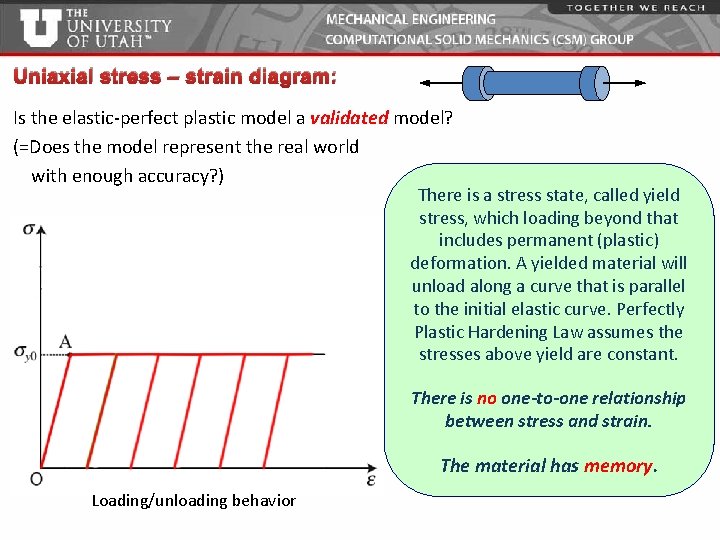
Uniaxial stress – strain diagram: Is the elastic-perfect plastic model a validated model? (=Does the model represent the real world with enough accuracy? ) There is a stress state, called yield stress, which loading beyond that includes permanent (plastic) deformation. A yielded material will unload along a curve that is parallel to the initial elastic curve. Perfectly Plastic Hardening Law assumes the stresses above yield are constant. There is no one-to-one relationship between stress and strain. The material has memory. Loading/unloading behavior
Uniaxial stress – strain diagram: Is the elastic model a validated model for this test? Is the elastic-perfect plastic model a validated model for this test? These questions are not the right (complete) ones ! We should specify: for which material? under which conditions? Note that we already assume that the loading/unloading is slow, and temperature is constant.
Validation of elastic and elastic-perfect plastic models: . • Many metals exhibit nearly linear elastic behavior at low strain magnitudes. • Rubbers exhibit Hyper-elastic behavior, and they remain elastic up to large strain values (often up to 100% strain and beyond). • For metals, the yield stress usually occurs at. 05% -. 1% of the material’s Elastic Modulus. • Based on my knowledge, there is almost no material showing the exact elastic-perfect plastic behavior. Perfectly Plastic can be used as an approximation which may be appropriate for some design processes.
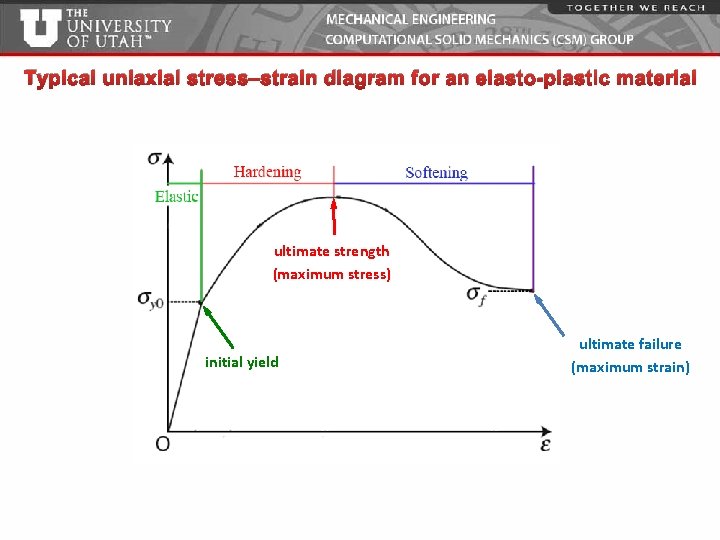
Typical uniaxial stress–strain diagram for an elasto-plastic material ultimate strength (maximum stress) initial yield ultimate failure (maximum strain)
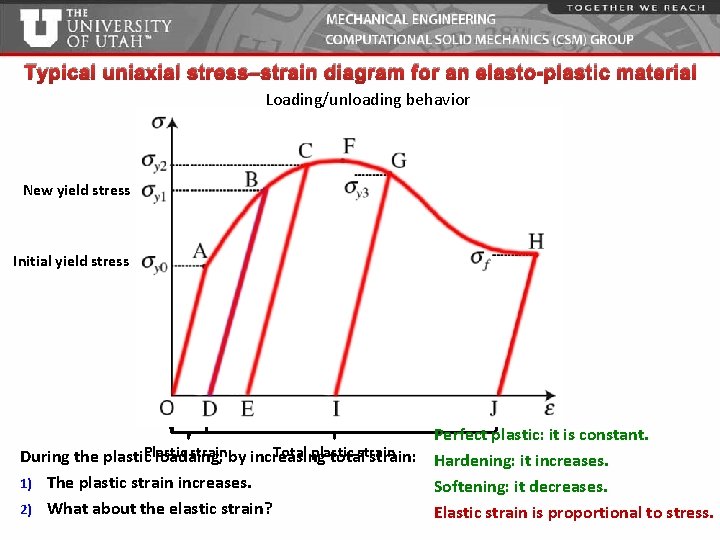
Typical uniaxial stress–strain diagram for an elasto-plastic material Loading/unloading behavior New yield stress Initial yield stress Perfect plastic: it is constant. strainby increasing Total plastic During the plastic. Plastic loadaing, totalstrain: Hardening: it increases. 1) The plastic strain increases. Softening: it decreases. 2) What about the elastic strain? Elastic strain is proportional to stress.
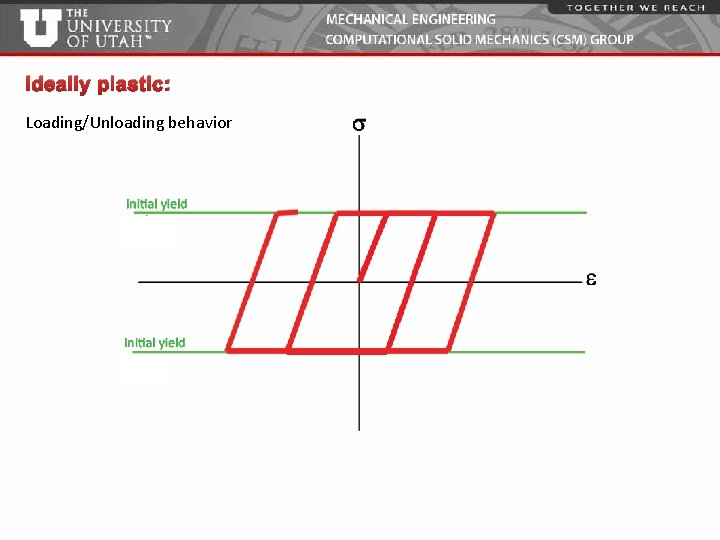
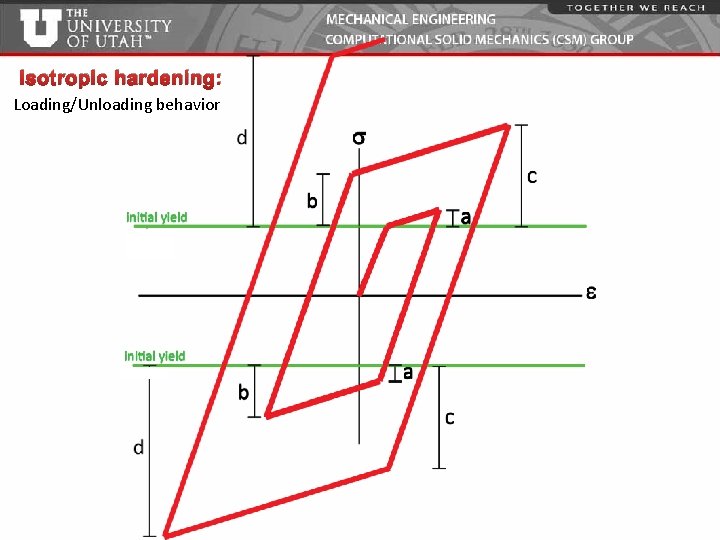
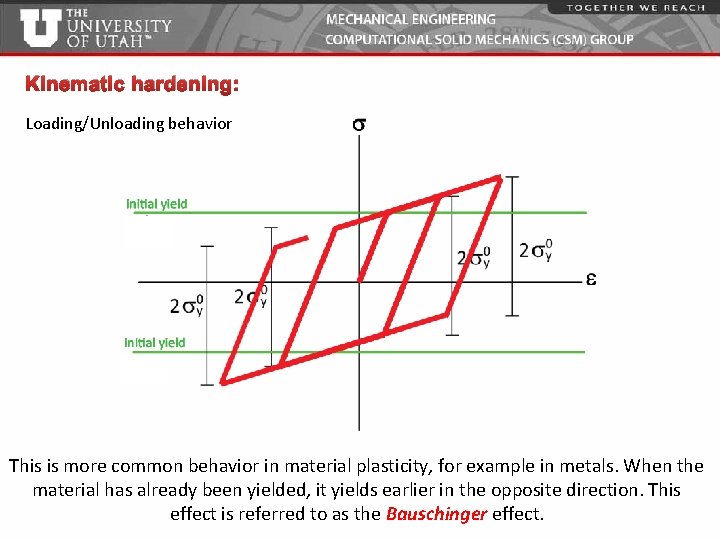
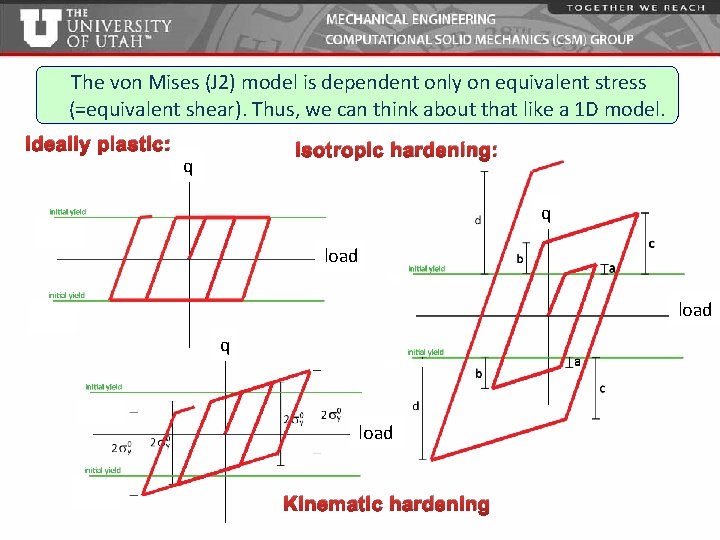
Three types of plastic behaviors are considered here: q q q perfect plastic isotropic hardening kinematic hardening
Ideally plastic: Loading/Unloading behavior
Isotropic hardening: Loading/Unloading behavior
Kinematic hardening: Loading/Unloading behavior This is more common behavior in material plasticity, for example in metals. When the material has already been yielded, it yields earlier in the opposite direction. This effect is referred to as the Bauschinger effect.
. Validation of isotropic and kinematic hardening: • Isotropic hardening is commonly used to model drawing or other metal forming operations. • For many materials, the kinematic hardening model gives a better representation of loading/unloading behavior than the isotropic hardening model. For cyclic loading, however, the kinematic hardening model cannot represent either cyclic hardening or cyclic softening.
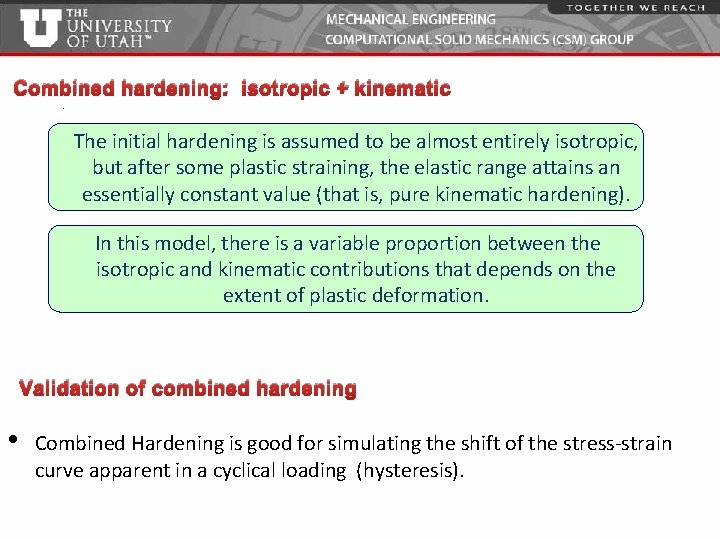
Combined hardening: isotropic + kinematic. The initial hardening is assumed to be almost entirely isotropic, but after some plastic straining, the elastic range attains an essentially constant value (that is, pure kinematic hardening). In this model, there is a variable proportion between the isotropic and kinematic contributions that depends on the extent of plastic deformation. Validation of combined hardening • Combined Hardening is good for simulating the shift of the stress-strain curve apparent in a cyclical loading (hysteresis).
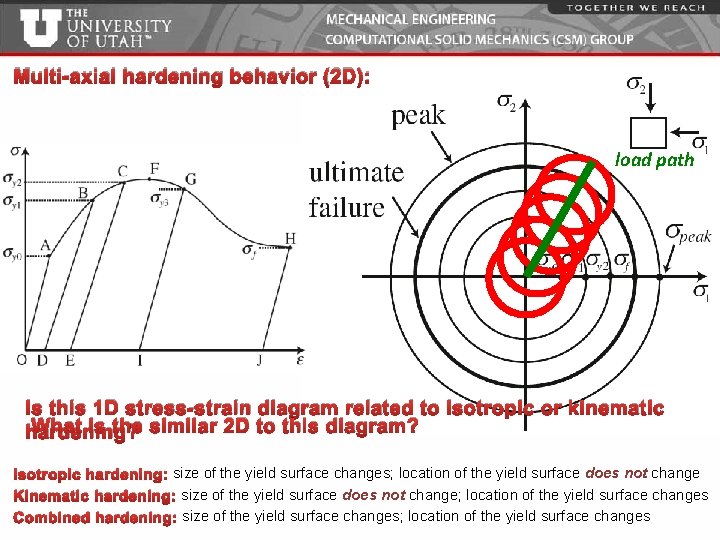
Multi-axial hardening behavior (2 D): load path Is this 1 D stress-strain diagram related to isotropic or kinematic What is the similar 2 D to this diagram? hardening? Isotropic hardening: size of the yield surface changes; location of the yield surface does not change Kinematic hardening: size of the yield surface does not change; location of the yield surface changes Combined hardening: size of the yield surface changes; location of the yield surface changes
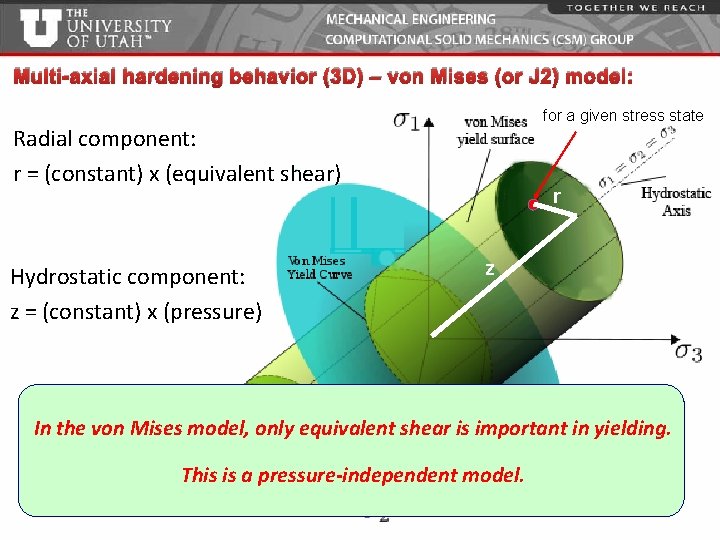
Multi-axial hardening behavior (3 D) – von Mises (or J 2) model: for a given stress state Radial component: r = (constant) x (equivalent shear) Hydrostatic component: z = (constant) x (pressure) r z In the von Mises model, only equivalent shear is important in yielding. This is a pressure-independent model.
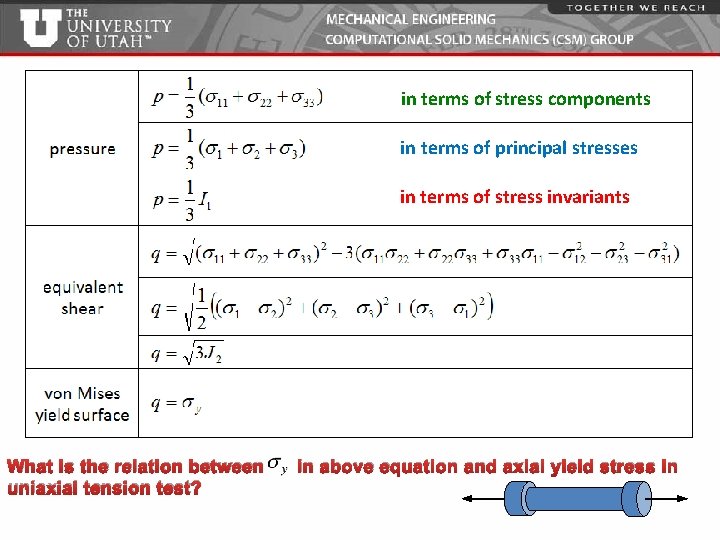
in terms of stress components in terms of principal stresses in terms of stress invariants What is the relation between uniaxial tension test? in above equation and axial yield stress in
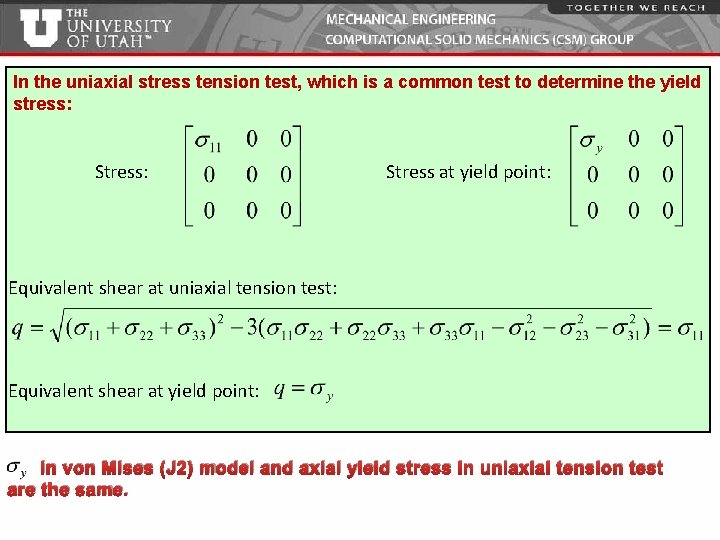
In the uniaxial stress tension test, which is a common test to determine the yield stress: Stress at yield point: Equivalent shear at uniaxial tension test: Equivalent shear at yield point: in von Mises (J 2) model and axial yield stress in uniaxial tension test are the same.
The von Mises (J 2) model is dependent only on equivalent stress (=equivalent shear). Thus, we can think about that like a 1 D model. Ideally plastic: Isotropic hardening: q q load Kinematic hardening
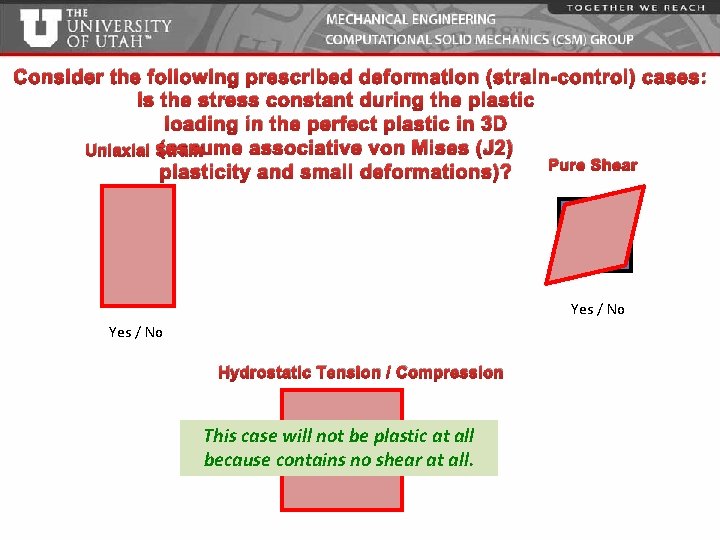
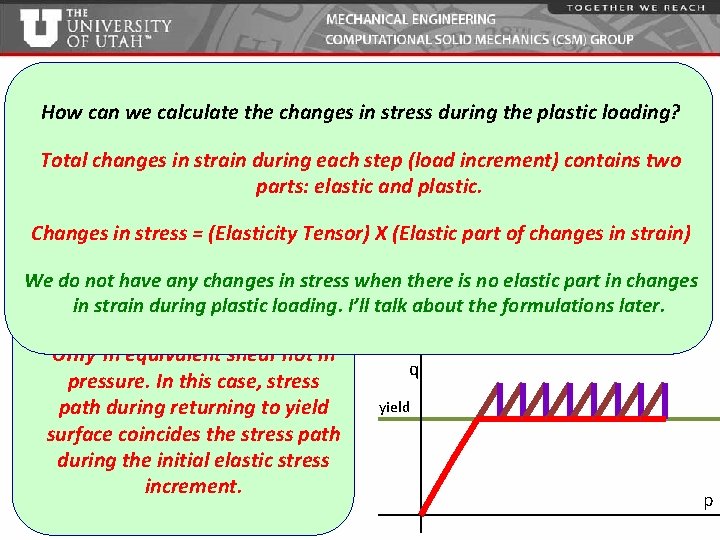
Consider the following prescribed deformation (strain-control) cases: Is the stress constant during the plastic loading in the perfect plastic in 3 D (assume associative von Mises (J 2) Uniaxial Strain Pure Shear plasticity and small deformations)? Yes / No Hydrostatic Tension / Compression This case will not be plastic at all because contains no shear at Yesall. / No
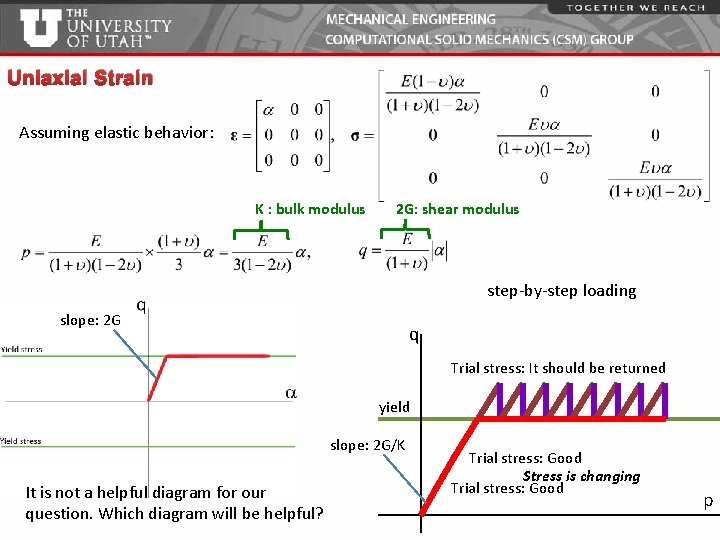
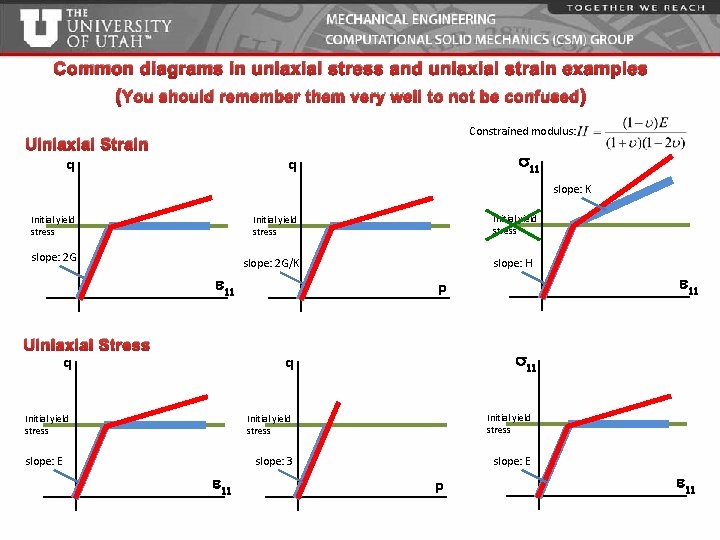
Uniaxial Strain Assuming elastic behavior: K : bulk modulus 2 G: shear modulus step-by-step loading slope: 2 G q Trial stress: It should be returned yield slope: 2 G/K It is not a helpful diagram for our question. Which diagram will be helpful? Trial stress: Good Stress is changing Trial stress: Good p
How can changes in stress during the plastic loading? When willwe thecalculate stress bethe constant during the plastic loading? Total changes in strain during each step (load increment) contains two parts: elastic and plastic. Which conditions are required? Changes in stress = (Elasticity Tensor) X (Elastic part of changes in strain) We do not have any changes in stress when there is no elastic part in changes Stressinisstrain constant if each step I’ll talk about the formulations later. during plasticloading. (increment) leads to changes only in equivalent shear not in q pressure. In this case, stress yield path during returning to yield surface coincides the stress path during the initial elastic stress increment. p
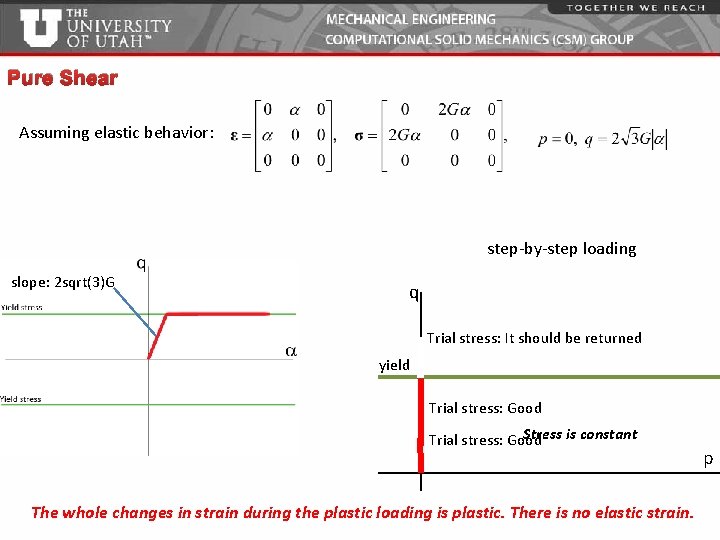
Pure Shear Assuming elastic behavior: step-by-step loading slope: 2 sqrt(3)G q Trial stress: It should be returned yield Trial stress: Good Stress is constant Trial stress: Good The whole changes in strain during the plastic loading is plastic. There is no elastic strain. p
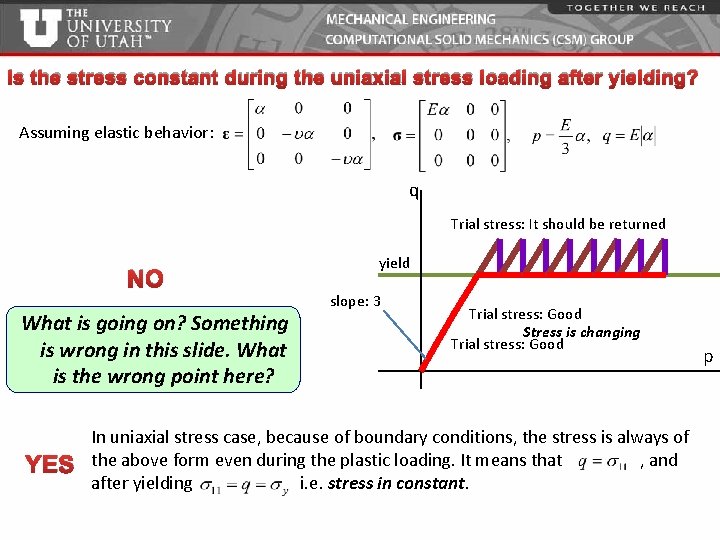
Is the stress constant during the uniaxial stress loading after yielding? Assuming elastic behavior: q Trial stress: It should be returned NO What is going on? Something is wrong in this slide. What is the wrong point here? YES yield slope: 3 Trial stress: Good Stress is changing Trial stress: Good In uniaxial stress case, because of boundary conditions, the stress is always of the above form even during the plastic loading. It means that , and after yielding i. e. stress in constant. p
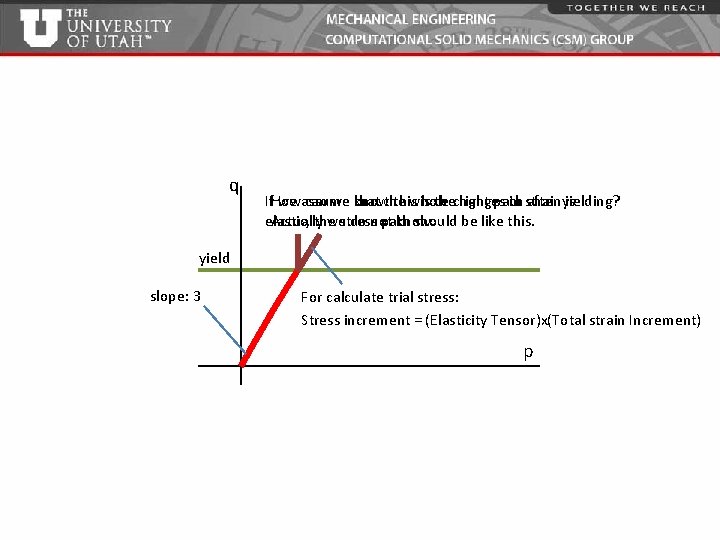
q If. How we assume can we that knowthe thiswhole is thechanges right path in strain after yielding? is elastic, Actually the westress do not path know. should be like this. yield slope: 3 For calculate trial stress: Stress increment = (Elasticity Tensor)x(Total strain Increment) p
Common diagrams in uniaxial stress and uniaxial strain examples (You should remember them very well to not be confused ) Constrained modulus: Uiniaxial Strain q s 11 q slope: K Initial yield stress slope: 2 G slope: H slope: 2 G/K e 11 Uiniaxial Stress q s 11 q Initial yield stress slope: E e 11 p Initial yield stress slope: 3 slope: E p e 11
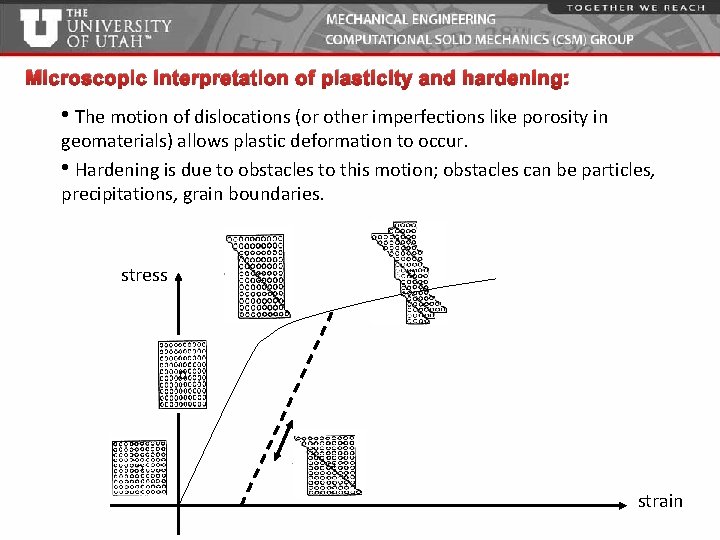
Microscopic interpretation of plasticity and hardening: • The motion of dislocations (or other imperfections like porosity in geomaterials) allows plastic deformation to occur. • Hardening is due to obstacles to this motion; obstacles can be particles, precipitations, grain boundaries. stress strain
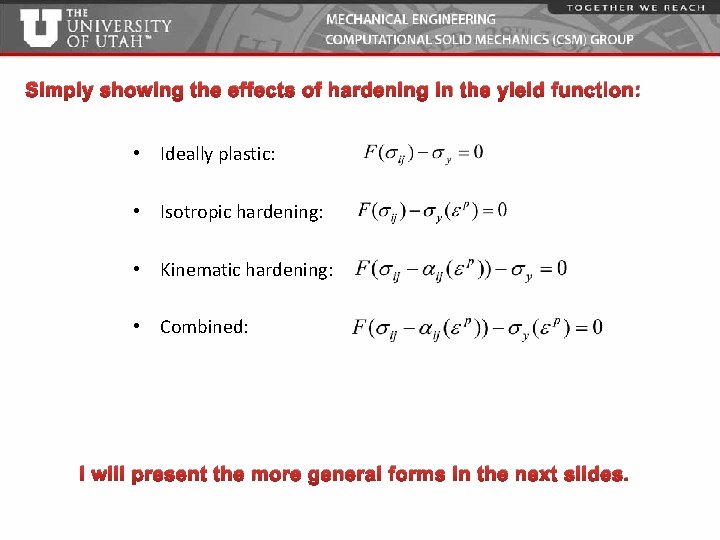
Simply showing the effects of hardening in the yield function: • Ideally plastic: • Isotropic hardening: • Kinematic hardening: • Combined: I will present the more general forms in the next slides.
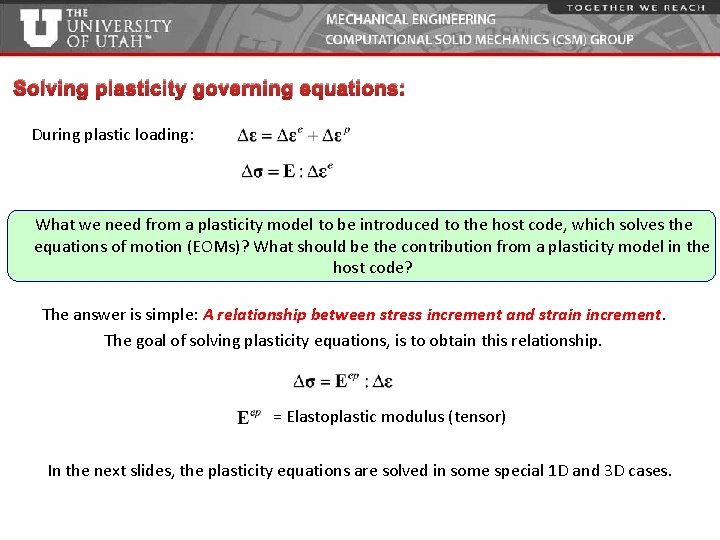
Solving plasticity governing equations: During plastic loading: What we need from a plasticity model to be introduced to the host code, which solves the equations of motion (EOMs)? What should be the contribution from a plasticity model in the host code? The answer is simple: A relationship between stress increment and strain increment. The goal of solving plasticity equations, is to obtain this relationship. = Elastoplastic modulus (tensor) In the next slides, the plasticity equations are solved in some special 1 D and 3 D cases.
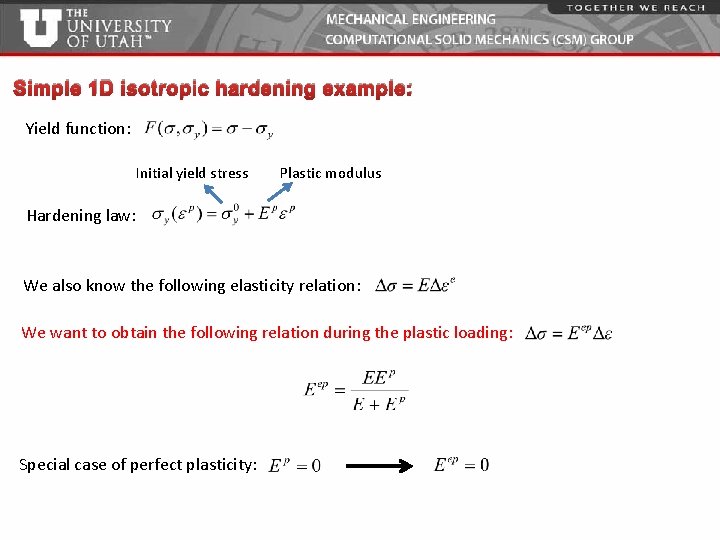
Simple 1 D isotropic hardening example: Yield function: Initial yield stress Plastic modulus Hardening law: We also know the following elasticity relation: We want to obtain the following relation during the plastic loading: Special case of perfect plasticity:
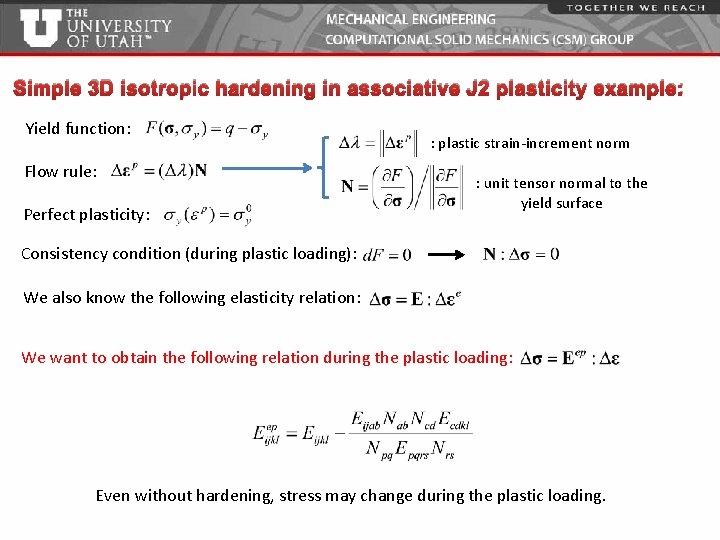
Simple 3 D isotropic hardening in associative J 2 plasticity example: Yield function: Flow rule: Perfect plasticity: : plastic strain-increment norm : unit tensor normal to the yield surface Consistency condition (during plastic loading): We also know the following elasticity relation: We want to obtain the following relation during the plastic loading: Even without hardening, stress may change during the plastic loading.
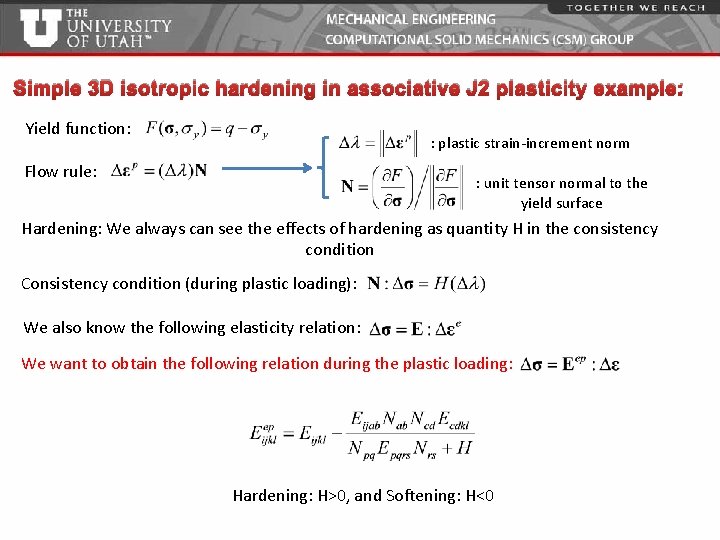
Simple 3 D isotropic hardening in associative J 2 plasticity example: Yield function: : plastic strain-increment norm Flow rule: : unit tensor normal to the yield surface Hardening: We always can see the effects of hardening as quantity H in the consistency condition Consistency condition (during plastic loading): We also know the following elasticity relation: We want to obtain the following relation during the plastic loading: Hardening: H>0, and Softening: H<0
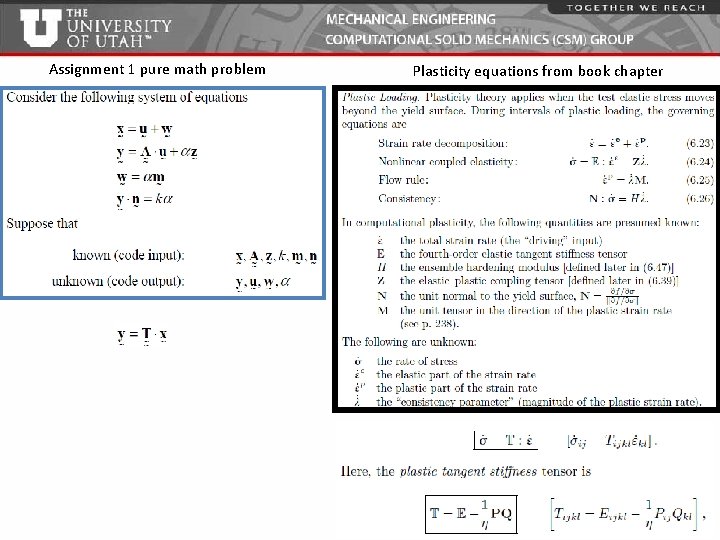
Assignment 1 pure math problem Plasticity equations from book chapter
References: A. Anandarajah, Computational Methods in Elasticity and Plasticity, Springer, 2010 units. civil. uwa. edu. au/teaching/CIVIL 8140? f=284007 www. cadfamily. com/download/CAE/Marc. . . /mar 120_lecture_09. ppt