
Validation of an Immunization Information System Against the
- Slides: 22
Validation of an Immunization Information System Against the National Immunization Survey and Improvement of Hepatitis B Birth Dose Coverage in New York City Melissa A. Mickle-Hope, MPH, Christopher M. Zimmerman, MD, MPH, Vikki Papadouka, Ph. D, MPH and Jane R. Zucker MD, MSc National Immunization Conference March 20, 2008 Atlanta, Georgia
Overview • Background – Hepatitis B virus infection – Universal hepatitis B vaccine birth dose recommendations – Methods of performing vaccine coverage assessment • Validation of immunization coverage • Improvement of hepatitis B vaccine birth dose coverage in NYC
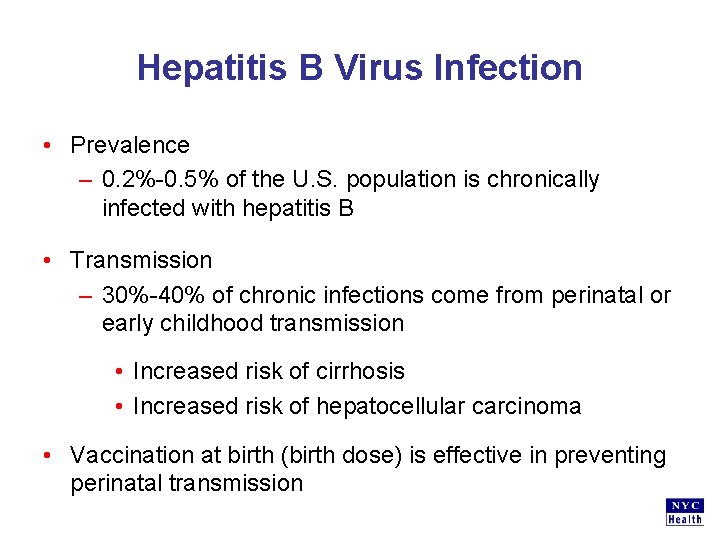
Hepatitis B Virus Infection • Prevalence – 0. 2%-0. 5% of the U. S. population is chronically infected with hepatitis B • Transmission – 30%-40% of chronic infections come from perinatal or early childhood transmission • Increased risk of cirrhosis • Increased risk of hepatocellular carcinoma • Vaccination at birth (birth dose) is effective in preventing perinatal transmission
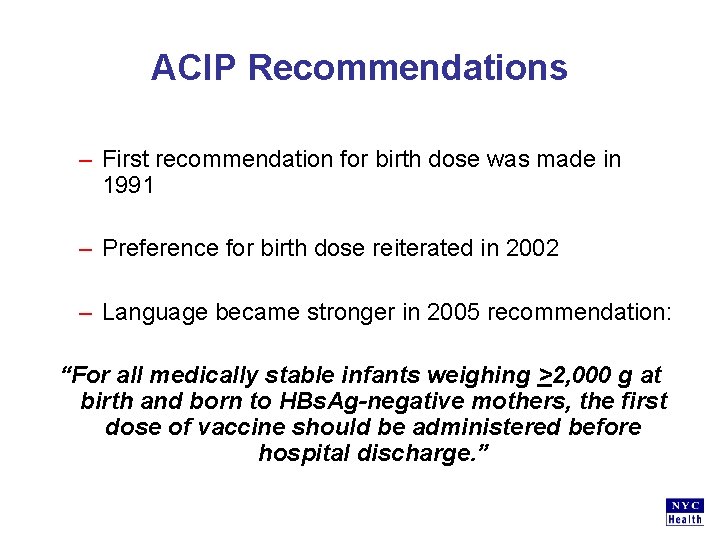
ACIP Recommendations – First recommendation for birth dose was made in 1991 – Preference for birth dose reiterated in 2002 – Language became stronger in 2005 recommendation: “For all medically stable infants weighing >2, 000 g at birth and born to HBs. Ag-negative mothers, the first dose of vaccine should be administered before hospital discharge. ”
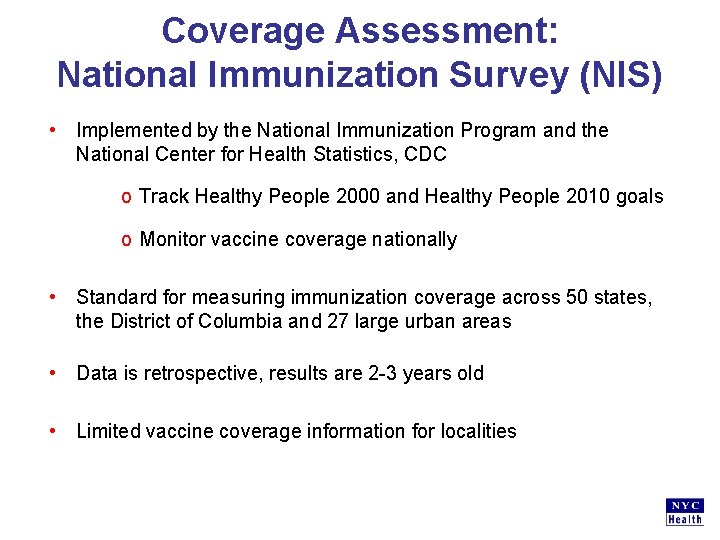
Coverage Assessment: National Immunization Survey (NIS) • Implemented by the National Immunization Program and the National Center for Health Statistics, CDC o Track Healthy People 2000 and Healthy People 2010 goals o Monitor vaccine coverage nationally • Standard for measuring immunization coverage across 50 states, the District of Columbia and 27 large urban areas • Data is retrospective, results are 2 -3 years old • Limited vaccine coverage information for localities
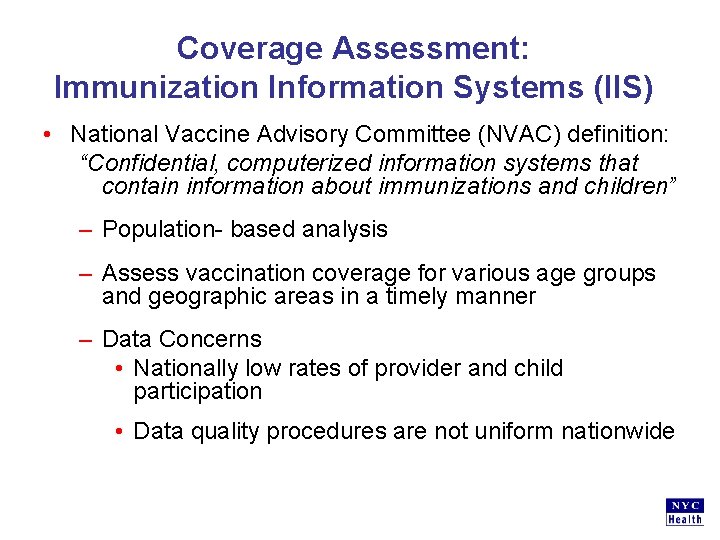
Coverage Assessment: Immunization Information Systems (IIS) • National Vaccine Advisory Committee (NVAC) definition: “Confidential, computerized information systems that contain information about immunizations and children” – Population- based analysis – Assess vaccination coverage for various age groups and geographic areas in a timely manner – Data Concerns • Nationally low rates of provider and child participation • Data quality procedures are not uniform nationwide
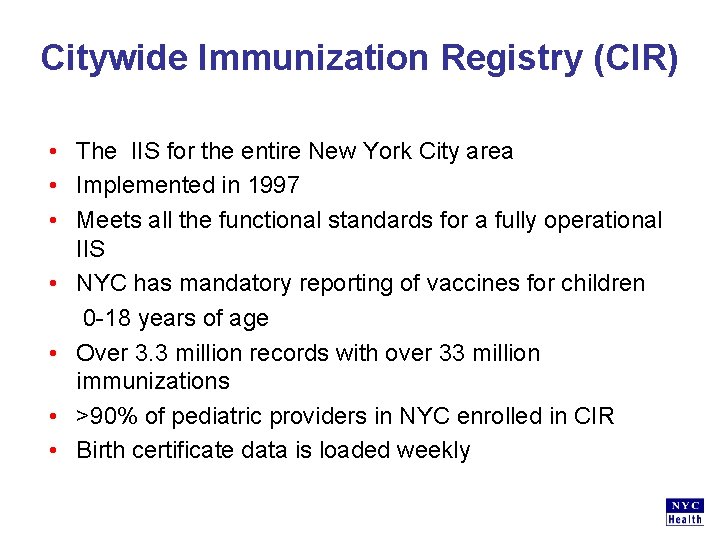
Citywide Immunization Registry (CIR) • The IIS for the entire New York City area • Implemented in 1997 • Meets all the functional standards for a fully operational IIS • NYC has mandatory reporting of vaccines for children 0 -18 years of age • Over 3. 3 million records with over 33 million immunizations • >90% of pediatric providers in NYC enrolled in CIR • Birth certificate data is loaded weekly
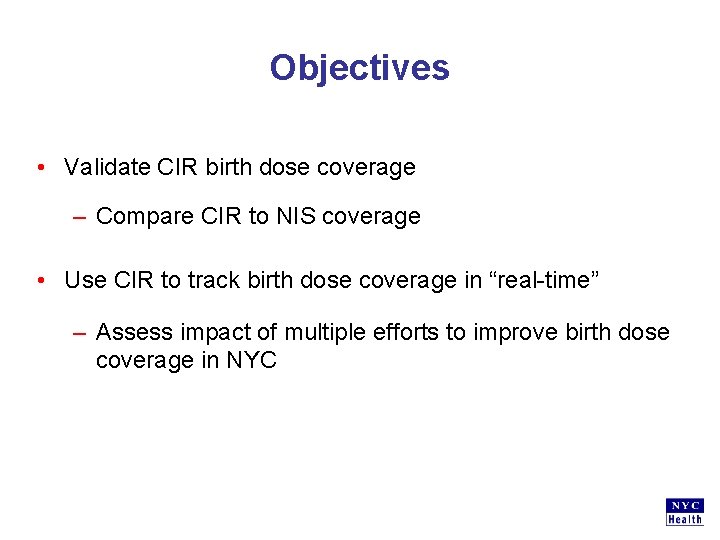
Objectives • Validate CIR birth dose coverage – Compare CIR to NIS coverage • Use CIR to track birth dose coverage in “real-time” – Assess impact of multiple efforts to improve birth dose coverage in NYC
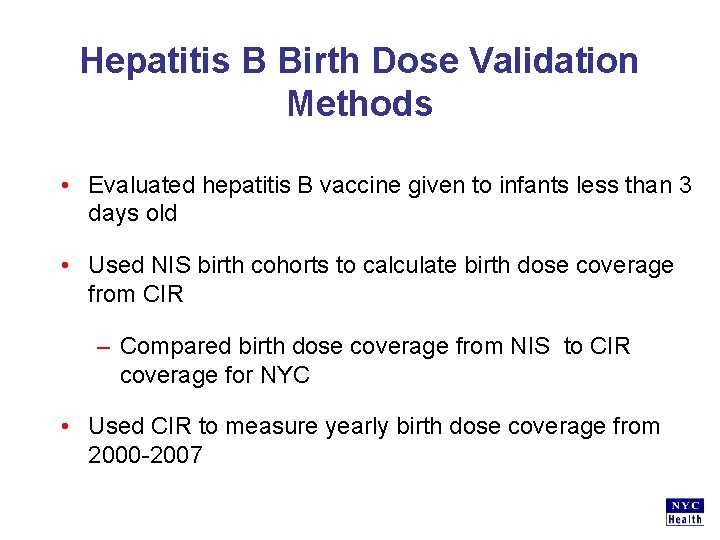
Hepatitis B Birth Dose Validation Methods • Evaluated hepatitis B vaccine given to infants less than 3 days old • Used NIS birth cohorts to calculate birth dose coverage from CIR – Compared birth dose coverage from NIS to CIR coverage for NYC • Used CIR to measure yearly birth dose coverage from 2000 -2007
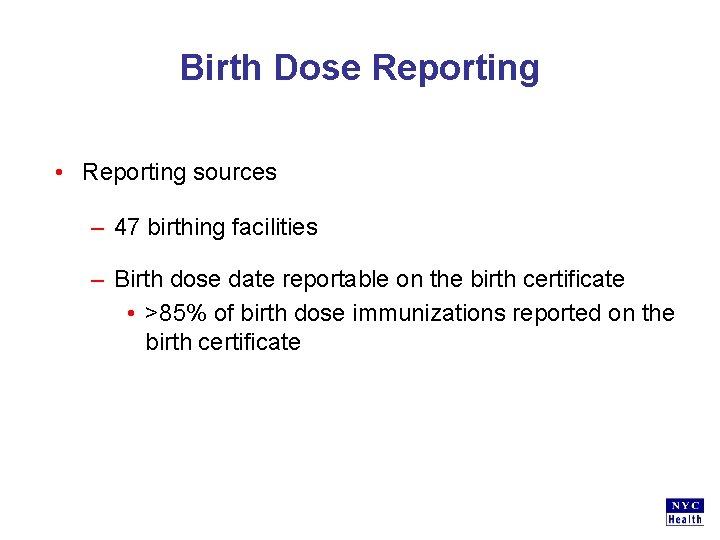
Birth Dose Reporting • Reporting sources – 47 birthing facilities – Birth dose date reportable on the birth certificate • >85% of birth dose immunizations reported on the birth certificate
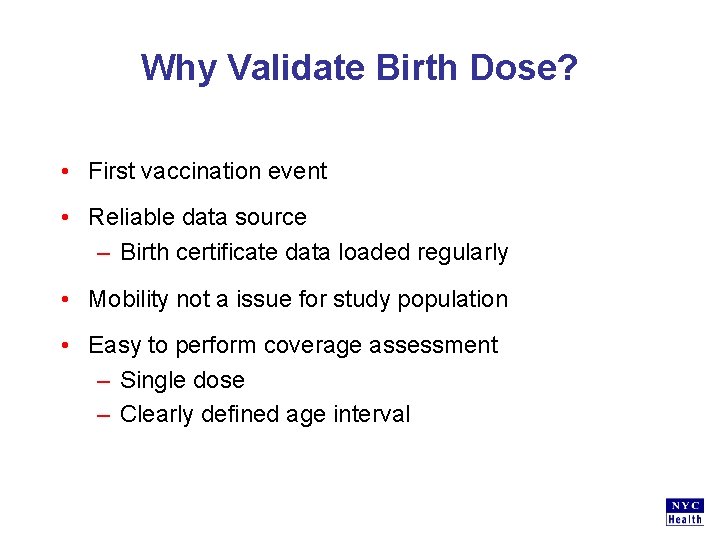
Why Validate Birth Dose? • First vaccination event • Reliable data source – Birth certificate data loaded regularly • Mobility not a issue for study population • Easy to perform coverage assessment – Single dose – Clearly defined age interval
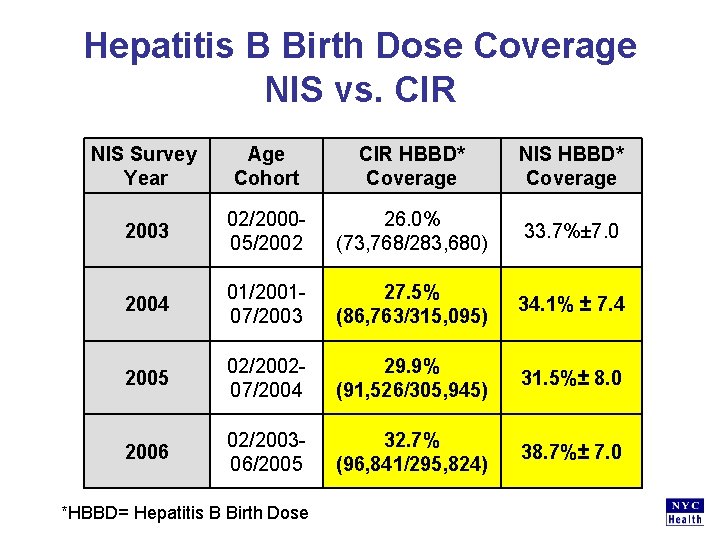
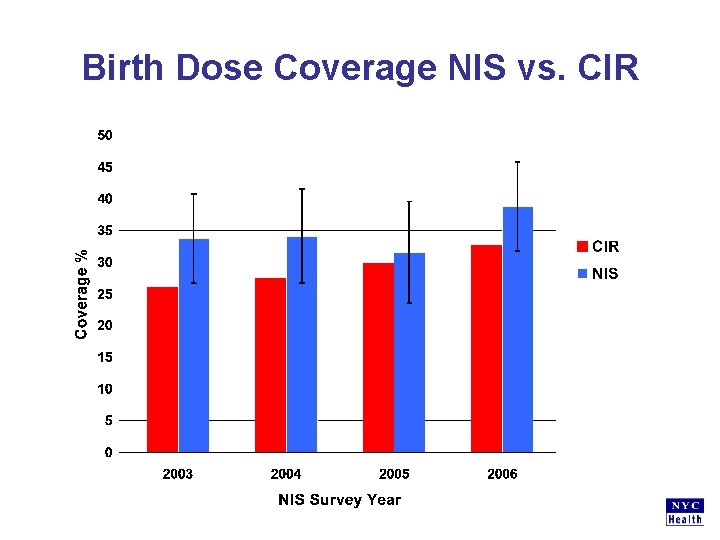
Hepatitis B Birth Dose Coverage NIS vs. CIR NIS Survey Year Age Cohort CIR HBBD* Coverage NIS HBBD* Coverage 2003 02/200005/2002 26. 0% (73, 768/283, 680) 33. 7%± 7. 0 2004 01/200107/2003 27. 5% (86, 763/315, 095) 34. 1% ± 7. 4 2005 02/200207/2004 29. 9% (91, 526/305, 945) 31. 5%± 8. 0 2006 02/200306/2005 32. 7% (96, 841/295, 824) 38. 7%± 7. 0 *HBBD= Hepatitis B Birth Dose
Birth Dose Coverage NIS vs. CIR
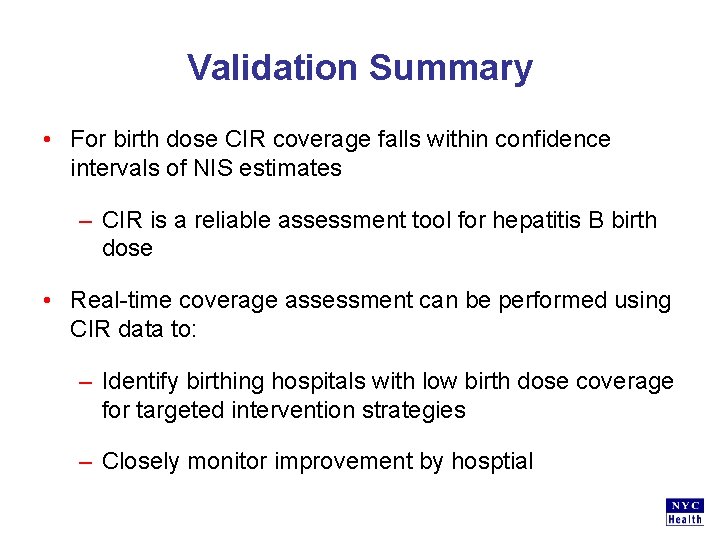
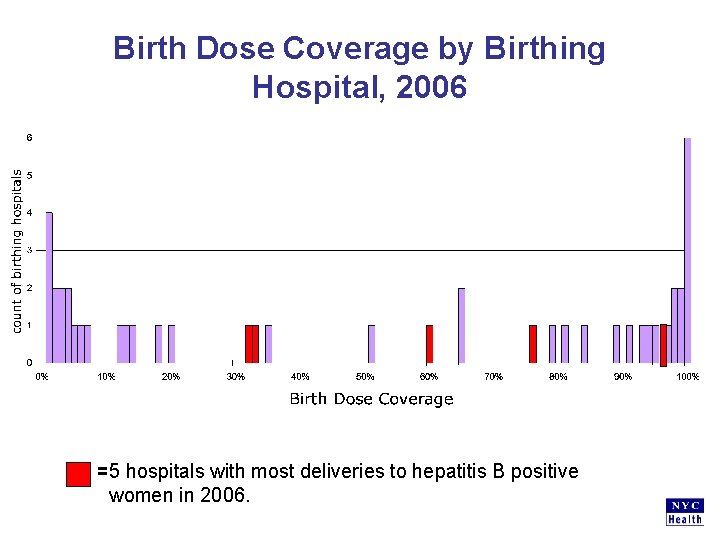
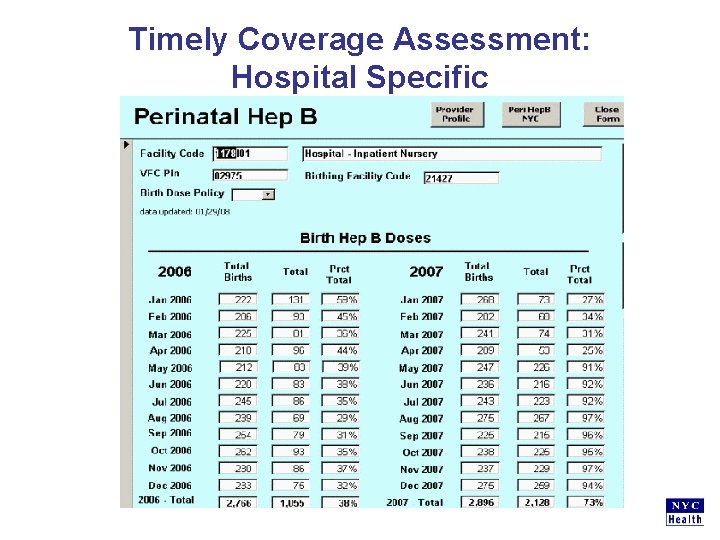
Validation Summary • For birth dose CIR coverage falls within confidence intervals of NIS estimates – CIR is a reliable assessment tool for hepatitis B birth dose • Real-time coverage assessment can be performed using CIR data to: – Identify birthing hospitals with low birth dose coverage for targeted intervention strategies – Closely monitor improvement by hosptial
Birth Dose Coverage by Birthing Hospital, 2006 = 5 hospitals with most deliveries to hepatitis B positive women in 2006.
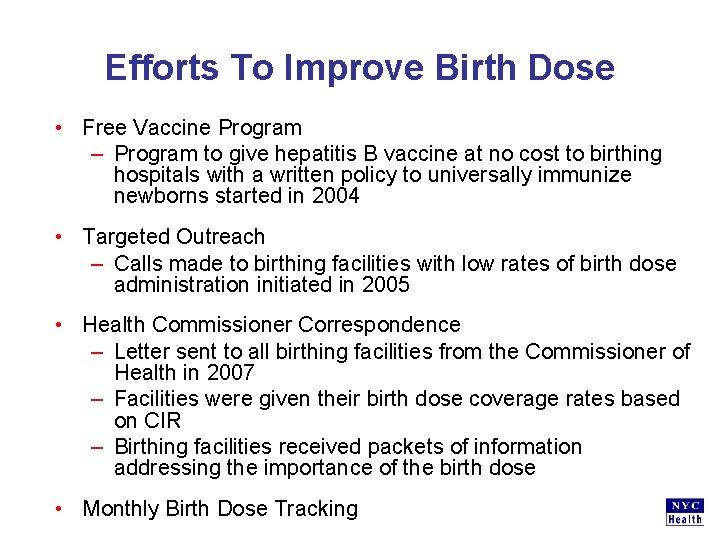
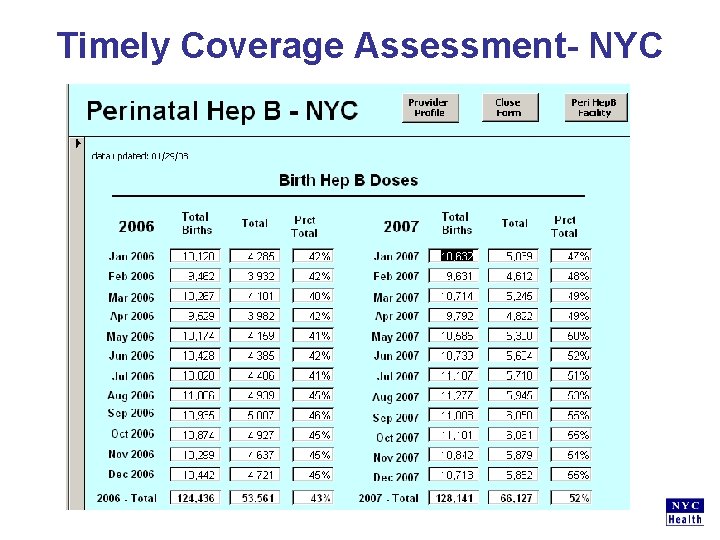
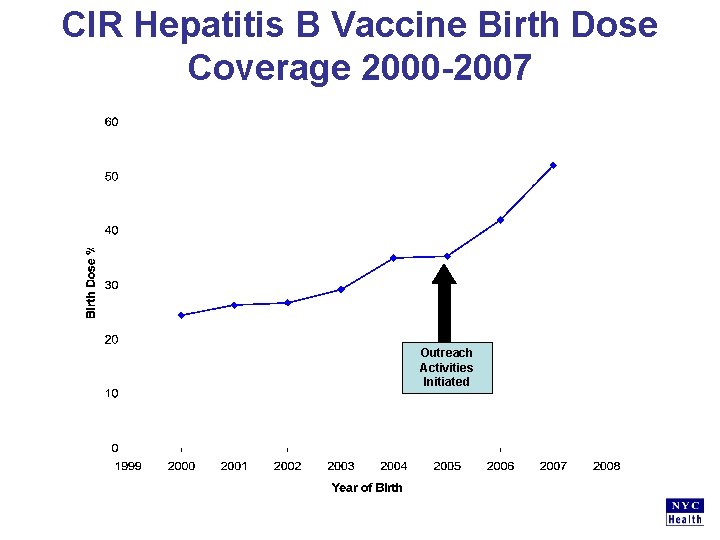
Efforts To Improve Birth Dose • Free Vaccine Program – Program to give hepatitis B vaccine at no cost to birthing hospitals with a written policy to universally immunize newborns started in 2004 • Targeted Outreach – Calls made to birthing facilities with low rates of birth dose administration initiated in 2005 • Health Commissioner Correspondence – Letter sent to all birthing facilities from the Commissioner of Health in 2007 – Facilities were given their birth dose coverage rates based on CIR – Birthing facilities received packets of information addressing the importance of the birth dose • Monthly Birth Dose Tracking
Timely Coverage Assessment- NYC
Timely Coverage Assessment: Hospital Specific
CIR Hepatitis B Vaccine Birth Dose Coverage 2000 -2007 Outreach Activities Initiated
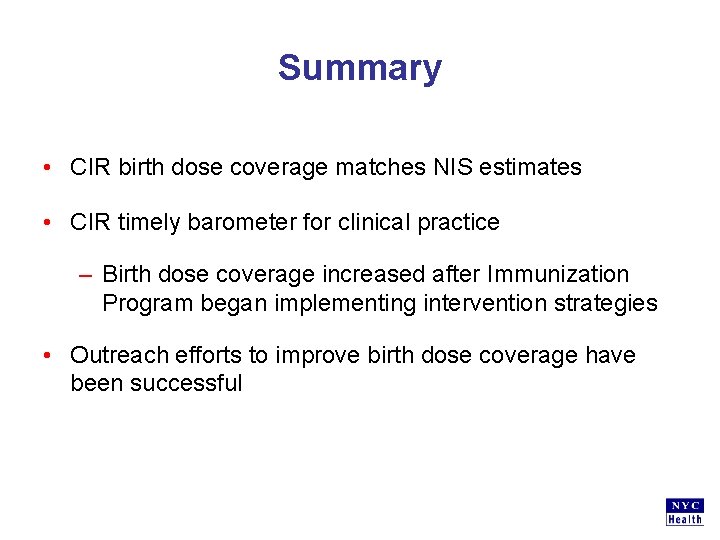
Summary • CIR birth dose coverage matches NIS estimates • CIR timely barometer for clinical practice – Birth dose coverage increased after Immunization Program began implementing intervention strategies • Outreach efforts to improve birth dose coverage have been successful
Next Steps For Birth Dose Improvement • Continued Outreach – Another letter from the Commissioner of Health will be sent to birthing facilities with updated coverage estimates from CIR • Birth dose coverage for every birthing facility will be made available to the public
Future Directions • Expand validation efforts using other vaccine groups • Continue to improve CIR data quality – Add reminder recall capabilities to the Online Registry – Continue to provide feedback to providers using quarterly coverage reports – Implement real time data capture through Electronic Medical Record (EMR) systems – Exchange data with neighboring states and localities