
Validation of a Salmonella Survival and Growth Model
- Slides: 1
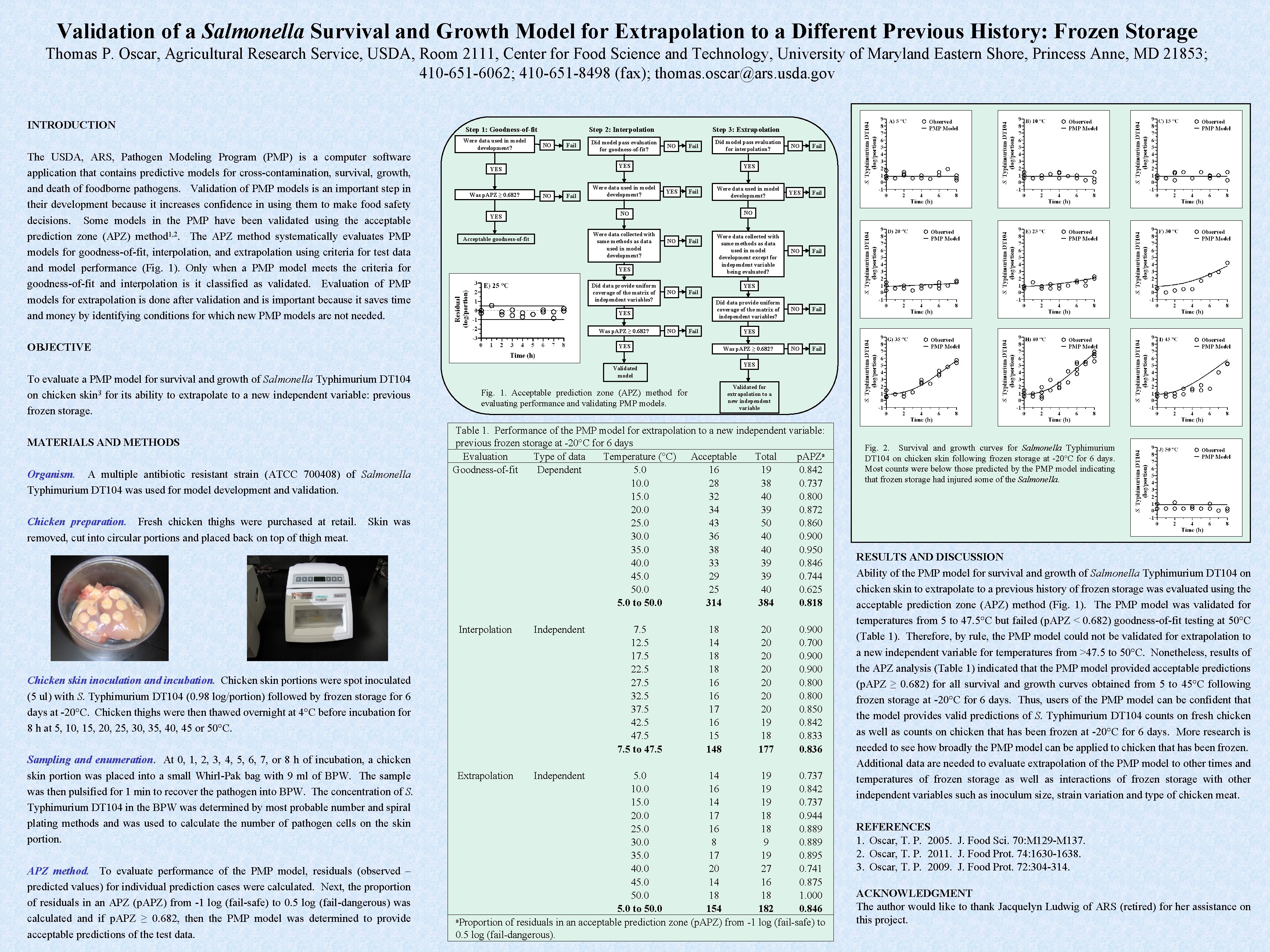
Validation of a Salmonella Survival and Growth Model for Extrapolation to a Different Previous History: Frozen Storage Thomas P. Oscar, Agricultural Research Service, USDA, Room 2111, Center for Food Science and Technology, University of Maryland Eastern Shore, Princess Anne, MD 21853; 410 -651 -6062; 410 -651 -8498 (fax); thomas. oscar@ars. usda. gov INTRODUCTION Step 1: Goodness-of-fit The USDA, ARS, Pathogen Modeling Program (PMP) is a computer software application that contains predictive models for cross-contamination, survival, growth, and death of foodborne pathogens. Validation of PMP models is an important step in their development because it increases confidence in using them to make food safety decisions. Some models in the PMP have been validated using the acceptable prediction zone (APZ) method 1, 2. The APZ method systematically evaluates PMP models for goodness-of-fit, interpolation, and extrapolation using criteria for test data and model performance (Fig. 1). Only when a PMP model meets the criteria for goodness-of-fit and interpolation is it classified as validated. Evaluation of PMP models for extrapolation is done after validation and is important because it saves time and money by identifying conditions for which new PMP models are not needed. Were data used in model development? Step 2: Interpolation NO Fail Were data used in model development? Fail Did model pass evaluation for interpolation? Were data collected with same methods as data used in model development? Acceptable goodness-of-fit YES Fail NO Were data used in model development? Were data collected with same methods as data used in model development except for independent variable being evaluated? Did data provide uniform coverage of the matrix of independent variables? NO Fail MATERIALS AND METHODS Organism. A multiple antibiotic resistant strain (ATCC 700408) of Salmonella Typhimurium DT 104 was used for model development and validation. Skin was APZ method. To evaluate performance of the PMP model, residuals (observed – predicted values) for individual prediction cases were calculated. Next, the proportion of residuals in an APZ (p. APZ) from -1 log (fail-safe) to 0. 5 log (fail-dangerous) was calculated and if p. APZ ≥ 0. 682, then the PMP model was determined to provide acceptable predictions of the test data. Was p. APZ ≥ 0. 682? NO Fail YES Validated model Validated for extrapolation to a new independent variable Fig. 1. Acceptable prediction zone (APZ) method for evaluating performance and validating PMP models. Table 1. Performance of the PMP model for extrapolation to a new independent variable: previous frozen storage at -20°C for 6 days Evaluation Type of data Temperature (°C) Acceptable Total p. APZa Goodness-of-fit Dependent 5. 0 16 19 0. 842 10. 0 28 38 0. 737 15. 0 32 40 0. 800 20. 0 34 39 0. 872 25. 0 43 50 0. 860 30. 0 36 40 0. 900 35. 0 38 40 0. 950 40. 0 33 39 0. 846 45. 0 29 39 0. 744 50. 0 25 40 0. 625 5. 0 to 50. 0 314 384 0. 818 Interpolation Independent Extrapolation Independent Chicken skin inoculation and incubation. Chicken skin portions were spot inoculated (5 ul) with S. Typhimurium DT 104 (0. 98 log/portion) followed by frozen storage for 6 days at -20°C. Chicken thighs were then thawed overnight at 4°C before incubation for 8 h at 5, 10, 15, 20, 25, 30, 35, 40, 45 or 50°C. Sampling and enumeration. At 0, 1, 2, 3, 4, 5, 6, 7, or 8 h of incubation, a chicken skin portion was placed into a small Whirl-Pak bag with 9 ml of BPW. The sample was then pulsified for 1 min to recover the pathogen into BPW. The concentration of S. Typhimurium DT 104 in the BPW was determined by most probable number and spiral plating methods and was used to calculate the number of pathogen cells on the skin portion. Fail YES To evaluate a PMP model for survival and growth of Salmonella Typhimurium DT 104 on chicken skin 3 for its ability to extrapolate to a new independent variable: previous frozen storage. YES Fail YES OBJECTIVE Fail NO YES Did data provide uniform coverage of the matrix of independent variables? NO YES Was p. APZ ≥ 0. 682? Chicken preparation. Fresh chicken thighs were purchased at retail. removed, cut into circular portions and placed back on top of thigh meat. NO YES Was p. APZ ≥ 0. 682? Did model pass evaluation for goodness-of-fit? Step 3: Extrapolation 7. 5 12. 5 17. 5 22. 5 27. 5 32. 5 37. 5 42. 5 47. 5 to 47. 5 18 14 18 18 16 16 17 16 15 148 20 20 19 18 177 0. 900 0. 700 0. 900 0. 800 0. 850 0. 842 0. 833 0. 836 5. 0 14 19 0. 737 10. 0 16 19 0. 842 15. 0 14 19 0. 737 20. 0 17 18 0. 944 25. 0 16 18 0. 889 30. 0 8 9 0. 889 35. 0 17 19 0. 895 40. 0 20 27 0. 741 45. 0 14 16 0. 875 50. 0 18 18 1. 000 5. 0 to 50. 0 154 182 0. 846 a. Proportion of residuals in an acceptable prediction zone (p. APZ) from -1 log (fail-safe) to 0. 5 log (fail-dangerous). Fig. 2. Survival and growth curves for Salmonella Typhimurium DT 104 on chicken skin following frozen storage at -20°C for 6 days. Most counts were below those predicted by the PMP model indicating that frozen storage had injured some of the Salmonella. RESULTS AND DISCUSSION Ability of the PMP model for survival and growth of Salmonella Typhimurium DT 104 on chicken skin to extrapolate to a previous history of frozen storage was evaluated using the acceptable prediction zone (APZ) method (Fig. 1). The PMP model was validated for temperatures from 5 to 47. 5°C but failed (p. APZ < 0. 682) goodness-of-fit testing at 50°C (Table 1). Therefore, by rule, the PMP model could not be validated for extrapolation to a new independent variable for temperatures from >47. 5 to 50°C. Nonetheless, results of the APZ analysis (Table 1) indicated that the PMP model provided acceptable predictions (p. APZ ≥ 0. 682) for all survival and growth curves obtained from 5 to 45°C following frozen storage at -20°C for 6 days. Thus, users of the PMP model can be confident that the model provides valid predictions of S. Typhimurium DT 104 counts on fresh chicken as well as counts on chicken that has been frozen at -20°C for 6 days. More research is needed to see how broadly the PMP model can be applied to chicken that has been frozen. Additional data are needed to evaluate extrapolation of the PMP model to other times and temperatures of frozen storage as well as interactions of frozen storage with other independent variables such as inoculum size, strain variation and type of chicken meat. REFERENCES 1. Oscar, T. P. 2005. J. Food Sci. 70: M 129 -M 137. 2. Oscar, T. P. 2011. J. Food Prot. 74: 1630 -1638. 3. Oscar, T. P. 2009. J. Food Prot. 72: 304 -314. ACKNOWLEDGMENT The author would like to thank Jacquelyn Ludwig of ARS (retired) for her assistance on this project.