
Validation of a Palliative Care Screening Tool Karen
- Slides: 1
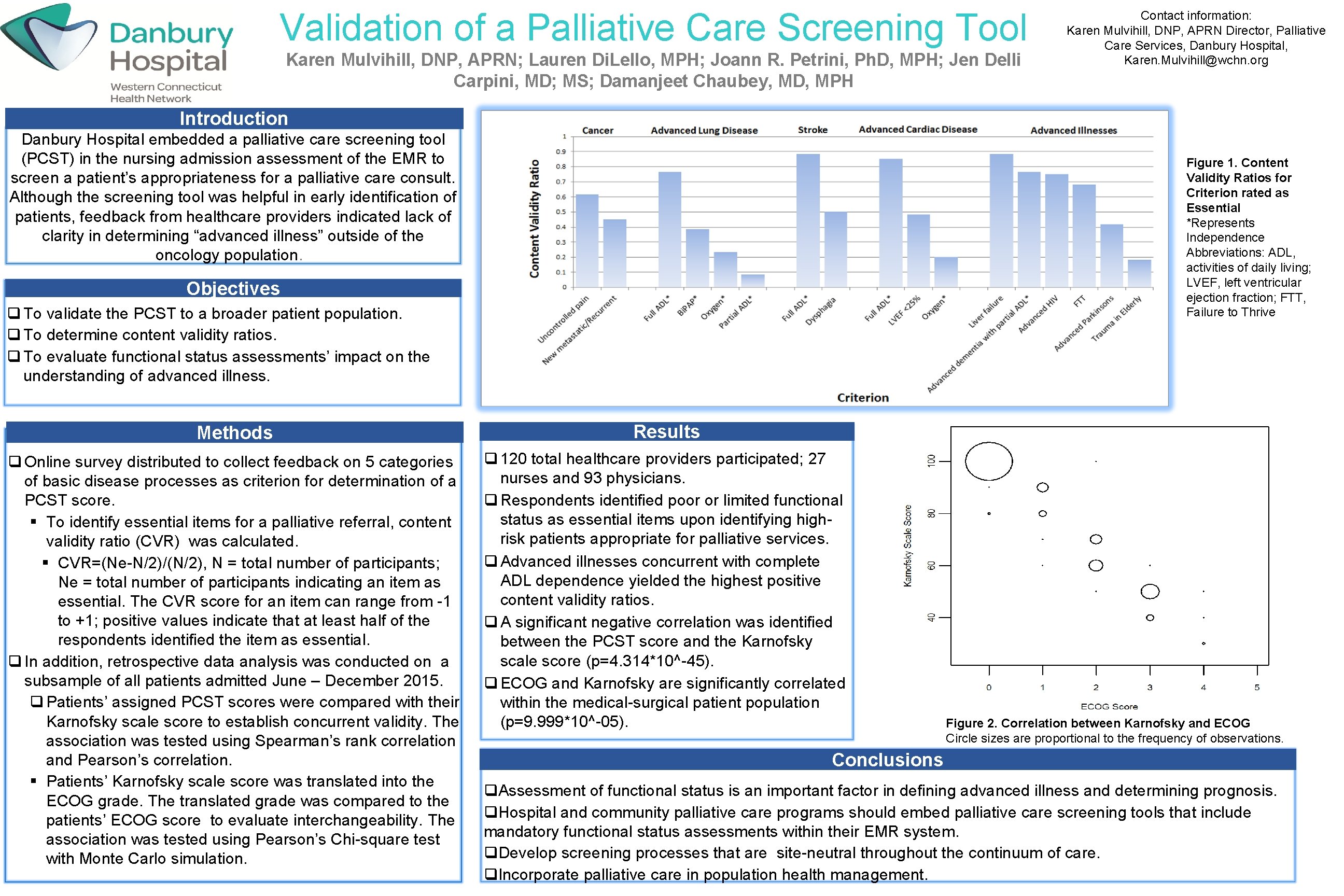
Validation of a Palliative Care Screening Tool Karen Mulvihill, DNP, APRN; Lauren Di. Lello, MPH; Joann R. Petrini, Ph. D, MPH; Jen Delli Carpini, MD; MS; Damanjeet Chaubey, MD, MPH Introduction Danbury Hospital embedded a palliative care screening tool (PCST) in the nursing admission assessment of the EMR to screen a patient’s appropriateness for a palliative care consult. Although the screening tool was helpful in early identification of patients, feedback from healthcare providers indicated lack of clarity in determining “advanced illness” outside of the oncology population. Contact information: Karen Mulvihill, DNP, APRN Director, Palliative Care Services, Danbury Hospital, Karen. Mulvihill@wchn. org Figure 1. Content Validity Ratios for Criterion rated as Essential *Represents Independence Abbreviations: ADL, activities of daily living; LVEF, left ventricular ejection fraction; FTT, Failure to Thrive Objectives q To validate the PCST to a broader patient population. q To determine content validity ratios. q To evaluate functional status assessments’ impact on the understanding of advanced illness. Methods Results q Online survey distributed to collect feedback on 5 categories of basic disease processes as criterion for determination of a PCST score. § To identify essential items for a palliative referral, content validity ratio (CVR) was calculated. § CVR=(Ne-N/2)/(N/2), N = total number of participants; Ne = total number of participants indicating an item as essential. The CVR score for an item can range from -1 to +1; positive values indicate that at least half of the respondents identified the item as essential. q In addition, retrospective data analysis was conducted on a subsample of all patients admitted June – December 2015. q Patients’ assigned PCST scores were compared with their Karnofsky scale score to establish concurrent validity. The association was tested using Spearman’s rank correlation and Pearson’s correlation. § Patients’ Karnofsky scale score was translated into the ECOG grade. The translated grade was compared to the patients’ ECOG score to evaluate interchangeability. The association was tested using Pearson’s Chi-square test with Monte Carlo simulation. q 120 total healthcare providers participated; 27 nurses and 93 physicians. q Respondents identified poor or limited functional status as essential items upon identifying highrisk patients appropriate for palliative services. q Advanced illnesses concurrent with complete ADL dependence yielded the highest positive content validity ratios. q A significant negative correlation was identified between the PCST score and the Karnofsky scale score (p=4. 314*10^-45). q ECOG and Karnofsky are significantly correlated within the medical-surgical patient population (p=9. 999*10^-05). Figure 2. Correlation between Karnofsky and ECOG Circle sizes are proportional to the frequency of observations. Conclusions q. Assessment of functional status is an important factor in defining advanced illness and determining prognosis. q. Hospital and community palliative care programs should embed palliative care screening tools that include mandatory functional status assessments within their EMR system. q. Develop screening processes that are site-neutral throughout the continuum of care. q. Incorporate palliative care in population health management.