
Validation of a novel catheterbased renal denervation system
Validation of a novel catheter-based renal denervation system of cryoablation (Cryo-RDN) in patients with resistant hypertension: a first-in-man study Junbo Gea, b, MD, Lei Gea, b, MD, Li Shena, b, MD, Meng Jia, b, c, MD, Han Chena, b, MD, Yi Zhangd, MD, Zhifeng Yaoa, b, MD, Yizhe Wua, b, MD, Yawei Xud, MD. a. Department of Cardiology, Zhongshan Hospital, Fudan University, Shanghai, China; b. Shanghai Institute of Cardiology Diseases, Shanghai, China; c. Institutes of Biomedical Scienses, Fudan University, Shanghai, China; d. Department of Cardiology, Shanghai Tenth People’s Hopsital, Tongji University School of Medicine
Potential conflicts of interest Speaker’s name: Lei Ge I do not have any potential conflict of interest to report in this presentation

Background Renal denervation (RDN) is the promising procedure of devicebased treatment for resistant hypertension(RH) Most RDN studies are accomplished by radiofrequency, endovascular or noninvasive ultrasound ablation RDN with cryoablation catheter was reported to be effective in the treatment of RH in non-responders to radiofrequency ablation Animal experiments with the novel dedicated Cryo-RDN balloon catheter has been shown safe and efficient previously Prochnau D, et al. Euro. Intervention 2014 Sep; 10(5) Ji M, et al. Chin. Med. J. 2015 Mar 20; 128(6)
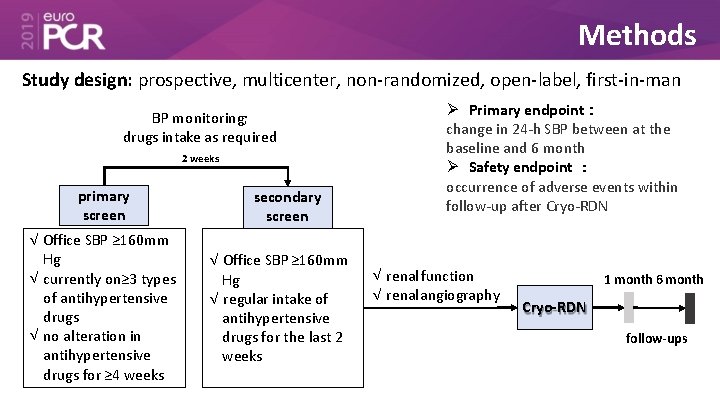
Methods Study design: prospective, multicenter, non-randomized, open-label, first-in-man BP monitoring; drugs intake as required 2 weeks primary screen secondary screen Primary endpoint: change in 24 -h SBP between at the baseline and 6 month Safety endpoint : occurrence of adverse events within follow-up after Cryo-RDN √ Office SBP ≥ 160 mm Hg √ currently on≥ 3 types of antihypertensive drugs √ no alteration in antihypertensive drugs for ≥ 4 weeks √ Office SBP ≥ 160 mm Hg √ regular intake of antihypertensive drugs for the last 2 weeks √ renal function √ renal angiography 1 month 6 month Cryo-RDN follow-ups

Methods Liquid nitrogen flows inside the coil freezing element, absorb heat from the surrounding Temperature outside the balloon decreases accordingly. Deep cryogenic polymer balloon Double helix High-efficiency cryogenic coil Cryo-RDN balloon elements in detail Cryo-RDN procedure in illustration Ablation is performed 360° in circumferential pattern
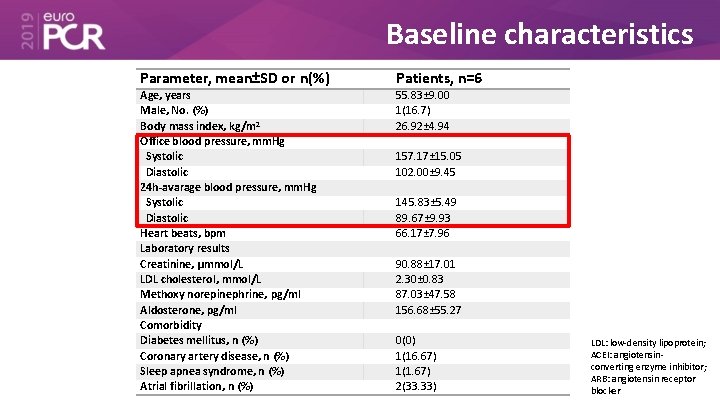
Baseline characteristics Parameter, mean±SD or n(%) Age, years Male, No. (%) Body mass index, kg/m 2 Office blood pressure, mm. Hg Systolic Diastolic 24 h-avarage blood pressure, mm. Hg Systolic Diastolic Heart beats, bpm Laboratory results Creatinine, µmmol/L LDL cholesterol, mmol/L Methoxy norepinephrine, pg/ml Aldosterone, pg/ml Comorbidity Diabetes mellitus, n (%) Coronary artery disease, n (%) Sleep apnea syndrome, n (%) Atrial fibrillation, n (%) Patients, n=6 55. 83± 9. 00 1(16. 7) 26. 92± 4. 94 157. 17± 15. 05 102. 00± 9. 45 145. 83± 5. 49 89. 67± 9. 93 66. 17± 7. 96 90. 88± 17. 01 2. 30± 0. 83 87. 03± 47. 58 156. 68± 55. 27 0(0) 1(16. 67) 1(1. 67) 2(33. 33) LDL: low-density lipoprotein; ACEI: angiotensinconverting enzyme inhibitor; ARB: angiotensin receptor blocker
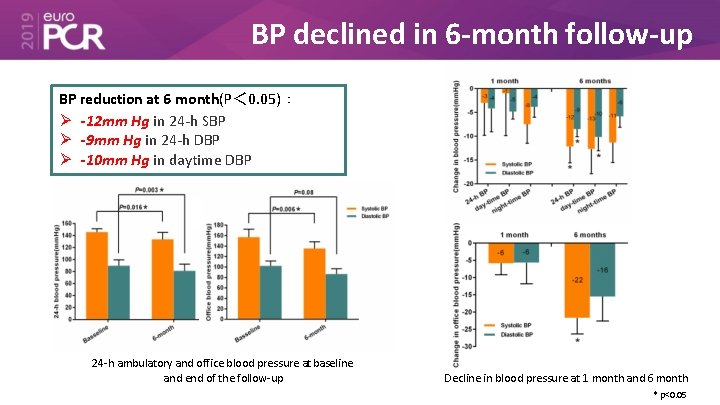
BP declined in 6 -month follow-up BP reduction at 6 month(P< 0. 05): -12 mm Hg in 24 -h SBP -9 mm Hg in 24 -h DBP -10 mm Hg in daytime DBP 24 -h ambulatory and office blood pressure at baseline and end of the follow-up Decline in blood pressure at 1 month and 6 month * p<0. 05
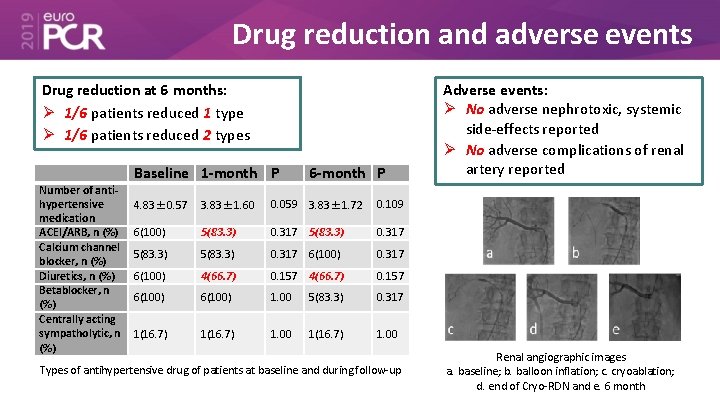
Drug reduction and adverse events Drug reduction at 6 months: 1/6 patients reduced 1 type 1/6 patients reduced 2 types Baseline 1 -month P Number of antihypertensive medication ACEI/ARB, n (%) Calcium channel blocker, n (%) Diuretics, n (%) Betablocker, n (%) Centrally acting sympatholytic, n (%) 6 -month P 4. 83± 0. 57 3. 83± 1. 60 0. 059 3. 83± 1. 72 0. 109 6(100) 5(83. 3) 0. 317 6(100) 4(66. 7) 0. 157 6(100) 1. 00 5(83. 3) 0. 317 1(16. 7) 1. 00 Types of antihypertensive drug of patients at baseline and during follow-up Adverse events: No adverse nephrotoxic, systemic side-effects reported No adverse complications of renal artery reported Renal angiographic images a. baseline; b. balloon inflation; c. cryoablation; d. end of Cryo-RDN and e. 6 month
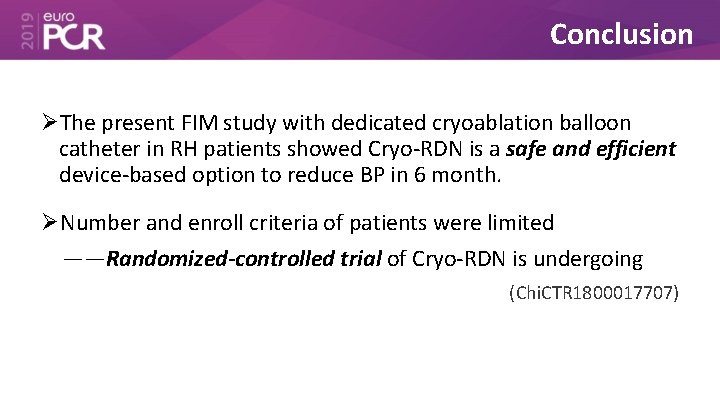
Conclusion The present FIM study with dedicated cryoablation balloon catheter in RH patients showed Cryo-RDN is a safe and efficient device-based option to reduce BP in 6 month. Number and enroll criteria of patients were limited ——Randomized-controlled trial of Cryo-RDN is undergoing (Chi. CTR 1800017707)
Thank you for your attention!
- Slides: 10