
Validation Challenge Problem Structural Dynamics John RedHorse Thomas
Validation Challenge Problem: Structural Dynamics John Red-Horse Thomas L. Paez Uncertainty Quantification and Validation Department Sandia National Laboratories Sandia is a multiprogram laboratory operated by Sandia Corporation, a Lockheed Martin Company, for the United States Department of Energy under contract DE-AC 04 -94 AL 85000.
Our Take on Workshop Motivation and Goal • Validation may be thought of as a process for assessing confidence in a computational prediction • Association with physical scenarios too early in the learning process inhibits deep understanding of what is driving discrepancy • Goal: Validation remains poorly understood; we seek to begin the process of discovery using analytical virtual experiments as validation objects
Workshop Objectives • Assessment of state-of-the-art in validation science from a variety of technical fields and contributors • Synergize various communities involved in validationrelated endeavors
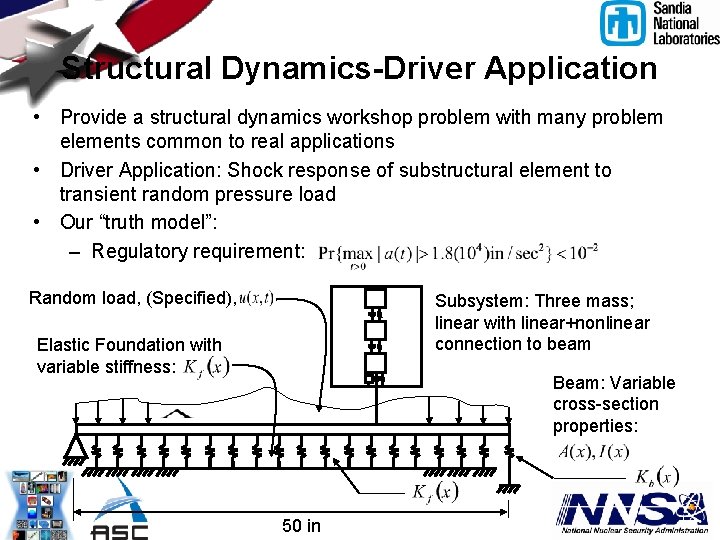
Structural Dynamics-Driver Application • Provide a structural dynamics workshop problem with many problem elements common to real applications • Driver Application: Shock response of substructural element to transient random pressure load • Our “truth model”: – Regulatory requirement: Random load, (Specified), Subsystem: Three mass; linear with linear+nonlinear connection to beam Elastic Foundation with variable stiffness: Beam: Variable cross-section properties: 50 in
Problem Elements • Decision Context • Requirements – Type: • Qualify System • Resource Allocation • Available Data – Ensemble of Data • Subsystem/Component level • Not fully relevant to application – Accreditation Test-Representative of application
Additional Elements To Consider • Criteria selection (Quantities of Interest) • Metric(s) • Presence of uncertainty: Characterize, Model, Analyze – Variability (irreducible, inherent) • Some parameters as random variables (RVs) – Ignorance (reducible) • Virtual systems: Nonlinear mechanics; Known probability distributions • Models for the virtual systems: Linear-only mechanics; Information on RVs only gained via samples
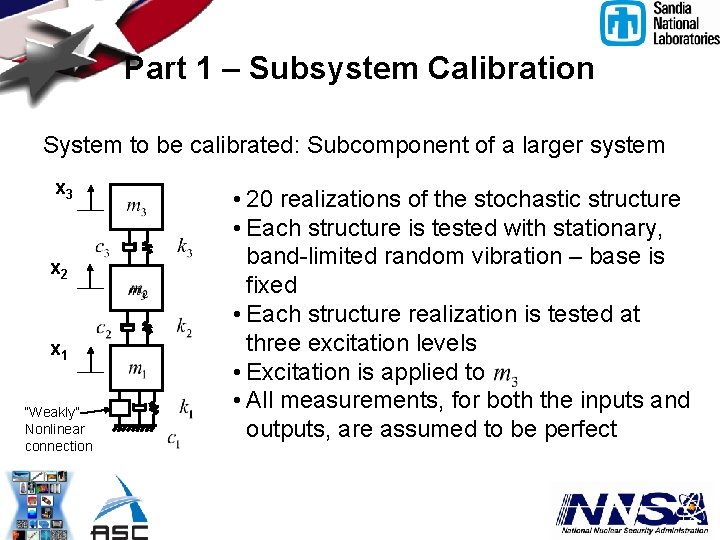
Part 1 – Subsystem Calibration System to be calibrated: Subcomponent of a larger system x 3 x 2 x 1 “Weakly” Nonlinear connection • 20 realizations of the stochastic structure • Each structure is tested with stationary, band-limited random vibration – base is fixed • Each structure realization is tested at three excitation levels • Excitation is applied to • All measurements, for both the inputs and outputs, are assumed to be perfect
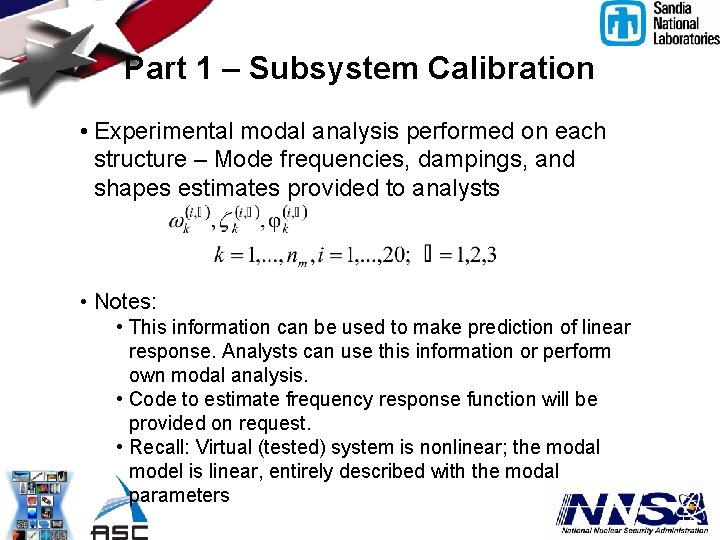
Part 1 – Subsystem Calibration • Experimental modal analysis performed on each structure – Mode frequencies, dampings, and shapes estimates provided to analysts • Notes: • This information can be used to make prediction of linear response. Analysts can use this information or perform own modal analysis. • Code to estimate frequency response function will be provided on request. • Recall: Virtual (tested) system is nonlinear; the modal model is linear, entirely described with the modal parameters
Part 1 – Subsystem Calibration • Deterministic or stochastic modal model to be developed. Model parameters must be “traditional, ” i. e. , not level or frequency dependent. • Response accelerations measured (computed) and provided to analysts • Excitation forces measured and provided to analysts
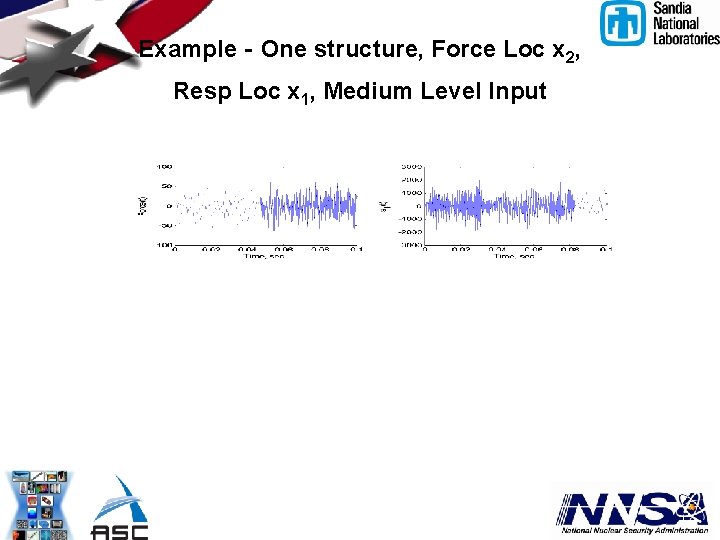
Example - One structure, Force Loc x 2, Resp Loc x 1, Medium Level Input
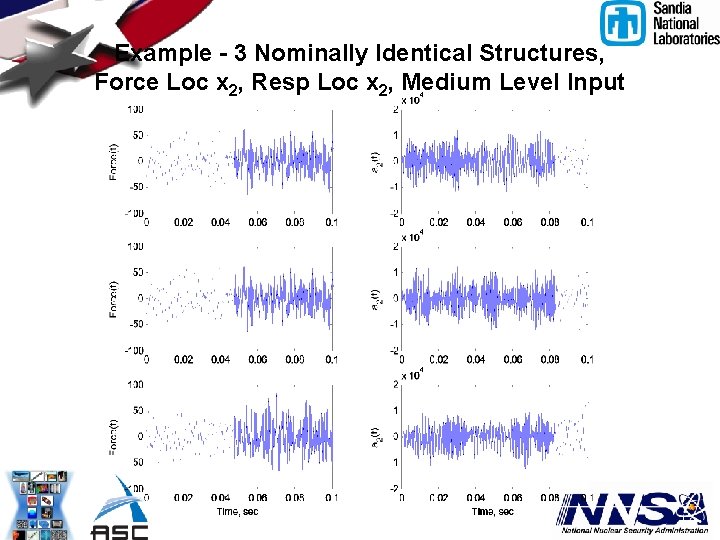
Example - 3 Nominally Identical Structures, Force Loc x 2, Resp Loc x 2, Medium Level Input
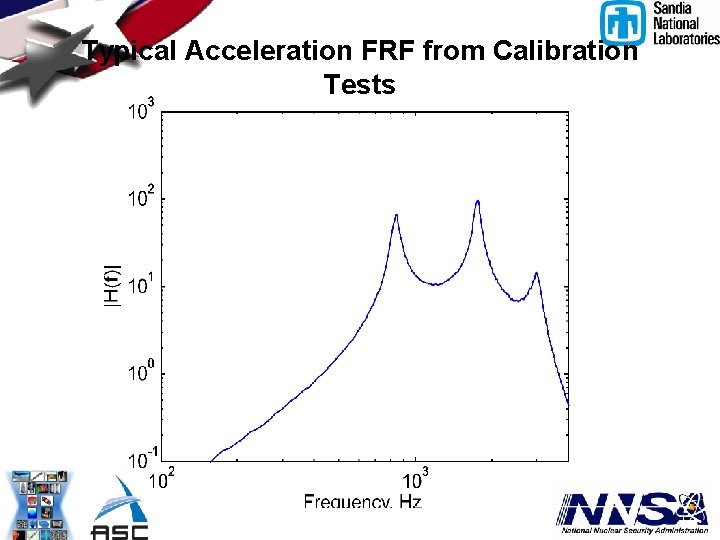
Typical Acceleration FRF from Calibration Tests
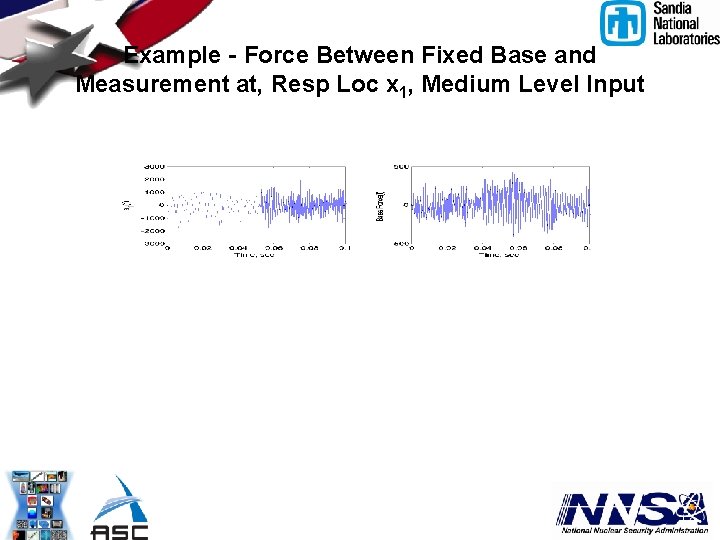
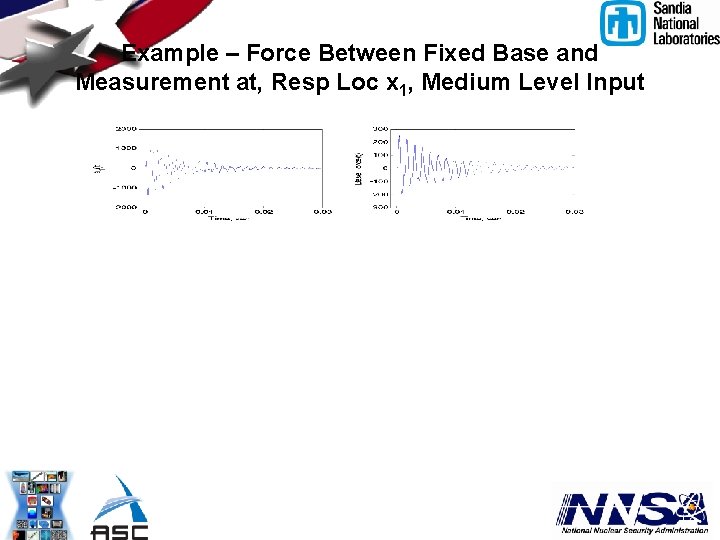
Example - Force Between Fixed Base and Measurement at, Resp Loc x 1, Medium Level Input
Part 1 – Subsystem Calibration • Force between fixed base and external mass measured and provided to analysts

Part 1 – Subsystem Validation System to be Validated: Subcomponent of the larger system x 3 x 2 x 1 “Weakly” Nonlinear connection • 20 realizations of the stochastic structure • Each structure is tested with classical shock excitation – base is fixed • Each input signal contains three shock pulses • Each structure realization is tested at three “levels” • Each input at each level is a haversine with random amplitude and duration • Source probability distributions of amplitude and duration are preestablished
Part 1 – Subsystem Validation • Each structure realization is tested three times at each level • Three response accelerations measured (computed) and provided to analysts • Excitation forces measured and provided to analysts
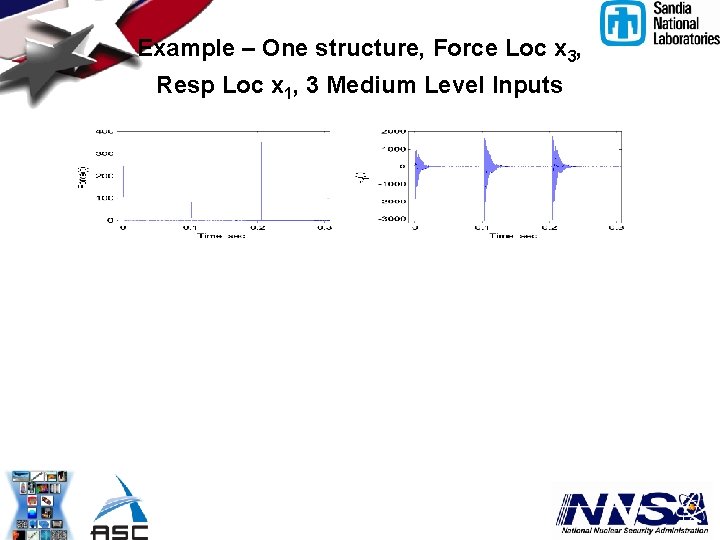
Example – One structure, Force Loc x 3, Resp Loc x 1, 3 Medium Level Inputs
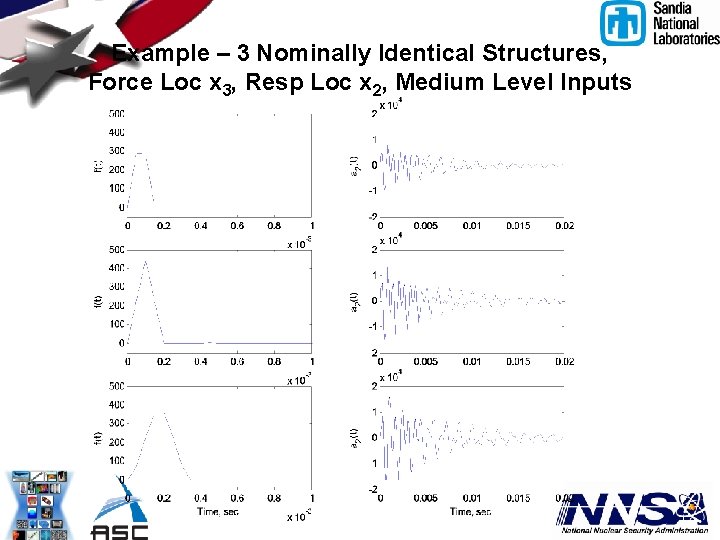
Example – 3 Nominally Identical Structures, Force Loc x 3, Resp Loc x 2, Medium Level Inputs
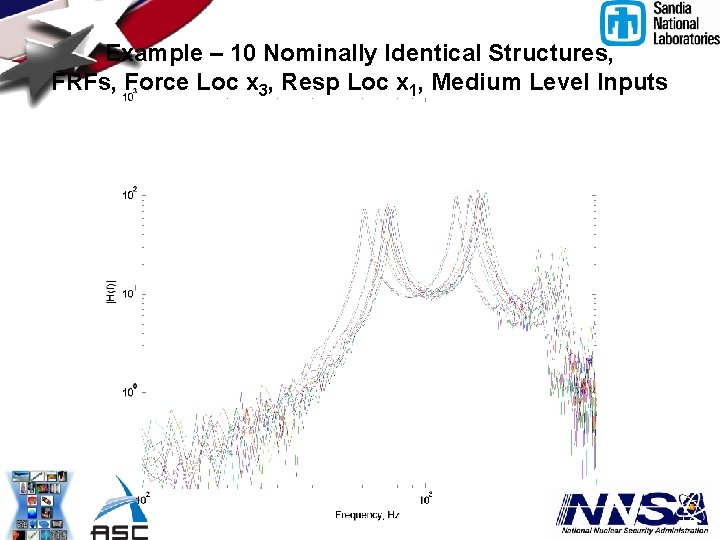
Example – 10 Nominally Identical Structures, FRFs, Force Loc x 3, Resp Loc x 1, Medium Level Inputs
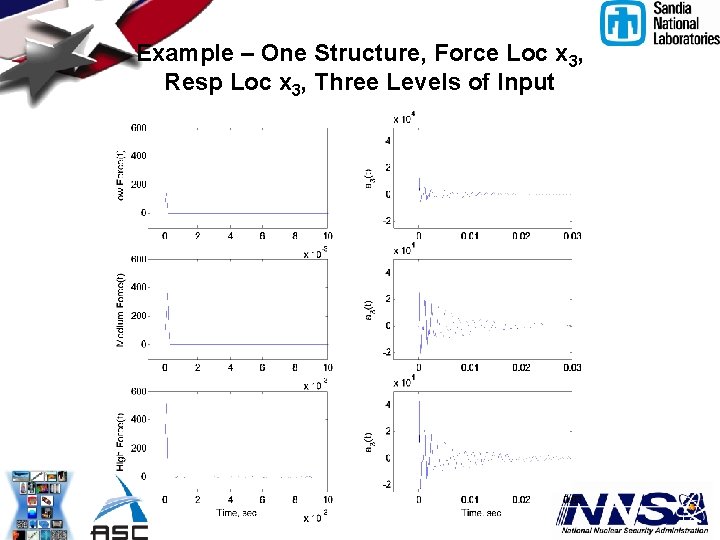
Example – One Structure, Force Loc x 3, Resp Loc x 3, Three Levels of Input
Part 1 – Subsystem validation • Accuracy assessment/calibration – Judge the accuracy of the calibrated modal model for prediction of response of the system subjected to shock input. • Criteria (quantity of interest) • Metrics • Effects of uncertainty • Other…
Part 1 – Subsystem Validation • Force between fixed base and external mass measured and provided to analysts
Example – Force Between Fixed Base and Measurement at, Resp Loc x 1, Medium Level Input
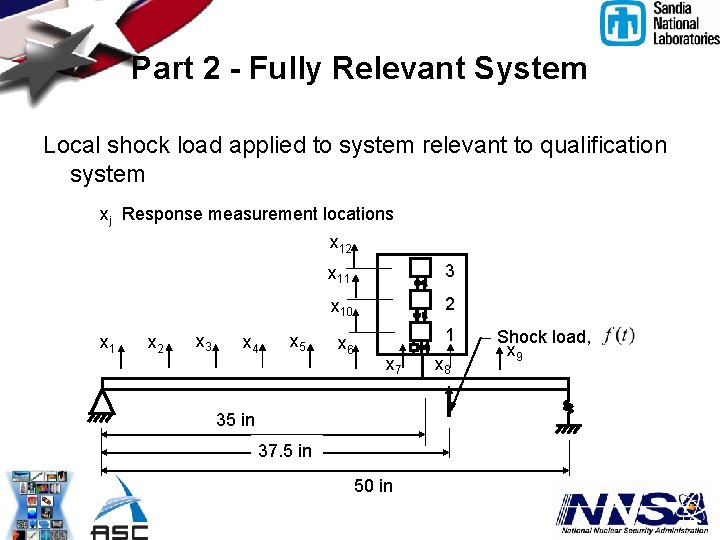
Part 2 - Fully Relevant System Local shock load applied to system relevant to qualification system xj Response measurement locations x 12 x 1 x 2 x 3 x 4 x 5 x 11 3 x 10 2 x 6 1 x 7 35 in 37. 5 in 50 in x 8 Shock load, x 9
Part 2 - Fully Relevant System • • Shock excitation similar to that in validation shock tests Measure (compute) responses at many DOF Provide to analysts Given system motion at x 12 compute response using modal model • Assess accuracy/validate modal model – Criteria ….
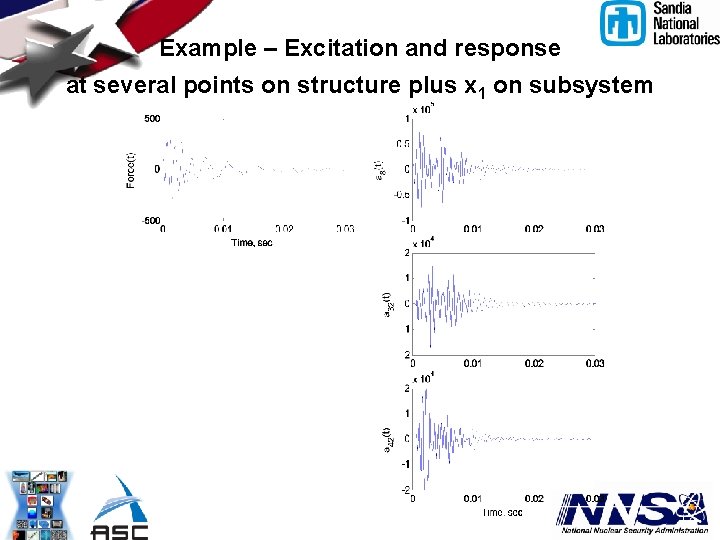
Example – Excitation and response at several points on structure plus x 1 on subsystem
Additional thoughts: • There is no correct or incorrect answer; objective is to examine validation approaches given simplified, although realistic constraints – Variability – Ignorance • Effects of available test data can be examined • Effects of number of function evaluations in analysis method/approach also of interest
- Slides: 27