
Validating Your Information Security Program ISP 3 of
- Slides: 12
Validating Your Information Security Program (ISP 3 of 3) Plan - Do - Check - Act
YOU’VE PLANNED RISK REDUCTION… YOU’VE IMPLEMENTED CONTROLS…
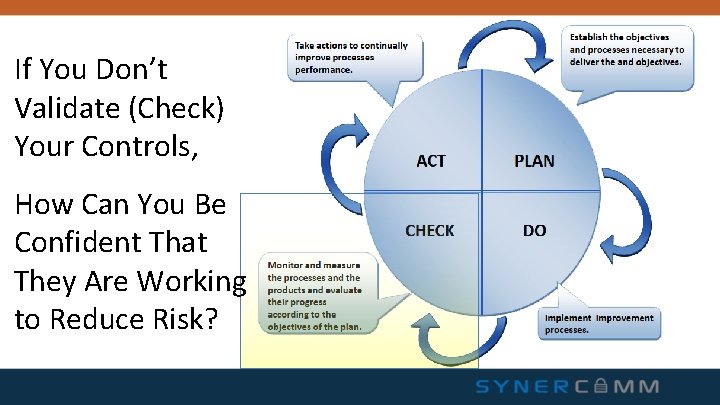
If You Don’t Validate (Check) Your Controls, How Can You Be Confident That They Are Working to Reduce Risk?
SO WE NEED TO VALIDATE BUT HOW?
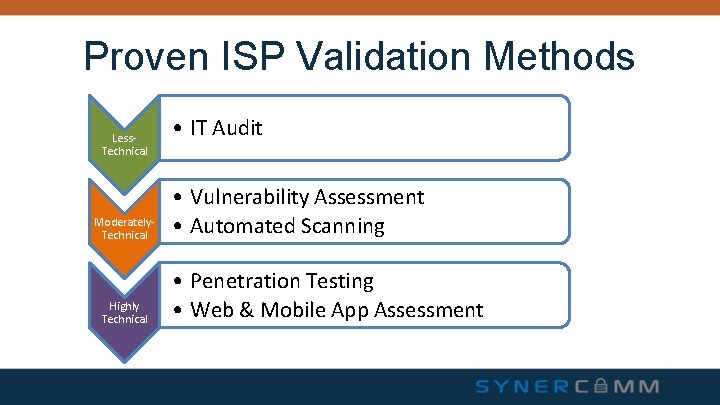
Proven ISP Validation Methods Less. Technical Moderately. Technical Highly Technical • IT Audit • Vulnerability Assessment • Automated Scanning • Penetration Testing • Web & Mobile App Assessment
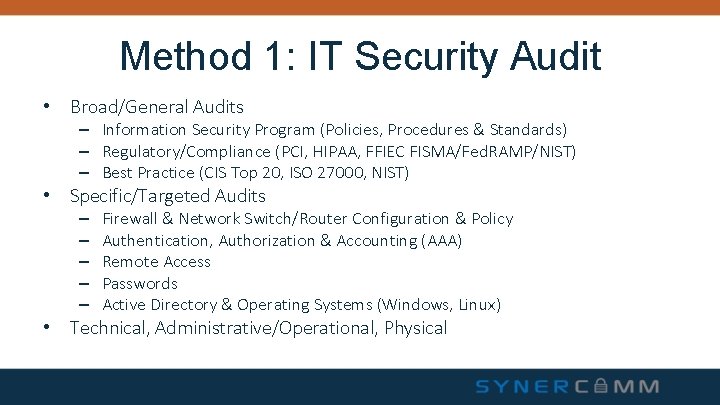
Method 1: IT Security Audit • Broad/General Audits – Information Security Program (Policies, Procedures & Standards) – Regulatory/Compliance (PCI, HIPAA, FFIEC FISMA/Fed. RAMP/NIST) – Best Practice (CIS Top 20, ISO 27000, NIST) • Specific/Targeted Audits – – – Firewall & Network Switch/Router Configuration & Policy Authentication, Authorization & Accounting (AAA) Remote Access Passwords Active Directory & Operating Systems (Windows, Linux) • Technical, Administrative/Operational, Physical
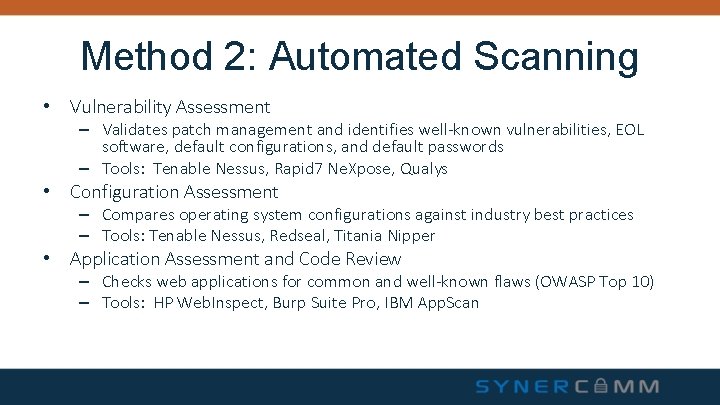
Method 2: Automated Scanning • Vulnerability Assessment – Validates patch management and identifies well-known vulnerabilities, EOL software, default configurations, and default passwords – Tools: Tenable Nessus, Rapid 7 Ne. Xpose, Qualys • Configuration Assessment – Compares operating system configurations against industry best practices – Tools: Tenable Nessus, Redseal, Titania Nipper • Application Assessment and Code Review – Checks web applications for common and well-known flaws (OWASP Top 10) – Tools: HP Web. Inspect, Burp Suite Pro, IBM App. Scan
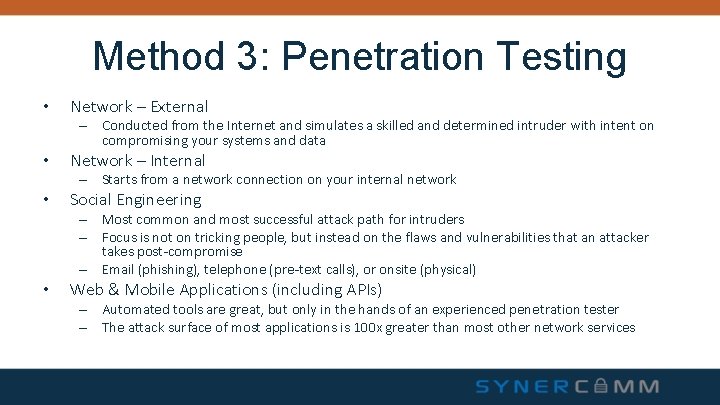
Method 3: Penetration Testing • Network – External – Conducted from the Internet and simulates a skilled and determined intruder with intent on compromising your systems and data • Network – Internal – Starts from a network connection on your internal network • Social Engineering – Most common and most successful attack path for intruders – Focus is not on tricking people, but instead on the flaws and vulnerabilities that an attacker takes post-compromise – Email (phishing), telephone (pre-text calls), or onsite (physical) • Web & Mobile Applications (including APIs) – Automated tools are great, but only in the hands of an experienced penetration tester – The attack surface of most applications is 100 x greater than most other network services
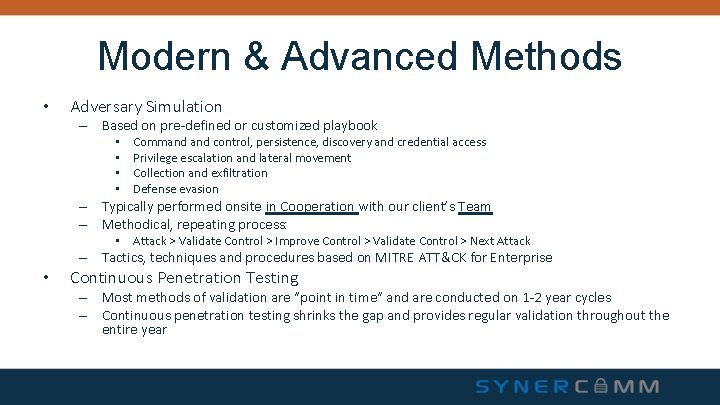
Modern & Advanced Methods • Adversary Simulation – Based on pre-defined or customized playbook • • Command control, persistence, discovery and credential access Privilege escalation and lateral movement Collection and exfiltration Defense evasion – Typically performed onsite in Cooperation with our client’s Team – Methodical, repeating process: • Attack > Validate Control > Improve Control > Validate Control > Next Attack – Tactics, techniques and procedures based on MITRE ATT&CK for Enterprise • Continuous Penetration Testing – Most methods of validation are “point in time” and are conducted on 1 -2 year cycles – Continuous penetration testing shrinks the gap and provides regular validation throughout the entire year
WHY INDEPENDENCE MATTERS
Experience Matters • It’s more than a 2 nd set of eyes, but it is that too! • Syner. Comm’s consultants work with dozens of clients annually and come from diverse backgrounds • Proven and repeatable processes • One person can’t know it all, but a team of experts helps
QUESTIONS? Thank You for Attending!