
Valid Statistical Analysis for Logistic Regression with Multiple



- Slides: 14
Valid Statistical Analysis for Logistic Regression with Multiple Sources Rob Hall (Dept of Machine Learning, CMU) Joint work with Yuval Nardi and Steve Fienberg http: //www. cs. cmu. edu/~rjhall+@cs. cmu. edu
Setting Patient ID Tobacco Age Weight Heart Disease 0001 ? ? 170 ? 0002 ? ? 150 N 0003 N 45 165 N Patient ID Tobacco Age Weight Heart Disease 0001 Y 35 ? Y 0002 Y 40 ? ? 0004 N 50 165 N Logistic regression (or any glm) 2
Alternatives • Multiple organizations with databases want to do a statistical calculation (e. g. , regression). • Each would benefit by mining the pooled data. • Not allowed/willing to share data (e. g. , HIPAA). • Share transformed data? • Secure multiparty computation? 3
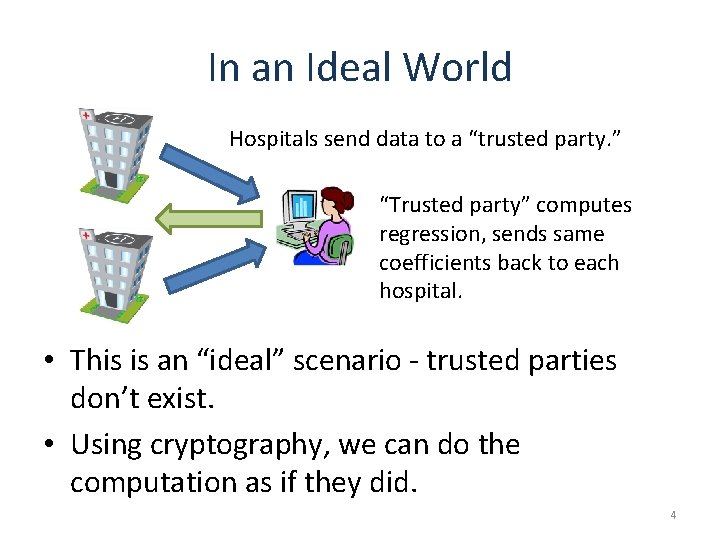
In an Ideal World Hospitals send data to a “trusted party. ” “Trusted party” computes regression, sends same coefficients back to each hospital. • This is an “ideal” scenario - trusted parties don’t exist. • Using cryptography, we can do the computation as if they did. 4
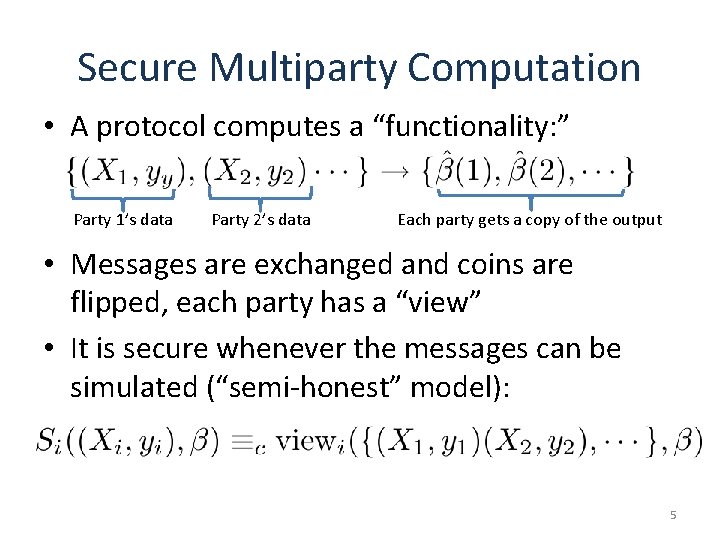
Secure Multiparty Computation • A protocol computes a “functionality: ” Party 1’s data Party 2’s data Each party gets a copy of the output • Messages are exchanged and coins are flipped, each party has a “view” • It is secure whenever the messages can be simulated (“semi-honest” model): 5
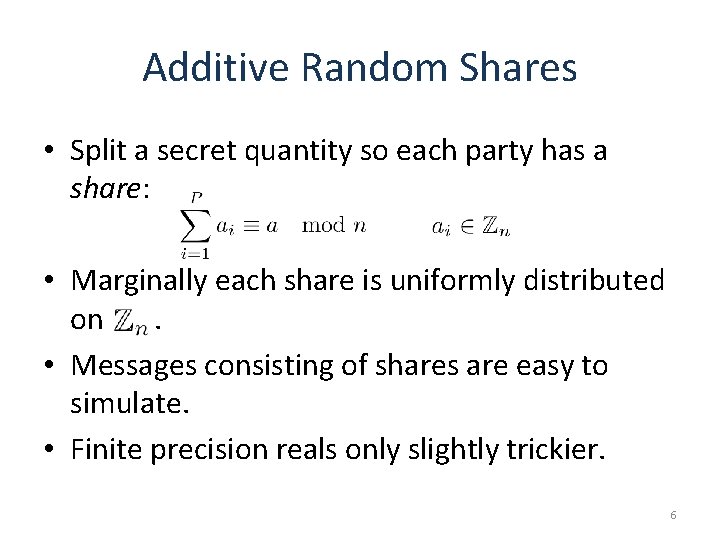
Additive Random Shares • Split a secret quantity so each party has a share: • Marginally each share is uniformly distributed on. • Messages consisting of shares are easy to simulate. • Finite precision reals only slightly trickier. 6
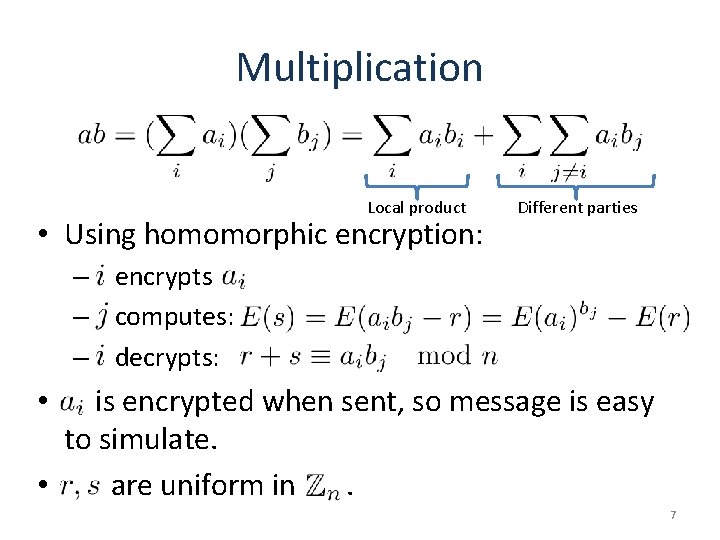
Multiplication Local product • Using homomorphic encryption: Different parties – encrypts – computes: – decrypts: is encrypted when sent, so message is easy to simulate. • are uniform in. • 7
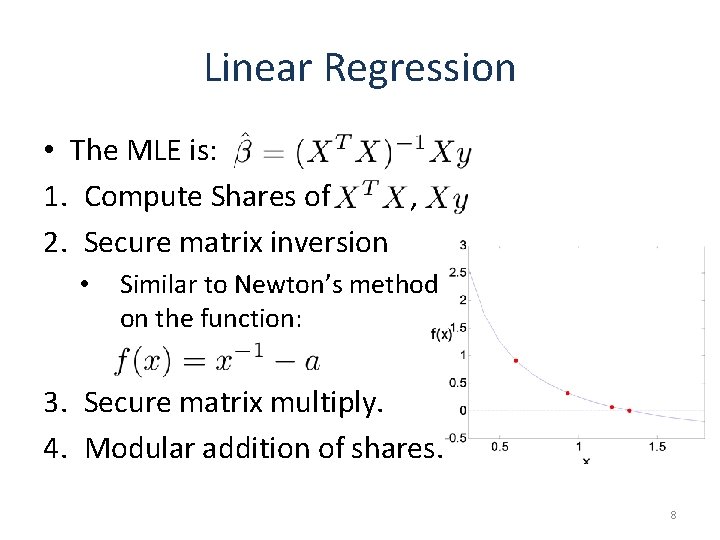
Linear Regression • The MLE is: 1. Compute Shares of , 2. Secure matrix inversion • Similar to Newton’s method on the function: 3. Secure matrix multiply. 4. Modular addition of shares. 8
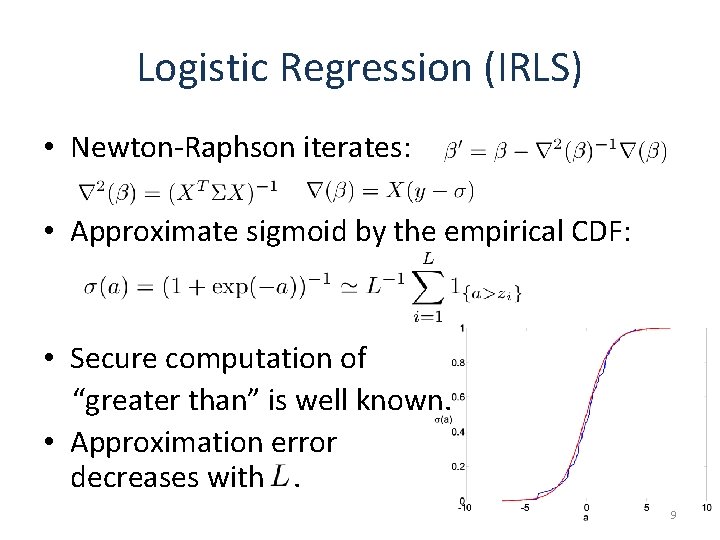
Logistic Regression (IRLS) • Newton-Raphson iterates: • Approximate sigmoid by the empirical CDF: • Secure computation of “greater than” is well known. • Approximation error decreases with. 9
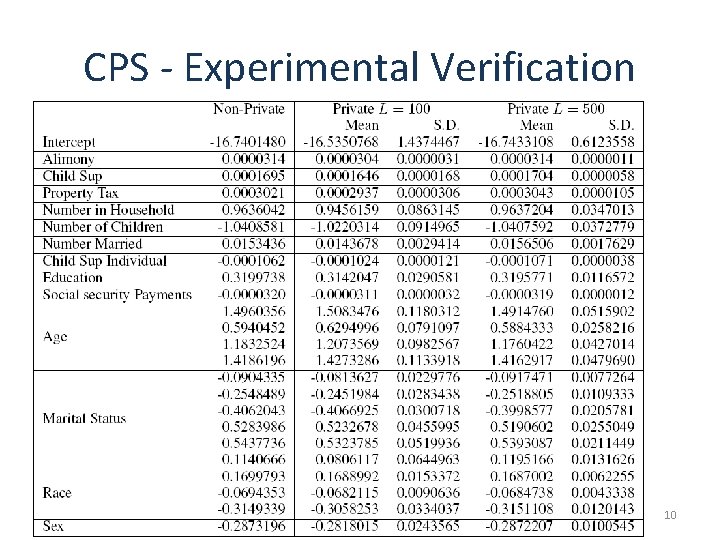
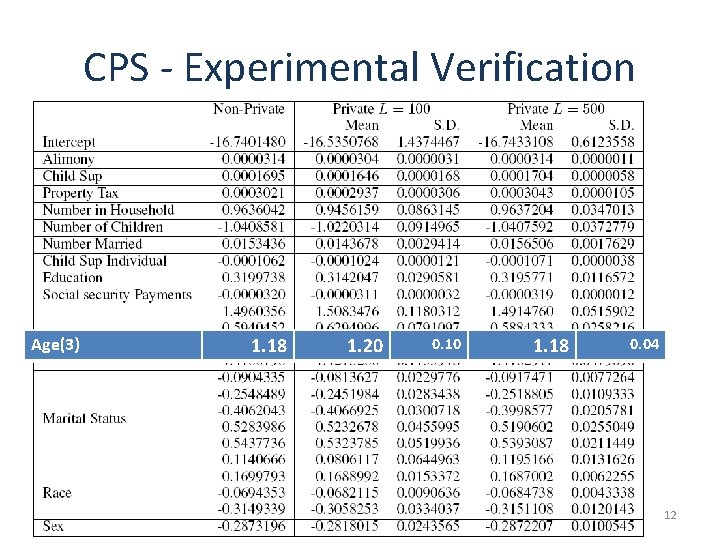
CPS - Experimental Verification 10
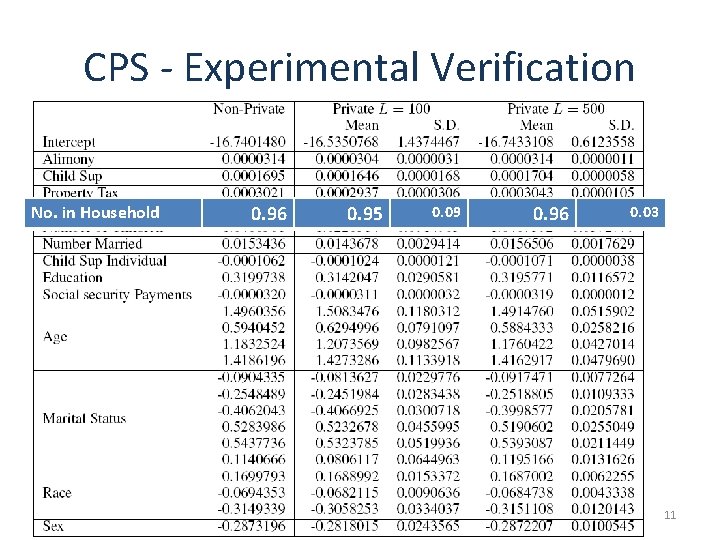
CPS - Experimental Verification No. in Household 0. 96 0. 95 0. 09 0. 96 0. 03 11
CPS - Experimental Verification Age(3) 1. 18 1. 20 0. 10 1. 18 0. 04 12
Ongoing Work Faster approximations to logistic functions. Record linkage (assumed here). Imputation of missing data. Secure computation of goodness-of-fit statistics. • Log-linear models. • Other GLMs. • • 13
Questions • For the technical details and a working implementation please see: http: //www. cs. cmu. edu/~rjhall/slr 14