
Valentina Posso April 10 th 2016 Period 8

- Slides: 10
Valentina Posso April 10 th, 2016 Period 8 Basketball
History/Origin of The American game, basketball, Basketball is now played by more than 250 million people worldwide in an organized fashion, as well as by countless others. Basketball originated in 1891 when a future Presbyterian minister named James Naismith was assigned to teach a physical education class at a Young Men's Christian Association training school in Springfield, Massachusetts. Naismith was told to invent a new game to keep the young men occupied, preferably, a game that could be played indoors was desirable. Naismith used peach baskets instead of boxes, which he originally planned to use. Naismith drew up the rules for the new game in "about an hour. " Most of them still apply in some form today. Basketball caught on because there was a need for a simple game that could be played indoors during winter. The first professional basketball league was formed in 1898. Many teams in the National Basketball Association now have foreign players, who return home to represent their native countries during the Olympic Games. The so-called Dream Team, made up of the top American professional basketball players, has represented the United States in recent Olympic Games. In 1996 the Dream Team trailed some opponents
REGULLATIONS van elevated hoop (10 feet above the ground) v. Formal basketball games are generally played indoors on a hardwood court measuring 94 feet x 50 feet (court dimensions can vary depending on the league and/or level). v. Most leagues/levels divide games into four equal periods called quarters (the length of each period differs according to the level). v. A team scores by throwing or dropping the ball through the opponent’s hoop from above. v. Foul Shot/Free Throw: The referee will grant a foul shot to a player who is fouled while in the act of shooting. A successful free throw is worth one point. v 2 Point: Any shot taken within the area between the end line and the three point arc is worth two points if it goes in. v 3 Pointer: Any successful shot taken behind the three-point line is worth three points. v. If the score is tied at the end of regulation time, an extra period is played to determine the winner, it is called “overtime. ” vbasketball is a non-contact sport. This does not mean that any physical contact between opponents is illegal. v. Traveling: It is illegal to take more than one step while holding the ball doing. Players are allowed to establish a pivot foot, but once a pivot foot is determined it cannot be lifted off the ground before the player shoots, passes, or dribbles the ball.
Offensive Strategies 1) Fast break: a team attempts to push the ball quickly up the court before defense gets in to its position. Players run at high speed make quick passes, communicate with each other to understand the plan of action and make adjustments if needed, when a player with the ball reaches the free throw line, he quickly decides his next step, whether he wants to continue driving to himself take a shot or he wants to pass the ball to his teammate short, fast break offense requires agility, speed, stamina, ball handling skills, decision making power and better understanding between players. 2) Pick and roll: an offensive player stands in the way of that defensive player, who is responsible for guarding another offensive player(ball handler). The ball handler starts to make a move, while at the same time other offensive player slips behind the defender to accept a pass. In this situation, defender gets confused and remains undecided in making a choice on whom to cover. If he chooses the ball handler, then other offensive player will gets a chance to move toward the basket and if he tries to guard the other offensive player, instead of ball handler then the player with the ball gets an open shot. 3) Give and go: one offensive player passes a ball to his teammate, hoping to unguard himself and runs to an open area generally near the basket to receive the ball back from his teammate. This strategy works well when defender concentrates more on ball instead of the offensive player who runs after passing the ball. 4) Triangle offense: offensive players are placed on one side of the court with an offensive player on low post, a player on corner and one on wing, making a sideline triangle and remaining two players form a two man game on weak side. This strategy creates a good spacing about 15 to 18 ft. between players and makes passing easy for players. The main objective is to pass a ball to a strong side low post player to create an easy scoring opportunity. This tactic is vey useful against man to man defense. 5) Isolation Offense: brings out the talent of the best offensive player on a team. It gives that big player a chance to play his own game, he gets a ball, creates his own shots and passes and takes on defender one on one. In isolation all offensive players accept the assigned one moves to the weak side of the court, bringing their defenders with them and maintaining a minimum distance of 10 to 15 ft from the best offensive player on a team. When the strong side is cleared out, the offensive player starts dribbling and creates scoring opportunities for his side. 6) Princeton Offense: aimed to slow down the pace of a game, mostly applied by less athletic teams to deal with the teams which have super athleticism. The features of this tactic are control on ball, constant motion, dribbling, high number of passing, 3 point shooting, back door cuts and disciplined teamwork. The most conventional scheme in Princeton is 4 -out with 1 -in, in this scheme four players set up outside the 3 point arc and one player inside at the top of the key. As this scheme aims to slow down the tempo of the game, if often results in low scoring affairs.
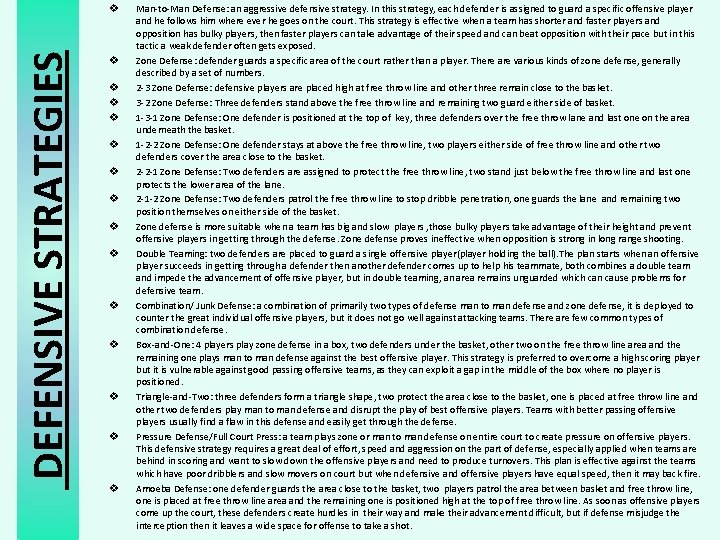
DEFENSIVE STRATEGIES v v v v Man-to-Man Defense: an aggressive defensive strategy. In this strategy, each defender is assigned to guard a specific offensive player and he follows him where ever he goes on the court. This strategy is effective when a team has shorter and faster players and opposition has bulky players, then faster players can take advantage of their speed and can beat opposition with their pace but in this tactic a weak defender often gets exposed. Zone Defense: defender guards a specific area of the court rather than a player. There are various kinds of zone defense, generally described by a set of numbers. 2 -3 Zone Defense: defensive players are placed high at free throw line and other three remain close to the basket. 3 -2 Zone Defense: Three defenders stand above the free throw line and remaining two guard either side of basket. 1 -3 -1 Zone Defense: One defender is positioned at the top of key, three defenders over the free throw lane and last one on the area underneath the basket. 1 -2 -2 Zone Defense: One defender stays at above the free throw line, two players either side of free throw line and other two defenders cover the area close to the basket. 2 -2 -1 Zone Defense: Two defenders are assigned to protect the free throw line, two stand just below the free throw line and last one protects the lower area of the lane. 2 -1 -2 Zone Defense: Two defenders patrol the free throw line to stop dribble penetration, one guards the lane and remaining two position themselves on either side of the basket. Zone defense is more suitable when a team has big and slow players , those bulky players take advantage of their height and prevent offensive players in getting through the defense. Zone defense proves ineffective when opposition is strong in long range shooting. Double Teaming: two defenders are placed to guard a single offensive player(player holding the ball). The plan starts when an offensive player succeeds in getting through a defender then another defender comes up to help his teammate, both combines a double team and impede the advancement of offensive player, but in double teaming, an area remains unguarded which can cause problems for defensive team. Combination/ Junk Defense: a combination of primarily two types of defense man to man defense and zone defense, it is deployed to counter the great individual offensive players, but it does not go well against attacking teams. There are few common types of combination defense. Box-and-One: 4 players play zone defense in a box, two defenders under the basket, other two on the free throw line area and the remaining one plays man to man defense against the best offensive player. This strategy is preferred to overcome a high scoring player but it is vulnerable against good passing offensive teams, as they can exploit a gap in the middle of the box where no player is positioned. Triangle-and-Two: three defenders form a triangle shape, two protect the area close to the basket, one is placed at free throw line and other two defenders play man to man defense and disrupt the play of best offensive players. Teams with better passing offensive players usually find a flaw in this defense and easily get through the defense. Pressure Defense/Full Court Press: a team plays zone or man to man defense on entire court to create pressure on offensive players. This defensive strategy requires a great deal of effort, speed and aggression on the part of defense, especially applied when teams are behind in scoring and want to slow down the offensive players and need to produce turnovers. This plan is effective against the teams which have poor dribblers and slow movers on court but when defensive and offensive players have equal speed, then it may back fire. Amoeba Defense: one defender guards the area close to the basket, two players patrol the area between basket and free throw line, one is placed at free throw line area and the remaining one is positioned high at the top of free throw line. As soon as offensive players come up the court, these defenders create hurdles in their way and make their advancement difficult, but if defense misjudge the interception then it leaves a wide space for offense to take a shot.
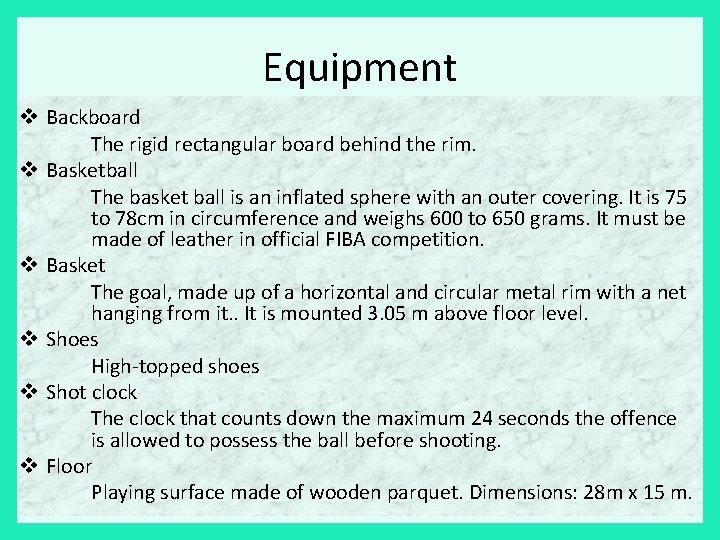
Equipment v Backboard The rigid rectangular board behind the rim. v Basketball The basket ball is an inflated sphere with an outer covering. It is 75 to 78 cm in circumference and weighs 600 to 650 grams. It must be made of leather in official FIBA competition. v Basket The goal, made up of a horizontal and circular metal rim with a net hanging from it. . It is mounted 3. 05 m above floor level. v Shoes High-topped shoes v Shot clock The clock that counts down the maximum 24 seconds the offence is allowed to possess the ball before shooting. v Floor Playing surface made of wooden parquet. Dimensions: 28 m x 15 m.
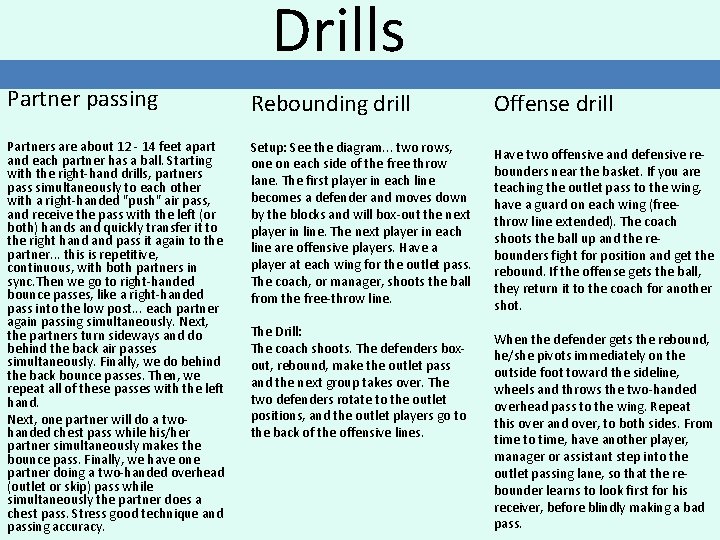
Drills Partner passing Rebounding drill Partners are about 12 - 14 feet apart and each partner has a ball. Starting with the right-hand drills, partners pass simultaneously to each other with a right-handed "push" air pass, and receive the pass with the left (or both) hands and quickly transfer it to the right hand pass it again to the partner. . . this is repetitive, continuous, with both partners in sync. Then we go to right-handed bounce passes, like a right-handed pass into the low post. . . each partner again passing simultaneously. Next, the partners turn sideways and do behind the back air passes simultaneously. Finally, we do behind the back bounce passes. Then, we repeat all of these passes with the left hand. Next, one partner will do a twohanded chest pass while his/her partner simultaneously makes the bounce pass. Finally, we have one partner doing a two-handed overhead (outlet or skip) pass while simultaneously the partner does a chest pass. Stress good technique and passing accuracy. Setup: See the diagram. . . two rows, one on each side of the free throw lane. The first player in each line becomes a defender and moves down by the blocks and will box-out the next player in line. The next player in each line are offensive players. Have a player at each wing for the outlet pass. The coach, or manager, shoots the ball from the free-throw line. The Drill: The coach shoots. The defenders boxout, rebound, make the outlet pass and the next group takes over. The two defenders rotate to the outlet positions, and the outlet players go to the back of the offensive lines. Offense drill Have two offensive and defensive rebounders near the basket. If you are teaching the outlet pass to the wing, have a guard on each wing (freethrow line extended). The coach shoots the ball up and the rebounders fight for position and get the rebound. If the offense gets the ball, they return it to the coach for another shot. When the defender gets the rebound, he/she pivots immediately on the outside foot toward the sideline, wheels and throws the two-handed overhead pass to the wing. Repeat this over and over, to both sides. From time to time, have another player, manager or assistant step into the outlet passing lane, so that the rebounder learns to look first for his receiver, before blindly making a bad pass.
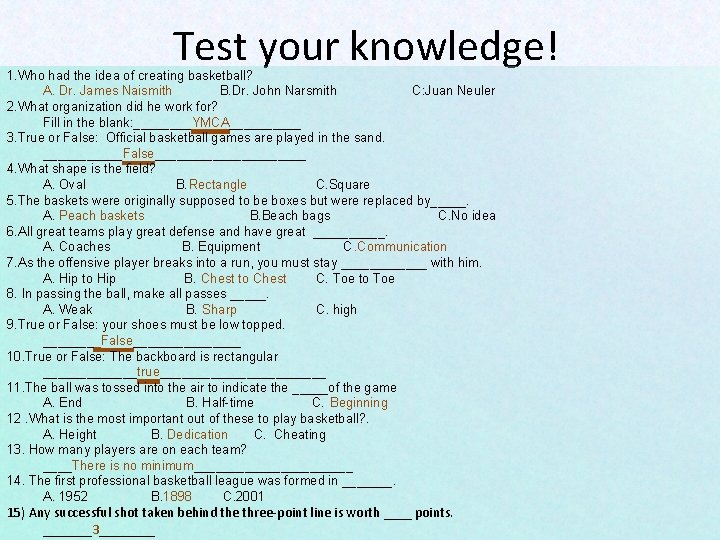
Test your knowledge! 1. Who had the idea of creating basketball? A. Dr. James Naismith B. Dr. John Narsmith C: Juan Neuler 2. What organization did he work for? Fill in the blank: ____YMCA_____ 3. True or False: Official basketball games are played in the sand. ______False___________ 4. What shape is the field? A. Oval B. Rectangle C. Square 5. The baskets were originally supposed to be boxes but were replaced by_____. A. Peach baskets B. Beach bags C. No idea 6. All great teams play great defense and have great _____. A. Coaches B. Equipment C. Communication 7. As the offensive player breaks into a run, you must stay ______ with him. A. Hip to Hip B. Chest to Chest C. Toe to Toe 8. In passing the ball, make all passes _____. A. Weak B. Sharp C. high 9. True or False: your shoes must be low topped. ____False________ 10. True or False: The backboard is rectangular _______true____________ 11. The ball was tossed into the air to indicate the _____of the game A. End B. Half-time C. Beginning 12. What is the most important out of these to play basketball? . A. Height B. Dedication C. Cheating 13. How many players are on each team? ____There is no minimum___________ 14. The first professional basketball league was formed in _______. A. 1952 B. 1898 C. 2001 15) Any successful shot taken behind the three-point line is worth ____ points. _______3____
eb e H f lp W l u is t s e • http: //www. olympic. org/basketball-equipmentand-history • basketball. isport. com • www. allaboutbasketball. us • www. breakthroughbasketball. com • www. factmonster. com
Yo u. T ub e. V • https: //www. youtube. com/watch? v= id 6 Ic. Pmb 2 yjl. A eo s • https: //www. youtube. com/watch? v=JG 1 rzv b 6 v 4 s • https: //www. youtube. com/watch? v=0 H 8 c 3 h Q 4 r. U 0