
Valence Electrons Bohr Diagrams Review Atomic Structure Atoms
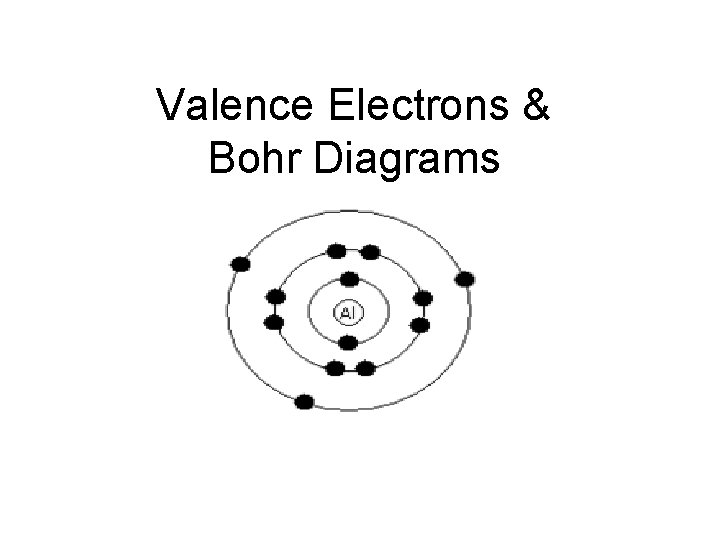
Valence Electrons & Bohr Diagrams
Review: Atomic Structure • Atoms have a nucleus that contains Protons and Neutrons • Electrons are contained in shells that surround the nucleus • An atom is made of mostly empty space • Protons have a positive charge • Electrons have a negative charge • Neutrons are Neutral
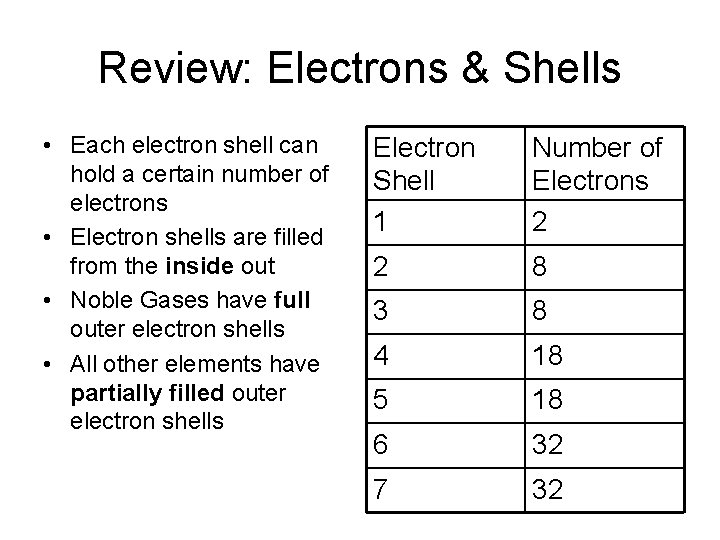
Review: Electrons & Shells • Each electron shell can hold a certain number of electrons • Electron shells are filled from the inside out • Noble Gases have full outer electron shells • All other elements have partially filled outer electron shells Electron Shell 1 Number of Electrons 2 2 8 3 8 4 18 5 18 6 32 7 32
Valence Electrons • The electrons in the outer most electron shell are called valence electrons • The shell containing electrons that is furthest from the nucleus is called the valence shell • The number of electron shells with electrons is the same as the period (row) number

Noble Gas Stability • Noble gases (column all the way to the right) are usually unreactive • This is because they have full valence shells (a stable octet) • An element with a full valence shell is a happy element All elements are trying to get a stable octet!
Noble Gas Stability • Atoms want to gain stability • Atoms will try to gain or lose electrons to have a full valence shell
Bohr Models • Niels Bohr created a visual model of the atom to make them easy to understand – A Bohr Model contains a central nucleus surrounded by electron shells – For each model you state the number of protons and neutrons in the nucleus and draw a dot on the electron shells for each electron • To determine the number of valence electrons an element has, you look at the number of electrons in the outermost shell
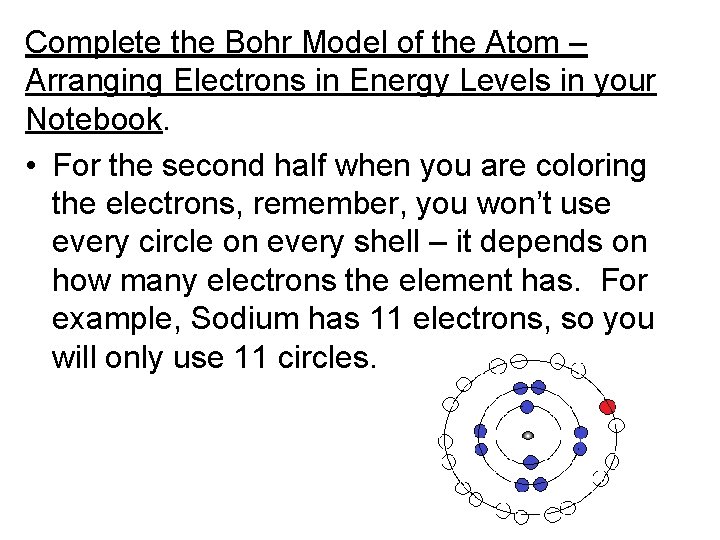
Complete the Bohr Model of the Atom – Arranging Electrons in Energy Levels in your Notebook. • For the second half when you are coloring the electrons, remember, you won’t use every circle on every shell – it depends on how many electrons the element has. For example, Sodium has 11 electrons, so you will only use 11 circles.
- Slides: 8