
Vaginal lesions Prof Greta Dreyer University of Pretoria


- Slides: 21
Vaginal lesions Prof Greta Dreyer University of Pretoria
Outline n Infections n Vaginal Intra-epithelial Lesions n Vaginal cancer Primary n Secondary n
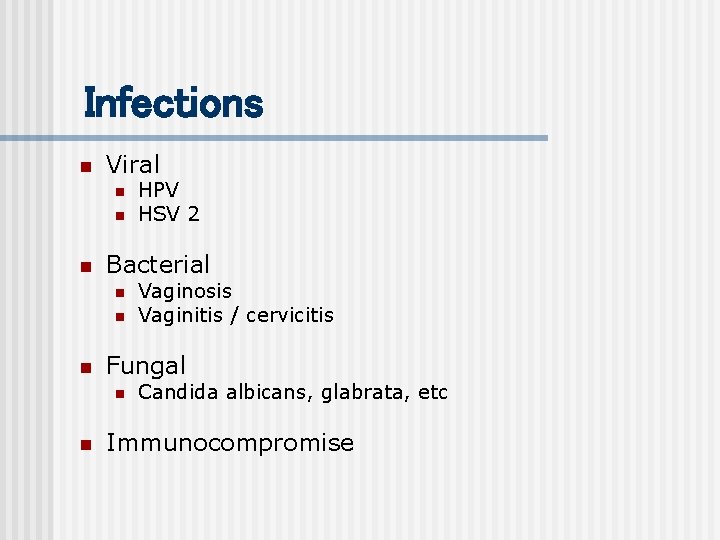
Infections n Viral n n n Bacterial n n n Vaginosis Vaginitis / cervicitis Fungal n n HPV HSV 2 Candida albicans, glabrata, etc Immunocompromise
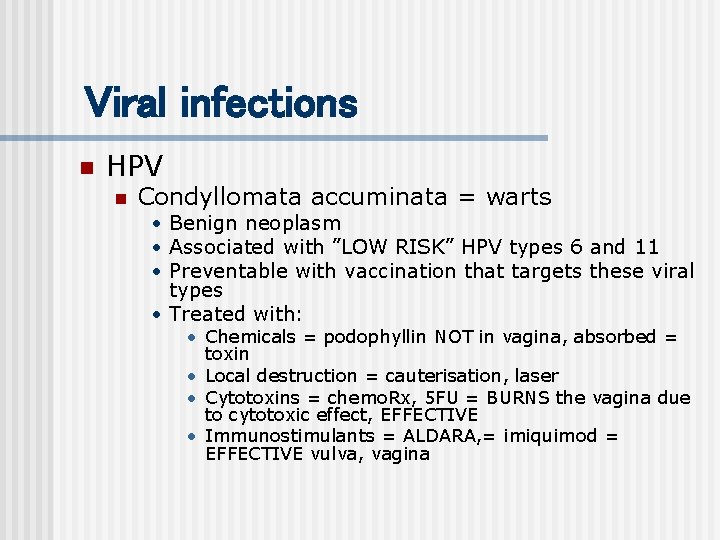
Viral infections n HPV n Condyllomata accuminata = warts • Benign neoplasm • Associated with ”LOW RISK” HPV types 6 and 11 • Preventable with vaccination that targets these viral types • Treated with: • Chemicals = podophyllin NOT in vagina, absorbed = toxin • Local destruction = cauterisation, laser • Cytotoxins = chemo. Rx, 5 FU = BURNS the vagina due to cytotoxic effect, EFFECTIVE • Immunostimulants = ALDARA, = imiquimod = EFFECTIVE vulva, vagina
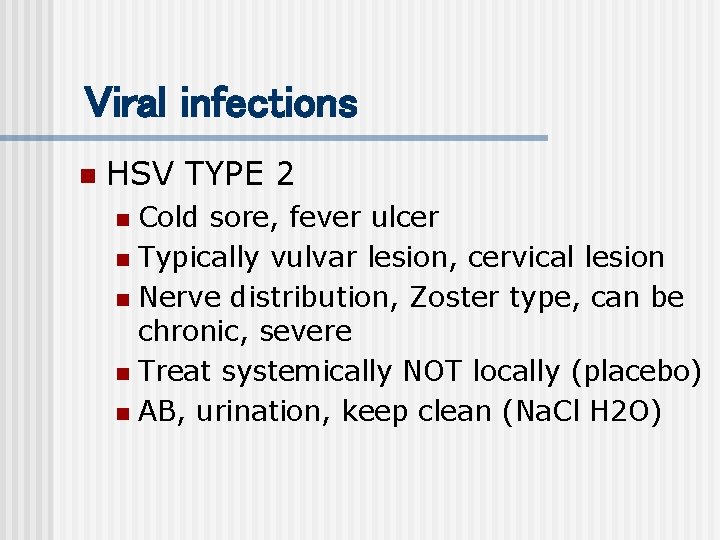
Viral infections n HSV TYPE 2 Cold sore, fever ulcer n Typically vulvar lesion, cervical lesion n Nerve distribution, Zoster type, can be chronic, severe n Treat systemically NOT locally (placebo) n AB, urination, keep clean (Na. Cl H 2 O) n
Bacterial infections n Vaginosis n n n CHANGE in vaginal flora for the worse! Often associated with sexual intercourse p. H alkaline (>4, 5), watery discharge, fishy Gardnerella vaginalis and friends colonise Not major inflammatory reaction Treatment n n n Kill offensives – metronidazole, clindamycin Change environment – lower the p. H Enhance “good” bacteria = Lactobacillus
Bacterial infections n Vaginitis n n n Also change in vaginal flora watery discharge, itch, burning Often Streptococcus culture Can have inflammatory reaction Pre- and post-menopausal condition Treatment: n n Kill offensives – Penicillin Change environment – increase the estrogen, enhance “good” bacteria = Lactobacillus
Bacterial infections n Vaginitis n n n STI’s – NOT a problem if vagina only Chlamydia and Gonococcus = friends Identical clinical picture n n / Cervicitis PAIN, RED, discharge Upper abdomen, peri-hepatitis, peritonitis Difficult to confirm, culture, identify Treated empirically n n Ciprofloxacin stat Doxycyclin for 21 days
Fungal infections n Vaginitis / Vulvitis n NOT an STI n Can be transmitted, aggrevated n Opportunistic infection n Commensal in GIT n After AB, hospitalisation, ICU, UTI
Fungal infections n Also associations with: Low estrogenic states n OC use n Eczema, dermatitis n High glucose states n Chronic trauma n
Fungal infections n Treatment: n Local antifungals • Creams, vaginal tablets, suppositories, SR tabs n Systemic antifungals • Stat, repeat (1 x pw, 1 x pm), courses • Equally effective, preference dictates • Better choice for recurrent, hypersensitivity states • NOT for pregnant, LIPID soluble
Immuno-compromise n HIV, transplant, severe malnourishment n MIXED infections Severe Candida, also C. glabrata SEVERE HPV related disease KS, other HSV, Zoster Lymphoma, carcinoma (Spontaneous) non-malignant fistulation n n
Immuno-compromise n n n n Improve immunity if possible Improve nutrition Improve hygiene Saltwater sit and douche Chronic AB (TMP-SMZ), AF (Flu-conazole) Repeated AV (Acyclovir) Diagnosis including serology, cytology, histology
VA ginal I ntra-epithelial N eoplasia – VAIN now SIL n With or without current cervical lesions Prior cervical lesions HPV “HIGH RISK” viral types 16, 18, 31, 33, 35, 45 n Diagnosis: n n n n Cytology HPV typing Colposcopy = vagina-scope Iodine = Schiller’s TEST (not LIST) = Iodine NEG Acetic acid = AWE
VAIN or Vaginal SIL: Treatment n Exclude invasion = histology = biopsy Increase immunity, smoking cessation Imiquimod 5 FU local application n Excision n n n n Vault excision In theatre, mark area carefully MONOCLONAL disease, usually confluent Can be multi-focal Destruction n Laser Caterisation With or without current cervical lesions
PRIMARY Vaginal cancer Squamous OR n Adenocarcinoma n Staging = FIGO cervical cancer n Treatment usually (chemo) radiation n HPV related n SCARCE!! n
PRIMARY Vaginal cancer Sarcoma OR n Melanoma n Treatment usually surgery n Systemic recurrence n NOT HPV related n VERY SCARCE!! n
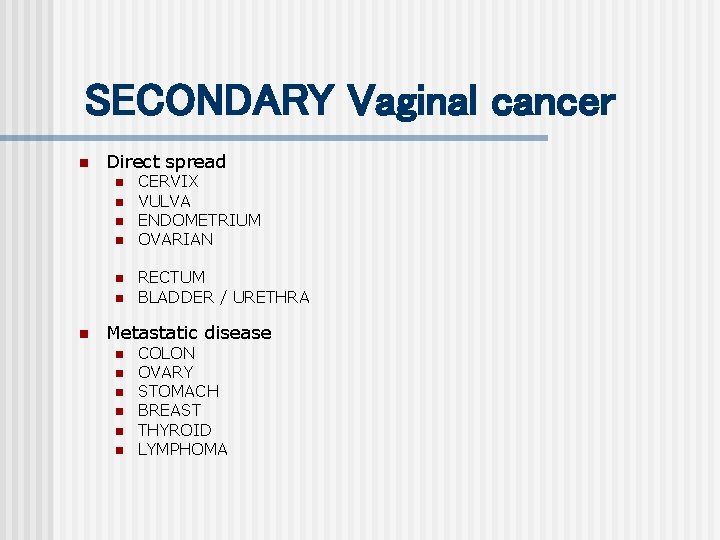
SECONDARY Vaginal cancer n Direct spread n n n n CERVIX VULVA ENDOMETRIUM OVARIAN RECTUM BLADDER / URETHRA Metastatic disease n n n COLON OVARY STOMACH BREAST THYROID LYMPHOMA
SECONDARY Vaginal cancer BIOPSY n FIND SOURCE n n STAGE and TREAT appropriately
Summary n Infections n Vaginal Intra-epithelial Lesions n Vaginal cancer Primary n Secondary n
Thank You