
Vacuum ultraviolet and Ultraviolet Spectrometers for Realtime Radiative
- Slides: 24
Vacuum ultraviolet and Ultraviolet Spectrometers for Real-time Radiative Divertor Feedback Control in the NSTX-U Tokamak V. A. Soukhanovskii, R. Kaita, B. Stratton, and NSTX-U Team Madison, WI, 5 -9 June 2016, 2016 V. A. Soukhanovskii, 21 st HTPD, Madison, WI, 5 -9 June 2016 1
Abstract To prevent excessive erosion and thermal damage of divertor plasma-facing components, a radiative divertor technique is planned for the NSTX-U tokamak. In the radiative (partially detached) divertor, plasma volumetric power and momentum losses are significantly increased by means of extrinsically seeded deuterium or impurity gases. A real-time feedback control of the gas seeding rate (the actuator) is planned. The control sensors can include a variety of diagnostics; however, to make the radiative divertor control independent of main plasma discharge parameters (e. g. , input power, plasma current, density, seeding gas, etc), we consider divertor plasma electron temperature as a control parameter. During divertor detachment, a radiation front is formed at 10 -15 e. V if low-Z impurities (e. g. , carbon, nitrogen) are used for radiation. In the strike point region, strong deuterium high-n Balmer and Paschen series line emissions are observed. A vacuum ultraviolet spectrometer SPRED with a fast camera detector is developed for temperature monitoring at Te < 15 e. V, based on the Dn=0, 1, 2 line intensity ratios of low-Z lines in the spectral range 300 -1600 A. A separate multichannel ultraviolet spectrometer is used for temperature measurements based on the Balmer line intensities at Te < 5 e. V. Both spectrometers use collisional-radiative model based line intensity ratio interpretation and output a real-time Te-dependent signal within a characteristic divertor detachment equilibration time of ≤ 15 ms. Prepared under Contracts DE-AC 52 -07 NA 27344 and DE-AC 02 -09 CH 11466. V. A. Soukhanovskii, 21 st HTPD, Madison, WI, 5 -9 June 2016 2
Outline • Radiative divertor technique in standard and snowflake configurations are leading heat flux mitigation candidates in NSTX-U • Real-time Te from two spectrometers is proposed as control signal for radiative divertor control – VUV spectrometer SPRED – carbon and nitrogen ion emission lines for 5 e. V ≤ Te ≤ 25 e. V – UV spectrometer DIBS – deuterium Balmer lines and recombination continuum for Te ≤ 0. 5 -3 e. V V. A. Soukhanovskii, 21 st HTPD, Madison, WI, 5 -9 June 2016 3
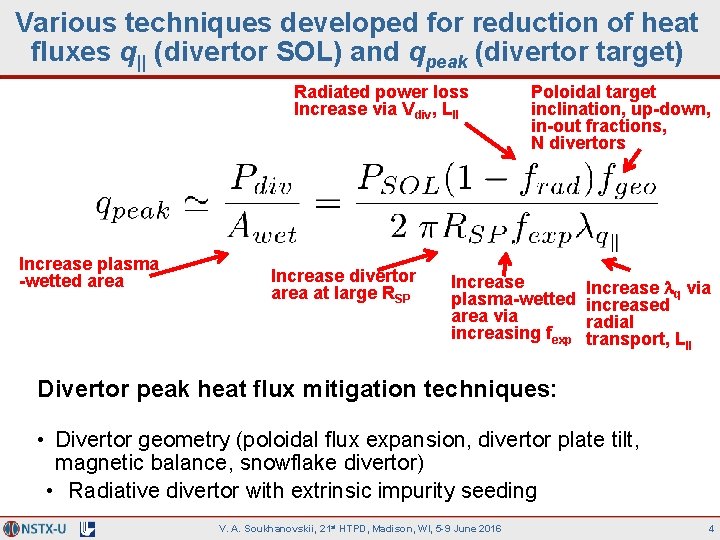
Various techniques developed for reduction of heat fluxes q|| (divertor SOL) and qpeak (divertor target) Radiated power loss Increase via Vdiv, LII Increase plasma -wetted area Increase divertor area at large RSP Poloidal target inclination, up-down, in-out fractions, N divertors Increase plasma-wetted area via increasing fexp Increase lq via increased radial transport, LII Divertor peak heat flux mitigation techniques: • Divertor geometry (poloidal flux expansion, divertor plate tilt, magnetic balance, snowflake divertor) • Radiative divertor with extrinsic impurity seeding V. A. Soukhanovskii, 21 st HTPD, Madison, WI, 5 -9 June 2016 4
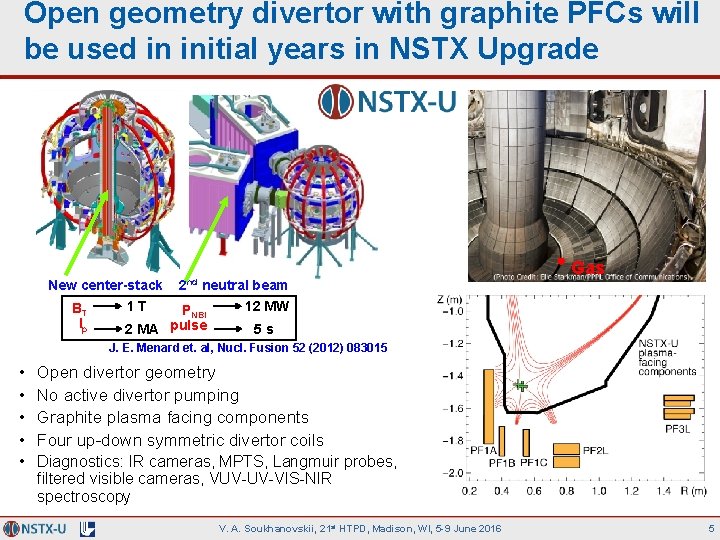
Open geometry divertor with graphite PFCs will be used in initial years in NSTX Upgrade New center-stack BT Ip 1 T 2 nd neutral beam PNBI 2 MA pulse Gas 12 MW 5 s J. E. Menard et. al, Nucl. Fusion 52 (2012) 083015 • • Open divertor geometry No active divertor pumping Graphite plasma facing components Four up-down symmetric divertor coils • Diagnostics: IR cameras, MPTS, Langmuir probes, filtered visible cameras, VUV-UV-VIS-NIR spectroscopy V. A. Soukhanovskii, 21 st HTPD, Madison, WI, 5 -9 June 2016 5
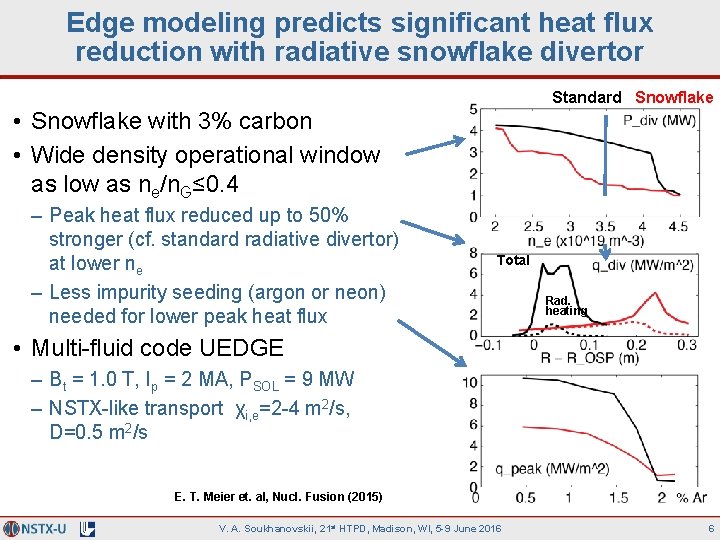
Edge modeling predicts significant heat flux reduction with radiative snowflake divertor Standard Snowflake • Snowflake with 3% carbon • Wide density operational window as low as ne/n. G≤ 0. 4 – Peak heat flux reduced up to 50% stronger (cf. standard radiative divertor) at lower ne – Less impurity seeding (argon or neon) needed for lower peak heat flux Total Rad. heating • Multi-fluid code UEDGE – Bt = 1. 0 T, Ip = 2 MA, PSOL = 9 MW – NSTX-like transport χi, e=2 -4 m 2/s, D=0. 5 m 2/s E. T. Meier et. al, Nucl. Fusion (2015) V. A. Soukhanovskii, 21 st HTPD, Madison, WI, 5 -9 June 2016 6
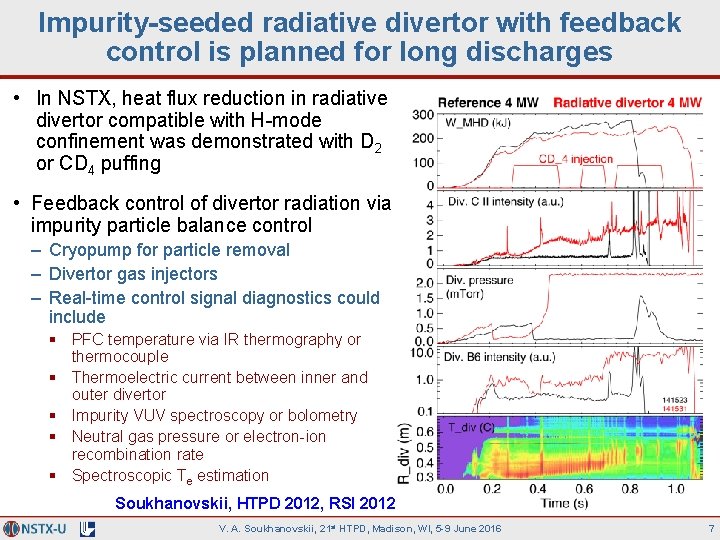
Impurity-seeded radiative divertor with feedback control is planned for long discharges • In NSTX, heat flux reduction in radiative divertor compatible with H-mode confinement was demonstrated with D 2 or CD 4 puffing • Feedback control of divertor radiation via impurity particle balance control – Cryopump for particle removal – Divertor gas injectors – Real-time control signal diagnostics could include § PFC temperature via IR thermography or thermocouple § Thermoelectric current between inner and outer divertor § Impurity VUV spectroscopy or bolometry § Neutral gas pressure or electron-ion recombination rate § Spectroscopic Te estimation Soukhanovskii, HTPD 2012, RSI 2012 V. A. Soukhanovskii, 21 st HTPD, Madison, WI, 5 -9 June 2016 7
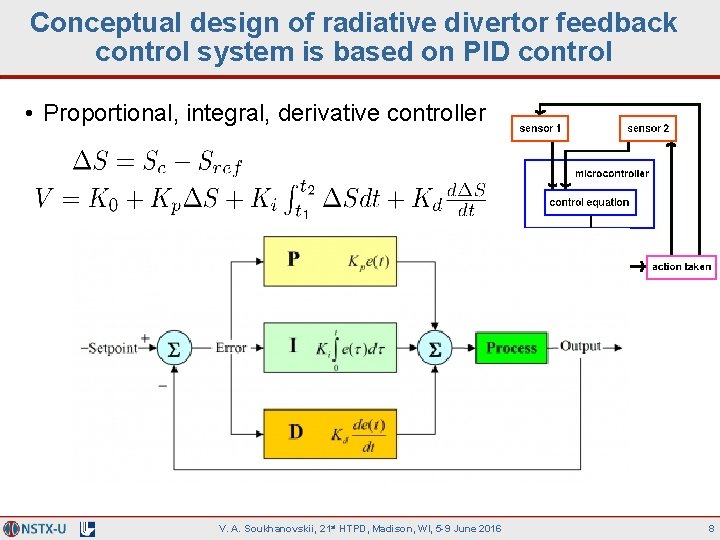
Conceptual design of radiative divertor feedback control system is based on PID control • Proportional, integral, derivative controller V. A. Soukhanovskii, 21 st HTPD, Madison, WI, 5 -9 June 2016 8
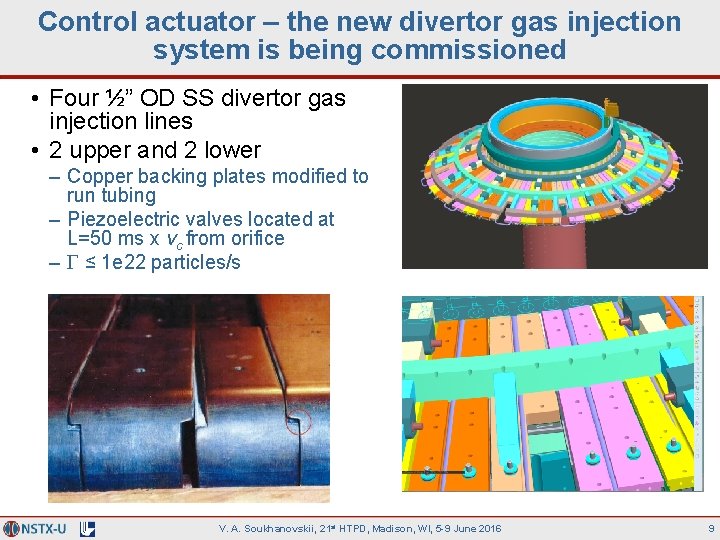
Control actuator – the new divertor gas injection system is being commissioned • Four ½” OD SS divertor gas injection lines • 2 upper and 2 lower – Copper backing plates modified to run tubing – Piezoelectric valves located at L=50 ms x vc from orifice – G ≤ 1 e 22 particles/s V. A. Soukhanovskii, 21 st HTPD, Madison, WI, 5 -9 June 2016 9
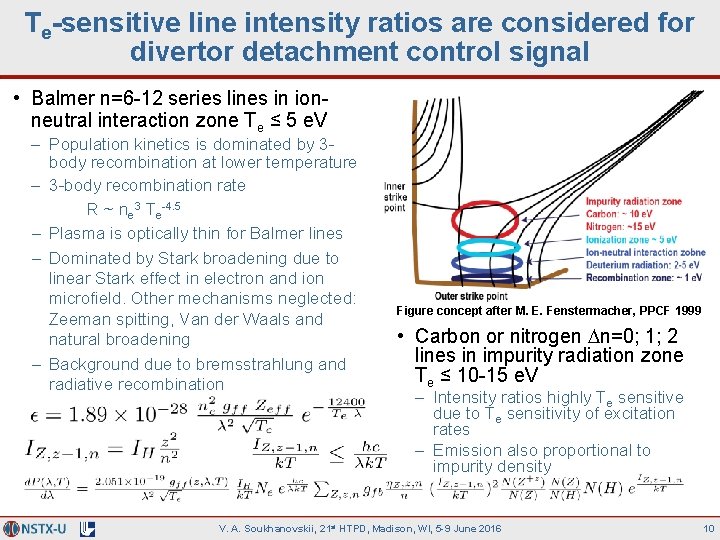
Te-sensitive line intensity ratios are considered for divertor detachment control signal • Balmer n=6 -12 series lines in ionneutral interaction zone Te ≤ 5 e. V – Population kinetics is dominated by 3 body recombination at lower temperature – 3 -body recombination rate R ~ ne 3 Te-4. 5 – Plasma is optically thin for Balmer lines – Dominated by Stark broadening due to linear Stark effect in electron and ion microfield. Other mechanisms neglected: Zeeman spitting, Van der Waals and natural broadening – Background due to bremsstrahlung and radiative recombination Figure concept after M. E. Fenstermacher, PPCF 1999 • Carbon or nitrogen Dn=0; 1; 2 lines in impurity radiation zone Te ≤ 10 -15 e. V – Intensity ratios highly Te sensitive due to Te sensitivity of excitation rates – Emission also proportional to impurity density V. A. Soukhanovskii, 21 st HTPD, Madison, WI, 5 -9 June 2016 10
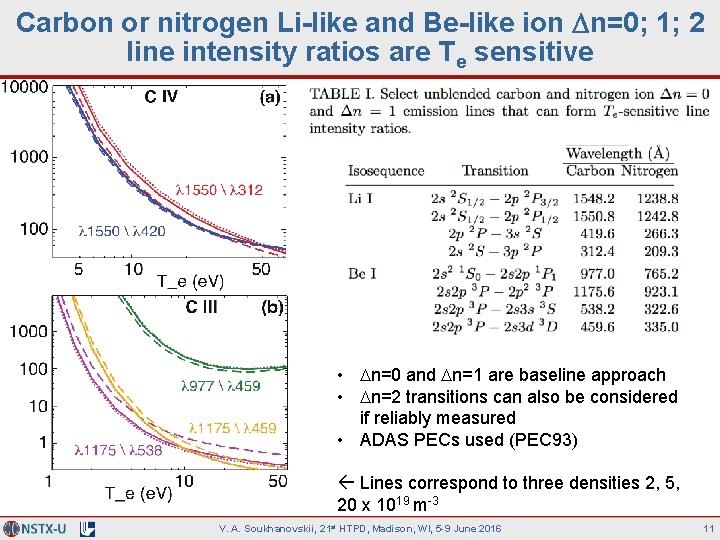
Carbon or nitrogen Li-like and Be-like ion Dn=0; 1; 2 line intensity ratios are Te sensitive • Dn=0 and Dn=1 are baseline approach • Dn=2 transitions can also be considered if reliably measured • ADAS PECs used (PEC 93) Lines correspond to three densities 2, 5, 20 x 1019 m-3 V. A. Soukhanovskii, 21 st HTPD, Madison, WI, 5 -9 June 2016 11
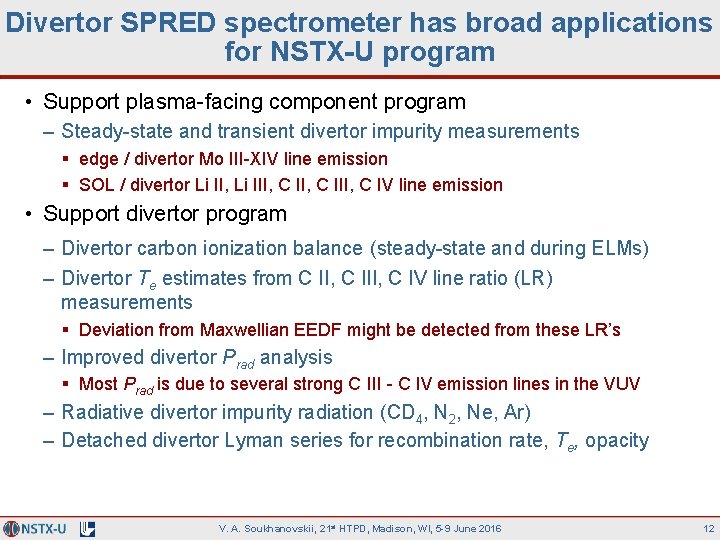
Divertor SPRED spectrometer has broad applications for NSTX-U program • Support plasma-facing component program – Steady-state and transient divertor impurity measurements § edge / divertor Mo III-XIV line emission § SOL / divertor Li II, Li III, C IV line emission • Support divertor program – Divertor carbon ionization balance (steady-state and during ELMs) – Divertor Te estimates from C II, C IV line ratio (LR) measurements § Deviation from Maxwellian EEDF might be detected from these LR’s – Improved divertor Prad analysis § Most Prad is due to several strong C III - C IV emission lines in the VUV – Radiative divertor impurity radiation (CD 4, N 2, Ne, Ar) – Detached divertor Lyman series for recombination rate, Te, opacity V. A. Soukhanovskii, 21 st HTPD, Madison, WI, 5 -9 June 2016 12
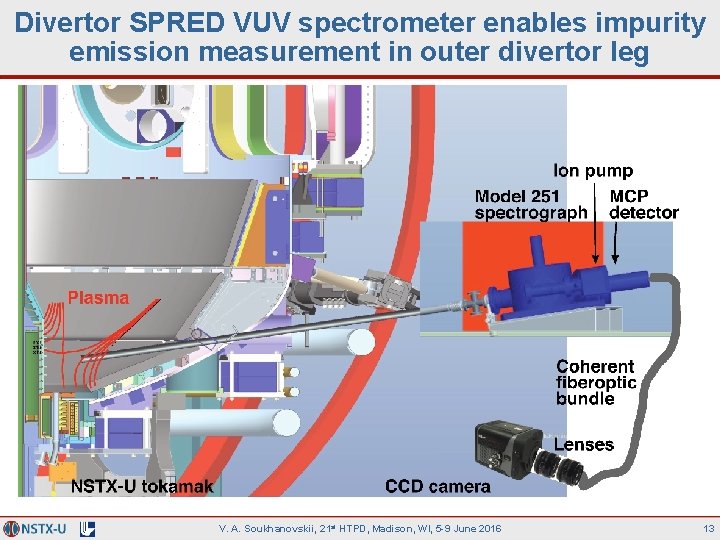
Divertor SPRED VUV spectrometer enables impurity emission measurement in outer divertor leg V. A. Soukhanovskii, 21 st HTPD, Madison, WI, 5 -9 June 2016 13
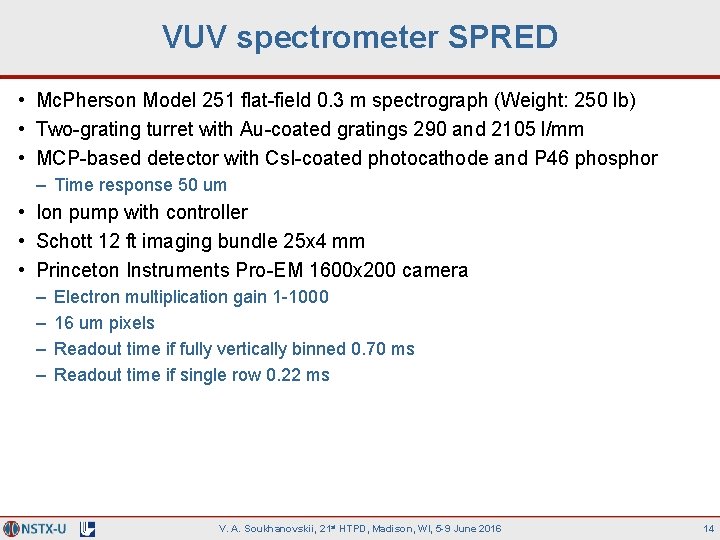
VUV spectrometer SPRED • Mc. Pherson Model 251 flat-field 0. 3 m spectrograph (Weight: 250 lb) • Two-grating turret with Au-coated gratings 290 and 2105 l/mm • MCP-based detector with Cs. I-coated photocathode and P 46 phosphor – Time response 50 um • Ion pump with controller • Schott 12 ft imaging bundle 25 x 4 mm • Princeton Instruments Pro-EM 1600 x 200 camera – – Electron multiplication gain 1 -1000 16 um pixels Readout time if fully vertically binned 0. 70 ms Readout time if single row 0. 22 ms V. A. Soukhanovskii, 21 st HTPD, Madison, WI, 5 -9 June 2016 14
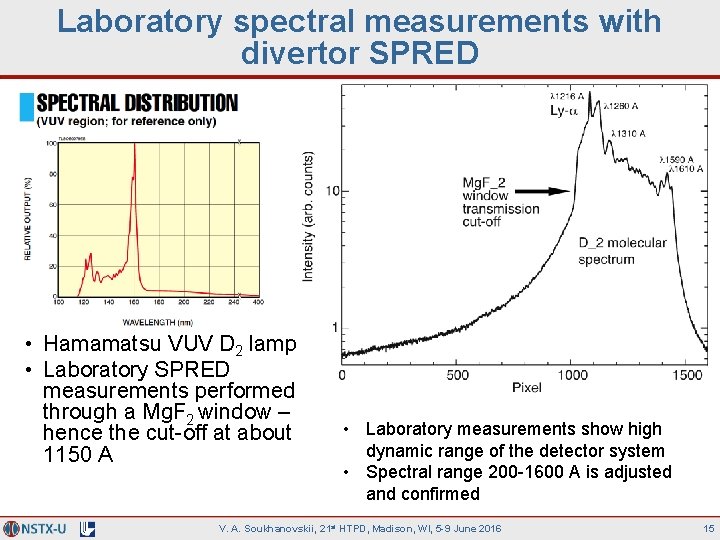
Laboratory spectral measurements with divertor SPRED • Hamamatsu VUV D 2 lamp • Laboratory SPRED measurements performed through a Mg. F 2 window – hence the cut-off at about 1150 A • Laboratory measurements show high dynamic range of the detector system • Spectral range 200 -1600 A is adjusted and confirmed V. A. Soukhanovskii, 21 st HTPD, Madison, WI, 5 -9 June 2016 15
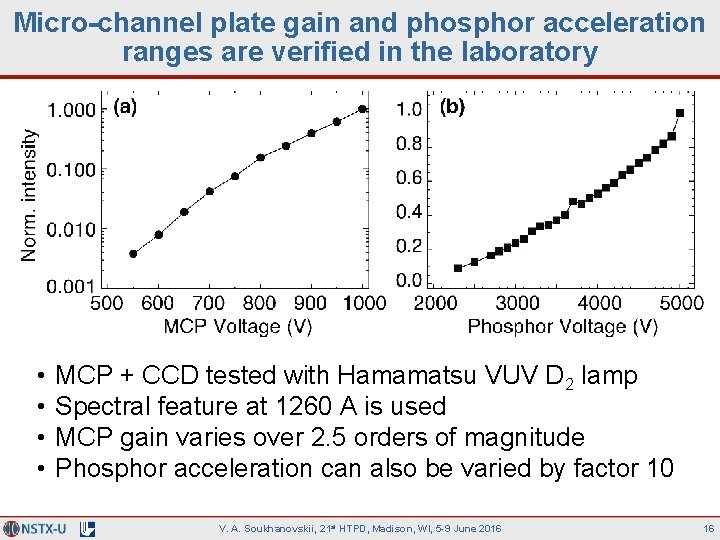
Micro-channel plate gain and phosphor acceleration ranges are verified in the laboratory • • MCP + CCD tested with Hamamatsu VUV D 2 lamp Spectral feature at 1260 A is used MCP gain varies over 2. 5 orders of magnitude Phosphor acceleration can also be varied by factor 10 V. A. Soukhanovskii, 21 st HTPD, Madison, WI, 5 -9 June 2016 16
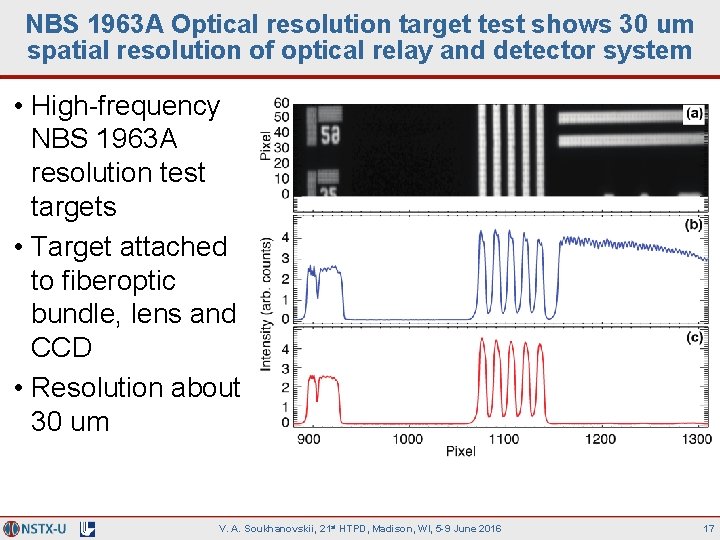
NBS 1963 A Optical resolution target test shows 30 um spatial resolution of optical relay and detector system • High-frequency NBS 1963 A resolution test targets • Target attached to fiberoptic bundle, lens and CCD • Resolution about 30 um V. A. Soukhanovskii, 21 st HTPD, Madison, WI, 5 -9 June 2016 17
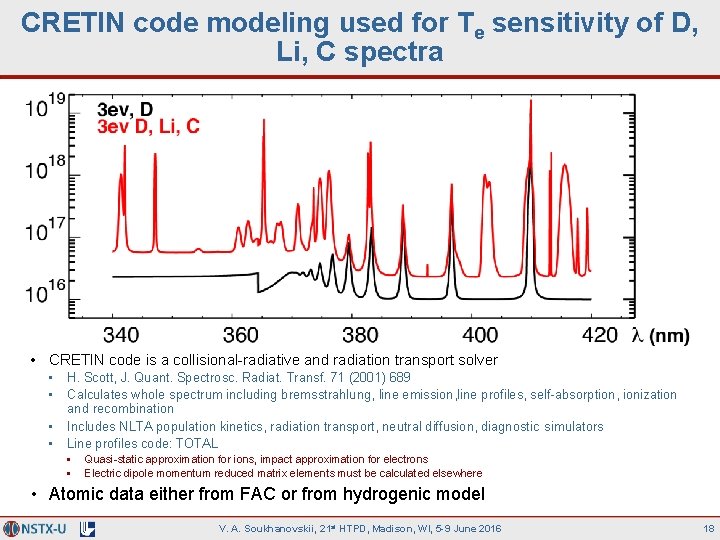
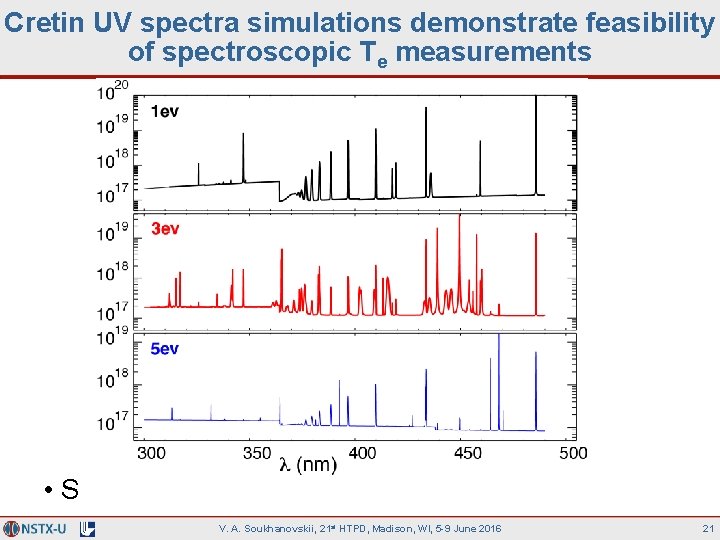
CRETIN code modeling used for Te sensitivity of D, Li, C spectra • CRETIN code is a collisional-radiative and radiation transport solver • H. Scott, J. Quant. Spectrosc. Radiat. Transf. 71 (2001) 689 • Calculates whole spectrum including bremsstrahlung, line emission, line profiles, self-absorption, ionization and recombination • Includes NLTA population kinetics, radiation transport, neutral diffusion, diagnostic simulators • Line profiles code: TOTAL • • Quasi-static approximation for ions, impact approximation for electrons Electric dipole momentum reduced matrix elements must be calculated elsewhere • Atomic data either from FAC or from hydrogenic model V. A. Soukhanovskii, 21 st HTPD, Madison, WI, 5 -9 June 2016 18
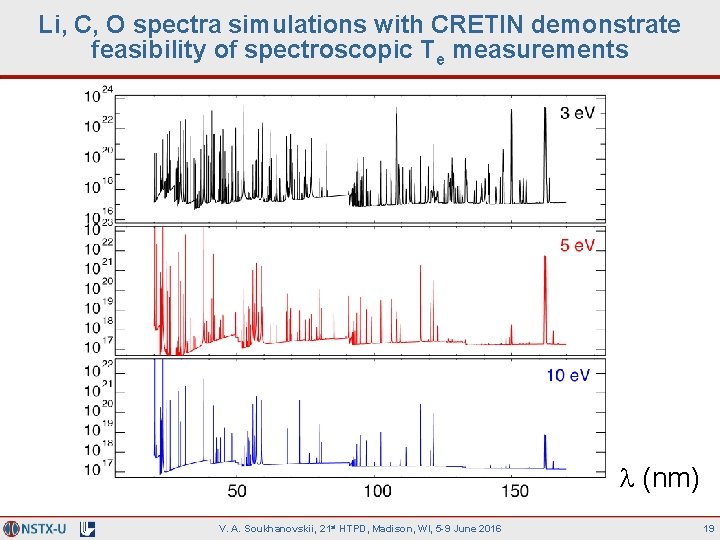
Li, C, O spectra simulations with CRETIN demonstrate feasibility of spectroscopic Te measurements l (nm) V. A. Soukhanovskii, 21 st HTPD, Madison, WI, 5 -9 June 2016 19
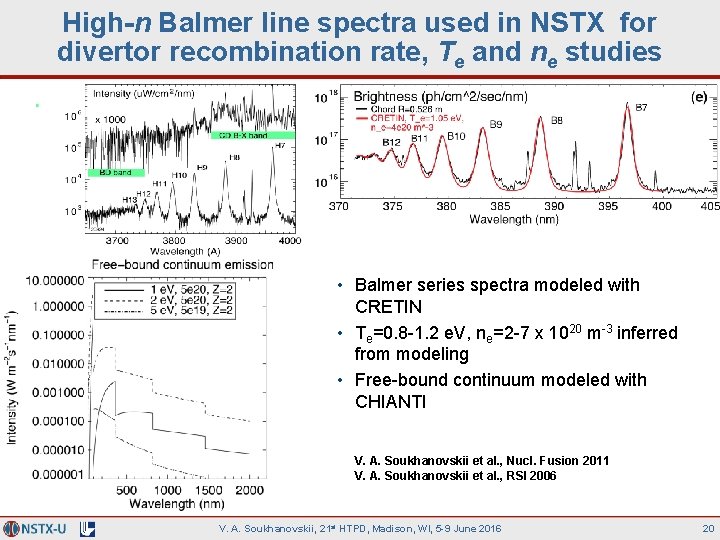
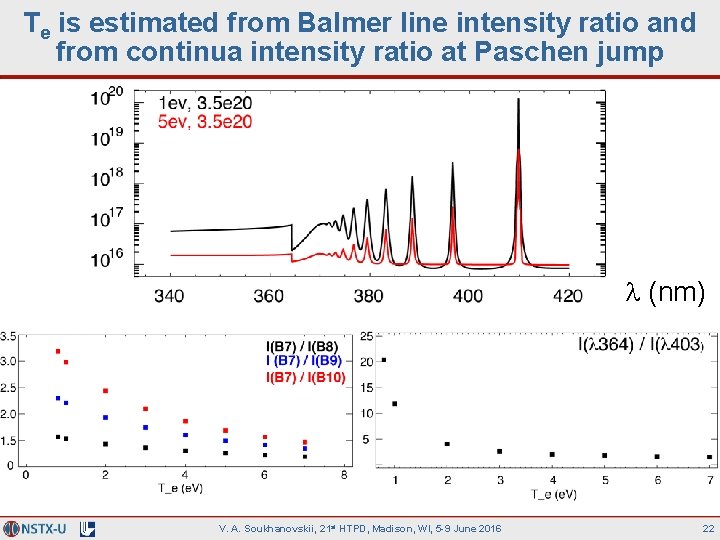
High-n Balmer line spectra used in NSTX for divertor recombination rate, Te and ne studies • Balmer series spectra modeled with CRETIN • Te=0. 8 -1. 2 e. V, ne=2 -7 x 10²⁰ m-3 inferred from modeling • Free-bound continuum modeled with CHIANTI V. A. Soukhanovskii et al. , Nucl. Fusion 2011 V. A. Soukhanovskii et al. , RSI 2006 V. A. Soukhanovskii, 21 st HTPD, Madison, WI, 5 -9 June 2016 20
Cretin UV spectra simulations demonstrate feasibility of spectroscopic Te measurements • S V. A. Soukhanovskii, 21 st HTPD, Madison, WI, 5 -9 June 2016 21
Te is estimated from Balmer line intensity ratio and from continua intensity ratio at Paschen jump l (nm) V. A. Soukhanovskii, 21 st HTPD, Madison, WI, 5 -9 June 2016 22
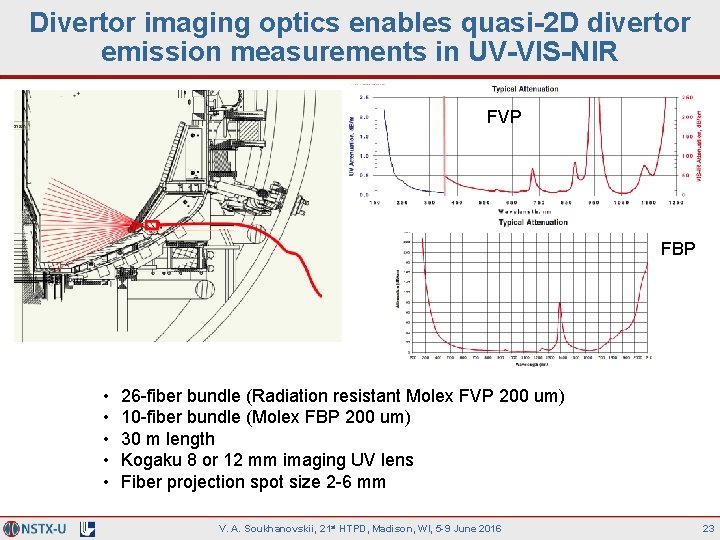
Divertor imaging optics enables quasi-2 D divertor emission measurements in UV-VIS-NIR FVP FBP • • • 26 -fiber bundle (Radiation resistant Molex FVP 200 um) 10 -fiber bundle (Molex FBP 200 um) 30 m length Kogaku 8 or 12 mm imaging UV lens Fiber projection spot size 2 -6 mm V. A. Soukhanovskii, 21 st HTPD, Madison, WI, 5 -9 June 2016 23
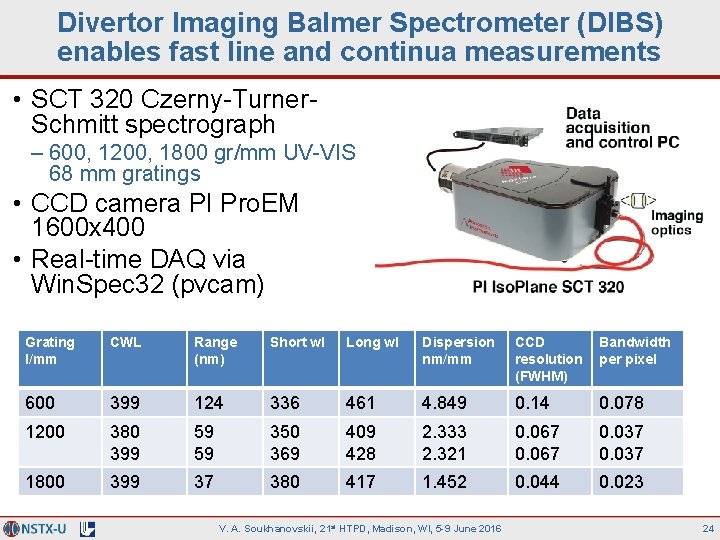
Divertor Imaging Balmer Spectrometer (DIBS) enables fast line and continua measurements • SCT 320 Czerny-Turner. Schmitt spectrograph – 600, 1200, 1800 gr/mm UV-VIS 68 mm gratings • CCD camera PI Pro. EM 1600 x 400 • Real-time DAQ via Win. Spec 32 (pvcam) Grating l/mm CWL Range (nm) Short wl Long wl Dispersion nm/mm CCD resolution (FWHM) Bandwidth per pixel 600 399 124 336 461 4. 849 0. 14 0. 078 1200 380 399 59 59 350 369 409 428 2. 333 2. 321 0. 067 0. 037 1800 399 37 380 417 1. 452 0. 044 0. 023 V. A. Soukhanovskii, 21 st HTPD, Madison, WI, 5 -9 June 2016 24