
Vacuum Technology Jim JrMin Lin Institute of Atomic










- Slides: 88
Vacuum Technology Jim Jr-Min Lin 林志民 Institute of Atomic and Molecular Sciences Academia Sinica, Taipei, Taiwan 106 中央研究院原分所 1
A very useful reference book: Building Scientific Apparatus A practical guide to design and construction by John H. Moore, C. C. Davis and M. A. Coplan 2 ed, 3 rd or 4 th edition 2
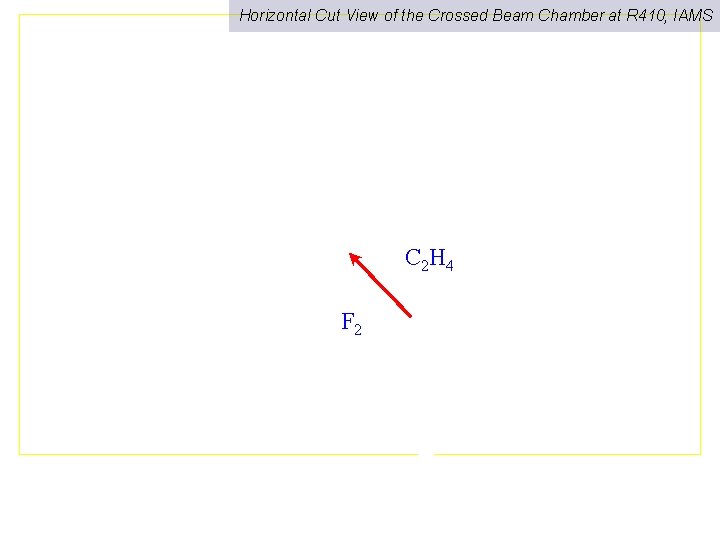
Horizontal Cut View of the Crossed Beam Chamber at R 410, IAMS C 2 H 4 F 2
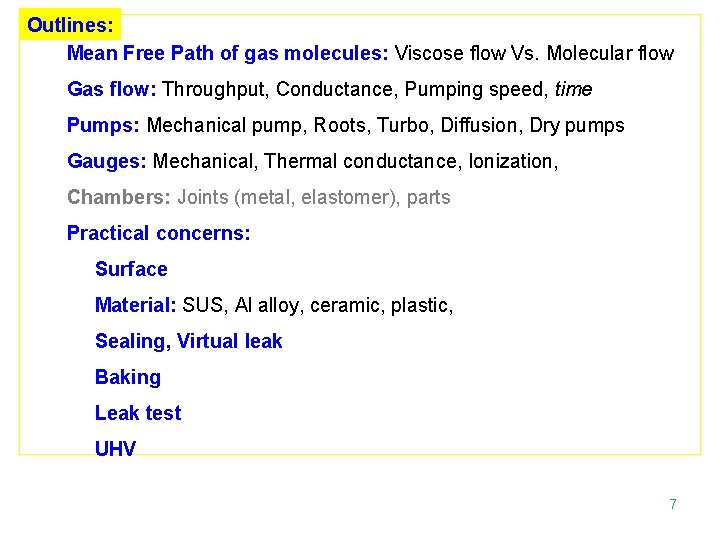
Outlines: Mean Free Path of gas molecules: Viscose flow Vs. Molecular flow Gas flow: Throughput, Conductance, Pumping speed, time Pumps: Mechanical pump, Roots, Turbo, Diffusion, Dry pumps Gauges: Mechanical, Thermal conductance, Ionization, Chambers: Joints (metal, elastomer), parts Practical concerns: Surface Material: SUS, Al alloy, ceramic, plastic, Sealing, Virtual leak Baking Leak test UHV 7
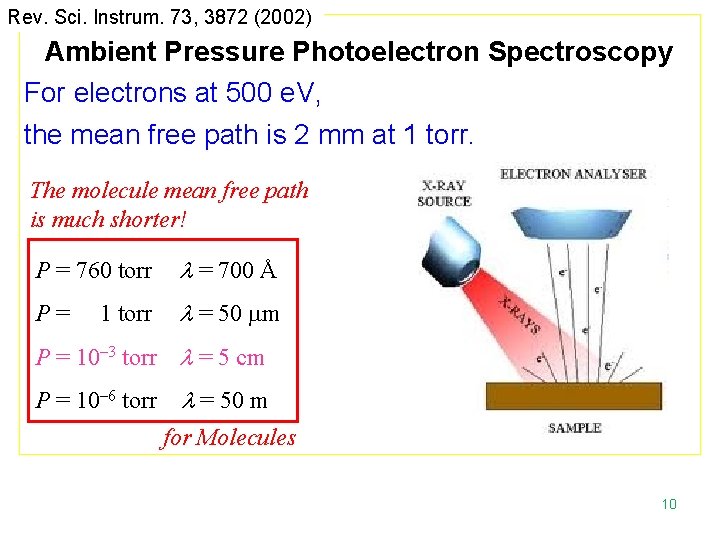
Mean Free Path: 平均自由徑 The average distance that a molecule travels between successive collisions. Speed of gas molecules: for air (80% N 2 + 20% O 2) at 20 o. C for molecules of 3 Å diameter P = 760 torr l = 700 Å t = 0. 14 ns P= l = 50 mm t = 100 ns 1 torr P = 10 -3 torr l = 5 cm t = 100 ms P = 10 -6 torr l = 50 m t = 0. 1 s 8
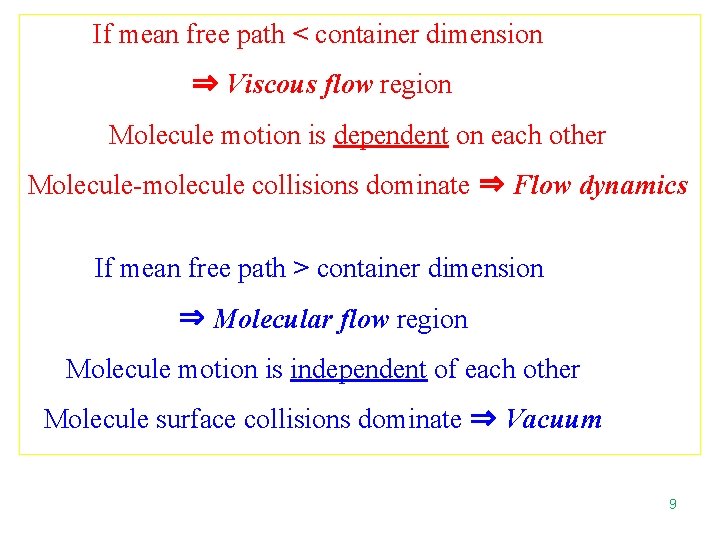
If mean free path < container dimension ⇒ Viscous flow region Molecule motion is dependent on each other Molecule-molecule collisions dominate ⇒ Flow dynamics If mean free path > container dimension ⇒ Molecular flow region Molecule motion is independent of each other Molecule surface collisions dominate ⇒ Vacuum 9
Rev. Sci. Instrum. 73, 3872 (2002) Ambient Pressure Photoelectron Spectroscopy For electrons at 500 e. V, the mean free path is 2 mm at 1 torr. The molecule mean free path is much shorter! P = 760 torr l = 700 Å P= l = 50 mm 1 torr P = 10 -3 torr l = 5 cm P = 10 -6 torr l = 50 m for Molecules 10
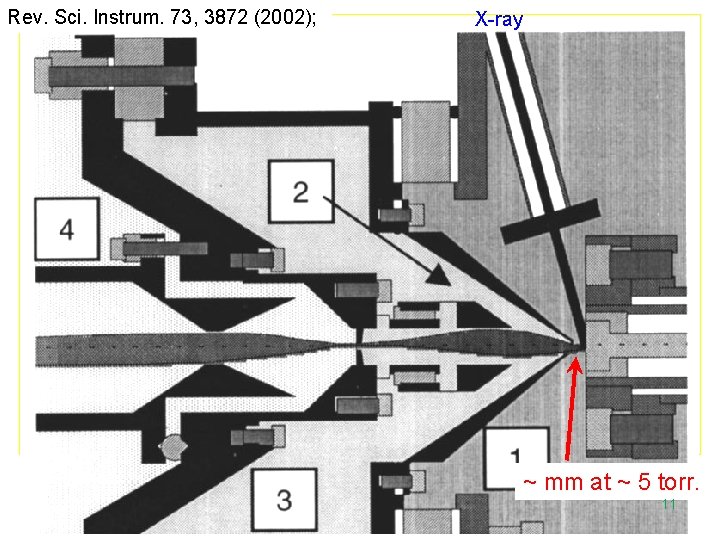
Rev. Sci. Instrum. 73, 3872 (2002); X-ray ~ mm at ~ 5 torr. 11
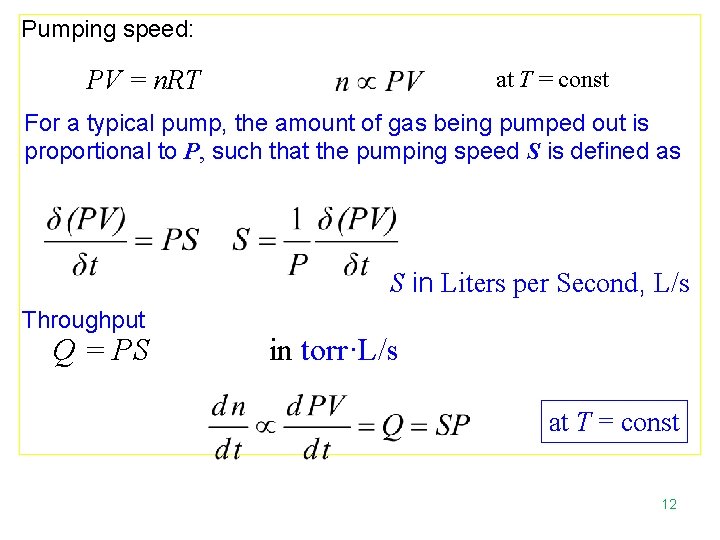
Pumping speed: PV = n. RT at T = const For a typical pump, the amount of gas being pumped out is proportional to P, such that the pumping speed S is defined as S in Liters per Second, L/s Throughput Q = PS in torr·L/s at T = const 12
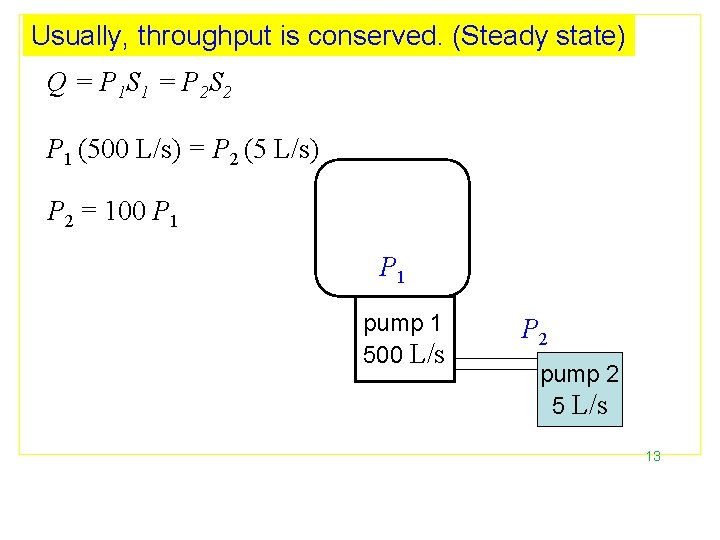
Usually, throughput is conserved. (Steady state) Q = P 1 S 1 = P 2 S 2 P 1 (500 L/s) = P 2 (5 L/s) P 2 = 100 P 1 pump 1 500 L/s P 2 pump 2 5 L/s 13
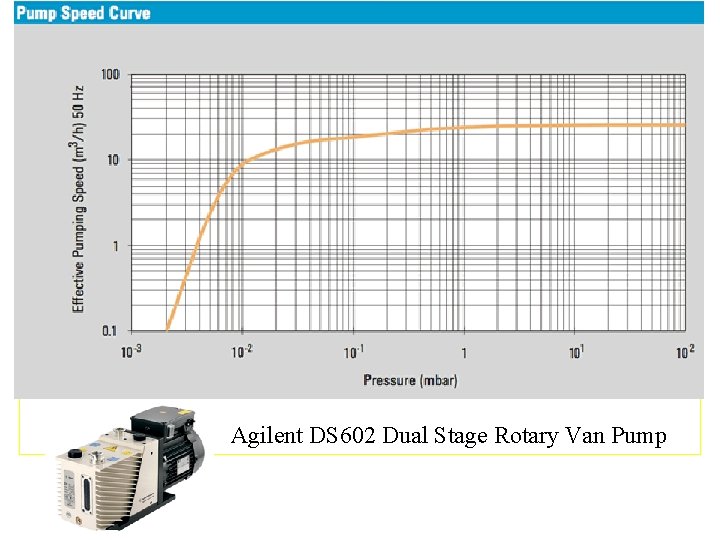
Agilent DS 602 Dual Stage Rotary Van Pump
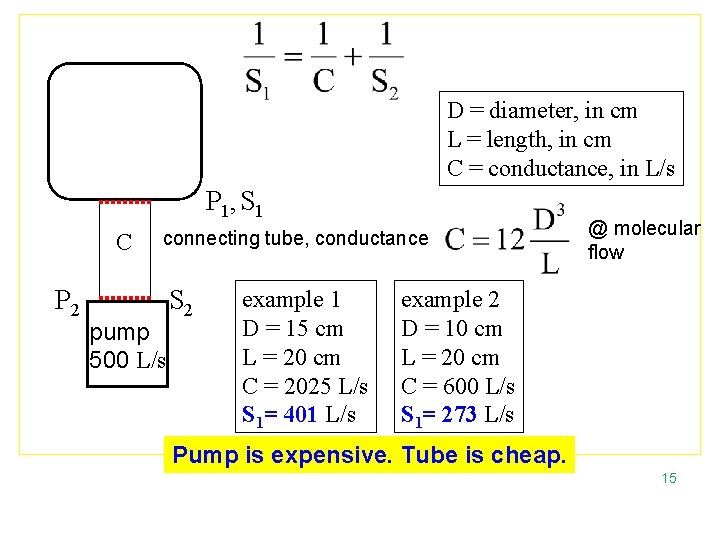
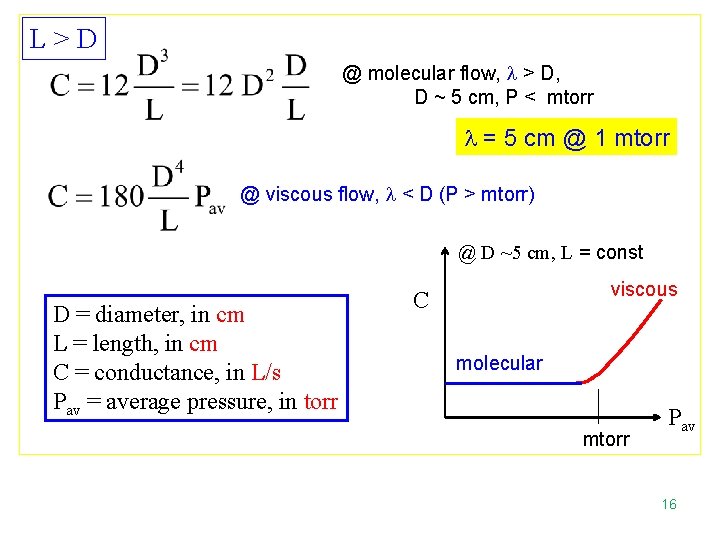
D = diameter, in cm L = length, in cm C = conductance, in L/s P 1, S 1 C P 2 connecting tube, conductance pump 500 L/s S 2 example 1 D = 15 cm L = 20 cm C = 2025 L/s S 1= 401 L/s @ molecular flow example 2 D = 10 cm L = 20 cm C = 600 L/s S 1= 273 L/s Pump is expensive. Tube is cheap. 15
L>D @ molecular flow, l > D, D ~ 5 cm, P < mtorr l = 5 cm @ 1 mtorr @ viscous flow, l < D (P > mtorr) @ D ~5 cm, L = const D = diameter, in cm L = length, in cm C = conductance, in L/s Pav = average pressure, in torr viscous C molecular mtorr Pav 16
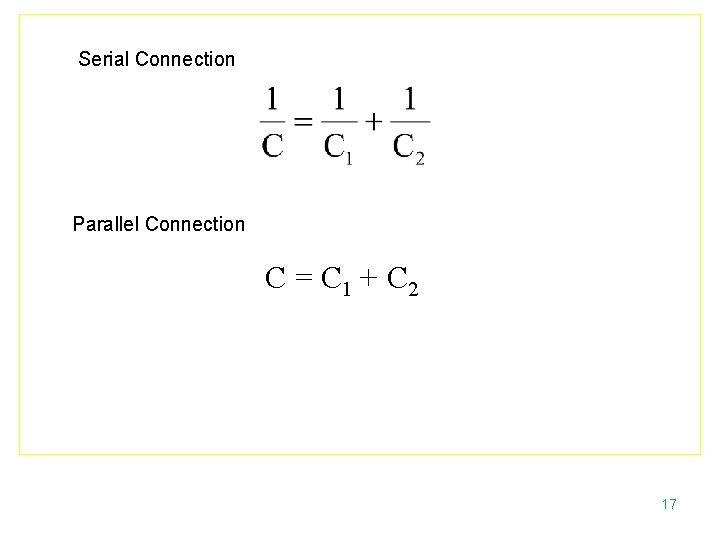
Serial Connection Parallel Connection C = C 1 + C 2 17
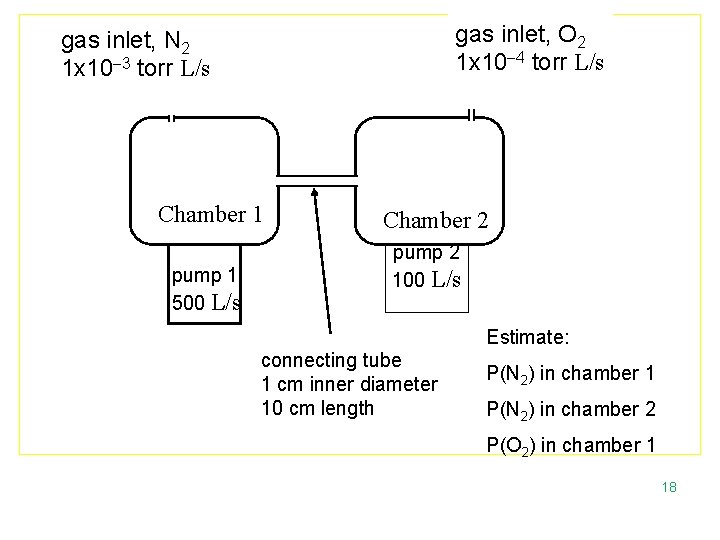
gas inlet, O 2 1 x 10 -4 torr L/s gas inlet, N 2 1 x 10 -3 torr L/s Chamber 1 pump 1 500 L/s Chamber 2 pump 2 100 L/s Estimate: connecting tube 1 cm inner diameter 10 cm length P(N 2) in chamber 1 P(N 2) in chamber 2 P(O 2) in chamber 1 18
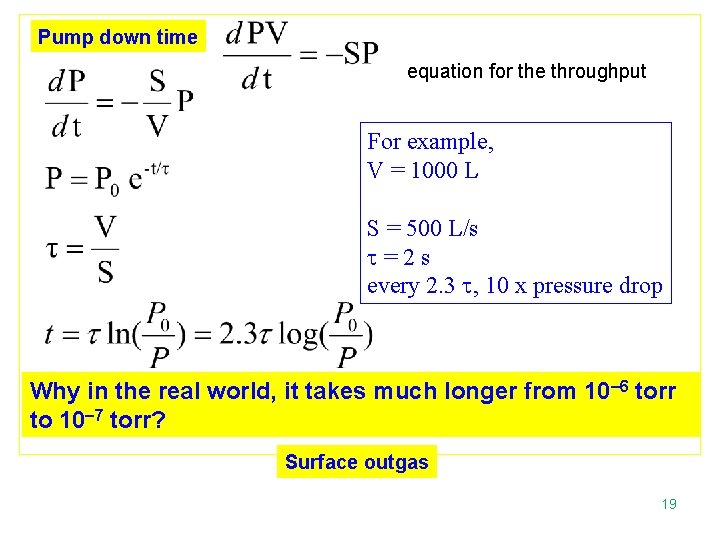
Pump down time equation for the throughput For example, V = 1000 L S = 500 L/s t=2 s every 2. 3 t, 10 x pressure drop Why in the real world, it takes much longer from 10 -6 torr to 10 -7 torr? Surface outgas 19
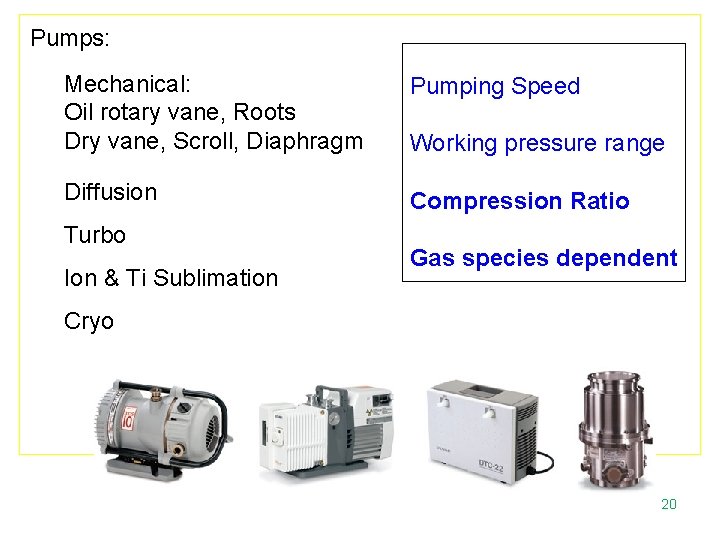
Pumps: Mechanical: Oil rotary vane, Roots Dry vane, Scroll, Diaphragm Pumping Speed Diffusion Compression Ratio Turbo Ion & Ti Sublimation Working pressure range Gas species dependent Cryo 20
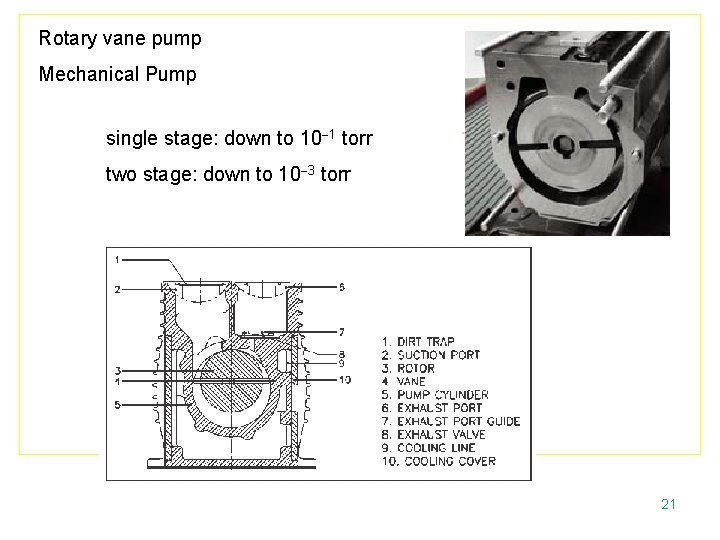
Rotary vane pump Mechanical Pump single stage: down to 10 -1 torr two stage: down to 10 -3 torr 21
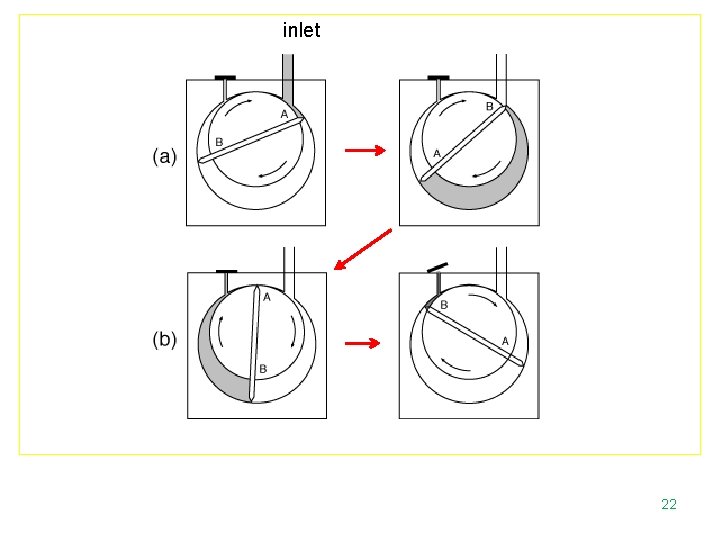
inlet 22
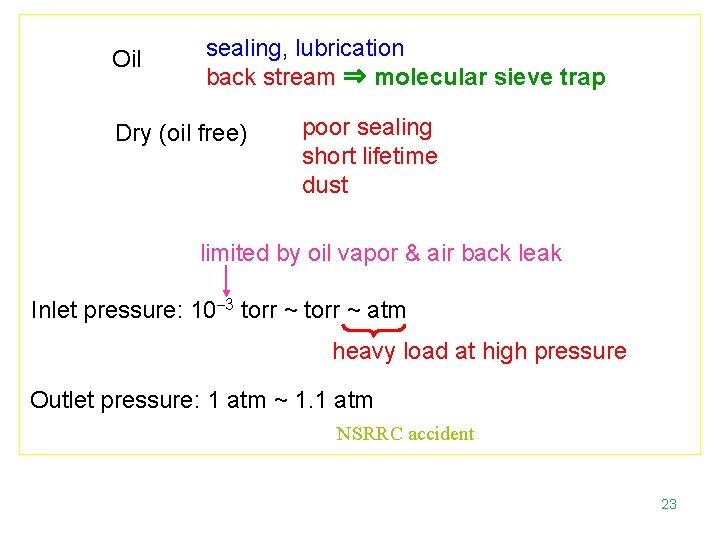
Oil sealing, lubrication back stream ⇒ molecular sieve trap Dry (oil free) poor sealing short lifetime dust limited by oil vapor & air back leak Inlet pressure: 10 -3 torr ~ atm heavy load at high pressure Outlet pressure: 1 atm ~ 1. 1 atm NSRRC accident 23
Roots blower Pin Large pumping speed Low compression ratio ~ 10 Compression ratio Net throughput Qnet = Pin Sfor - Pout. Sback Pout to rotary pump If Pout is high, Qnet can be reduced to 0 Here Pout/Pin is at maximum and K = Pout/Pin = Sfor/Sback 24
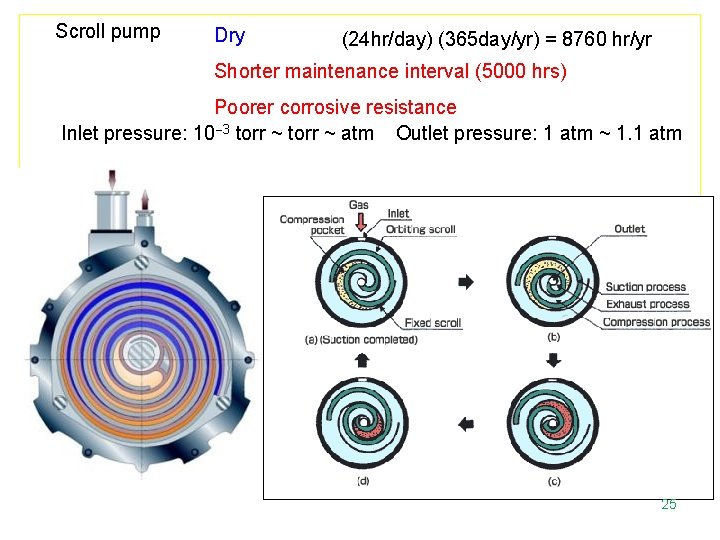
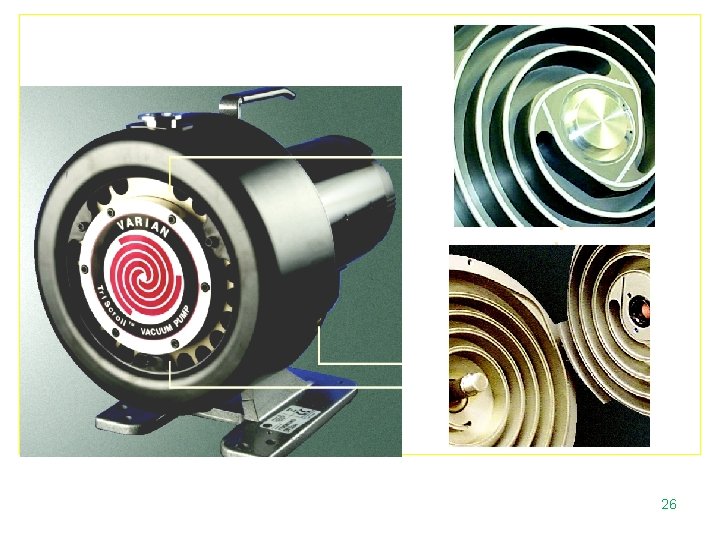
Scroll pump Dry (24 hr/day) (365 day/yr) = 8760 hr/yr Shorter maintenance interval (5000 hrs) Poorer corrosive resistance Inlet pressure: 10 -3 torr ~ atm Outlet pressure: 1 atm ~ 1. 1 atm 25
26
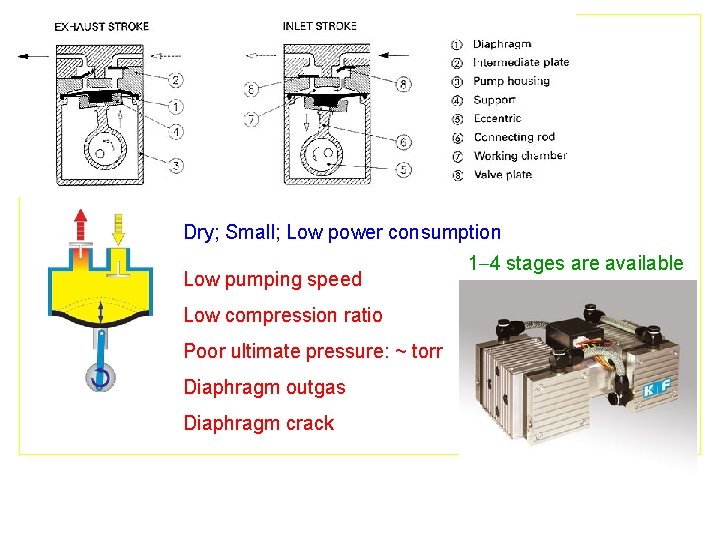
Dry; Small; Low power consumption Low pumping speed Low compression ratio Poor ultimate pressure: ~ torr Diaphragm outgas Diaphragm crack 1 -4 stages are available
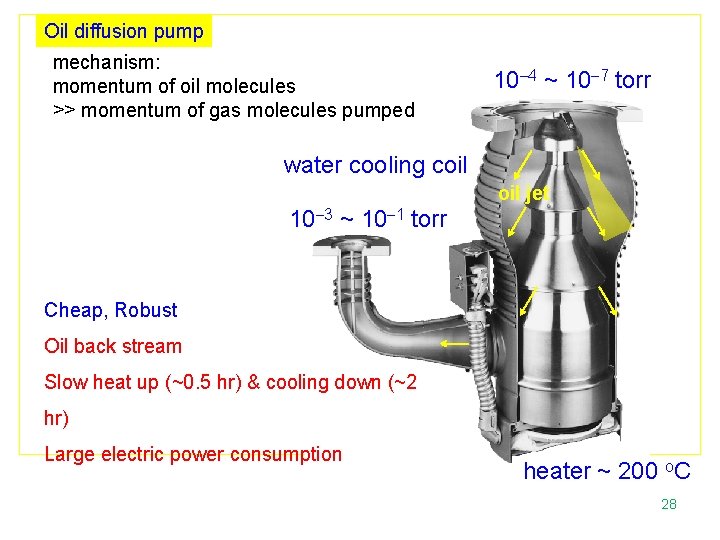
Oil diffusion pump mechanism: momentum of oil molecules >> momentum of gas molecules pumped 10 -4 ~ 10 -7 torr water cooling coil jet 10 -3 ~ 10 -1 torr Cheap, Robust Oil back stream Slow heat up (~0. 5 hr) & cooling down (~2 hr) Large electric power consumption heater ~ 200 o. C 28
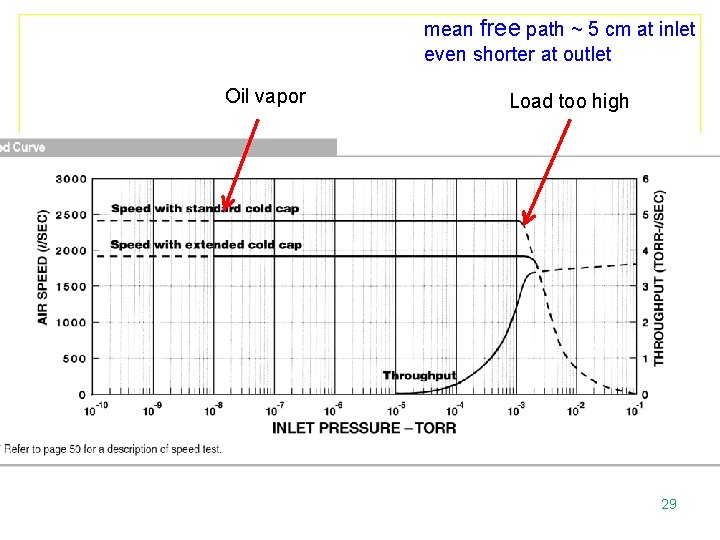
mean free path ~ 5 cm at inlet even shorter at outlet Oil vapor Load too high 29
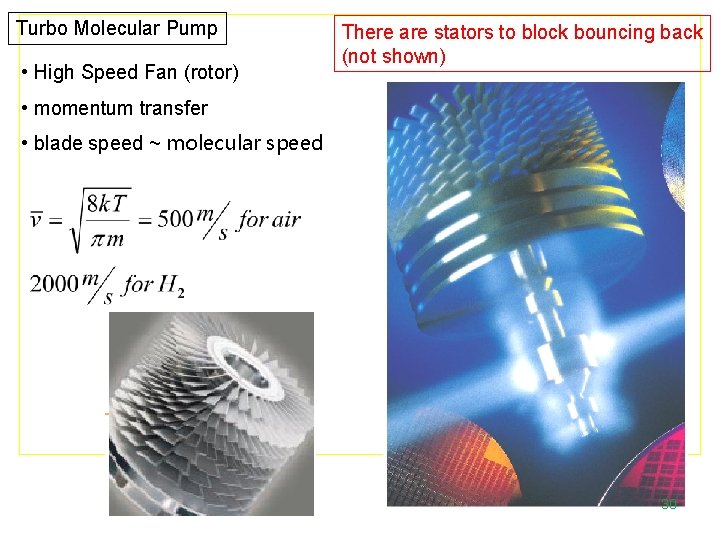
Turbo Molecular Pump • High Speed Fan (rotor) There are stators to block bouncing back (not shown) • momentum transfer • blade speed ~ molecular speed 30
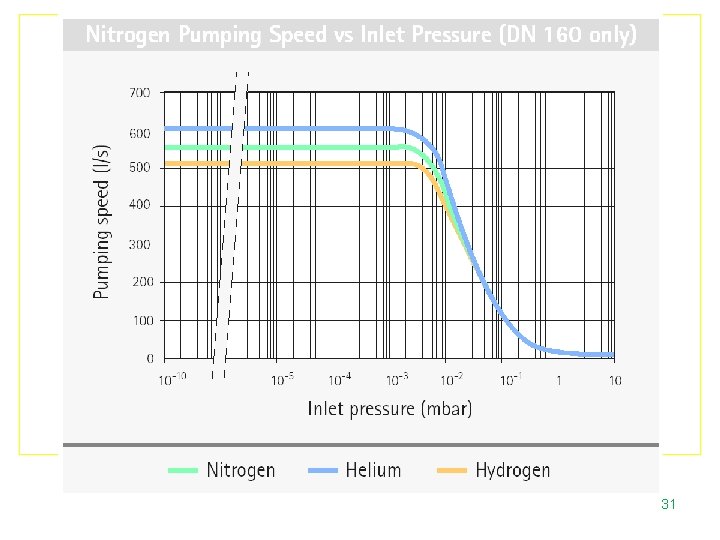
31
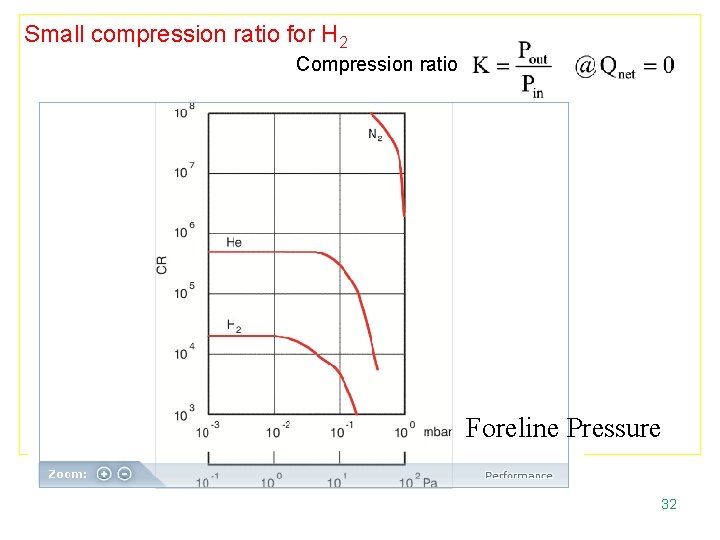
Small compression ratio for H 2 Compression ratio Foreline Pressure 32
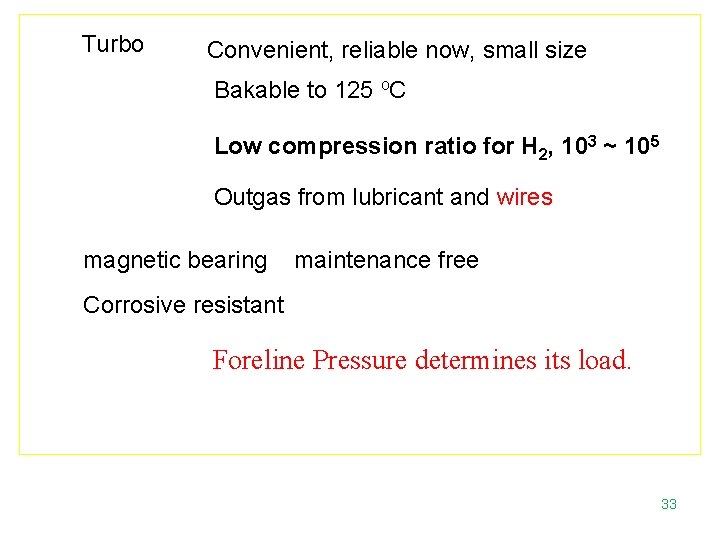
Turbo Convenient, reliable now, small size Bakable to 125 o. C Low compression ratio for H 2, 103 ~ 105 Outgas from lubricant and wires magnetic bearing maintenance free Corrosive resistant Foreline Pressure determines its load. 33
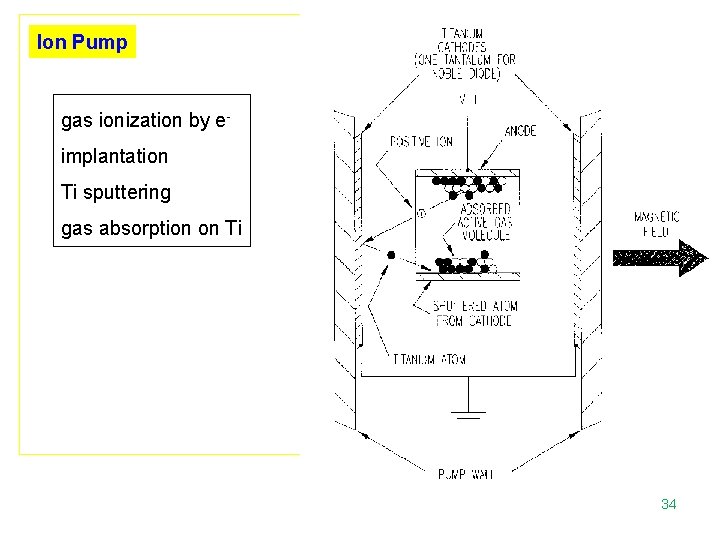
Ion Pump gas ionization by eimplantation Ti sputtering gas absorption on Ti 34
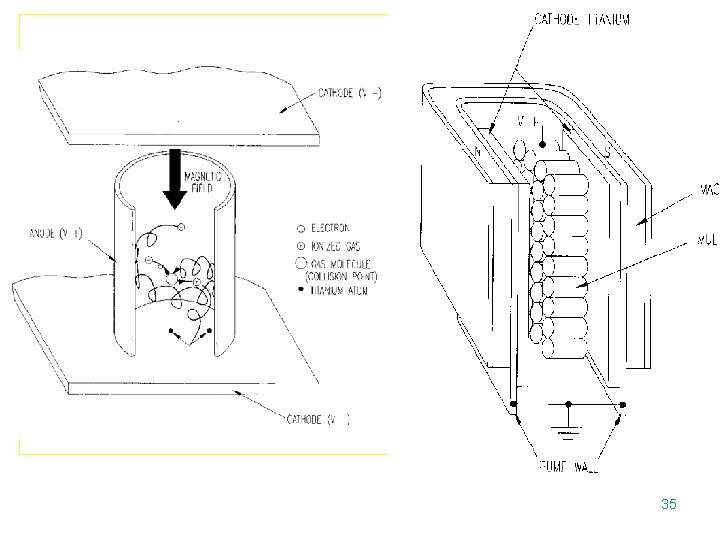
35
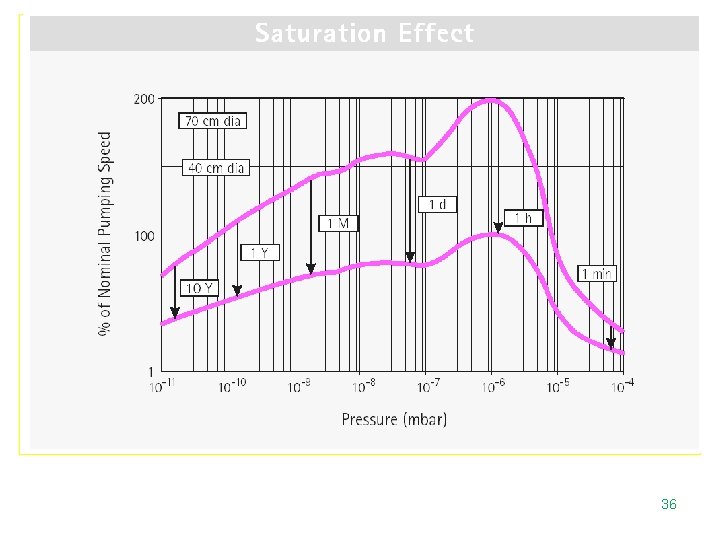
36
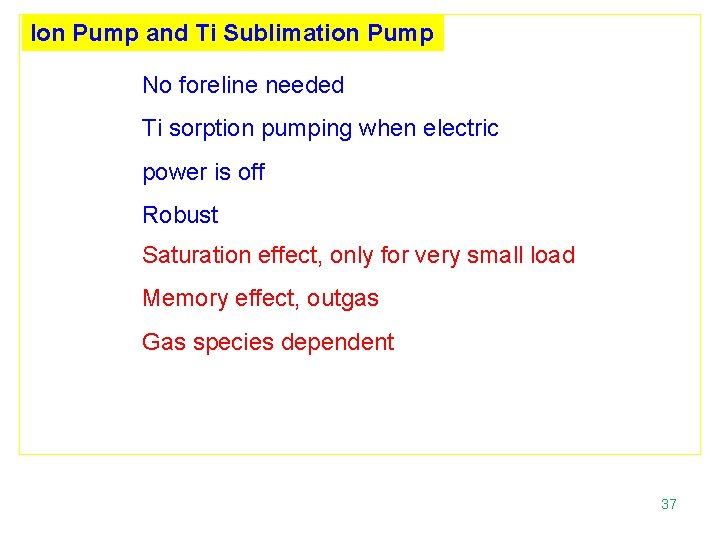
Ion Pump and Ti Sublimation Pump No foreline needed Ti sorption pumping when electric power is off Robust Saturation effect, only for very small load Memory effect, outgas Gas species dependent 37
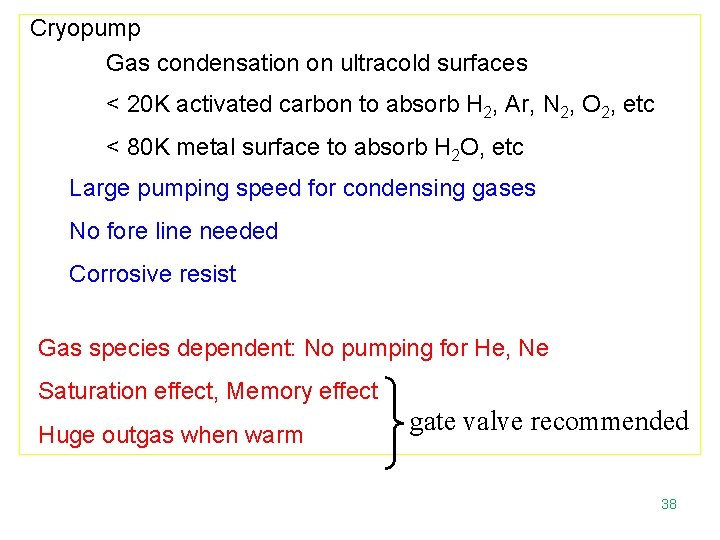
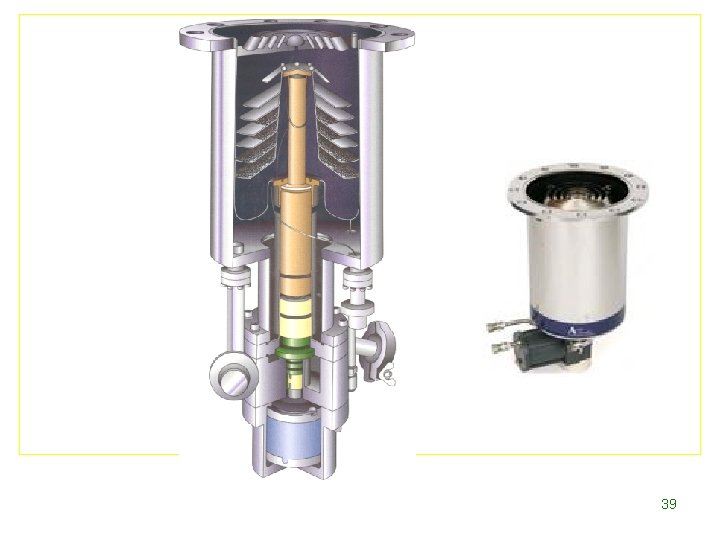
Cryopump Gas condensation on ultracold surfaces < 20 K activated carbon to absorb H 2, Ar, N 2, O 2, etc < 80 K metal surface to absorb H 2 O, etc Large pumping speed for condensing gases No fore line needed Corrosive resist Gas species dependent: No pumping for He, Ne Saturation effect, Memory effect Huge outgas when warm gate valve recommended 38
39
40
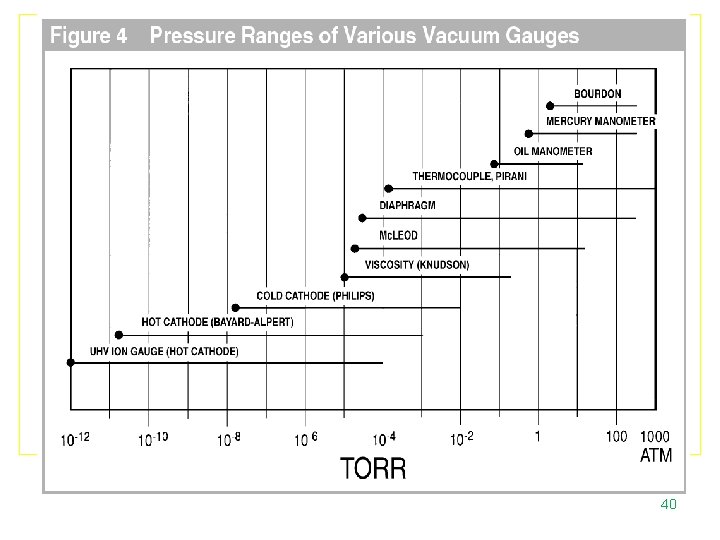
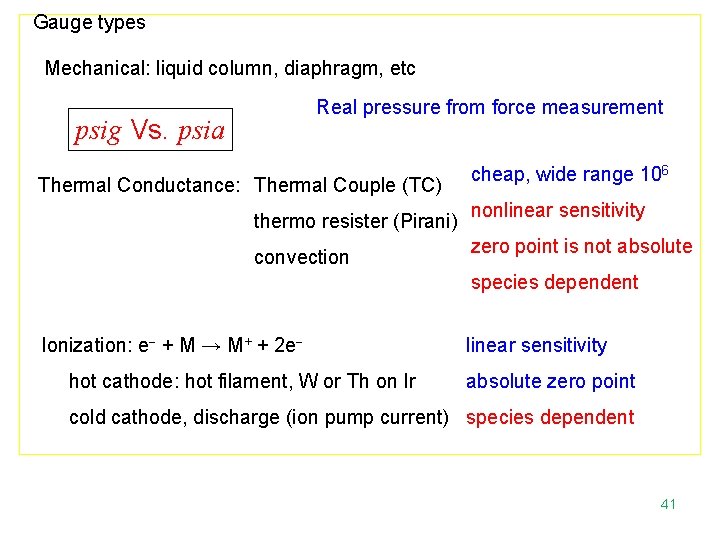
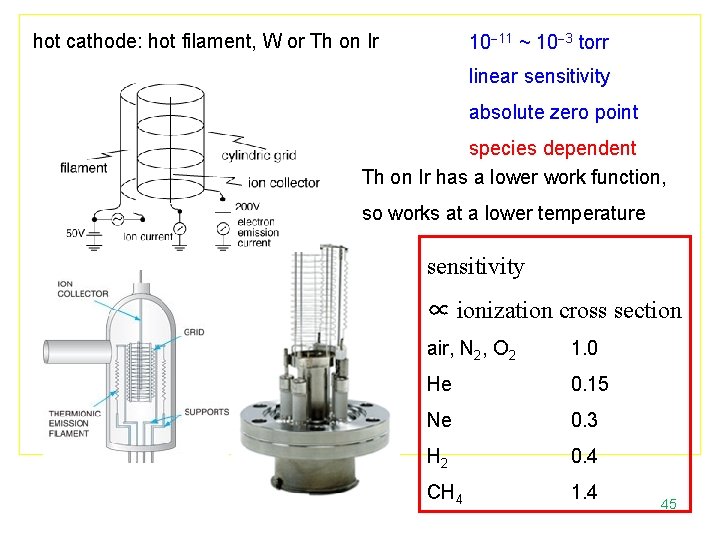
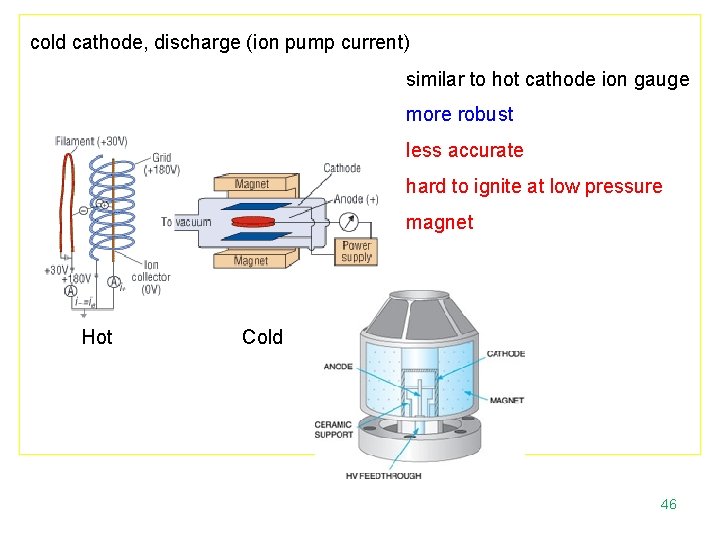
Gauge types Mechanical: liquid column, diaphragm, etc Real pressure from force measurement psig Vs. psia Thermal Conductance: Thermal Couple (TC) thermo resister (Pirani) convection cheap, wide range 106 nonlinear sensitivity zero point is not absolute species dependent Ionization: e- + M → M+ + 2 ehot cathode: hot filament, W or Th on Ir linear sensitivity absolute zero point cold cathode, discharge (ion pump current) species dependent 41
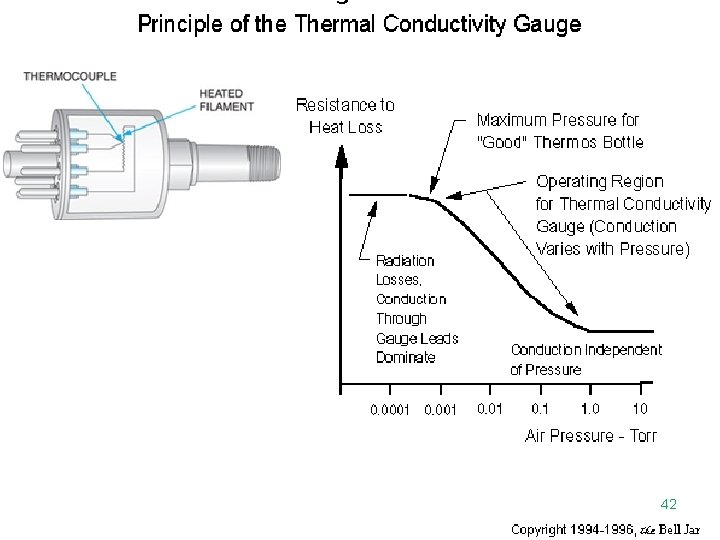
42
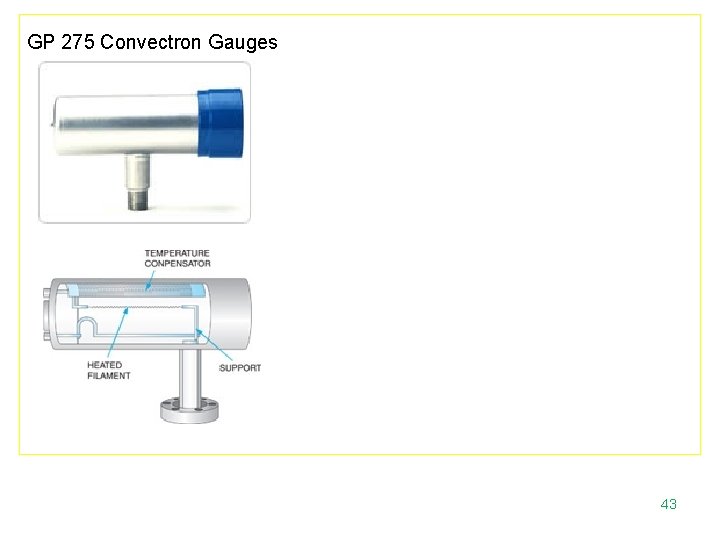
GP 275 Convectron Gauges 43
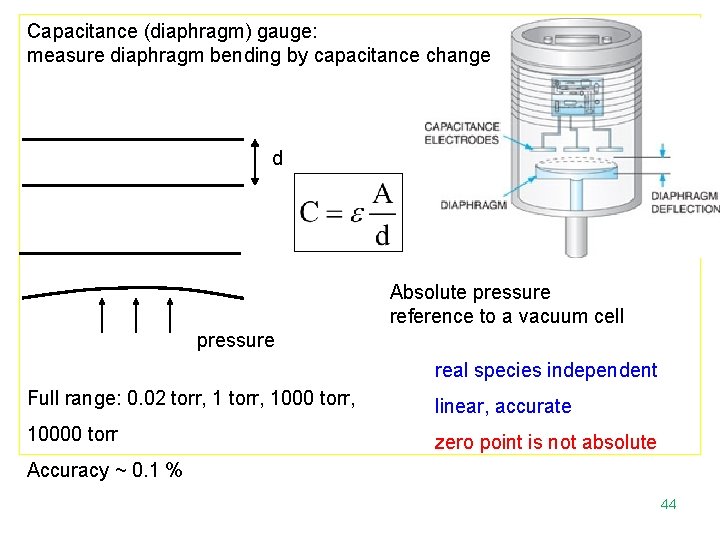
Capacitance (diaphragm) gauge: measure diaphragm bending by capacitance change d Absolute pressure reference to a vacuum cell pressure real species independent Full range: 0. 02 torr, 1000 torr, linear, accurate 10000 torr zero point is not absolute Accuracy ~ 0. 1 % 44
hot cathode: hot filament, W or Th on Ir 10 -11 ~ 10 -3 torr linear sensitivity absolute zero point species dependent Th on Ir has a lower work function, so works at a lower temperature sensitivity ∝ ionization cross section air, N 2, O 2 1. 0 He 0. 15 Ne 0. 3 H 2 0. 4 CH 4 1. 4 45
cold cathode, discharge (ion pump current) similar to hot cathode ion gauge more robust less accurate hard to ignite at low pressure magnet Hot Cold 46
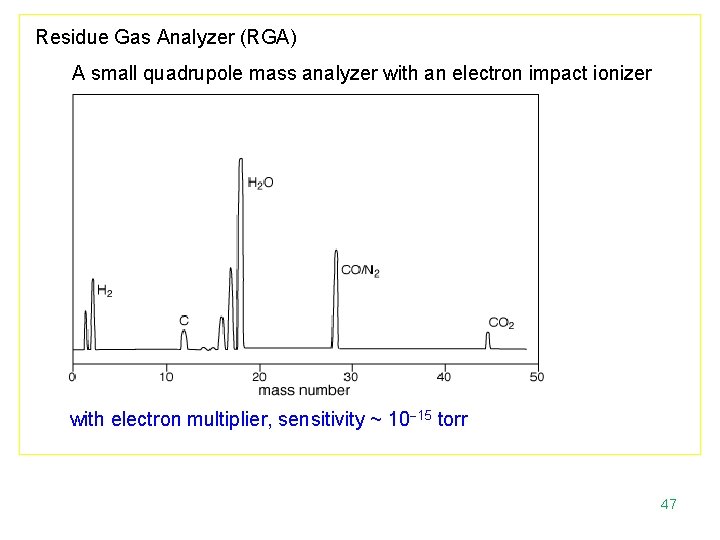
Residue Gas Analyzer (RGA) A small quadrupole mass analyzer with an electron impact ionizer with electron multiplier, sensitivity ~ 10 -15 torr 47
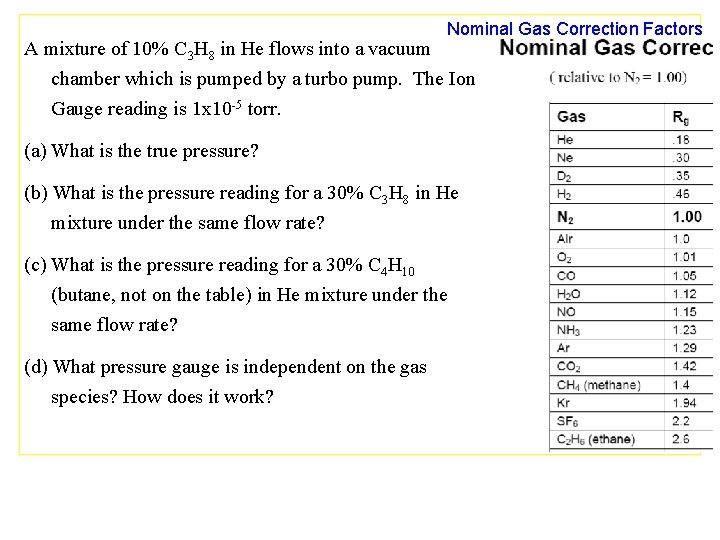
Nominal Gas Correction Factors A mixture of 10% C 3 H 8 in He flows into a vacuum chamber which is pumped by a turbo pump. The Ion Gauge reading is 1 x 10 -5 torr. (a) What is the true pressure? (b) What is the pressure reading for a 30% C 3 H 8 in He mixture under the same flow rate? (c) What is the pressure reading for a 30% C 4 H 10 (butane, not on the table) in He mixture under the same flow rate? (d) What pressure gauge is independent on the gas species? How does it work?
Where to get information? Wiki, Google, . . . Manufacturer: catalog, manual, . . Experienced users: . . . (salesman? ) Thinking: operation principle, . . .
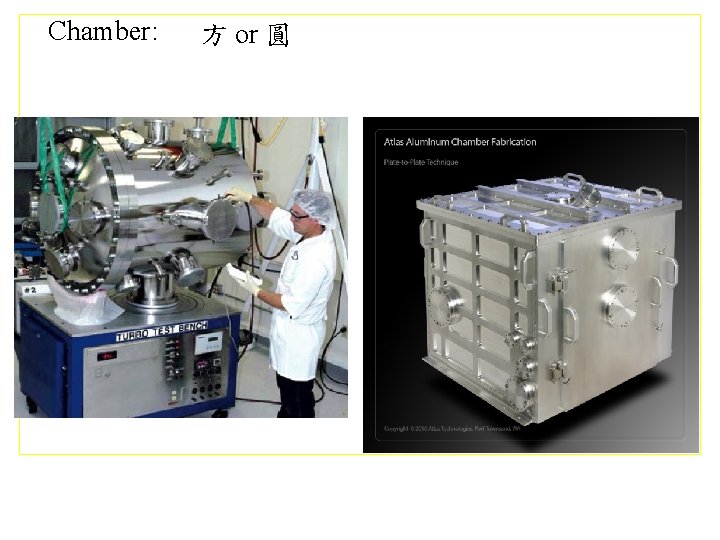
Chamber: 方 or 圓
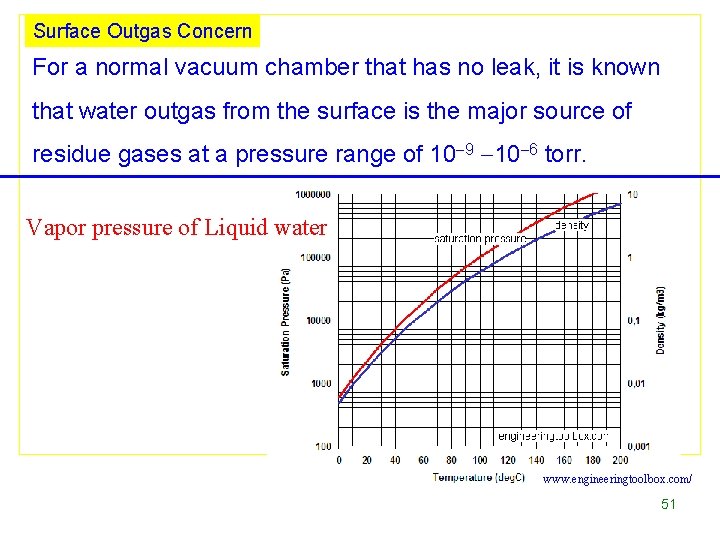
Surface Outgas Concern For a normal vacuum chamber that has no leak, it is known that water outgas from the surface is the major source of residue gases at a pressure range of 10 -9 -10 -6 torr. Vapor pressure of Liquid water www. engineeringtoolbox. com/ 51
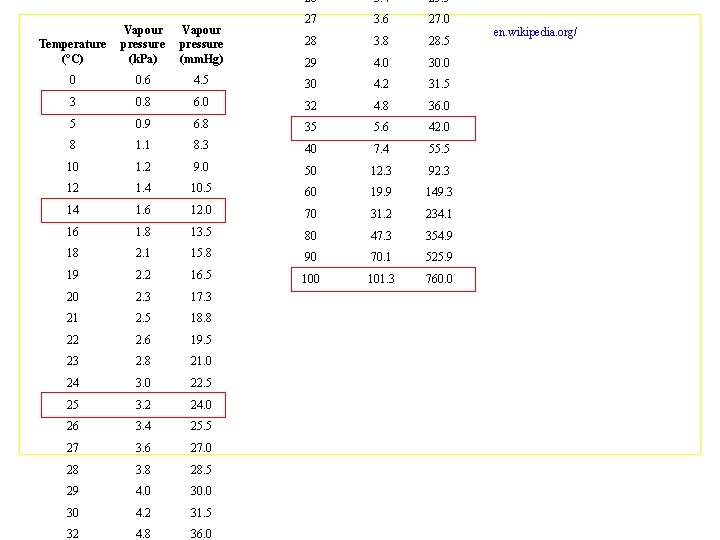
26 3. 4 25. 5 27 3. 6 27. 0 28 3. 8 28. 5 29 4. 0 30. 0 Temperature (°C) Vapour pressure (k. Pa) Vapour pressure (mm. Hg) 0 0. 6 4. 5 30 4. 2 31. 5 3 0. 8 6. 0 32 4. 8 36. 0 5 0. 9 6. 8 35 5. 6 42. 0 8 1. 1 8. 3 40 7. 4 55. 5 10 1. 2 9. 0 50 12. 3 92. 3 12 1. 4 10. 5 60 19. 9 149. 3 14 1. 6 12. 0 70 31. 2 234. 1 16 1. 8 13. 5 80 47. 3 354. 9 18 2. 1 15. 8 90 70. 1 525. 9 19 2. 2 16. 5 100 101. 3 760. 0 20 2. 3 17. 3 21 2. 5 18. 8 22 2. 6 19. 5 23 2. 8 21. 0 24 3. 0 22. 5 25 3. 2 24. 0 26 3. 4 25. 5 27 3. 6 27. 0 28 3. 8 28. 5 29 4. 0 30 4. 2 31. 5 32 4. 8 36. 0 en. wikipedia. org/
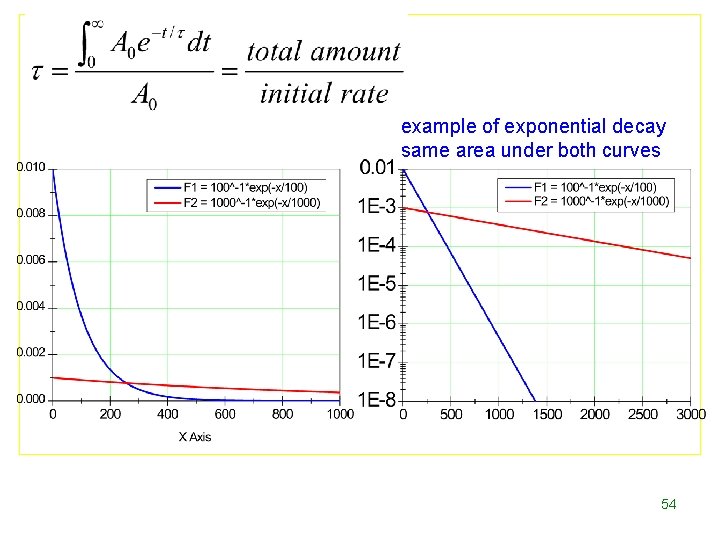
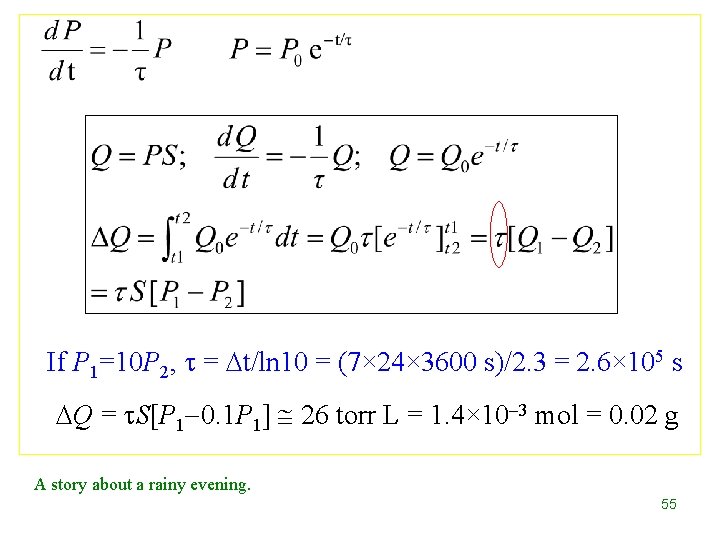
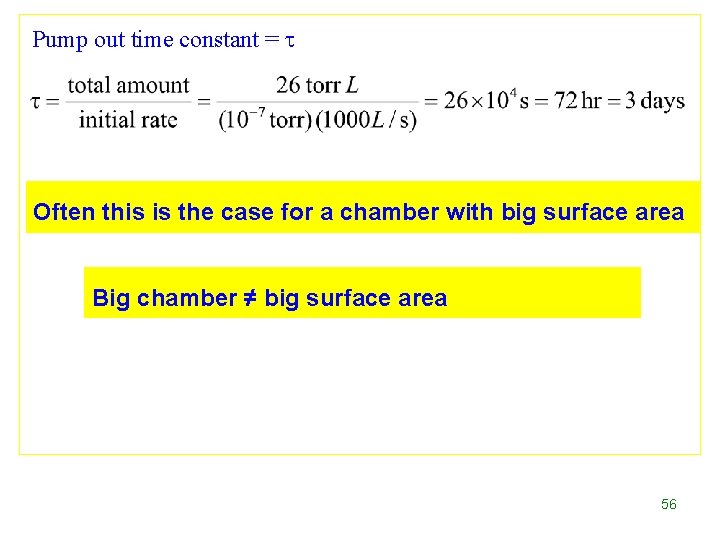
If the water outgas pressure is 1 x 10 -7 torr and it takes a week to pump down to 1 x 10 -8 torr when the pumping speed is 1000 L/s, how much water has been pumped out? Assume an exponential decay of the water outgas.
example of exponential decay same area under both curves 54
If P 1=10 P 2, t = Dt/ln 10 = (7× 24× 3600 s)/2. 3 = 2. 6× 10⁵ s DQ = t. S[P 1 -0. 1 P 1] 26 torr L = 1. 4× 10 -3 mol = 0. 02 g A story about a rainy evening. 55
Pump out time constant = t Often this is the case for a chamber with big surface area Big chamber ≠ big surface area 56
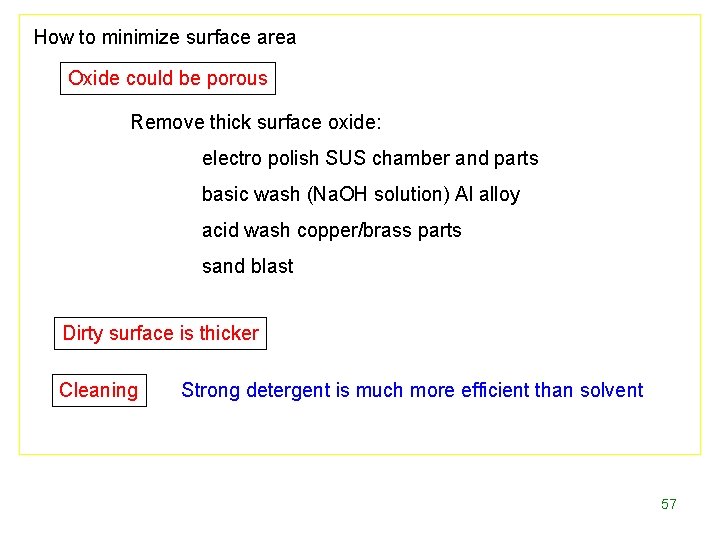
How to minimize surface area Oxide could be porous Remove thick surface oxide: electro polish SUS chamber and parts basic wash (Na. OH solution) Al alloy acid wash copper/brass parts sand blast Dirty surface is thicker Cleaning Strong detergent is much more efficient than solvent 57
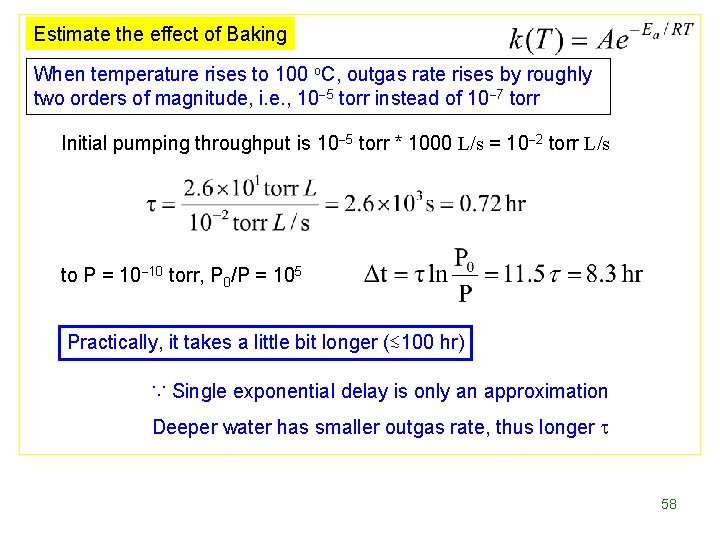
Estimate the effect of Baking When temperature rises to 100 o. C, outgas rate rises by roughly two orders of magnitude, i. e. , 10 -5 torr instead of 10 -7 torr Initial pumping throughput is 10 -5 torr * 1000 L/s = 10 -2 torr L/s to P = 10 -10 torr, P 0/P = 105 Practically, it takes a little bit longer (≲ 100 hr) ∵ Single exponential delay is only an approximation Deeper water has smaller outgas rate, thus longer t 58
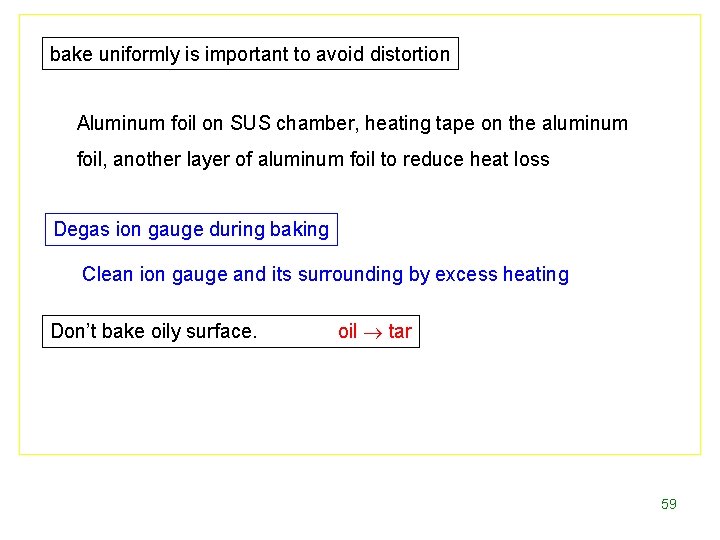
bake uniformly is important to avoid distortion Aluminum foil on SUS chamber, heating tape on the aluminum foil, another layer of aluminum foil to reduce heat loss Degas ion gauge during baking Clean ion gauge and its surrounding by excess heating Don’t bake oily surface. oil tar 59
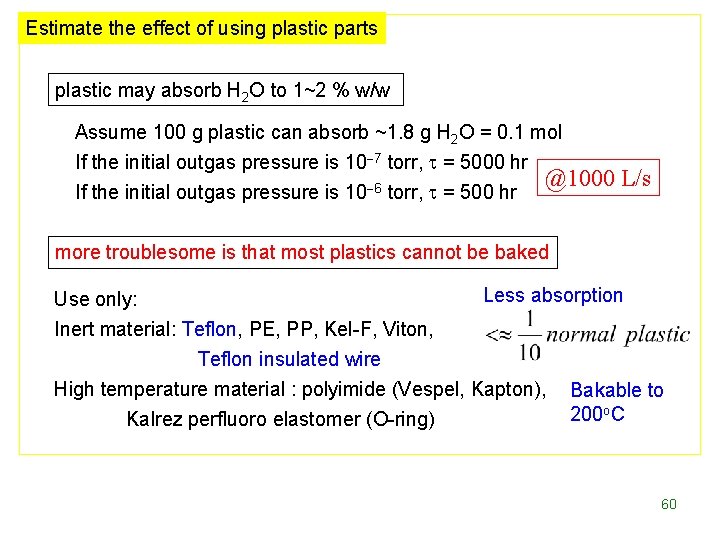
Estimate the effect of using plastic parts plastic may absorb H 2 O to 1~2 % w/w Assume 100 g plastic can absorb ~1. 8 g H 2 O = 0. 1 mol If the initial outgas pressure is 10 -7 torr, t = 5000 hr @1000 If the initial outgas pressure is 10 -6 torr, t = 500 hr L/s more troublesome is that most plastics cannot be baked Less absorption Use only: Inert material: Teflon, PE, PP, Kel-F, Viton, Teflon insulated wire High temperature material : polyimide (Vespel, Kapton), Bakable to 200 o. C Kalrez perfluoro elastomer (O-ring) 60
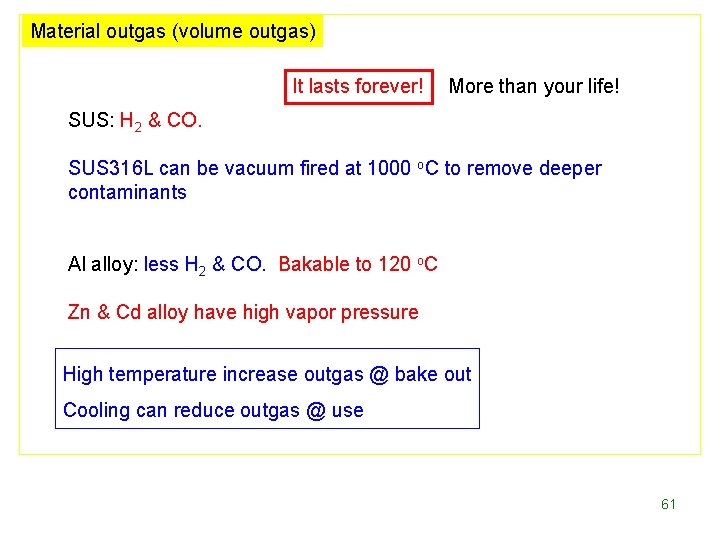
Material outgas (volume outgas) It lasts forever! More than your life! SUS: H 2 & CO. SUS 316 L can be vacuum fired at 1000 o. C to remove deeper contaminants Al alloy: less H 2 & CO. Bakable to 120 o. C Zn & Cd alloy have high vapor pressure High temperature increase outgas @ bake out Cooling can reduce outgas @ use 61
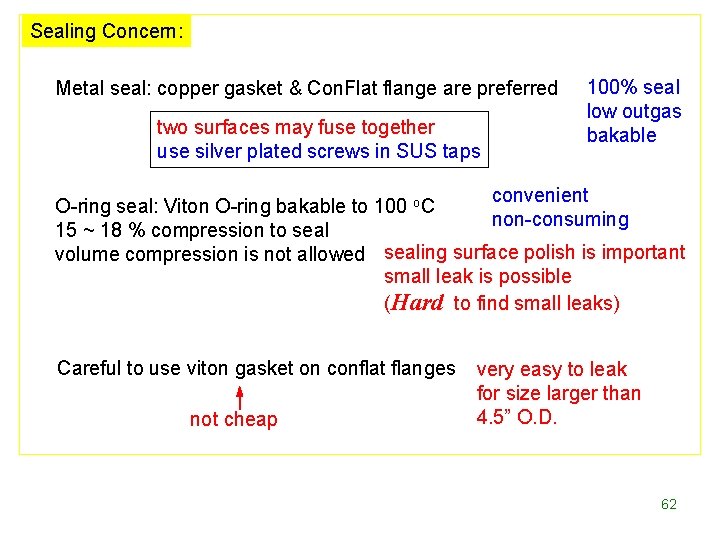
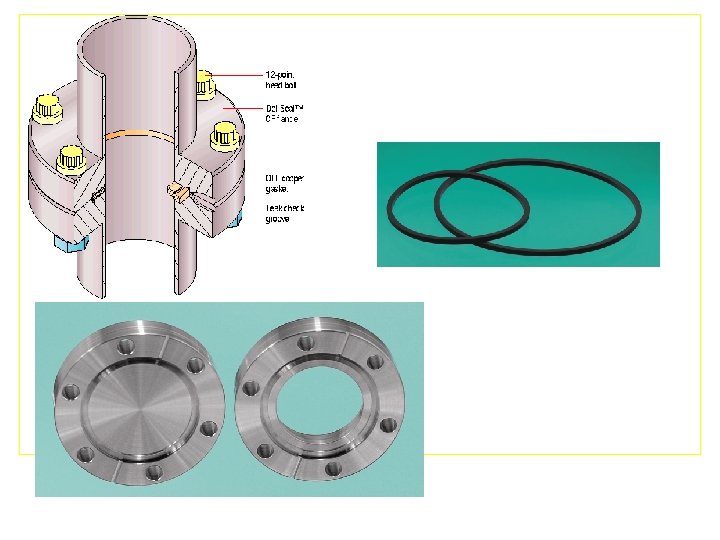
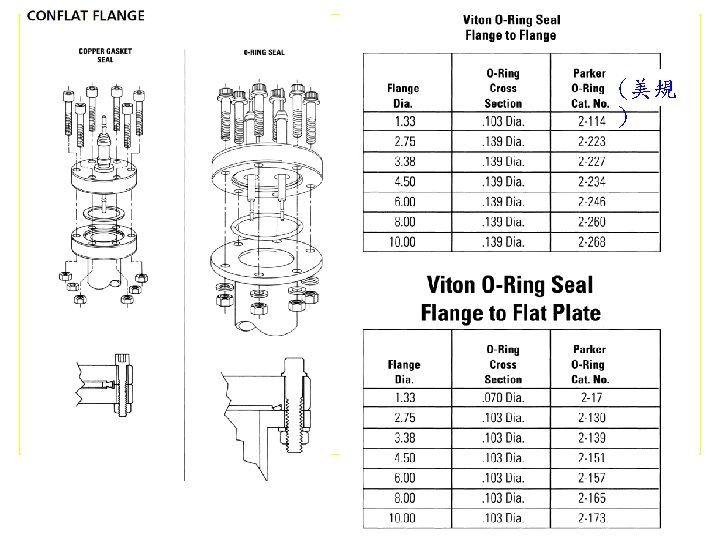
Sealing Concern: Metal seal: copper gasket & Con. Flat flange are preferred two surfaces may fuse together use silver plated screws in SUS taps 100% seal low outgas bakable convenient O-ring seal: Viton O-ring bakable to 100 o. C non-consuming 15 ~ 18 % compression to seal volume compression is not allowed sealing surface polish is important small leak is possible (Hard to find small leaks) Careful to use viton gasket on conflat flanges not cheap very easy to leak for size larger than 4. 5” O. D. 62
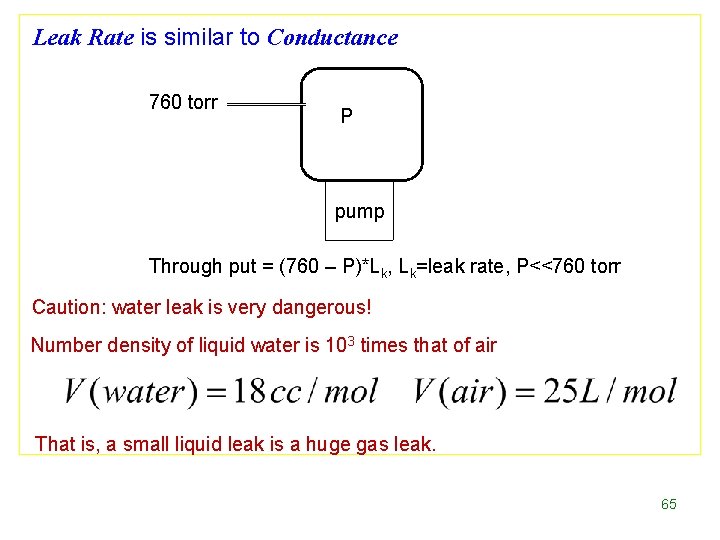
Leak Rate is similar to Conductance 760 torr P pump Through put = (760 – P)*Lk, Lk=leak rate, P<<760 torr Caution: water leak is very dangerous! Number density of liquid water is 103 times that of air That is, a small liquid leak is a huge gas leak. 65
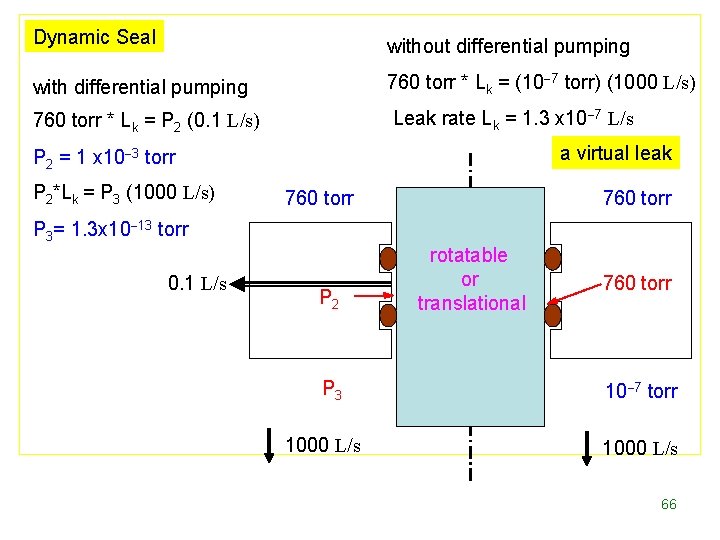
Dynamic Seal without differential pumping with differential pumping 760 torr * Lk = (10 -7 torr) (1000 L/s) 760 torr * Lk = P 2 (0. 1 L/s) Leak rate Lk = 1. 3 x 10 -7 L/s a virtual leak P 2 = 1 x 10 -3 torr P 2*Lk = P 3 (1000 L/s) 760 torr P 3= 1. 3 x 10 -13 torr 0. 1 L/s P 2 P 3 1000 L/s rotatable or translational 760 torr 10 -7 torr 1000 L/s 66
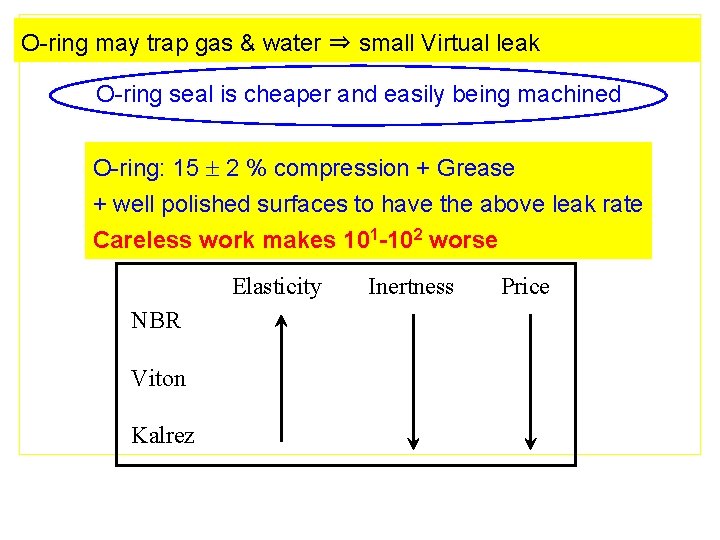
O-ring may trap gas & water ⇒ small Virtual leak O-ring seal is cheaper and easily being machined O-ring: 15 2 % compression + Grease + well polished surfaces to have the above leak rate Careless work makes 101 -102 worse Elasticity NBR Viton Kalrez Inertness Price
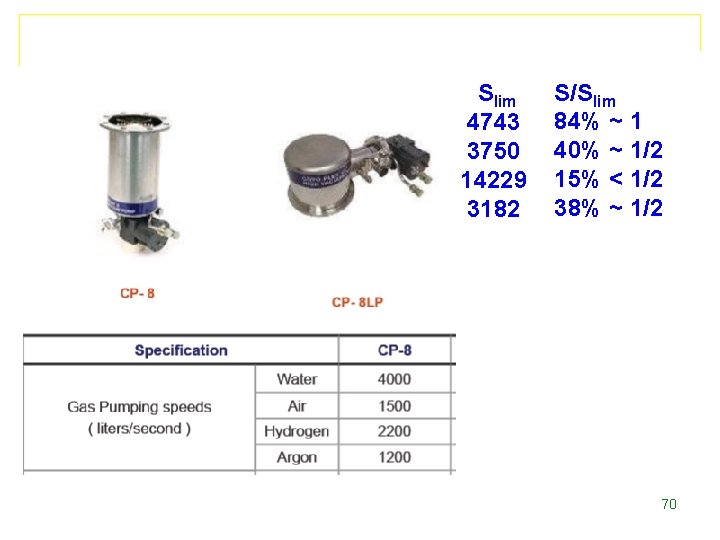
Conductance of an Aperture or short tube If there is a “black-hole” pump, For pumping port f=20 cm, A=314 cm 2, Slim(air)=3750 L/s 68
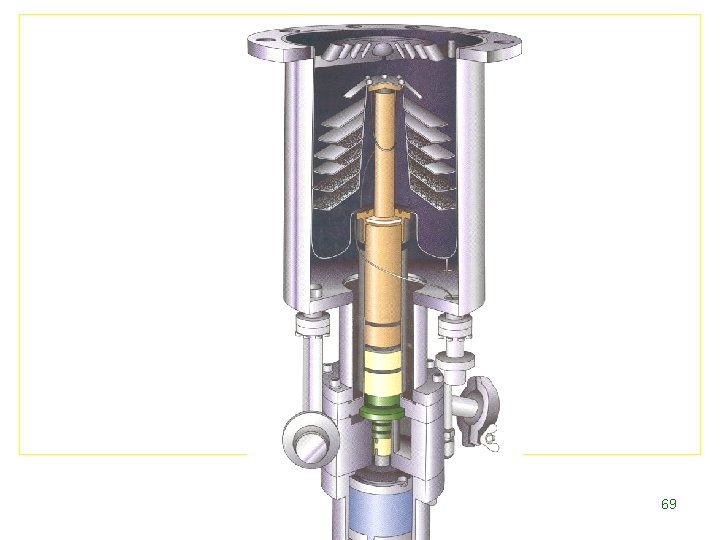
69
Slim 4743 3750 14229 3182 S/Slim 84% ~ 1 40% ~ 1/2 15% < 1/2 38% ~ 1/2 70
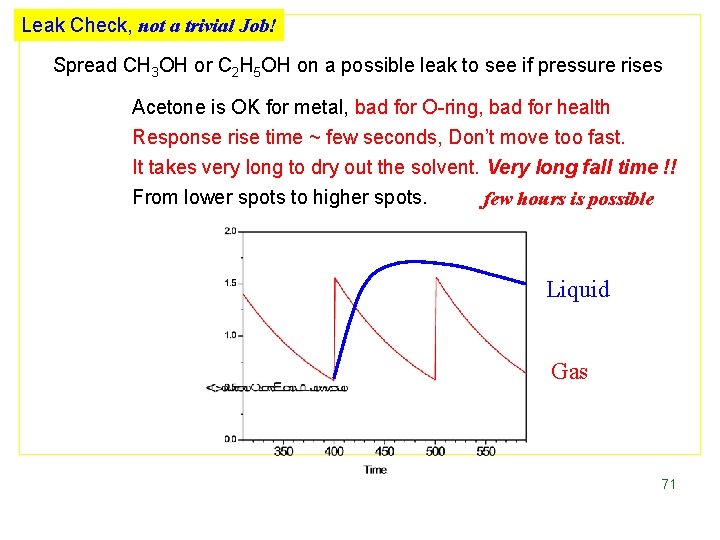
Leak Check, not a trivial Job! Spread CH 3 OH or C 2 H 5 OH on a possible leak to see if pressure rises Acetone is OK for metal, bad for O-ring, bad for health Response rise time ~ few seconds, Don’t move too fast. It takes very long to dry out the solvent. Very long fall time !! From lower spots to higher spots. few hours is possible Liquid Gas 71
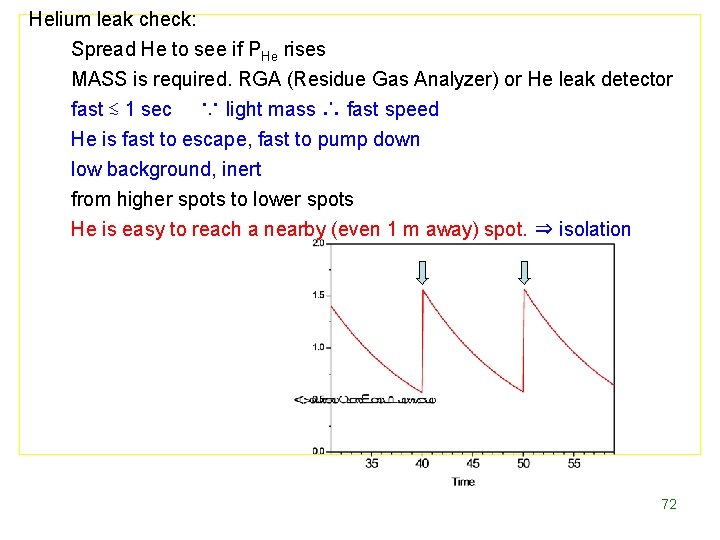
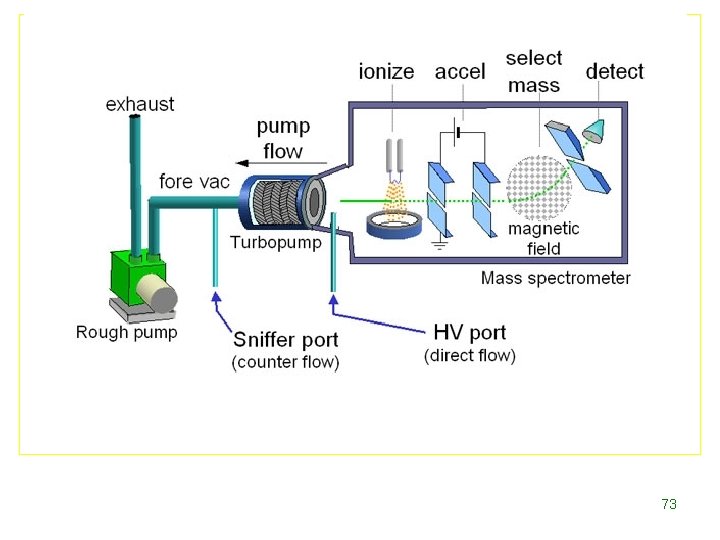
Helium leak check: Spread He to see if PHe rises MASS is required. RGA (Residue Gas Analyzer) or He leak detector fast ≲ 1 sec ∵ light mass ∴ fast speed He is fast to escape, fast to pump down low background, inert from higher spots to lower spots He is easy to reach a nearby (even 1 m away) spot. ⇒ isolation 72
73
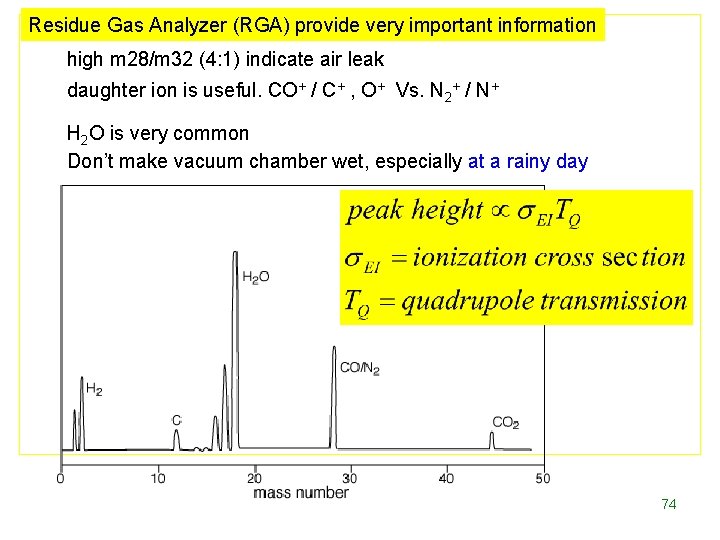
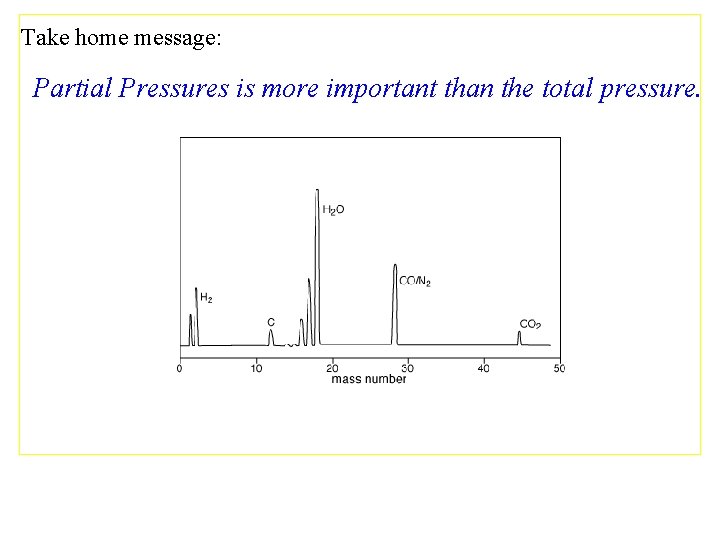
Residue Gas Analyzer (RGA) provide very important information high m 28/m 32 (4: 1) indicate air leak daughter ion is useful. CO+ / C+ , O+ Vs. N 2+ / N+ H 2 O is very common Don’t make vacuum chamber wet, especially at a rainy day 74
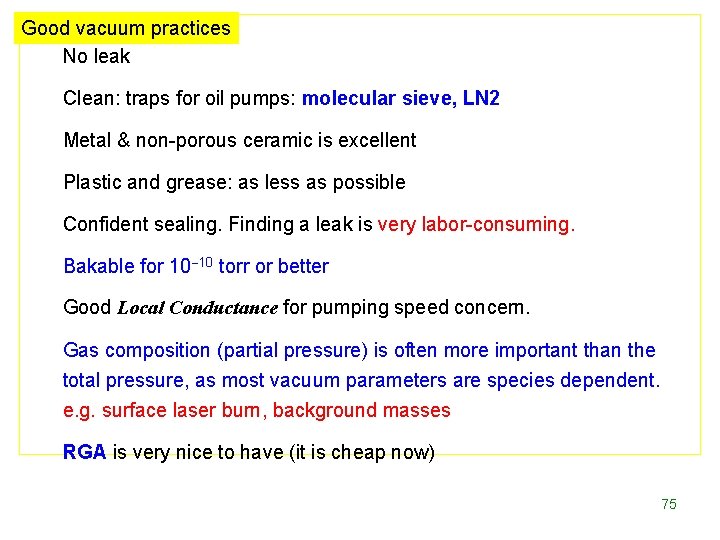
Good vacuum practices No leak Clean: traps for oil pumps: molecular sieve, LN 2 Metal & non-porous ceramic is excellent Plastic and grease: as less as possible Confident sealing. Finding a leak is very labor-consuming. Bakable for 10 -10 torr or better Good Local Conductance for pumping speed concern. Gas composition (partial pressure) is often more important than the total pressure, as most vacuum parameters are species dependent. e. g. surface laser burn, background masses RGA is very nice to have (it is cheap now) 75
Take home message: Partial Pressures is more important than the total pressure.
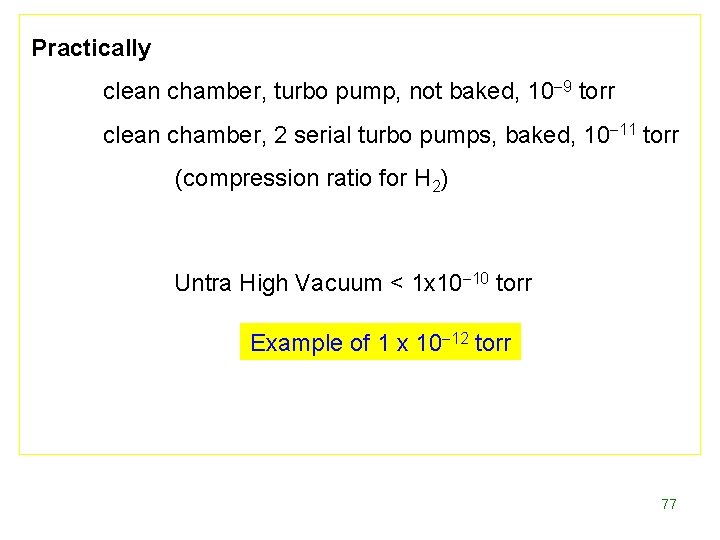
Practically clean chamber, turbo pump, not baked, 10 -9 torr clean chamber, 2 serial turbo pumps, baked, 10 -11 torr (compression ratio for H 2) Untra High Vacuum < 1 x 10 -10 torr Example of 1 x 10 -12 torr 77
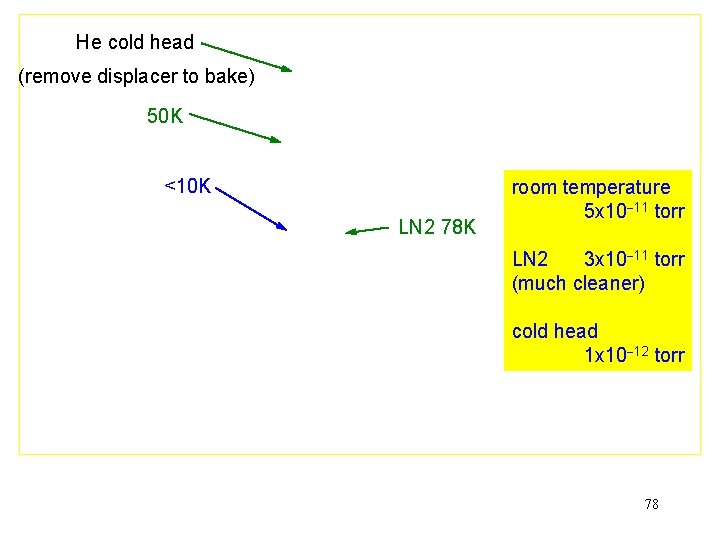
He cold head (remove displacer to bake) 50 K <10 K LN 2 78 K room temperature 5 x 10 -11 torr LN 2 3 x 10 -11 torr (much cleaner) cold head 1 x 10 -12 torr 78
79
80
81
82
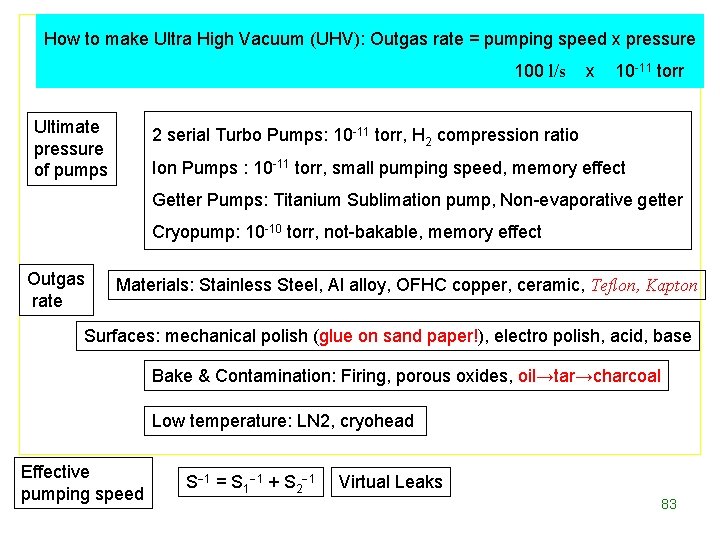
How to make Ultra High Vacuum (UHV): Outgas rate = pumping speed x pressure 100 l/s Ultimate pressure of pumps x 10 -11 torr 2 serial Turbo Pumps: 10 -11 torr, H 2 compression ratio Ion Pumps : 10 -11 torr, small pumping speed, memory effect Getter Pumps: Titanium Sublimation pump, Non-evaporative getter Cryopump: 10 -10 torr, not-bakable, memory effect Outgas rate Materials: Stainless Steel, Al alloy, OFHC copper, ceramic, Teflon, Kapton Surfaces: mechanical polish (glue on sand paper!), electro polish, acid, base Bake & Contamination: Firing, porous oxides, oil→tar→charcoal Low temperature: LN 2, cryohead Effective pumping speed S-1 = S 1 -1 + S 2 -1 Virtual Leaks 83
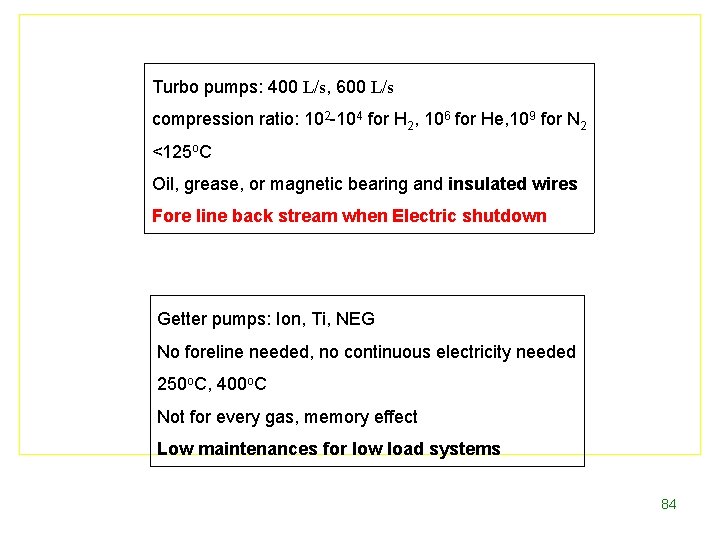
Turbo pumps: 400 L/s, 600 L/s compression ratio: 102 -104 for H 2, 106 for He, 109 for N 2 <125 o. C Oil, grease, or magnetic bearing and insulated wires Fore line back stream when Electric shutdown Getter pumps: Ion, Ti, NEG No foreline needed, no continuous electricity needed 250 o. C, 400 o. C Not for every gas, memory effect Low maintenances for low load systems 84
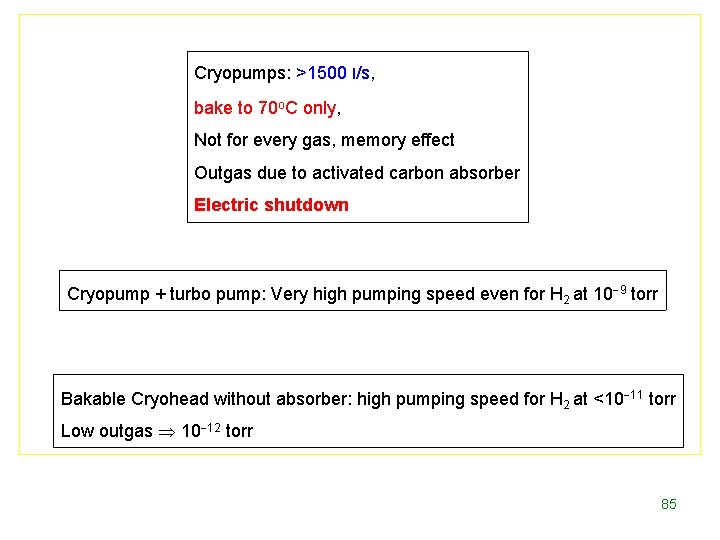
Cryopumps: >1500 l/s, bake to 70 o. C only, Not for every gas, memory effect Outgas due to activated carbon absorber Electric shutdown Cryopump + turbo pump: Very high pumping speed even for H 2 at 10 -9 torr Bakable Cryohead without absorber: high pumping speed for H 2 at <10 -11 torr Low outgas 10 -12 torr 85
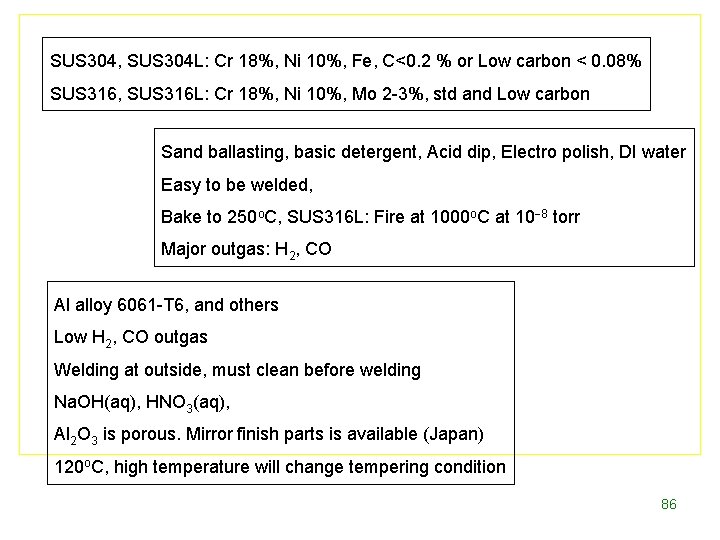
SUS 304, SUS 304 L: Cr 18%, Ni 10%, Fe, C<0. 2 % or Low carbon < 0. 08% SUS 316, SUS 316 L: Cr 18%, Ni 10%, Mo 2 -3%, std and Low carbon Sand ballasting, basic detergent, Acid dip, Electro polish, DI water Easy to be welded, Bake to 250 o. C, SUS 316 L: Fire at 1000 o. C at 10 -8 torr Major outgas: H 2, CO Al alloy 6061 -T 6, and others Low H 2, CO outgas Welding at outside, must clean before welding Na. OH(aq), HNO 3(aq), Al 2 O 3 is porous. Mirror finish parts is available (Japan) 120 o. C, high temperature will change tempering condition 86
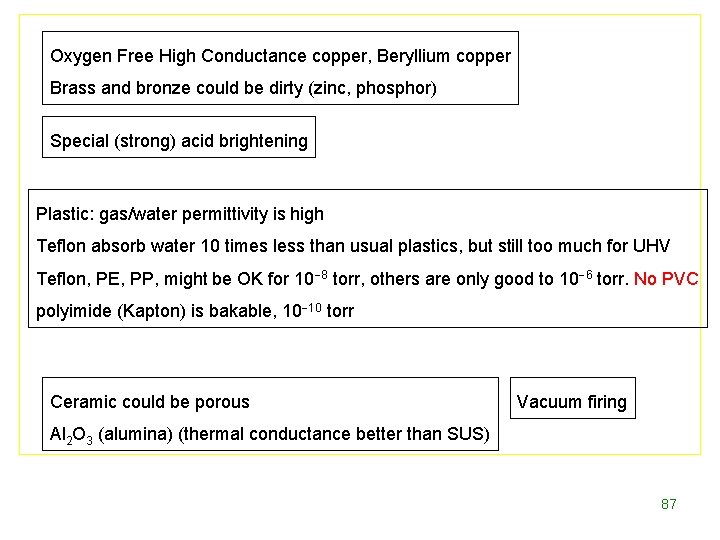
Oxygen Free High Conductance copper, Beryllium copper Brass and bronze could be dirty (zinc, phosphor) Special (strong) acid brightening Plastic: gas/water permittivity is high Teflon absorb water 10 times less than usual plastics, but still too much for UHV Teflon, PE, PP, might be OK for 10 -8 torr, others are only good to 10 -6 torr. No PVC polyimide (Kapton) is bakable, 10 -10 torr Ceramic could be porous Vacuum firing Al 2 O 3 (alumina) (thermal conductance better than SUS) 87
Thank You for Your Attention