
Vacuum Pump Vibration Isolation System Advisor Dr Dave
Vacuum Pump Vibration Isolation System Advisor Dr. Dave Turcic Sponsor Edwards Vacuum Ltd. Team Members Duc Le Ron Pahle Thanh Nguyen Khoa Tran
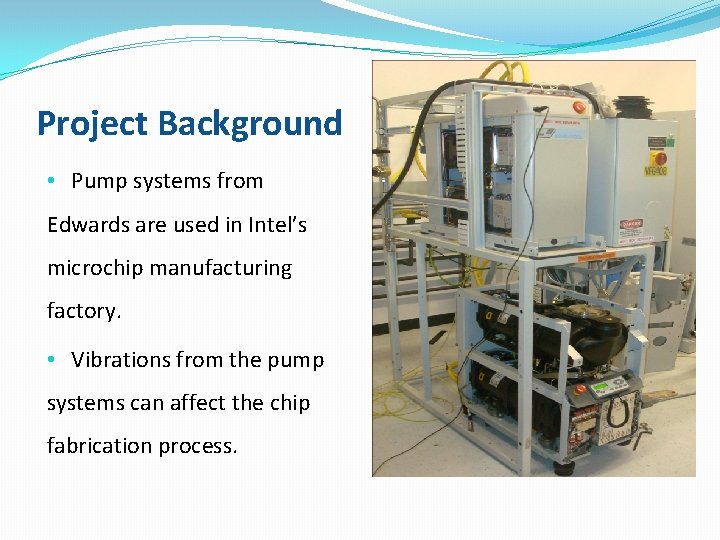
Project Background • Pump systems from Edwards are used in Intel’s microchip manufacturing factory. • Vibrations from the pump systems can affect the chip fabrication process.
Mission Statement Devise a solution to minimize the vibration propagated from the pump system, through the steel frame, and to the surrounding workplace. This is meant to reduce any interference the pumps vibrations could have on sensitive manufacturing equipment.
Main Design Requirements • Design a system to reduce the vibration transmitted from the pump to the frame by at least 25% (measured by acceleration) • Requirements: Cost less than $1000 per frame. Require no power (passive). Work at 4 designated pump speeds. Fit within the current frame.
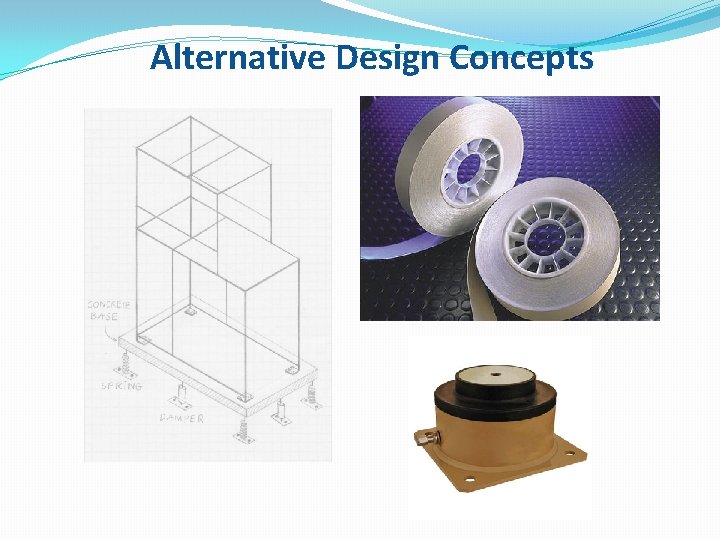
Alternative Design Concepts
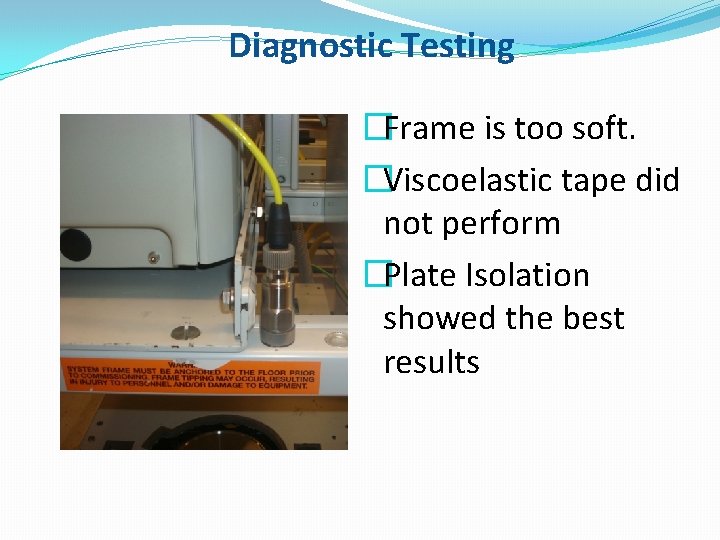
Diagnostic Testing �Frame is too soft. �Viscoelastic tape did not perform �Plate Isolation showed the best results
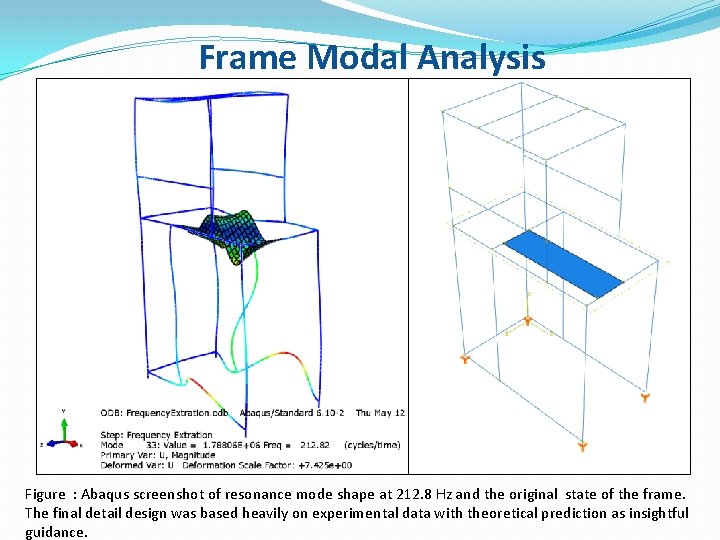
Frame Modal Analysis Figure : Abaqus screenshot of resonance mode shape at 212. 8 Hz and the original state of the frame. The final detail design was based heavily on experimental data with theoretical prediction as insightful guidance.
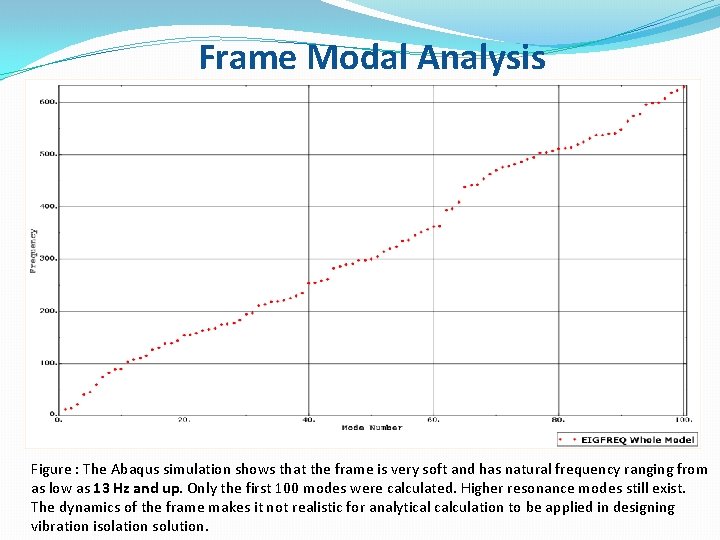
Frame Modal Analysis Figure : The Abaqus simulation shows that the frame is very soft and has natural frequency ranging from as low as 13 Hz and up. Only the first 100 modes were calculated. Higher resonance modes still exist. The dynamics of the frame makes it not realistic for analytical calculation to be applied in designing vibration isolation solution.
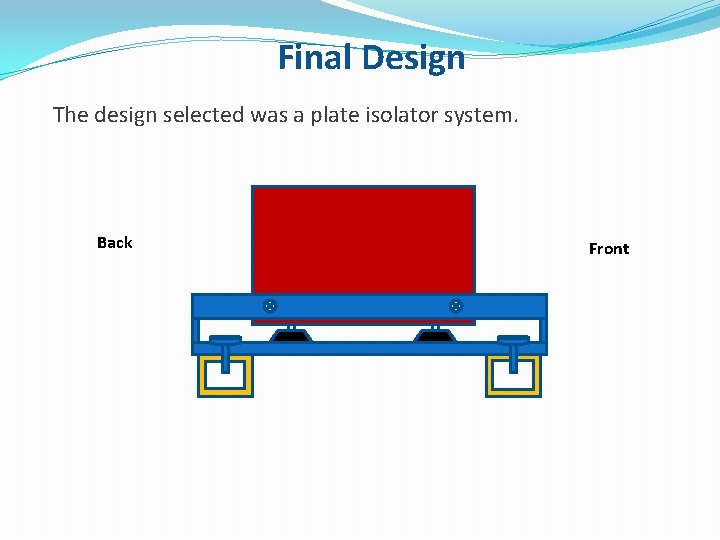
Final Design The design selected was a plate isolator system. Back Front
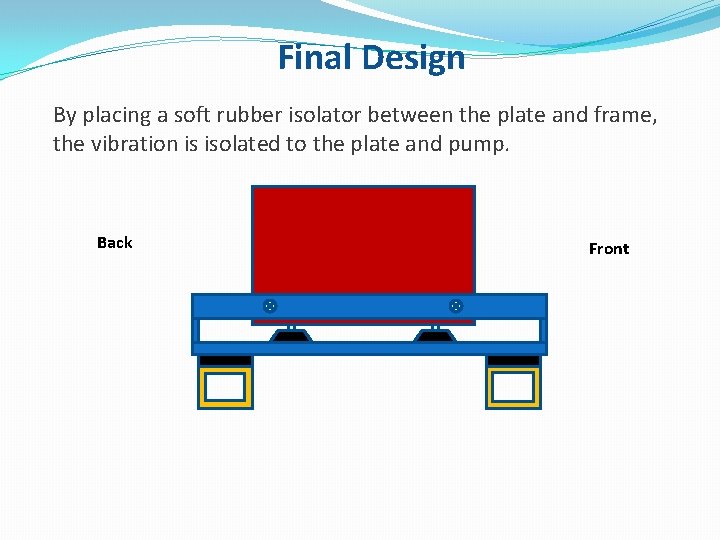
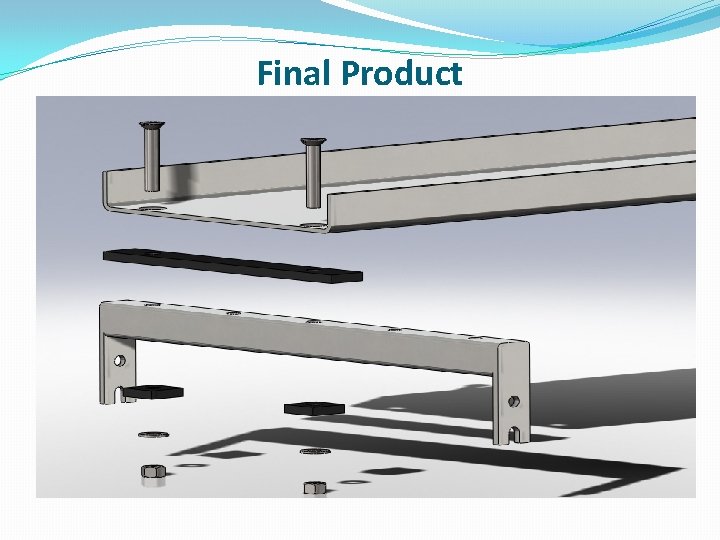
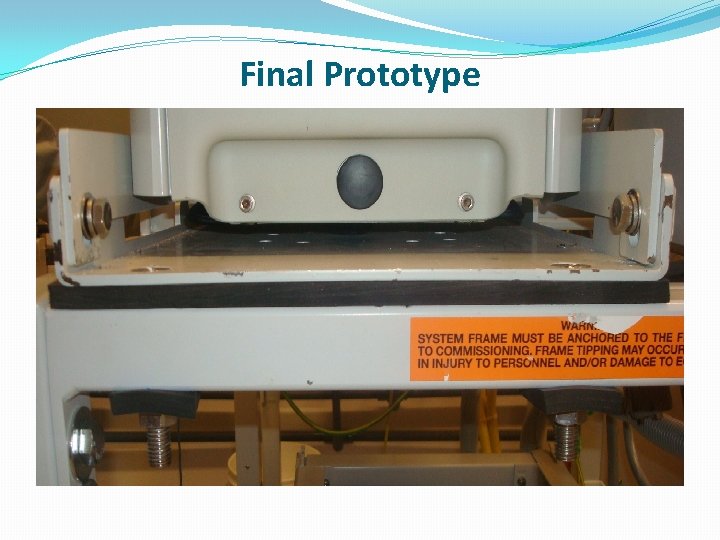
Final Design By placing a soft rubber isolator between the plate and frame, the vibration is isolated to the plate and pump. Back Front
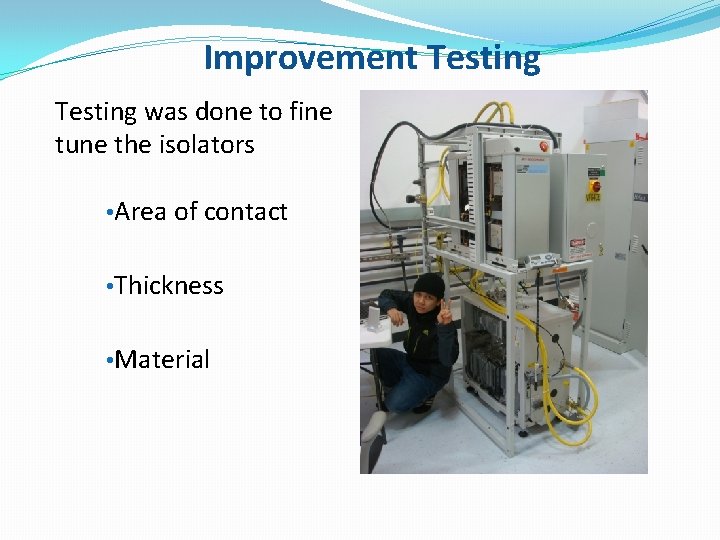
Improvement Testing was done to fine tune the isolators • Area of contact • Thickness • Material
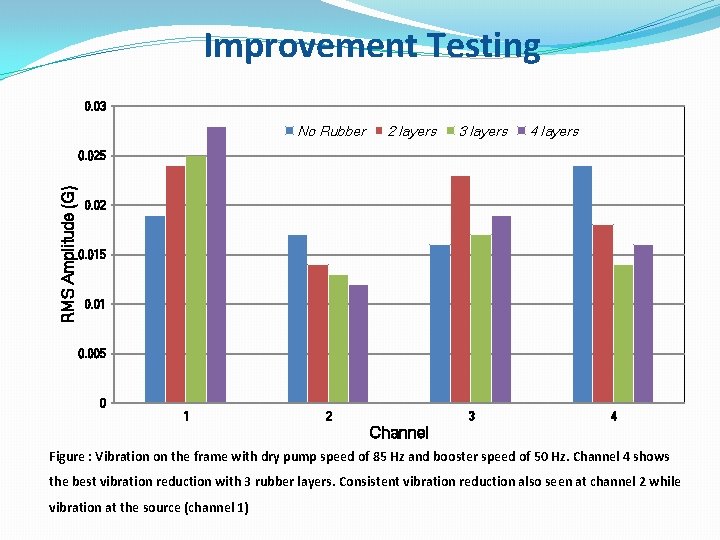
Improvement Testing 0. 03 No Rubber 2 layers 3 layers 4 layers RMS Amplitude (G) 0. 025 0. 02 0. 015 0. 01 0. 005 0 1 2 3 4 Channel Figure : Vibration on the frame with dry pump speed of 85 Hz and booster speed of 50 Hz. Channel 4 shows the best vibration reduction with 3 rubber layers. Consistent vibration reduction also seen at channel 2 while vibration at the source (channel 1)
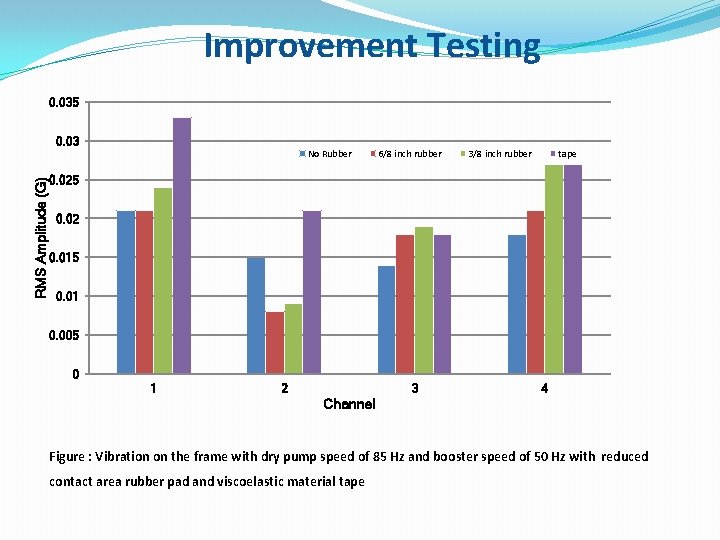
Improvement Testing 0. 035 RMS Amplitude (G) 0. 03 No Rubber 6/8 inch rubber 3/8 inch rubber tape 0. 025 0. 02 0. 015 0. 01 0. 005 0 1 2 3 4 Channel Figure : Vibration on the frame with dry pump speed of 85 Hz and booster speed of 50 Hz with reduced contact area rubber pad and viscoelastic material tape
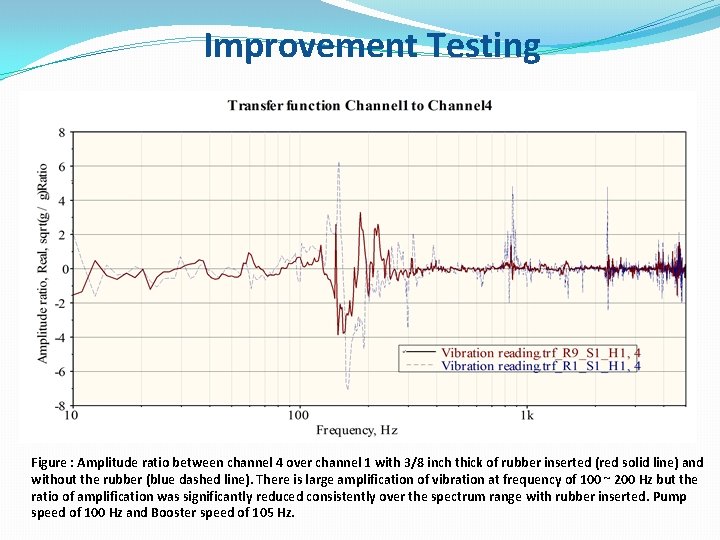
Improvement Testing Figure : Amplitude ratio between channel 4 over channel 1 with 3/8 inch thick of rubber inserted (red solid line) and without the rubber (blue dashed line). There is large amplification of vibration at frequency of 100 ~ 200 Hz but the ratio of amplification was significantly reduced consistently over the spectrum range with rubber inserted. Pump speed of 100 Hz and Booster speed of 105 Hz.

Testing Conclusions �Reducing the rubber pad’s contact area does not improve vibration isolation �Damping effect is much more critical than reducing the rubber stiffness �Thickness: 3/8 inch �Contact Area: Full �Material: Neoprene Rubber
Final Product
Final Prototype
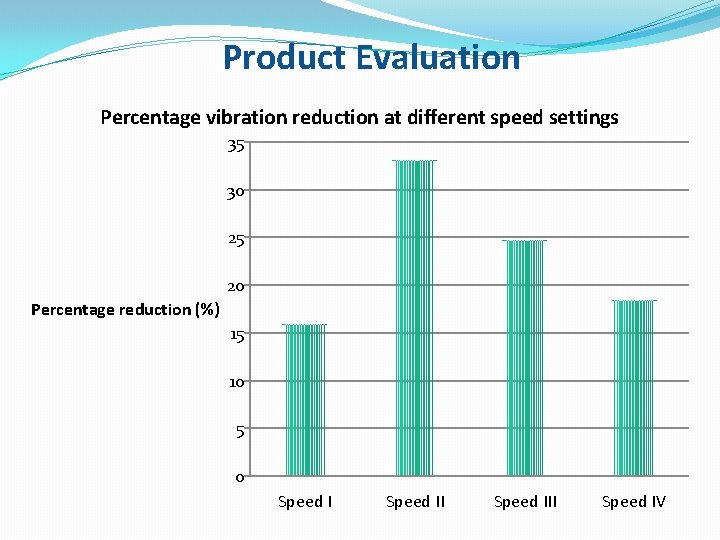
Product Evaluation Percentage vibration reduction at different speed settings 35 30 25 20 Percentage reduction (%) 15 10 5 0 Speed III Speed IV
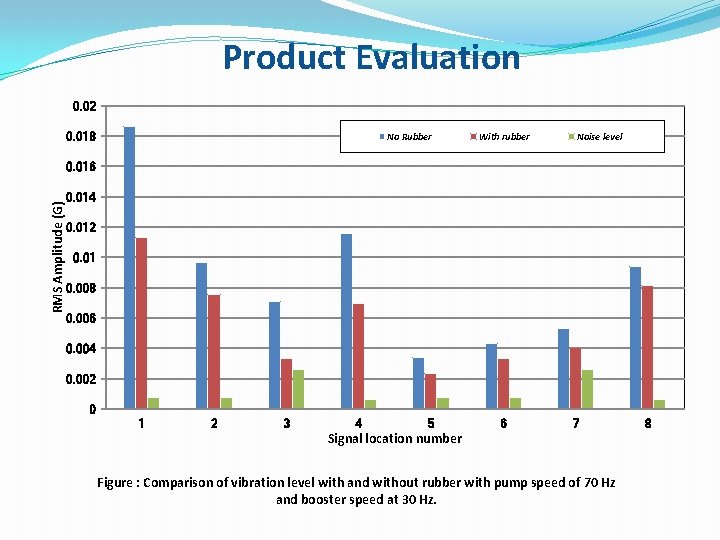
Product Evaluation 0. 02 0. 018 No Rubber With rubber Noise level RMS Amplitude (G) 0. 016 0. 014 0. 012 0. 01 0. 008 0. 006 0. 004 0. 002 0 1 2 3 4 5 Signal location number 6 7 Figure : Comparison of vibration level with and without rubber with pump speed of 70 Hz and booster speed at 30 Hz. 8

Meeting Design Requirements Khoawhy me? ? Requirement Expected Results Performance 25% 23% Cost $1000/frame $83. 81/frame Power None ü Speeds 4 Speed Combo ü Frame Constraint Fit in current frame ü
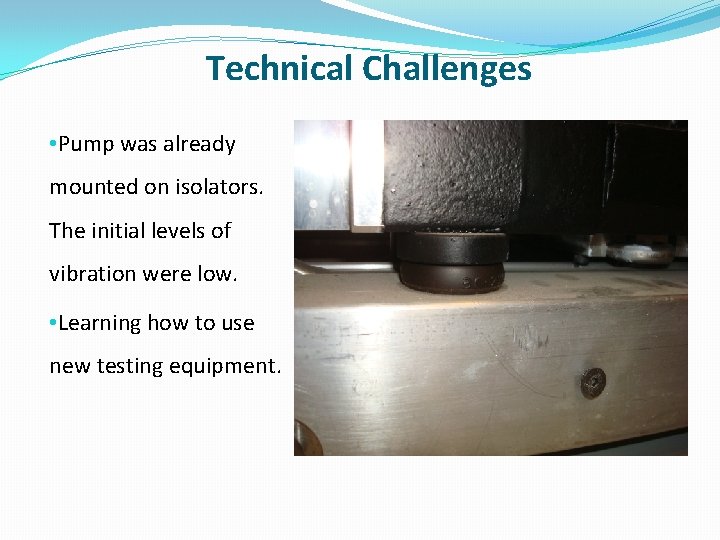
Technical Challenges • Pump was already mounted on isolators. The initial levels of vibration were low. • Learning how to use new testing equipment.
Project Challenges �Project has many unexpected elements. �Project’s scope has changed. �A lot of effort required to coordinate actions.
What We Learned �System Dynamics �Vibration Technologies and Approaches �Operation of Different Testing Equipment �Working as a team on a real technical project �Project management (people, time, money …)
Conclusion �The team has come up with a solution to reduce vibration transmission from the vacuum pump to the frame, built a prototype and tested it. � 4 out of 5 criteria are satisfied. More work is still needed to achieve higher performance. � Made suggestions to improve the product based on our experience.
Questions ?

Thank you
- Slides: 26