
Vacuum extractor and pump q principles of operation

- Slides: 12
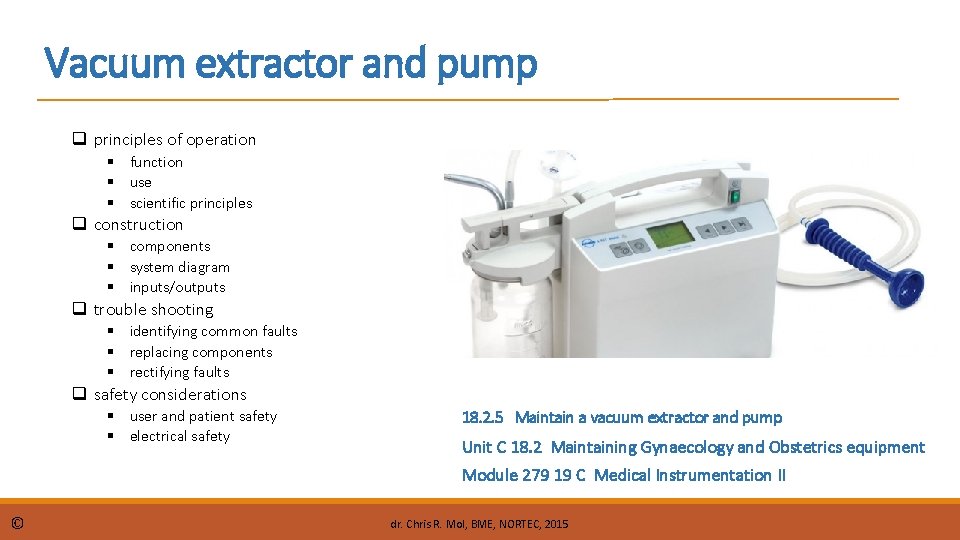
Vacuum extractor and pump q principles of operation § function § use § scientific principles q construction § components § system diagram § inputs/outputs q trouble shooting § identifying common faults § replacing components § rectifying faults q safety considerations § user and patient safety § electrical safety 18. 2. 5 Maintain a vacuum extractor and pump Unit C 18. 2 Maintaining Gynaecology and Obstetrics equipment Module 279 19 C Medical Instrumentation II © dr. Chris R. Mol, BME, NORTEC, 2015
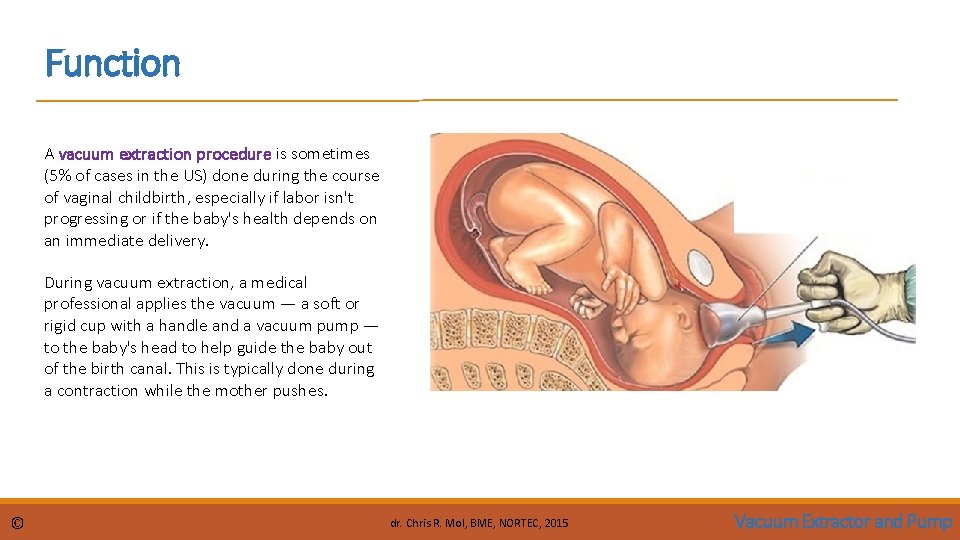
Function A vacuum extraction procedure is sometimes (5% of cases in the US) done during the course of vaginal childbirth, especially if labor isn't progressing or if the baby's health depends on an immediate delivery. During vacuum extraction, a medical professional applies the vacuum — a soft or rigid cup with a handle and a vacuum pump — to the baby's head to help guide the baby out of the birth canal. This is typically done during a contraction while the mother pushes. © dr. Chris R. Mol, BME, NORTEC, 2015 Vacuum Extractor and Pump
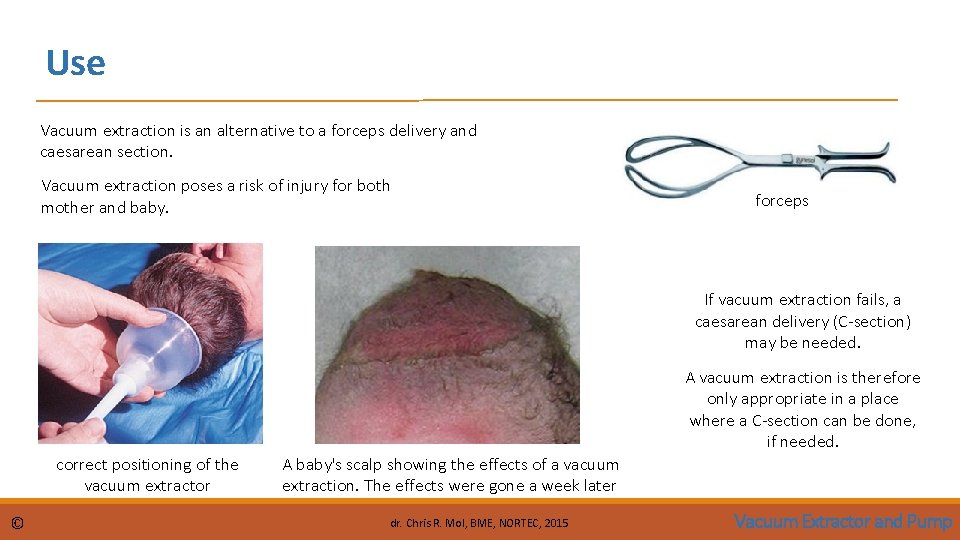
Use Vacuum extraction is an alternative to a forceps delivery and caesarean section. Vacuum extraction poses a risk of injury for both mother and baby. forceps If vacuum extraction fails, a caesarean delivery (C-section) may be needed. A vacuum extraction is therefore only appropriate in a place where a C-section can be done, if needed. correct positioning of the vacuum extractor © A baby's scalp showing the effects of a vacuum extraction. The effects were gone a week later dr. Chris R. Mol, BME, NORTEC, 2015 Vacuum Extractor and Pump
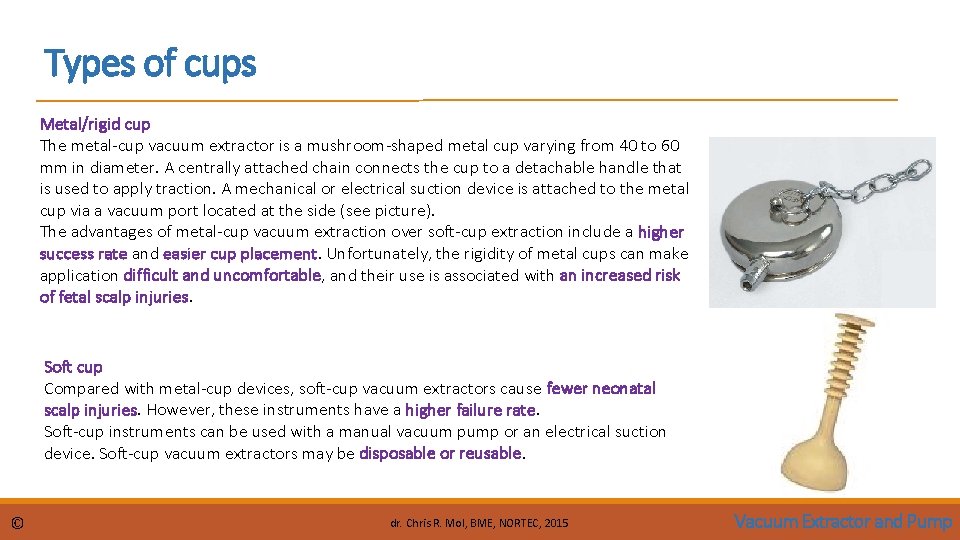
Types of cups Metal/rigid cup The metal-cup vacuum extractor is a mushroom-shaped metal cup varying from 40 to 60 mm in diameter. A centrally attached chain connects the cup to a detachable handle that is used to apply traction. A mechanical or electrical suction device is attached to the metal cup via a vacuum port located at the side (see picture). The advantages of metal-cup vacuum extraction over soft-cup extraction include a higher success rate and easier cup placement. Unfortunately, the rigidity of metal cups can make application difficult and uncomfortable, and their use is associated with an increased risk of fetal scalp injuries. Soft cup Compared with metal-cup devices, soft-cup vacuum extractors cause fewer neonatal scalp injuries. However, these instruments have a higher failure rate. Soft-cup instruments can be used with a manual vacuum pump or an electrical suction device. Soft-cup vacuum extractors may be disposable or reusable. © dr. Chris R. Mol, BME, NORTEC, 2015 Vacuum Extractor and Pump
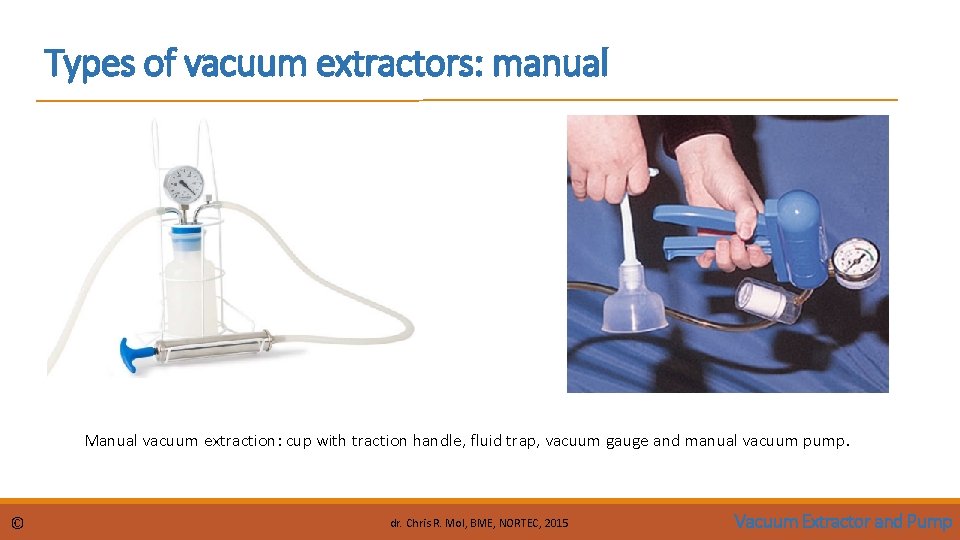
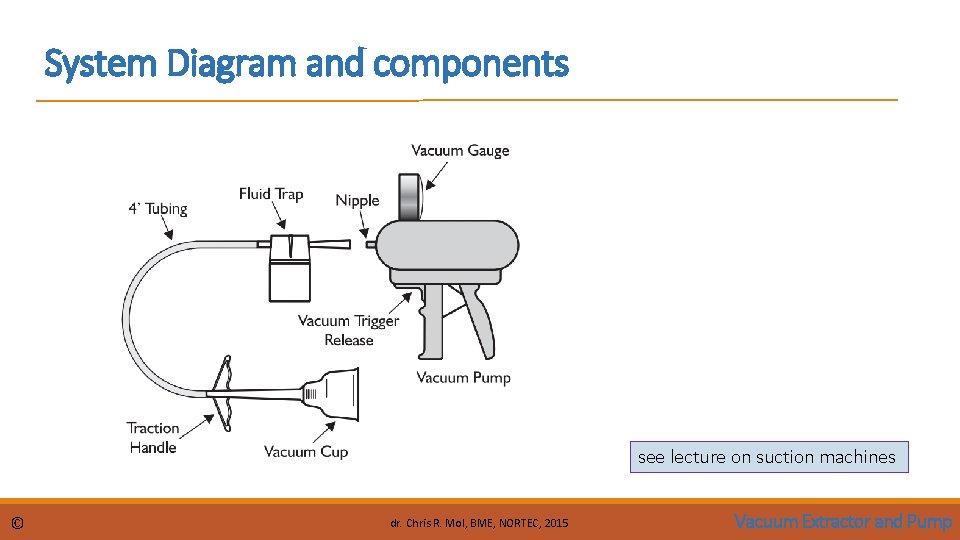
Types of vacuum extractors: manual Manual vacuum extraction: cup with traction handle, fluid trap, vacuum gauge and manual vacuum pump. © dr. Chris R. Mol, BME, NORTEC, 2015 Vacuum Extractor and Pump
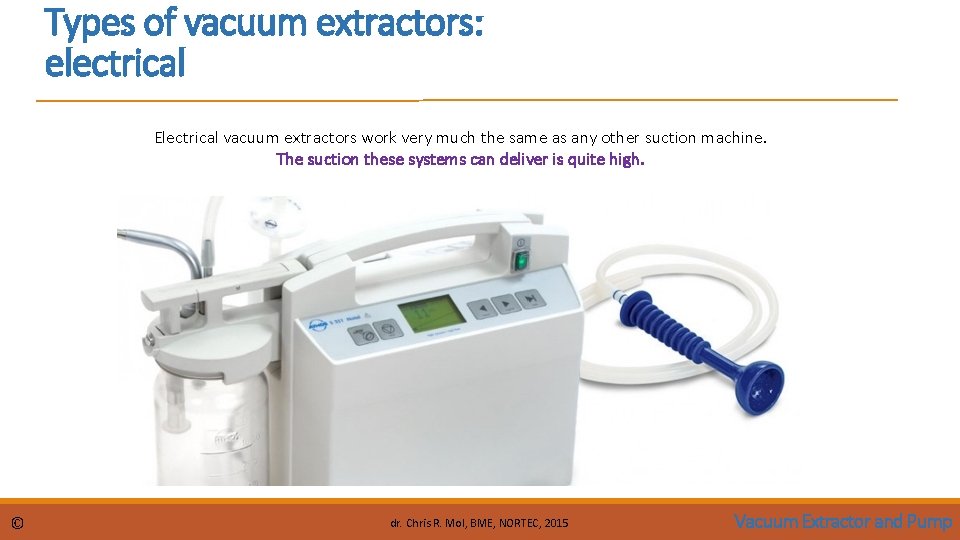
Types of vacuum extractors: electrical Electrical vacuum extractors work very much the same as any other suction machine. The suction these systems can deliver is quite high. © dr. Chris R. Mol, BME, NORTEC, 2015 Vacuum Extractor and Pump
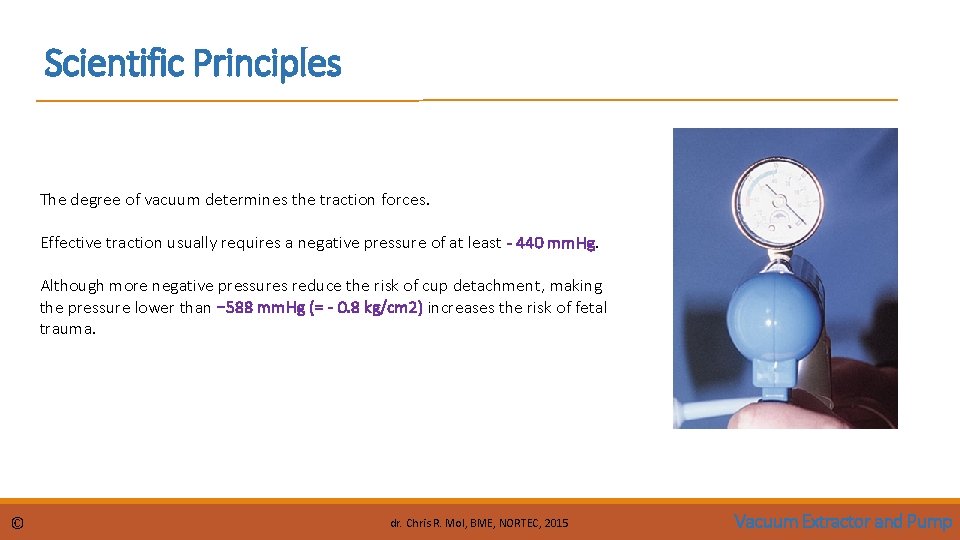
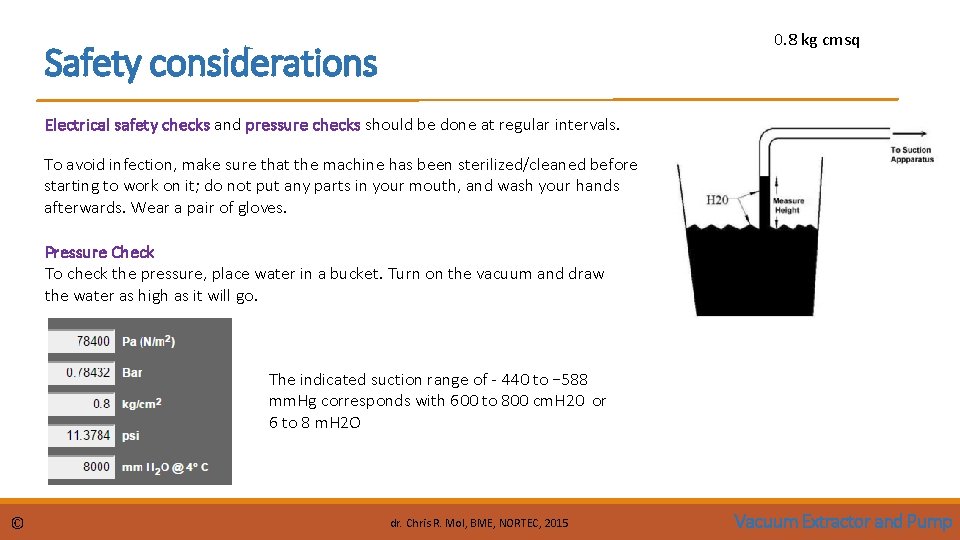
Scientific Principles The degree of vacuum determines the traction forces. Effective traction usually requires a negative pressure of at least - 440 mm. Hg. Although more negative pressures reduce the risk of cup detachment, making the pressure lower than − 588 mm. Hg (= - 0. 8 kg/cm 2) increases the risk of fetal trauma. © dr. Chris R. Mol, BME, NORTEC, 2015 Vacuum Extractor and Pump
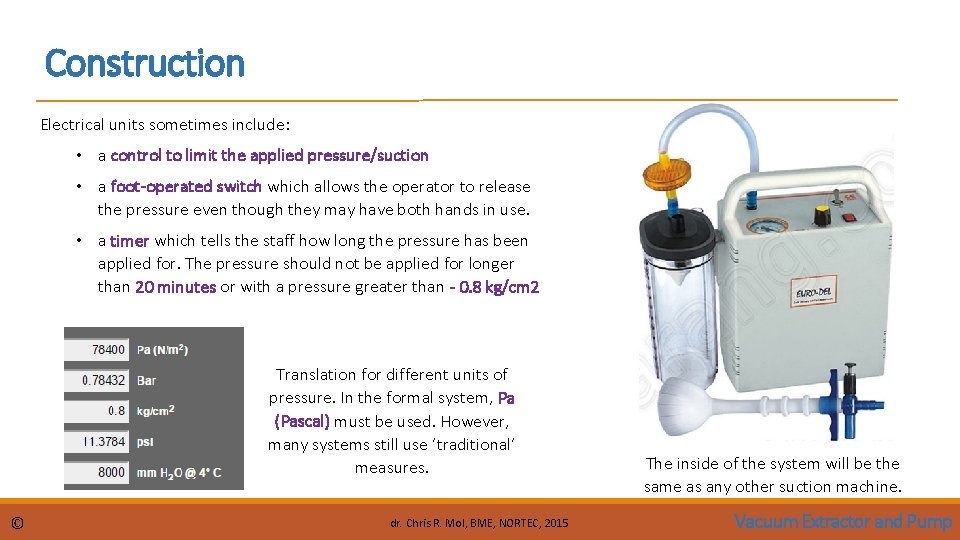
Construction Electrical units sometimes include: • a control to limit the applied pressure/suction • a foot-operated switch which allows the operator to release the pressure even though they may have both hands in use. • a timer which tells the staff how long the pressure has been applied for. The pressure should not be applied for longer than 20 minutes or with a pressure greater than - 0. 8 kg/cm 2 Translation for different units of pressure. In the formal system, Pa (Pascal) must be used. However, many systems still use ‘traditional’ measures. © dr. Chris R. Mol, BME, NORTEC, 2015 The inside of the system will be the same as any other suction machine. Vacuum Extractor and Pump
System Diagram and components see lecture on suction machines © dr. Chris R. Mol, BME, NORTEC, 2015 Vacuum Extractor and Pump
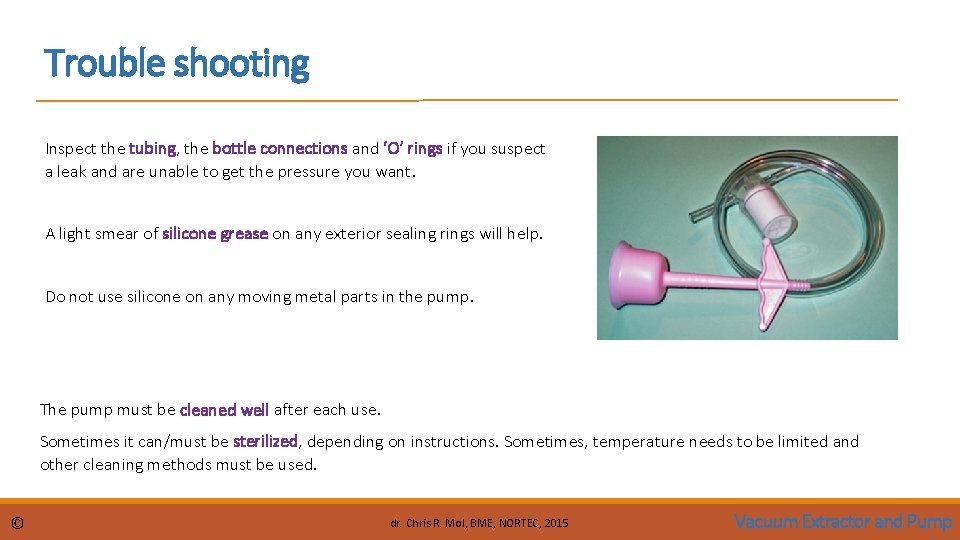
Trouble shooting Inspect the tubing, the bottle connections and ‘O’ rings if you suspect a leak and are unable to get the pressure you want. A light smear of silicone grease on any exterior sealing rings will help. Do not use silicone on any moving metal parts in the pump. The pump must be cleaned well after each use. Sometimes it can/must be sterilized, depending on instructions. Sometimes, temperature needs to be limited and other cleaning methods must be used. © dr. Chris R. Mol, BME, NORTEC, 2015 Vacuum Extractor and Pump
0. 8 kg cmsq Safety considerations Electrical safety checks and pressure checks should be done at regular intervals. To avoid infection, make sure that the machine has been sterilized/cleaned before starting to work on it; do not put any parts in your mouth, and wash your hands afterwards. Wear a pair of gloves. Pressure Check To check the pressure, place water in a bucket. Turn on the vacuum and draw the water as high as it will go. The indicated suction range of - 440 to − 588 mm. Hg corresponds with 600 to 800 cm. H 20 or 6 to 8 m. H 2 O © dr. Chris R. Mol, BME, NORTEC, 2015 Vacuum Extractor and Pump
END The creation of this presentation was supported by a grant from THET: see https: //www. thet. org/