
Vaccine Storage and Handling Presentation to Presented by
Vaccine Storage and Handling Presentation to: Presented by: Date:
Disclosure Statements • Neither the planners of this session nor I have any financial relationship with pharmaceutical companies, biomedical device manufacturers, or corporations whose products and services are related to the vaccines we discuss. • There is no commercial support being received for this event. • The mention of specific brands of vaccines in this presentation is for the purpose of providing education and does not constitute endorsement. • The GA Immunization Office utilizes ACIP recommendations as the basis for this presentation and for our guidelines, policies, and recommendations. • For certain vaccines this may represent a slight departure from or off-label use of the vaccine package insert guidelines.
Disclosure Statements • To obtain nursing contact hours for this session, you must be present for the entire hour and complete an evaluation. Contact hours for this session only are available from 12/1/2011 until 12/01/2013
Objectives • List and name the five components of the “cold chain” process and explain the importance of proper vaccine storage and handling based on CDC guidelines • Recall and discuss “Tips” for proper vaccine storage and handling • List the required temperature settings for vaccine storage • Identify measures to prevent vaccine storage and handling mishaps • List the components of vaccine storage and handling management
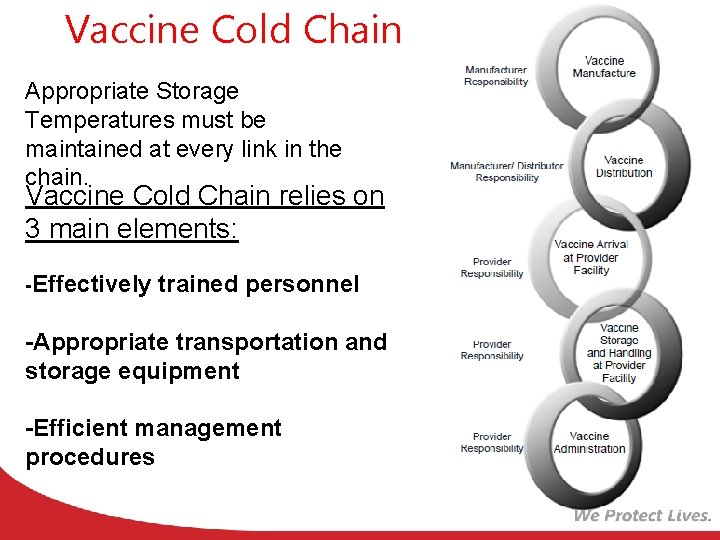
Vaccine Cold Chain Appropriate Storage Temperatures must be maintained at every link in the chain. Vaccine Cold Chain relies on 3 main elements: -Effectively trained personnel -Appropriate transportation and storage equipment -Efficient management procedures
Importance of Maintaining the Vaccine Cold Chain Vaccine Potency • Excessive heat or cold exposure can damage vaccines, resulting in reduced potency. Once potency is lost, it cannot be restored. • Each time vaccines are exposed to excessive heat or cold, reduced potency increases
Burden of Vaccine Cold Chain Failure • Reduced vaccine potency due to inappropriate storage conditions can be costly. Vaccines are very expensive. • Patients who receive vaccine with reduced potency caused by inappropriate storage conditions may not be fully protected against vaccine-preventable diseases.
Tips for Protecting Vaccines • Assign responsibility of handling vaccines: primary and back-up staff • Check vaccine shipments • Store vaccines in appropriate type of refrigerator • Store vaccines in appropriate place in the refrigerator • Check expiration dates & rotate stock • Check temperatures • Document temperatures • Take action if temperatures are out of range • Have routine and emergency vaccine handling plan • Take other preventive measures
Vaccine Coordinator • Assign primary responsibilities to one person • Designate a back-up person • Train all office staff working with vaccines
Primary Vaccine Coordinator Responsibility • Ordering vaccines • Overseeing proper receipt and storage of vaccine shipments • Organizing vaccines within the storage unit(s) • Reading and documenting storage unit temperatures a minimum of twice each workday • Reading and documenting storage unit minimum/maximum temperatures once per workday, preferably in the morning • Downloading and reviewing stored temperature monitoring data at least weekly • Inspecting storage unit(s) daily
Primary Vaccine Coordinator Responsibility • Rotating stock so that vaccine closest to its expiration date will be used first • Responding to possible temperature excursions; • Overseeing proper vaccine transport • Maintaining all appropriate vaccine storage and handling documentation, including temperature excursion responses • Maintaining storage equipment and records, including Vaccines for Children (VFC) program documentation in participating facilities • Ensuring that designated staff is adequately trained
Alternate Vaccine Coordinator Each office should also designate at least one alternate vaccine coordinator who can assume these same responsibilities in the absence of the primary vaccine coordinator. The primary and alternate vaccine coordinators should be fully trained regarding routine and emergency policies and procedures related to vaccine shipments, storage, handling, transport, and inventory management.
Other Staff/Training • All staff members who handle or administer vaccines should be familiar with storage and handling policies and procedures • Staff who handle and administer vaccines should receive comprehensive training regarding storage and handling policies and procedures. This training should be integrated into new staff orientation
Check Vaccine Shipments • Examine shipments on arrival • Examine container and contents for damage • Cross-check contents with the packing slip • Check the shipment date • Record shipment on an inventory log
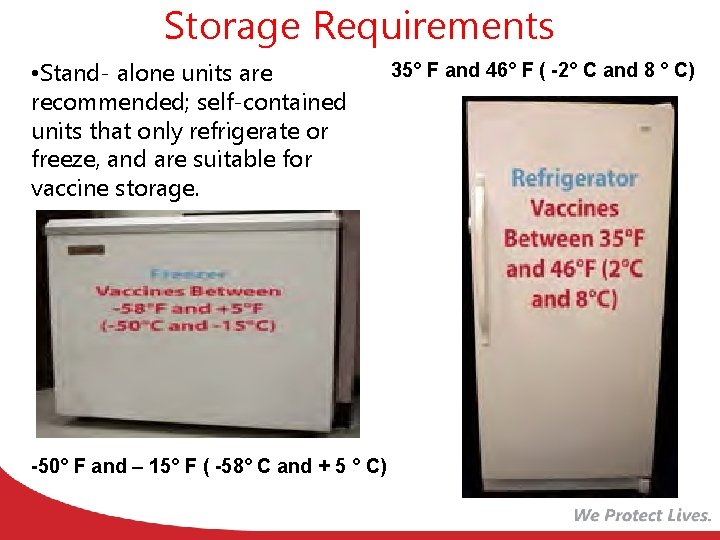
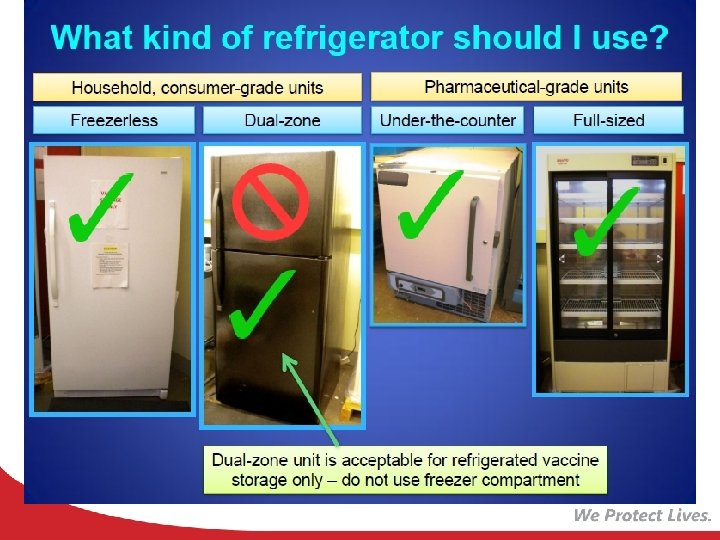
Storage Requirements • Stand- alone units are recommended; self-contained units that only refrigerate or freeze, and are suitable for vaccine storage. -50° F and – 15° F ( -58° C and + 5 ° C) 35° F and 46° F ( -2° C and 8 ° C)
Storage Requirements • Be large enough to hold the year's largest inventory • Have enough room to store water bottles and coolant packs • Have a calibrated thermometer inside each storage unit • Reliably maintain the appropriate vaccine storage temperatures year-round • Dedicated to the storage of vaccines. Food and beverages should NOT be stored in a vaccine storage unit
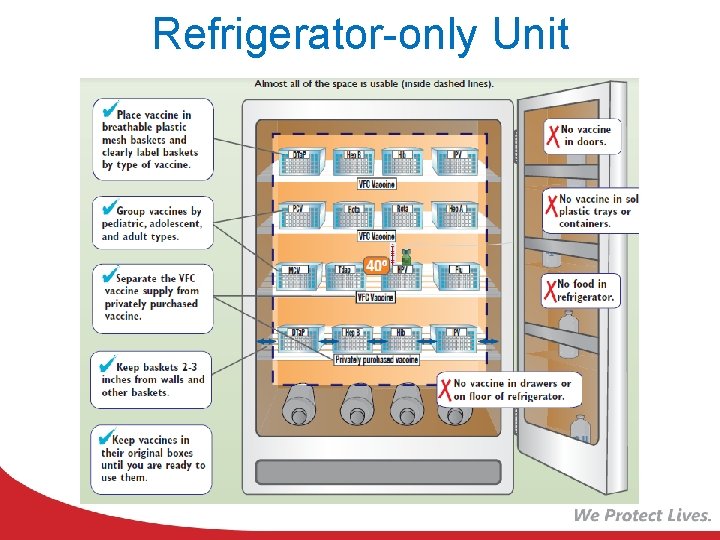
Refrigerator-only Unit
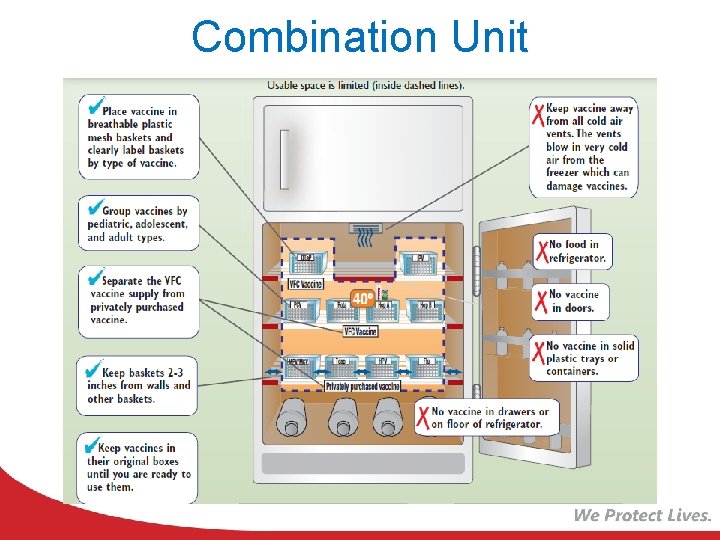
Combination Unit
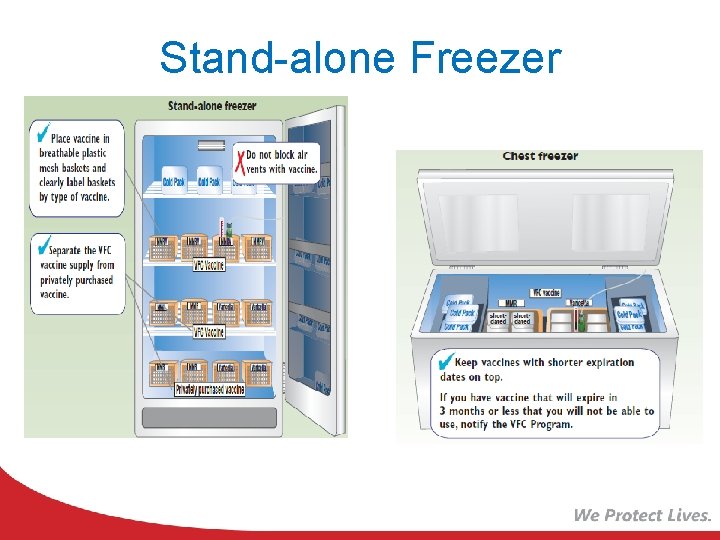
Stand-alone Freezer
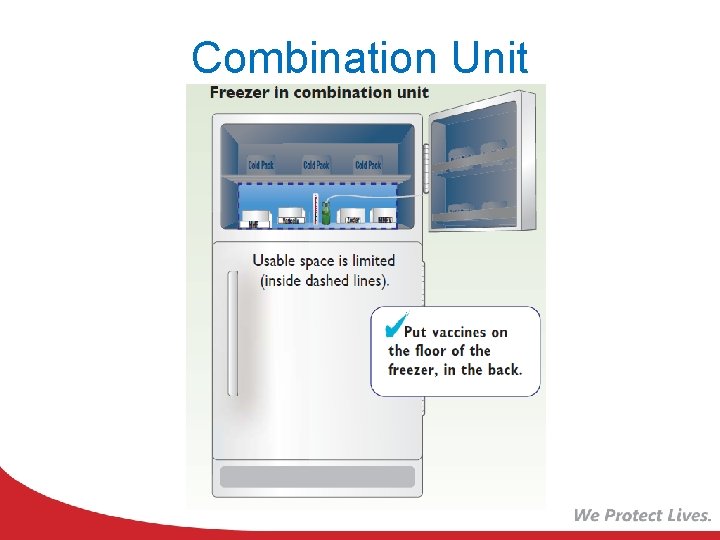
Combination Unit
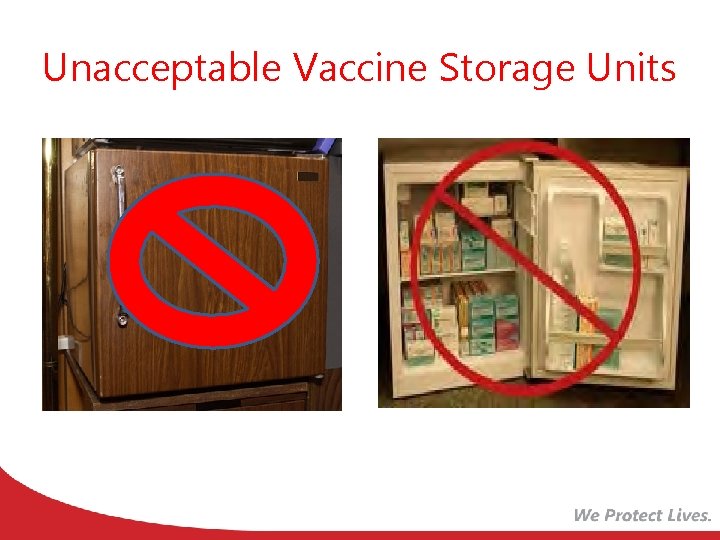
Unacceptable Vaccine Storage Units
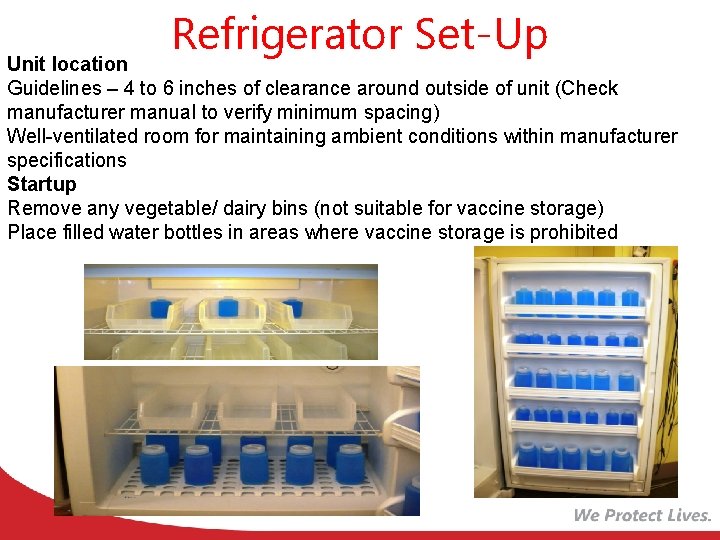
Refrigerator Set-Up Unit location Guidelines – 4 to 6 inches of clearance around outside of unit (Check manufacturer manual to verify minimum spacing) Well-ventilated room for maintaining ambient conditions within manufacturer specifications Startup Remove any vegetable/ dairy bins (not suitable for vaccine storage) Place filled water bottles in areas where vaccine storage is prohibited
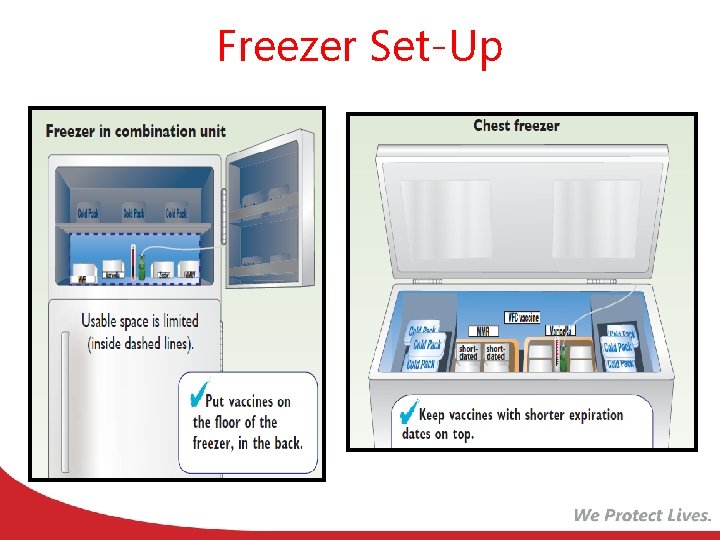
Freezer Set-Up
Storage Unit Maintenance Daily Maintenance • Read and document the internal temperature • Check that each unit door is closed Monthly Maintenance • Clean the coils and motor • Clean the refrigerator and freezer unit • Check the door seal Periodic Maintenance • Clean the drain pan
Thermometers Calibrated Thermometers: For measuring vaccine storage unit temperatures, CDC recommends using only calibrated thermometers with a Certificate of Traceability and Calibration Testing. This certificate informs user of a thermometer’s level of accuracy compared to a recognized standard.
Types of Thermometers Thermometer Characteristics • Continuous monitoring with active display • Alarm for out-of-range temperatures • Reset button if using data logger with min/max display • Shows current temperature as well as min/max temperatures • Be within +/-. 5° C accuracy (+/- 1° F) • Low Battery Indicator
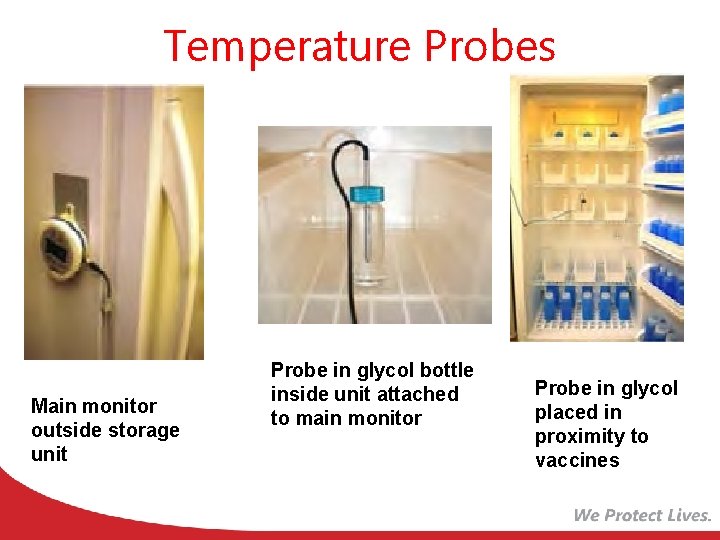
Temperature Probes Main monitor outside storage unit Probe in glycol bottle inside unit attached to main monitor Probe in glycol placed in proximity to vaccines
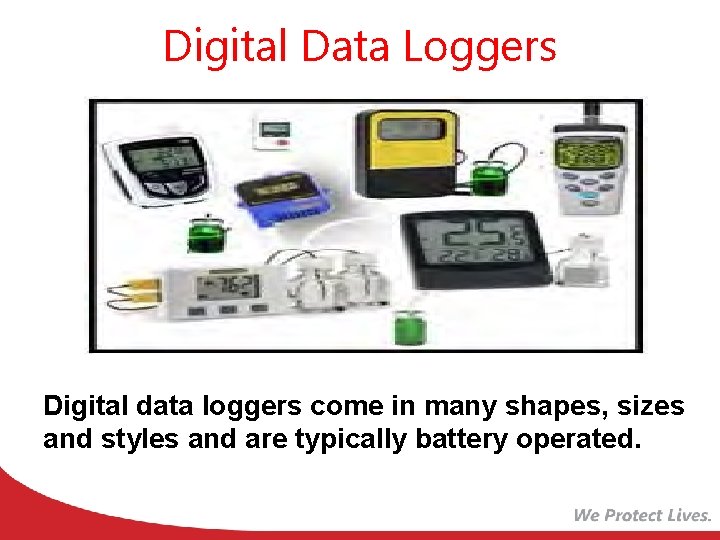
Digital Data Loggers Digital data loggers come in many shapes, sizes and styles and are typically battery operated.
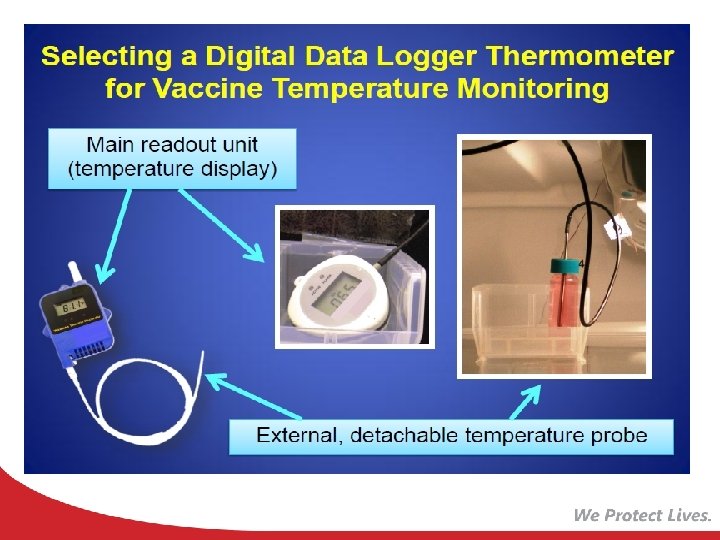
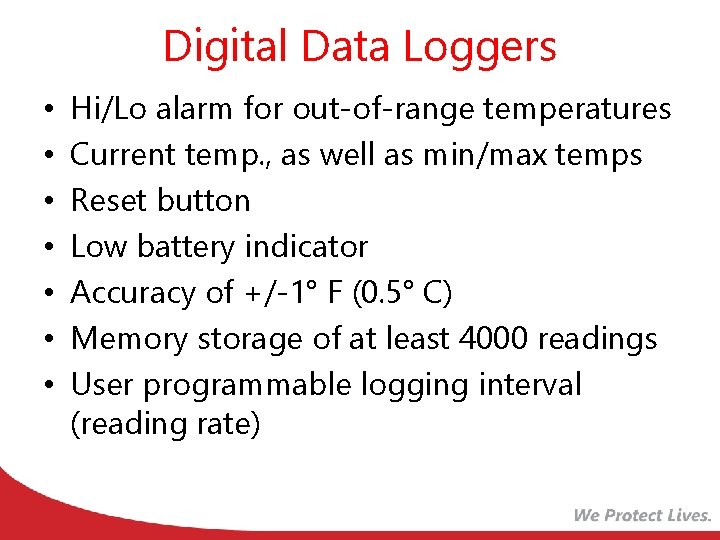
Digital Data Loggers • • Hi/Lo alarm for out-of-range temperatures Current temp. , as well as min/max temps Reset button Low battery indicator Accuracy of +/-1° F (0. 5° C) Memory storage of at least 4000 readings User programmable logging interval (reading rate)
Thermometers “NOT” Recommended • Fluid filled biosafe liquid thermometers • Bi-metal stem thermometers • Food thermometers and household mercury thermometers • Chart recorders • Infrared thermometers • Thermometers not calibrated
Thermometer Placement within the unit is just as important as thermometer selection. The thermometer should be in proximity to the vaccines being stored. Thermometers should NOT be: • Placed in the doors • Near or against the walls • Close to vents • On the floor of the unit
Vaccine Security Protecting the Power Supply • Avoid using power outlets with built-in circuit switches • Use a safety-lock plug or an outlet cover • Post a warning sign at the plug and on the refrigerator and freezer units • Label the fuses and circuit breakers to alert people not to turn off the power to the storage units • Consider installing a temperature alarm to alert staff to after-hours temperature excursions • Back-up generators
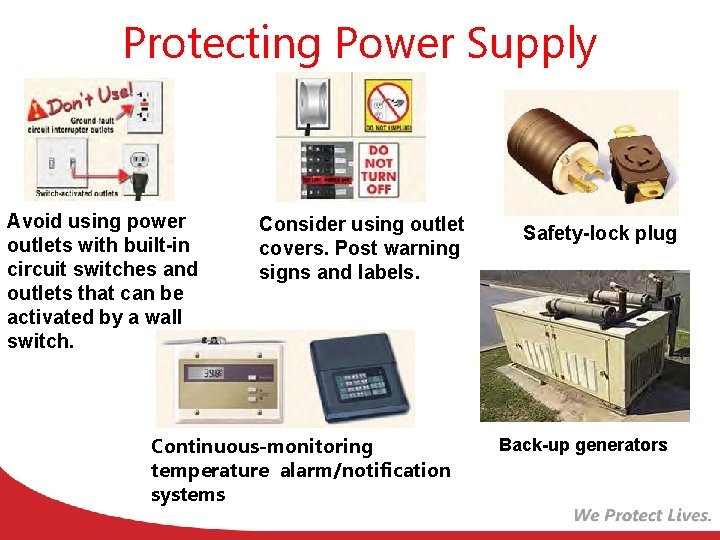
Protecting Power Supply Avoid using power outlets with built-in circuit switches and outlets that can be activated by a wall switch. Consider using outlet covers. Post warning signs and labels. Continuous-monitoring temperature alarm/notification systems Safety-lock plug Back-up generators
Required Temperature Ranges Refrigerator • Temperatures between 35°F and 46°F (2°C and 8°C) Freezer • The freezer should maintain temperatures between -58°F and +5°F (-50°C and -15°C)
Adjusting Storage Temperatures Only the primary or alternate vaccine coordinator should adjust the temperature of a vaccine storage unit. A warning sign should be posted on the storage unit that says, “Do not adjust refrigerator (or freezer) temperature controls
Temperature Variations Temperatures can vary in a vaccine storage unit based on the contents, how often the door is opened, and power interruptions. The only way to be sure the temperature in a storage unit has remained within the appropriate range is to frequently read and document the temperature using a calibrated thermometer.
Appropriate Storage Conditions Vaccines Stored in Freezer • Varicella-containing vaccines (MMRV, VAR, HZV) must be stored in freezer until reconstitution and administration Vaccines Stored in Refrigerator • All routinely recommended vaccines should be stored in refrigerator Vaccine Light Sensitivity • Several vaccines must be protected from light/kept in original packaging Lyophilized Vaccines and Diluents • Diluents packaged separately from their corresponding vaccines may be stored at room temperature (MMR, MMRV, VAR, HZV). Never store diluents in the freezer.
Storage Location and Positioning A best practice is to place vaccine in the central area of the storage space and keep vaccines in their original packaging inside storage trays positioned 2 to 3 inches away from storage unit walls. • Vaccine Spacing-allow for cold air circulation • Vaccine Packaging-similar packaging should be stored in different locations
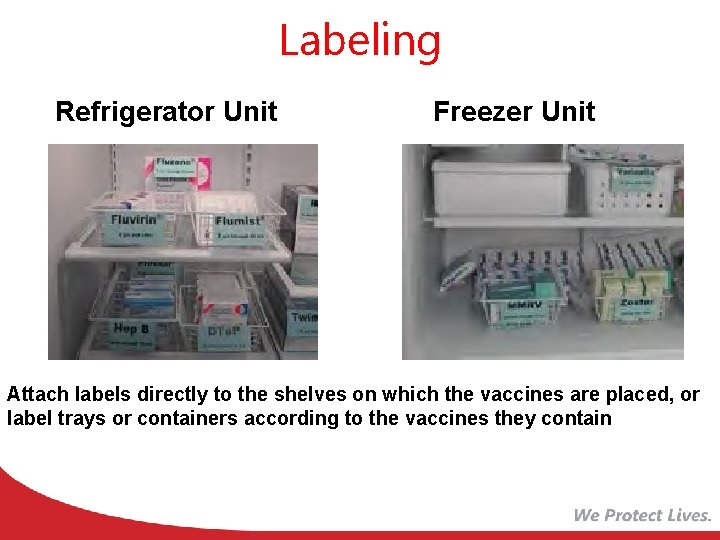
Labeling Refrigerator Unit Freezer Unit Attach labels directly to the shelves on which the vaccines are placed, or label trays or containers according to the vaccines they contain
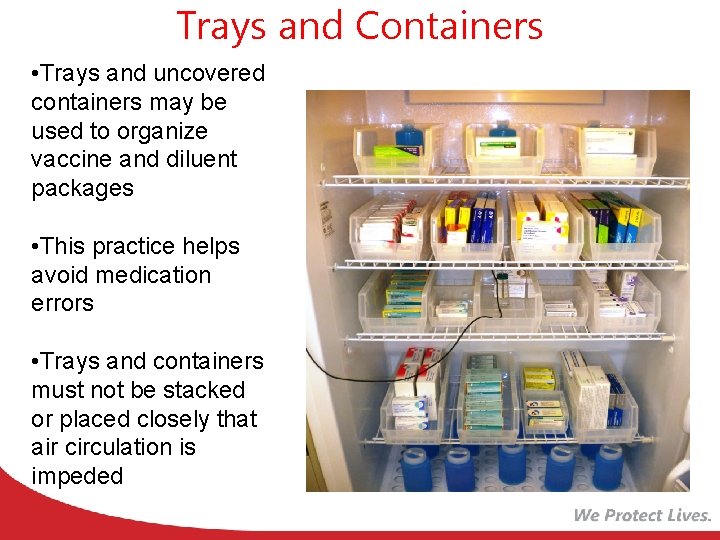
Trays and Containers • Trays and uncovered containers may be used to organize vaccine and diluent packages • This practice helps avoid medication errors • Trays and containers must not be stacked or placed closely that air circulation is impeded
Reading and Documenting Temperatures Best Practices: • Post temperature log on storage unit • Read thermometer in both storage units twice daily (morning/end of work day) • Read min/max temperatures in both units a minimum of once each work day • Document readings for both units on temperature log • Record times of reading and staff initial who took reading • Download and review stored continuous monitoring data at least weekly
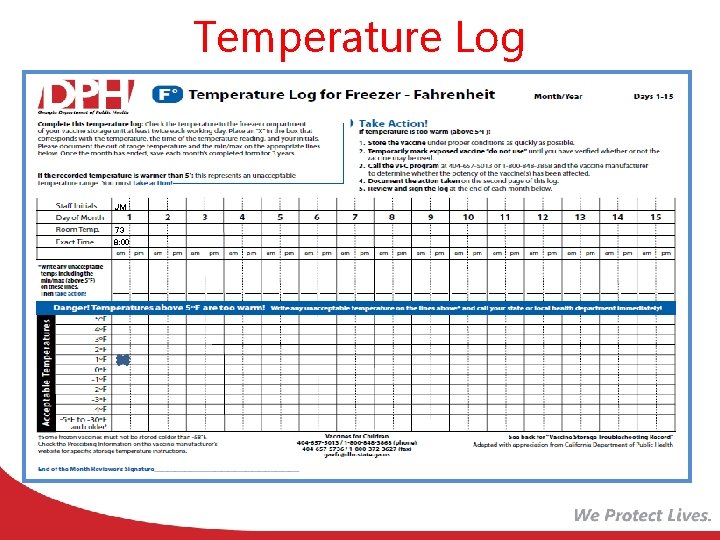
Temperature Log JM 73 8: 00
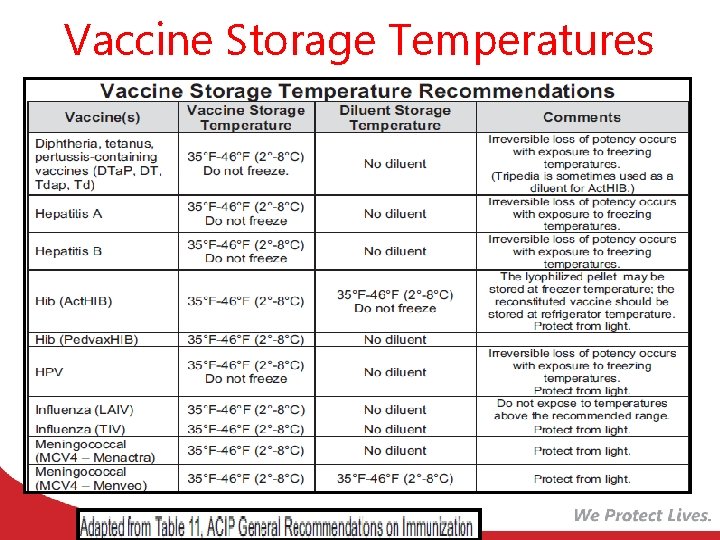
Vaccine Storage Temperatures
Standard Operating Procedures (SOP) It is important to establish routine, systematic procedures for handling vaccine shipments. Each facility should develop its own written standard operating procedures to address: • Receiving Vaccine Shipments • Checking the Condition of a Shipment • Storing and Documenting Vaccine Shipments Upon Arrival
Transporting Vaccine manufacturers do not generally recommend or provide guidance for transport of vaccines. If vaccines must be transported during an emergency or to an off -site facility, it is critical that vaccine potency is protected by maintaining the vaccine cold chain at all times.
Transporting Vaccine The facility SOP should specify that vaccines are: • • Attended at all times during transport Not placed in the trunk of the vehicle Delivered directly to the facility Promptly unpacked and placed into appropriate storage units upon arrival
Transporting Multidose Vials When a multi-dose vial is used, FDA regulations require that it only be used in the facility where it was first opened. Only if absolutely necessary, a partially used vial may be transported to or from an offsite facility operated by the same provider, as long as the vaccine cold chain is properly maintained
Transporting Varicella-Containing Vaccines The vaccine manufacturer does not recommend transporting varicella-containing vaccines (MMRV, VAR, HZV). If these vaccines must be transported (e. g. , during an emergency), CDC recommends transport in a portable freezer unit that maintains the temperature between -58°F and +5°F (-50°C and -15°C). Ø Do Not Use Dry Ice
Transporting Varicella-Containing Vaccines Varicella-containing vaccines may be transported at refrigerator temperature between 36°F and 46°F (2°C and 8°C) for up to 72 continuous hours prior to reconstitution. If varicella-containing vaccines must be transported at refrigerator temperature, follow these steps: • Place calibrated thermometer in container as close as possible to the vaccines • Record time vaccines and placed in container, temperature during transport, and time and temperature at the beginning and end of transport • Immediately, upon arrival at alternate storage facility, place vaccines in the freezer between -58°F and +5°F (-50°C and -15°C) and label “DO NOT USE. ” Document time the vaccines are removed from the container and placed in alternate storage unit. Note that this is considered a temperature excursion, so contact the manufacturer for further guidance • Do not discard vaccines without contacting the manufacturer and/or your immunization program for guidance
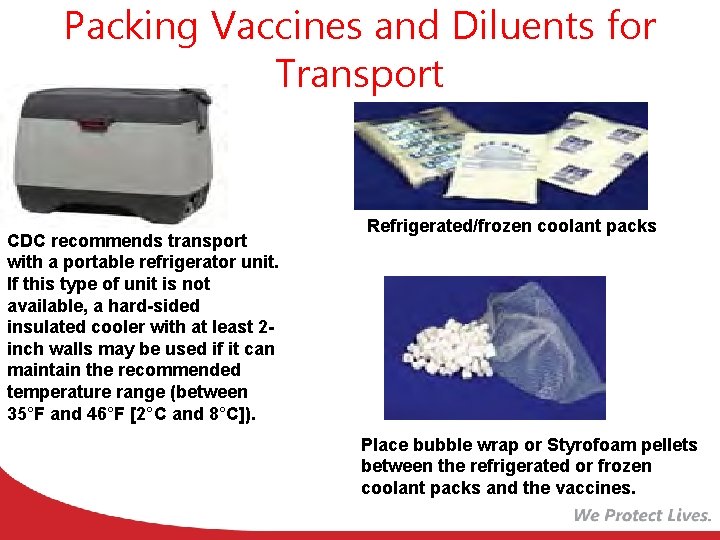
Packing Vaccines and Diluents for Transport CDC recommends transport with a portable refrigerator unit. If this type of unit is not available, a hard-sided insulated cooler with at least 2 inch walls may be used if it can maintain the recommended temperature range (between 35°F and 46°F [2°C and 8°C]). Refrigerated/frozen coolant packs Place bubble wrap or Styrofoam pellets between the refrigerated or frozen coolant packs and the vaccines.
Storage Troubleshooting Immediate Action must be taken to correct improper vaccine storage conditions, including inappropriate exposure to light and exposure to storage temperatures outside the recommended ranges. Actions should be documented and include: • • • Date and Time of occurrence Ambient room and storage unit temperatures Description of problem Action taken Outcome Initials of the person documenting the incident
Routine Storage and Handling Plan Each Routine Vaccine Storage and Handling Plan should include: Up-to-date contact information for: -Primary and alternate vaccine coordinators -Immunization program (VFC Contact) -Manufacturers of the vaccines -Refrigerator/freezer maintenance and repair companies -Utility/power company -Vaccine storage unit alarm company -Sources of packing materials and calibrated thermometers
Routine Storage and Handling Plan • Descriptions of the roles/responsibilities or primary and alternate coordinators • Policy on education and training for staff • Protocols for ordering and accepting vaccine deliveries • Summaries of the storage requirements for each vaccine and diluent • Protocols for vaccine storage unit temperature monitoring • Protocols for vaccine storage equipment maintenance • Protocols for the correct placement of vaccines within storage units
Routine Storage and Handling Plan • Protocols for responding to vaccine storage and handling problems • Protocols for vaccine inventory management • Protocols for transporting and receiving shipments • Protocols for handling vaccine prior to administration • Protocols for proper disposal of vaccines and supplies • Samples of the forms used in your vaccination program
Emergency Vaccine Retrieval and Storage Plan You should have the following in place: • Designated primary and alternate coordinator with emergency contact info • Emergency staff contact list in order of contact preference • Vaccine storage unit specifications • Alternate vaccine storage facility or facilities • Written protocols, vehicles and drivers for transporting vaccines to and from the alternate vaccine storage facility
Emergency Vaccine Retrieval and Storage Plan • Written instructions for entering your facility and vaccine storage spaces in an emergency if the building is closed • Appropriate packing materials to safely transport or temporarily store vaccine • Written protocol for vaccine packing
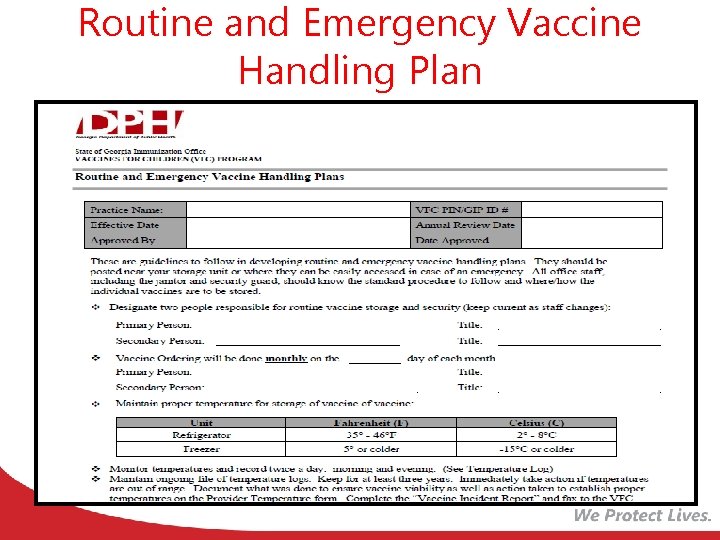
Routine and Emergency Vaccine Handling Plan
VACCINE ACCESS Only authorized personnel should have access to the vaccine supply. This will help to protect the vaccine supply by avoiding inappropriate removal of vaccines or inappropriate handling of vaccines and vaccine storage units by untrained personnel.
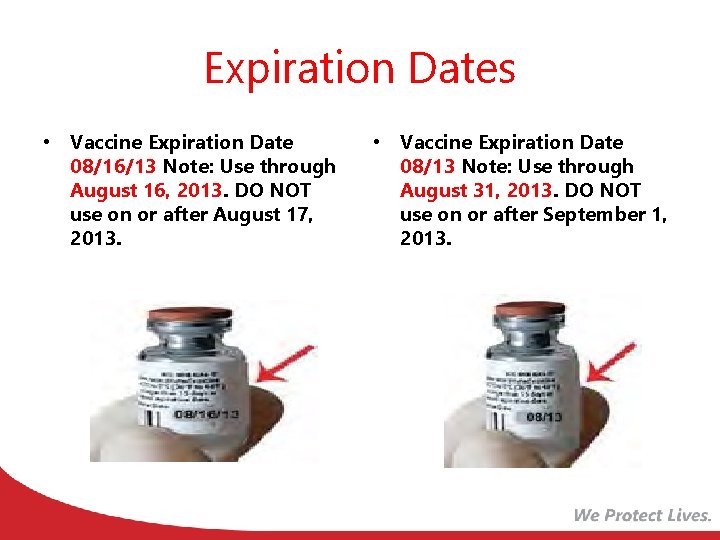
Expiration Dates • Vaccine Expiration Date 08/16/13 Note: Use through August 16, 2013. DO NOT use on or after August 17, 2013. • Vaccine Expiration Date 08/13 Note: Use through August 31, 2013. DO NOT use on or after September 1, 2013.
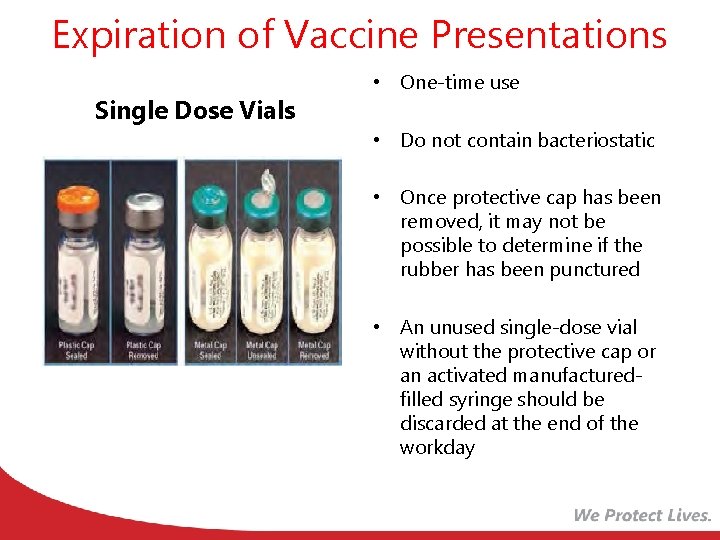
Expiration of Vaccine Presentations Single Dose Vials • One-time use • Do not contain bacteriostatic • Once protective cap has been removed, it may not be possible to determine if the rubber has been punctured • An unused single-dose vial without the protective cap or an activated manufacturedfilled syringe should be discarded at the end of the workday
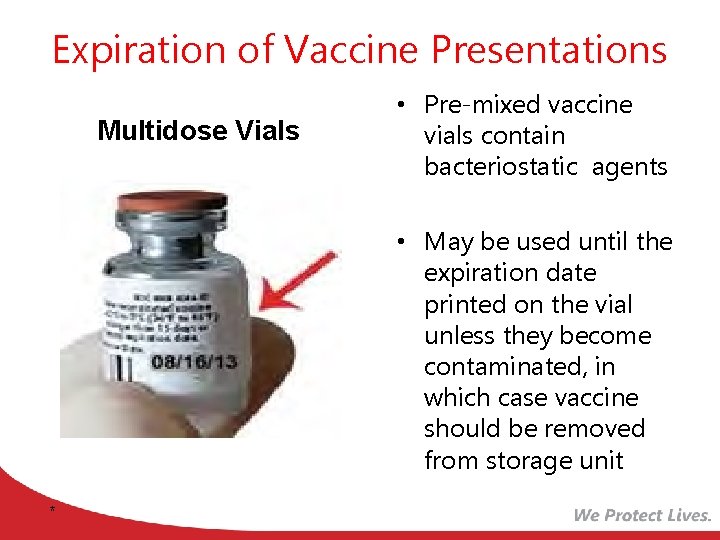
Expiration of Vaccine Presentations Multidose Vials • Pre-mixed vaccine vials contain bacteriostatic agents • May be used until the expiration date printed on the vial unless they become contaminated, in which case vaccine should be removed from storage unit *
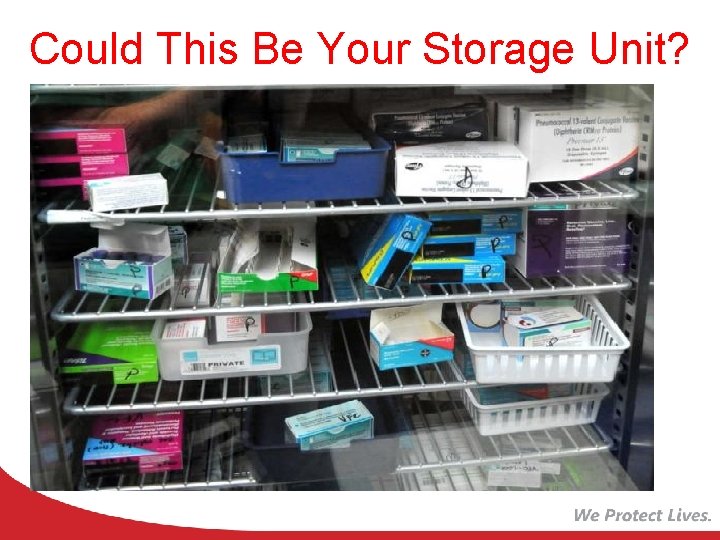
Could This Be Your Storage Unit?
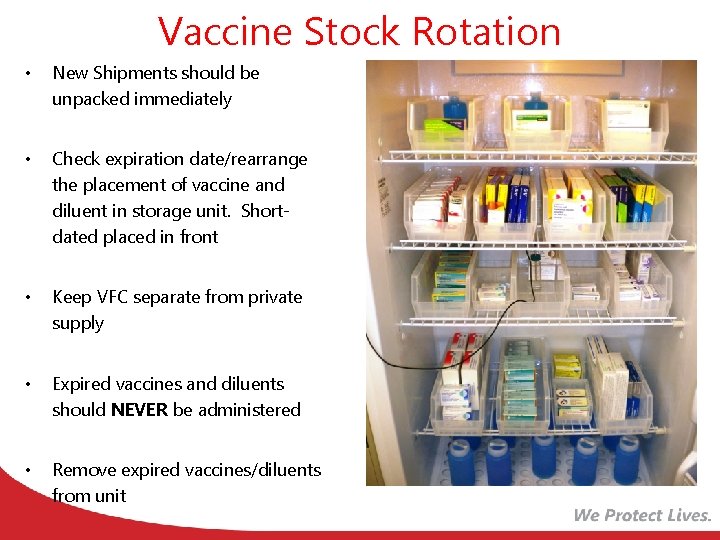
Vaccine Stock Rotation • New Shipments should be unpacked immediately • Check expiration date/rearrange the placement of vaccine and diluent in storage unit. Shortdated placed in front • Keep VFC separate from private supply • Expired vaccines and diluents should NEVER be administered • Remove expired vaccines/diluents from unit
Vaccine Inventory Vaccine inventory accounting is important for efficient vaccine management. Proper vaccine inventory management means knowing the following: • Quantity of vaccines/diluents received • Quantity of vaccines/diluents administered, wasted, or spoiled • Which vaccines/diluents are in stock • Which vaccine/diluents should be used first • Which vaccines/diluents are expired • Which vaccines/diluents need to be ordered
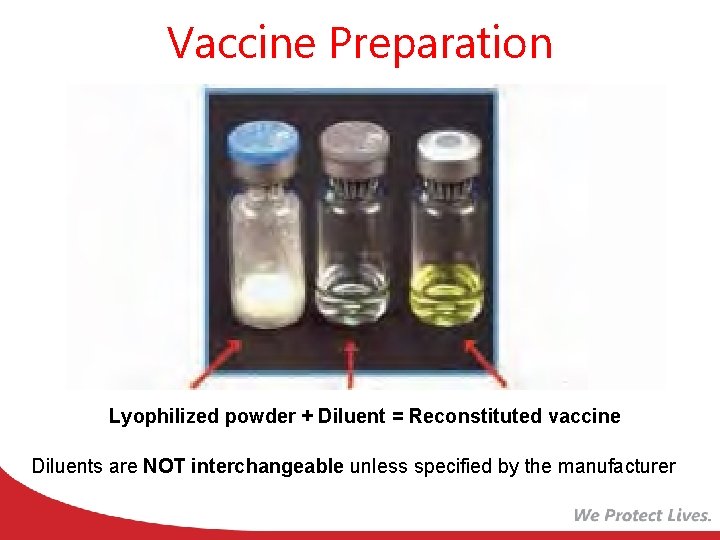
Vaccine Preparation Lyophilized powder + Diluent = Reconstituted vaccine Diluents are NOT interchangeable unless specified by the manufacturer
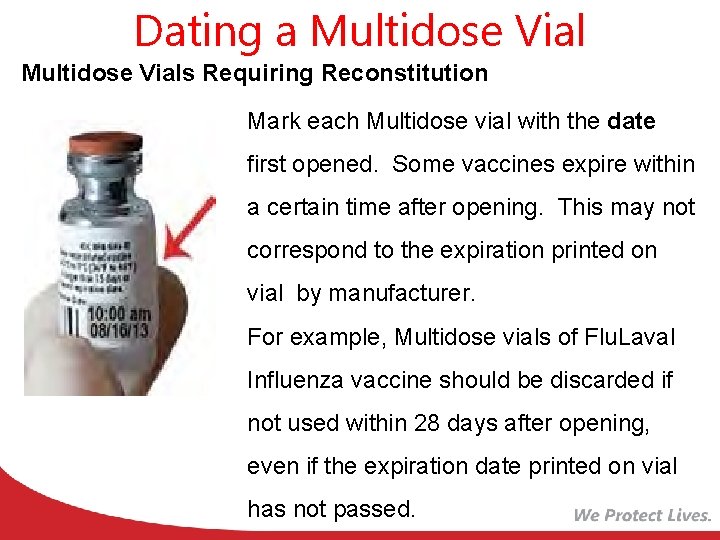
Dating a Multidose Vials Requiring Reconstitution Mark each Multidose vial with the date first opened. Some vaccines expire within a certain time after opening. This may not correspond to the expiration printed on vial by manufacturer. For example, Multidose vials of Flu. Laval Influenza vaccine should be discarded if not used within 28 days after opening, even if the expiration date printed on vial has not passed.
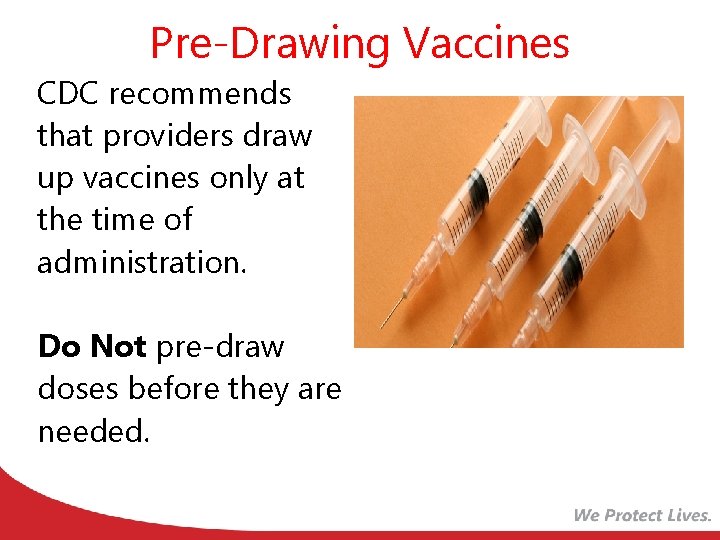
Pre-Drawing Vaccines CDC recommends that providers draw up vaccines only at the time of administration. Do Not pre-draw doses before they are needed.
Vaccine Storage & Handling Trivia Challenge 1. Which vaccine is not stored in the freezer? a) MMR b)MMRV c )Rotavirus d)Varicella 2. Which storage unit is not recommended for vaccine storage? a)stand-alone freezer b)dormitory c)stand-alone refrigerator 3. Emergency procedures to protect vaccine in the event of a power outage or mechanical failure a vital part of vaccine management? a) True b) False 4. Multi-dose vials must be used within 30 days after opening? a)True b) False
Take-Home Messages • A proper cold chain is a temperature-controlled supply chain that includes all equipment and procedures used in the transport and storage and handling of vaccines from the time of manufacturer to administration of the vaccine. • Out of range temperature readings require IMMEDIATE action • For patients to be protected by the vaccines it is your responsibility to handle vaccines with care. • Vaccine management, including proper storage and handling procedures, is the basis on which good immunization practices are built.
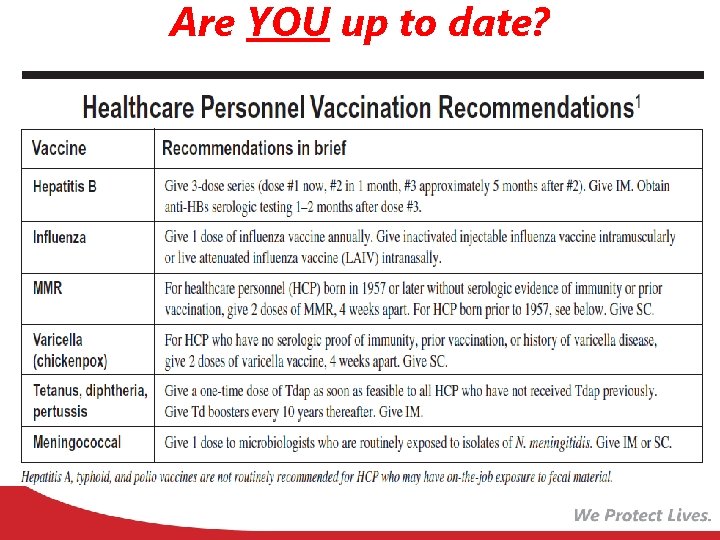
Are YOU up to date?
Considerations for HCW Immunization Plan/Policy • Immunization/immunity record maintained by the facility on each HCW • Catch-up programs for current employees and policies for newlyhired workers • Work restriction policies for susceptible workers after exposure • Management and control of outbreaks • Options for refusal of vaccination by employees
Vaccine Adverse Event Reporting System The Vaccine Adverse Event Reporting System (VAERS) is a national vaccine safety surveillance program co-sponsored by the Centers for Disease Control and Prevention and the Food and Drug Administration. • What Can Be Reported to VAERS? • Who Reports to VAERS? • Does VAERS Provide General Vaccine Information? • All PH Clinics send their VAERS to the GA Immunization Office http: //vaers. hhs. gov/ or 1 -800 -822 -7967
National Vaccine Injury Compensation Program (VICP) National Vaccine Injury Compensation Program provides compensation to individuals found to be injured by or have died from certain childhood vaccines. – Established in 1988 by NCVIA – Federal “no fault” system to compensate those injured – Claim must be filed by individual, parent or guardian – Must show that injury is on “Vaccine Injury Table”
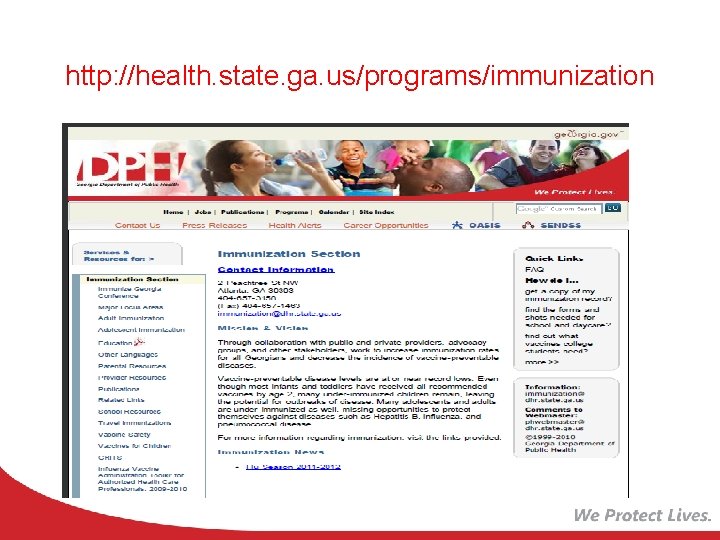
http: //health. state. ga. us/programs/immunization
Vaccine Storage & Handling Resources • Vaccines & Immunizations www. cdc. gov/vaccines/pubs/vac-mgt-book. htm • Vaccine Storage and Handling Toolkit http: //www. cdc. gov/vaccines/recs/storage/toolkit/default. htm • Immunization Action Coalition (IAC) www. immunize. org Georgia Immunization Office (GIO) http: //health. state. ga. us/programs/immunization/index. asp
Resources • Local health department • District Immunization Coordinator • GA Immunization Program Office • • • On call Help line: 404 -657 -3158 GRITS Help Line: 1 -888 -223 -8644 VFC Help Line: 1 -800 -848 -3868 Website http: //health. state. ga. us/programs/immunization Your local Immunization Program Consultant (IPC) • GA Chapter of the AAP • GA Academy of Family Physicians
- Slides: 79