
Vaccine Administration Technique Presented by Date Disclosure Statements

Vaccine Administration Technique Presented by: Date:
Disclosure Statements • Neither the planners of this session nor I have any conflicts of interest or financial relationship with pharmaceutical companies, biomedical device manufacturers, or corporations whose products and services are related to the vaccines we discuss. • There is no commercial support being received for this event. • The mention of specific brands of vaccines in this presentation is for the purpose of providing education and does not constitute endorsement. • The GA Immunization Program utilizes ACIP recommendations as the basis for this presentation and for our guidelines, policies, and recommendations. • For certain vaccines this may represent a slight departure from or offlabel use of the vaccine package insert guidelines.
Disclosure Statements To obtain nursing contact hours for this session, you must be present for the entire hour and complete an evaluation.
Objectives • Discuss staff training needs and strategies for communication • List positioning, comforting and pain control techniques • Review infection control guidelines • Discuss vaccine preparation, administration routes, sites, and needle sizes • Explain vaccine administration special situations • Review documentation requirements • Discuss avoiding vaccine administration errors and managing adverse events
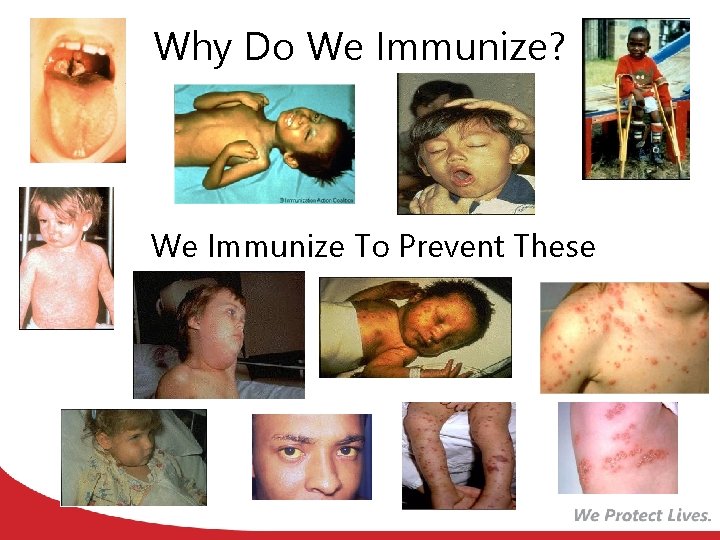
Why Do We Immunize? We Immunize To Prevent These Diseases
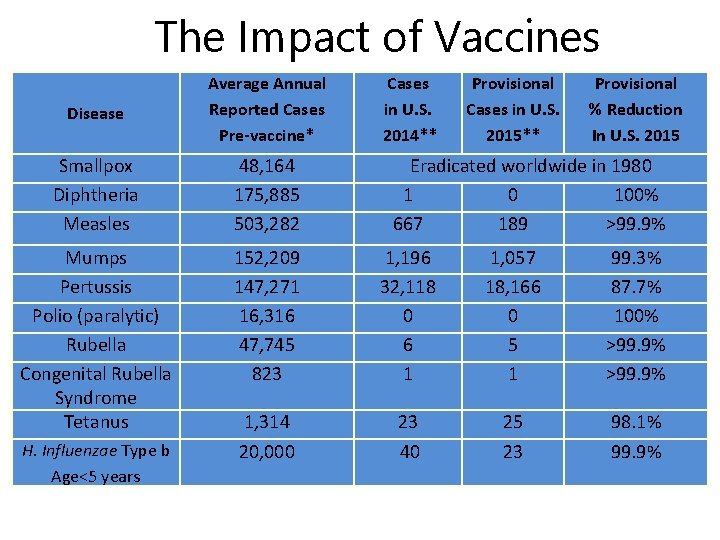
The Impact of Vaccines Disease Average Annual Reported Cases Pre-vaccine* Smallpox Diphtheria Measles 48, 164 175, 885 503, 282 Mumps Pertussis Polio (paralytic) Rubella Congenital Rubella Syndrome Tetanus 152, 209 147, 271 16, 316 47, 745 823 1, 196 32, 118 0 6 1 1, 057 18, 166 0 5 1 99. 3% 87. 7% 100% >99. 9% 1, 314 20, 000 23 40 25 23 98. 1% 99. 9% H. Influenzae Type b Age<5 years *MMWR 48(12); 243 -248 April 2, 1999 Cases in U. S. 2014** Provisional Cases in U. S. 2015** Provisional % Reduction In U. S. 2015 Eradicated worldwide in 1980 1 0 100% 667 189 >99. 9% **MMWR 64(52), ND-923 -ND-940, January 8, 2016
Vaccine Administration Technique Training
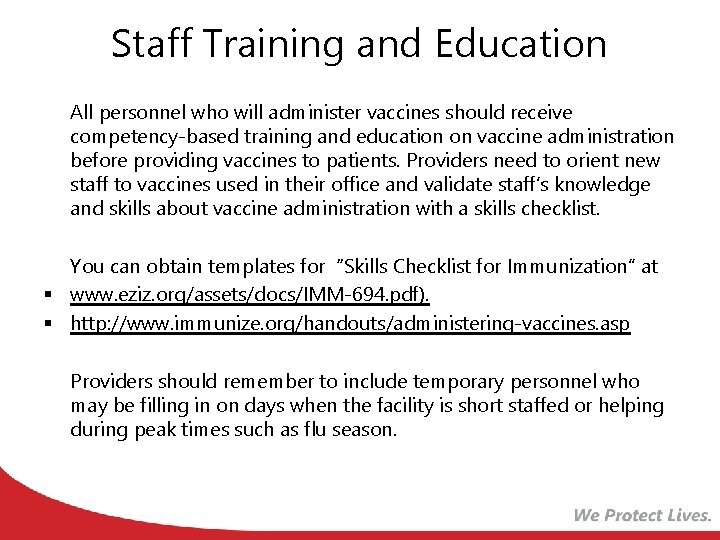
Staff Training and Education All personnel who will administer vaccines should receive competency-based training and education on vaccine administration before providing vaccines to patients. Providers need to orient new staff to vaccines used in their office and validate staff’s knowledge and skills about vaccine administration with a skills checklist. You can obtain templates for “Skills Checklist for Immunization” at § www. eziz. org/assets/docs/IMM-694. pdf). § http: //www. immunize. org/handouts/administering-vaccines. asp Providers should remember to include temporary personnel who may be filling in on days when the facility is short staffed or helping during peak times such as flu season.
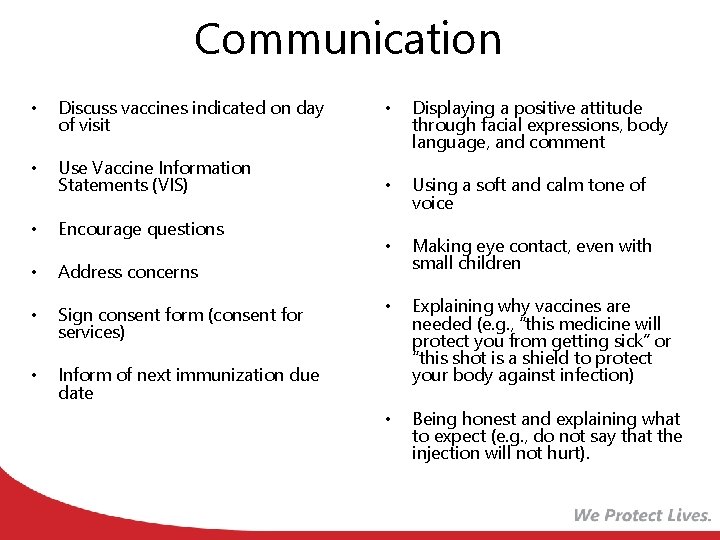
Communication • Discuss vaccines indicated on day of visit • Use Vaccine Information Statements (VIS) • Encourage questions • Address concerns • Sign consent form (consent for services) • Inform of next immunization due date • Displaying a positive attitude through facial expressions, body language, and comment • Using a soft and calm tone of voice • Making eye contact, even with small children • Explaining why vaccines are needed (e. g. , “this medicine will protect you from getting sick” or “this shot is a shield to protect your body against infection) • Being honest and explaining what to expect (e. g. , do not say that the injection will not hurt).
Positioning & Comforting Techniques • Comfort • Safety • Age • Activity level • Site of administration • IM: Position limb to allow relaxation of muscle injected – Deltoid: flex arm – Anterolateral thigh: some degree of internal rotation • Infants and Young Children: – Hold securely in parent’s lap • Older Children: – Sit on parent’s lap or edge of exam table and hug parent’s chest • Adolescents and adults should be seated for immunizations ACIP recommends observing client for 15 minutes after immunization (s) while seated or lying down.
Pain Control • Physical Techniques • Psychological Techniques • Pharmacologic Techniques *Antipyretics - An age-appropriate dose of a non-aspirincontaining pain reliever may be considered to decrease discomfort and fever if it should occur after vaccination. ACIP does not recommend the prophylactic use of analgesics before or at the time of vaccination.
Infection Control • Handwashing -Critical to prevent the spread of illness and disease • Gloves -OSHA regulations do not require gloves to be worn when administering vaccines unless the person administering the vaccine is likely to come into contact with potentially infectious body fluids or has open lesions on the hands • Equipment Disposal -Used needles should not be recapped, cut or detached from the syringes before disposal -Filled sharps containers should be disposed of properly; never dispose of sharps containers or empty vaccine vials at an outreach site. DHR Rule 290 -5 -60, ”Sharps Injury Prevention”
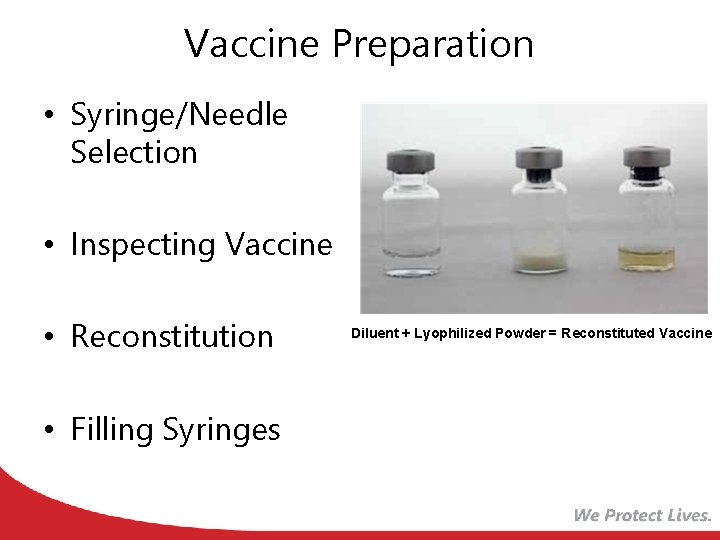
Vaccine Preparation • Syringe/Needle Selection • Inspecting Vaccine • Reconstitution • Filling Syringes Diluent + Lyophilized Powder = Reconstituted Vaccine
Injections Routes, Site and Needle Size Based upon: • • • Age Volume of material Viscosity of material Size of muscle Recommended depth
Importance of Administering Vaccines Correctly • Ensure Optimal Vaccine Efficacy • Decreased Localized and Systemic Reactions • Decreased Pain
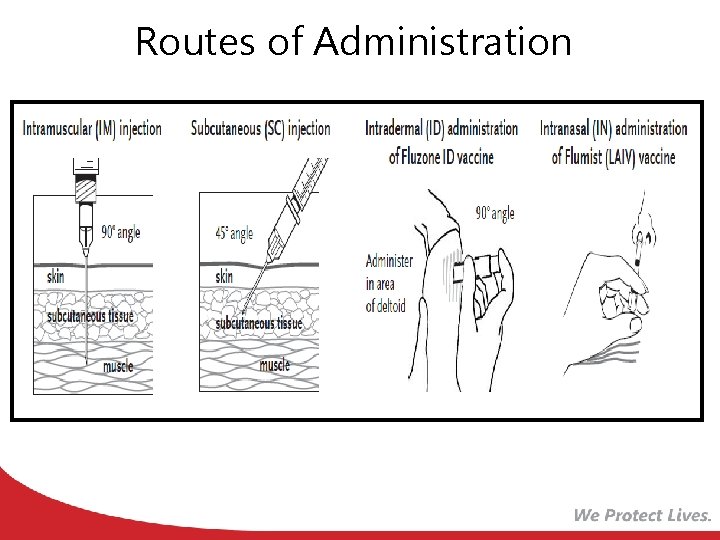
Routes of Administration
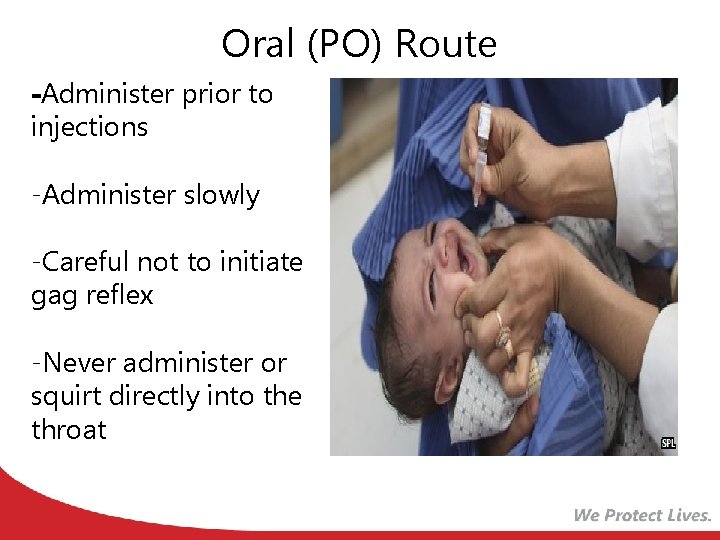
Oral (PO) Route -Administer prior to injections -Administer slowly -Careful not to initiate gag reflex -Never administer or squirt directly into the throat
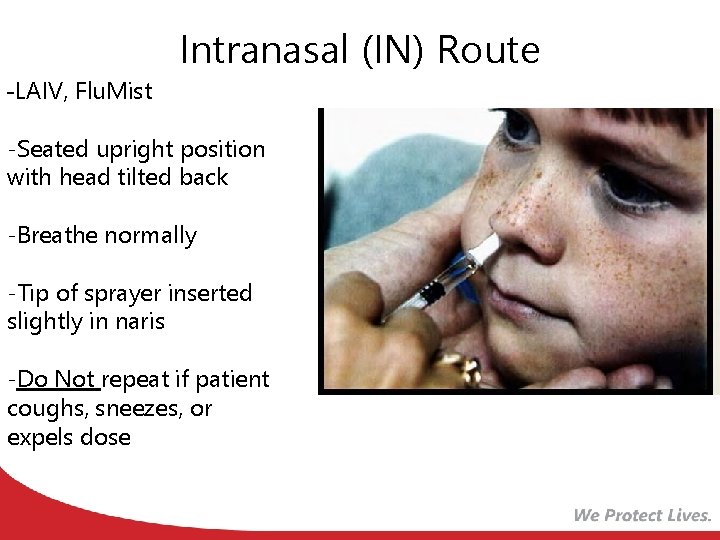
Intranasal (IN) Route -LAIV, Flu. Mist -Seated upright position with head tilted back -Breathe normally -Tip of sprayer inserted slightly in naris -Do Not repeat if patient coughs, sneezes, or expels dose
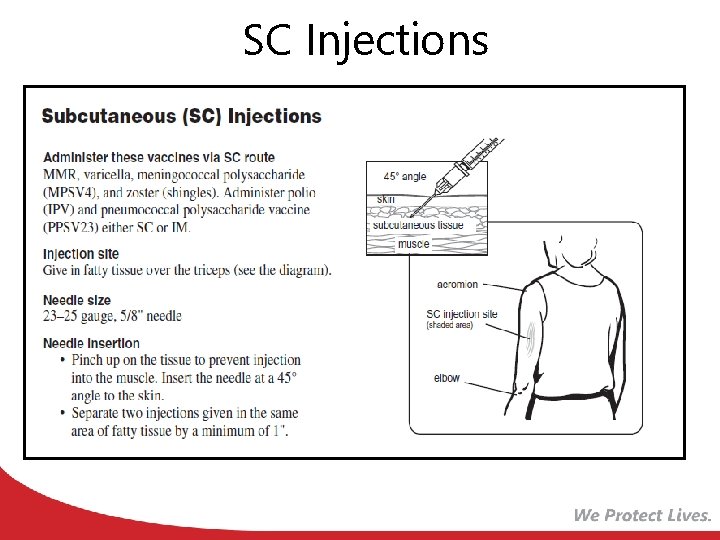
SC Injections
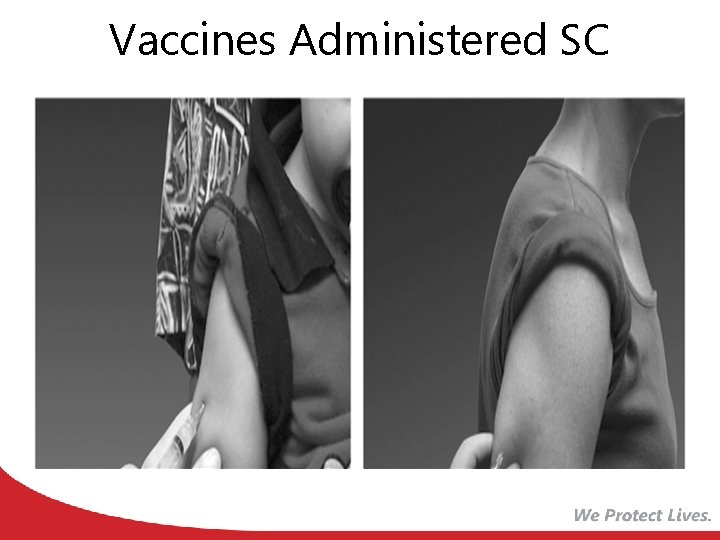
Vaccines Administered SC
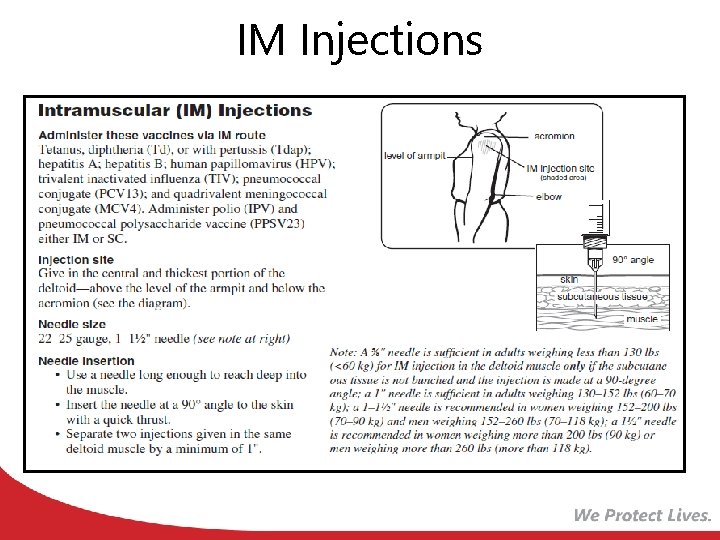
IM Injections
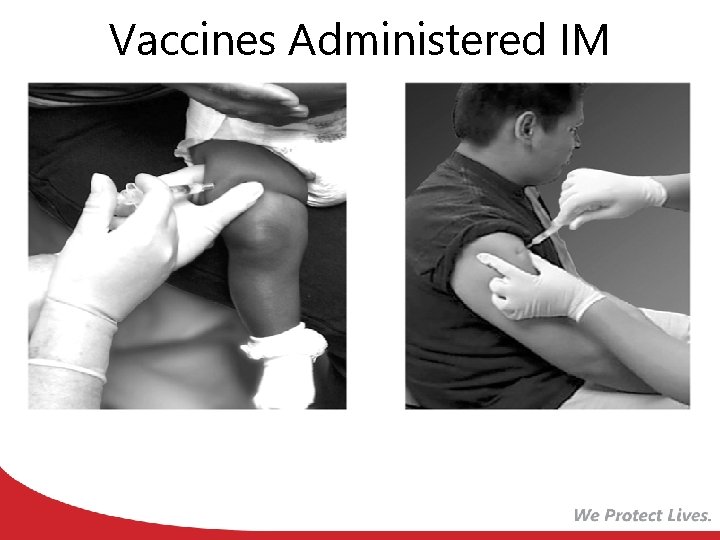
Vaccines Administered IM
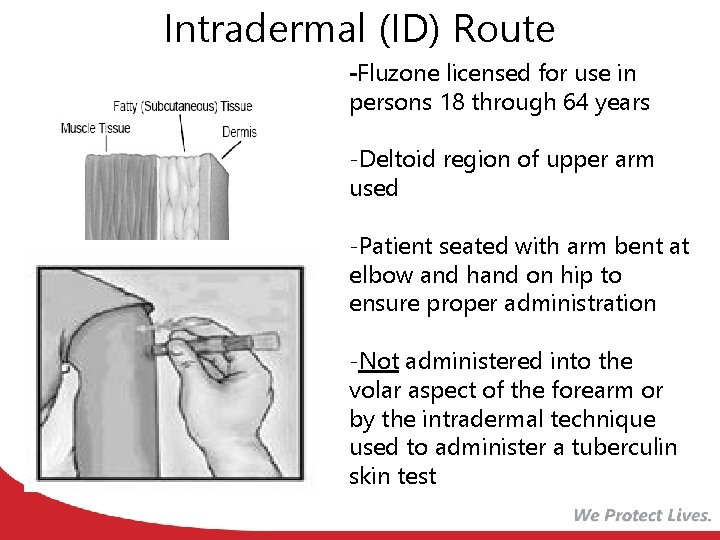
Intradermal (ID) Route -Fluzone licensed for use in persons 18 through 64 years -Deltoid region of upper arm used -Patient seated with arm bent at elbow and hand on hip to ensure proper administration -Not administered into the volar aspect of the forearm or by the intradermal technique used to administer a tuberculin skin test
Special Situations • Multiple Vaccinations • Persons with Bleeding Disorders • Nonstandard Administration • Managing Acute Vaccine Reactions
Multiple Vaccines • When multiple vaccines are administered, separate sites should ordinarily be used if possible. • When necessary, two vaccines may be given in the same limb at a single visit. • The thigh is the preferred site for infants and smaller children for two simultaneous IM injections because of its greater muscle mass. • The distance for separating the two injections is arbitrary but should be sufficient (e. g. , 1 to 2 in. apart) so that local reactions are unlikely to develop. • Multiple vaccines should not be mixed in a single syringe unless specifically licensed and labeled for administering in one syringe.
Bleeding Disorders Individuals with a bleeding disorder or who are receiving anticoagulant therapy may develop hematomas in IM injection sites. When any intramuscularly administered vaccine is indicated for a patient with a bleeding disorder, the vaccine should be administered intramuscularly if a physician familiar with the patient’s bleeding risk determines that the vaccine can be administered by this route with reasonable safety.
Non-Standard Administration • CDC discourages deviating from the recommended route, site, dosage, or number of doses for any vaccine. Deviation can result in reduced protection and increase the risk of an exaggerated local reaction. For certain vaccines, the ACIP recommends revaccination if a nonstandard route or site is used. • Larger than recommended dosages can be hazardous because of excessive local or systemic concentrations of antigens or other vaccine constituents deposited into the tissue.
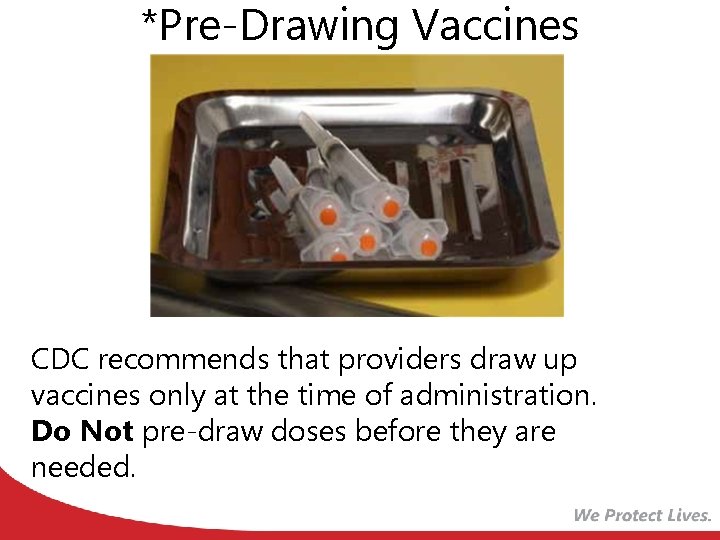
*Pre-Drawing Vaccines CDC recommends that providers draw up vaccines only at the time of administration. Do Not pre-draw doses before they are needed.
Managing Acute Vaccine Reactions • Thorough screening for contraindications and precautions • Procedures in place for managing reaction • Be familiar with the signs & symptoms of anaphylaxis • Know staff role in the event of an emergency • CPR certified • Emergency cart & equipment available
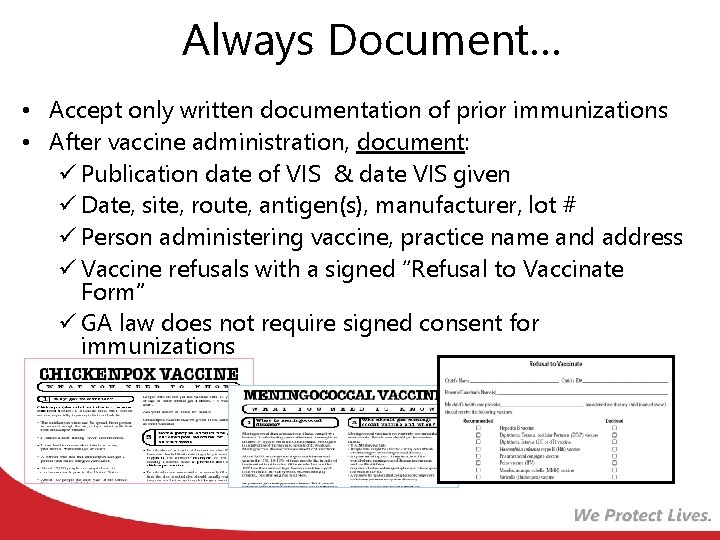
Always Document… • Accept only written documentation of prior immunizations • After vaccine administration, document: ü Publication date of VIS & date VIS given ü Date, site, route, antigen(s), manufacturer, lot # ü Person administering vaccine, practice name and address ü Vaccine refusals with a signed “Refusal to Vaccinate Form” ü GA law does not require signed consent for immunizations
The 7 Rights of Vaccine Administration ü Right Patient ü Right Vaccine or Diluent ü Right Time* ü Right Dosage ü Right Route, Needle Length, Technique ü Right Site for route indicated ü Right Documentation * Correct age, appropriate interval, and administer before vaccine or diluent expires Ref: Epidemiology and Prevention of Vaccine-Preventable Diseases. 12 th Edition, May 2012.
Avoiding Vaccine Errors • When possible, involve staff in selection of vaccine products • Keep current reference materials on each vaccine • Rotate vaccines • Consider the potential for product mix-up • Triple Check Your work
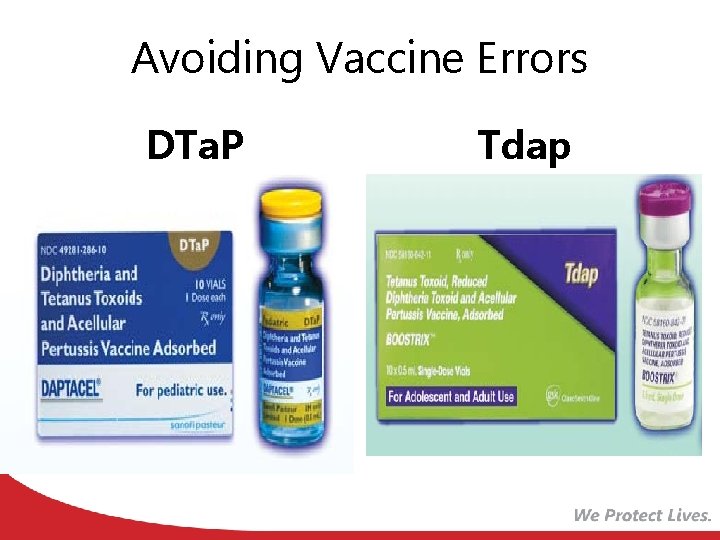
Avoiding Vaccine Errors DTa. P Tdap
Test Your Knowledge! Four month old Lucas was given Tdap instead of DTa. P. What should be done?
Test Your Knowledge! Four month old Lucas was given Tdap instead of DTa. P. What should be done? If Tdap was inadvertently given to a child under age 7 years, it should not be counted as either the first, second, or third dose of DTa. P. The dose should be repeated with DTa. P. Continue vaccinating on schedule. If the dose of Tdap was administered for the fourth or fifth DTa. P dose, the Tdap dose can be counted as valid. Please remind your staff to always check the vaccine vial at least 3 times before administering any vaccine. IAC Ask the Experts - Reviewed July 2014
Test Your Knowledge! Lillian, a 50 year old grandmother, was given DTa. P instead of Tdap. Does she need to receive one dose of Tdap?
Test Your Knowledge! Lillian, a 50 year old grandmother, was given DTa. P instead of Tdap. Does she need to receive one dose of Tdap? Lillian received the appropriate amount of tetanus toxoid and MORE diphtheria toxoid and pertussis antigen than is recommended. Count the dose as Tdap. The patient does not need a repeat dose of Tdap. Take measures to prevent this error in the future. IAC Ask the Experts - Reviewed July 2014
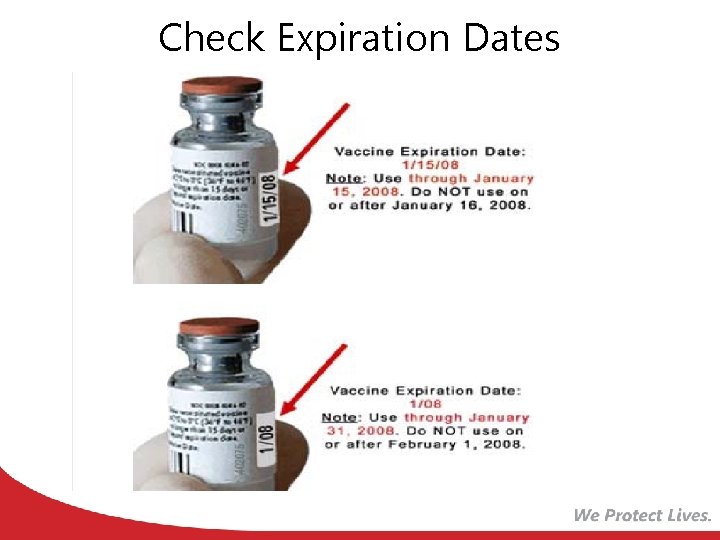
Check Expiration Dates
Test Your Knowledge! Five-year-old Tonia received her second MMR a week ago. How long should she wait before receiving live attenuated influenza vaccine (LAIV)?
Test Your Knowledge! Five-year-old Tonia received her second MMR a week ago. How long should she wait before receiving live attenuated influenza vaccine (LAIV)? LAIV can be administered simultaneously with another live vaccine (for example, MMR, varicella), but if not given at the same time, ACIP recommends waiting four weeks before administering the second live vaccine. IAC Ask the Experts - Reviewed January 2014
Vaccine Injury Compensation Program (VICP) VICP is a no-fault alternative to the traditional tort system for resolving vaccine injury claims. It was established as part of the National Childhood Vaccine Injury Act of 1986, after a rash of lawsuits against vaccine manufacturers and healthcare providers threatened to cause vaccine shortages and reduce vaccination rates. Who can file a claim? – Claim must be filed by individual, parent or guardian, legal representative, non-United States citizen – Must show that injury is on “Vaccine Injury Table” In addition, to be eligible to file a claim, the effects of the person’s injury must have: • Lasted for more than 6 months after vaccine was given • Resulted in hospital stay and surgery • Resulted in death
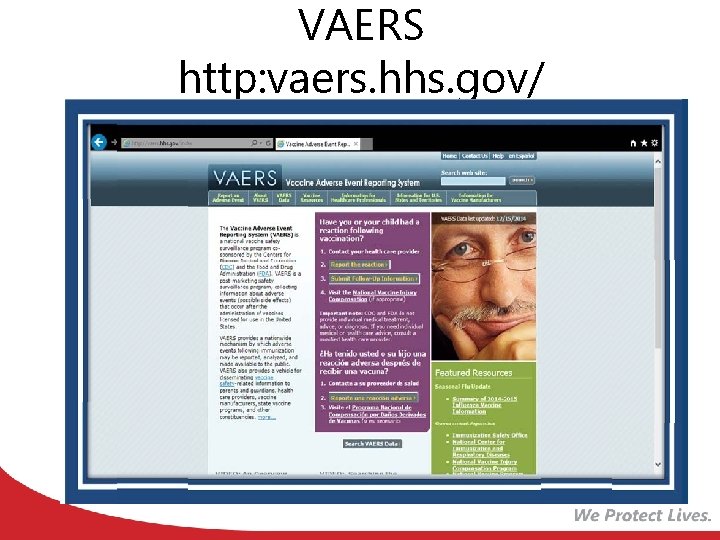
VAERS http: vaers. hhs. gov/
Are YOU up to date? Healthcare Personnel (HCP) Need These Immunizations • Annual influenza vaccine • Tdap or Td • Hepatitis B (exposure risk) Check immunity Validate immune status of: • Varicella • Measles, Mumps & Rubella(MMR)
Resources • Local health department • District Immunization Coordinator • GA Immunization Program Office – On call Help line: 404 -657 -3158 – GRITS Help Line: 1 -866 -483 -2958 – VFC Help Line: 1 -800 -848 -3868 – Website http: //dph. georgia. gov/immunization-section – Your local Immunization Program Consultant (IPC) • GA Chapter of the AAP • GA Academy of Family Physicians
Internet Resources Georgia Department of Public Health l http: //dph. georgia. gov/immunization-section CDC Immunization information l http: //www. cdc. gov/vaccines/ CDC Flu information l http: //www. cdc. gov/flu/ Immunization Action Coalition l www. immunize. org

QUESTIONS?
- Slides: 46