
VA LIFESUSTAINING TREATMENT DECISIONS INITIATIVE 2 VA LifeSustaining
- Slides: 16
VA LIFE-SUSTAINING TREATMENT DECISIONS INITIATIVE
2 VA Life-Sustaining Treatment Decisions Initiative National quality improvement initiative to promote personalized, proactive, patient-driven care for Veterans with serious illness Desired outcomes: The values, goals, and life-sustaining treatment decisions of Veterans with serious illness are proactively elicited, documented, and honored
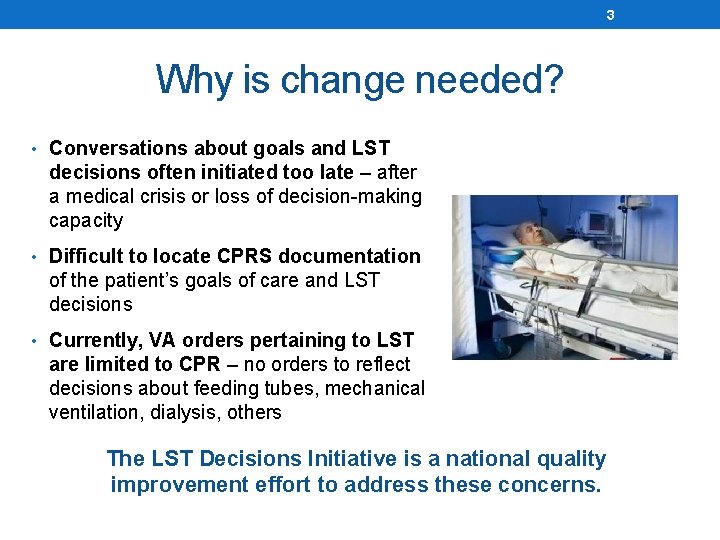
3 Why is change needed? • Conversations about goals and LST decisions often initiated too late – after a medical crisis or loss of decision-making capacity • Difficult to locate CPRS documentation of the patient’s goals of care and LST decisions • Currently, VA orders pertaining to LST are limited to CPR – no orders to reflect decisions about feeding tubes, mechanical ventilation, dialysis, others The LST Decisions Initiative is a national quality improvement effort to address these concerns.
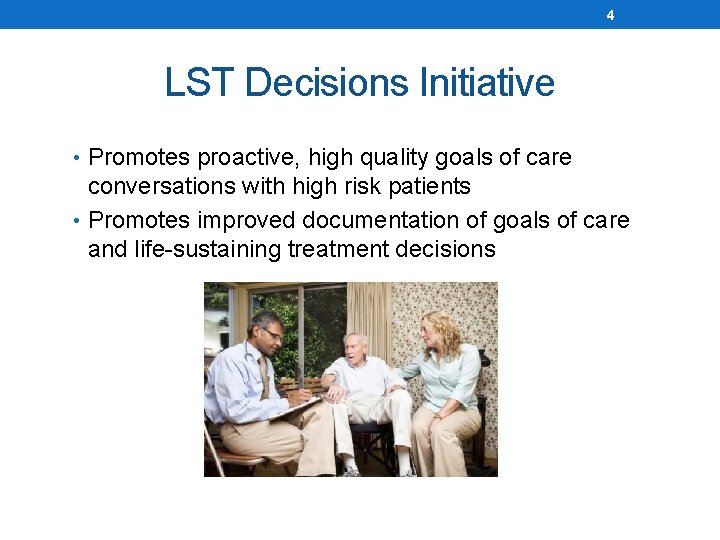
4 LST Decisions Initiative • Promotes proactive, high quality goals of care conversations with high risk patients • Promotes improved documentation of goals of care and life-sustaining treatment decisions
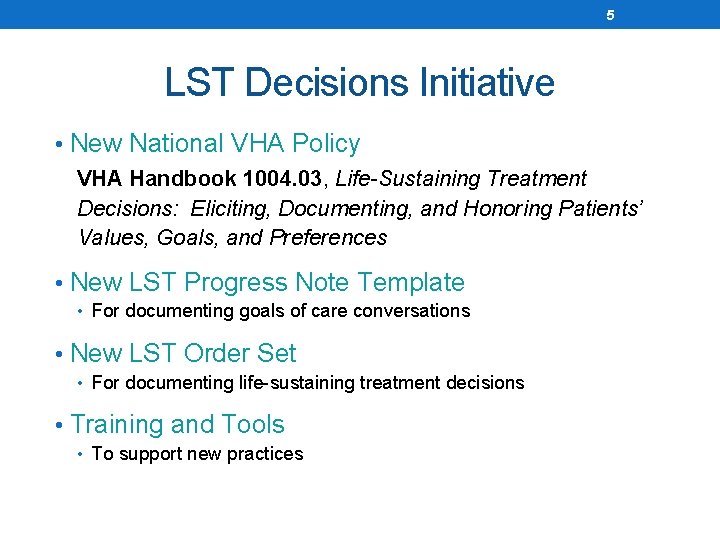
5 LST Decisions Initiative • New National VHA Policy VHA Handbook 1004. 03, Life-Sustaining Treatment Decisions: Eliciting, Documenting, and Honoring Patients’ Values, Goals, and Preferences • New LST Progress Note Template • For documenting goals of care conversations • New LST Order Set • For documenting life-sustaining treatment decisions • Training and Tools • To support new practices
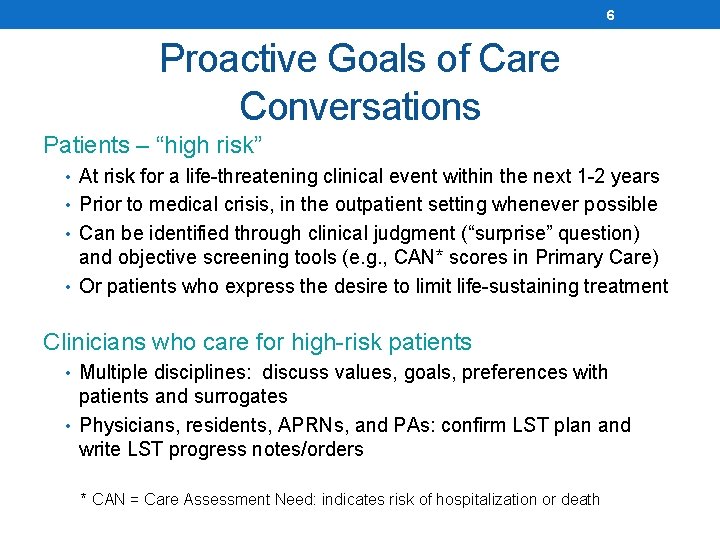
6 Proactive Goals of Care Conversations Patients – “high risk” • At risk for a life-threatening clinical event within the next 1 -2 years • Prior to medical crisis, in the outpatient setting whenever possible • Can be identified through clinical judgment (“surprise” question) and objective screening tools (e. g. , CAN* scores in Primary Care) • Or patients who express the desire to limit life-sustaining treatment Clinicians who care for high-risk patients • Multiple disciplines: discuss values, goals, preferences with patients and surrogates • Physicians, residents, APRNs, and PAs: confirm LST plan and write LST progress notes/orders * CAN = Care Assessment Need: indicates risk of hospitalization or death
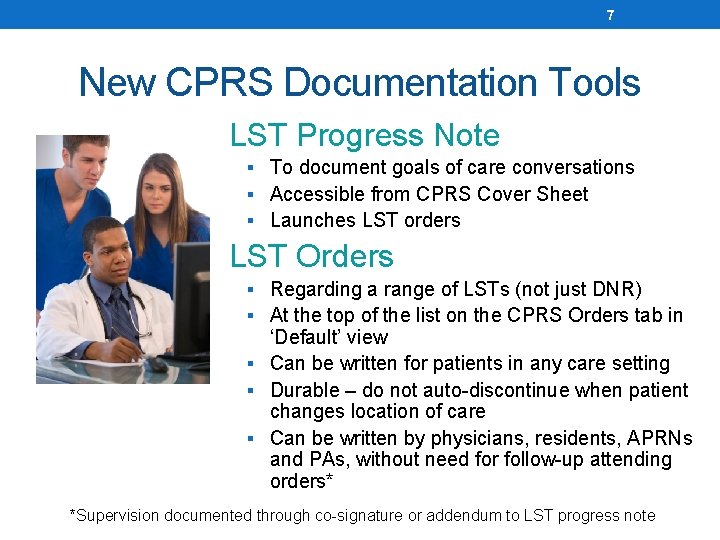
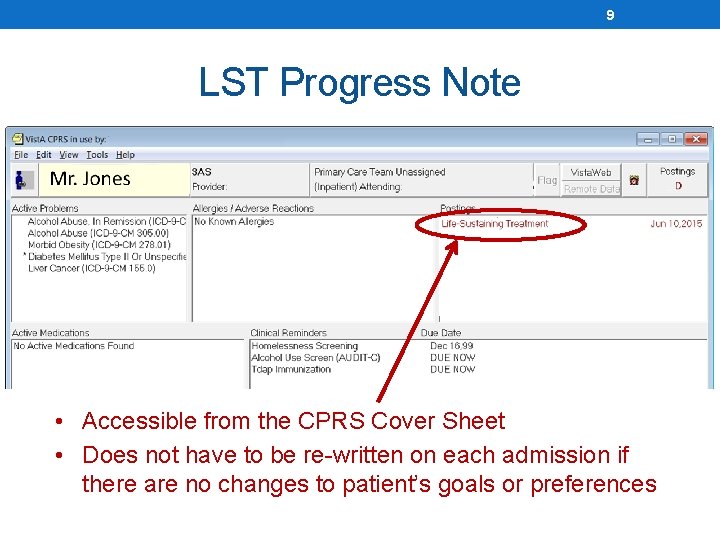
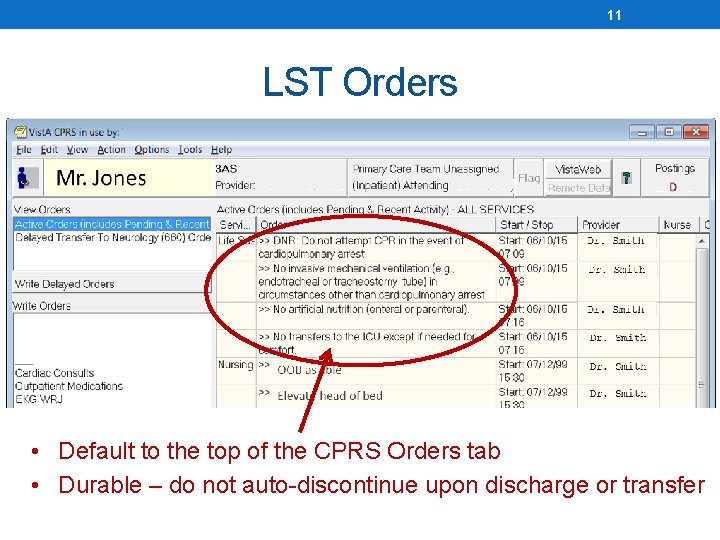
7 New CPRS Documentation Tools LST Progress Note § To document goals of care conversations § Accessible from CPRS Cover Sheet § Launches LST orders LST Orders § Regarding a range of LSTs (not just DNR) § At the top of the list on the CPRS Orders tab in ‘Default’ view § Can be written for patients in any care setting § Durable – do not auto-discontinue when patient changes location of care § Can be written by physicians, residents, APRNs and PAs, without need for follow-up attending orders* *Supervision documented through co-signature or addendum to LST progress note
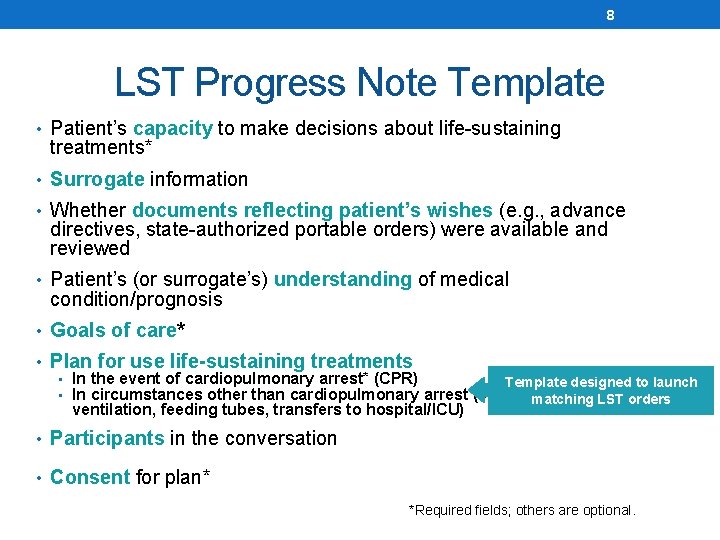
8 LST Progress Note Template • Patient’s capacity to make decisions about life-sustaining treatments* • Surrogate information • Whether documents reflecting patient’s wishes (e. g. , advance directives, state-authorized portable orders) were available and reviewed • Patient’s (or surrogate’s) understanding of medical condition/prognosis • Goals of care* • Plan for use life-sustaining treatments • In the event of cardiopulmonary arrest* (CPR) Template designed to launch • In circumstances other than cardiopulmonary arrest (e. g. , mechanical matching LST orders ventilation, feeding tubes, transfers to hospital/ICU) • Participants in the conversation • Consent for plan* *Required fields; others are optional.
9 LST Progress Note • Accessible from the CPRS Cover Sheet • Does not have to be re-written on each admission if there are no changes to patient’s goals or preferences
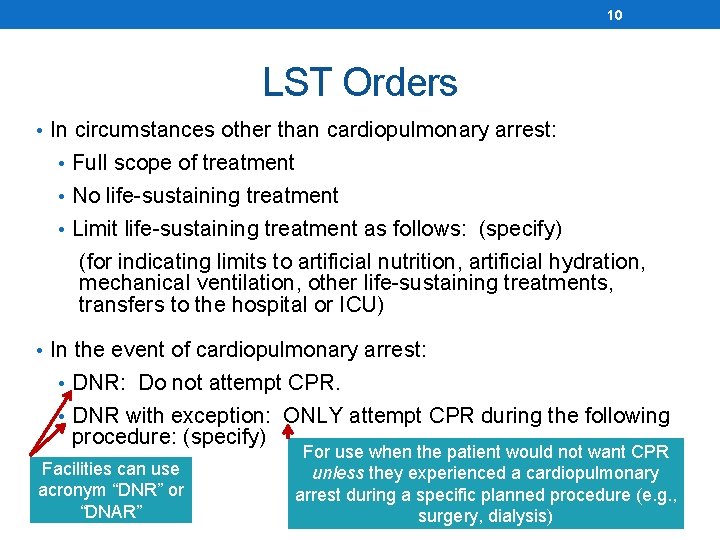
10 LST Orders • In circumstances other than cardiopulmonary arrest: • Full scope of treatment • No life-sustaining treatment • Limit life-sustaining treatment as follows: (specify) (for indicating limits to artificial nutrition, artificial hydration, mechanical ventilation, other life-sustaining treatments, transfers to the hospital or ICU) • In the event of cardiopulmonary arrest: • DNR: Do not attempt CPR. • DNR with exception: ONLY attempt CPR during the following procedure: (specify) Facilities can use acronym “DNR” or “DNAR” For use when the patient would not want CPR unless they experienced a cardiopulmonary arrest during a specific planned procedure (e. g. , surgery, dialysis)
11 LST Orders • Default to the top of the CPRS Orders tab • Durable – do not auto-discontinue upon discharge or transfer
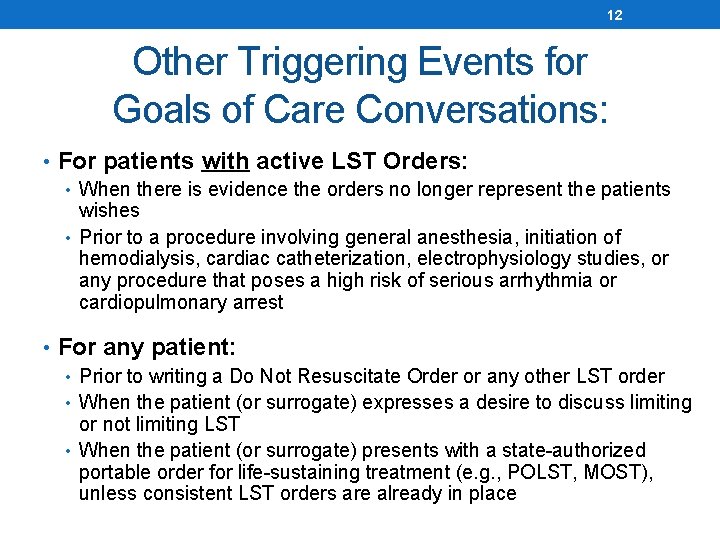
12 Other Triggering Events for Goals of Care Conversations: • For patients with active LST Orders: • When there is evidence the orders no longer represent the patients wishes • Prior to a procedure involving general anesthesia, initiation of hemodialysis, cardiac catheterization, electrophysiology studies, or any procedure that poses a high risk of serious arrhythmia or cardiopulmonary arrest • For any patient: • Prior to writing a Do Not Resuscitate Order or any other LST order • When the patient (or surrogate) expresses a desire to discuss limiting or not limiting LST • When the patient (or surrogate) presents with a state-authorized portable order for life-sustaining treatment (e. g. , POLST, MOST), unless consistent LST orders are already in place
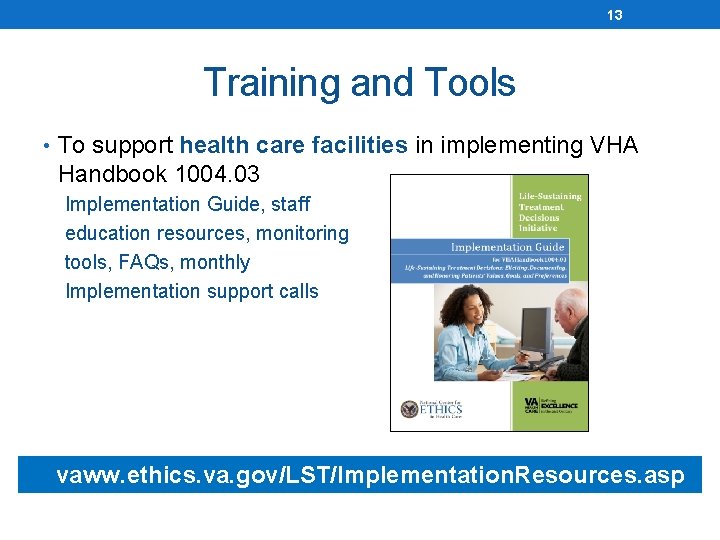
13 Training and Tools • To support health care facilities in implementing VHA Handbook 1004. 03 Implementation Guide, staff education resources, monitoring tools, FAQs, monthly Implementation support calls vaww. ethics. va. gov/LST/Implementation. Resources. asp
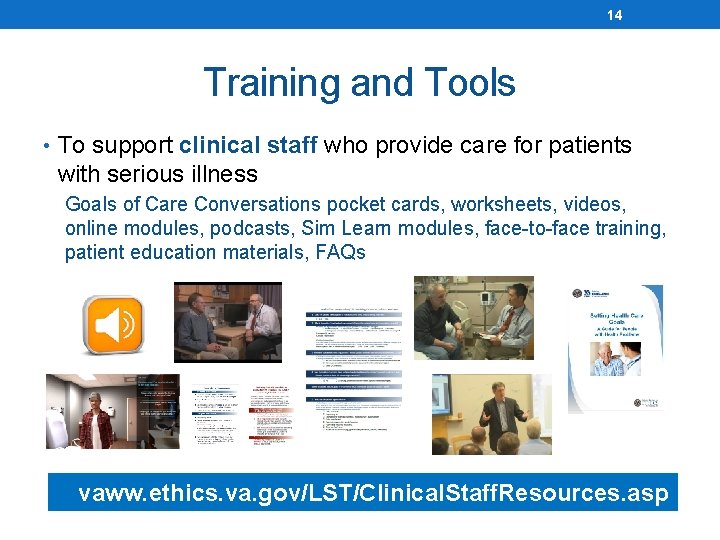
14 Training and Tools • To support clinical staff who provide care for patients with serious illness Goals of Care Conversations pocket cards, worksheets, videos, online modules, podcasts, Sim Learn modules, face-to-face training, patient education materials, FAQs vaww. ethics. va. gov/LST/Clinical. Staff. Resources. asp
15 Goals of Care Conversations Communication Skills Training • For MDs/APRNs/PAs • Teaches skills required to deliver serious news, conduct goals of care conversations, and make shared decisions with high-risk patients about life-sustaining treatments. • For RNs, Social Workers, Psychologists, Chaplains • Teaches skills required to proactively identify high-risk patients, prepare them for goals of care conversations, and conduct discussions about the patient’s values, goals, surrogate, and preferences for services and treatments. Includes team-based strategies for successfully incorporating goals of care conversations into routine clinical practice. For a list of trainers in your facility: vaww. ethics. va. gov/Goalsof. Care. Training/Trainers. pdf
16 Life-Sustaining Treatment Decisions Initiative Website: vaww. ethics. va. gov/LST. as p Contact: vhaethics@va. gov