
V V planning l l Careful planning is
- Slides: 32
V & V planning l l Careful planning is required to get the most out of testing and inspection processes. Planning should start early in the development process. The plan should identify the balance between static verification and testing. Test planning is about defining standards for the testing process rather than describing product tests. ©Ian Sommerville 2004 Software Engineering, 7 th edition. Chapter 22 Slide 1
The structure of a software test plan l l l l The testing process. Requirements traceability. Tested items. Testing schedule. Test recording procedures. Hardware and software requirements. Constraints. ©Ian Sommerville 2004 Software Engineering, 7 th edition. Chapter 22 Slide 2
The software test plan ©Ian Sommerville 2004 Software Engineering, 7 th edition. Chapter 22 Slide 3
Software inspections l l These involve people examining the source representation with the aim of discovering anomalies and defects. Inspections not require execution of a system so may be used before implementation. They may be applied to any representation of the system (requirements, design, configuration data, test data, etc. ). They have been shown to be an effective technique for discovering program errors. ©Ian Sommerville 2004 Software Engineering, 7 th edition. Chapter 22 Slide 4
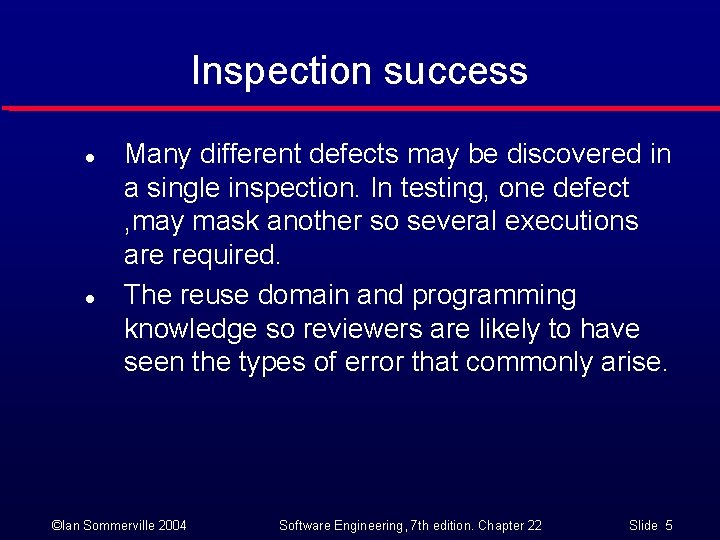
Inspection success l l Many different defects may be discovered in a single inspection. In testing, one defect , may mask another so several executions are required. The reuse domain and programming knowledge so reviewers are likely to have seen the types of error that commonly arise. ©Ian Sommerville 2004 Software Engineering, 7 th edition. Chapter 22 Slide 5
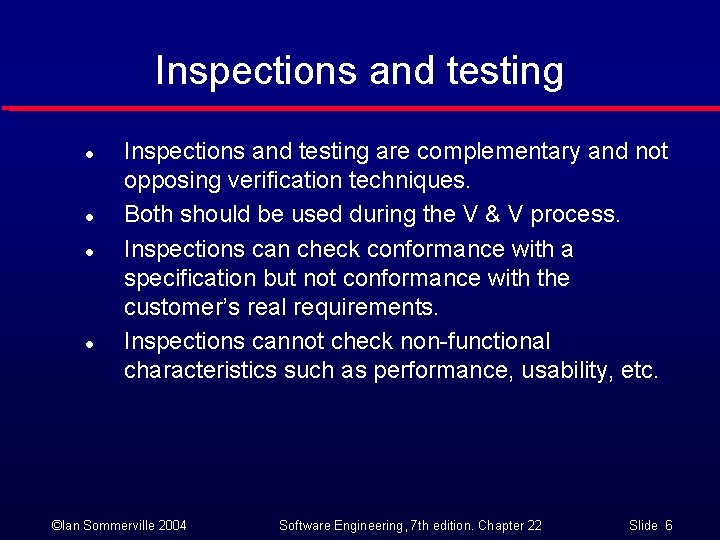
Inspections and testing l l Inspections and testing are complementary and not opposing verification techniques. Both should be used during the V & V process. Inspections can check conformance with a specification but not conformance with the customer’s real requirements. Inspections cannot check non-functional characteristics such as performance, usability, etc. ©Ian Sommerville 2004 Software Engineering, 7 th edition. Chapter 22 Slide 6
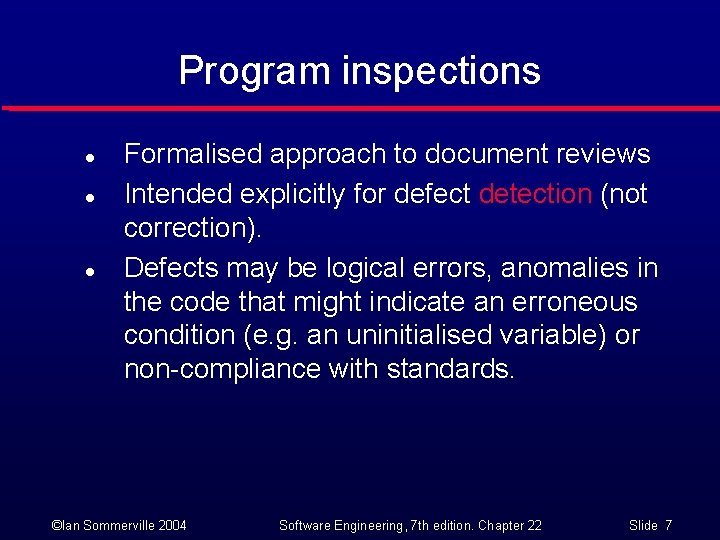
Program inspections l l l Formalised approach to document reviews Intended explicitly for defect detection (not correction). Defects may be logical errors, anomalies in the code that might indicate an erroneous condition (e. g. an uninitialised variable) or non-compliance with standards. ©Ian Sommerville 2004 Software Engineering, 7 th edition. Chapter 22 Slide 7
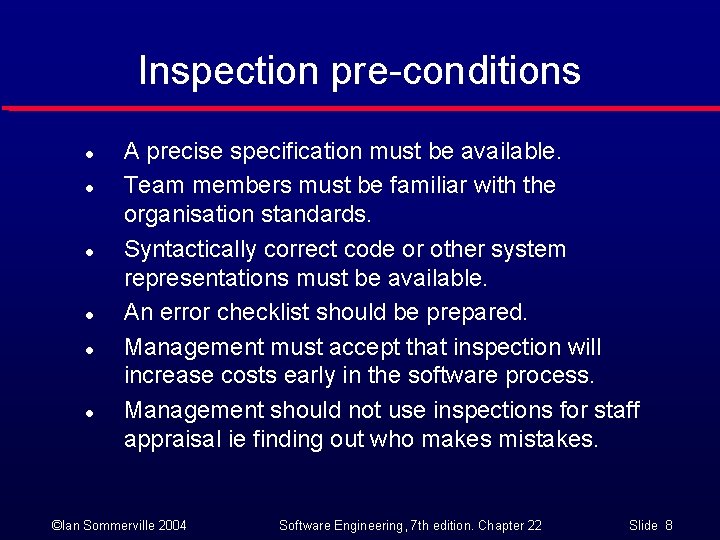
Inspection pre-conditions l l l A precise specification must be available. Team members must be familiar with the organisation standards. Syntactically correct code or other system representations must be available. An error checklist should be prepared. Management must accept that inspection will increase costs early in the software process. Management should not use inspections for staff appraisal ie finding out who makes mistakes. ©Ian Sommerville 2004 Software Engineering, 7 th edition. Chapter 22 Slide 8
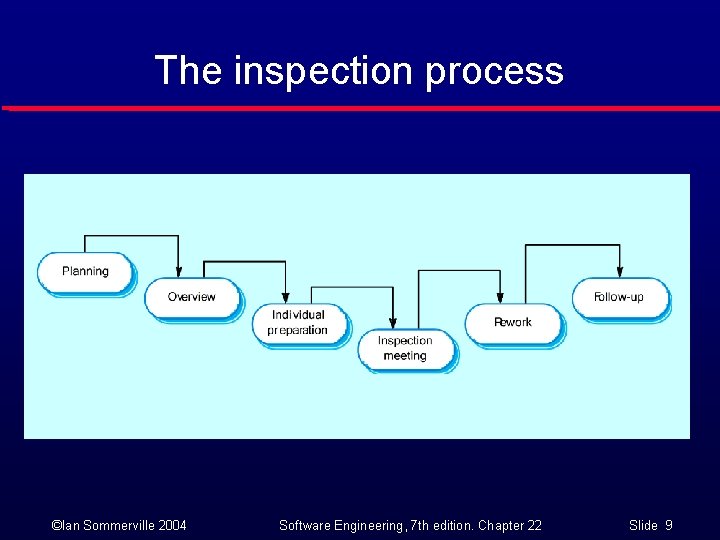
The inspection process ©Ian Sommerville 2004 Software Engineering, 7 th edition. Chapter 22 Slide 9
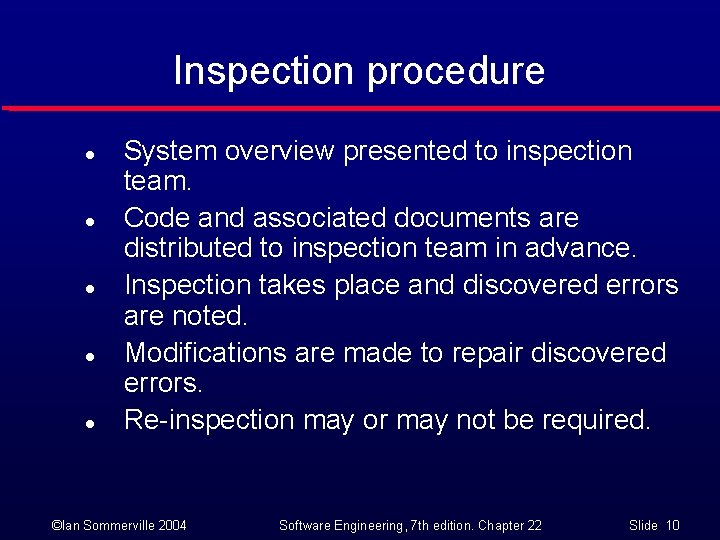
Inspection procedure l l l System overview presented to inspection team. Code and associated documents are distributed to inspection team in advance. Inspection takes place and discovered errors are noted. Modifications are made to repair discovered errors. Re-inspection may or may not be required. ©Ian Sommerville 2004 Software Engineering, 7 th edition. Chapter 22 Slide 10
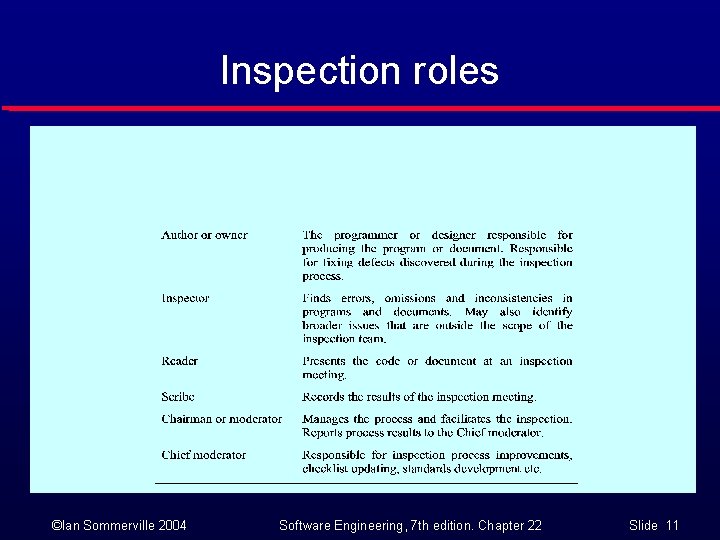
Inspection roles ©Ian Sommerville 2004 Software Engineering, 7 th edition. Chapter 22 Slide 11
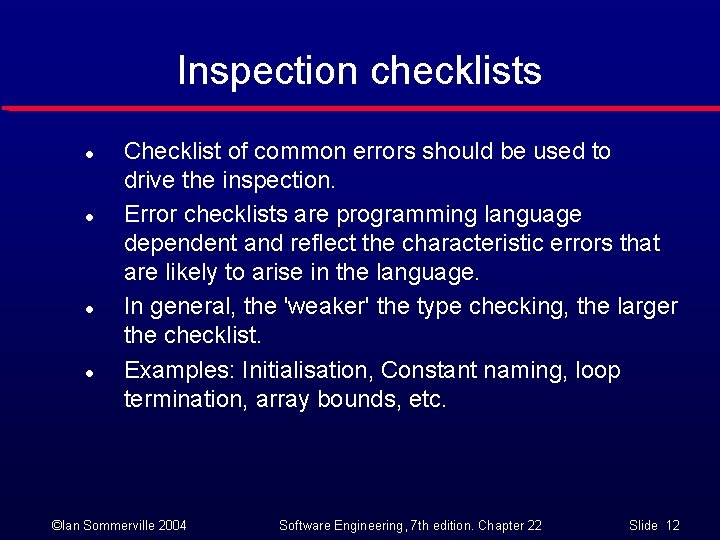
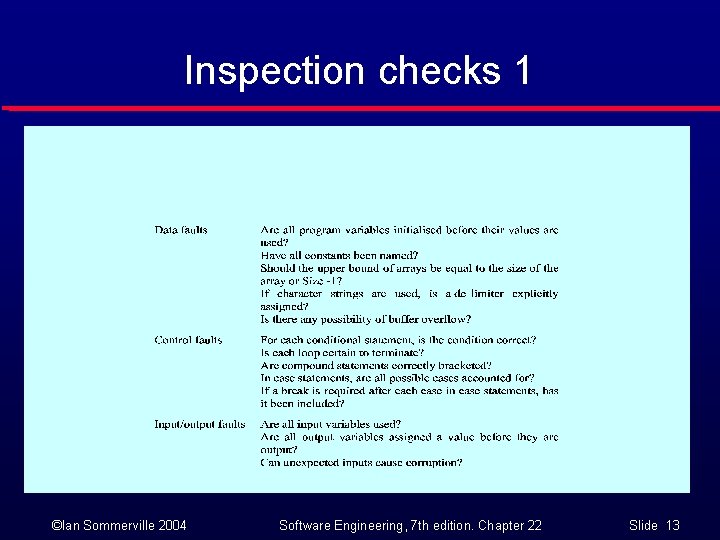
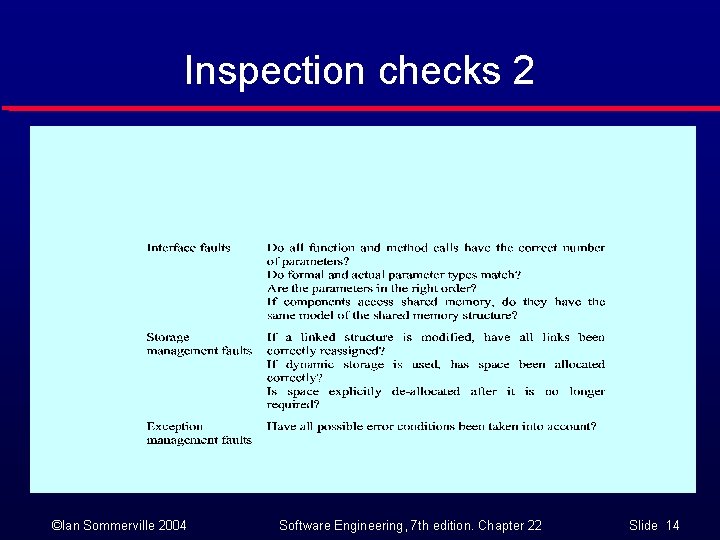
Inspection checklists l l Checklist of common errors should be used to drive the inspection. Error checklists are programming language dependent and reflect the characteristic errors that are likely to arise in the language. In general, the 'weaker' the type checking, the larger the checklist. Examples: Initialisation, Constant naming, loop termination, array bounds, etc. ©Ian Sommerville 2004 Software Engineering, 7 th edition. Chapter 22 Slide 12
Inspection checks 1 ©Ian Sommerville 2004 Software Engineering, 7 th edition. Chapter 22 Slide 13
Inspection checks 2 ©Ian Sommerville 2004 Software Engineering, 7 th edition. Chapter 22 Slide 14
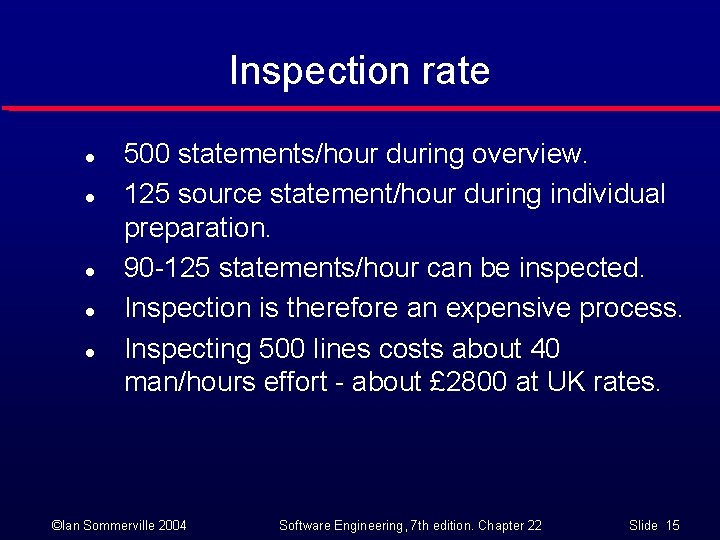
Inspection rate l l l 500 statements/hour during overview. 125 source statement/hour during individual preparation. 90 -125 statements/hour can be inspected. Inspection is therefore an expensive process. Inspecting 500 lines costs about 40 man/hours effort - about £ 2800 at UK rates. ©Ian Sommerville 2004 Software Engineering, 7 th edition. Chapter 22 Slide 15
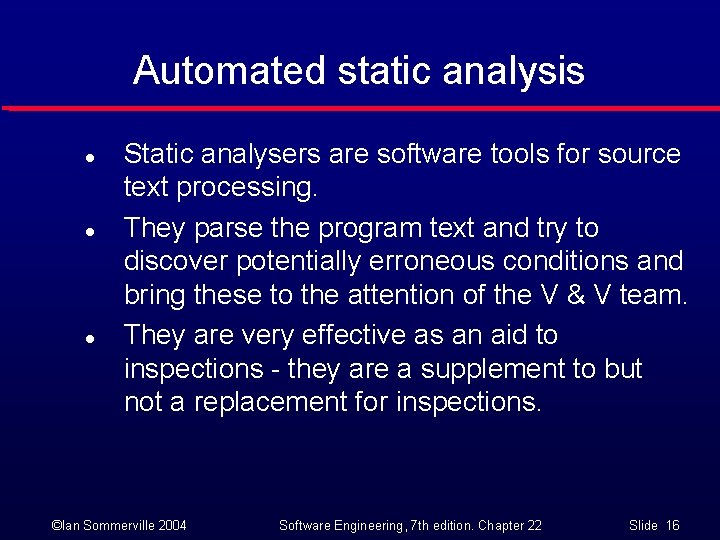
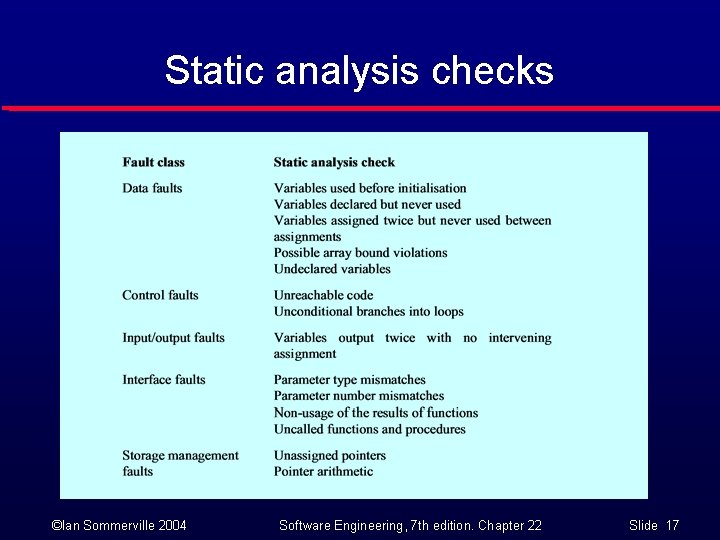
Automated static analysis l l l Static analysers are software tools for source text processing. They parse the program text and try to discover potentially erroneous conditions and bring these to the attention of the V & V team. They are very effective as an aid to inspections - they are a supplement to but not a replacement for inspections. ©Ian Sommerville 2004 Software Engineering, 7 th edition. Chapter 22 Slide 16
Static analysis checks ©Ian Sommerville 2004 Software Engineering, 7 th edition. Chapter 22 Slide 17
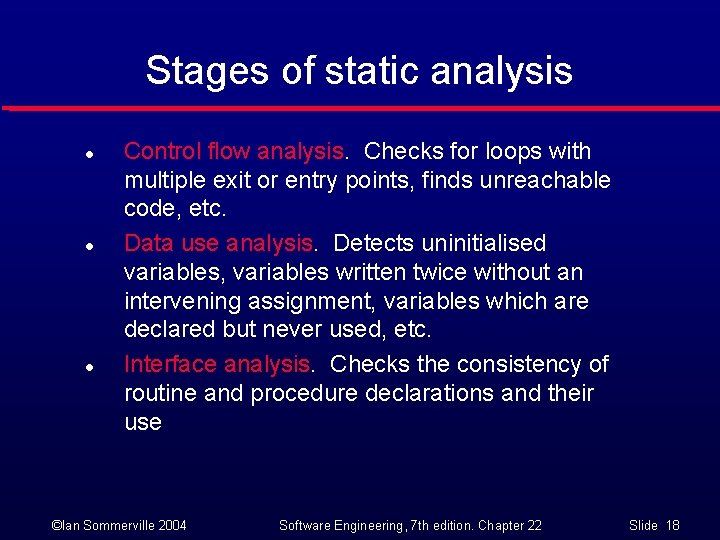
Stages of static analysis l l l Control flow analysis. Checks for loops with multiple exit or entry points, finds unreachable code, etc. Data use analysis. Detects uninitialised variables, variables written twice without an intervening assignment, variables which are declared but never used, etc. Interface analysis. Checks the consistency of routine and procedure declarations and their use ©Ian Sommerville 2004 Software Engineering, 7 th edition. Chapter 22 Slide 18
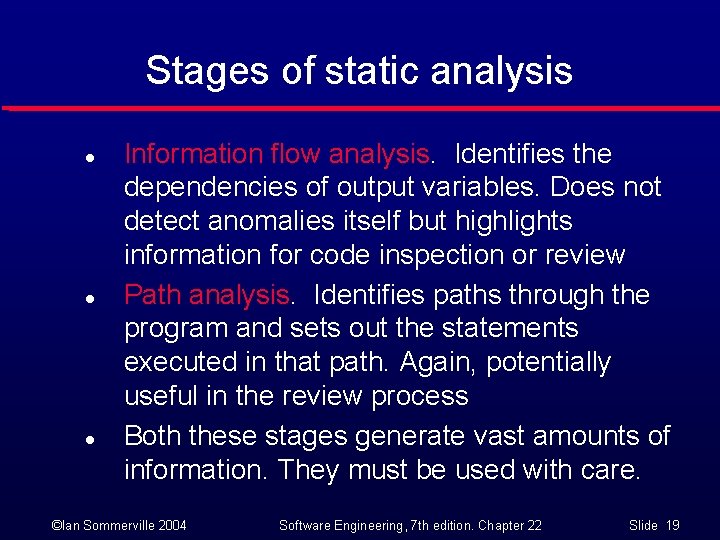
Stages of static analysis l l l Information flow analysis. Identifies the dependencies of output variables. Does not detect anomalies itself but highlights information for code inspection or review Path analysis. Identifies paths through the program and sets out the statements executed in that path. Again, potentially useful in the review process Both these stages generate vast amounts of information. They must be used with care. ©Ian Sommerville 2004 Software Engineering, 7 th edition. Chapter 22 Slide 19
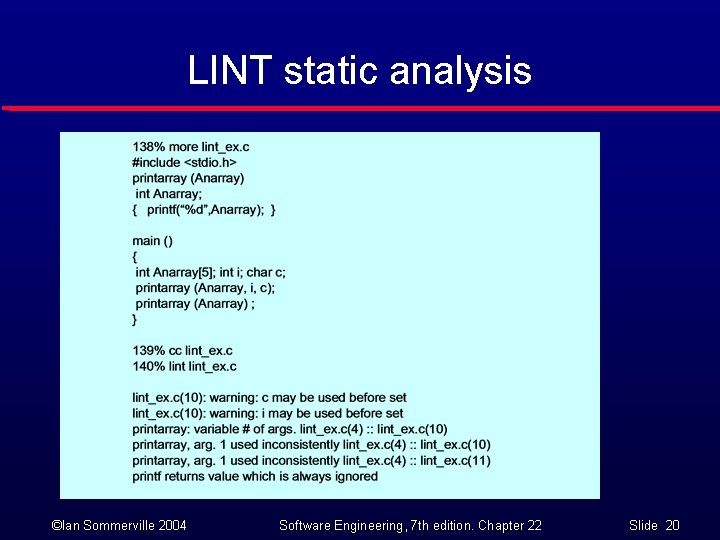
LINT static analysis ©Ian Sommerville 2004 Software Engineering, 7 th edition. Chapter 22 Slide 20
Use of static analysis l l Particularly valuable when a language such as C is used which has weak typing and hence many errors are undetected by the compiler, Less cost-effective for languages like Java that have strong type checking and can therefore detect many errors during compilation. ©Ian Sommerville 2004 Software Engineering, 7 th edition. Chapter 22 Slide 21
Verification and formal methods l l l Formal methods can be used when a mathematical specification of the system is produced. They are the ultimate static verification technique. They involve detailed mathematical analysis of the specification and may develop formal arguments that a program conforms to its mathematical specification. ©Ian Sommerville 2004 Software Engineering, 7 th edition. Chapter 22 Slide 22
Arguments formal methods l l Producing a mathematical specification requires a detailed analysis of the requirements and this is likely to uncover errors. They can detect implementation errors before testing when the program is analysed alongside the specification. ©Ian Sommerville 2004 Software Engineering, 7 th edition. Chapter 22 Slide 23
Arguments against formal methods l l l Require specialised notations that cannot be understood by domain experts. Very expensive to develop a specification and even more expensive to show that a program meets that specification. It may be possible to reach the same level of confidence in a program more cheaply using other V & V techniques. ©Ian Sommerville 2004 Software Engineering, 7 th edition. Chapter 22 Slide 24
Cleanroom software development l l The name is derived from the 'Cleanroom' process in semiconductor fabrication. The philosophy is defect avoidance rather than defect removal. This software development process is based on: • • Incremental development; Formal specification; Static verification using correctness arguments; Statistical testing to determine program reliability. ©Ian Sommerville 2004 Software Engineering, 7 th edition. Chapter 22 Slide 25
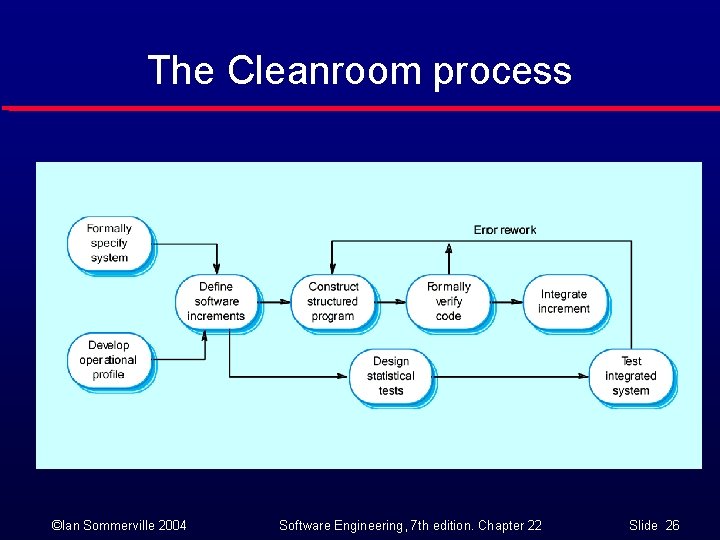
The Cleanroom process ©Ian Sommerville 2004 Software Engineering, 7 th edition. Chapter 22 Slide 26
Cleanroom process characteristics l l l Formal specification using a state transition model. Incremental development where the customer prioritises increments. Structured programming - limited control and abstraction constructs are used in the program. Static verification using rigorous inspections. Statistical testing of the system (covered in Ch. 24). ©Ian Sommerville 2004 Software Engineering, 7 th edition. Chapter 22 Slide 27
Formal specification and inspections l l l The state based model is a system specification and the inspection process checks the program against this mode. l The programming approach is defined so that the correspondence between the model and the system is clear. Mathematical arguments (not proofs) are used to increase confidence in the inspection process. ©Ian Sommerville 2004 Software Engineering, 7 th edition. Chapter 22 Slide 28
Cleanroom process teams l l l Specification team. Responsible for developing and maintaining the system specification. Development team. Responsible for developing and verifying the software. The software is NOT executed or even compiled during this process. Certification team. Responsible for developing a set of statistical tests to exercise the software after development. Reliability growth models used to determine when reliability is acceptable. ©Ian Sommerville 2004 Software Engineering, 7 th edition. Chapter 22 Slide 29
Cleanroom process evaluation l l The results of using the Cleanroom process have been very impressive with few discovered faults in delivered systems. Independent assessment shows that the process is no more expensive than other approaches. There were fewer errors than in a 'traditional' development process. However, the process is not widely used. It is not clear how this approach can be transferred to an environment with less skilled or less motivated software engineers. ©Ian Sommerville 2004 Software Engineering, 7 th edition. Chapter 22 Slide 30
Key points l l l Verification and validation are not the same thing. Verification shows conformance with specification; validation shows that the program meets the customer’s needs. Test plans should be drawn up to guide the testing process. Static verification techniques involve examination and analysis of the program for error detection. ©Ian Sommerville 2004 Software Engineering, 7 th edition. Chapter 22 Slide 31
Key points l l Program inspections are very effective in discovering errors. Program code in inspections is systematically checked by a small team to locate software faults. Static analysis tools can discover program anomalies which may be an indication of faults in the code. The Cleanroom development process depends on incremental development, static verification and statistical testing. ©Ian Sommerville 2004 Software Engineering, 7 th edition. Chapter 22 Slide 32