
V Mineral Identification A Physical Properties Color 1
- Slides: 40
V. Mineral Identification A. Physical Properties
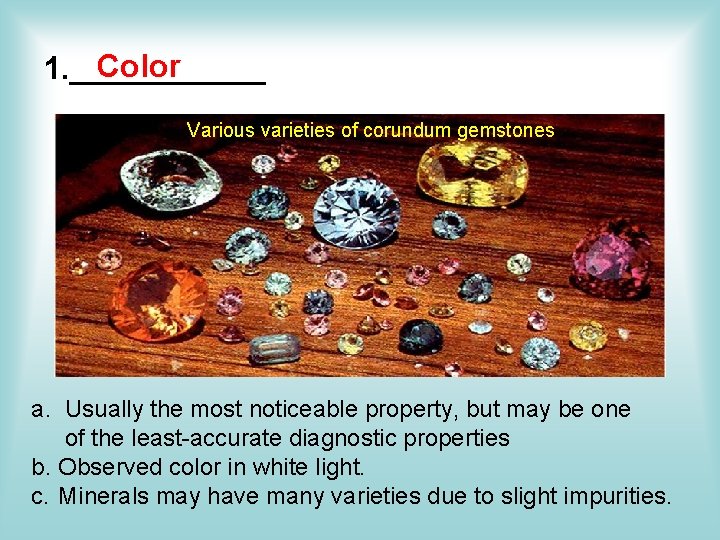
Color 1. ______ Various varieties of corundum gemstones a. Usually the most noticeable property, but may be one of the least-accurate diagnostic properties b. Observed color in white light. c. Minerals may have many varieties due to slight impurities.
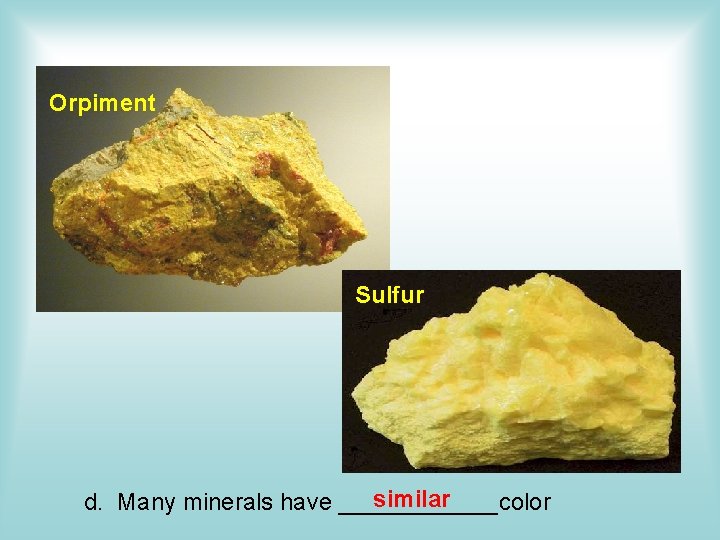
Orpiment Sulfur similar d. Many minerals have ______color
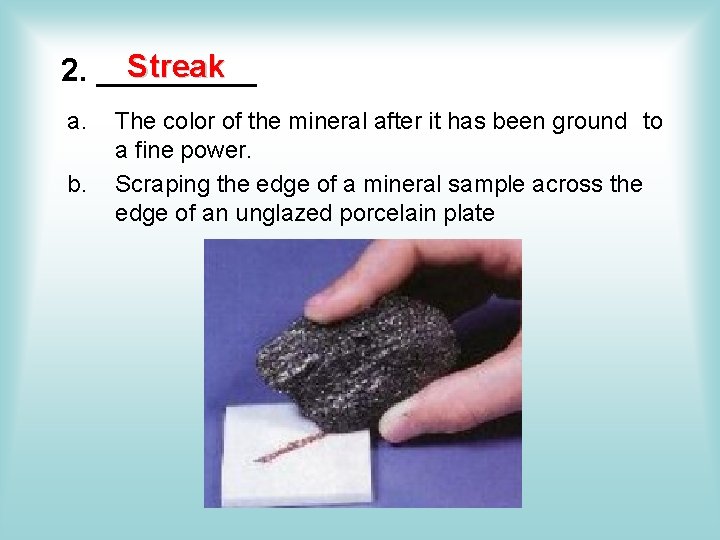
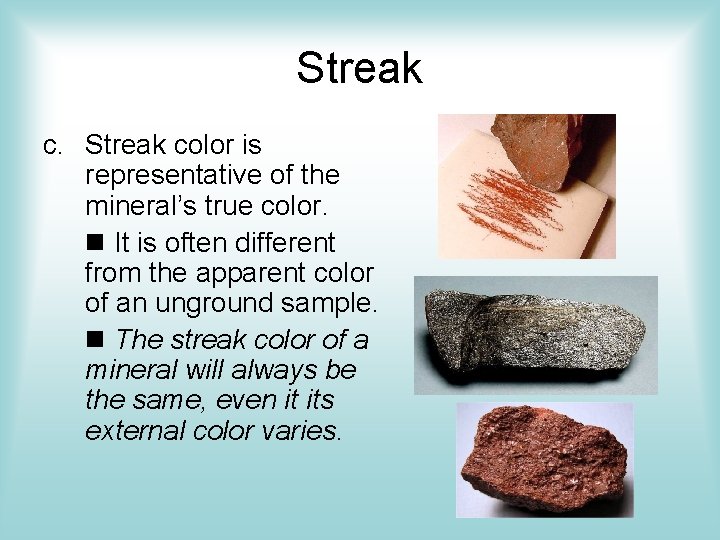
Streak 2. _____ a. b. The color of the mineral after it has been ground to a fine power. Scraping the edge of a mineral sample across the edge of an unglazed porcelain plate
Streak color is representative of the mineral’s true color. It is often different from the apparent color of an unground sample. The streak color of a mineral will always be the same, even it its external color varies.
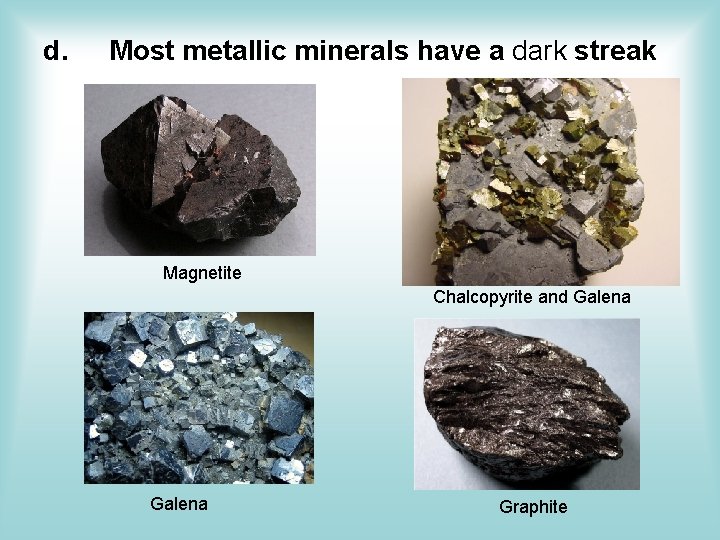
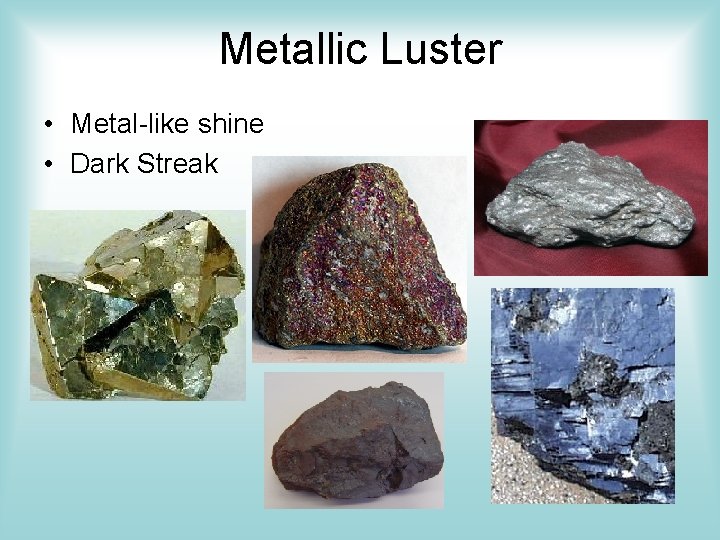
d. Most metallic minerals have a dark streak Magnetite Chalcopyrite and Galena Graphite
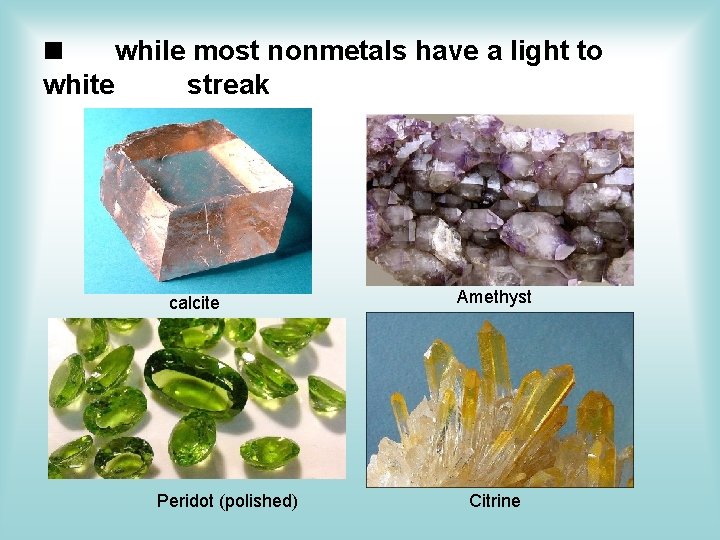
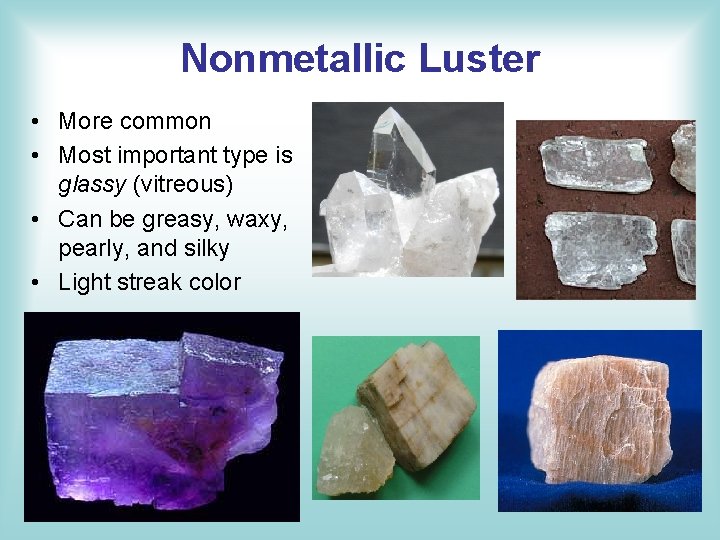
while most nonmetals have a light to white streak calcite Peridot (polished) Amethyst Citrine
3. a. b. Luster ______ The quality and intensity of light that is reflected from the surface. metallic nonmetallic Luster is either ______ or _______.
Metallic Luster • Metal-like shine • Dark Streak
Nonmetallic Luster • More common • Most important type is glassy (vitreous) • Can be greasy, waxy, pearly, and silky • Light streak color
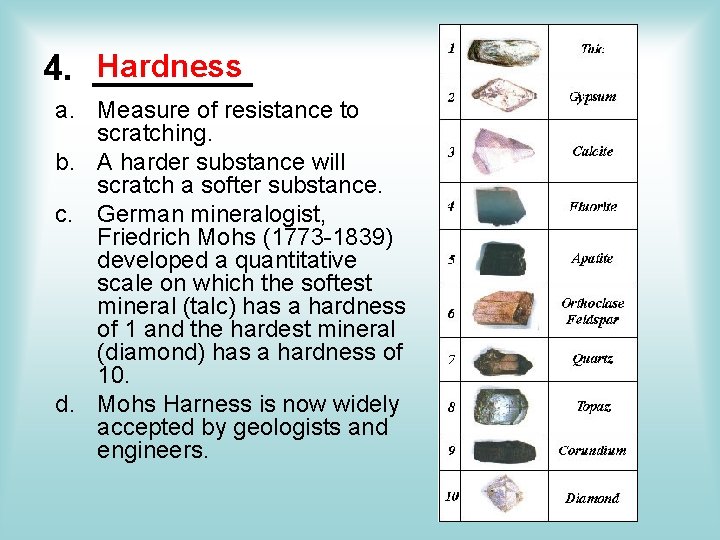
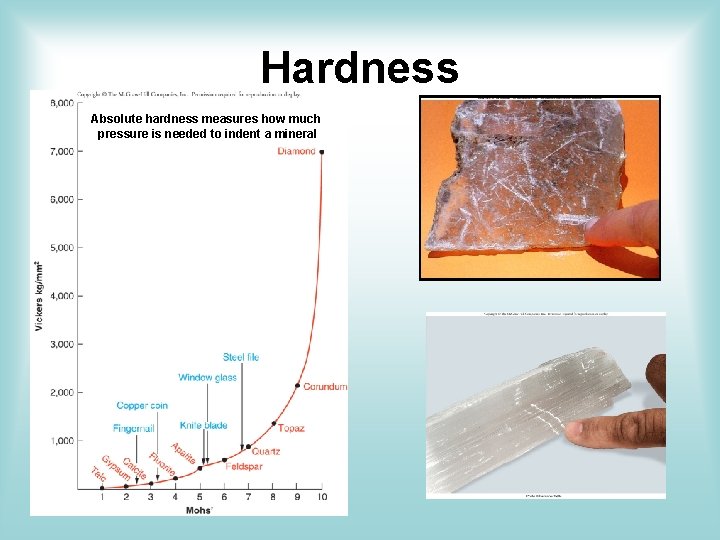
Hardness 4. ____ a. Measure of resistance to scratching. b. A harder substance will scratch a softer substance. c. German mineralogist, Friedrich Mohs (1773 -1839) developed a quantitative scale on which the softest mineral (talc) has a hardness of 1 and the hardest mineral (diamond) has a hardness of 10. d. Mohs Harness is now widely accepted by geologists and engineers.
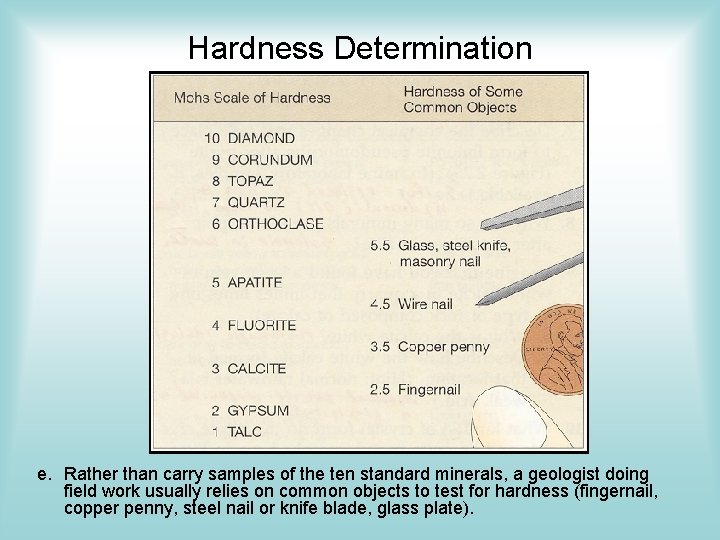
Hardness Determination e. Rather than carry samples of the ten standard minerals, a geologist doing field work usually relies on common objects to test for hardness (fingernail, copper penny, steel nail or knife blade, glass plate).
Hardness Absolute hardness measures how much pressure is needed to indent a mineral
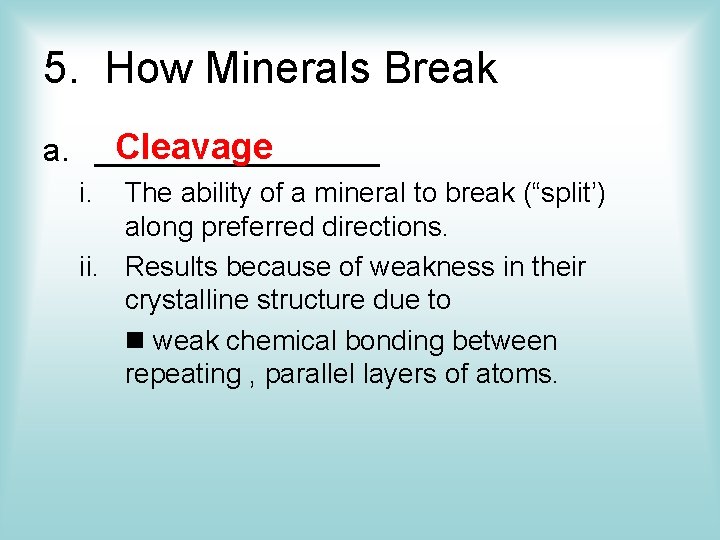
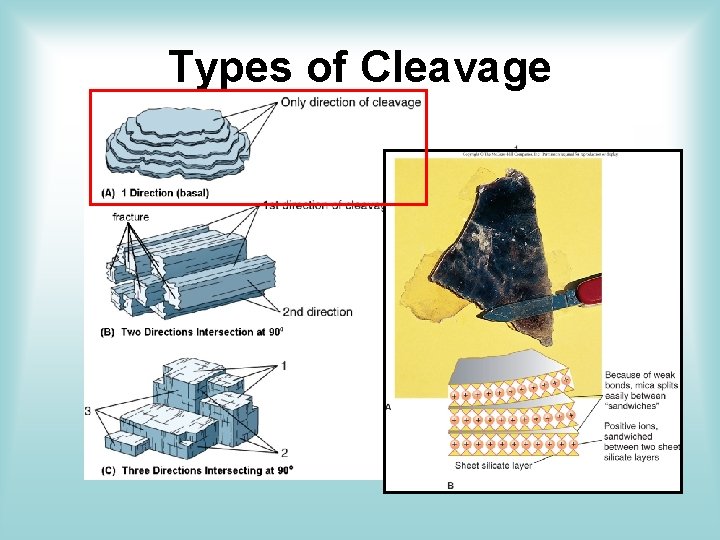
5. How Minerals Break Cleavage a. ________ i. The ability of a mineral to break (“split’) along preferred directions. ii. Results because of weakness in their crystalline structure due to weak chemical bonding between repeating , parallel layers of atoms.
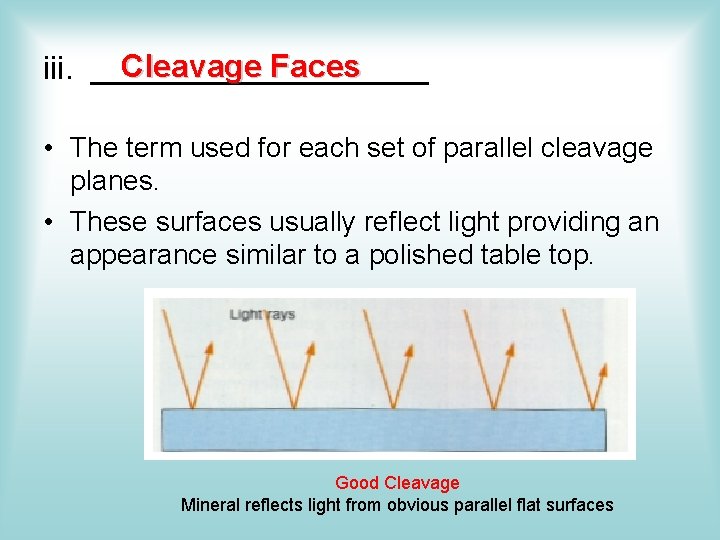
Cleavage Faces iii. __________ • The term used for each set of parallel cleavage planes. • These surfaces usually reflect light providing an appearance similar to a polished table top. Good Cleavage Mineral reflects light from obvious parallel flat surfaces
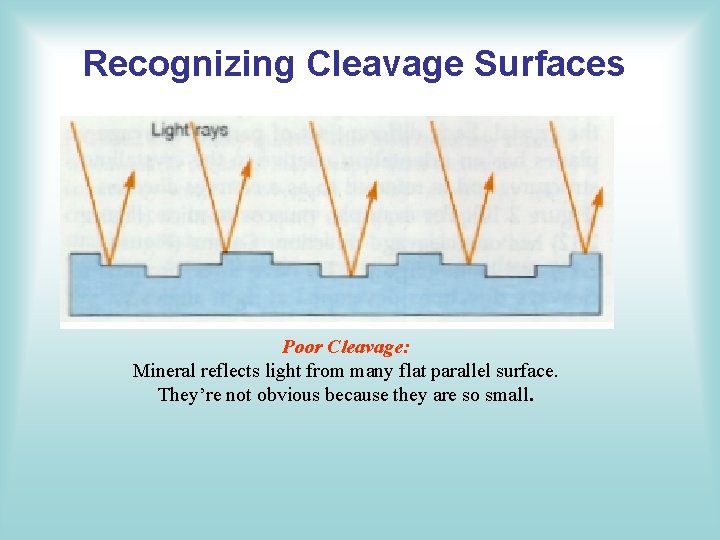
Recognizing Cleavage Surfaces Poor Cleavage: Mineral reflects light from many flat parallel surface. They’re not obvious because they are so small.
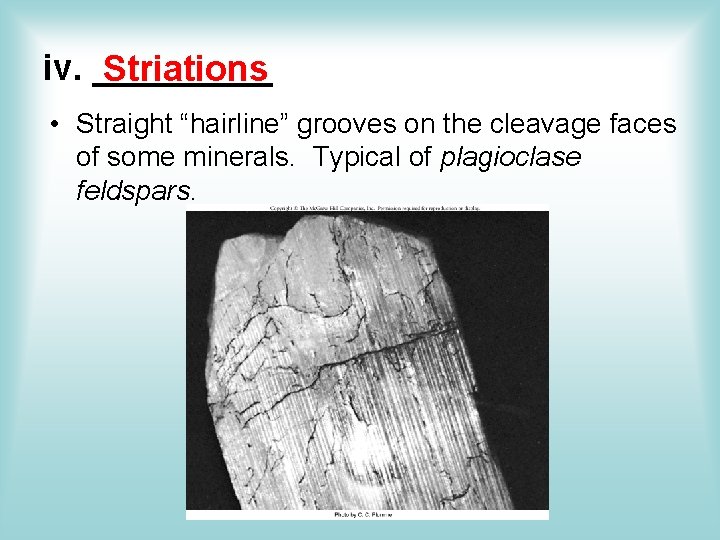
iv. _____ Striations • Straight “hairline” grooves on the cleavage faces of some minerals. Typical of plagioclase feldspars.
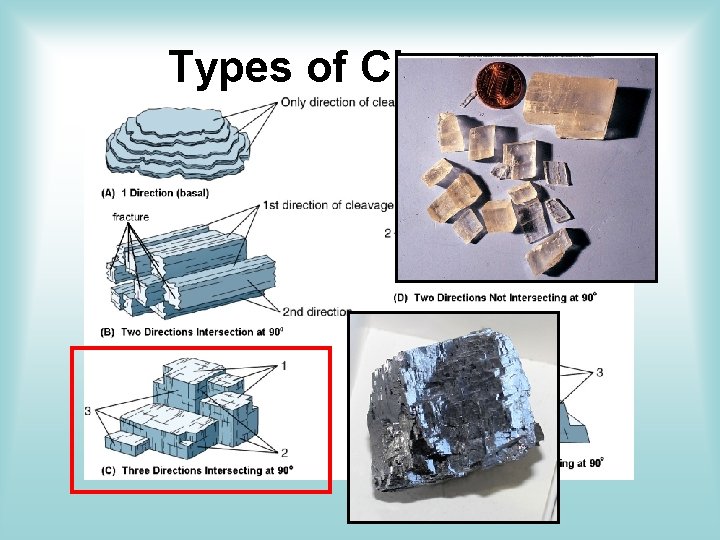
Types of Cleavage
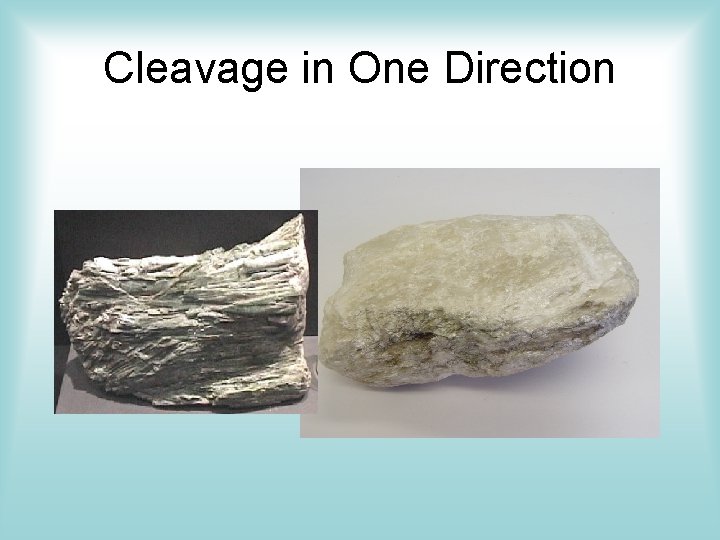
Cleavage in One Direction
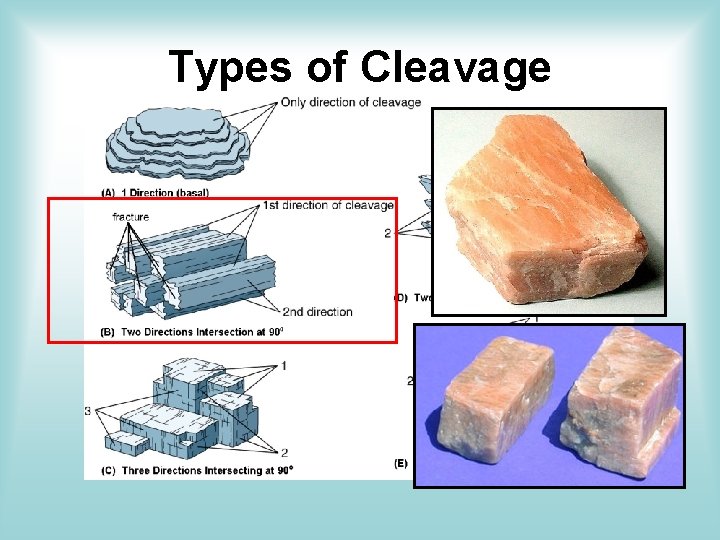
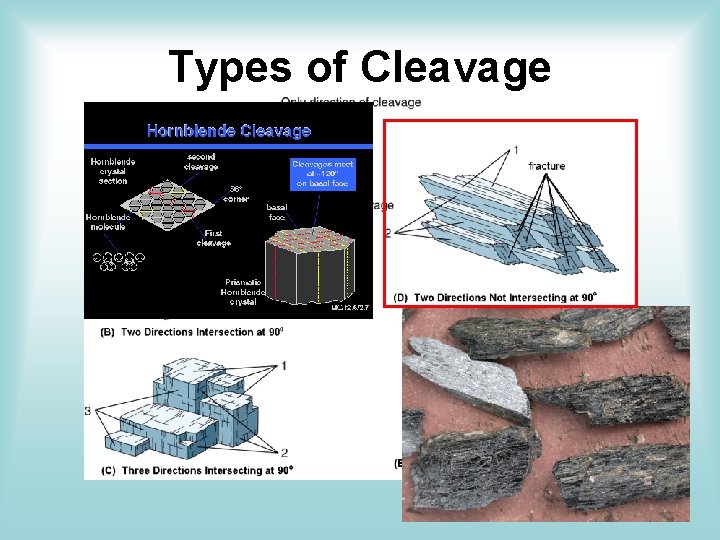
Types of Cleavage
Types of Cleavage
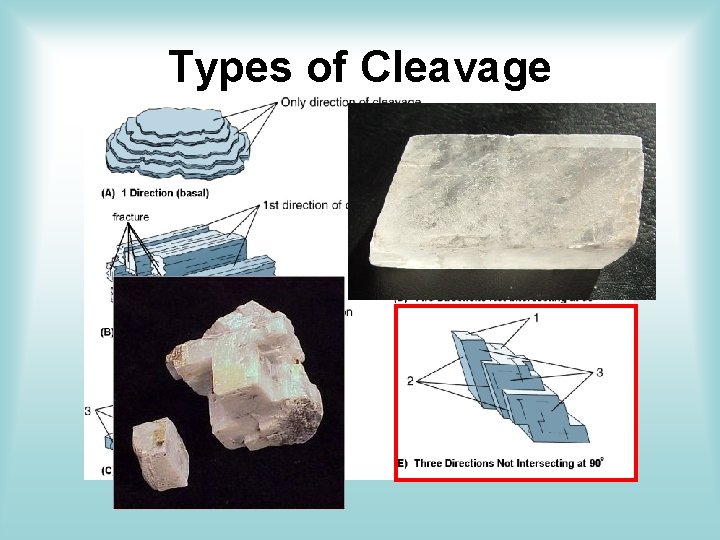
Types of Cleavage
Types of Cleavage
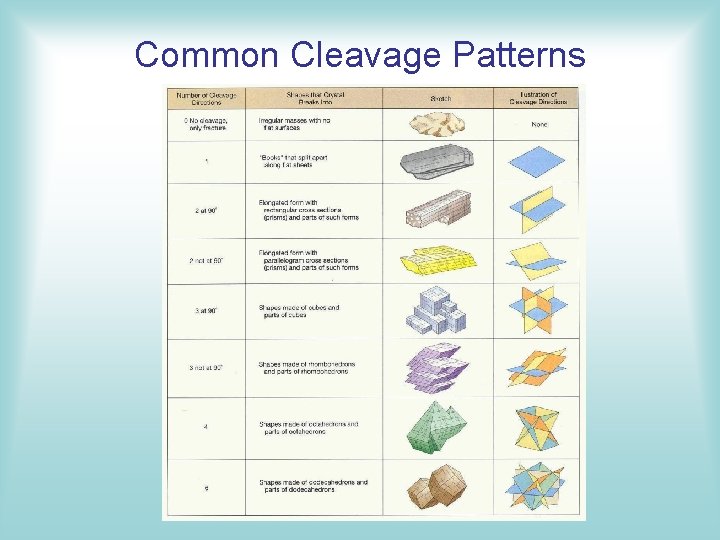
Common Cleavage Patterns
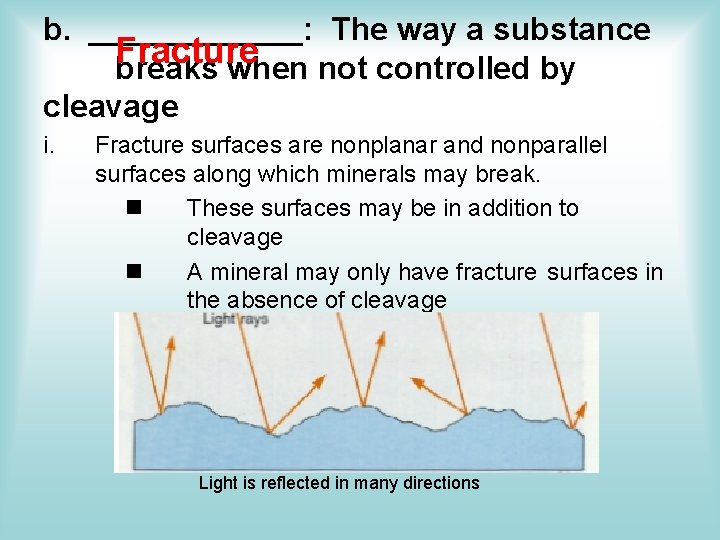
b. ______: The way a substance Fracture breaks when not controlled by cleavage i. Fracture surfaces are nonplanar and nonparallel surfaces along which minerals may break. These surfaces may be in addition to cleavage A mineral may only have fracture surfaces in the absence of cleavage Light is reflected in many directions
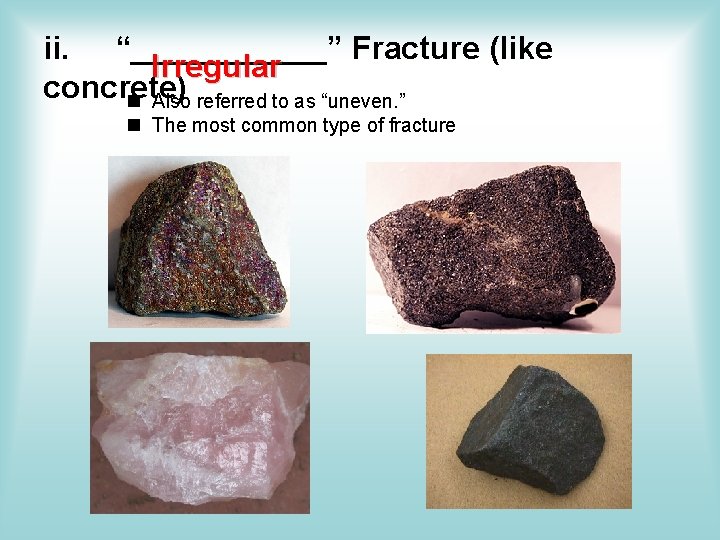
ii. “______” Fracture (like Irregular concrete) Also referred to as “uneven. ” The most common type of fracture
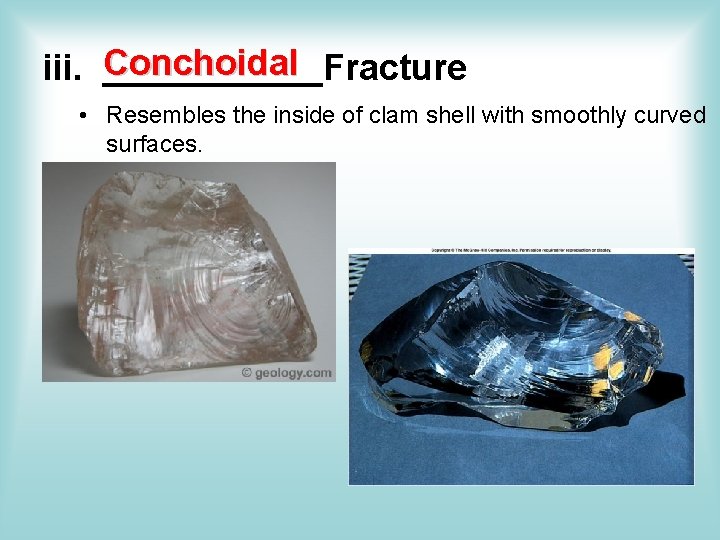
Conchoidal iii. ______Fracture • Resembles the inside of clam shell with smoothly curved surfaces.
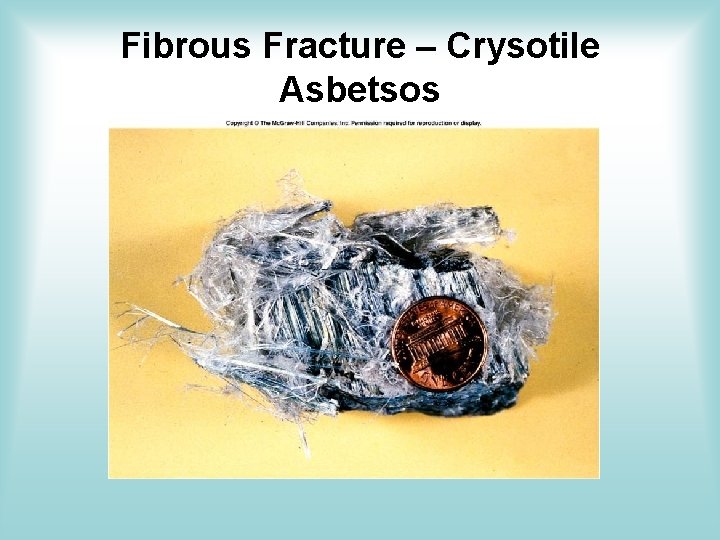
Fibrous Fracture – Crysotile Asbetsos
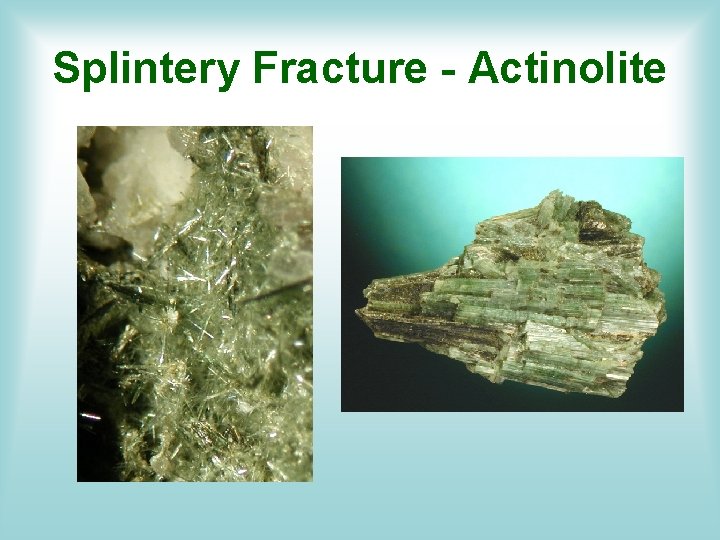
Splintery Fracture - Actinolite
Remember, a mineral may cleave in some directions and fracture in others. Generally, we say a mineral exhibits cleavage if it has cleavage in at least one direction even if it also shows fracture.
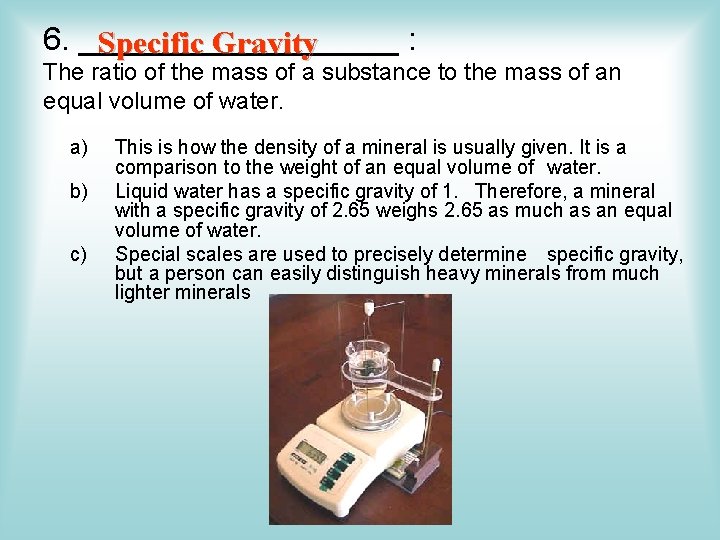
6. _________ : Specific Gravity The ratio of the mass of a substance to the mass of an equal volume of water. a) b) c) This is how the density of a mineral is usually given. It is a comparison to the weight of an equal volume of water. Liquid water has a specific gravity of 1. Therefore, a mineral with a specific gravity of 2. 65 weighs 2. 65 as much as an equal volume of water. Special scales are used to precisely determine specific gravity, but a person can easily distinguish heavy minerals from much lighter minerals
B. Other Properties
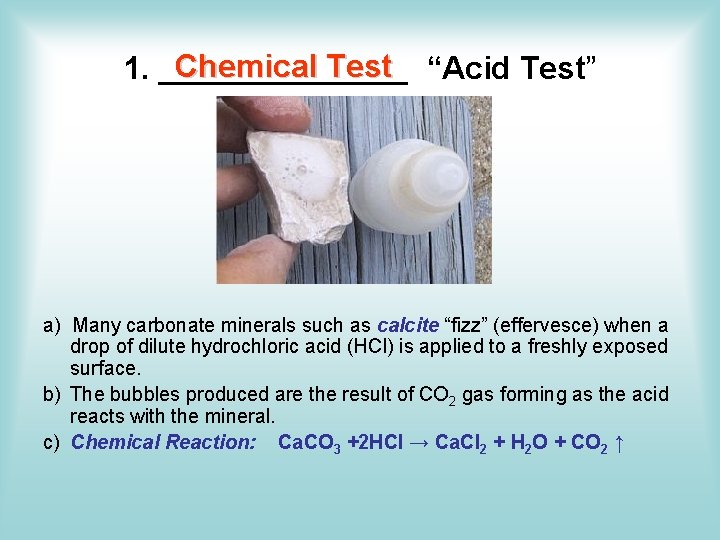
Chemical Test “Acid Test” 1. _______ a) Many carbonate minerals such as calcite “fizz” (effervesce) when a drop of dilute hydrochloric acid (HCl) is applied to a freshly exposed surface. b) The bubbles produced are the result of CO 2 gas forming as the acid reacts with the mineral. c) Chemical Reaction: Ca. CO 3 +2 HCl → Ca. Cl 2 + H 2 O + CO 2 ↑
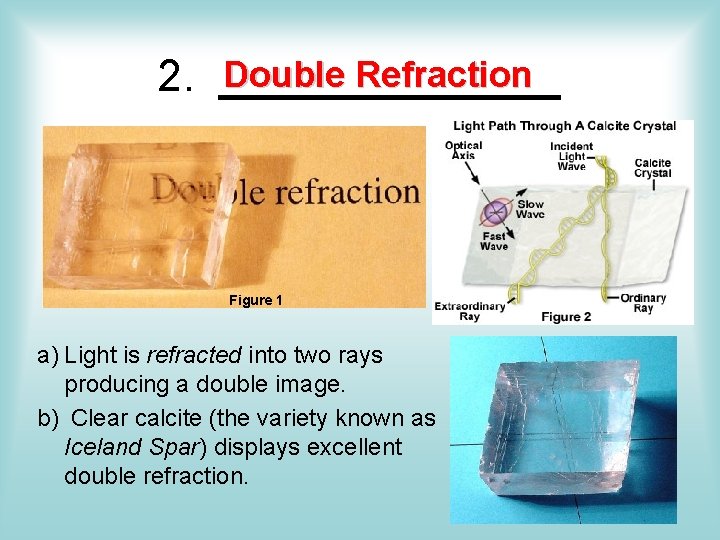
Double Refraction 2. _______ Figure 1 a) Light is refracted into two rays producing a double image. b) Clear calcite (the variety known as Iceland Spar) displays excellent double refraction.
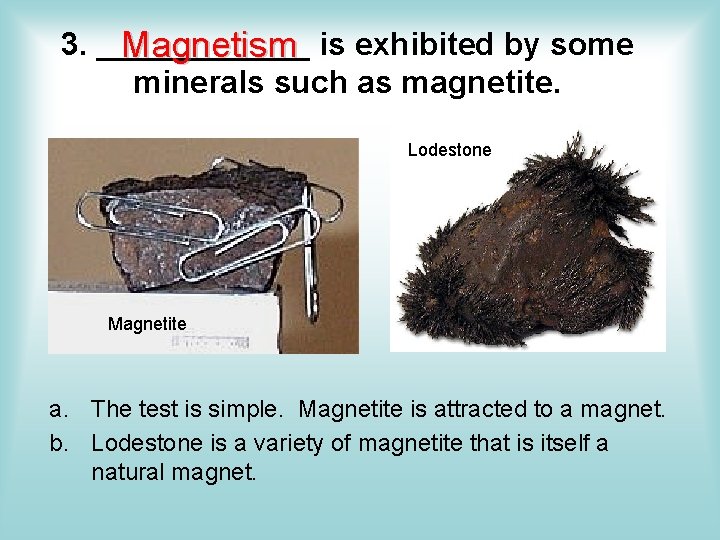
3. ______ Magnetism is exhibited by some minerals such as magnetite. Lodestone Magnetite a. The test is simple. Magnetite is attracted to a magnet. b. Lodestone is a variety of magnetite that is itself a natural magnet.
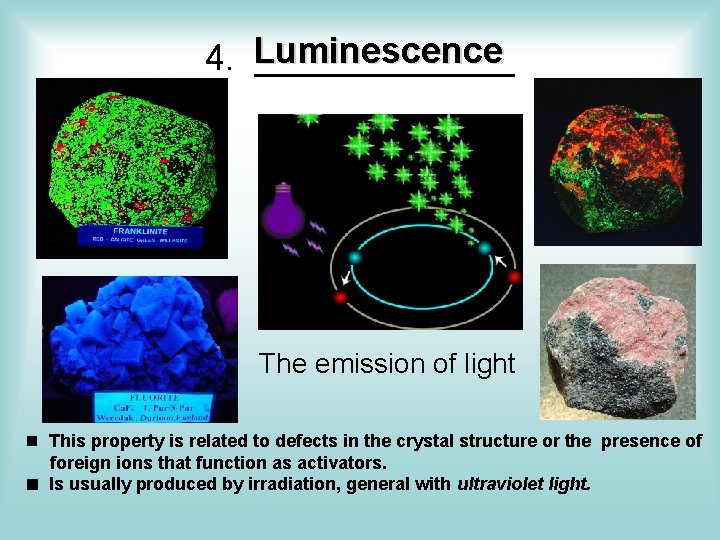
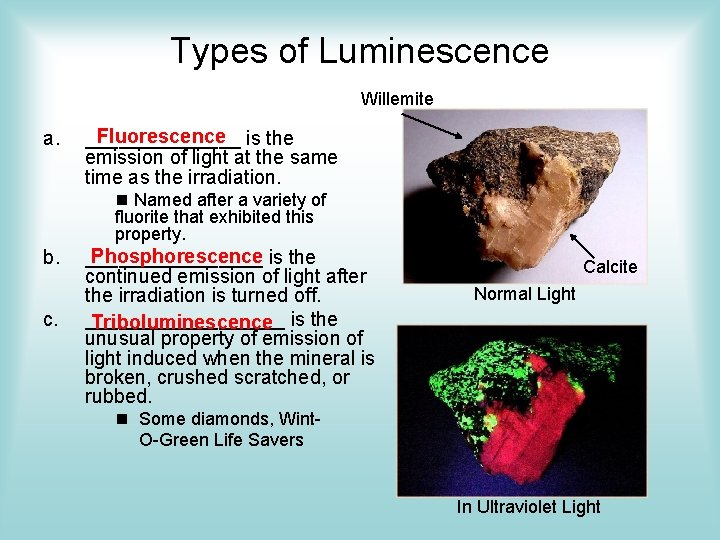
4. Luminescence _______ The emission of light This property is related to defects in the crystal structure or the presence of foreign ions that function as activators. Is usually produced by irradiation, general with ultraviolet light.
Types of Luminescence Willemite a. Fluorescence is the _______ emission of light at the same time as the irradiation. Named after a variety of fluorite that exhibited this property. b. c. Phosphorescence is the ________ continued emission of light after the irradiation is turned off. _________ Triboluminescence is the unusual property of emission of light induced when the mineral is broken, crushed scratched, or rubbed. Calcite Normal Light Some diamonds, Wint. O-Green Life Savers In Ultraviolet Light
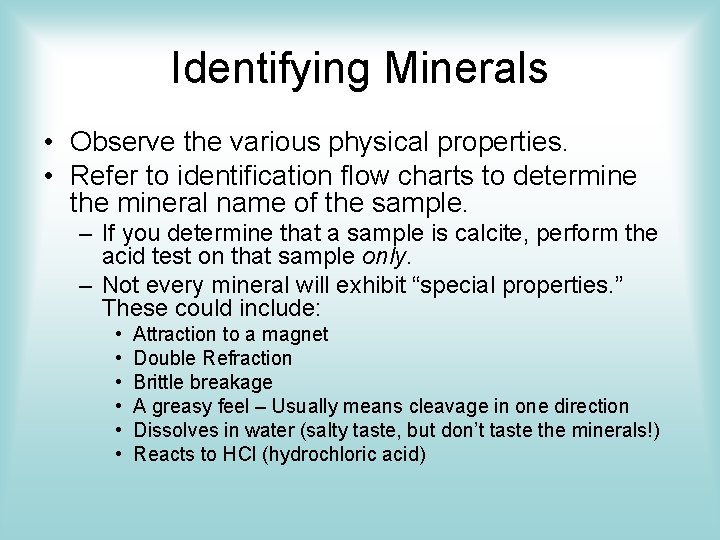
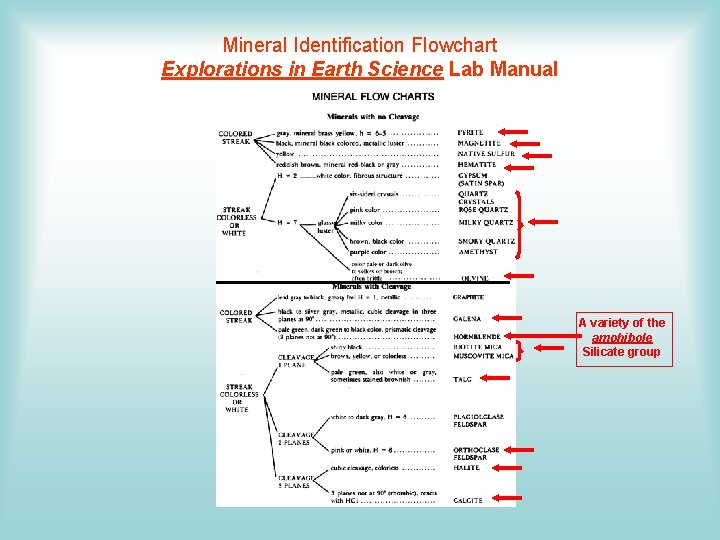
Identifying Minerals • Observe the various physical properties. • Refer to identification flow charts to determine the mineral name of the sample. – If you determine that a sample is calcite, perform the acid test on that sample only. – Not every mineral will exhibit “special properties. ” These could include: • • • Attraction to a magnet Double Refraction Brittle breakage A greasy feel – Usually means cleavage in one direction Dissolves in water (salty taste, but don’t taste the minerals!) Reacts to HCl (hydrochloric acid)
Mineral Identification Flowchart Explorations in Earth Science Lab Manual A variety of the amphibole Silicate group
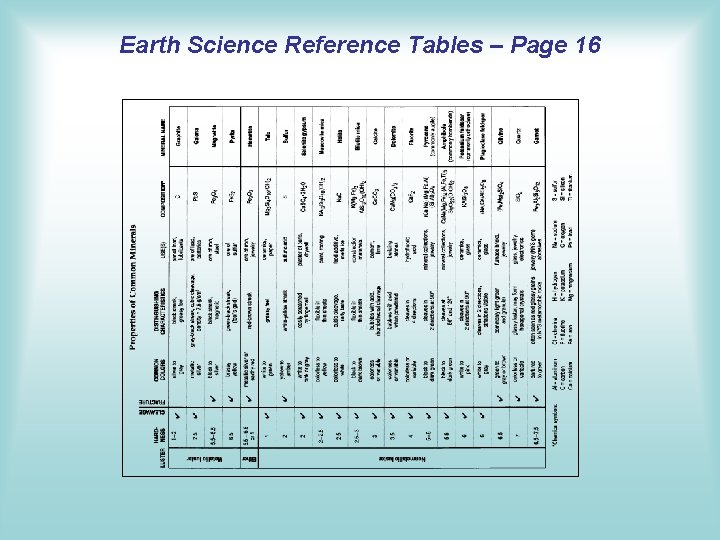
Earth Science Reference Tables – Page 16