
v Johnathan Bergmann and Aaron Sams 2007 science


v Johnathan Bergmann and Aaron Sams (2007), science teachers at Woodland Park High School in Colorado, are considered the originators of the Flipped classroom.

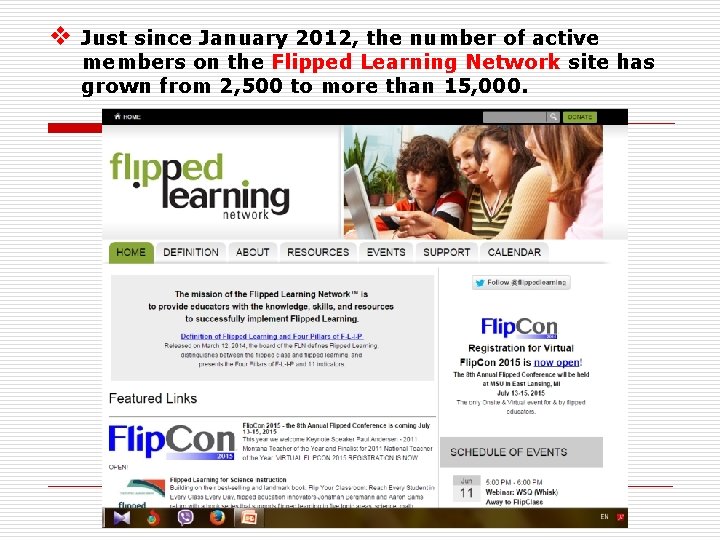
v Just since January 2012, the number of active members on the Flipped Learning Network site has grown from 2, 500 to more than 15, 000.
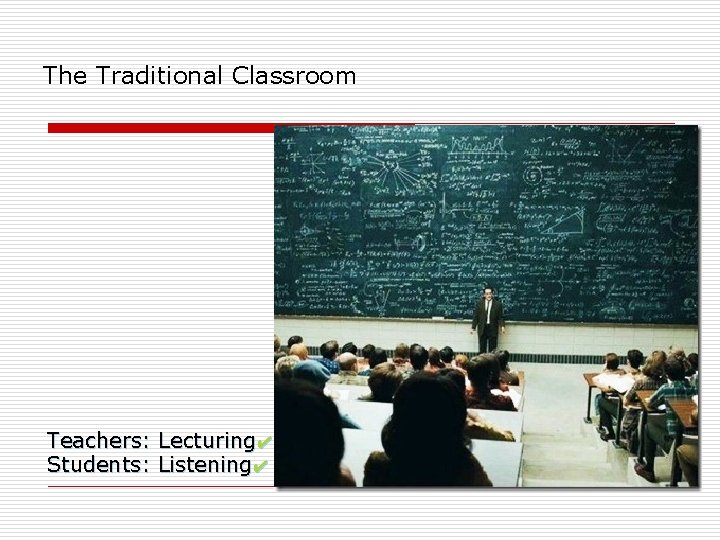
The Traditional Classroom Teachers: Lecturing✔ Students: Listening✔
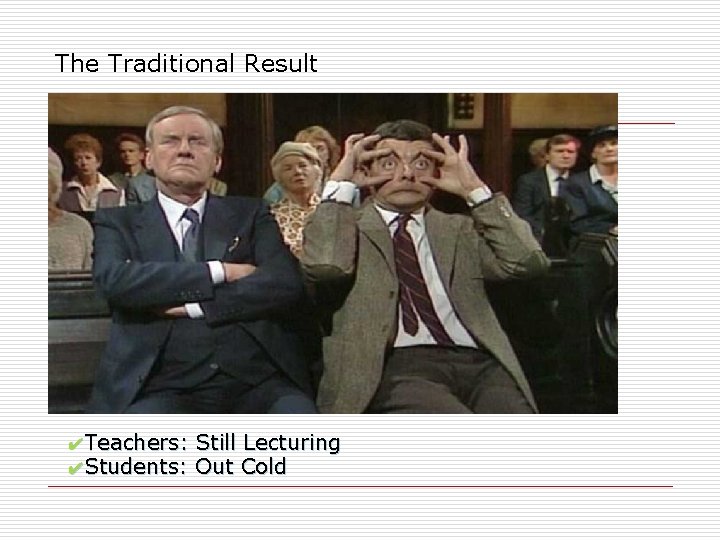
The Traditional Result ✔Teachers: Still Lecturing ✔Students: Out Cold
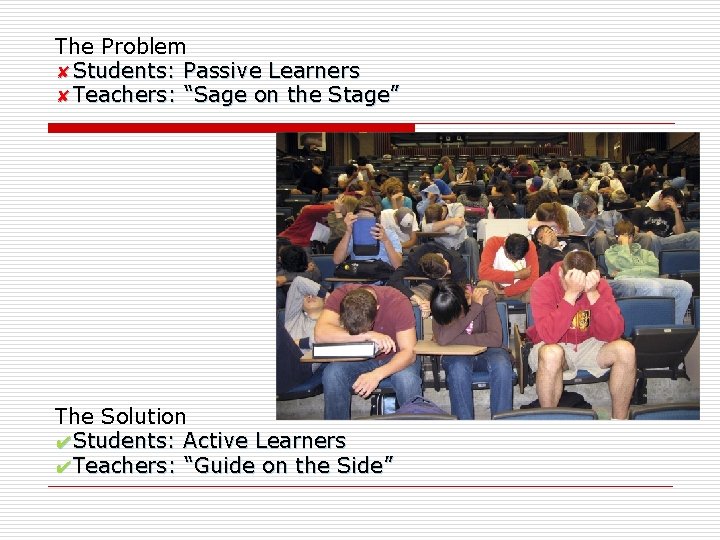
The Problem ✘Students: Passive Learners ✘Teachers: “Sage on the Stage” The Solution ✔Students: Active Learners ✔Teachers: “Guide on the Side”
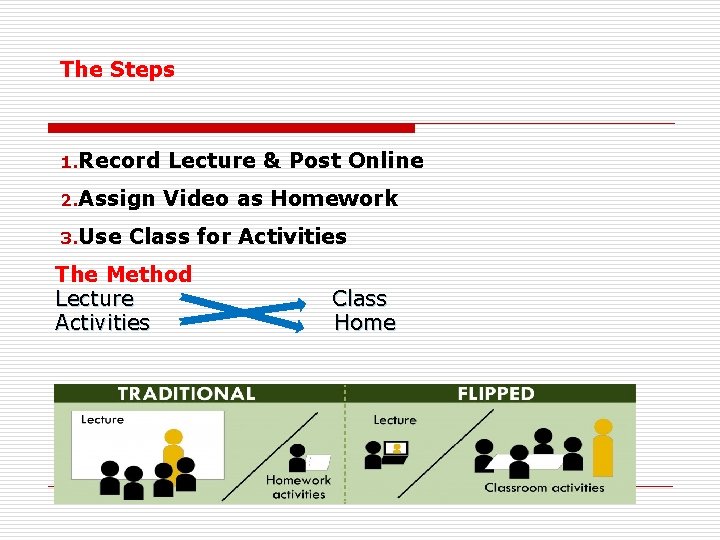
The Steps 1. Record Lecture & Post Online 2. Assign Video as Homework 3. Use Class for Activities The Method Lecture Class Activities Home
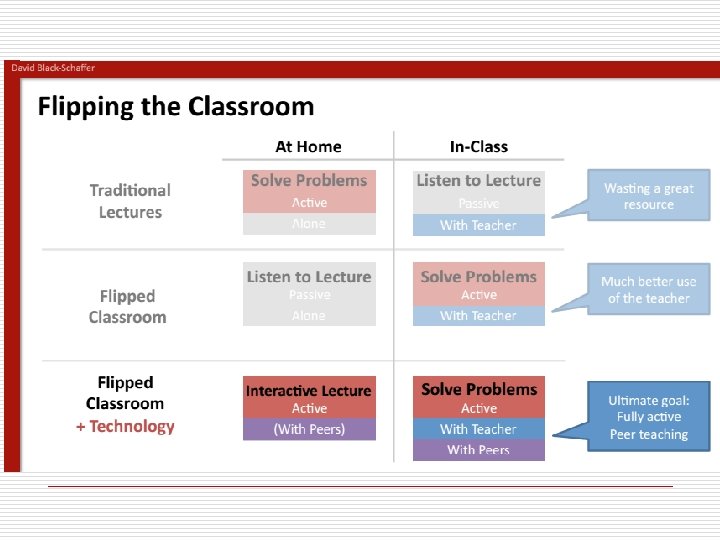
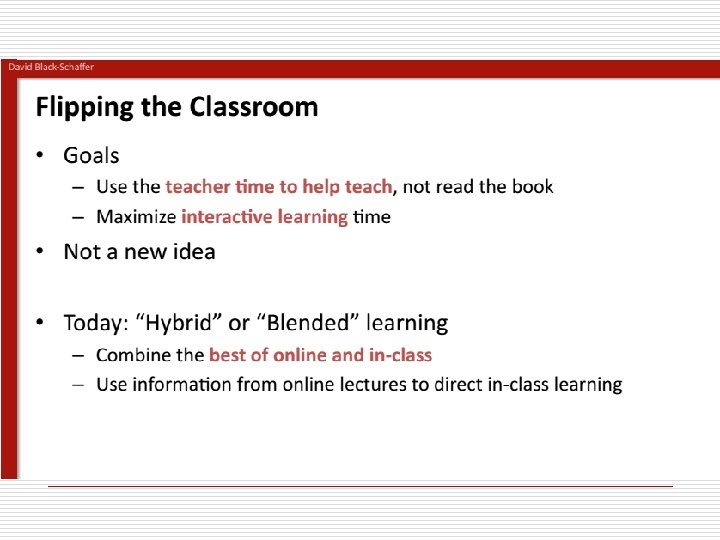
What is flipping? Flipped learning is a pedagogical approach in which direct instruction moves from the group learning space to the individual learning space, and the resulting group space is transformed into a dynamic, interactive learning environment where the educator guides students as they apply concepts and engage creatively in the subject matter. Flipped Learning Network Definition, 13/03/14
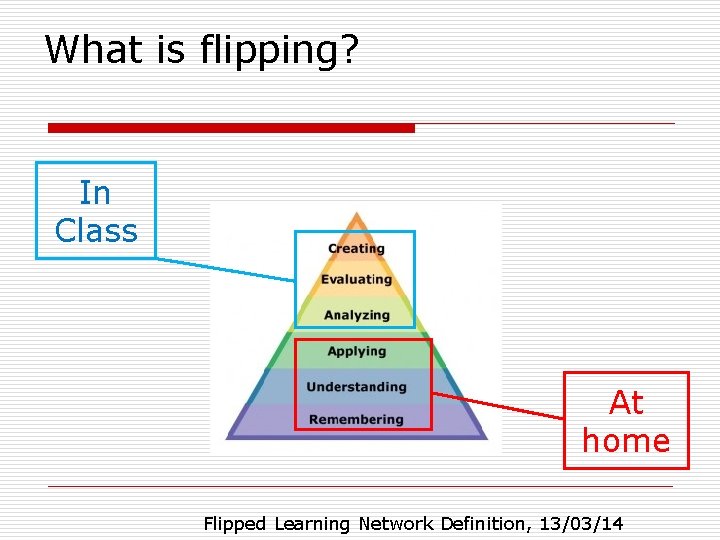
What is flipping? In Class At home Flipped Learning Network Definition, 13/03/14
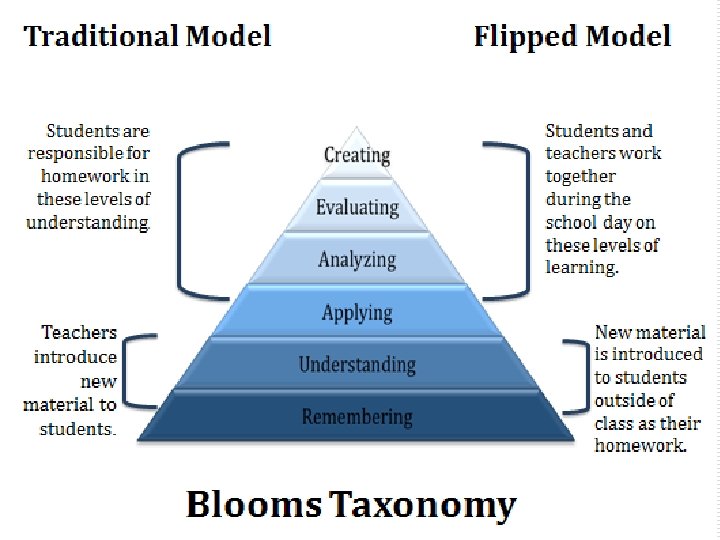
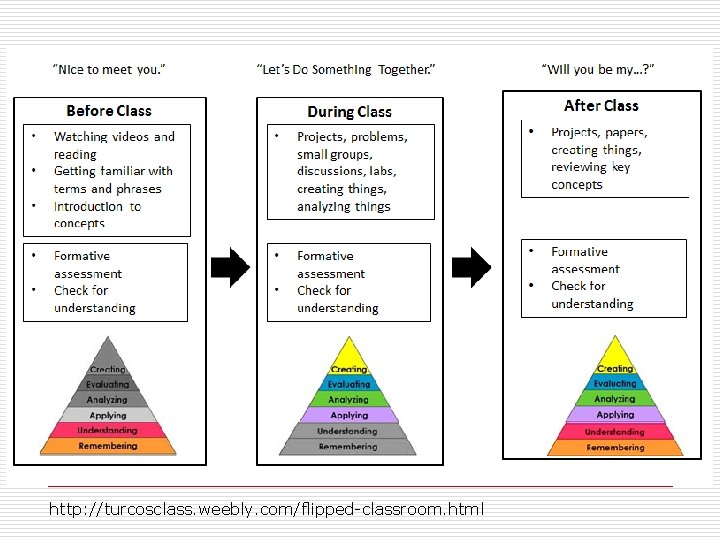
http: //turcosclass. weebly. com/flipped-classroom. html
o We move lectures out of the classroom. We tape them in advance and post them on a website. Students watch lectures before coming to class. Frequent low-stakes quizzes motivate students to keep pace and watch the videos. o Classroom contact hours are for coached activities, discussions, and student presentations.
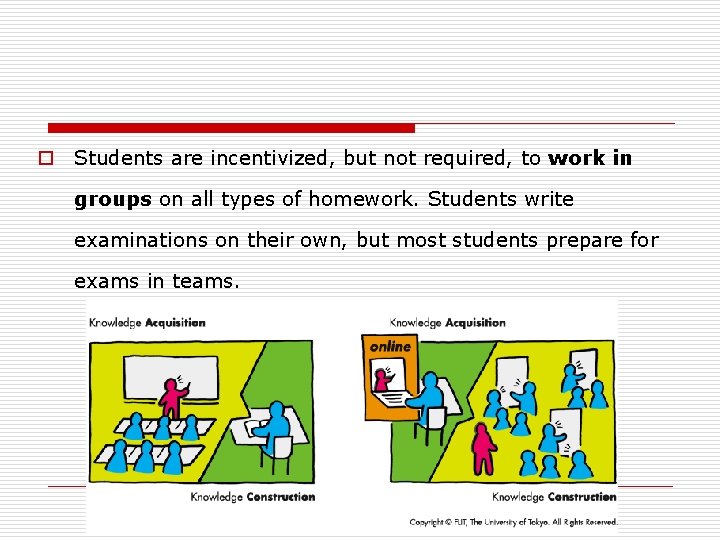
o Students are incentivized, but not required, to work in groups on all types of homework. Students write examinations on their own, but most students prepare for exams in teams.
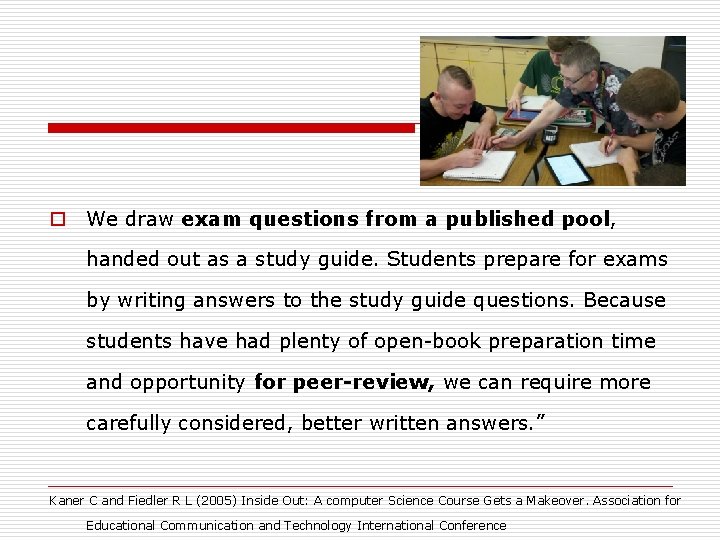
o We draw exam questions from a published pool, handed out as a study guide. Students prepare for exams by writing answers to the study guide questions. Because students have had plenty of open-book preparation time and opportunity for peer-review, we can require more carefully considered, better written answers. ” Kaner C and Fiedler R L (2005) Inside Out: A computer Science Course Gets a Makeover. Association for Educational Communication and Technology International Conference
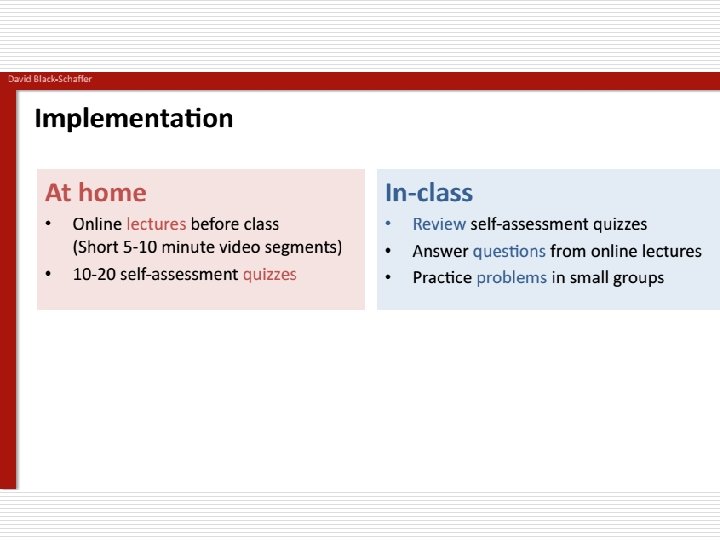
The UPRM model : 1 - a set of pre-Lecture Modules and Exercises, delivered online; 2 - a Lecture that responds to the students' experience in the pre-Lecture activities, 3 - a Problem-Solving Session after each Lecture. o Papadopoulos C, Santiago-Roman A and Portela G (2010) Work in progress — Developing and implementing an Inverted Classroom for Engineering Statics. Frontiers in Education Conference (FIE), 2010 IEEE
v Today, it seems, there is no one correct way to flip the classroom, and approaches vary both by subject and educational philosophy. v But no matter what the underlying philosophy, creating, curating, and maintaining a trove of video resources is central to success. v Bergmann & Sams coauthored the book: Flip Your Classroom: Reach Every Student in Every Class Every Day
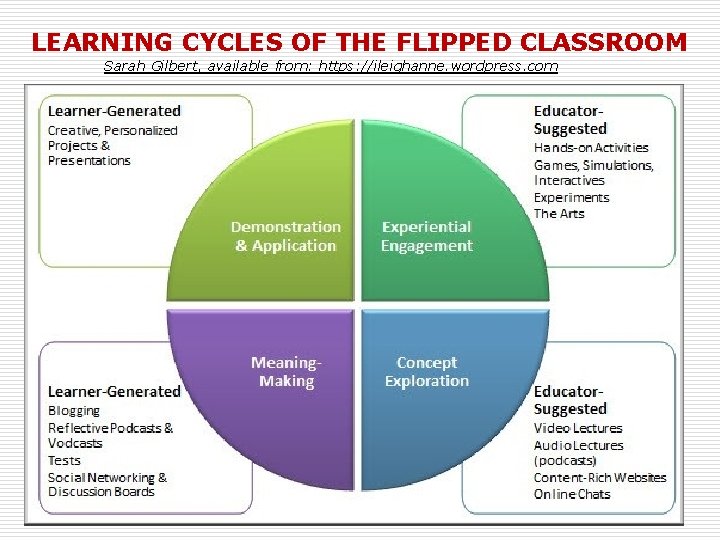
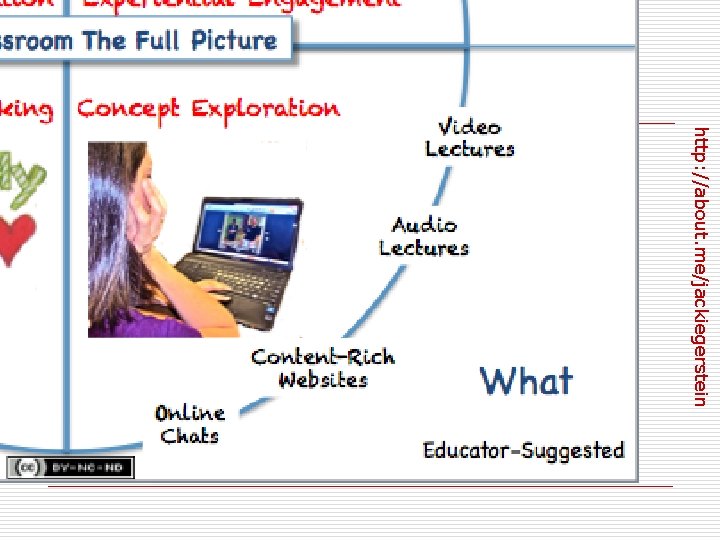
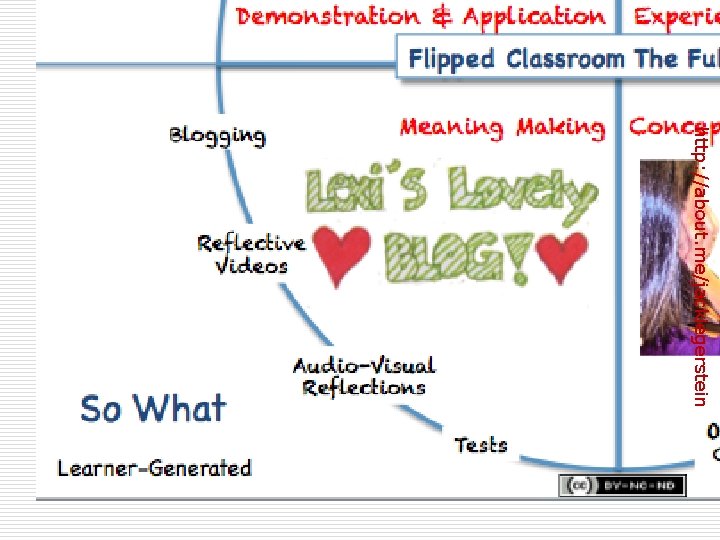
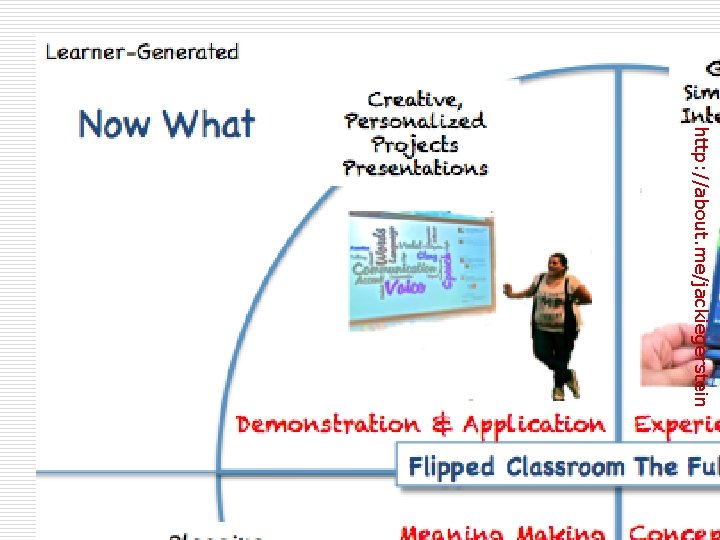
LEARNING CYCLES OF THE FLIPPED CLASSROOM Sarah Gilbert, available from: https: //ileighanne. wordpress. com
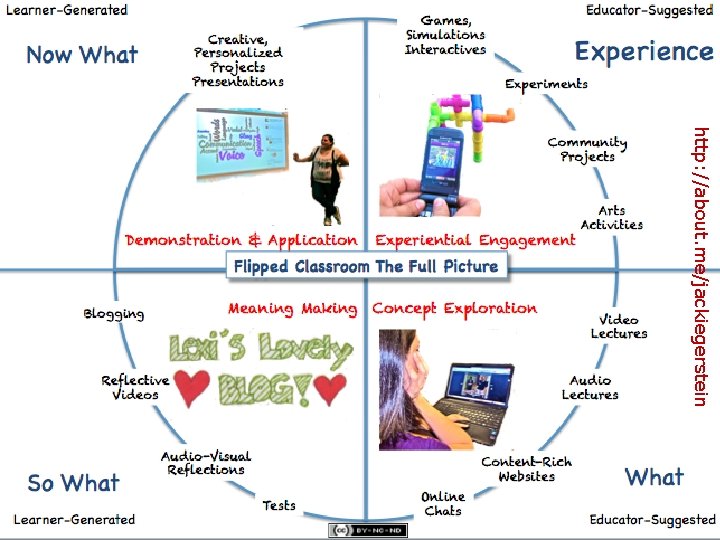
http: //about. me/jackiegerstein
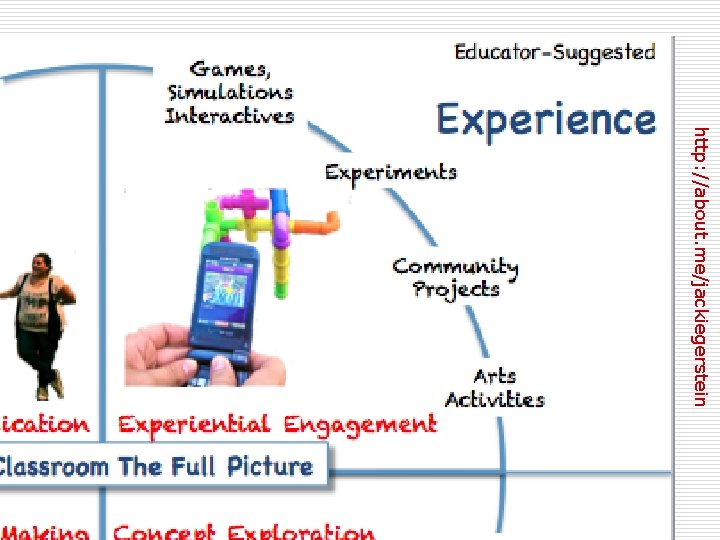
http: //about. me/jackiegerstein
http: //about. me/jackiegerstein
http: //about. me/jackiegerstein
http: //about. me/jackiegerstein
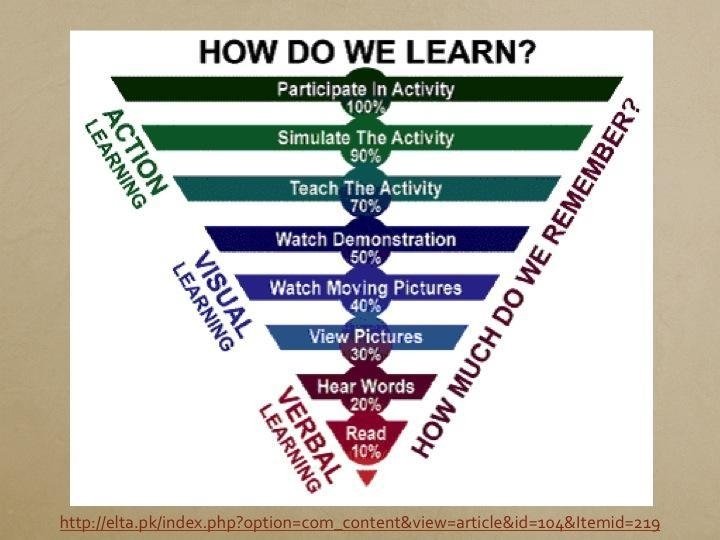
v Lectures should support the learning, not be central to it, or drive it.
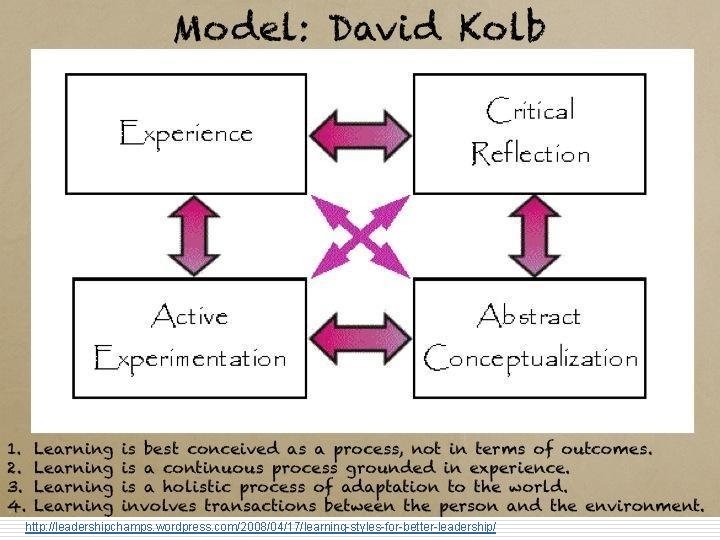
http: //leadershipchamps. wordpress. com/2008/04/17/learning-styles-for-better-leadership/
The flipped classroom is NOT: Ø A synonym of online videos. It is the interaction and the meaningful learning activities that occur during the face-toface time. Ø About replacing teachers with videos. Ø A completely online course. Ø Students working without structure. Ø Students spending the entire class starting at a computer screen. Ø Students work in isolation.
There are Many Ways to Flip Your Classroom * Ø Don’t think you have to make your own videos—there is much available now on line (Khan Academy, You. Tube, …) Ø Takes time to plan on what “parts” of your content/classroom you want to flip—not everything fits with flipping” Ø Find out what is the “best” way to access your students— what access to they have at home, do some need to have the information “burned” on a disc, do all have the capability of Elluminate, etc? Ø Find a way to engage students in the videos, not just “listening” to lectures on tapes. Should follow by some sort of discussion questions, etc. Barb Penprase penprase@oakland. edu
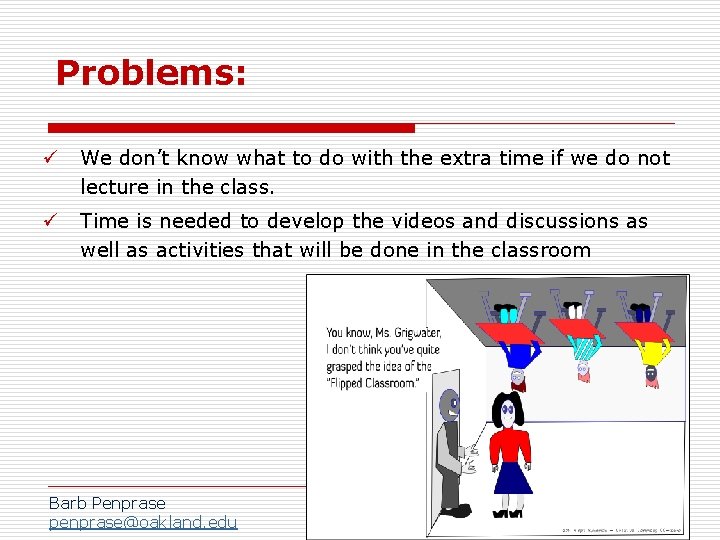
Problems: ü We don’t know what to do with the extra time if we do not lecture in the class. ü Time is needed to develop the videos and discussions as well as activities that will be done in the classroom Barb Penprase penprase@oakland. edu
Perceived Challenges Rebecca Hamlett, hamlettr@william. jewell. edu ü Faculty buy-in ü Faculty may not be open to a different pedagogical method of teaching ü Faculty may be unwilling to assign out-of-class material for instruction sessions ü Student resistance ü Students may be resistant to completing video assignments ü ü Students may not be at their “point of need” MONEY – who has any?
Benefits of the flipped classroom Rebecca Hamlett, hamlettr@william. jewell. edu ü Students are able to watch recorded lectures/tutorials any time, any place ü Students are able to review the material as many times as necessary to understand the content without frantic notetaking ü Different learning styles can be better accommodated by instructors and applied by students ü Instructors are able to devote class time to the application of skills instead of “telling” students the information ü Collaborative activities can be better designed to further peer teaching ü Students have an opportunity to ask questions during application rather than after class or from graded feedback
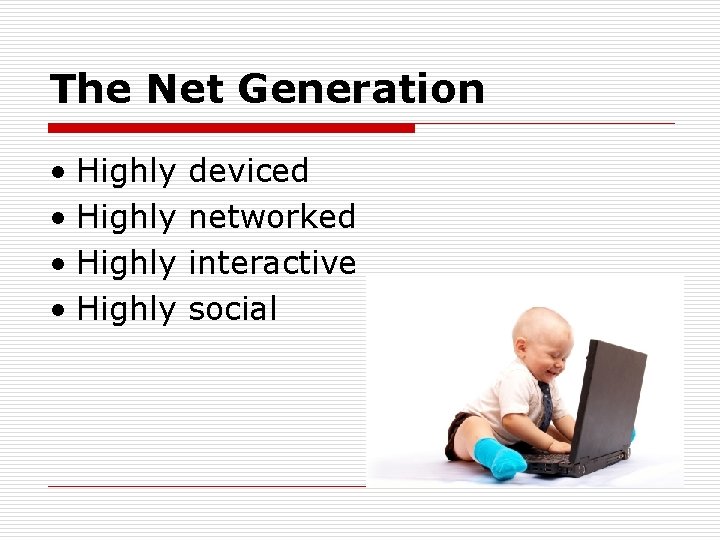
The Net Generation • Highly deviced • Highly networked • Highly interactive • Highly social
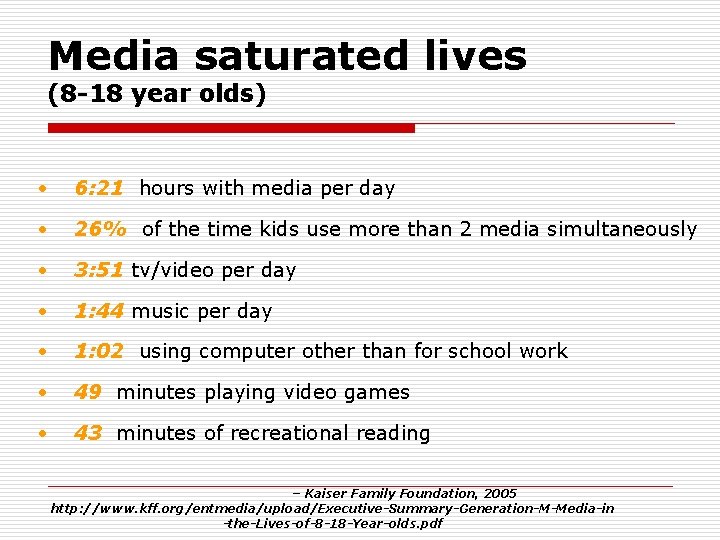
Media saturated lives (8 -18 year olds) • 6: 21 hours with media per day • 26% of the time kids use more than 2 media simultaneously • 3: 51 tv/video per day • 1: 44 music per day • 1: 02 using computer other than for school work • 49 minutes playing video games • 43 minutes of recreational reading – Kaiser Family Foundation, 2005 http: //www. kff. org/entmedia/upload/Executive-Summary-Generation-M-Media-in -the-Lives-of-8 -18 -Year-olds. pdf
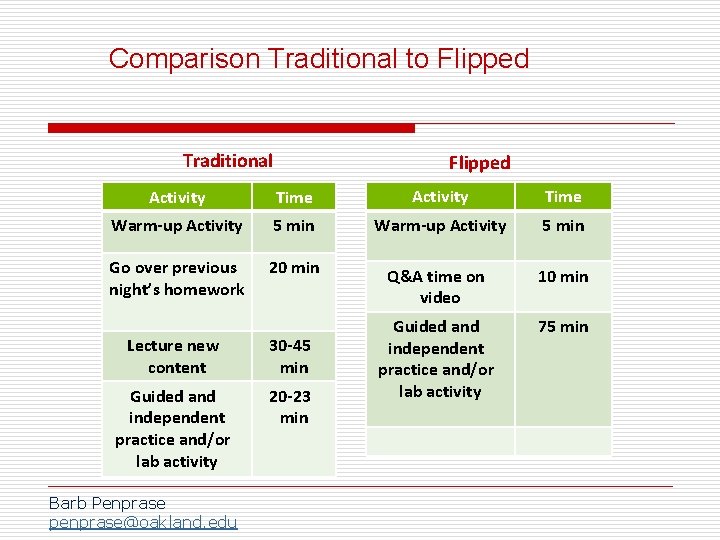
Comparison Traditional to Flipped Traditional Flipped Activity Time Warm-up Activity 5 min Go over previous night’s homework 20 min Q&A time on video 10 min Guided and independent practice and/or lab activity 75 min Lecture new content 30 -45 min Guided and independent practice and/or lab activity 20 -23 min Barb Penprase penprase@oakland. edu
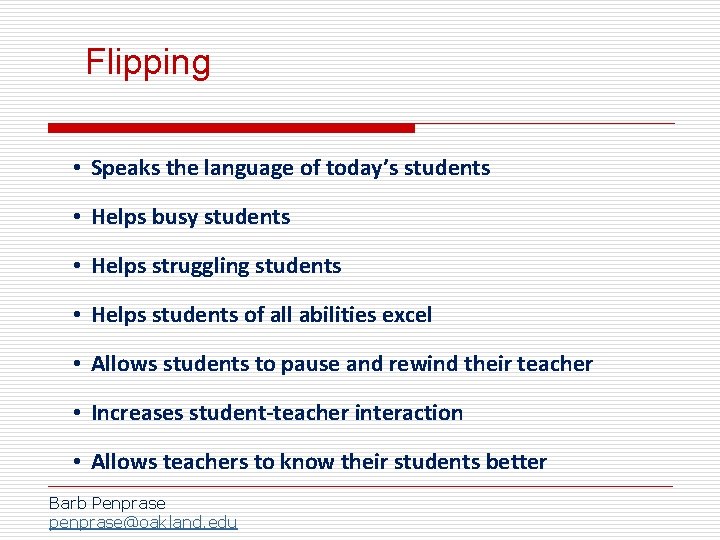
Flipping • Speaks the language of today’s students • Helps busy students • Helps struggling students • Helps students of all abilities excel • Allows students to pause and rewind their teacher • Increases student-teacher interaction • Allows teachers to know their students better Barb Penprase penprase@oakland. edu
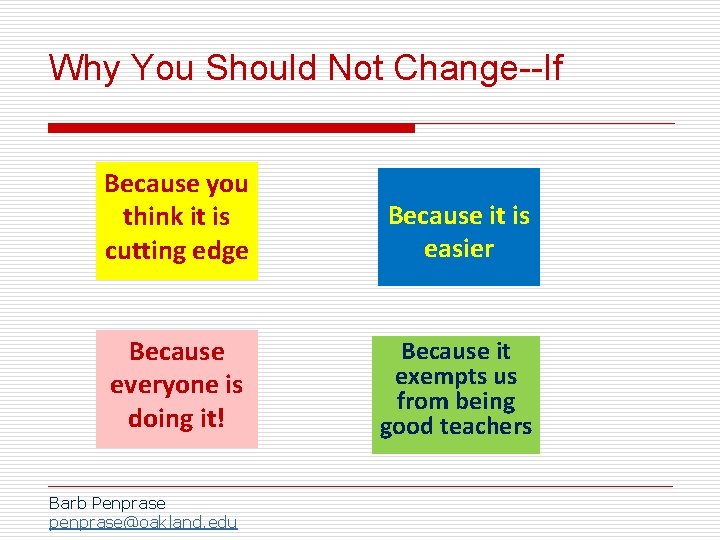
Why You Should Not Change--If Because you think it is cutting edge Because it is easier Because everyone is doing it! Because it exempts us from being good teachers Barb Penprase penprase@oakland. edu
What’s Next? Step 1 Make Commitment to Change Step 2 Learn about Flipping –Good, Bad and Ugly Step 3 Develop Your First Flipped Class Video (or whatever venue you choose) Step 4 Plan to begin to use next summer or fall Barb Penprase penprase@oakland. edu
Flipped Classroom: Yes or No?
![“[the] use of deliberate practice teaching strategies can improve both learning and engagement in](http://slidetodoc.com/presentation_image_h/36cec82bdab7c6eeb2efc7f5ea612553/image-43.jpg "“[the] use of deliberate practice teaching strategies can improve both learning and engagement in")
“[the] use of deliberate practice teaching strategies can improve both learning and engagement in a large introductory physics course as compared with what was obtained with the lecture method. ” Des. Lauriers L, Schelew E, and Wieman C (2011). Improved learning in a large-enrollment physics class. Science 332: 864 “The flipped classroom is an easy model to get wrong. Although the idea is straightforward, an effective flip requires careful preparation. Recording lectures requires effort and time on the part of faculty…Students, for their part, have been known to complain about the loss of face-to-face lectures, particularly if they feel the assigned video lectures are available to anyone online. ” EDUCAUSE 7 Things You Should Know About Flipped Classrooms, February 2012
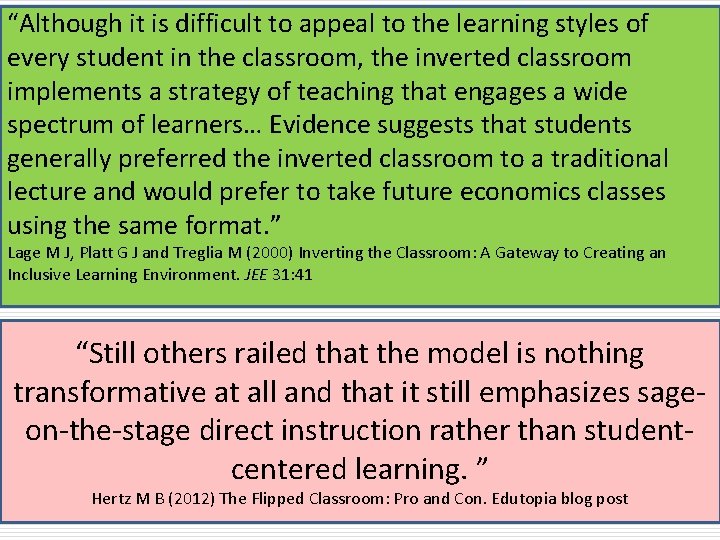
“Although it is difficult to appeal to the learning styles of every student in the classroom, the inverted classroom implements a strategy of teaching that engages a wide spectrum of learners… Evidence suggests that students generally preferred the inverted classroom to a traditional lecture and would prefer to take future economics classes using the same format. ” Lage M J, Platt G J and Treglia M (2000) Inverting the Classroom: A Gateway to Creating an Inclusive Learning Environment. JEE 31: 41 “Still others railed that the model is nothing transformative at all and that it still emphasizes sageon-the-stage direct instruction rather than studentcentered learning. ” Hertz M B (2012) The Flipped Classroom: Pro and Con. Edutopia blog post
9 Video Tips for a Better Flipped Classroom
T. H. E. Journal 9 Video Tips for a Better Flipped Classroom: 1 - Devise a flipped strategy. , v Will teachers make their own videos, curate others' material, or a combination of the two? v One teacher can spend hours looking for the perfect video online or spend the same amount of time creating one of his own. v Bergmann says: "We need to have professional development for teachers to learn how to create videos. “
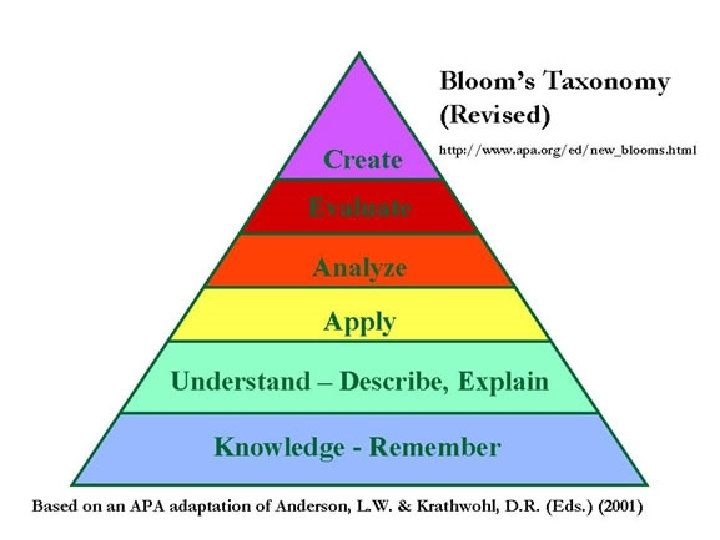
v Teachers should start out simple, with a basic tool, but move to more feature-rich applications. v What will teachers do with class time if they are not lecturing as much (or at all)? v "The important thing is to keep the lower-order things on Bloom's taxonomy to the videos and the higher-order things in class, ”
2) Start small. v Some teachers try to flip everything at once and end up feeling overwhelmed. v Making the videos is a very big time commitment. It is recommended that doing it in smaller chunks. v Teachers should create videos for their top few lessons and see how the students react before plunging ahead.
3) Get student buy-in. v Students may initially react negatively to being asked to watch videos or do other work outside of class. v Successful teacher take time to explain why she flips her class and even included an explanation of Bloom's taxonomy.
4) Teach parents, too. v The biggest roadblock to flipping is with parents who don't initially get the concept.
5) Teach students how to watch videos. v Students don't watch instructional videos in the same manner as a popular film. v WSQ framework: (Watch, Summarize, Question): v v v W: Students watch videos, making use of the pause and rewind buttons … S: They then complete a guided summary of the lesson online … Q: They are required to develop a question to bring to class.
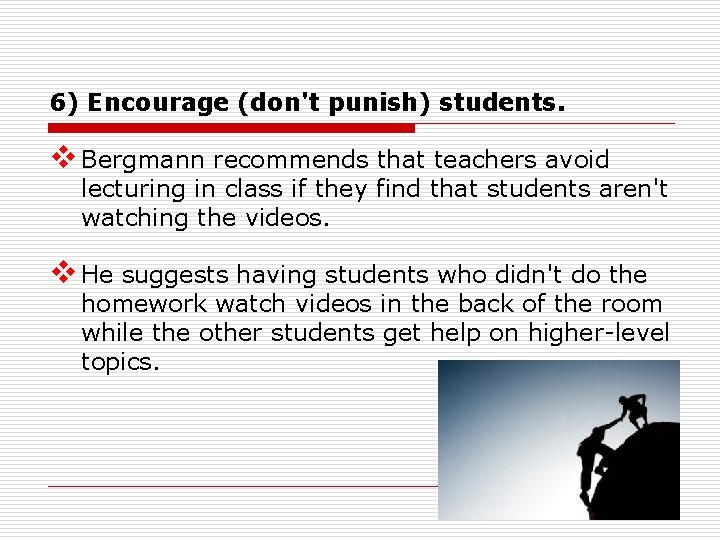
6) Encourage (don't punish) students. v Bergmann recommends that teachers avoid lecturing in class if they find that students aren't watching the videos. v He suggests having students who didn't do the homework watch videos in the back of the room while the other students get help on higher-level topics.
7) Don't use videos as the only engagement tool. v Baugus recommends moving beyond a blog with just videos, because students may eventually perceive it as stale. (mobile devices, LMS, …)
8) Make videos short and interactive. v The videos should be short, with one video per discrete objective. v Videos should be no longer than 6 to 15 minutes with interactive elements and a table of contents according to the students level. v For instance, if a student answers quiz questions incorrectly, he or she will be led back to the lecture section on that topic for review.
9) Find fellow flippers. v If you are the only teacher at your school flipping your class, it can be difficult to sustain enthusiasm and get new ideas. v "Video is valuable, but it is just one tool. Flipping is defined by what you do in class and studentcentered learning. "
Some useful programs
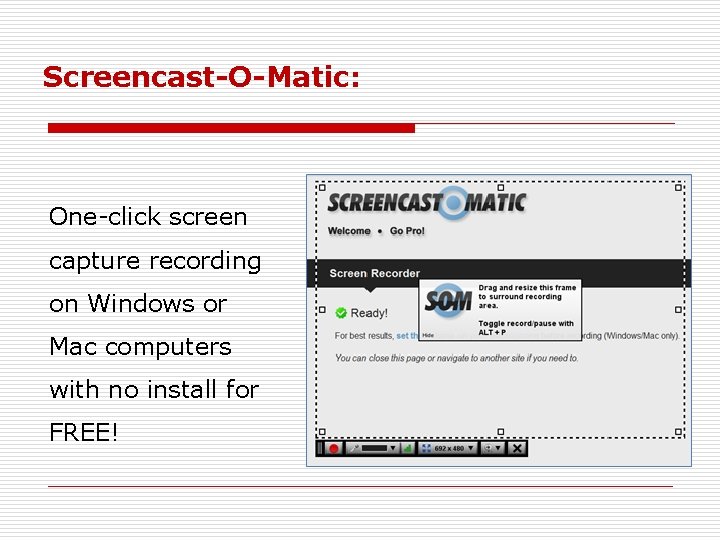
Screencast-O-Matic: One-click screen capture recording on Windows or Mac computers with no install for FREE!
Jing (free, available for Mac or PC) Captures anything you see on your computer screen, as an image or short video, and lets you share it instantly
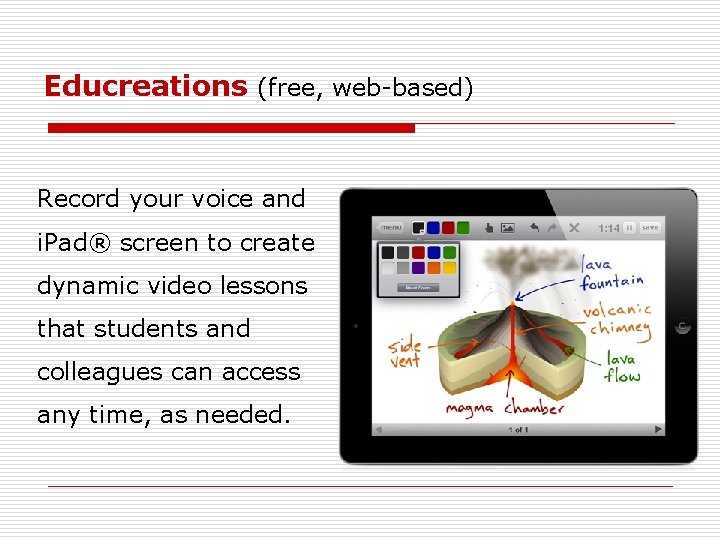
Educreations (free, web-based) Record your voice and i. Pad® screen to create dynamic video lessons that students and colleagues can access any time, as needed.
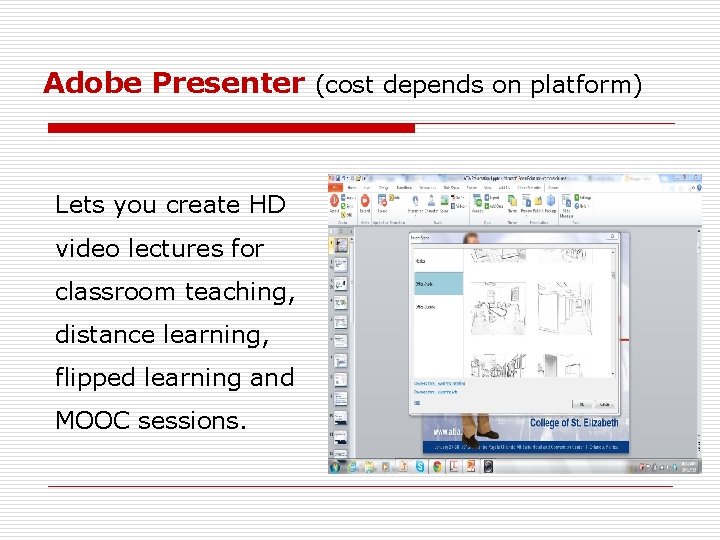
Adobe Presenter (cost depends on platform) Lets you create HD video lectures for classroom teaching, distance learning, flipped learning and MOOC sessions.
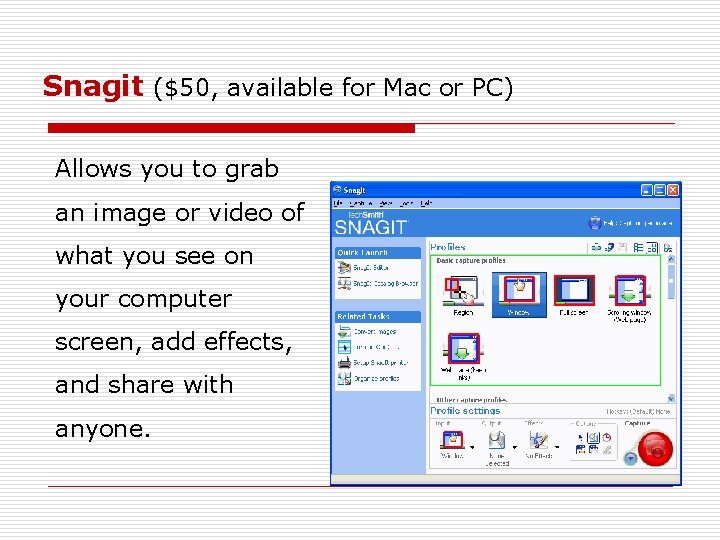
Snagit ($50, available for Mac or PC) Allows you to grab an image or video of what you see on your computer screen, add effects, and share with anyone.
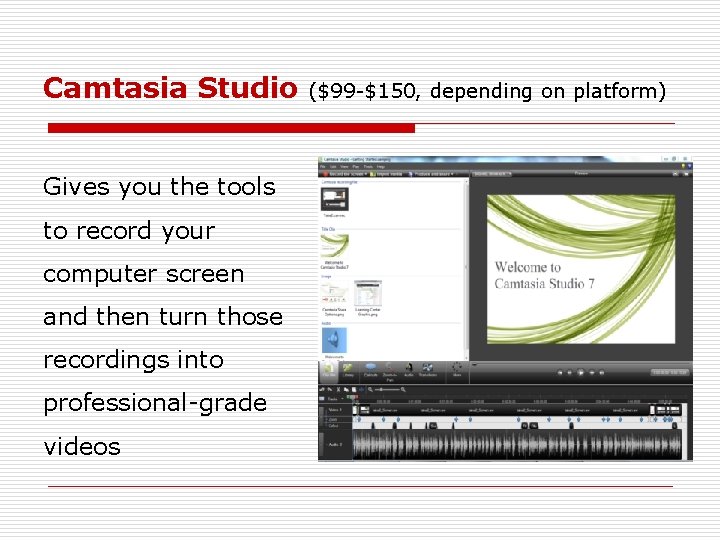
Camtasia Studio ($99 -$150, depending on platform) Gives you the tools to record your computer screen and then turn those recordings into professional-grade videos
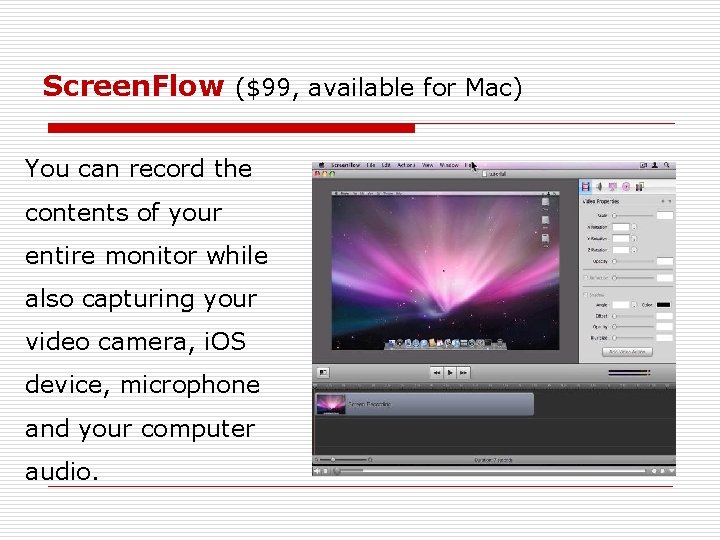
Screen. Flow ($99, available for Mac) You can record the contents of your entire monitor while also capturing your video camera, i. OS device, microphone and your computer audio.


A Sample
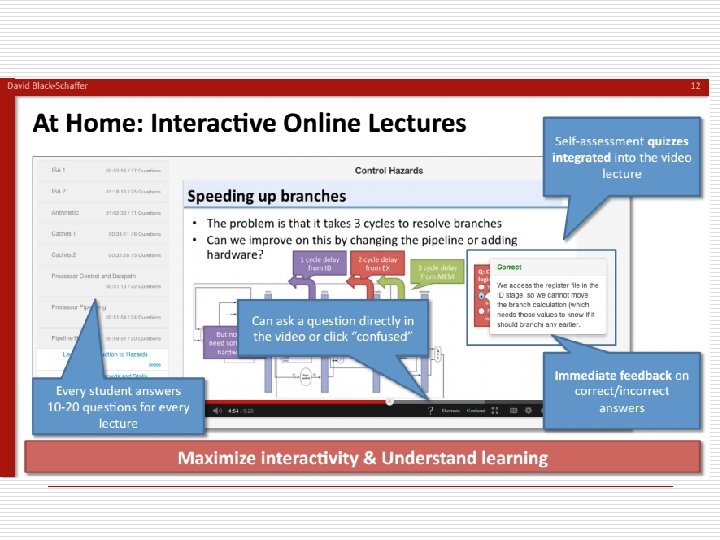
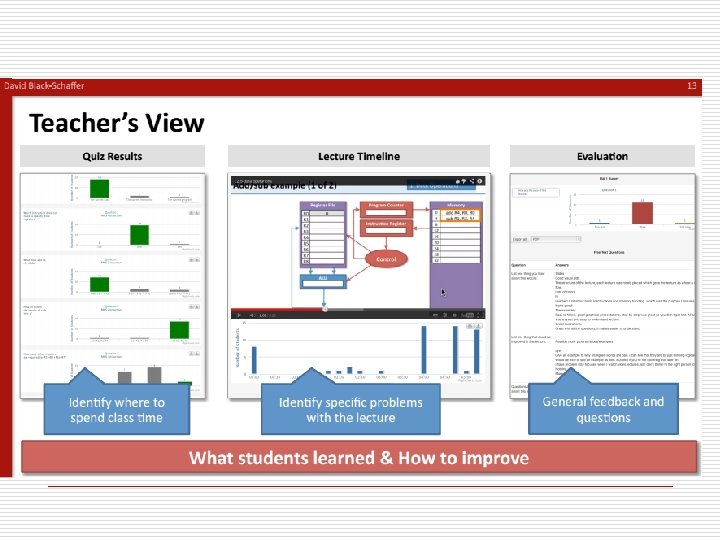
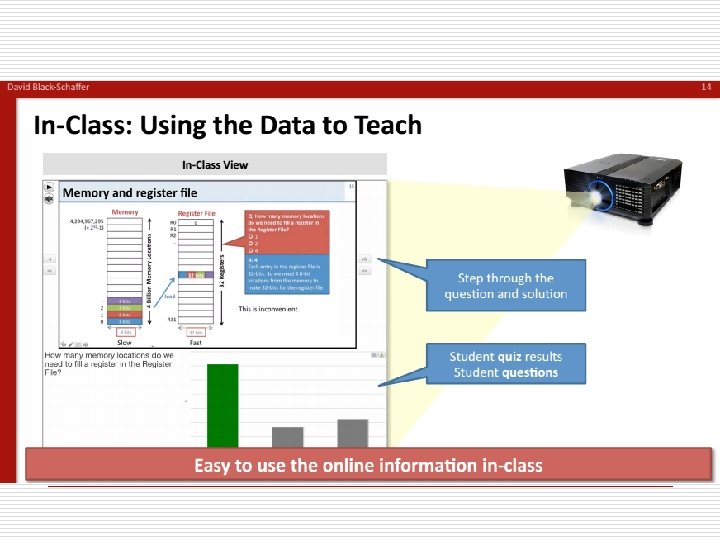
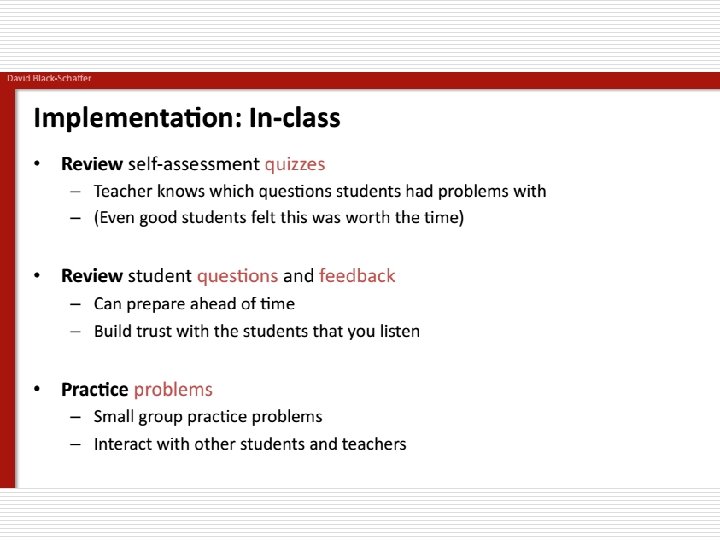
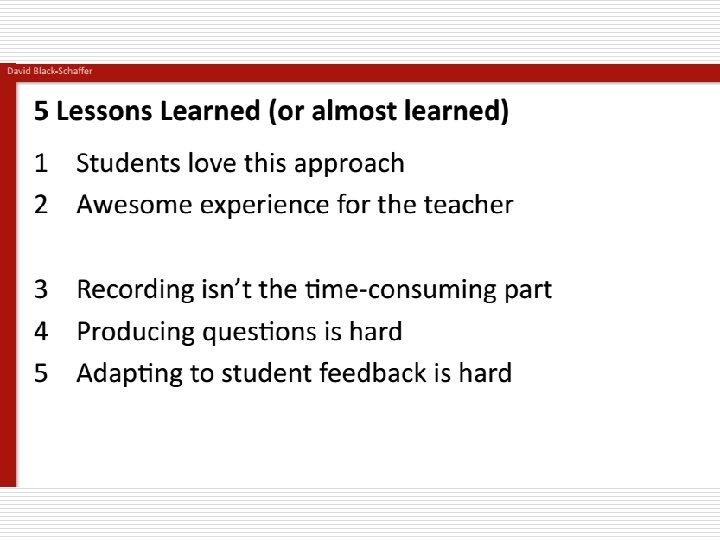
And the last
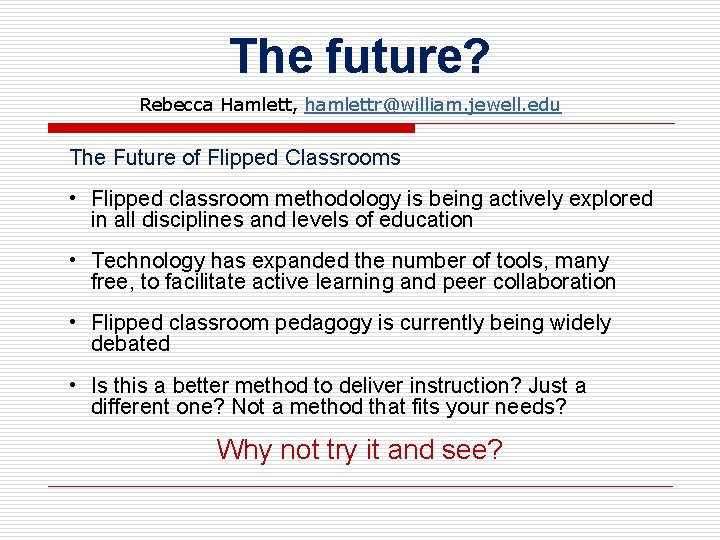
The future? Rebecca Hamlett, hamlettr@william. jewell. edu The Future of Flipped Classrooms • Flipped classroom methodology is being actively explored in all disciplines and levels of education • Technology has expanded the number of tools, many free, to facilitate active learning and peer collaboration • Flipped classroom pedagogy is currently being widely debated • Is this a better method to deliver instruction? Just a different one? Not a method that fits your needs? Why not try it and see?

- Slides: 78