
v Energy Work and Simple Machines v Chapter

- Slides: 34
v. Energy, Work and Simple Machines v. Chapter 10 v. Physics I
v. Energy v Energy is the property that describes an object’s ability to change itself or the environment around it. v Energy can be found in many forms. v Kinetic Energy (KE) – energy of motion. v Potential Energy (PE) – energy gained by a change in position or structure
v. Kinetic Energy (KE) v Moving objects possess Kinetic Energy. v KE = ½ mv 2 v Energy is a scalar quantity and has the unit of Joule (J) (1 J = 1 Nm)
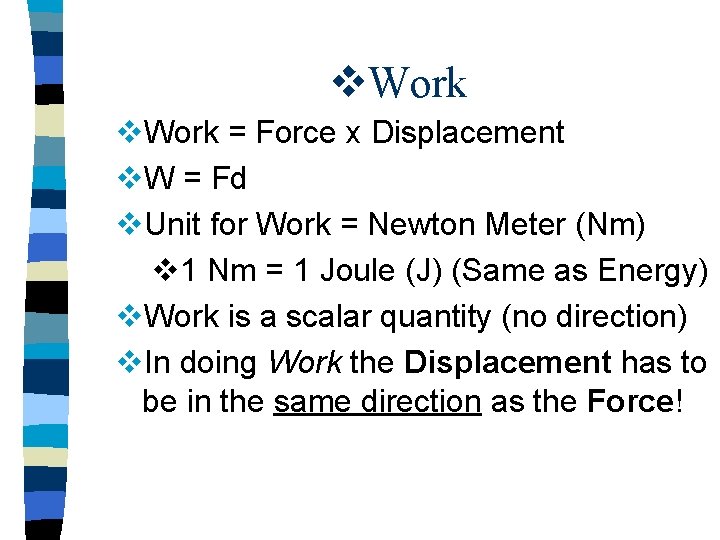
v. Work has its own meaning in physics. v Work is done on an object when an applied force acting on the object moves the object over a distance. v Work depends on two factors. v Force (F) v Displacement (d) v
v. Work = Force x Displacement v. W = Fd v. Unit for Work = Newton Meter (Nm) v 1 Nm = 1 Joule (J) (Same as Energy) v. Work is a scalar quantity (no direction) v. In doing Work the Displacement has to be in the same direction as the Force!
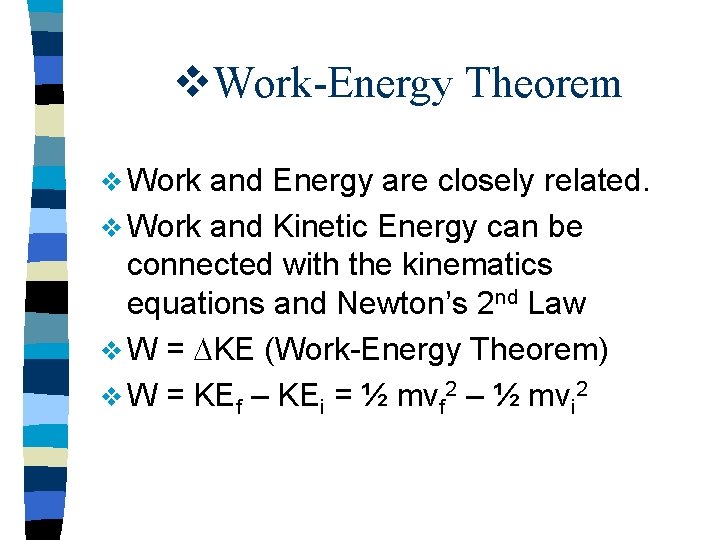
v. Work-Energy Theorem v Work and Energy are closely related. v Work and Kinetic Energy can be connected with the kinematics equations and Newton’s 2 nd Law v W = DKE (Work-Energy Theorem) v W = KEf – KEi = ½ mvf 2 – ½ mvi 2
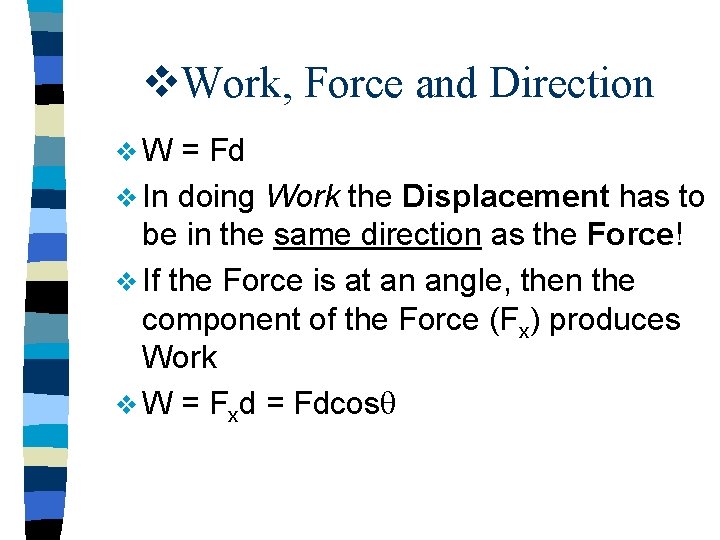
v. Work, Force and Direction v. W = Fd v In doing Work the Displacement has to be in the same direction as the Force! v If the Force is at an angle, then the component of the Force (Fx) produces Work v W = Fxd = Fdcosq
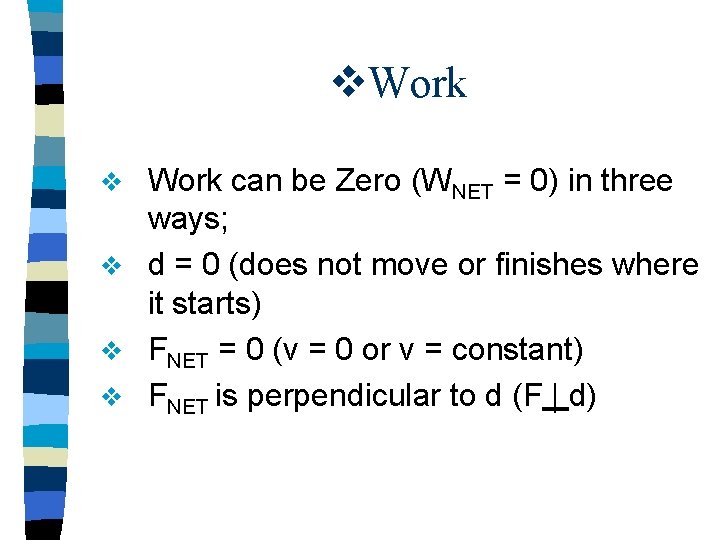
v. Work can be Zero (WNET = 0) in three ways; v d = 0 (does not move or finishes where it starts) v FNET = 0 (v = 0 or v = constant) v FNET is perpendicular to d (F | d) v
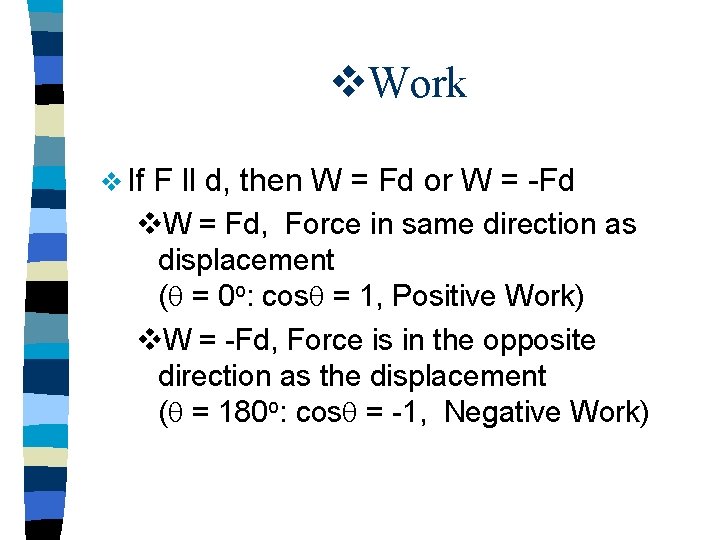
v. Work v If F ll d, then W = Fd or W = -Fd v. W = Fd, Force in same direction as displacement (q = 0 o: cosq = 1, Positive Work) v. W = -Fd, Force is in the opposite direction as the displacement (q = 180 o: cosq = -1, Negative Work)
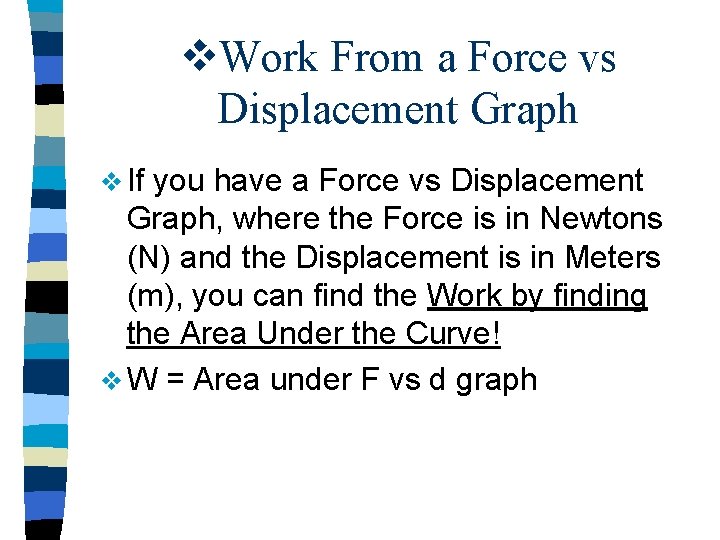
v. Work From a Force vs Displacement Graph v If you have a Force vs Displacement Graph, where the Force is in Newtons (N) and the Displacement is in Meters (m), you can find the Work by finding the Area Under the Curve! v W = Area under F vs d graph
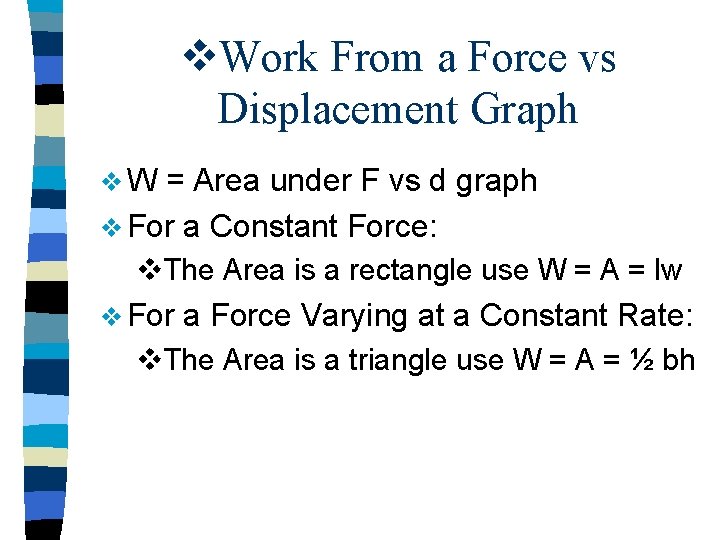
v. Work From a Force vs Displacement Graph v. W = Area under F vs d graph v For a Constant Force: v. The Area is a rectangle use W = A = lw v For a Force Varying at a Constant Rate: v. The Area is a triangle use W = A = ½ bh
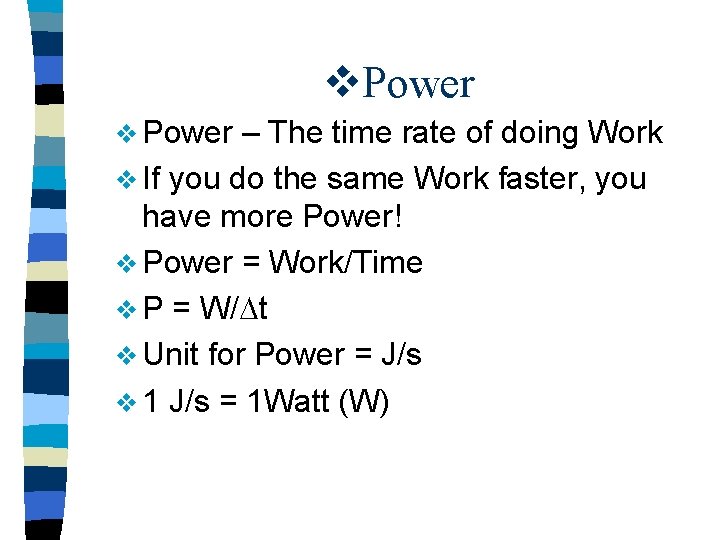
v. Power v Power – The time rate of doing Work v If you do the same Work faster, you have more Power! v Power = Work/Time v P = W/Dt v Unit for Power = J/s v 1 J/s = 1 Watt (W)
v. Power v Power is a scalar quantity (no direction) v Another way to find Power: v. P = W/t = (Fd)/t v. Since v = d/t v. P = Fv = Force x Velocity = Power v Since a Watt is small, Power often uses kilowatt (k. W) megawatt (MW) or Horsepower (hp)
v. Energy From Power v We can use the Power Equation to find Energy. v P = W/t (Work is similar to Energy) v Therefore; P = E/t v E = Pt (Solve for Energy) v A Unit for Energy = W s or k. W-hr (kilowatt-hour)
v. Machines can do any of the following; v Machines can Multiply the Force (Lever) v Change the Direction of the Force (Pulley) v Change the speed in which the force acts (Gears) v
v. Machines v Most machines make work easier by multiplying the Force! v Machines never Multiply the Work! v When using a machine there is always a Work put into the machine (WIN) and a Work the machine puts out (WOUT). v Ideally, the WIN = WOUT in an ideal machine (no friction).
v. Machines v How Does a Machine multiply the force without multiplying the Work? v Answer: If a machine multiplies the Input Force (FIN), then the machine must act over a larger Displacement (d. IN)! v Remember, W = Fd
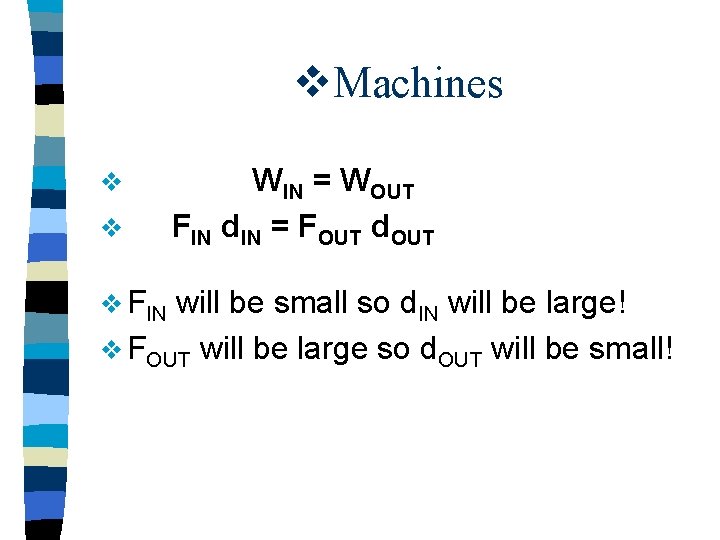
v. Machines v v v FIN WIN = WOUT FIN d. IN = FOUT d. OUT will be small so d. IN will be large! v FOUT will be large so d. OUT will be small!
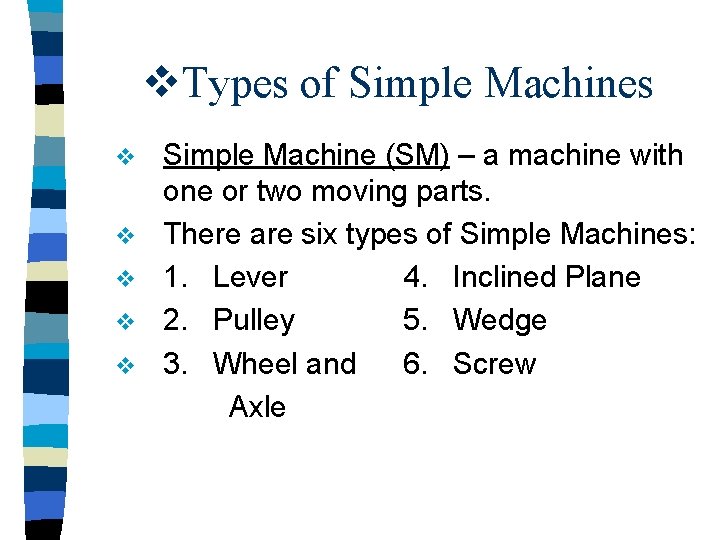
v. Types of Simple Machines v v v Simple Machine (SM) – a machine with one or two moving parts. There are six types of Simple Machines: 1. Lever 4. Inclined Plane 2. Pulley 5. Wedge 3. Wheel and 6. Screw Axle
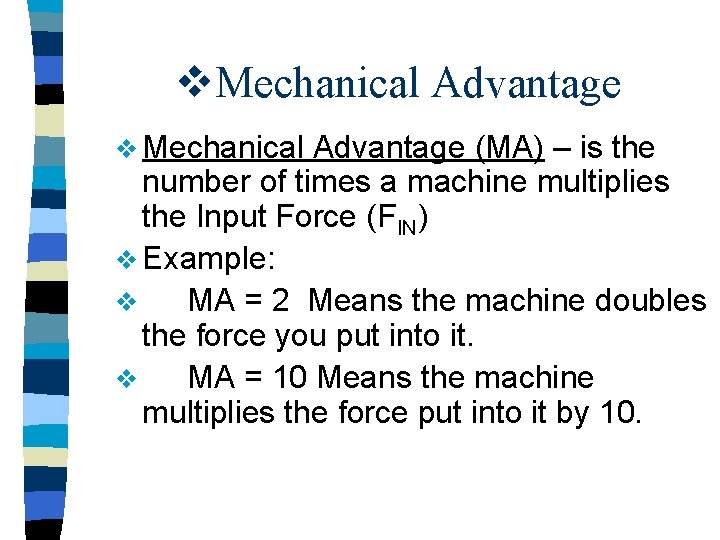
v. Mechanical Advantage v Mechanical Advantage (MA) – is the number of times a machine multiplies the Input Force (FIN) v Example: v MA = 2 Means the machine doubles the force you put into it. v MA = 10 Means the machine multiplies the force put into it by 10.
v. Mechanical Advantage v MA >1 (Machine multiplies the force) v MA < 1(Machine multiplies the distance) v MA = 1(Machine does not multiply either force or distance. Probably only changes the direction to the force. )
v. Mechanical Advantage v To find the Mechanical Advantage (MA) of a machine, we take the ratio of the Resistance Force (Fr) to the Effort Force (Fe) v Effort Force (Fe) – is the force applied to the machine v Resistance Force (Fr) – is the force the machine applies to the object
v. Ideal Mechanical Advantage (IMA) v The Ideal Mechanical Advantage (IMA) is the largest possible MA a machine can have if the machine operated without friction. v To find the Ideal Mechanical Advantage (IMA) of a machine you take the ratio of the Effort Distance (de) over the Resistance Distance (dr)
v. Calculating MA and IMA v To calculate MA we use the Forces (Fr and Fe). Since Friction is a force, Friction affects MA. MA = Fr/Fe v To calculate IMA we use the distances (dr and de). Friction does not affect IMA = de/dr v MA has No Unit!! It’s a number telling how many times the force is multiplied!
v. Ideal Mechanical Advantage and Actual Mechanical Advantage v The Actual Mechanical Advantage (MA) is always less than the IMA (MA < IMA) because of Friction. v Machines are designed with an IMA v Machines are tested to find Actual MA
v Note v. Input/Effort and Output/Resistance from this point on: v Effort = Input v(FIN = Fe and d. IN = de) v Resistance = Output v(FOUT = Fr and d. OUT = dr) v WIN = WOUT (Ideal Machine) v F e d e = F rd r
v. Compound Machines v Compound Machine – any combination of two or more simple machines v Examples: Axe, Shovel, Scissors v Compound Machines have a higher Mechanical Advantage (MA) because they are made up of multiple machines
v. Mechanical Advantage of Compound Machines v To calculate the Mechanical Advantage (MA) of a Compound Machine (CM), you multiply the Mechanical Advantages of all the Simple Machines in the Compound Machine v MACM = MASM#1 x MASM#2 x MASM#3 x …
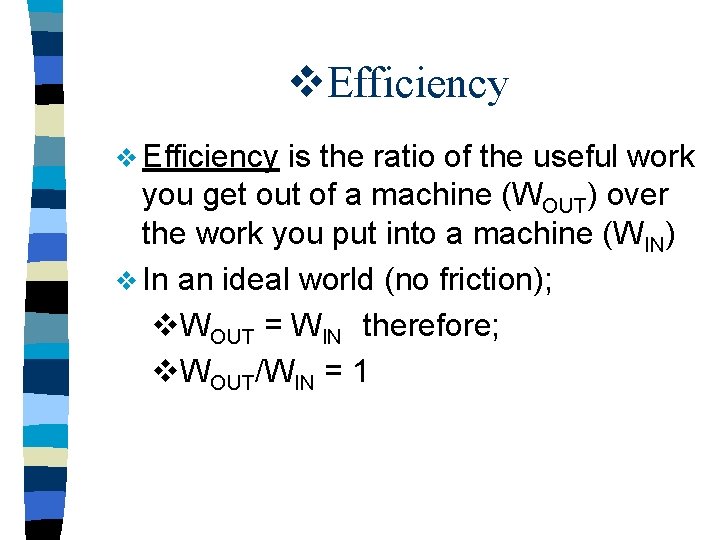
v. Efficiency v Efficiency is the ratio of the useful work you get out of a machine (WOUT) over the work you put into a machine (WIN) v In an ideal world (no friction); v. WOUT = WIN therefore; v. WOUT/WIN = 1
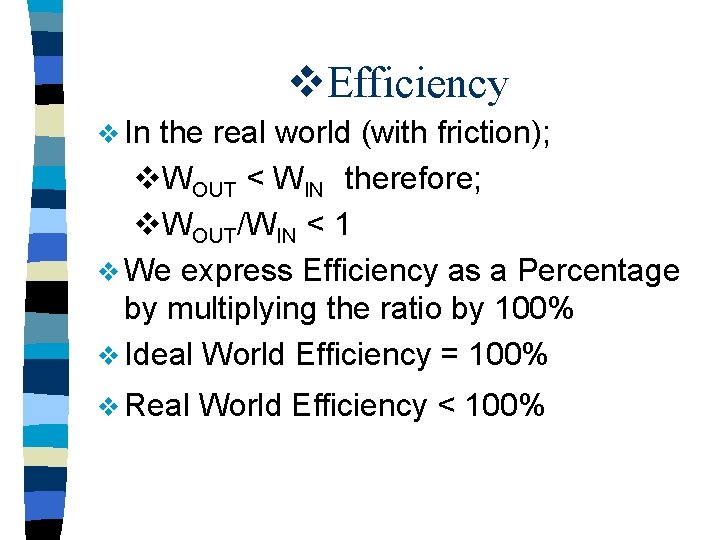
v. Efficiency v In the real world (with friction); v. WOUT < WIN therefore; v. WOUT/WIN < 1 v We express Efficiency as a Percentage by multiplying the ratio by 100% v Ideal World Efficiency = 100% v Real World Efficiency < 100%
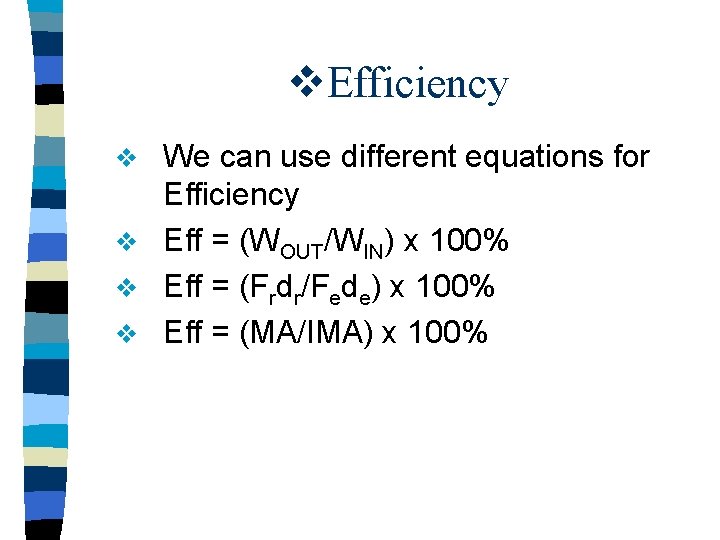
v. Efficiency We can use different equations for Efficiency v Eff = (WOUT/WIN) x 100% v Eff = (Frdr/Fede) x 100% v Eff = (MA/IMA) x 100% v
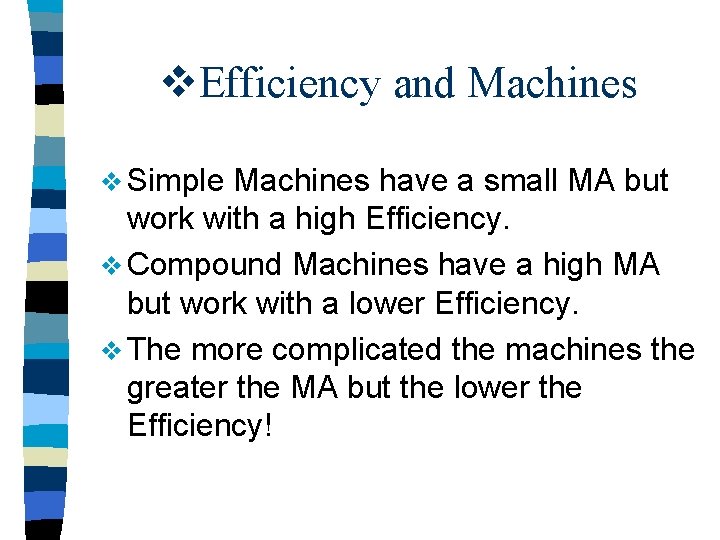
v. Efficiency and Machines v Simple Machines have a small MA but work with a high Efficiency. v Compound Machines have a high MA but work with a lower Efficiency. v The more complicated the machines the greater the MA but the lower the Efficiency!
v. The Human Machine v Levers – Muscles and Tendons v Wedges – Teeth and Finger Nails v Your Body uses many Simple and Compound machines to create Mechanical Advantage v Human Walking Machine Page 273