
V 7 Biological PPI Networks graph bisection communities
V 7 – Biological PPI Networks - graph bisection (-> communities) - are biological networks really scale-free? - network growth - functional annotation in the network Mon, Nov 14, 2016 Bioinformatics 3 – SS 18 V 7 – 1
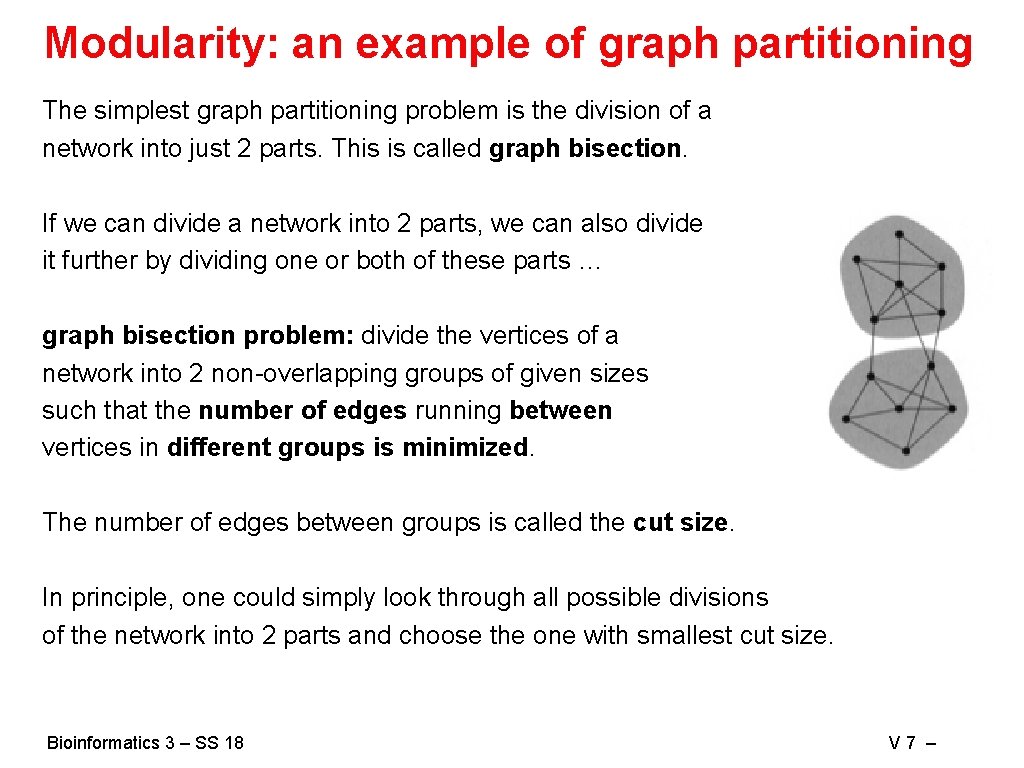
Modularity: an example of graph partitioning The simplest graph partitioning problem is the division of a network into just 2 parts. This is called graph bisection. If we can divide a network into 2 parts, we can also divide it further by dividing one or both of these parts … graph bisection problem: divide the vertices of a network into 2 non-overlapping groups of given sizes such that the number of edges running between vertices in different groups is minimized. The number of edges between groups is called the cut size. In principle, one could simply look through all possible divisions of the network into 2 parts and choose the one with smallest cut size. Bioinformatics 3 – SS 18 V 7 –
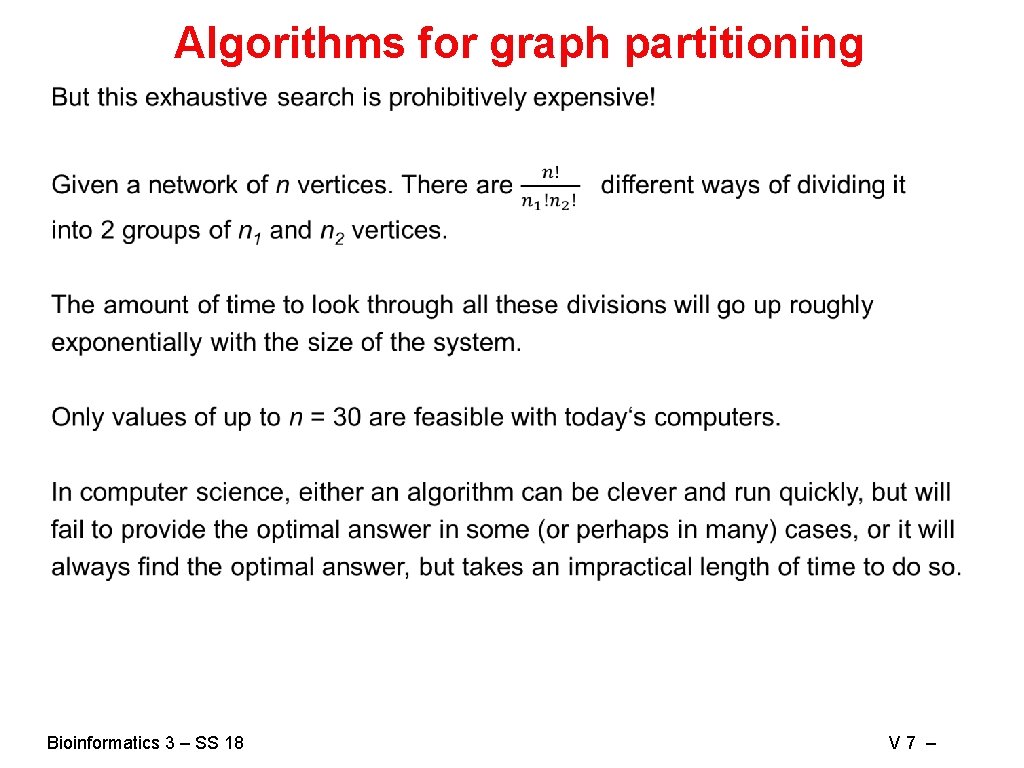
Algorithms for graph partitioning Bioinformatics 3 – SS 18 V 7 –
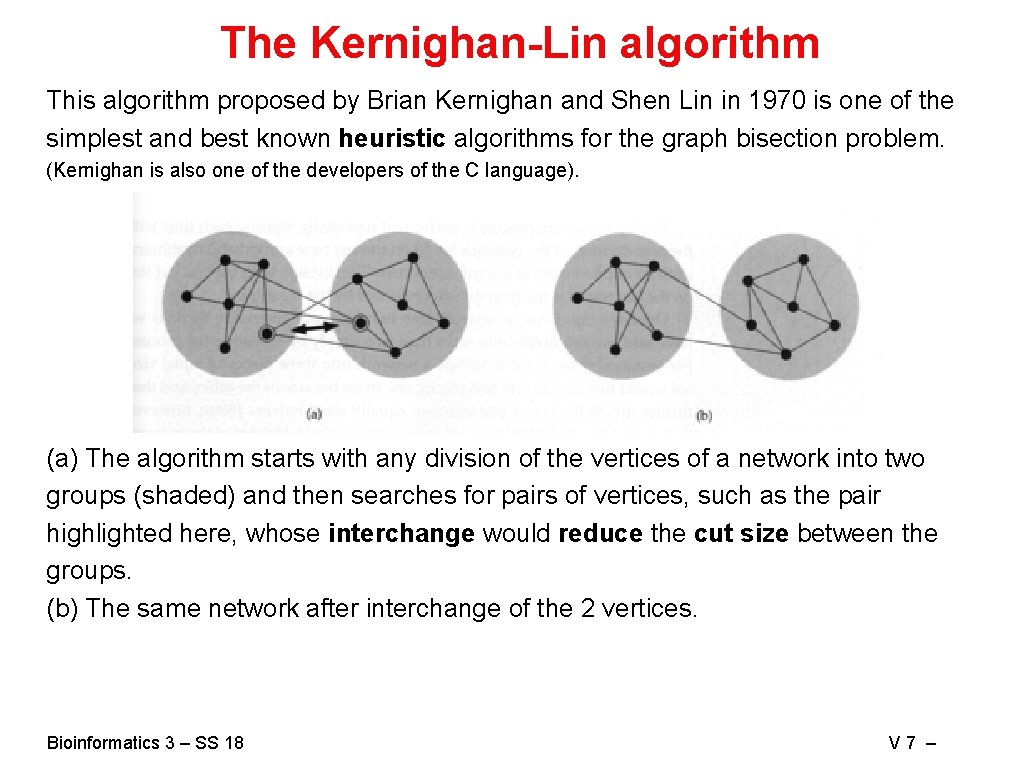
The Kernighan-Lin algorithm This algorithm proposed by Brian Kernighan and Shen Lin in 1970 is one of the simplest and best known heuristic algorithms for the graph bisection problem. (Kernighan is also one of the developers of the C language). (a) The algorithm starts with any division of the vertices of a network into two groups (shaded) and then searches for pairs of vertices, such as the pair highlighted here, whose interchange would reduce the cut size between the groups. (b) The same network after interchange of the 2 vertices. Bioinformatics 3 – SS 18 V 7 –

The Kernighan-Lin algorithm (1) Divide the vertices of a given network into 2 groups (e. g. randomly). (2) For each pair (i, j) of vertices, where i belongs to the first group and j to the second group, calculate how much the cut size between the groups would change if i and j were interchanged between the groups. (3) Find the pair that reduces the cut size by the largest amount and swap the vertices. If no pair reduces it, find the pair that increases it by the smallest amount. Repeat this process, but with the important restriction that each vertex in the network can only be moved once. Stop when there is no pair of vertices left that can be swapped. Bioinformatics 3 – SS 18 V 7 –

The Kernighan-Lin algorithm (II) (3) Go back through every state that the network passed through during the swapping procedure and choose among them the state in which the cut size takes its smallest value. (4) Perform this entire process repeatedly, starting each time with the best division of the network found in the last round. (5) Stop when no improvement on the cut size occurs. Note that if the initial assignment of vertices to groups is done randomly, the Kernighan-Lin algorithm may give (slightly) different answers when it is run twice on the same network. Bioinformatics 3 – SS 18 V 7 –
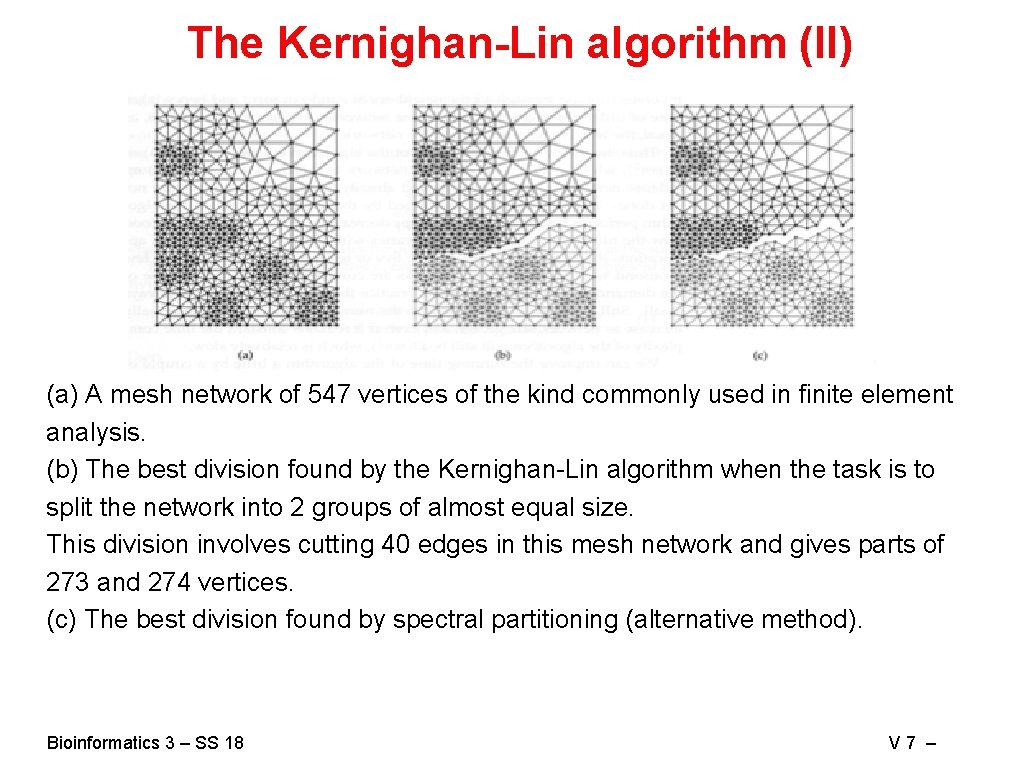
The Kernighan-Lin algorithm (II) (a) A mesh network of 547 vertices of the kind commonly used in finite element analysis. (b) The best division found by the Kernighan-Lin algorithm when the task is to split the network into 2 groups of almost equal size. This division involves cutting 40 edges in this mesh network and gives parts of 273 and 274 vertices. (c) The best division found by spectral partitioning (alternative method). Bioinformatics 3 – SS 18 V 7 –
Runtime of the Kernighan-Lin algorithm The number of swaps performed during one round of the algorithm is equal to the smaller of the sizes of the two groups [0, n / 2]. → in the worst case, there are O(n) swaps. For each swap, we have to examine all pairs of vertices in different groups to determine how the cut size would be affected if the pair was swapped. At most (if both groups have the same size), there are n / 2 = n 2 / 4 such pairs, which is O(n 2). Bioinformatics 3 – SS 18 V 7 –
Runtime of the Kernighan-Lin algorithm (ii) When a vertex i moves from one group to the other group, any edges connecting it to vertices in its current group become edges between groups after the swap. Let us suppose that there are kisame such edges. Similarly, any edges that i has to vertices in the other group, (say kiother ones) become within-group edges after the swap. There is one exception. If i is being swapped with vertex j and they are connected by an edge, then the edge is still between the groups after the swap → the change in the cut size due to the movement of i is –(kiother - kisame – Aij) A similar expression applies for vertex j. → the total change in cut size due to the swap is –(kiother - kisame +kjother - kjsame – 2 Aij) Bioinformatics 3 – SS 18 V 7 –
Runtime of the Kernighan-Lin algorithm (iii) Bioinformatics 3 – SS 18 V 7 –
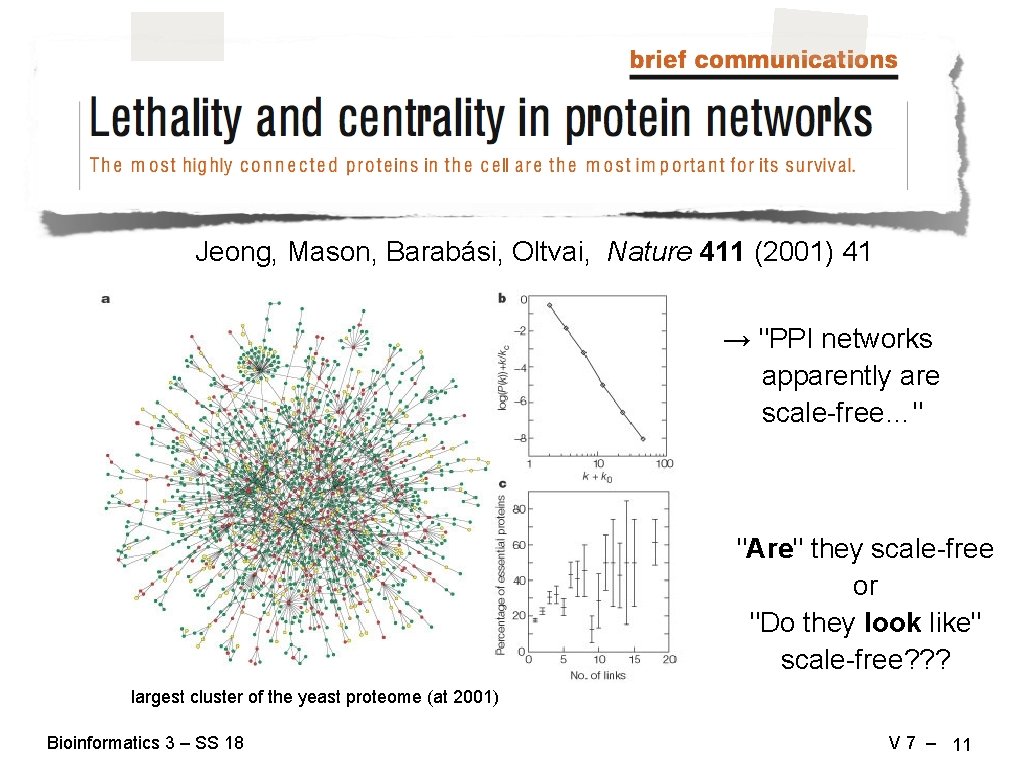
Jeong, Mason, Barabási, Oltvai, Nature 411 (2001) 41 → "PPI networks apparently are scale-free…" "Are" they scale-free or "Do they look like" scale-free? ? ? largest cluster of the yeast proteome (at 2001) Bioinformatics 3 – SS 18 V 7 – 11
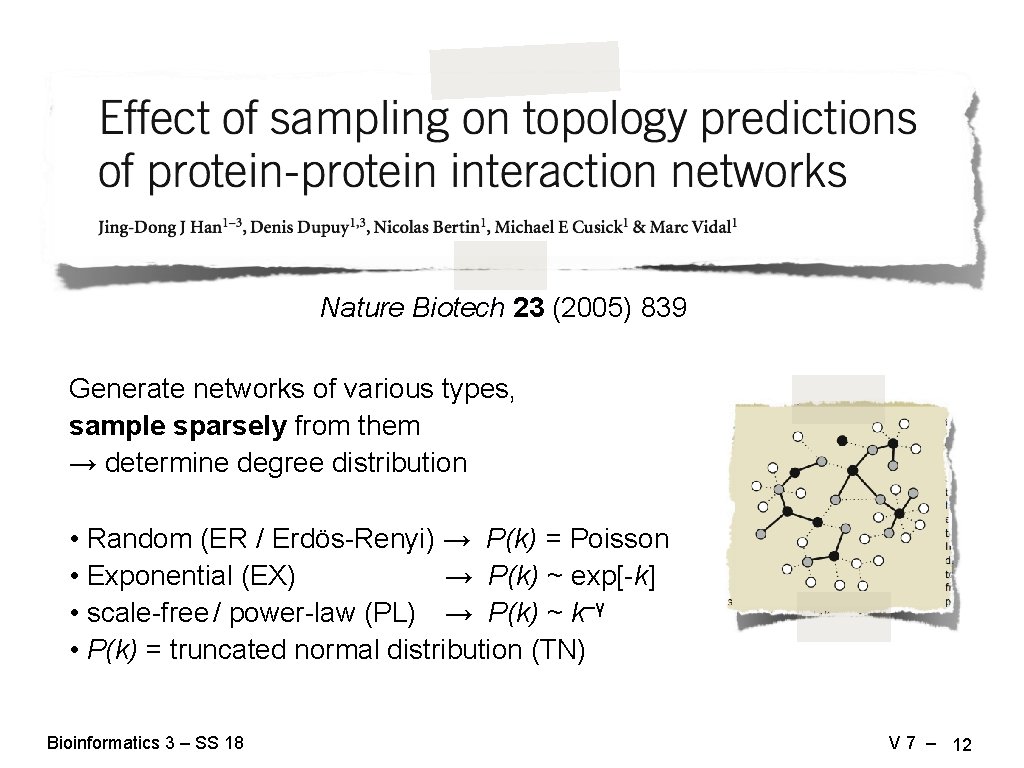
Nature Biotech 23 (2005) 839 Generate networks of various types, sample sparsely from them → determine degree distribution • Random (ER / Erdös-Renyi) → P(k) = Poisson • Exponential (EX) → P(k) ~ exp[-k] • scale-free / power-law (PL) → P(k) ~ k–γ • P(k) = truncated normal distribution (TN) Bioinformatics 3 – SS 18 V 7 – 12
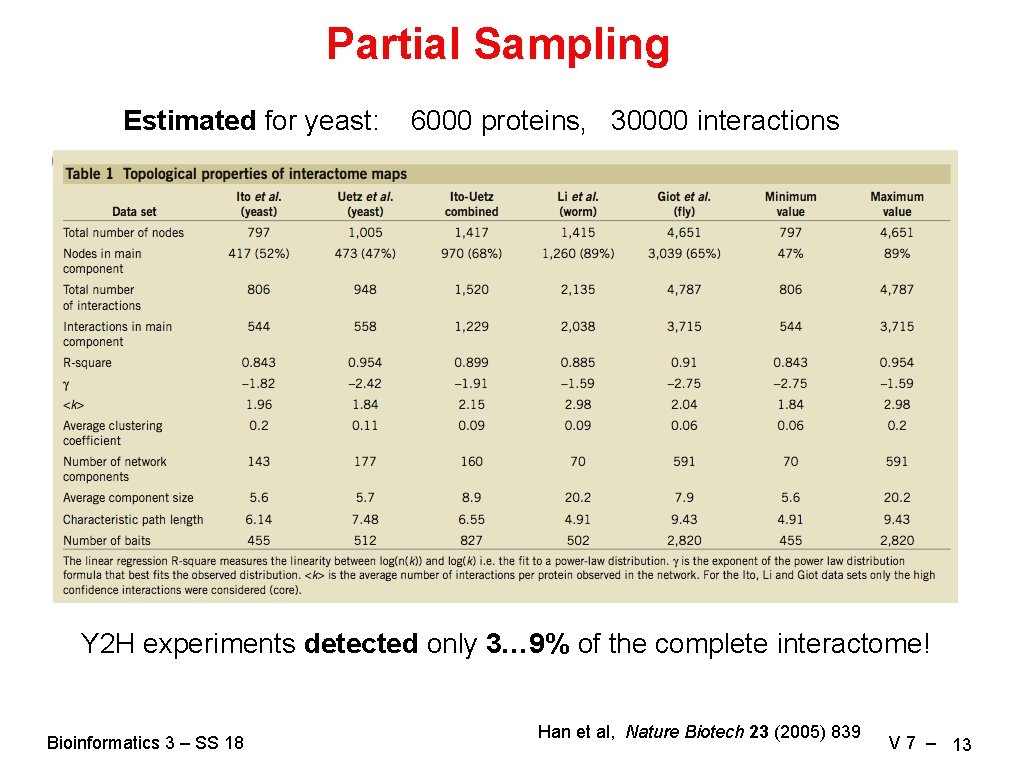
Partial Sampling Estimated for yeast: 6000 proteins, 30000 interactions Y 2 H experiments detected only 3… 9% of the complete interactome! Bioinformatics 3 – SS 18 Han et al, Nature Biotech 23 (2005) 839 V 7 – 13
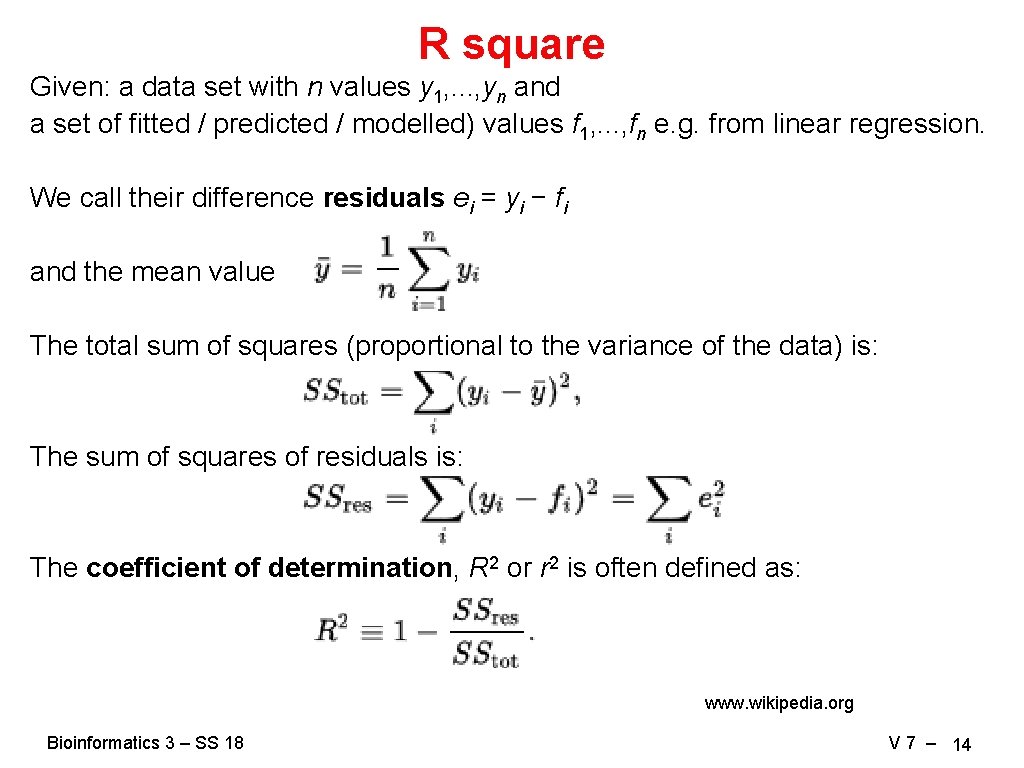
R square Given: a data set with n values y 1, . . . , yn and a set of fitted / predicted / modelled) values f 1, . . . , fn e. g. from linear regression. We call their difference residuals ei = yi − fi and the mean value The total sum of squares (proportional to the variance of the data) is: The sum of squares of residuals is: The coefficient of determination, R 2 or r 2 is often defined as: www. wikipedia. org Bioinformatics 3 – SS 18 V 7 – 14
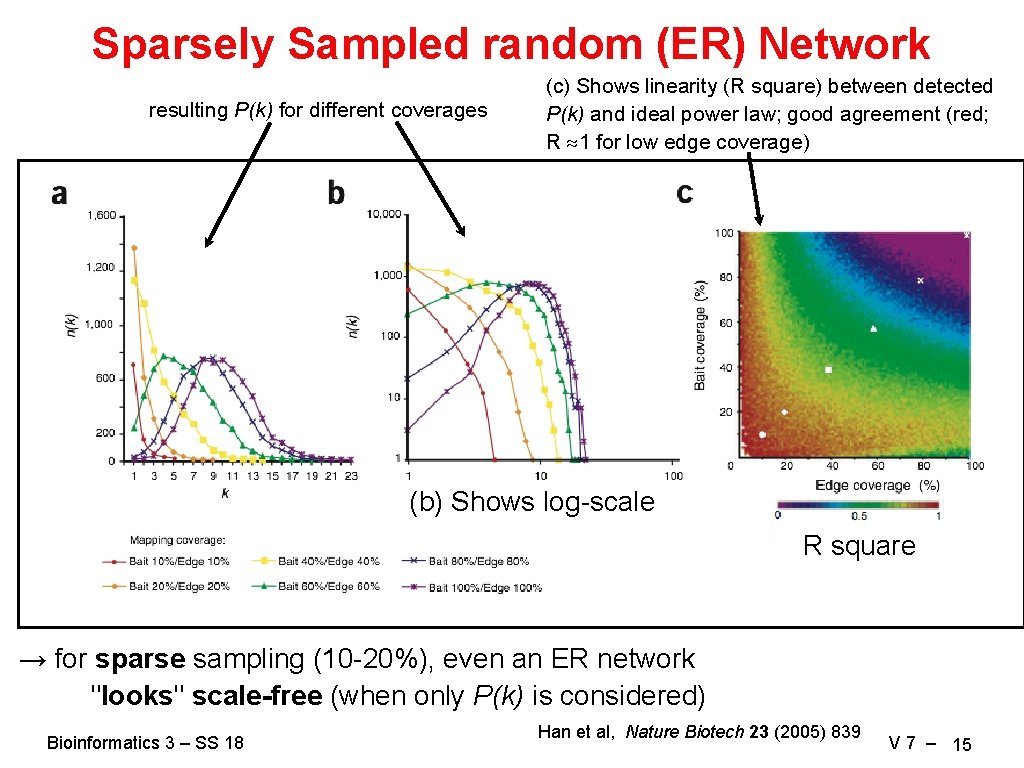
Sparsely Sampled random (ER) Network resulting P(k) for different coverages (c) Shows linearity (R square) between detected P(k) and ideal power law; good agreement (red; R 1 for low edge coverage) (b) Shows log-scale R square → for sparse sampling (10 -20%), even an ER network "looks" scale-free (when only P(k) is considered) Bioinformatics 3 – SS 18 Han et al, Nature Biotech 23 (2005) 839 V 7 – 15
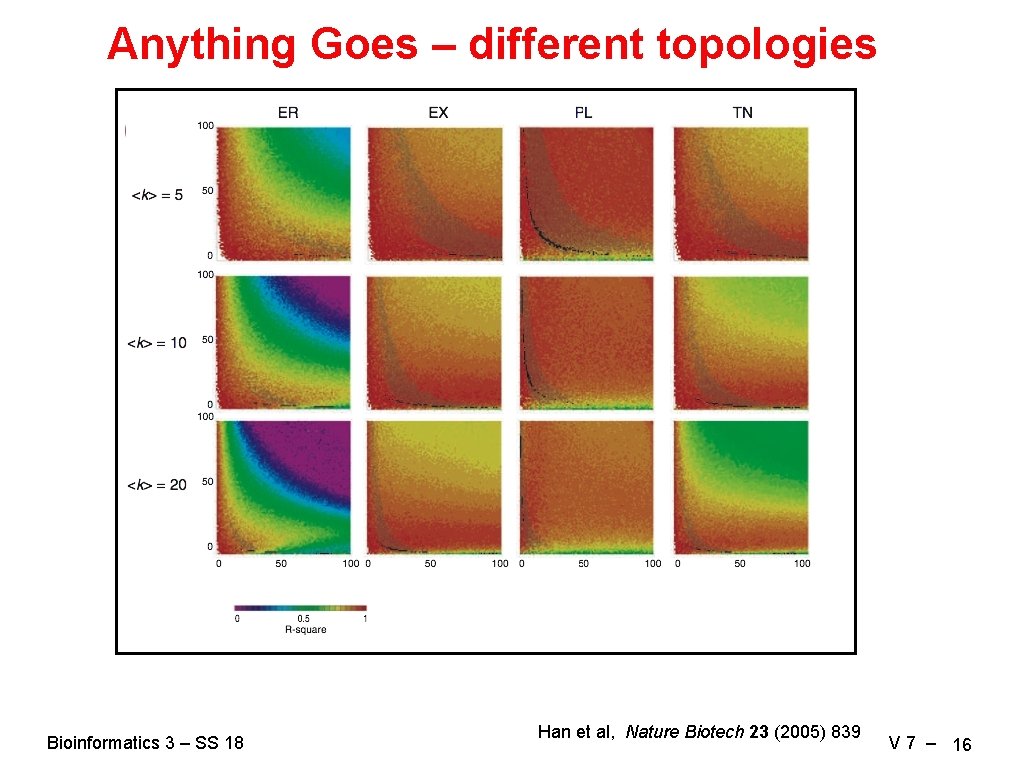
Anything Goes – different topologies Bioinformatics 3 – SS 18 Han et al, Nature Biotech 23 (2005) 839 V 7 – 16
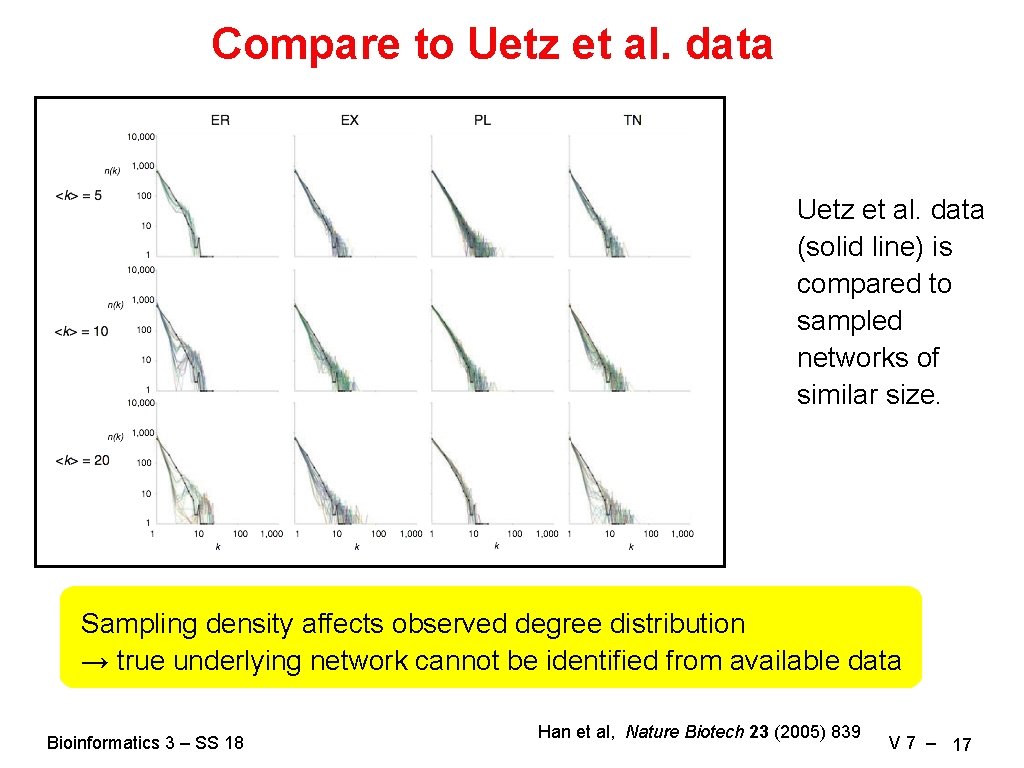
Compare to Uetz et al. data (solid line) is compared to sampled networks of similar size. Sampling density affects observed degree distribution → true underlying network cannot be identified from available data Bioinformatics 3 – SS 18 Han et al, Nature Biotech 23 (2005) 839 V 7 – 17
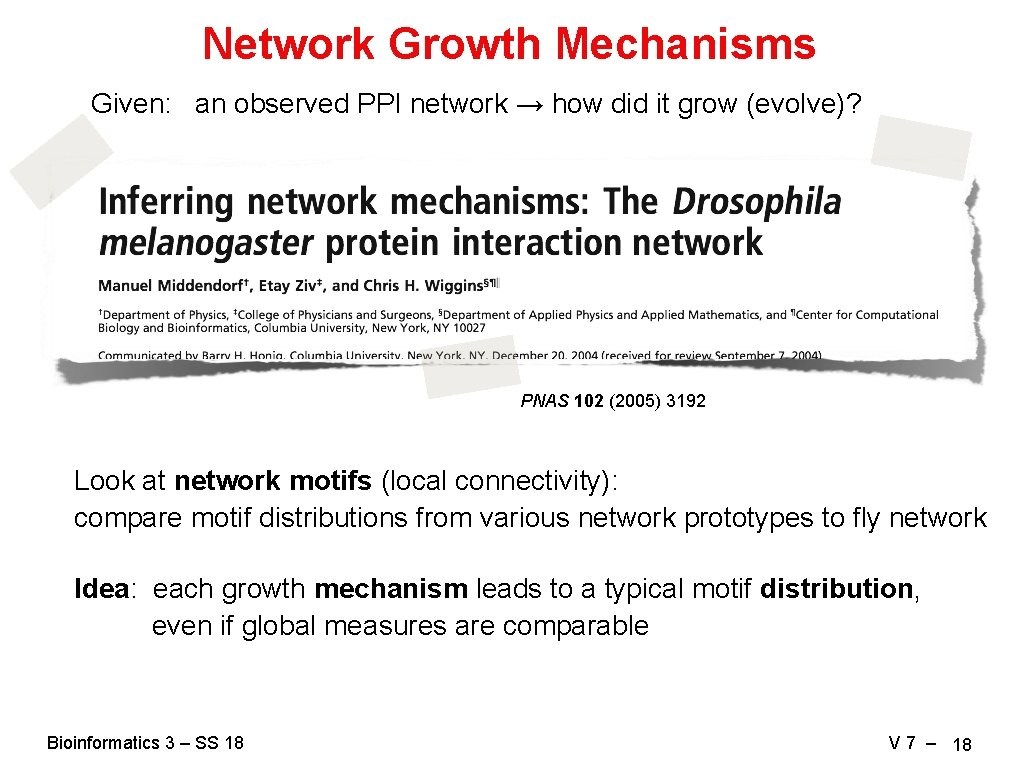
Network Growth Mechanisms Given: an observed PPI network → how did it grow (evolve)? PNAS 102 (2005) 3192 Look at network motifs (local connectivity): compare motif distributions from various network prototypes to fly network Idea: each growth mechanism leads to a typical motif distribution, even if global measures are comparable Bioinformatics 3 – SS 18 V 7 – 18
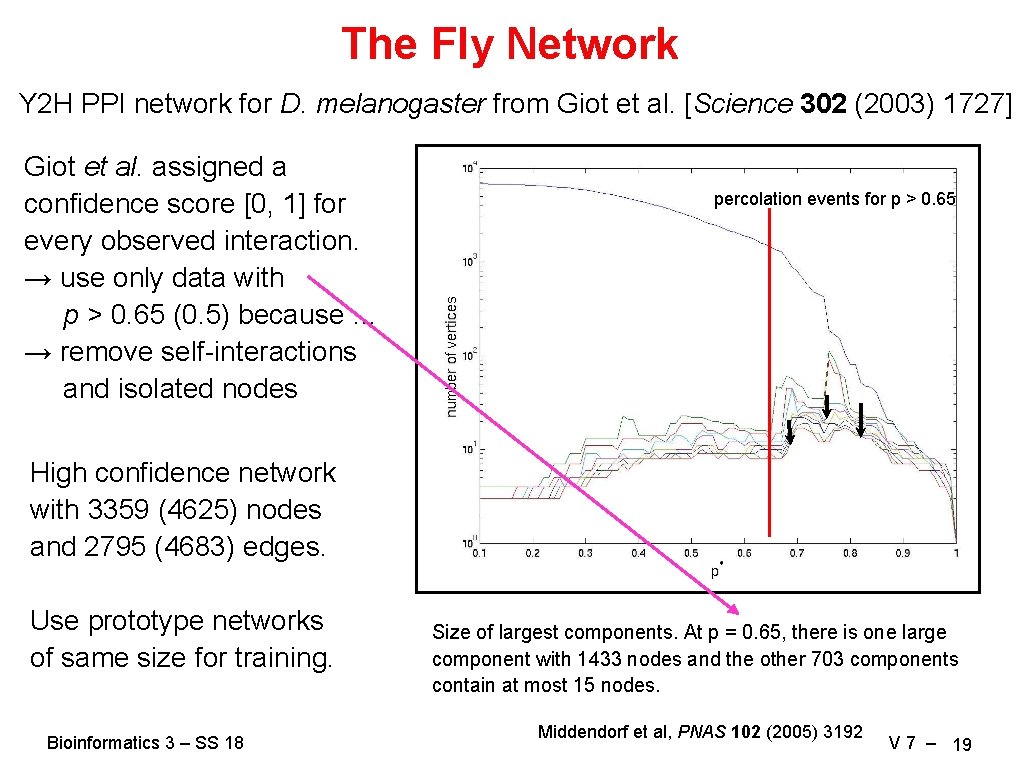
The Fly Network Y 2 H PPI network for D. melanogaster from Giot et al. [Science 302 (2003) 1727] Giot et al. assigned a confidence score [0, 1] for every observed interaction. → use only data with p > 0. 65 (0. 5) because … → remove self-interactions and isolated nodes percolation events for p > 0. 65 High confidence network with 3359 (4625) nodes and 2795 (4683) edges. Use prototype networks of same size for training. Bioinformatics 3 – SS 18 Size of largest components. At p = 0. 65, there is one large component with 1433 nodes and the other 703 components contain at most 15 nodes. Middendorf et al, PNAS 102 (2005) 3192 V 7 – 19
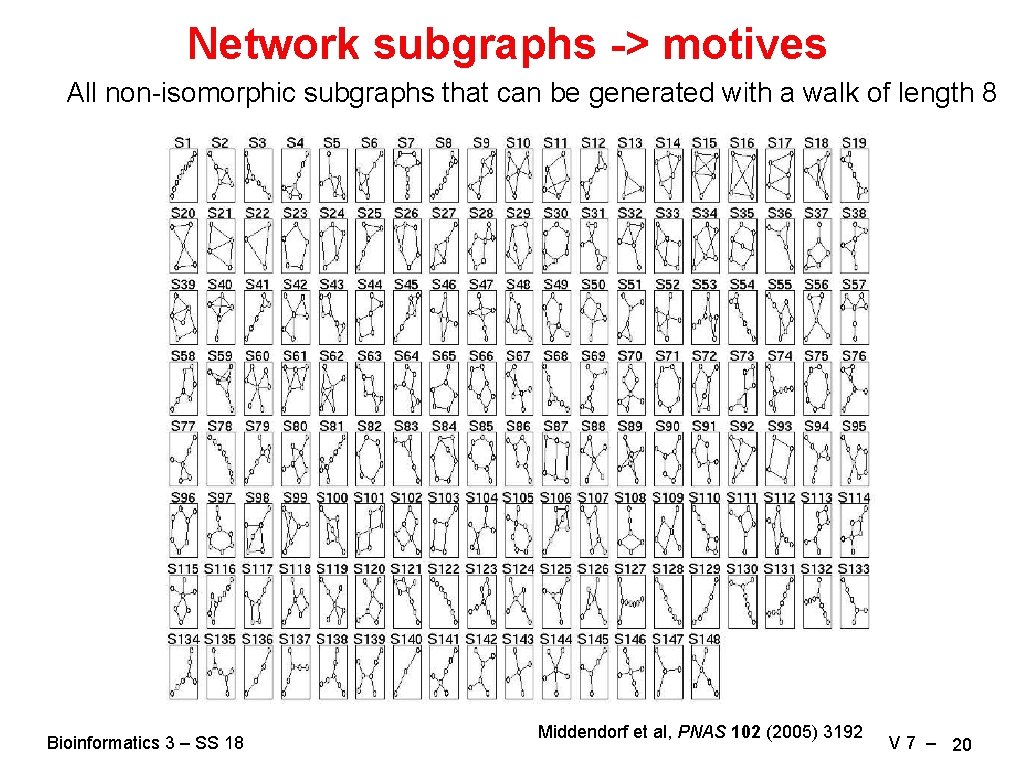
Network subgraphs -> motives All non-isomorphic subgraphs that can be generated with a walk of length 8 Bioinformatics 3 – SS 18 Middendorf et al, PNAS 102 (2005) 3192 V 7 – 20
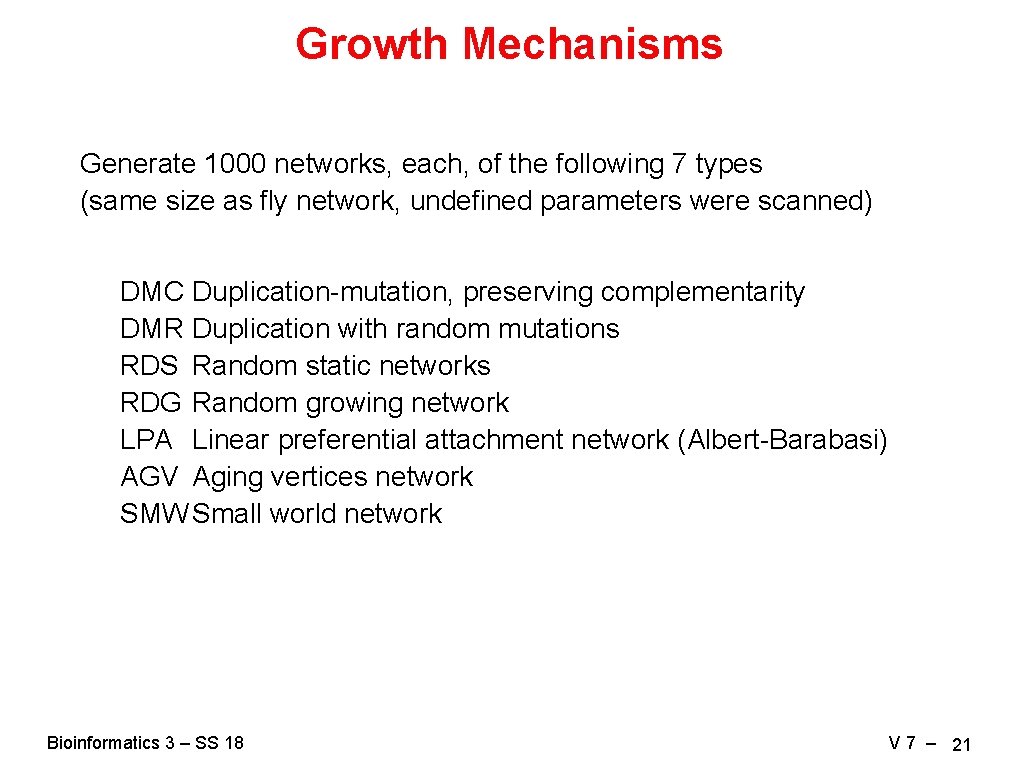
Growth Mechanisms Generate 1000 networks, each, of the following 7 types (same size as fly network, undefined parameters were scanned) DMC Duplication-mutation, preserving complementarity DMR Duplication with random mutations RDS Random static networks RDG Random growing network LPA Linear preferential attachment network (Albert-Barabasi) AGV Aging vertices network SMW Small world network Bioinformatics 3 – SS 18 V 7 – 21
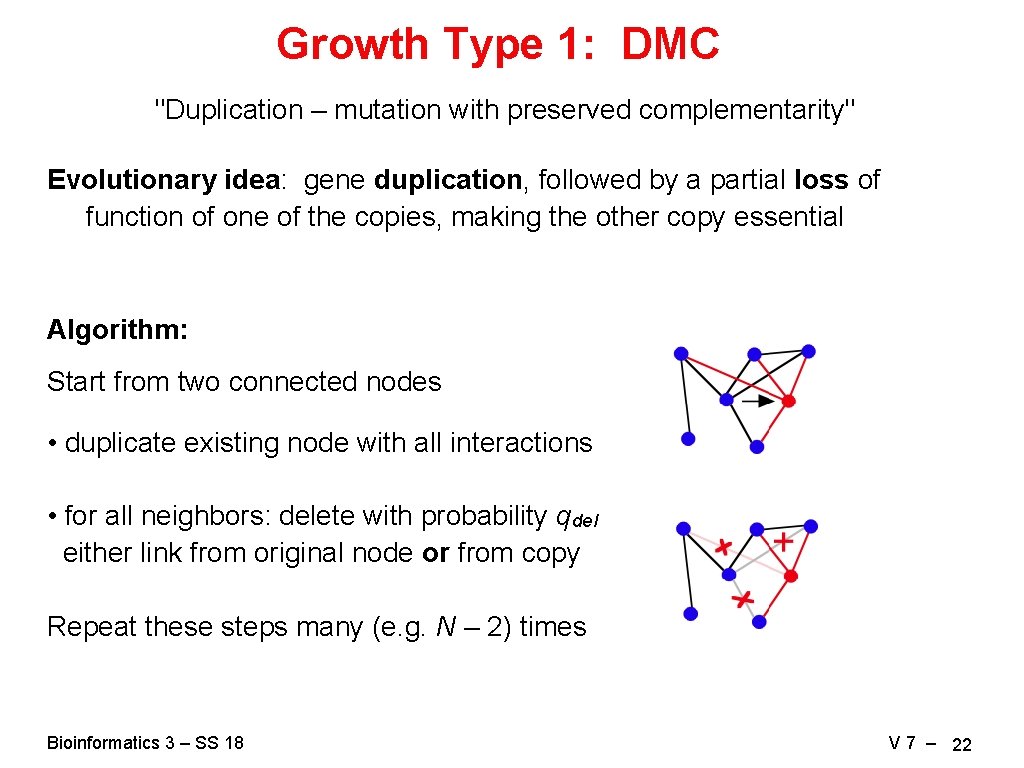
Growth Type 1: DMC "Duplication – mutation with preserved complementarity" Evolutionary idea: gene duplication, followed by a partial loss of function of one of the copies, making the other copy essential Algorithm: Start from two connected nodes • duplicate existing node with all interactions • for all neighbors: delete with probability qdel either link from original node or from copy Repeat these steps many (e. g. N – 2) times Bioinformatics 3 – SS 18 V 7 – 22
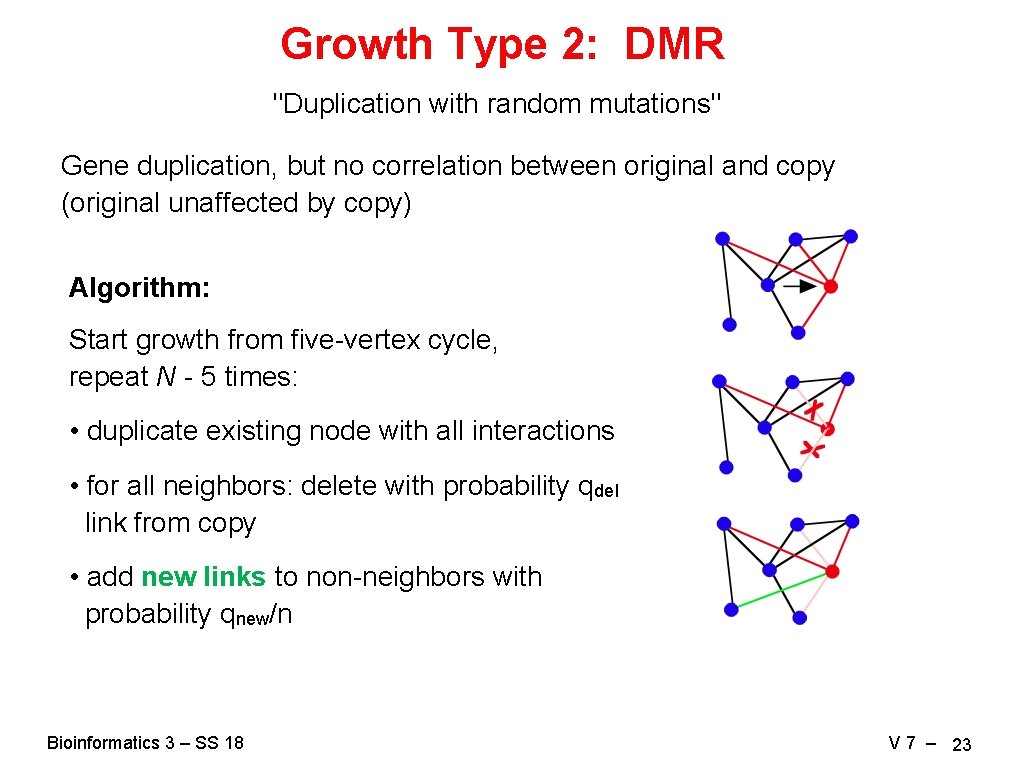
Growth Type 2: DMR "Duplication with random mutations" Gene duplication, but no correlation between original and copy (original unaffected by copy) Algorithm: Start growth from five-vertex cycle, repeat N - 5 times: • duplicate existing node with all interactions • for all neighbors: delete with probability qdel link from copy • add new links to non-neighbors with probability qnew/n Bioinformatics 3 – SS 18 V 7 – 23
Growth Types 3– 5: RDS, RDG, and LPA RDS = static random network Start from N nodes, add L links randomly RDG = growing random network Start from small random network, add nodes, then edges between all existing nodes LPA = linear preferential attachment Add new nodes similar to Barabási-Albert algorithm, but with preference according to (ki + α), α = 0… 5 (BA for α = 0) Bioinformatics 3 – SS 18 V 7 – 24
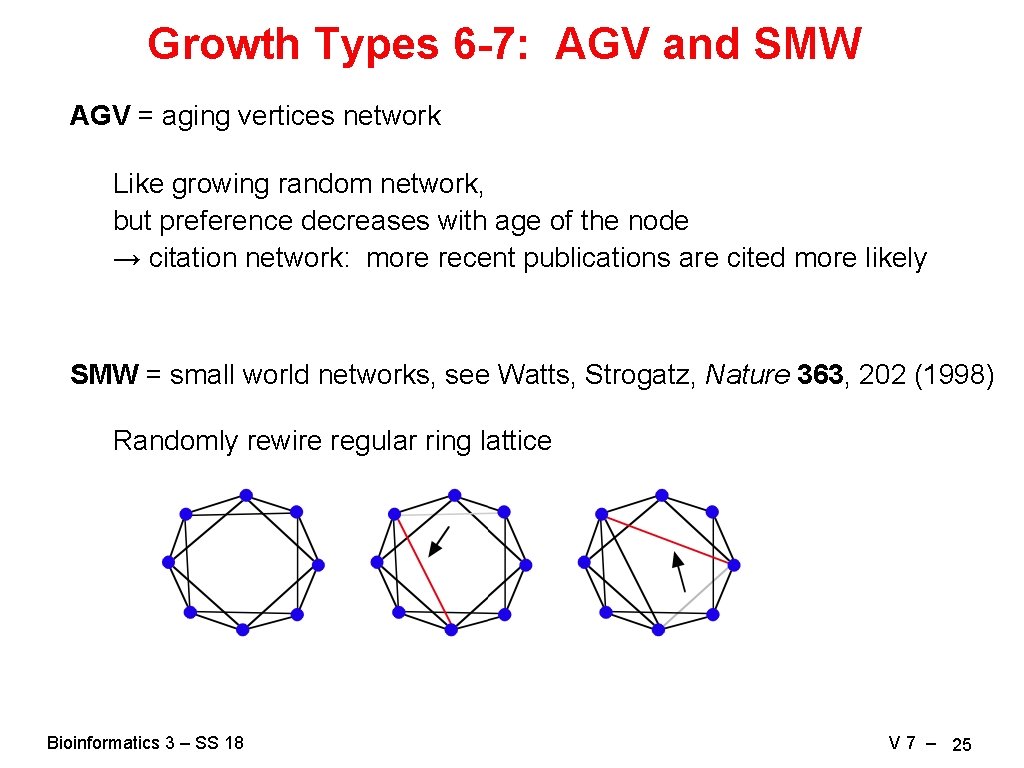
Growth Types 6 -7: AGV and SMW AGV = aging vertices network Like growing random network, but preference decreases with age of the node → citation network: more recent publications are cited more likely SMW = small world networks, see Watts, Strogatz, Nature 363, 202 (1998) Randomly rewire regular ring lattice Bioinformatics 3 – SS 18 V 7 – 25
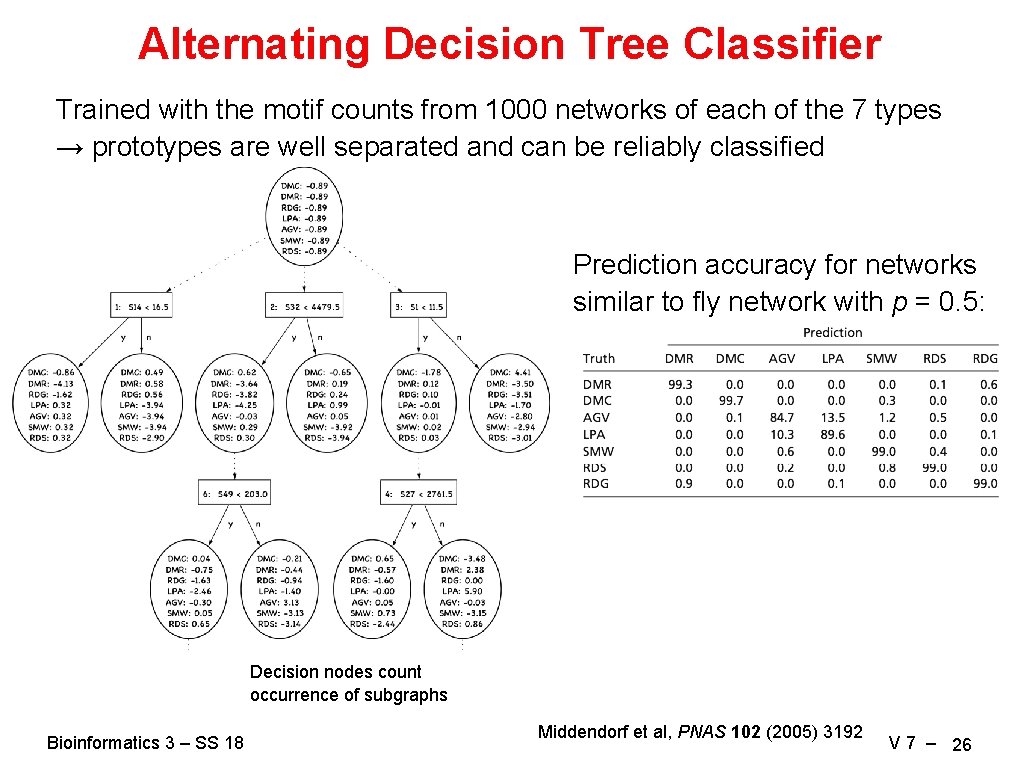
Alternating Decision Tree Classifier Trained with the motif counts from 1000 networks of each of the 7 types → prototypes are well separated and can be reliably classified Prediction accuracy for networks similar to fly network with p = 0. 5: Part of a trained ADT Decision nodes count occurrence of subgraphs Bioinformatics 3 – SS 18 Middendorf et al, PNAS 102 (2005) 3192 V 7 – 26
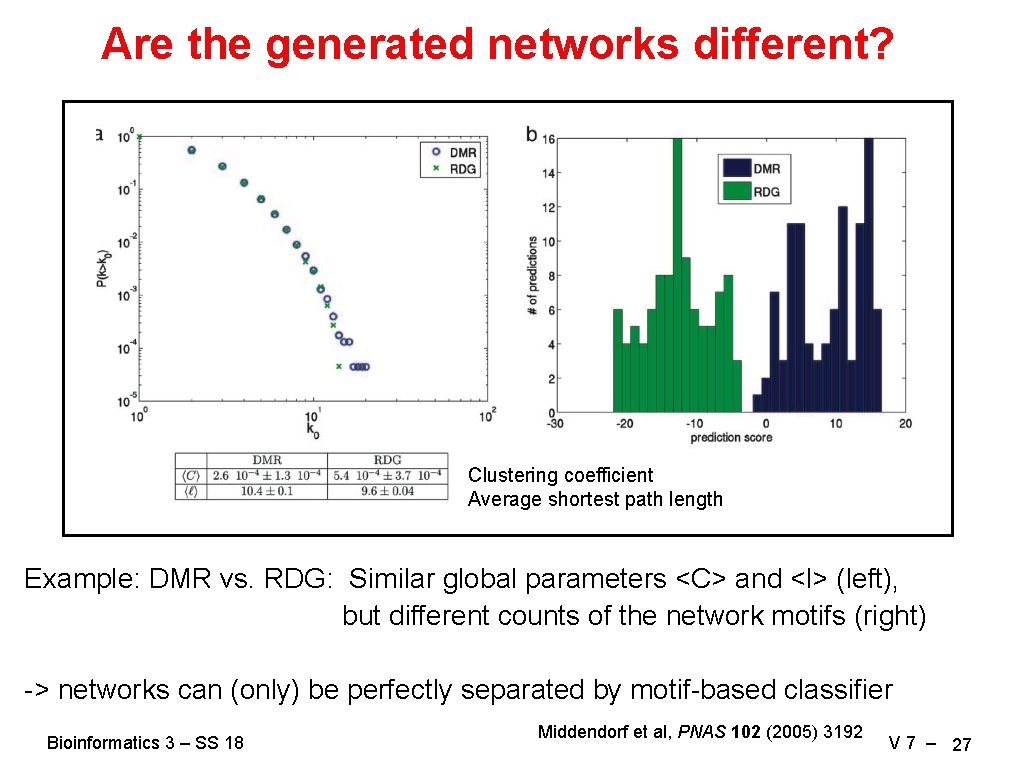
Are the generated networks different? Clustering coefficient Average shortest path length Example: DMR vs. RDG: Similar global parameters <C> and <l> (left), but different counts of the network motifs (right) -> networks can (only) be perfectly separated by motif-based classifier Bioinformatics 3 – SS 18 Middendorf et al, PNAS 102 (2005) 3192 V 7 – 27
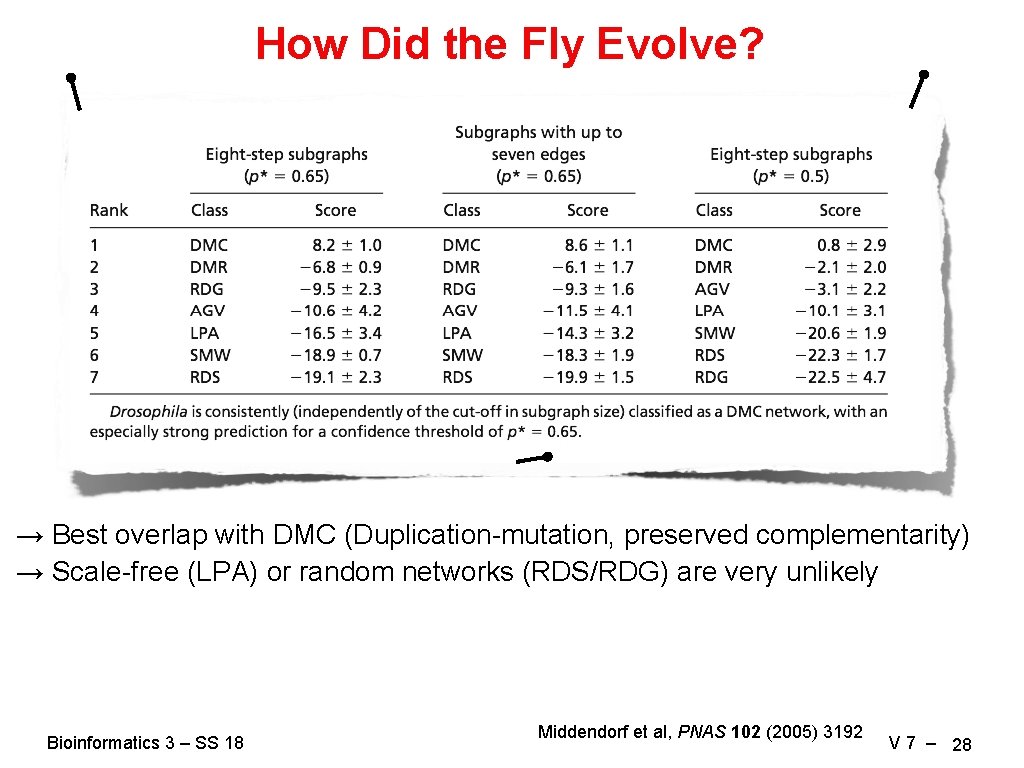
How Did the Fly Evolve? → Best overlap with DMC (Duplication-mutation, preserved complementarity) → Scale-free (LPA) or random networks (RDS/RDG) are very unlikely Bioinformatics 3 – SS 18 Middendorf et al, PNAS 102 (2005) 3192 V 7 – 28
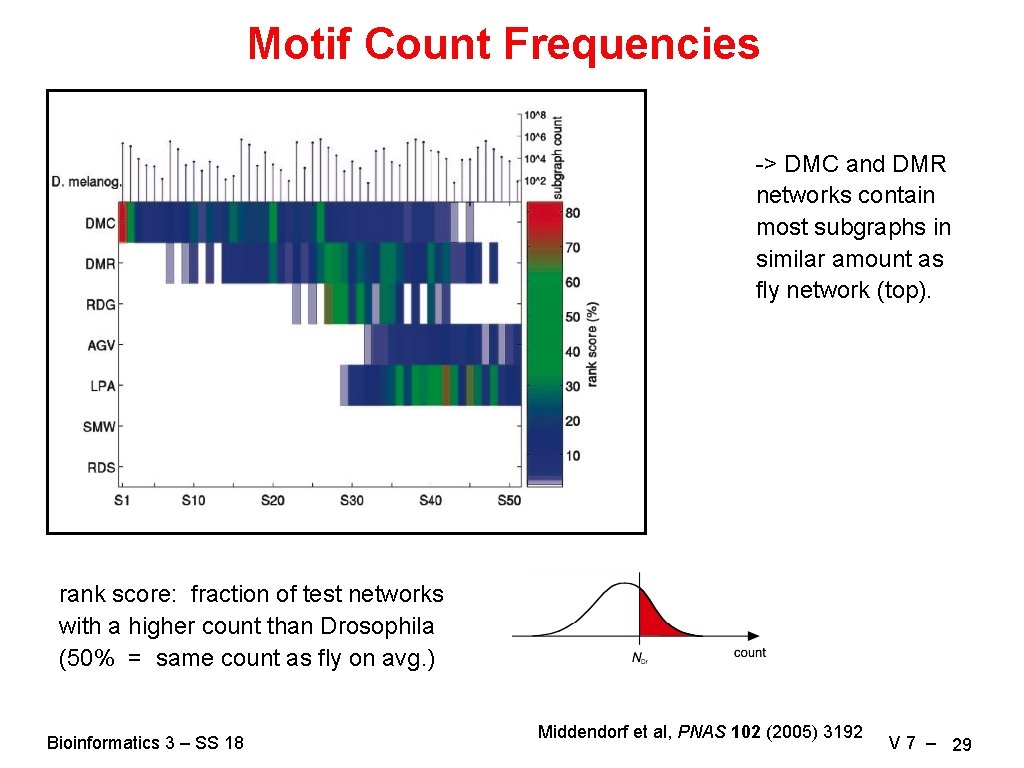
Motif Count Frequencies -> DMC and DMR networks contain most subgraphs in similar amount as fly network (top). rank score: fraction of test networks with a higher count than Drosophila (50% = same count as fly on avg. ) Bioinformatics 3 – SS 18 Middendorf et al, PNAS 102 (2005) 3192 V 7 – 29
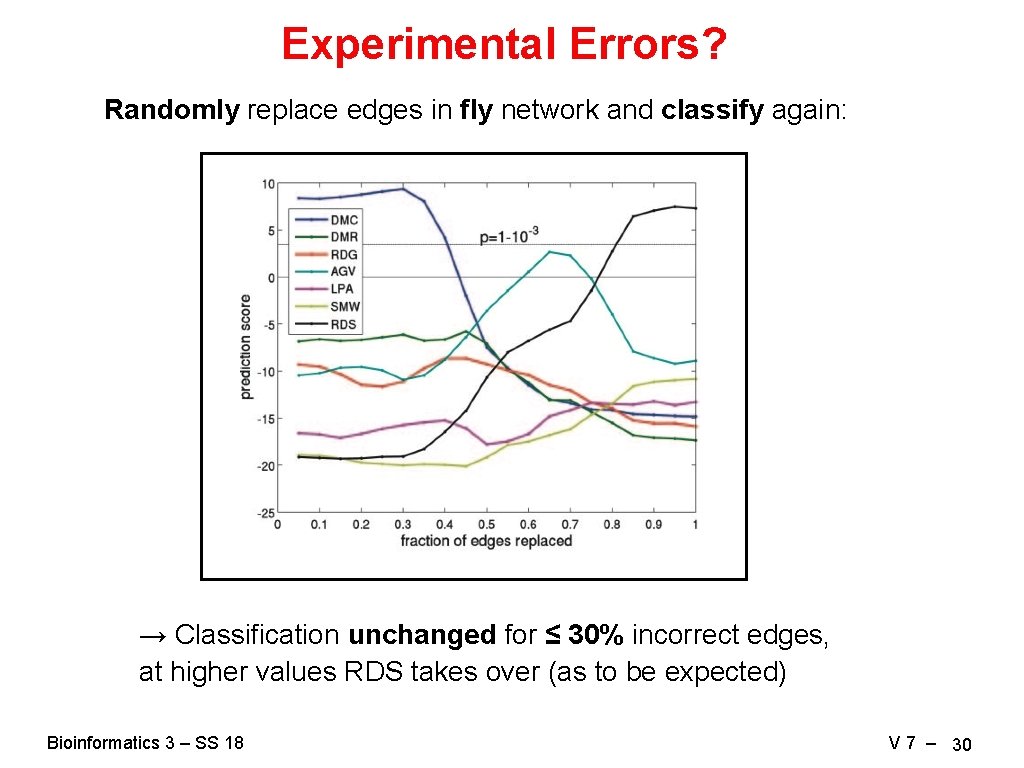
Experimental Errors? Randomly replace edges in fly network and classify again: → Classification unchanged for ≤ 30% incorrect edges, at higher values RDS takes over (as to be expected) Bioinformatics 3 – SS 18 V 7 – 30
Summary (I) Sampling matters! → "Scale-free" P(k) is obtained by sparse sampling from many network types Test different hypotheses for • global features → depends on unknown parameters and sampling → no clear statement possible • local features (motifs) → are better preserved → DMC best among tested prototypes Bioinformatics 3 – SS 18 V 7 – 31
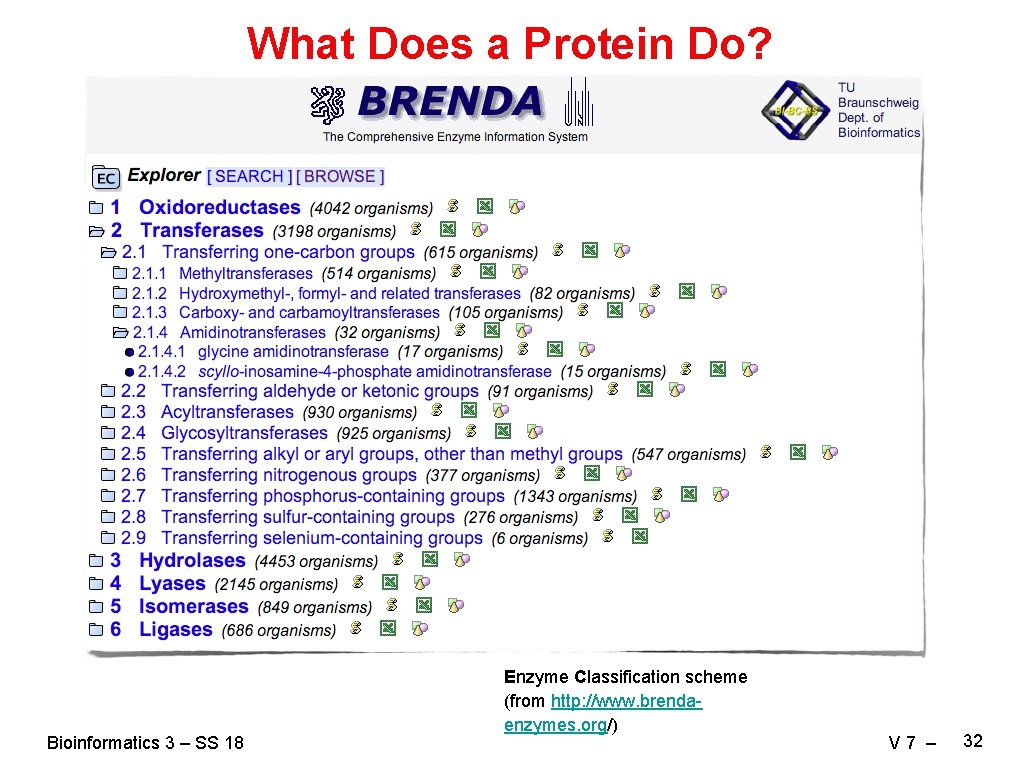
What Does a Protein Do? Bioinformatics 3 – SS 18 Enzyme Classification scheme (from http: //www. brendaenzymes. org/) V 7 – 32
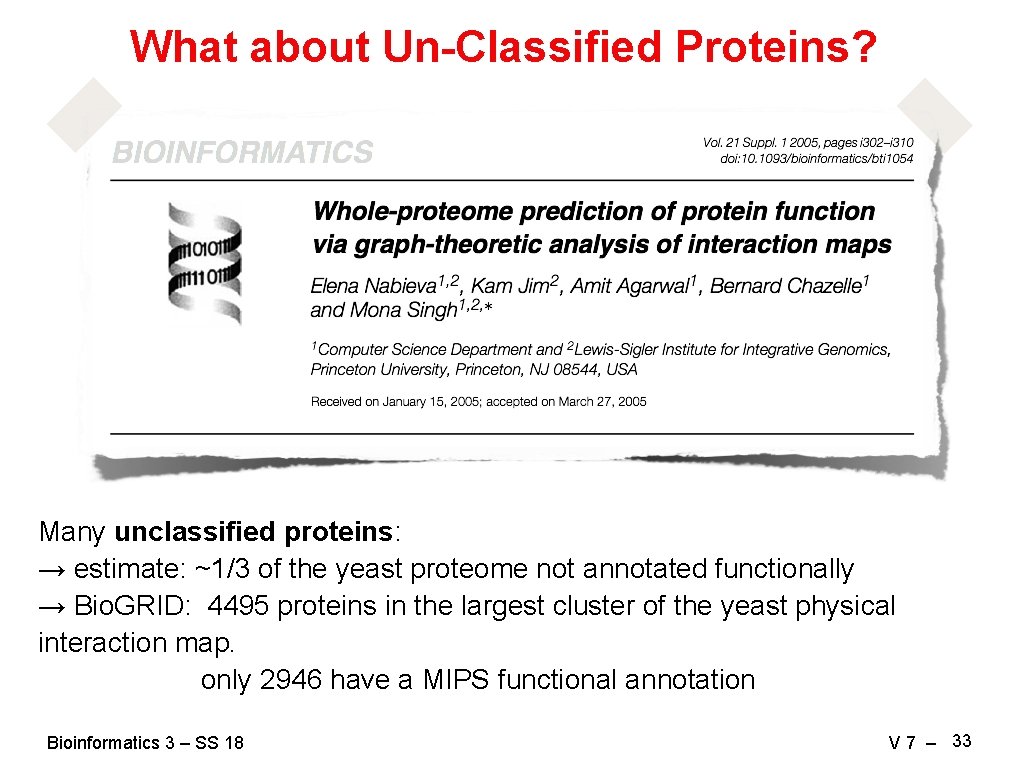
What about Un-Classified Proteins? Many unclassified proteins: → estimate: ~1/3 of the yeast proteome not annotated functionally → Bio. GRID: 4495 proteins in the largest cluster of the yeast physical interaction map. only 2946 have a MIPS functional annotation Bioinformatics 3 – SS 18 V 7 – 33
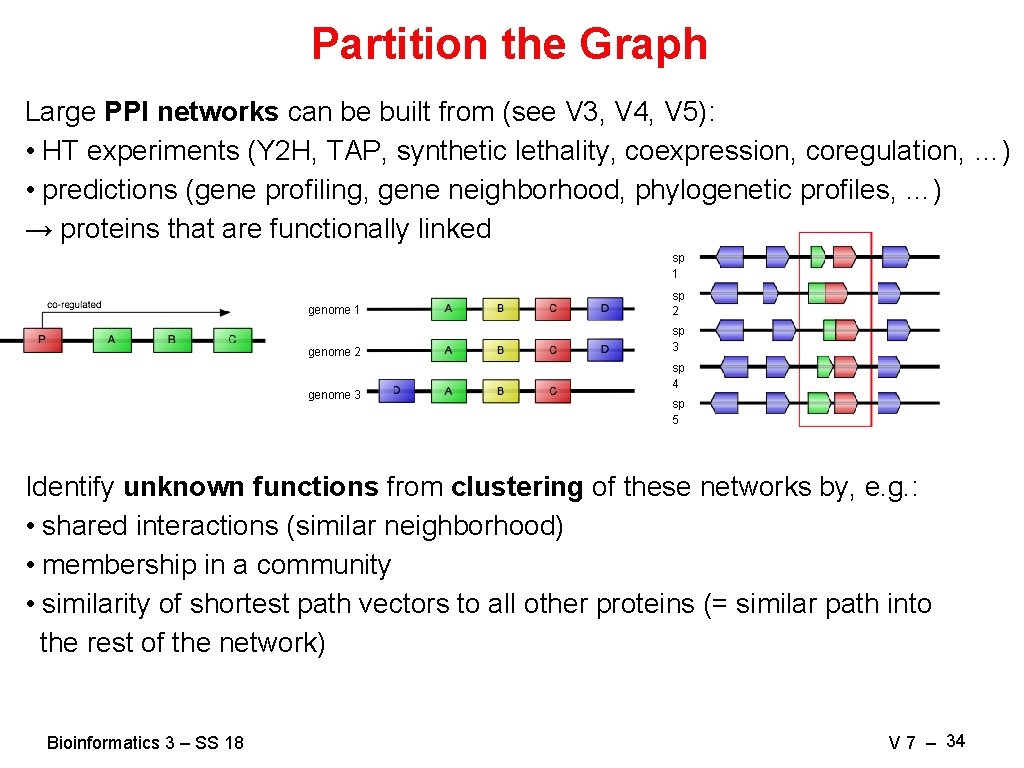
Partition the Graph Large PPI networks can be built from (see V 3, V 4, V 5): • HT experiments (Y 2 H, TAP, synthetic lethality, coexpression, coregulation, …) • predictions (gene profiling, gene neighborhood, phylogenetic profiles, …) → proteins that are functionally linked sp 1 genome 1 sp 2 genome 2 sp 3 genome 3 sp 4 sp 5 Identify unknown functions from clustering of these networks by, e. g. : • shared interactions (similar neighborhood) • membership in a community • similarity of shortest path vectors to all other proteins (= similar path into the rest of the network) Bioinformatics 3 – SS 18 V 7 – 34
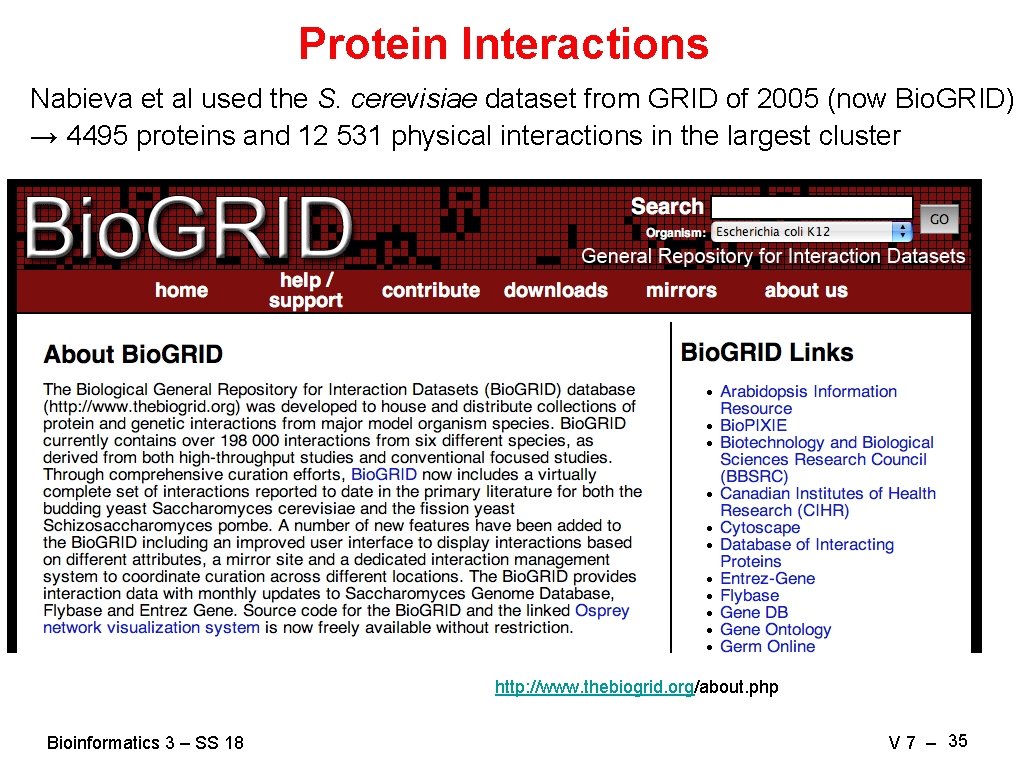
Protein Interactions Nabieva et al used the S. cerevisiae dataset from GRID of 2005 (now Bio. GRID) → 4495 proteins and 12 531 physical interactions in the largest cluster http: //www. thebiogrid. org/about. php Bioinformatics 3 – SS 18 V 7 – 35
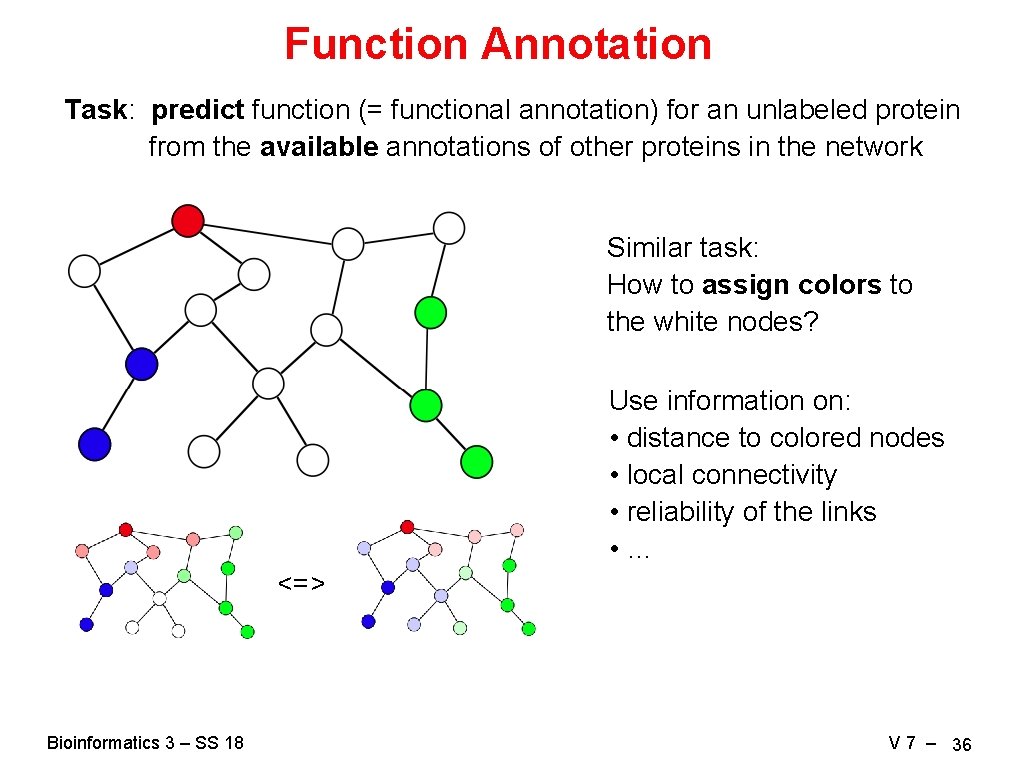
Function Annotation Task: predict function (= functional annotation) for an unlabeled protein from the available annotations of other proteins in the network Similar task: How to assign colors to the white nodes? Use information on: • distance to colored nodes • local connectivity • reliability of the links • … <=> Bioinformatics 3 – SS 18 V 7 – 36
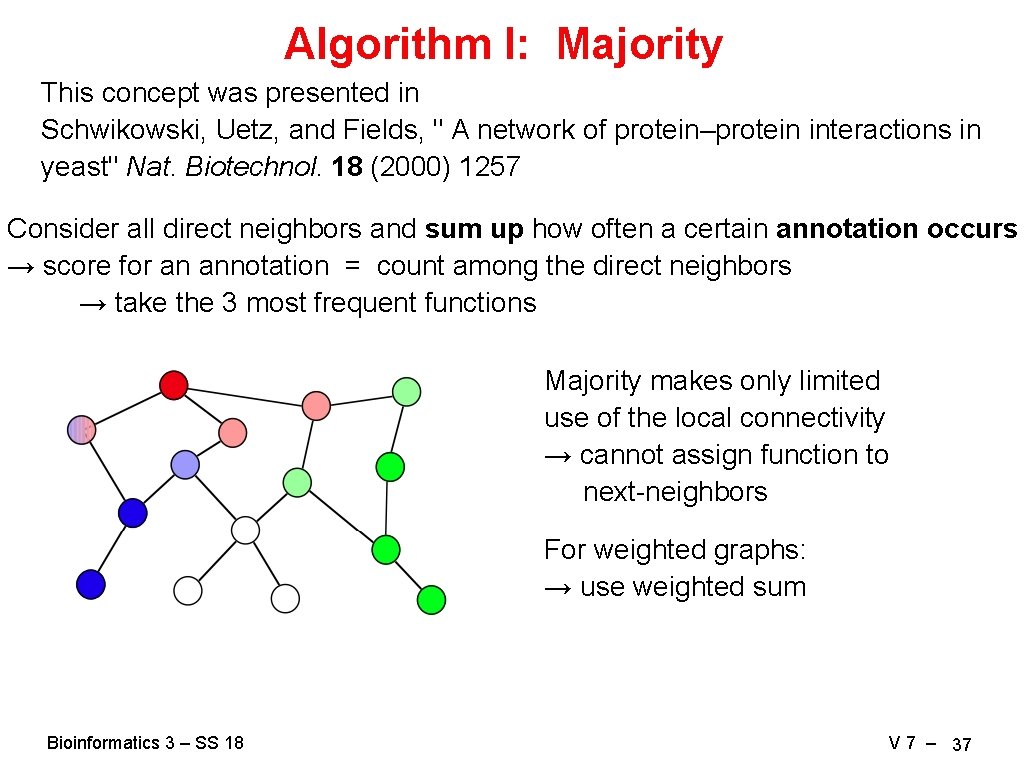
Algorithm I: Majority This concept was presented in Schwikowski, Uetz, and Fields, " A network of protein–protein interactions in yeast" Nat. Biotechnol. 18 (2000) 1257 Consider all direct neighbors and sum up how often a certain annotation occurs → score for an annotation = count among the direct neighbors → take the 3 most frequent functions Majority makes only limited use of the local connectivity → cannot assign function to next-neighbors For weighted graphs: → use weighted sum Bioinformatics 3 – SS 18 V 7 – 37
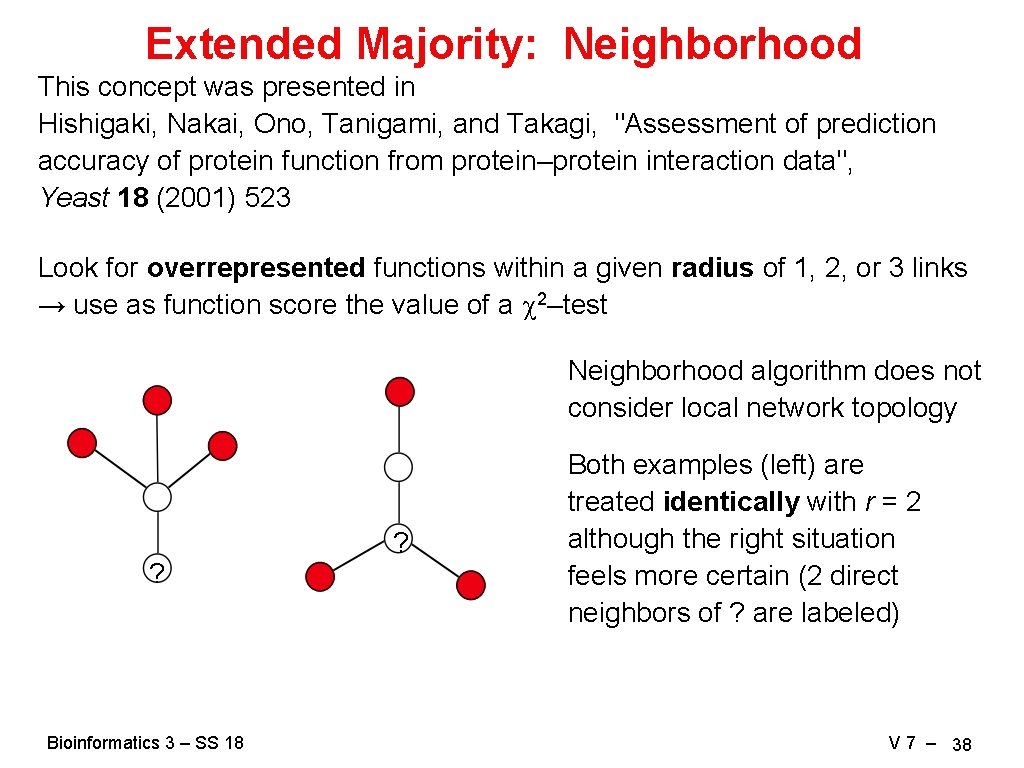
Extended Majority: Neighborhood This concept was presented in Hishigaki, Nakai, Ono, Tanigami, and Takagi, "Assessment of prediction accuracy of protein function from protein–protein interaction data", Yeast 18 (2001) 523 Look for overrepresented functions within a given radius of 1, 2, or 3 links → use as function score the value of a 2–test Neighborhood algorithm does not consider local network topology ? Bioinformatics 3 – SS 18 ? Both examples (left) are treated identically with r = 2 although the right situation feels more certain (2 direct neighbors of ? are labeled) V 7 – 38
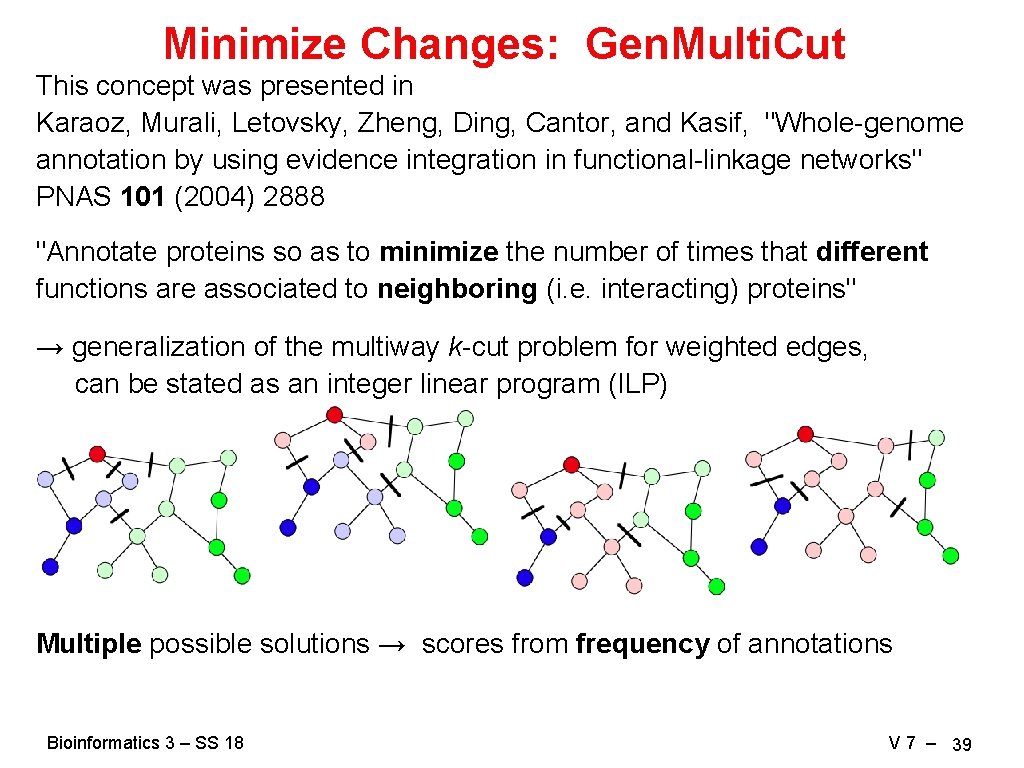
Minimize Changes: Gen. Multi. Cut This concept was presented in Karaoz, Murali, Letovsky, Zheng, Ding, Cantor, and Kasif, "Whole-genome annotation by using evidence integration in functional-linkage networks" PNAS 101 (2004) 2888 "Annotate proteins so as to minimize the number of times that different functions are associated to neighboring (i. e. interacting) proteins" → generalization of the multiway k-cut problem for weighted edges, can be stated as an integer linear program (ILP) Multiple possible solutions → scores from frequency of annotations Bioinformatics 3 – SS 18 V 7 – 39
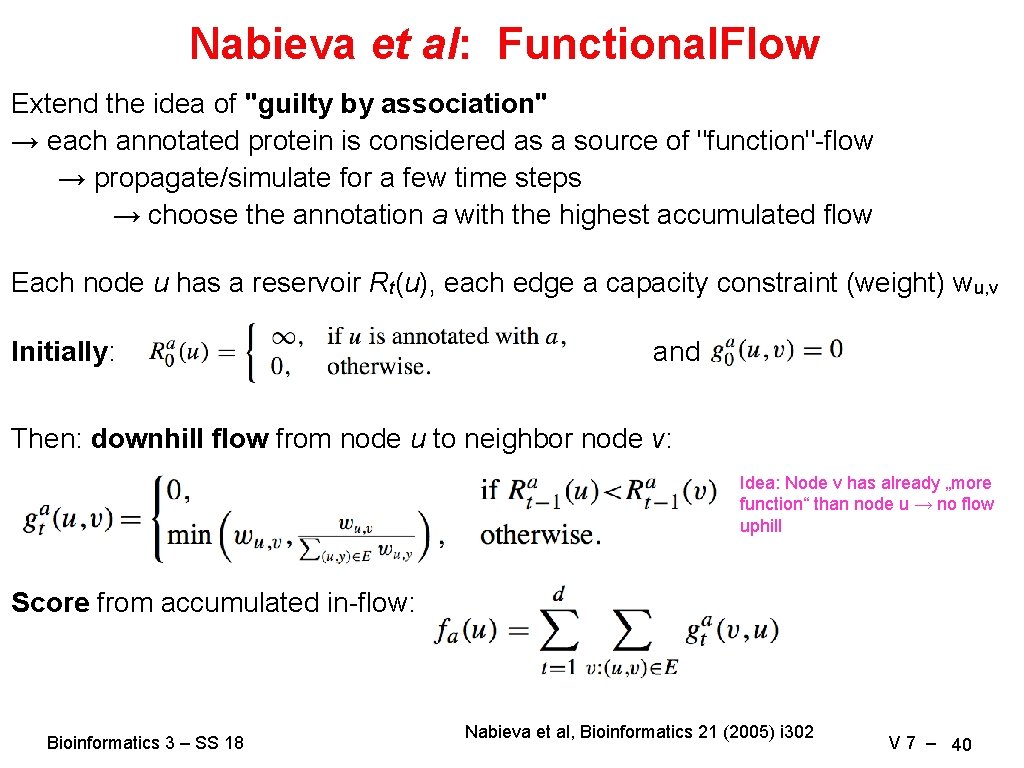
Nabieva et al: Functional. Flow Extend the idea of "guilty by association" → each annotated protein is considered as a source of "function"-flow → propagate/simulate for a few time steps → choose the annotation a with the highest accumulated flow Each node u has a reservoir Rt(u), each edge a capacity constraint (weight) wu, v Initially: and Then: downhill flow from node u to neighbor node v: Idea: Node v has already „more function“ than node u → no flow uphill Score from accumulated in-flow: Bioinformatics 3 – SS 18 Nabieva et al, Bioinformatics 21 (2005) i 302 V 7 – 40
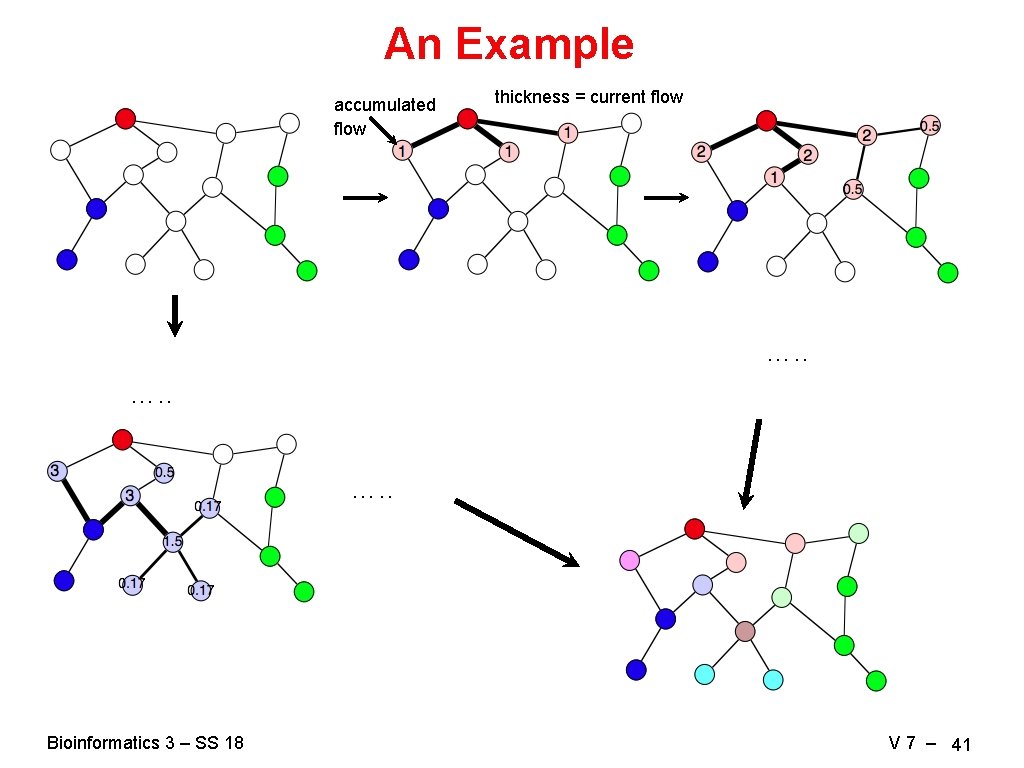
An Example accumulated flow thickness = current flow …. . Bioinformatics 3 – SS 18 V 7 – 41
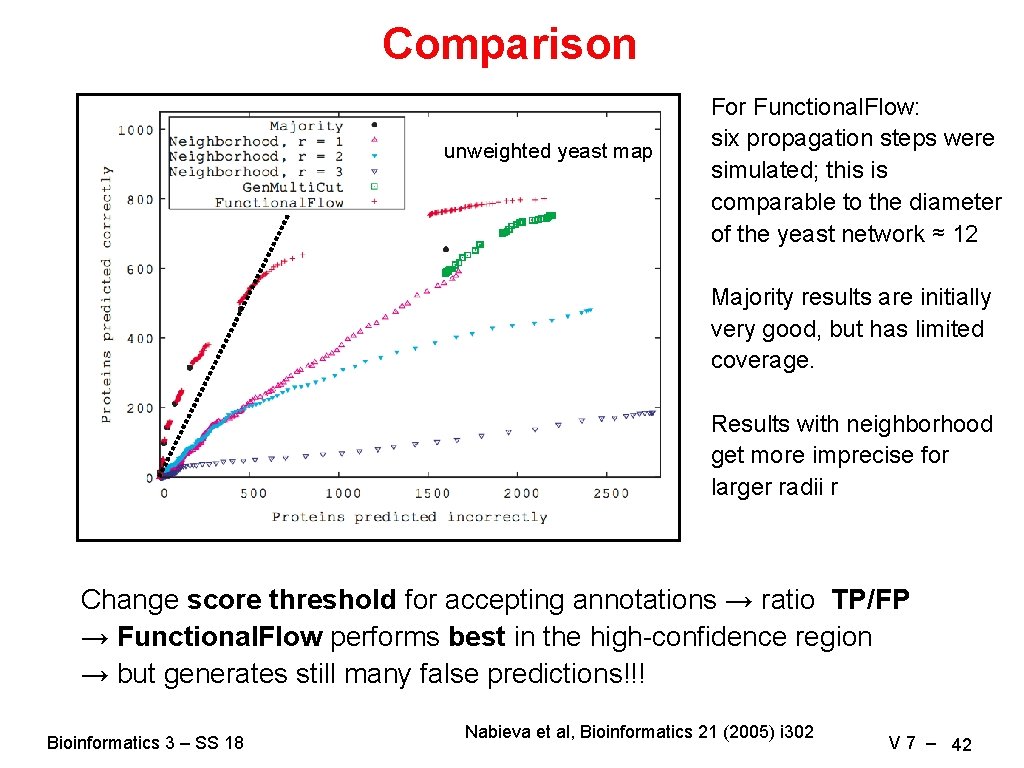
Comparison unweighted yeast map For Functional. Flow: six propagation steps were simulated; this is comparable to the diameter of the yeast network ≈ 12 Majority results are initially very good, but has limited coverage. Results with neighborhood get more imprecise for larger radii r Change score threshold for accepting annotations → ratio TP/FP → Functional. Flow performs best in the high-confidence region → but generates still many false predictions!!! Bioinformatics 3 – SS 18 Nabieva et al, Bioinformatics 21 (2005) i 302 V 7 – 42
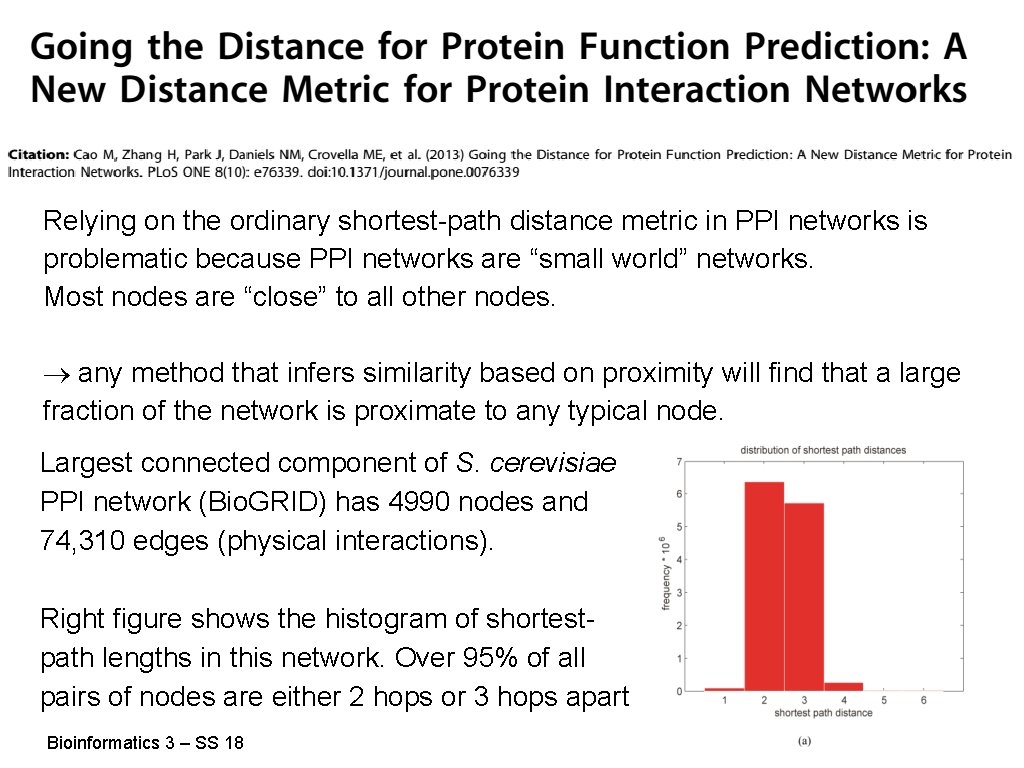
Relying on the ordinary shortest-path distance metric in PPI networks is problematic because PPI networks are “small world” networks. Most nodes are “close” to all other nodes. any method that infers similarity based on proximity will find that a large fraction of the network is proximate to any typical node. Largest connected component of S. cerevisiae PPI network (Bio. GRID) has 4990 nodes and 74, 310 edges (physical interactions). Right figure shows the histogram of shortestpath lengths in this network. Over 95% of all pairs of nodes are either 2 hops or 3 hops apart Bioinformatics 3 – SS 18 V 7 – 43
What nodes mediate short contacts? The 2 -hop neighborhood of a typical node probably includes around half of all nodes in the graph. One of the reasons that paths are typically short in biological networks like the PPI network is due to the presence of hubs. But hub proteins often represent proteins with different functional roles than their neighbors. Hub proteins likely also have multiple, distinct functions. not all short paths provide equally strong evidence of similar function in PPI networks. Bioinformatics 3 – SS 18 V 7 – 44
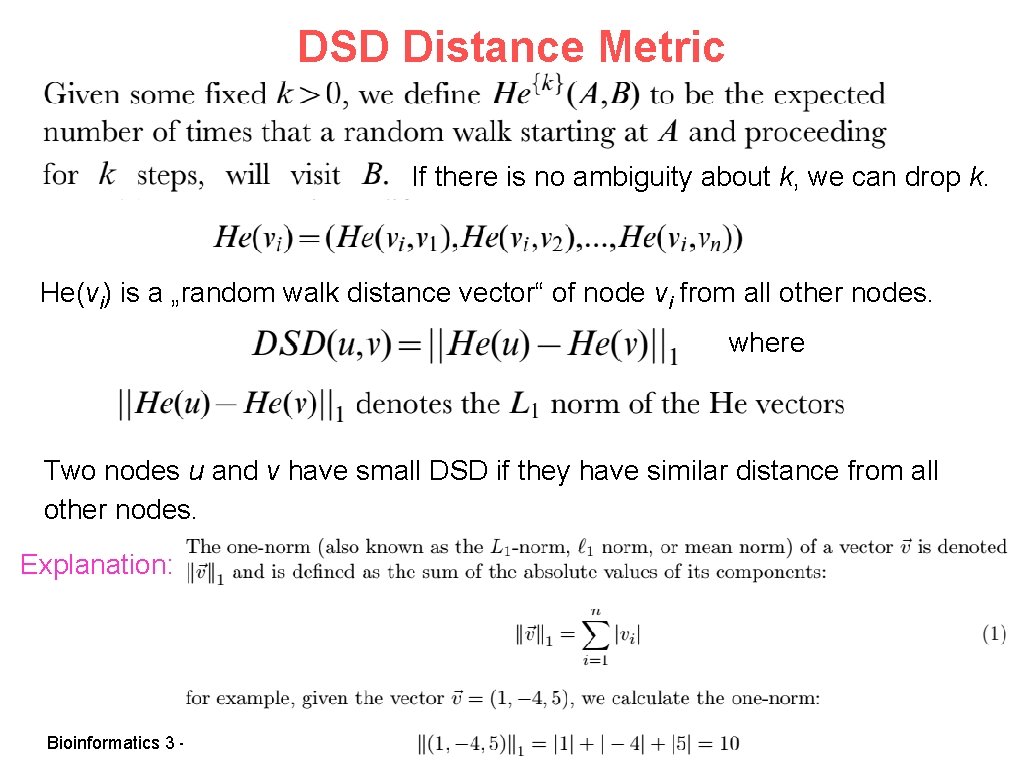
DSD Distance Metric If there is no ambiguity about k, we can drop k. He(vi) is a „random walk distance vector“ of node vi from all other nodes. where Two nodes u and v have small DSD if they have similar distance from all other nodes. Explanation: Bioinformatics 3 – SS 18 V 7 – 45
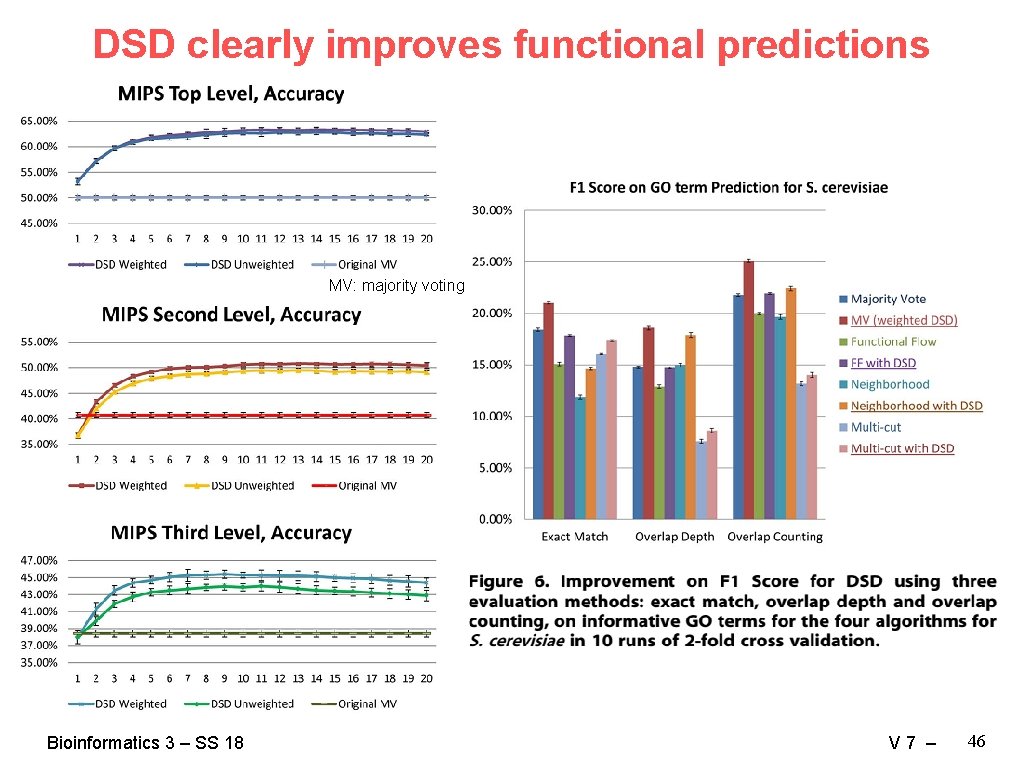
DSD clearly improves functional predictions MV: majority voting Bioinformatics 3 – SS 18 V 7 – 46
Summary V 8: wrap up protein interaction networks Then next block of the lecture: gene-regulatory networks Bioinformatics 3 – SS 18 V 7 – 47
- Slides: 47