
V 5 peak detection Detecting peaks in observed
V 5 – peak detection Detecting peaks in observed data is a common task in many fields. Program for today: - Principles of peak detection - Peak detection in biomedical 1 D-data - Ch. IP-seq data - MS data - Peak detection in biomedical 2 D-data - breathomics V 5 Processing of Biological Data 1
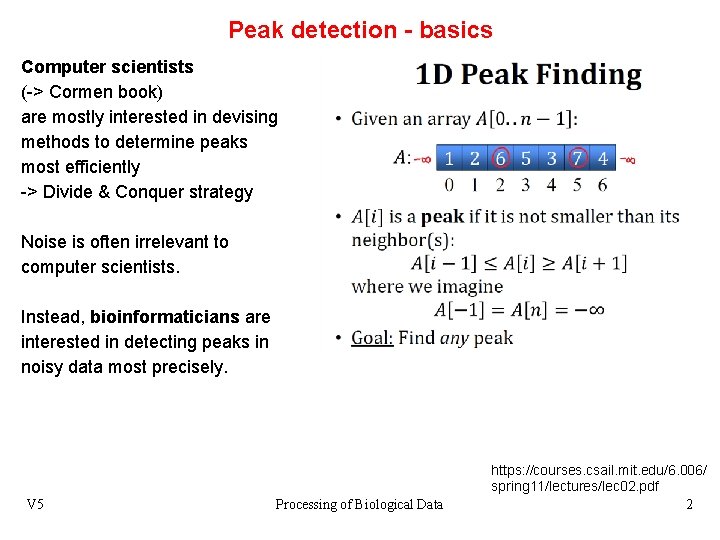
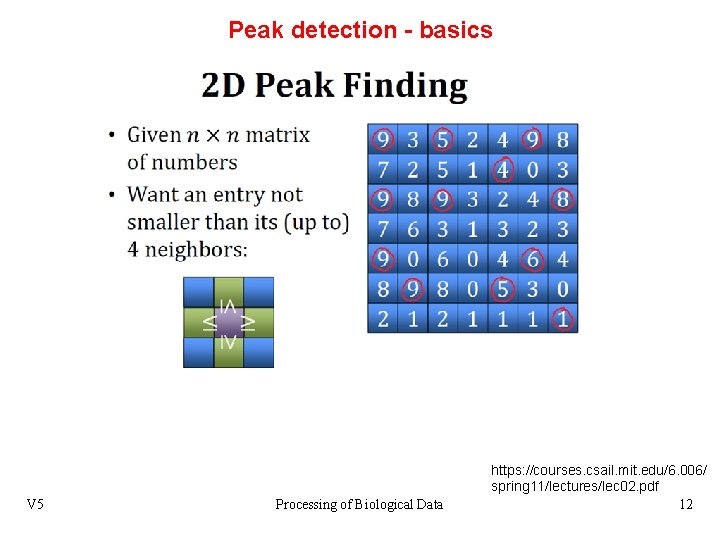
Peak detection - basics Computer scientists (-> Cormen book) are mostly interested in devising methods to determine peaks most efficiently -> Divide & Conquer strategy Noise is often irrelevant to computer scientists. Instead, bioinformaticians are interested in detecting peaks in noisy data most precisely. V 5 Processing of Biological Data https: //courses. csail. mit. edu/6. 006/ spring 11/lectures/lec 02. pdf 2
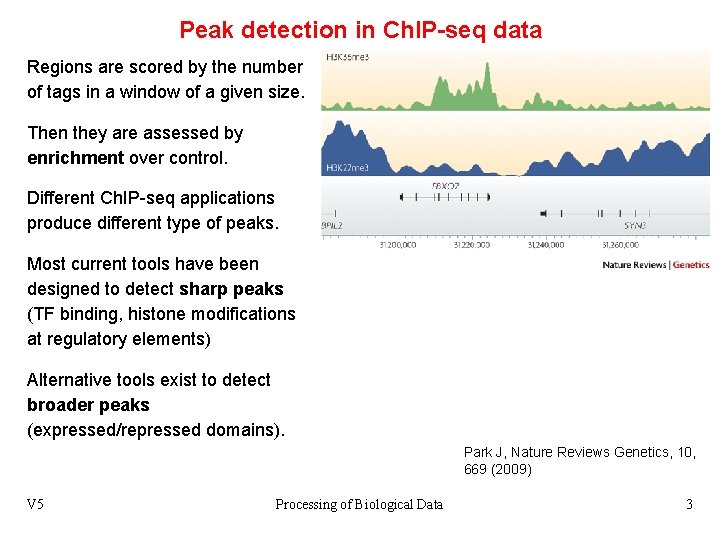
Peak detection in Ch. IP-seq data Regions are scored by the number of tags in a window of a given size. Then they are assessed by enrichment over control. Different Ch. IP-seq applications produce different type of peaks. Most current tools have been designed to detect sharp peaks (TF binding, histone modifications at regulatory elements) Alternative tools exist to detect broader peaks (expressed/repressed domains). Park J, Nature Reviews Genetics, 10, 669 (2009) V 5 Processing of Biological Data 3
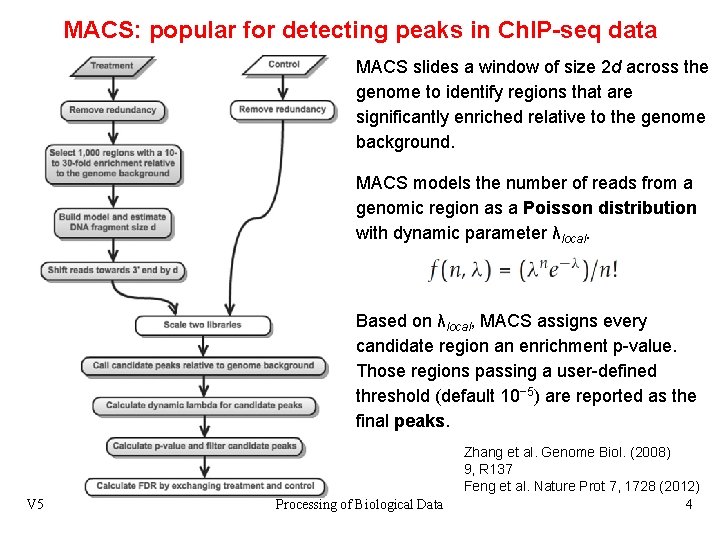
MACS: popular for detecting peaks in Ch. IP-seq data MACS slides a window of size 2 d across the genome to identify regions that are significantly enriched relative to the genome background. MACS models the number of reads from a genomic region as a Poisson distribution with dynamic parameter λlocal. Based on λlocal, MACS assigns every candidate region an enrichment p-value. Those regions passing a user-defined threshold (default 10− 5) are reported as the final peaks. V 5 Processing of Biological Data Zhang et al. Genome Biol. (2008) 9, R 137 Feng et al. Nature Prot 7, 1728 (2012) 4
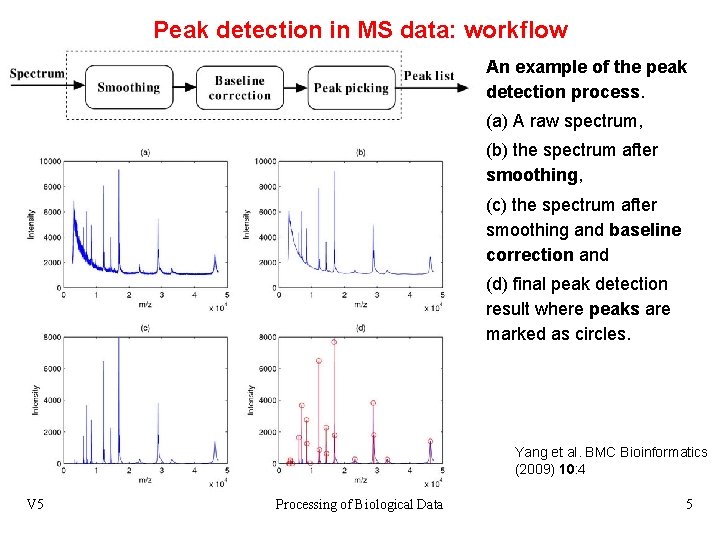
Peak detection in MS data: workflow An example of the peak detection process. (a) A raw spectrum, (b) the spectrum after smoothing, (c) the spectrum after smoothing and baseline correction and (d) final peak detection result where peaks are marked as circles. Yang et al. BMC Bioinformatics (2009) 10: 4 V 5 Processing of Biological Data 5
Peak detection in MS data Yang et al. BMC Bioinformatics (2009) 10: 4 V 5 Processing of Biological Data 6

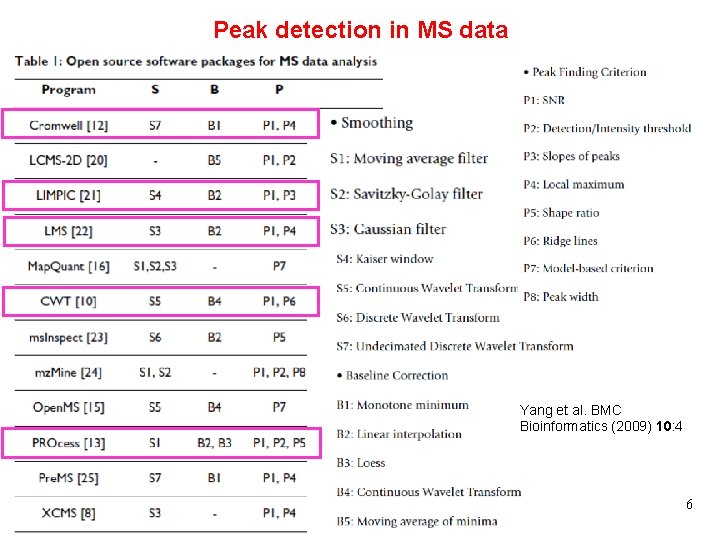
Peak detection in MS data: smoothing Aim: remove high-frequency (likely umimportant) variations from the data Approach: replace current value x(n) by an average taken over its neighbor points. Moving average filter 2 k +1 is the filter width Gaussian filter Yang et al. BMC Bioinformatics (2009) 10: 4 V 5 Processing of Biological Data 7

Peak detection in MS data: continuous wavelet transform CWT (t) is a wavelet function, e. g. a Mexican-hat wavelet (an inverted parabola, that is squeezed (in the middle) and flattened (at the sides) by multiplication with an exponential function) Yang et al. BMC Bioinformatics (2009) 10: 4 V 5 Processing of Biological Data 8
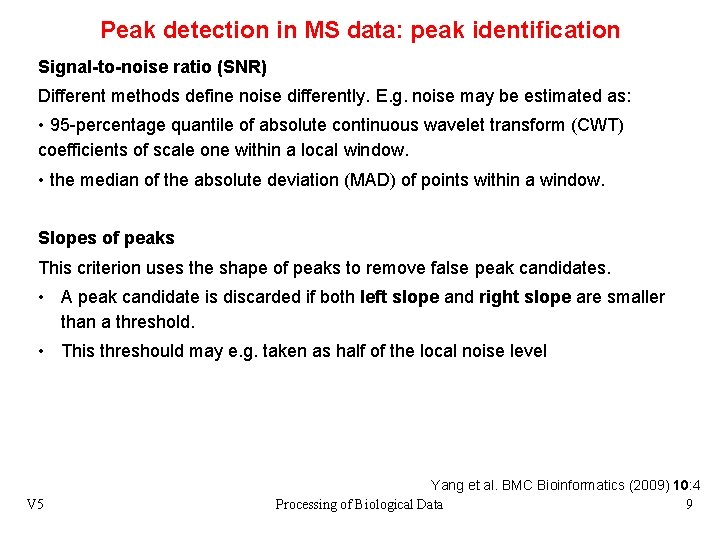
Peak detection in MS data: peak identification Signal-to-noise ratio (SNR) Different methods define noise differently. E. g. noise may be estimated as: • 95 -percentage quantile of absolute continuous wavelet transform (CWT) coefficients of scale one within a local window. • the median of the absolute deviation (MAD) of points within a window. Slopes of peaks This criterion uses the shape of peaks to remove false peak candidates. • A peak candidate is discarded if both left slope and right slope are smaller than a threshold. • This threshould may e. g. taken as half of the local noise level V 5 Yang et al. BMC Bioinformatics (2009) 10: 4 Processing of Biological Data 9
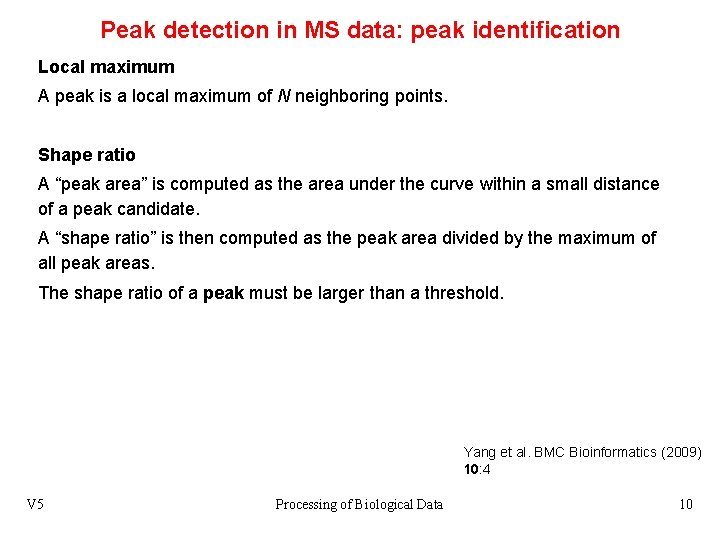
Peak detection in MS data: peak identification Local maximum A peak is a local maximum of N neighboring points. Shape ratio A “peak area” is computed as the area under the curve within a small distance of a peak candidate. A “shape ratio” is then computed as the peak area divided by the maximum of all peak areas. The shape ratio of a peak must be larger than a threshold. Yang et al. BMC Bioinformatics (2009) 10: 4 V 5 Processing of Biological Data 10
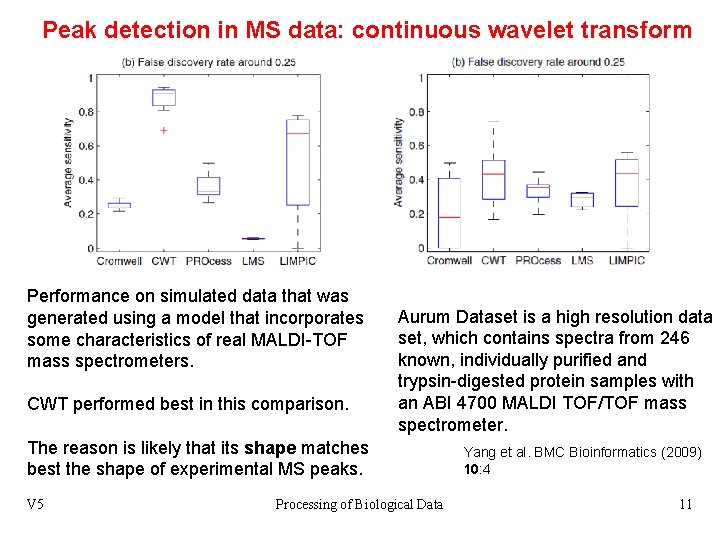
Peak detection in MS data: continuous wavelet transform Performance on simulated data that was generated using a model that incorporates some characteristics of real MALDI-TOF mass spectrometers. CWT performed best in this comparison. Aurum Dataset is a high resolution data set, which contains spectra from 246 known, individually purified and trypsin-digested protein samples with an ABI 4700 MALDI TOF/TOF mass spectrometer. The reason is likely that its shape matches best the shape of experimental MS peaks. V 5 Processing of Biological Data Yang et al. BMC Bioinformatics (2009) 10: 4 11
Peak detection - basics V 5 Processing of Biological Data https: //courses. csail. mit. edu/6. 006/ spring 11/lectures/lec 02. pdf 12
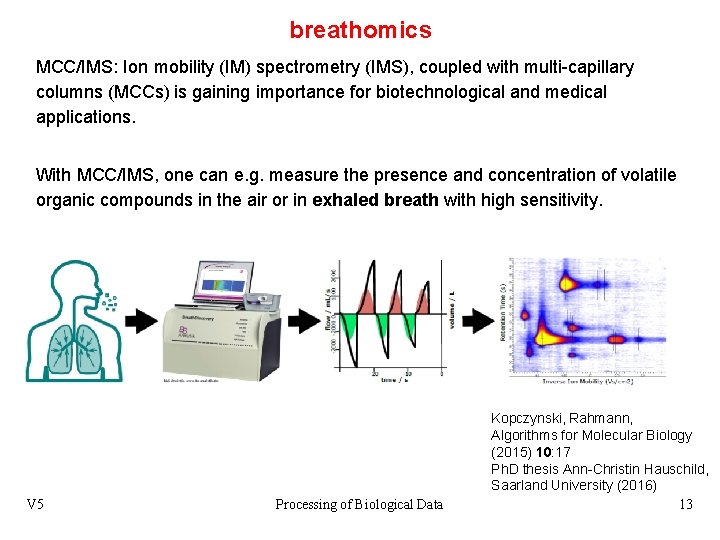
breathomics MCC/IMS: Ion mobility (IM) spectrometry (IMS), coupled with multi-capillary columns (MCCs) is gaining importance for biotechnological and medical applications. With MCC/IMS, one can e. g. measure the presence and concentration of volatile organic compounds in the air or in exhaled breath with high sensitivity. V 5 Processing of Biological Data Kopczynski, Rahmann, Algorithms for Molecular Biology (2015) 10: 17 Ph. D thesis Ann-Christin Hauschild, Saarland University (2016) 13
MCC/IMS experiments: output In an MCC/IMS experiment, a mixture of several unknown volatile organic compounds is separated in two dimensions: (1) by retention time r in the capillary column (the time required for a particular compound to pass through the column). The retention time is proportional to the substance's affinity for the stationary phase. (2) by drift time d through the ion mobility spectrometer. Instead of the drift time itself, one uses a quantity normalized for pressure and temperature called the inverse reduced mobility (IRM) t. This allows comparing spectra taken under different or changing conditions. V 5 Processing of Biological Data Kopczynski, Rahmann, Algorithms for Molecular Biology (2015) 10: 17 14
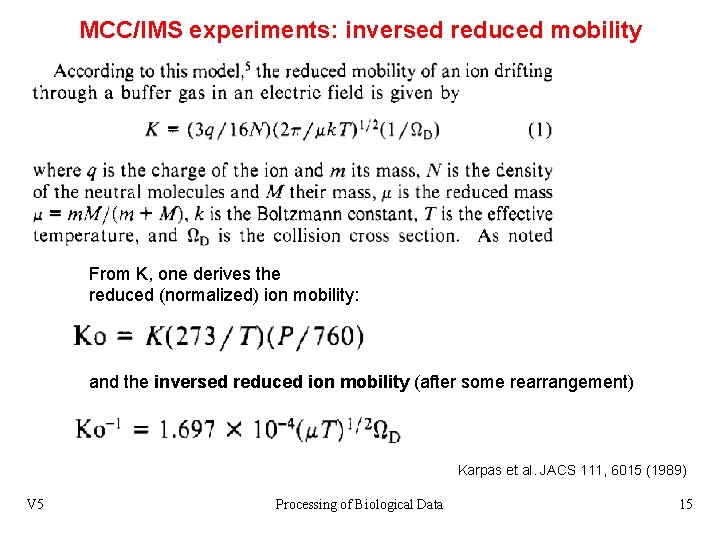
MCC/IMS experiments: inversed reduced mobility From K, one derives the reduced (normalized) ion mobility: and the inversed reduced ion mobility (after some rearrangement) Karpas et al. JACS 111, 6015 (1989) V 5 Processing of Biological Data 15
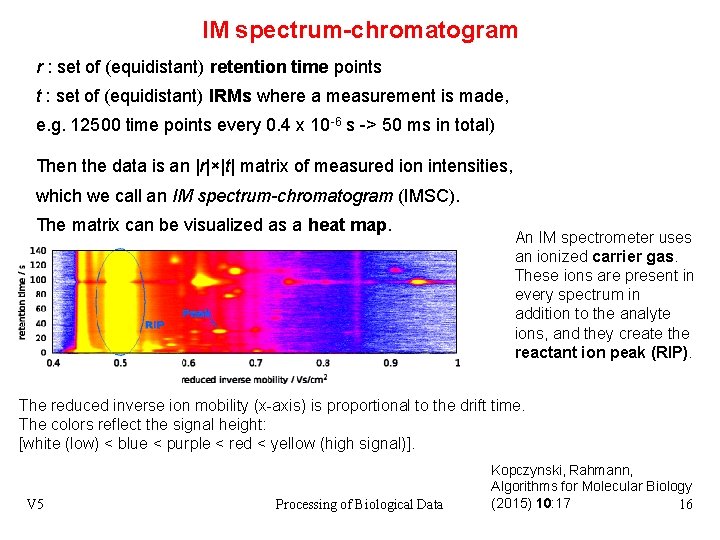
IM spectrum-chromatogram r : set of (equidistant) retention time points t : set of (equidistant) IRMs where a measurement is made, e. g. 12500 time points every 0. 4 x 10 -6 s -> 50 ms in total) Then the data is an |r|×|t| matrix of measured ion intensities, which we call an IM spectrum-chromatogram (IMSC). The matrix can be visualized as a heat map. An IM spectrometer uses an ionized carrier gas. These ions are present in every spectrum in addition to the analyte ions, and they create the reactant ion peak (RIP). The reduced inverse ion mobility (x-axis) is proportional to the drift time. The colors reflect the signal height: [white (low) < blue < purple < red < yellow (high signal)]. V 5 Processing of Biological Data Kopczynski, Rahmann, Algorithms for Molecular Biology (2015) 10: 17 16
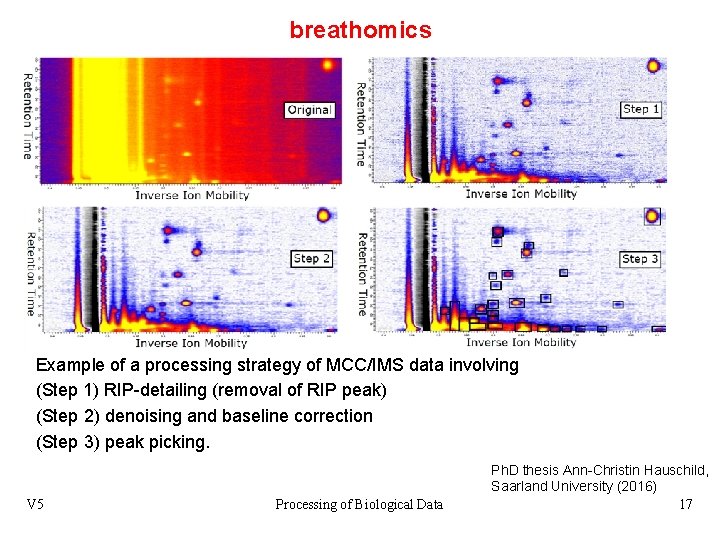
breathomics Example of a processing strategy of MCC/IMS data involving (Step 1) RIP-detailing (removal of RIP peak) (Step 2) denoising and baseline correction (Step 3) peak picking. V 5 Processing of Biological Data Ph. D thesis Ann-Christin Hauschild, Saarland University (2016) 17
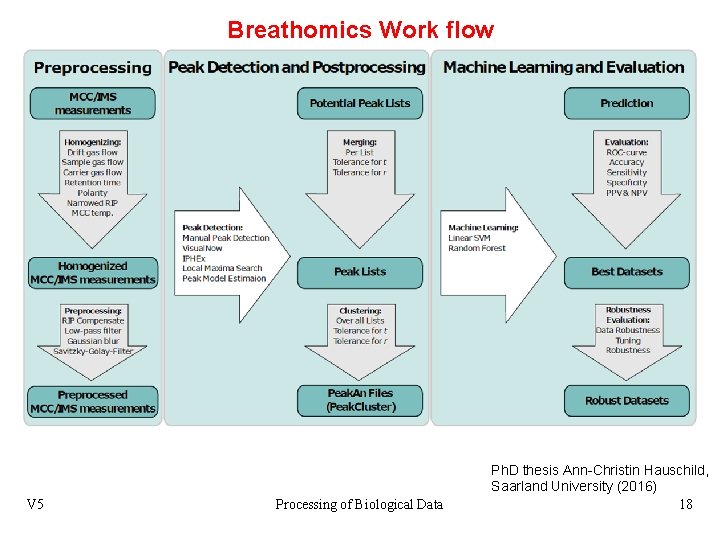
Breathomics Work flow V 5 Processing of Biological Data Ph. D thesis Ann-Christin Hauschild, Saarland University (2016) 18
Manual Peak detection The easiest and most intuitive way of peak detection is manual evaluation of a visualization of the measurement. The human eye and visual cortex is optimized for pattern recognition in 3 D. Therefore one can immediately spot most of the peaks in the measurement. There are several drawbacks of the manual approach: - it is time consuming and therefore inappropriate in a high-throughput context, - the results depend on a subjective assessment, and are therefore hardly reproducible. Nevertheless, manual evaluation is still the state of the art for the evaluation of smaller MCC/IMS data sets. Manually created peak lists áre used as “gold standard" in MCC/IMS studies. V 5 Processing of Biological Data Ph. D thesis Ann-Christin Hauschild, Saarland University (2016) 19

Local maxima search According to this criterion, a point is a local maximum if all 8 neighbors in the matrix have a lower intensity than the intensity at the central point. We call the neighborhood of a point “significant" if - its own intensity, - the intensity of its 8 neighbors, and - that of A additional adjacent points (e. g. A = 2), lie above a given intensity threshold I. V 5 Processing of Biological Data Ph. D thesis Ann-Christin Hauschild, Saarland University (2016) 20
Merged peak cluster localization (MPCL) The MPCL consists of two phases: (1) clustering and (2) merging. (1) each data point in the chromatogram is assigned to one of 2 classes, either peak or non-peak. For this, one uses a clustering method that is based e. g. on the Euclidean distance metric of the intensity values. (2) neighboring data points that belong to the peak-label and therefore to the same peak are merged together. (3) each peak of the analyzed measurement is characterized by the centroid point, i. e. that data point, which has the smallest mean distance to all other points in the peak region V 5 Processing of Biological Data Ph. D thesis Ann-Christin Hauschild, Saarland University (2016) 21
Watershed algorithm Here, the IMS chromatogram is treated like a landscape including hills and valleys. The algorithm starts with a water level above the highest intensity followed by a continuous lowering of the level while uncovering more and more of the local maxima. In each step, the new uncovered data points are annotated by the label of adjacent labeled neighbors. Those data points that remain unlabeled are identified as a new peak and receive a new label. The highest data point among a set of new labeled positions denotes the peak coordinate. The algorithm stops if all data points are labeled or the level drops below a denoted threshold. V 5 Processing of Biological Data Ph. D thesis Ann-Christin Hauschild, Saarland University (2016) 22
Watershed algorithm: implementation The watershed algorithm can be implemented as a priority queue to sort all data points. (1) The largest data point is extracted and labeled first. (2 - n) This is followed by the next largest point in the queue and so on. - Each point drawn out of the queue is compared with its neighbors. - If the neighbors are of equal or larger value, the extracted point is given the same label as its largest neighbor. - In contrast, if the data point is larger than its neighbors (i. e. the neighbors have not been labelled sofar), the data point is given a new label to indicate that it is part of another peak. (n + 1) This procedure is repeated until the queue is empty. V 5 Processing of Biological Data Latha et al. Journal of Chromatography A, 1218 (2011) 6792– 6798 23
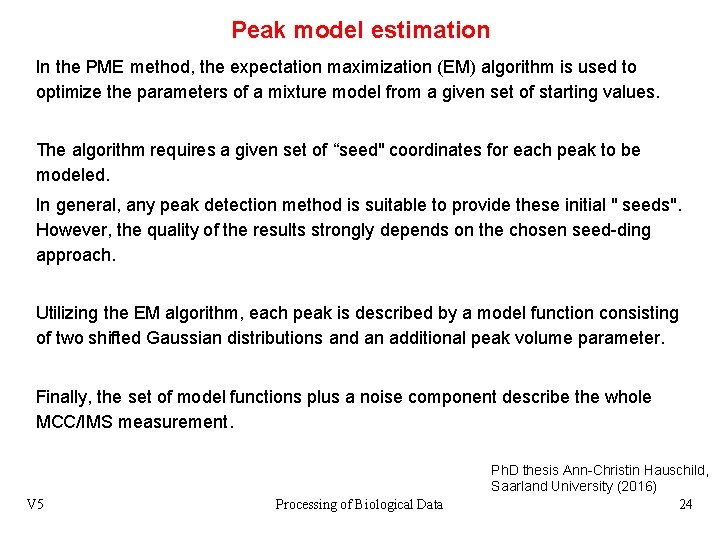
Peak model estimation In the PME method, the expectation maximization (EM) algorithm is used to optimize the parameters of a mixture model from a given set of starting values. The algorithm requires a given set of “seed" coordinates for each peak to be modeled. In general, any peak detection method is suitable to provide these initial " seeds". However, the quality of the results strongly depends on the chosen seed-ding approach. Utilizing the EM algorithm, each peak is described by a model function consisting of two shifted Gaussian distributions and an additional peak volume parameter. Finally, the set of model functions plus a noise component describe the whole MCC/IMS measurement. V 5 Processing of Biological Data Ph. D thesis Ann-Christin Hauschild, Saarland University (2016) 24
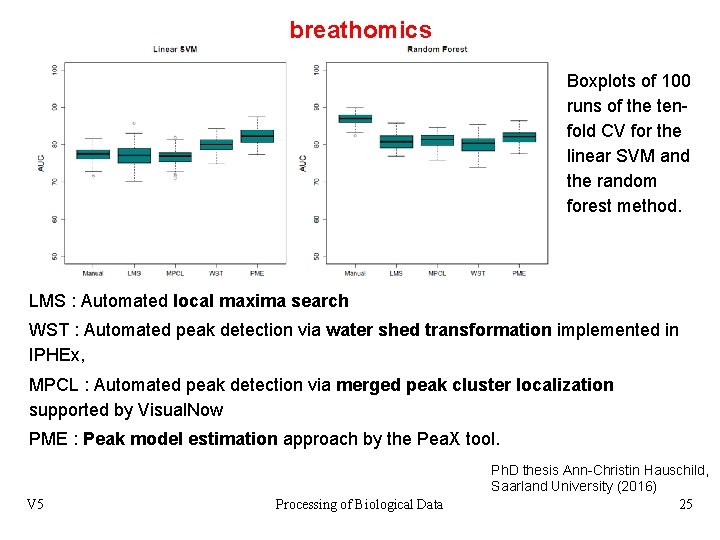
breathomics Boxplots of 100 runs of the tenfold CV for the linear SVM and the random forest method. LMS : Automated local maxima search WST : Automated peak detection via water shed transformation implemented in IPHEx, MPCL : Automated peak detection via merged peak cluster localization supported by Visual. Now PME : Peak model estimation approach by the Pea. X tool. V 5 Processing of Biological Data Ph. D thesis Ann-Christin Hauschild, Saarland University (2016) 25
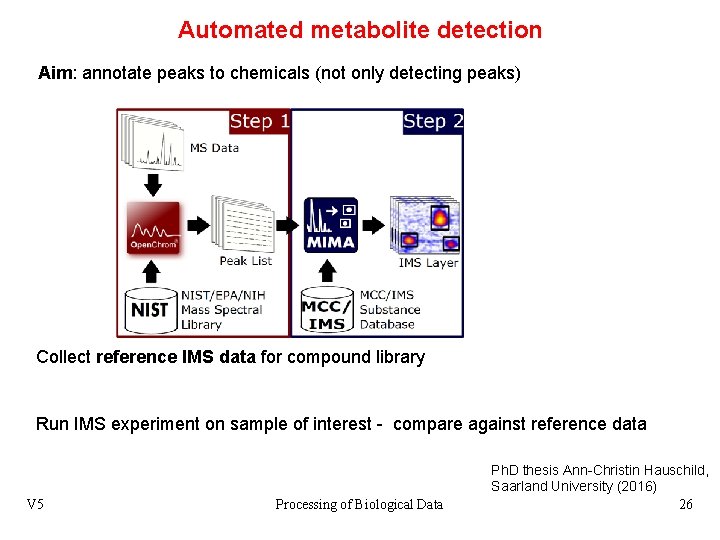
Automated metabolite detection Aim: annotate peaks to chemicals (not only detecting peaks) Collect reference IMS data for compound library Run IMS experiment on sample of interest - compare against reference data V 5 Processing of Biological Data Ph. D thesis Ann-Christin Hauschild, Saarland University (2016) 26
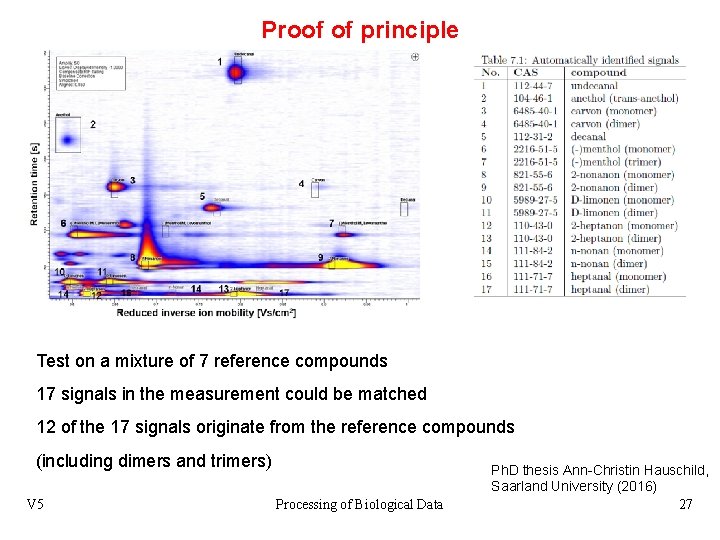
Proof of principle Test on a mixture of 7 reference compounds 17 signals in the measurement could be matched 12 of the 17 signals originate from the reference compounds (including dimers and trimers) V 5 Processing of Biological Data Ph. D thesis Ann-Christin Hauschild, Saarland University (2016) 27

Application: can one detect COPD in exhaled breath? Chronic obstructive pulmonary disease (COPD) is an umbrella term used to describe chronic lung diseases that cause a permanent blockage of airflow from the lungs, which is not fully reversible (WHO). The most prominent symptoms are - breathlessness, - a chronic cough, and - excessive sputum production. Airways and lungs react to noxious particles or gases, like smoke from cigarettes or fuel, with an increased inflammatory response. The World Health Organization (WHO) reported COPD as one of the four most frequent causes of death. V 5 Processing of Biological Data Ph. D thesis Ann-Christin Hauschild, Saarland University (2016) 28
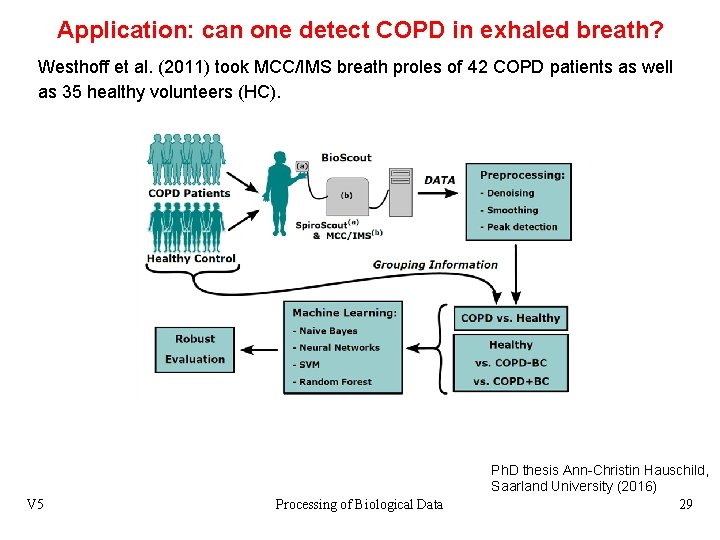
Application: can one detect COPD in exhaled breath? Westhoff et al. (2011) took MCC/IMS breath proles of 42 COPD patients as well as 35 healthy volunteers (HC). V 5 Processing of Biological Data Ph. D thesis Ann-Christin Hauschild, Saarland University (2016) 29
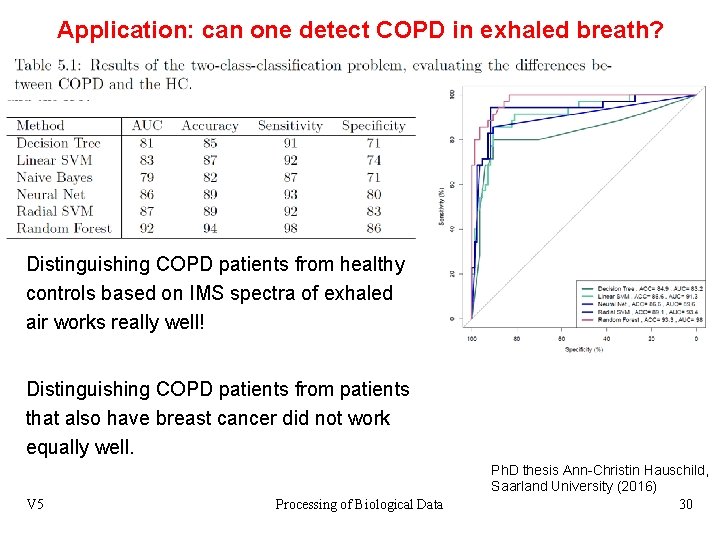
Application: can one detect COPD in exhaled breath? Distinguishing COPD patients from healthy controls based on IMS spectra of exhaled air works really well! Distinguishing COPD patients from patients that also have breast cancer did not work equally well. V 5 Processing of Biological Data Ph. D thesis Ann-Christin Hauschild, Saarland University (2016) 30
- Slides: 30