
V 4 Select and Implement a Human Resource
- Slides: 19
V 4 Select and Implement a Human Resource Information System Tailor your HRIS selection based on your needs rather than industry trends. Info-Tech Research Group, Inc. is a global leader in providing IT research and advice. Info-Tech’s products and services combine actionable insight and relevant advice with ready-to-use tools and templates that cover the full spectrum of IT concerns. © 1997 -2016 Info-Tech Research Group Inc. Info-Tech Research Group 1
ANALYST PERSPECTIVE Understand the market, but don’t forget your organizational needs and culture. Selecting an HR Information System (HRIS) can be an overwhelming process. There are dozens of full-service vendors, but organizations are expected to pick one system that will likely be with them for years. The scariest part is the uncertainty associated with the choice, with the process, and with the implementation, but it does not have to be that way. There are predictable elements that can not only be well planned, but also brilliantly executed. Given the modular nature of HRIS applications today, making the right selection cascade future benefits relating to scalability and growth. Guidance during the selection and implementation process can prevent organizations from committing costly and irreversible mistakes that can threaten the effectiveness of one of the most critical parts of the organization – its people. Ilia Maor, MBA Senior Manager, Enterprise Applications Practice Info-Tech Research Group 2
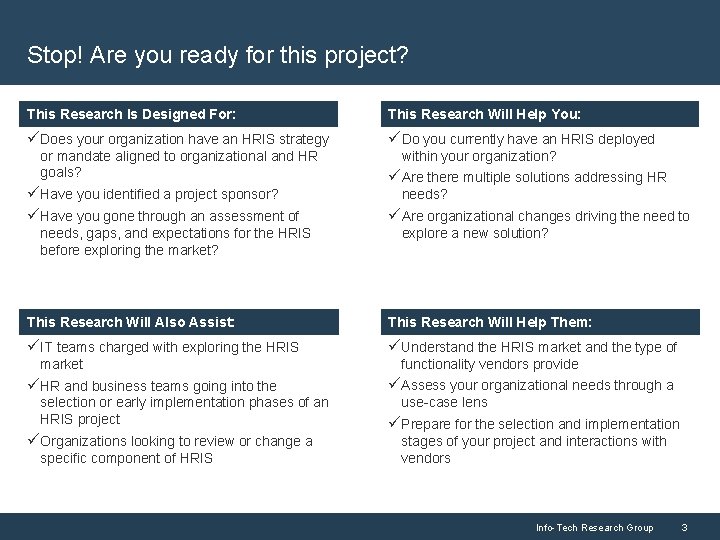
Stop! Are you ready for this project? This Research is Is Designed For: This Research Will Help You: üDoes your organization have an HRIS strategy üDo you currently have an HRIS deployed or mandate aligned to organizational and HR goals? üHave you identified a project sponsor? üHave you gone through an assessment of needs, gaps, and expectations for the HRIS before exploring the market? within your organization? üAre there multiple solutions addressing HR needs? üAre organizational changes driving the need to explore a new solution? This Research Will Also Assist: This Research Will Help You: Them: üIT teams charged with exploring the HRIS üUnderstand the HRIS market and the type of market üHR and business teams going into the selection or early implementation phases of an HRIS project üOrganizations looking to review or change a specific component of HRIS functionality vendors provide üAssess your organizational needs through a use-case lens üPrepare for the selection and implementation stages of your project and interactions with vendors Info-Tech Research Group 3
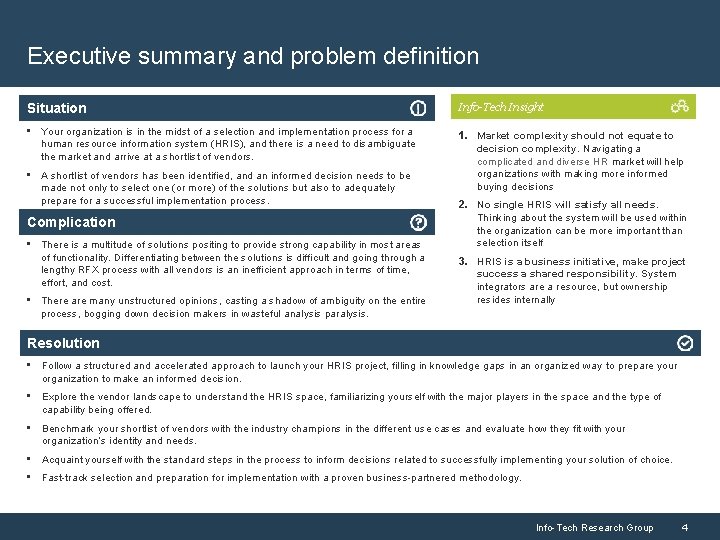
Executive summary and problem definition Situation Info-Tech Insight • Your organization is in the midst of a selection and implementation process for a human resource information system (HRIS), and there is a need to disambiguate the market and arrive at a shortlist of vendors. 1. Market complexity should not equate to decision complexity. Navigating a complicated and diverse HR market will help organizations with making more informed buying decisions • A shortlist of vendors has been identified, and an informed decision needs to be made not only to select one (or more) of the solutions but also to adequately prepare for a successful implementation process. Complication • There is a multitude of solutions positing to provide strong capability in most areas of functionality. Differentiating between the solutions is difficult and going through a lengthy RFX process with all vendors is an inefficient approach in terms of time, effort, and cost. • There are many unstructured opinions, casting a shadow of ambiguity on the entire process, bogging down decision makers in wasteful analysis paralysis. 2. No single HRIS will satisfy all needs. Thinking about the system will be used within the organization can be more important than selection itself 3. HRIS is a business initiative, make project success a shared responsibility. System integrators are a resource, but ownership resides internally Resolution • Follow a structured and accelerated approach to launch your HRIS project, filling in knowledge gaps in an organized way to prepare your organization to make an informed decision. • Explore the vendor landscape to understand the HRIS space, familiarizing yourself with the major players in the space and the type of capability being offered. • Benchmark your shortlist of vendors with the industry champions in the different use cases and evaluate how they fit with your organization’s identity and needs. • Acquaint yourself with the standard steps in the process to inform decisions related to successfully implementing your solution of choice. • Fast-track selection and preparation for implementation with a proven business-partnered methodology. Info-Tech Research Group 4
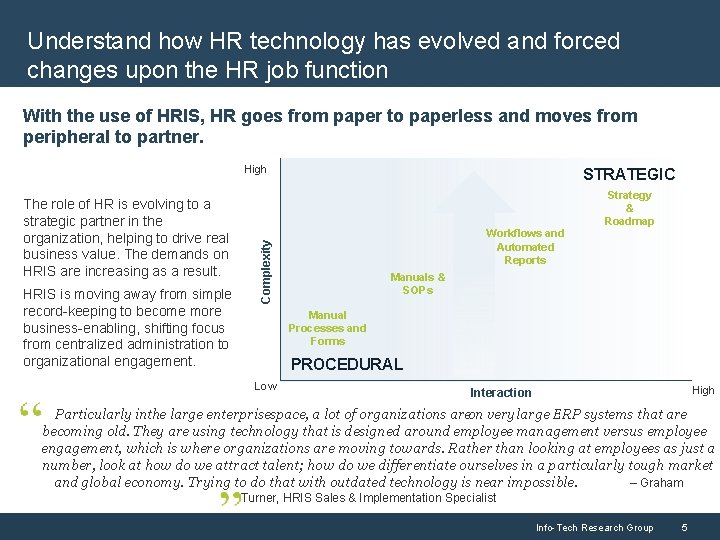
Understand how HR technology has evolved and forced changes upon the HR job function With the use of HRIS, HR goes from paper to paperless and moves from peripheral to partner. High HRIS is moving away from simple record-keeping to become more business-enabling, shifting focus from centralized administration to organizational engagement. Workflows and Automated Reports Complexity The role of HR is evolving to a strategic partner in the organization, helping to drive real business value. The demands on HRIS are increasing as a result. STRATEGIC Strategy & Roadmap Manuals & SOPs Manual Processes and Forms PROCEDURAL Low High Interaction Particularly inthe large enterprisespace, a lot of organizations areon very large ERP systems that are becoming old. They are using technology that is designed around employee management versus employee engagement, which is where organizations are moving towards. Rather than looking at employees as just a number, look at how do we attract talent; how do we differentiate ourselves in a particularly tough market and global economy. Trying to do that with outdated technology is near impossible. – Graham Turner, HRIS Sales & Implementation Specialist Info-Tech Research Group 5
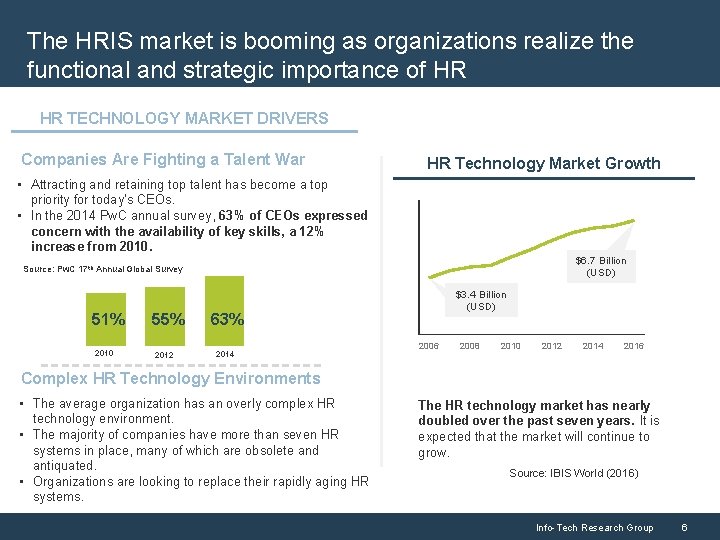
The HRIS market is booming as organizations realize the functional and strategic importance of HR HR TECHNOLOGY MARKET DRIVERS Companies Are Fighting a Talent War • Attracting and retaining top talent has become a top priority for today’s CEOs. • In the 2014 Pw. C annual survey, 63% of CEOs expressed concern with the availability of key skills, a 12% increase from 2010. HR Technology Market Growth 8000 7000 6000 5000 $6. 7 Billion (USD) 4000 Source: Pw. C 17 th Annual Global Survey 3000 $3. 4 Billion (USD) 2000 51% 55% 63% 1000 0 2012 2014 2006 2008 2010 2012 2014 2016 Complex HR Technology Environments • The average organization has an overly complex HR technology environment. • The majority of companies have more than seven HR systems in place, many of which are obsolete and antiquated. • Organizations are looking to replace their rapidly aging HR systems. The HR technology market has nearly doubled over the past seven years. It is expected that the market will continue to grow. Source: IBIS World (2016) Info-Tech Research Group 6
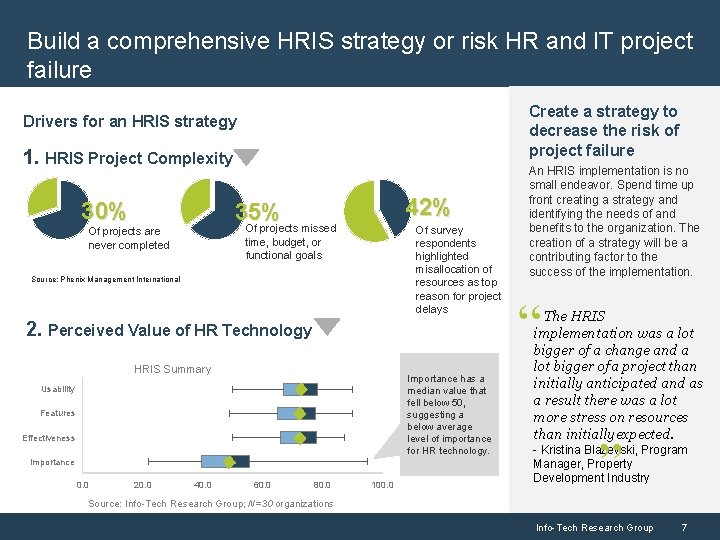
Build a comprehensive HRIS strategy or risk HR and IT project failure Create a strategy to decrease the risk of project failure Drivers for an HRIS strategy 1. HRIS Project Complexity 30% 42% 35% Of projects missed Of projects are never completed Of survey respondents highlighted misallocation of resources as top reason for project delays time, budget, or functional goals Source: Phenix Management International 2. Perceived Value of HR Technology HRIS Summary Importance has a median value that fell below 50, suggesting a below average level of importance for HR technology. Usability Features Effectiveness Importance 0. 0 20. 0 40. 0 60. 0 80. 0 100. 0 An HRIS implementation is no small endeavor. Spend time up front creating a strategy and identifying the needs of and benefits to the organization. The creation of a strategy will be a contributing factor to the success of the implementation. The HRIS implementation was a lot bigger of a change and a lot bigger of a project than initially anticipated and as a result there was a lot more stress on resources than initially expected. - Kristina Blazevski, Program Manager, Property Development Industry Source: Info-Tech Research Group; N=30 organizations Info-Tech Research Group 7
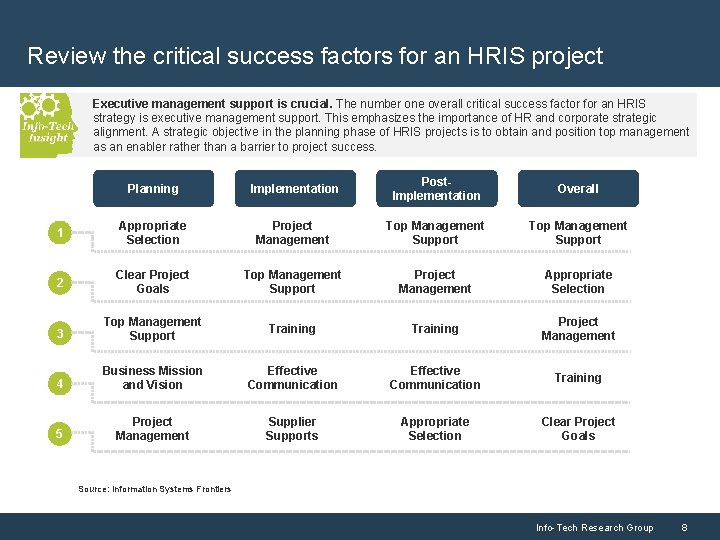
Review the critical success factors for an HRIS project Executive management support is crucial. The number one overall critical success factor for an HRIS strategy is executive management support. This emphasizes the importance of HR and corporate strategic alignment. A strategic objective in the planning phase of HRIS projects is to obtain and position top management as an enabler rather than a barrier to project success. Planning 1234 Implementation Post. Implementation Overall 1 Appropriate Selection Project Management Top Management Support 2 Clear Project Goals Top Management Support Project Management Appropriate Selection 3 Top Management Support Training Project Management 4 Business Mission and Vision Effective Communication Training 5 Project Management Supplier Supports Appropriate Selection Clear Project Goals Source: Information Systems Frontiers Info-Tech Research Group 8
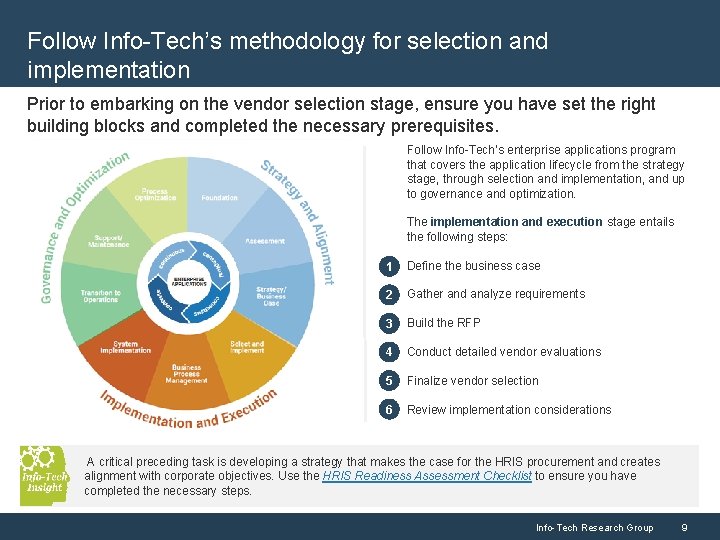
Follow Info-Tech’s methodology for selection and implementation Prior to embarking on the vendor selection stage, ensure you have set the right building blocks and completed the necessary prerequisites. Follow Info-Tech’s enterprise applications program that covers the application lifecycle from the strategy stage, through selection and implementation, and up to governance and optimization. The implementation and execution stage entails the following steps: 1 Define the business case 2 Gather and analyze requirements 3 Build the RFP 4 Conduct detailed vendor evaluations 5 Finalize vendor selection 6 Review implementation considerations A critical preceding task is developing a strategy that makes the case for the HRIS procurement and creates alignment with corporate objectives. Use the HRIS Readiness Assessment Checklist to ensure you have completed the necessary steps. Info-Tech Research Group 9
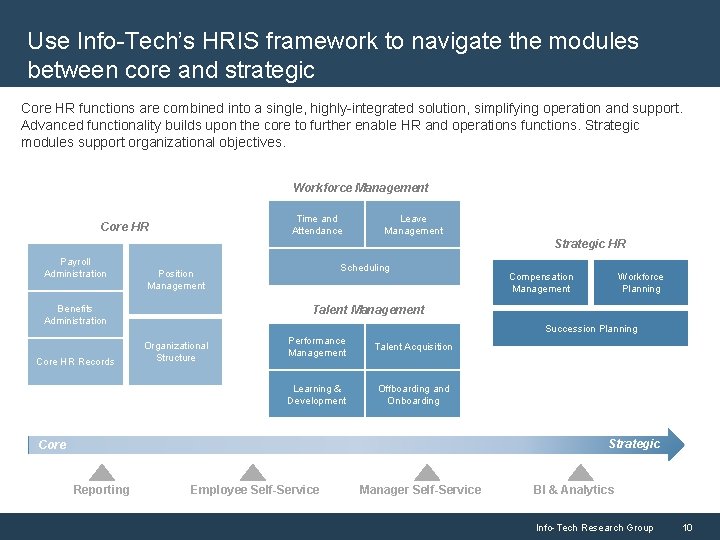
Use Info-Tech’s HRIS framework to navigate the modules between core and strategic Core HR functions are combined into a single, highly-integrated solution, simplifying operation and support. Advanced functionality builds upon the core to further enable HR and operations functions. Strategic modules support organizational objectives. Workforce Management Time and Attendance Core HR Leave Management Strategic HR Payroll Administration Workforce Planning Compensation Management Talent Management Benefits Administration Core HR Records Scheduling Position Management Succession Planning Organizational Structure Performance Management Talent Acquisition Learning & Development Offboarding and Onboarding Strategic Core Reporting Employee Self-Service Manager Self-Service BI & Analytics Info-Tech Research Group 10
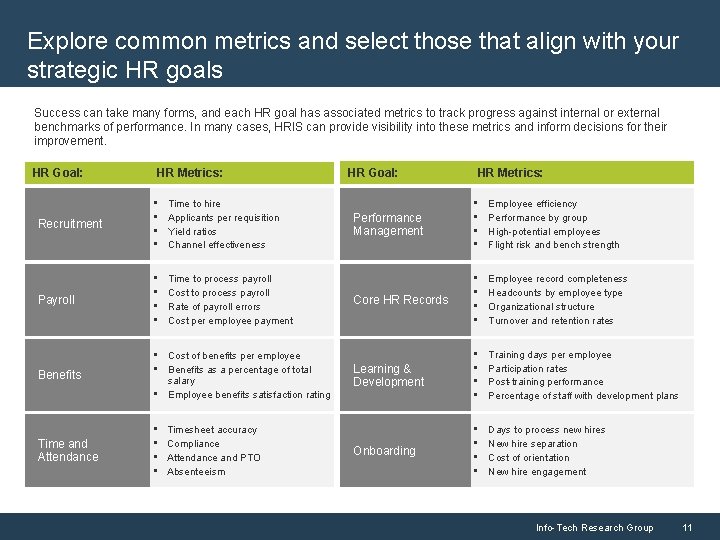
Explore common metrics and select those that align with your strategic HR goals Success can take many forms, and each HR goal has associated metrics to track progress against internal or external benchmarks of performance. In many cases, HRIS can provide visibility into these metrics and inform decisions for their improvement. HR Goal: HR Metrics: Recruitment • • Time to hire Applicants per requisition Yield ratios Channel effectiveness Payroll • • Time to process payroll Cost to process payroll Rate of payroll errors Cost per employee payment • • • Cost of benefits per employee Benefits as a percentage of total salary Employee benefits satisfaction rating • • Timesheet accuracy Compliance Attendance and PTO Absenteeism Benefits Time and Attendance HR Goal: HR Metrics: Performance Management • • Employee efficiency Performance by group High-potential employees Flight risk and bench strength Core HR Records • • Employee record completeness Headcounts by employee type Organizational structure Turnover and retention rates Learning & Development • • Training days per employee Participation rates Post-training performance Percentage of staff with development plans Onboarding • • Days to process new hires New hire separation Cost of orientation New hire engagement Info-Tech Research Group 11
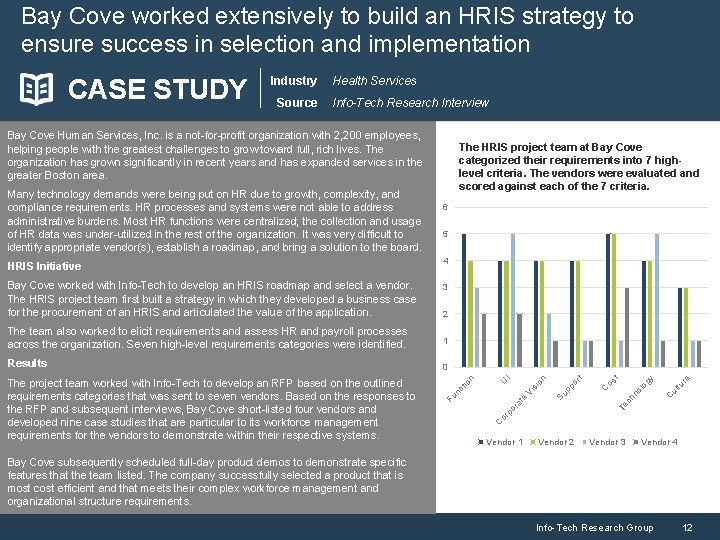
Bay Cove worked extensively to build an HRIS strategy to ensure success in selection and implementation Info-Tech Research Interview Bay Cove Human Services, Inc. is a not-for-profit organization with 2, 200 employees, helping people with the greatest challenges to grow toward full, rich lives. The organization has grown significantly in recent years and has expanded services in the greater Boston area. 4 3 re tu ul no lo ch Te C gy t os C is po io nc t Fu The project team worked with Info-Tech to develop an RFP based on the outlined requirements categories that was sent to seven vendors. Based on the responses to the RFP and subsequent interviews, Bay Cove short-listed four vendors and developed nine case studies that are particular to its workforce management requirements for the vendors to demonstrate within their respective systems. Su p 0 n Results io 1 n The team also worked to elicit requirements and assess HR and payroll processes across the organization. Seven high-level requirements categories were identified. rt 2 I Bay Cove worked with Info-Tech to develop an HRIS roadmap and select a vendor. The HRIS project team first built a strategy in which they developed a business case for the procurement of an HRIS and articulated the value of the application. 5 U HRIS Initiative 6 ra te V Many technology demands were being put on HR due to growth, complexity, and compliance requirements. HR processes and systems were not able to address administrative burdens. Most HR functions were centralized; the collection and usage of HR data was under-utilized in the rest of the organization. It was very difficult to identify appropriate vendor(s), establish a roadmap, and bring a solution to the board. The HRIS project team at Bay Cove categorized their requirements into 7 highlevel criteria. The vendors were evaluated and scored against each of the 7 criteria. po Source Health Services or Industry C CASE STUDY Vendor 1 Vendor 2 Vendor 3 Vendor 4 Bay Cove subsequently scheduled full-day product demos to demonstrate specific features that the team listed. The company successfully selected a product that is most cost efficient and that meets their complex workforce management and organizational structure requirements. Info-Tech Research Group 12
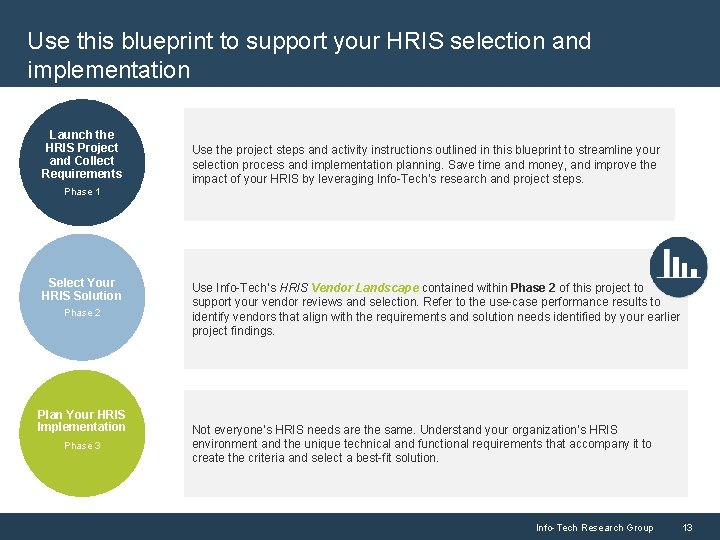
Use this blueprint to support your HRIS selection and implementation Launch the HRIS Project and Collect Requirements Phase 1 Select Your HRIS Solution Phase 2 Plan Your HRIS Implementation Phase 3 Use the project steps and activity instructions outlined in this blueprint to streamline your selection process and implementation planning. Save time and money, and improve the impact of your HRIS by leveraging Info-Tech’s research and project steps. Use Info-Tech’s HRIS Vendor Landscape contained within Phase 2 of this project to support your vendor reviews and selection. Refer to the use-case performance results to identify vendors that align with the requirements and solution needs identified by your earlier project findings. Not everyone’s HRIS needs are the same. Understand your organization’s HRIS environment and the unique technical and functional requirements that accompany it to create the criteria and select a best-fit solution. Info-Tech Research Group 13
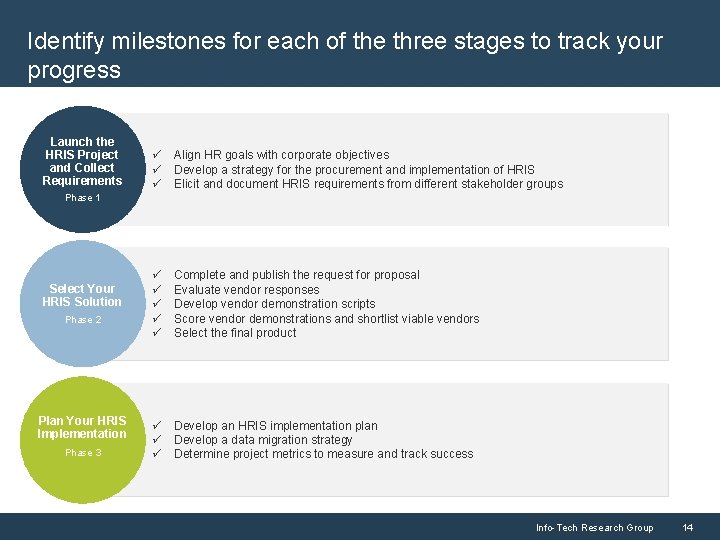
Identify milestones for each of the three stages to track your progress Launch the HRIS Project and Collect Requirements ü ü ü Align HR goals with corporate objectives Develop a strategy for the procurement and implementation of HRIS Elicit and document HRIS requirements from different stakeholder groups ü ü ü Complete and publish the request for proposal Evaluate vendor responses Develop vendor demonstration scripts Score vendor demonstrations and shortlist viable vendors Select the final product ü ü ü Develop an HRIS implementation plan Develop a data migration strategy Determine project metrics to measure and track success Phase 1 Select Your HRIS Solution Phase 2 Plan Your HRIS Implementation Phase 3 Info-Tech Research Group 14
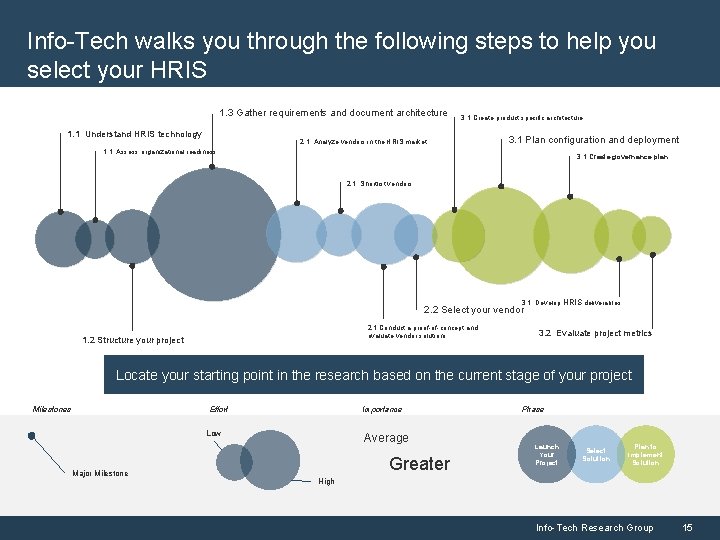
Info-Tech walks you through the following steps to help you select your HRIS 1. 3 Gather requirements and document architecture 1. 1 Understand HRIS technology 3. 1 Create product specific architecture 2. 1 Analyze vendors in the HRIS market 3. 1 Plan configuration and deployment 1. 1 Assess organizational readiness 3. 1 Create governance plan 2. 1 Shortlist vendors 3. 1 Develop HRIS deliverables 2. 2 Select your vendor 2. 1 Conduct a proof-of-concept and evaluate vendor solutions 1. 2 Structure your project 3. 2 Evaluate project metrics Locate your starting point in the research based on the current stage of your project Effort Milestones Importance Low Major Milestone Average Greater Phase Launch Your Project Select Solution Plan to Implement Solution High Info-Tech Research Group 15
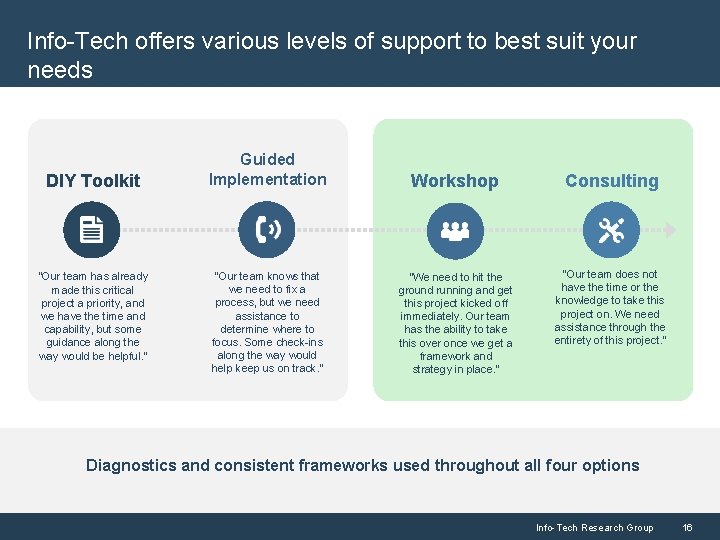
Info-Tech offers various levels of support to best suit your needs DIY Toolkit “Our team has already made this critical project a priority, and we have the time and capability, but some guidance along the way would be helpful. ” Guided Implementation Workshop Consulting “Our team knows that we need to fix a process, but we need assistance to determine where to focus. Some check-ins along the way would help keep us on track. ” “We need to hit the ground running and get this project kicked off immediately. Our team has the ability to take this over once we get a framework and strategy in place. ” “Our team does not have the time or the knowledge to take this project on. We need assistance through the entirety of this project. ” Diagnostics and consistent frameworks used throughout all four options Info-Tech Research Group 16
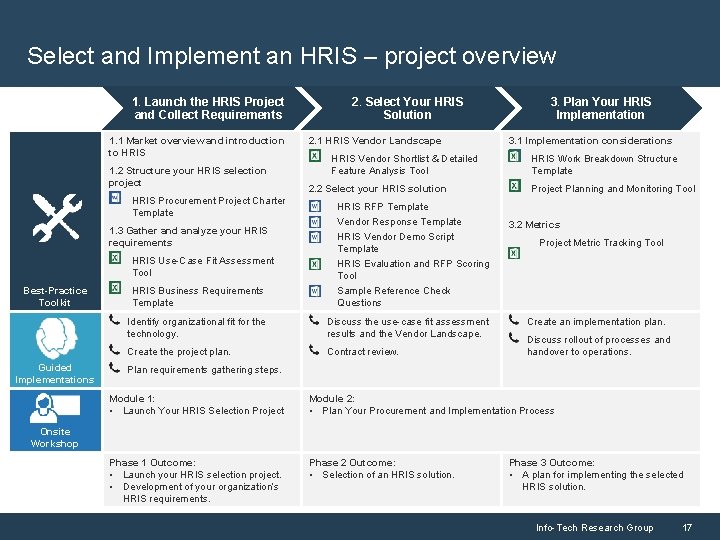
Select and Implement an HRIS – project overview 1. Launch the HRIS Project and Collect Requirements 1. 1 Market overview and introduction to HRIS 1. 2 Structure your HRIS selection project HRIS Procurement Project Charter Template HRIS Vendor Shortlist & Detailed Feature Analysis Tool 2. 2 Select your HRIS solution HRIS Business Requirements Template Identify organizational fit for the technology. Discuss the use-case fit assessment results and the Vendor Landscape. Create the project plan. Contract review. HRIS Use-Case Fit Assessment Tool Guided Implementations 2. 1 HRIS Vendor Landscape HRIS RFP Template Vendor Response Template HRIS Vendor Demo Script Template HRIS Evaluation and RFP Scoring Tool Sample Reference Check Questions 1. 3 Gather and analyze your HRIS requirements Best-Practice Toolkit 2. Select Your HRIS Solution 3. Plan Your HRIS Implementation 3. 1 Implementation considerations HRIS Work Breakdown Structure Template Project Planning and Monitoring Tool 3. 2 Metrics Project Metric Tracking Tool Create an implementation plan. Discuss rollout of processes and handover to operations. Plan requirements gathering steps. Module 1: • Launch Your HRIS Selection Project Module 2: • Plan Your Procurement and Implementation Process Phase 1 Outcome: • Launch your HRIS selection project. • Development of your organization’s HRIS requirements. Phase 2 Outcome: • Selection of an HRIS solution. Onsite Workshop Phase 3 Outcome: • A plan for implementing the selected HRIS solution. Info-Tech Research Group 17
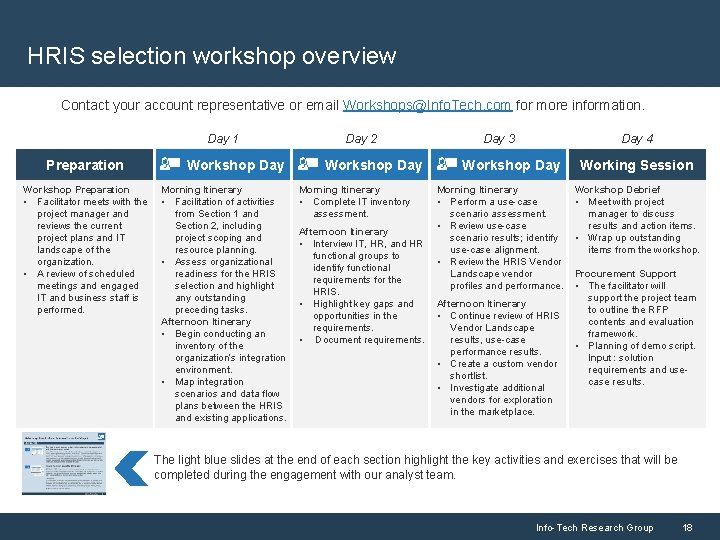
HRIS selection workshop overview Contact your account representative or email Workshops@Info. Tech. com for more information. Day 1 Preparation Workshop Preparation • Facilitator meets with the project manager and reviews the current project plans and IT landscape of the organization. • A review of scheduled meetings and engaged IT and business staff is performed. Workshop Day Morning Itinerary • Facilitation of activities from Section 1 and Section 2, including project scoping and resource planning. • Assess organizational readiness for the HRIS selection and highlight any outstanding preceding tasks. Afternoon Itinerary • Begin conducting an inventory of the organization’s integration environment. • Map integration scenarios and data flow plans between the HRIS and existing applications. Day 2 Workshop Day Morning Itinerary • Complete IT inventory assessment. Day 3 Day 4 Workshop Day Morning Itinerary • Perform a use-case scenario assessment. • Review use-case scenario results; identify use-case alignment. • Review the HRIS Vendor Landscape vendor profiles and performance. Afternoon Itinerary • Interview IT, HR, and HR functional groups to identify functional requirements for the HRIS. • Highlight key gaps and Afternoon Itinerary opportunities in the • Continue review of HRIS requirements. Vendor Landscape • Document requirements. results, use-case performance results. • Create a custom vendor shortlist. • Investigate additional vendors for exploration in the marketplace. Working Session Workshop Debrief • Meet with project manager to discuss results and action items. • Wrap up outstanding items from the workshop. Procurement Support • The facilitator will support the project team to outline the RFP contents and evaluation framework. • Planning of demo script. Input: solution requirements and usecase results. The light blue slides at the end of each section highlight the key activities and exercises that will be completed during the engagement with our analyst team. Info-Tech Research Group 18
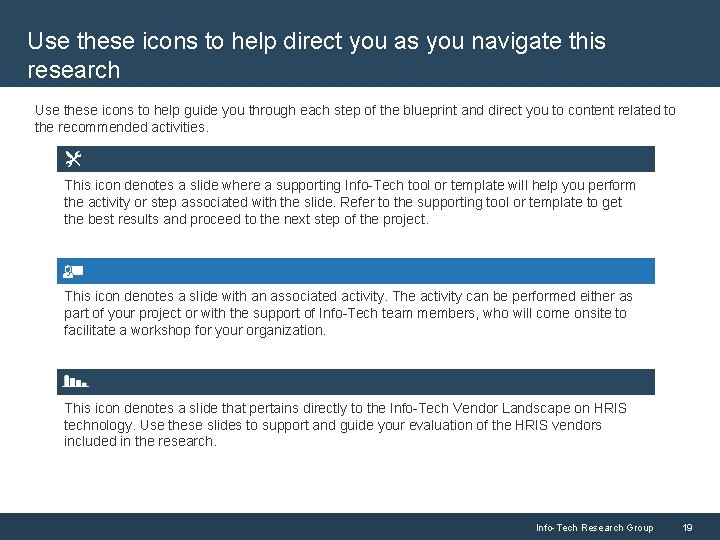
Use these icons to help direct you as you navigate this research Use these icons to help guide you through each step of the blueprint and direct you to content related to the recommended activities. This icon denotes a slide where a supporting Info-Tech tool or template will help you perform the activity or step associated with the slide. Refer to the supporting tool or template to get the best results and proceed to the next step of the project. This icon denotes a slide with an associated activity. The activity can be performed either as part of your project or with the support of Info-Tech team members, who will come onsite to facilitate a workshop for your organization. This icon denotes a slide that pertains directly to the Info-Tech Vendor Landscape on HRIS technology. Use these slides to support and guide your evaluation of the HRIS vendors included in the research. Info-Tech Research Group 19