
V 4 Prototype With an Innovation Design Sprint
- Slides: 11
V 4 Prototype With an Innovation Design Sprint Test and develop innovative ideas in four-day sprints. Info-Tech Research Group, Inc. is a global leader in providing IT research and advice. Info-Tech’s products and services combine actionable insight and relevant advice with Info-Tech's products and services combine actionable insight and advice ready-to-use tools and templates that cover the fullrelevant spectrum of IT with concerns. and templates that cover the full spectrum IT concerns. © 1997 -2017 Info-Tech Group © of 1997 -2017 Info-Tech Research Group Research Inc. Info-Tech Research Group 1
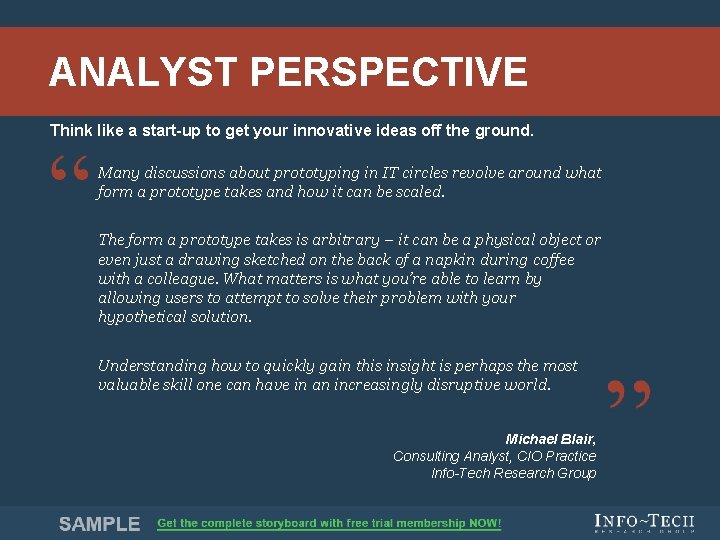
ANALYST PERSPECTIVE Think like a start-up to get your innovative ideas off the ground. Many discussions about prototyping in IT circles revolve around what form a prototype takes and how it can be scaled. The form a prototype takes is arbitrary – it can be a physical object or even just a drawing sketched on the back of a napkin during coffee with a colleague. What matters is what you’re able to learn by allowing users to attempt to solve their problem with your hypothetical solution. Understanding how to quickly gain this insight is perhaps the most valuable skill one can have in an increasingly disruptive world. Michael Blair, Consulting Analyst, CIO Practice Info-Tech Research Group 2
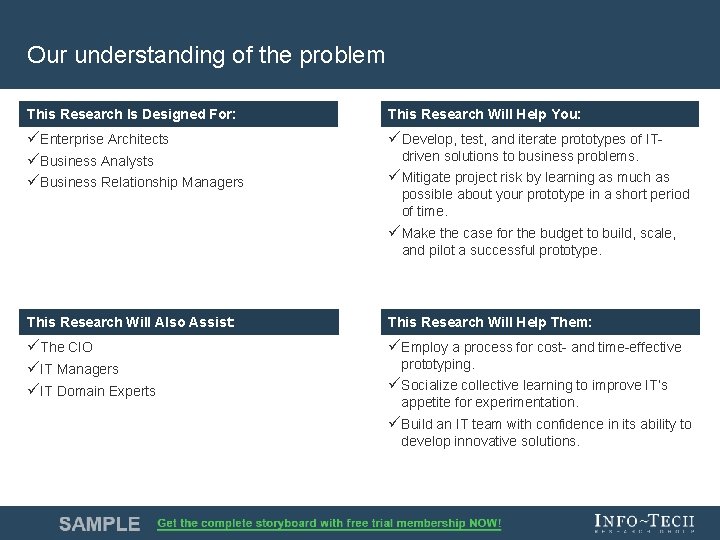
Our understanding of the problem This Research is Is Designed For: This Research Will Help You: üEnterprise Architects üBusiness Analysts üBusiness Relationship Managers üDevelop, test, and iterate prototypes of ITdriven solutions to business problems. üMitigate project risk by learning as much as possible about your prototype in a short period of time. üMake the case for the budget to build, scale, and pilot a successful prototype. This Research Will Also Assist: This Research Will Help You: Them: üThe CIO üIT Managers üIT Domain Experts üEmploy a process for cost- and time-effective prototyping. üSocialize collective learning to improve IT’s appetite for experimentation. üBuild an IT team with confidence in its ability to develop innovative solutions. Info-Tech Research Group 3
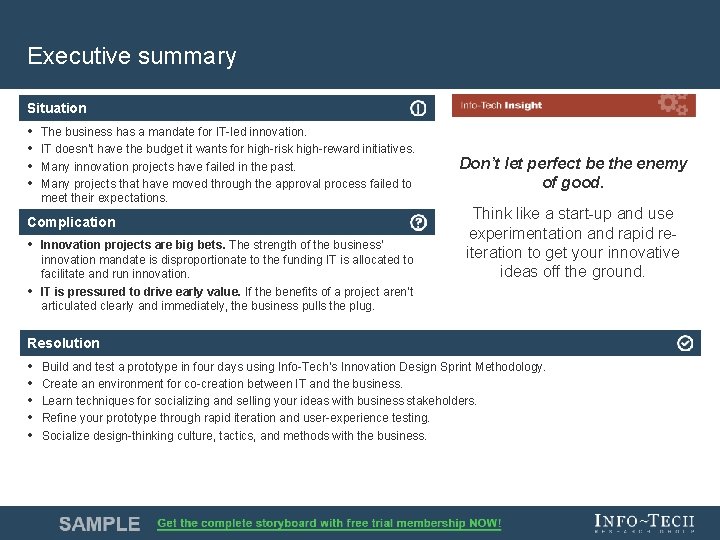
Executive summary Situation • • The business has a mandate for IT-led innovation. IT doesn’t have the budget it wants for high-risk high-reward initiatives. Many innovation projects have failed in the past. Many projects that have moved through the approval process failed to meet their expectations. Complication • Innovation projects are big bets. The strength of the business’ • innovation mandate is disproportionate to the funding IT is allocated to facilitate and run innovation. IT is pressured to drive early value. If the benefits of a project aren’t articulated clearly and immediately, the business pulls the plug. Don’t let perfect be the enemy of good. Think like a start-up and use experimentation and rapid reiteration to get your innovative ideas off the ground. Resolution • • • Build and test a prototype in four days using Info-Tech’s Innovation Design Sprint Methodology. Create an environment for co-creation between IT and the business. Learn techniques for socializing and selling your ideas with business stakeholders. Refine your prototype through rapid iteration and user-experience testing. Socialize design-thinking culture, tactics, and methods with the business. Info-Tech Research Group 4
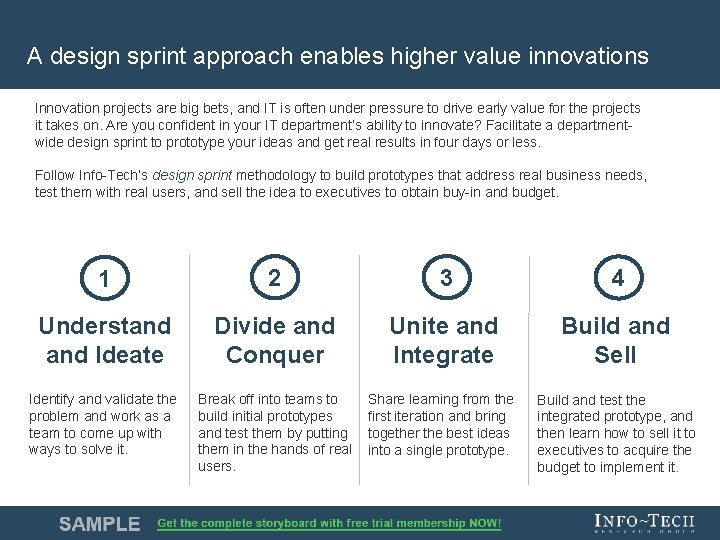
A design sprint approach enables higher value innovations Innovation projects are big bets, and IT is often under pressure to drive early value for the projects it takes on. Are you confident in your IT department’s ability to innovate? Facilitate a departmentwide design sprint to prototype your ideas and get real results in four days or less. Follow Info-Tech’s design sprint methodology to build prototypes that address real business needs, test them with real users, and sell the idea to executives to obtain buy-in and budget. 1 2 3 4 Understand Ideate Divide and Conquer Unite and Integrate Build and Sell Identify and validate the problem and work as a team to come up with ways to solve it. Break off into teams to build initial prototypes and test them by putting them in the hands of real users. Share learning from the first iteration and bring together the best ideas into a single prototype. Build and test the integrated prototype, and then learn how to sell it to executives to acquire the budget to implement it. Info-Tech Research Group 5
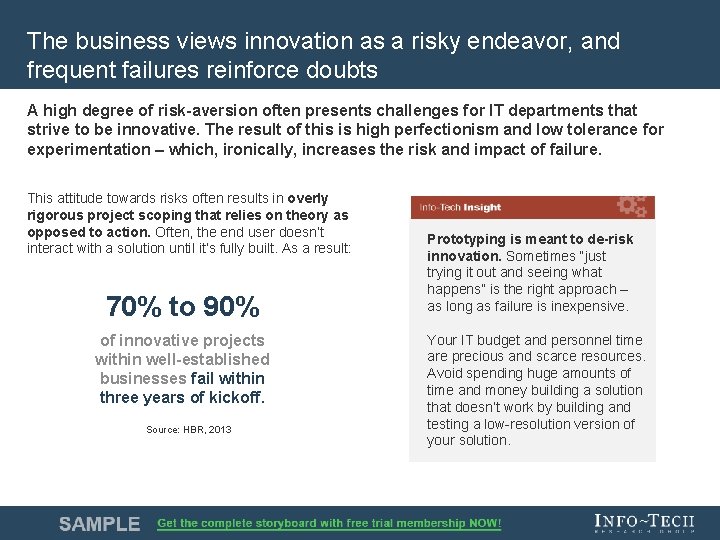
The business views innovation as a risky endeavor, and frequent failures reinforce doubts A high degree of risk-aversion often presents challenges for IT departments that strive to be innovative. The result of this is high perfectionism and low tolerance for experimentation – which, ironically, increases the risk and impact of failure. This attitude towards risks often results in overly rigorous project scoping that relies on theory as opposed to action. Often, the end user doesn’t interact with a solution until it’s fully built. As a result: 70% to 90% of innovative projects within well-established businesses fail within three years of kickoff. Source: HBR, 2013 Prototyping is meant to de-risk innovation. Sometimes “just trying it out and seeing what happens” is the right approach – as long as failure is inexpensive. Your IT budget and personnel time are precious and scarce resources. Avoid spending huge amounts of time and money building a solution that doesn’t work by building and testing a low-resolution version of your solution. Info-Tech Research Group 6
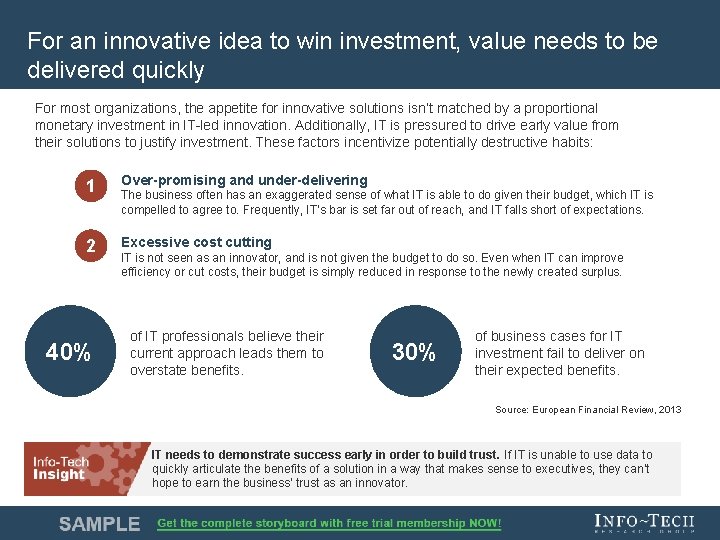
For an innovative idea to win investment, value needs to be delivered quickly For most organizations, the appetite for innovative solutions isn’t matched by a proportional monetary investment in IT-led innovation. Additionally, IT is pressured to drive early value from their solutions to justify investment. These factors incentivize potentially destructive habits: 1 Over-promising and under-delivering 2 Excessive cost cutting 40% The business often has an exaggerated sense of what IT is able to do given their budget, which IT is compelled to agree to. Frequently, IT’s bar is set far out of reach, and IT falls short of expectations. IT is not seen as an innovator, and is not given the budget to do so. Even when IT can improve efficiency or cut costs, their budget is simply reduced in response to the newly created surplus. of IT professionals believe their current approach leads them to overstate benefits. 30% of business cases for IT investment fail to deliver on their expected benefits. Source: European Financial Review, 2013 IT needs to demonstrate success early in order to build trust. If IT is unable to use data to quickly articulate the benefits of a solution in a way that makes sense to executives, they can’t hope to earn the business’ trust as an innovator. Info-Tech Research Group 7
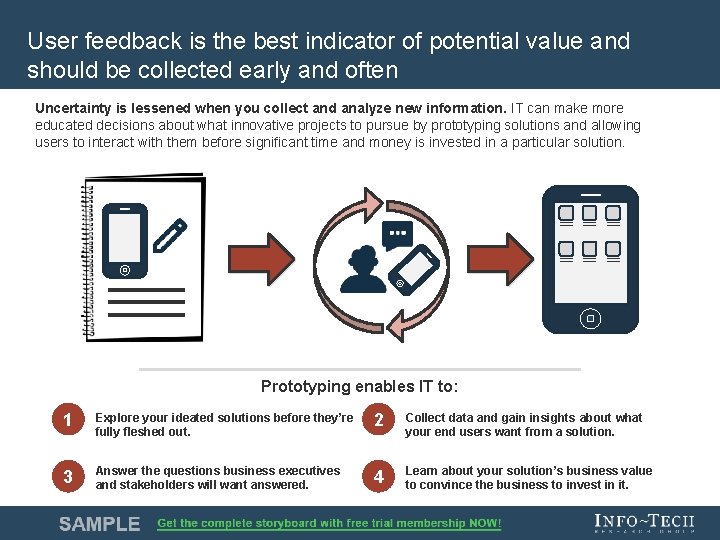
User feedback is the best indicator of potential value and should be collected early and often Uncertainty is lessened when you collect and analyze new information. IT can make more educated decisions about what innovative projects to pursue by prototyping solutions and allowing users to interact with them before significant time and money is invested in a particular solution. Prototyping enables IT to: 1 Explore your ideated solutions before they’re fully fleshed out. 2 Collect data and gain insights about what your end users want from a solution. 3 Answer the questions business executives and stakeholders will want answered. 4 Learn about your solution’s business value to convince the business to invest in it. Info-Tech Research Group 8
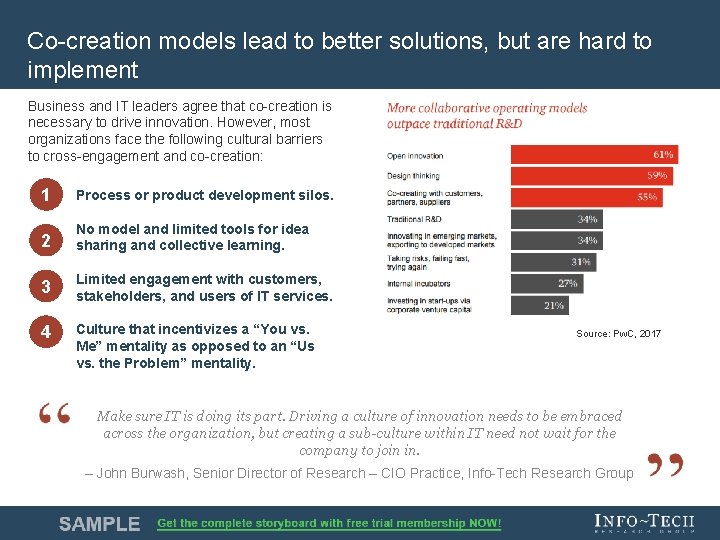
Co-creation models lead to better solutions, but are hard to implement Business and IT leaders agree that co-creation is necessary to drive innovation. However, most organizations face the following cultural barriers to cross-engagement and co-creation: 1 Process or product development silos. 2 No model and limited tools for idea sharing and collective learning. 3 Limited engagement with customers, stakeholders, and users of IT services. 4 Culture that incentivizes a “You vs. Me” mentality as opposed to an “Us vs. the Problem” mentality. Source: Pw. C, 2017 Make sure IT is doing its part. Driving a culture of innovation needs to be embraced across the organization, but creating a sub-culture within IT need not wait for the company to join in. – John Burwash, Senior Director of Research – CIO Practice, Info-Tech Research Group 9
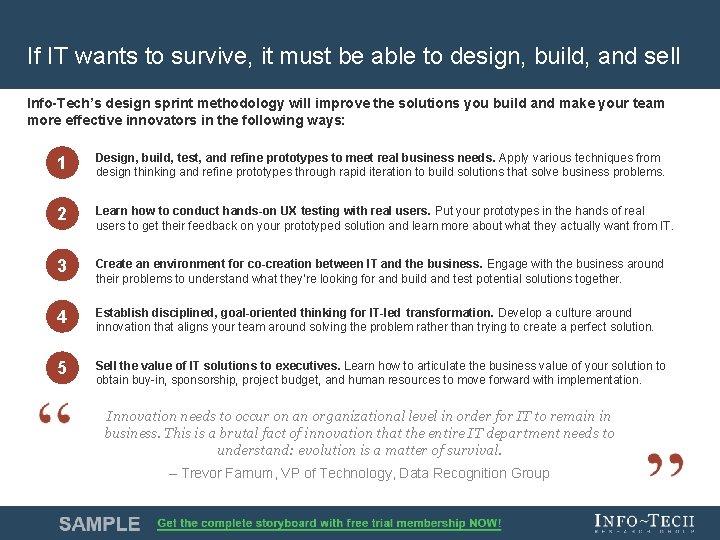
If IT wants to survive, it must be able to design, build, and sell Info-Tech’s design sprint methodology will improve the solutions you build and make your team more effective innovators in the following ways: 1 Design, build, test, and refine prototypes to meet real business needs. Apply various techniques from design thinking and refine prototypes through rapid iteration to build solutions that solve business problems. 2 Learn how to conduct hands-on UX testing with real users. Put your prototypes in the hands of real users to get their feedback on your prototyped solution and learn more about what they actually want from IT. 3 Create an environment for co-creation between IT and the business. Engage with the business around their problems to understand what they’re looking for and build and test potential solutions together. 4 Establish disciplined, goal-oriented thinking for IT-led transformation. Develop a culture around innovation that aligns your team around solving the problem rather than trying to create a perfect solution. 5 Sell the value of IT solutions to executives. Learn how to articulate the business value of your solution to obtain buy-in, sponsorship, project budget, and human resources to move forward with implementation. Innovation needs to occur on an organizational level in order for IT to remain in business. This is a brutal fact of innovation that the entire IT department needs to understand: evolution is a matter of survival. – Trevor Farnum, VP of Technology, Data Recognition Group Info-Tech Research Group 10
Info-Tech Research Group Helps IT Professionals To: ü ü ü Quickly get up to speed with new technologies ü Manage business expectations ü Justify IT spending and prove the value of IT ü Train IT staff and effectively manage an IT department Make the right technology purchasing decisions – fast Deliver critical IT projects, on time and within budget Sign up for free trial membership to get practical solutions for your IT challenges • “Info-Tech helps me to be proactive instead of reactive – a cardinal rule in a stable and leading edge IT environment. - ARCS Commercial Mortgage Co. , LP Toll Free: 1 -888 -670 -8889 Info-Tech Research Group www. infotech. com 11