
v 1 Welcome to Breakout 5 BO 5
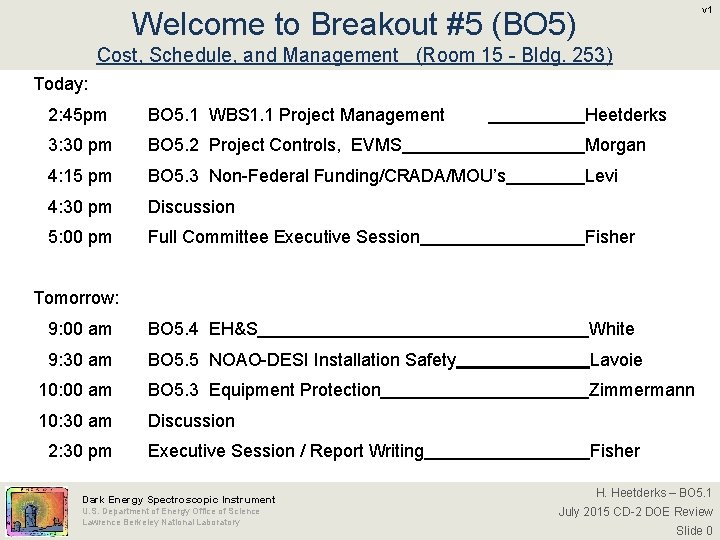
v 1 Welcome to Breakout #5 (BO 5) Cost, Schedule, and Management (Room 15 - Bldg. 253) Today: 2: 45 pm BO 5. 1 WBS 1. 1 Project Management Heetderks 3: 30 pm BO 5. 2 Project Controls, EVMS Morgan 4: 15 pm BO 5. 3 Non-Federal Funding/CRADA/MOU’s Levi 4: 30 pm Discussion 5: 00 pm Full Committee Executive Session Fisher 9: 00 am BO 5. 4 EH&S White 9: 30 am BO 5. 5 NOAO-DESI Installation Safety Lavoie 10: 00 am BO 5. 3 Equipment Protection Zimmermann 10: 30 am Discussion Tomorrow: 2: 30 pm Executive Session / Report Writing Dark Energy Spectroscopic Instrument U. S. Department of Energy Office of Science Lawrence Berkeley National Laboratory Fisher H. Heetderks – BO 5. 1 July 2015 CD-2 DOE Review Slide 0
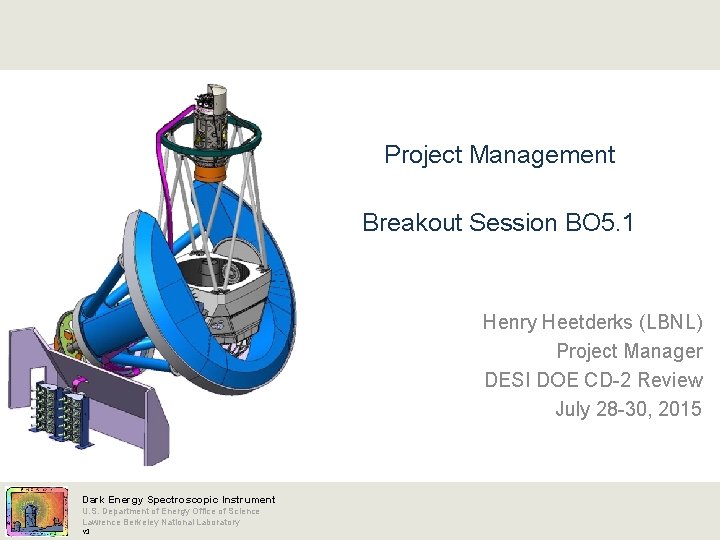
Project Management Breakout Session BO 5. 1 Henry Heetderks (LBNL) Project Manager DESI DOE CD-2 Review July 28 -30, 2015 Dark Energy Spectroscopic Instrument U. S. Department of Energy Office of Science Lawrence Berkeley National Laboratory v 1
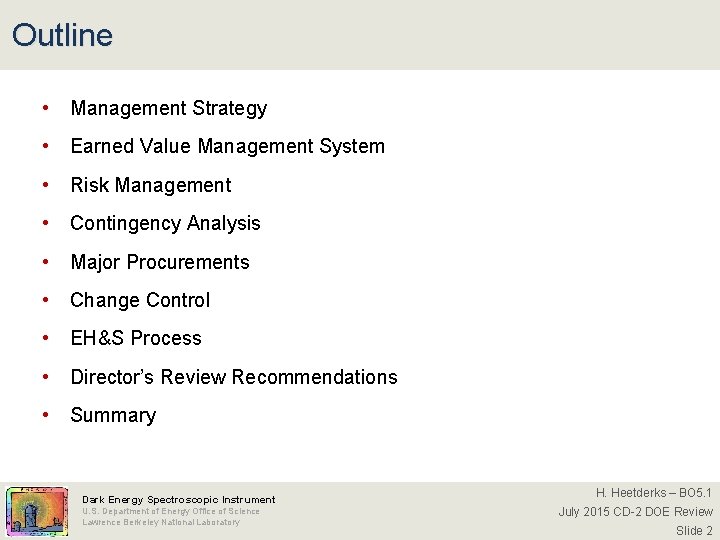
Outline • Management Strategy • Earned Value Management System • Risk Management • Contingency Analysis • Major Procurements • Change Control • EH&S Process • Director’s Review Recommendations • Summary Dark Energy Spectroscopic Instrument U. S. Department of Energy Office of Science Lawrence Berkeley National Laboratory H. Heetderks – BO 5. 1 July 2015 CD-2 DOE Review Slide 2
• Management Strategy • Earned Value Management System • Risk Management • Contingency Analysis • Major Procurements • Change Control • EH&S Process • Director’s Review Recommendations • Summary Dark Energy Spectroscopic Instrument U. S. Department of Energy Office of Science Lawrence Berkeley National Laboratory H. Heetderks – BO 5. 1 July 2015 CD-2 DOE Review Slide 3
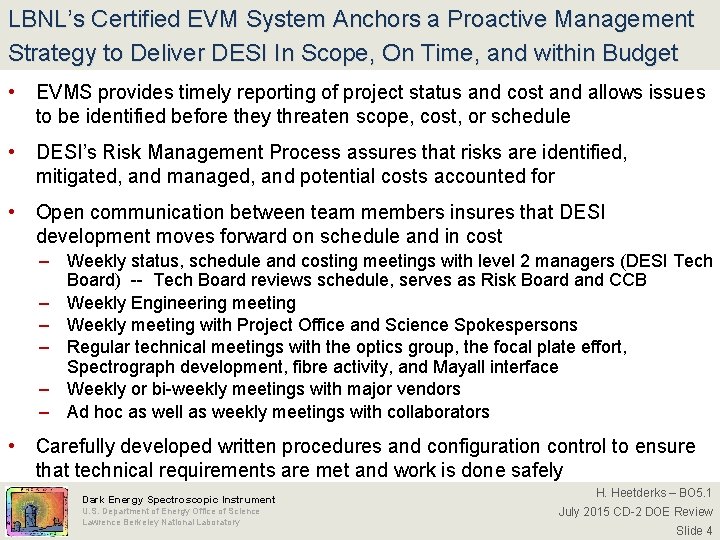
LBNL’s Certified EVM System Anchors a Proactive Management Strategy to Deliver DESI In Scope, On Time, and within Budget • EVMS provides timely reporting of project status and cost and allows issues to be identified before they threaten scope, cost, or schedule • DESI’s Risk Management Process assures that risks are identified, mitigated, and managed, and potential costs accounted for • Open communication between team members insures that DESI development moves forward on schedule and in cost – Weekly status, schedule and costing meetings with level 2 managers (DESI Tech Board) -- Tech Board reviews schedule, serves as Risk Board and CCB – Weekly Engineering meeting – Weekly meeting with Project Office and Science Spokespersons – Regular technical meetings with the optics group, the focal plate effort, Spectrograph development, fibre activity, and Mayall interface – Weekly or bi-weekly meetings with major vendors – Ad hoc as well as weekly meetings with collaborators • Carefully developed written procedures and configuration control to ensure that technical requirements are met and work is done safely Dark Energy Spectroscopic Instrument U. S. Department of Energy Office of Science Lawrence Berkeley National Laboratory H. Heetderks – BO 5. 1 July 2015 CD-2 DOE Review Slide 4
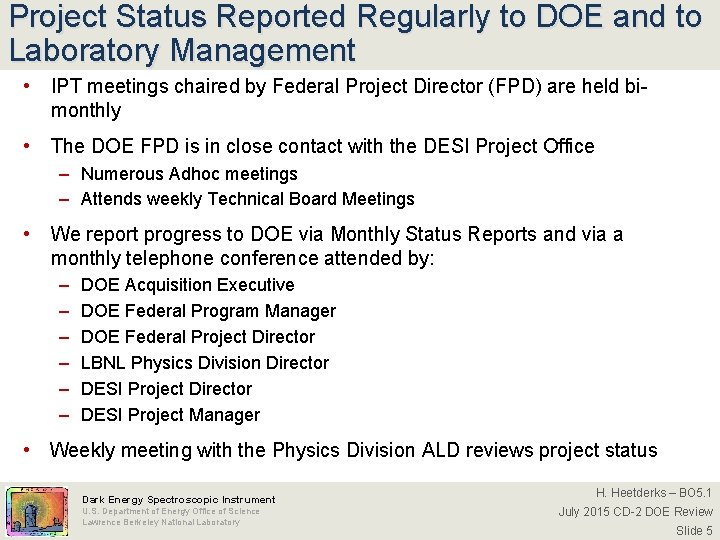
Project Status Reported Regularly to DOE and to Laboratory Management • IPT meetings chaired by Federal Project Director (FPD) are held bimonthly • The DOE FPD is in close contact with the DESI Project Office – Numerous Adhoc meetings – Attends weekly Technical Board Meetings • We report progress to DOE via Monthly Status Reports and via a monthly telephone conference attended by: – – – DOE Acquisition Executive DOE Federal Program Manager DOE Federal Project Director LBNL Physics Division Director DESI Project Manager • Weekly meeting with the Physics Division ALD reviews project status Dark Energy Spectroscopic Instrument U. S. Department of Energy Office of Science Lawrence Berkeley National Laboratory H. Heetderks – BO 5. 1 July 2015 CD-2 DOE Review Slide 5
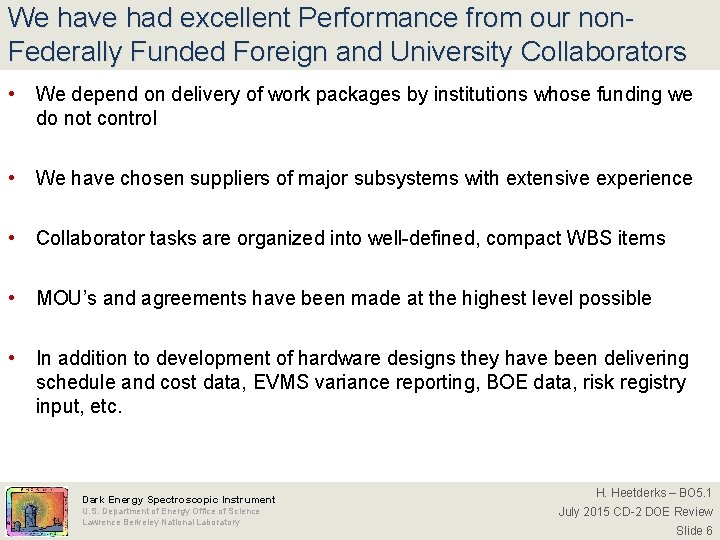
We have had excellent Performance from our non. Federally Funded Foreign and University Collaborators • We depend on delivery of work packages by institutions whose funding we do not control • We have chosen suppliers of major subsystems with extensive experience • Collaborator tasks are organized into well-defined, compact WBS items • MOU’s and agreements have been made at the highest level possible • In addition to development of hardware designs they have been delivering schedule and cost data, EVMS variance reporting, BOE data, risk registry input, etc. Dark Energy Spectroscopic Instrument U. S. Department of Energy Office of Science Lawrence Berkeley National Laboratory H. Heetderks – BO 5. 1 July 2015 CD-2 DOE Review Slide 6
• Management Strategy • Earned Value Management System • Risk Management • Contingency Analysis • Major Procurements • Change Control • EH&S Process • Director’s Review Recommendations • Summary Dark Energy Spectroscopic Instrument U. S. Department of Energy Office of Science Lawrence Berkeley National Laboratory H. Heetderks – BO 5. 1 July 2015 CD-2 DOE Review Slide 7
EVMS timely reporting of project status allows issues to be identified before they threaten scope, cost, or schedule • OPA certified EVM System based on Primavera P 6 / Cobra • Current P 6 schedule contains ~3, 000 lines • Ten Control Accounts established at WBS Level 3 • CPR’s generated for March through May with variances responded to and reports submitted. The June CPR is currently in draft. • Four BCP’s submitted to date with two approved and implemented to address major structure changes recommended by the DR panel; two are pending and will be completed following the review Dark Energy Spectroscopic Instrument U. S. Department of Energy Office of Science Lawrence Berkeley National Laboratory H. Heetderks – P 2 July 2015 CD-2 DOE Review Slide 8
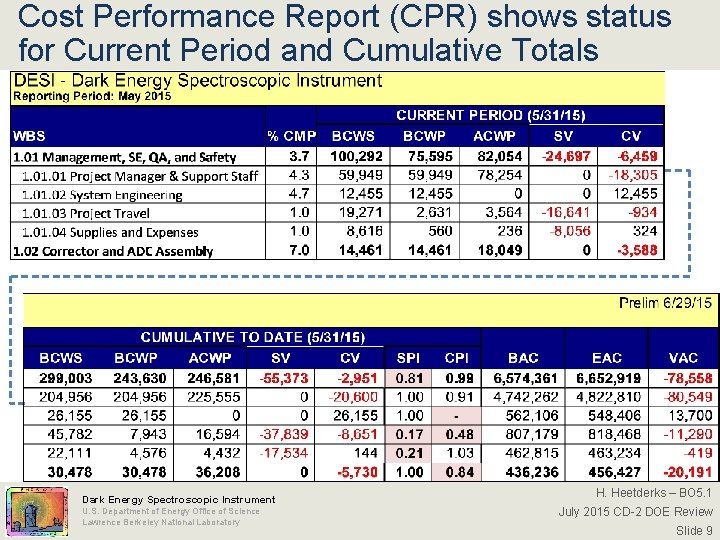
Cost Performance Report (CPR) shows status for Current Period and Cumulative Totals Dark Energy Spectroscopic Instrument U. S. Department of Energy Office of Science Lawrence Berkeley National Laboratory H. Heetderks – BO 5. 1 July 2015 CD-2 DOE Review Slide 9
Variance Analysis for WBS 1. 1 • Project is spending less on WBS 1. 1. 3 Travel, and WBS 1. 1. 4 Supplies & Expense than was budgeted – Some travel has been combined with travel on other projects resulting in lower total travel cost – The period during which the EVMS has been operating coincides with extensive effort on review preparation and hence less travel – S&E is lower during review preparation time • The % complete for these activities was entered as the fraction of actual cost divided by budgeted cost • This generates a low SPI for the activity • Future plan is to take % complete and the amount of travel done divided by the amount of travel needed to perform project activities during the time period. This will generate and SPI of 1. 0 and with a CPI > 1. • If travel and S&E have truly been over budgeted, we will make a baseline change request Dark Energy Spectroscopic Instrument U. S. Department of Energy Office of Science Lawrence Berkeley National Laboratory H. Heetderks – BO 5. 1 July 2015 CD-2 DOE Review Slide 10
Variance Reporting and Analysis is now performed by all CAM’s at WBS Level 3 Dark Energy Spectroscopic Instrument U. S. Department of Energy Office of Science Lawrence Berkeley National Laboratory H. Heetderks – BO 5. 1 July 2015 CD-2 DOE Review Slide 11
EVMS variances at WBS level 2 for the entire project will be addressed in individual breakout sessions • • We have taken EVMS on line as early as possible to exercise the system and our Level 2’s and to get up on the learning curve Identified inconsistencies are being corrected. Discussed in breakout. Note: SPI = Schedule Performance Index CPI = Cost Performance Index H. Heetderks – BO 5. 1 July 2015 CD-2 DOE Review Slide 12
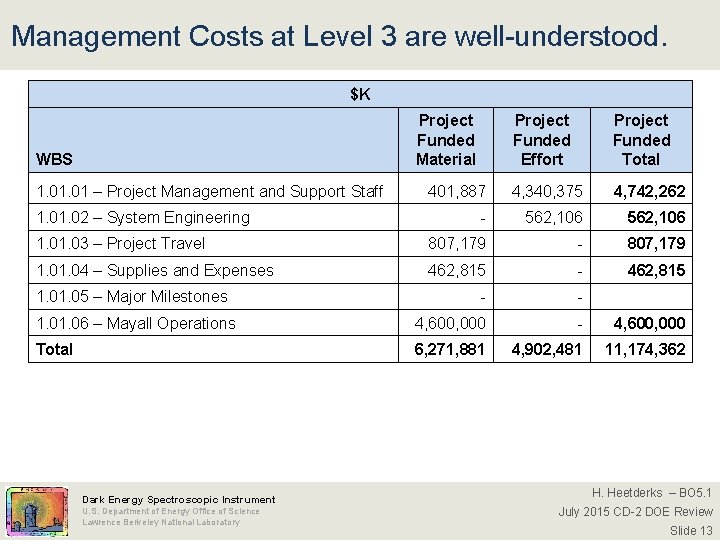
Management Costs at Level 3 are well-understood. $K Project Funded Material Project Funded Effort Project Funded Total 401, 887 4, 340, 375 4, 742, 262 - 562, 106 1. 03 – Project Travel 807, 179 - 807, 179 1. 04 – Supplies and Expenses 462, 815 - - 1. 06 – Mayall Operations 4, 600, 000 - 4, 600, 000 Total 6, 271, 881 4, 902, 481 11, 174, 362 WBS 1. 01 – Project Management and Support Staff 1. 02 – System Engineering 1. 05 – Major Milestones Dark Energy Spectroscopic Instrument U. S. Department of Energy Office of Science Lawrence Berkeley National Laboratory H. Heetderks – BO 5. 1 July 2015 CD-2 DOE Review Slide 13
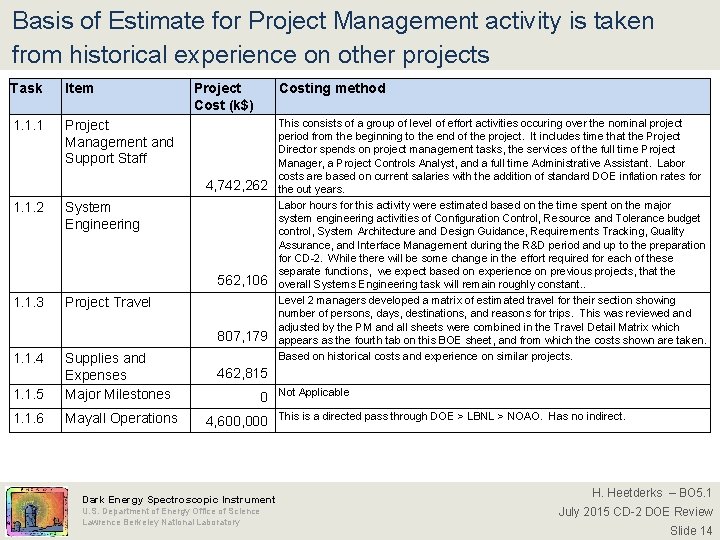
Basis of Estimate for Project Management activity is taken from historical experience on other projects Task Item 1. 1. 1 Project Management and Support Staff Project Cost (k$) Costing method 4, 742, 262 1. 1. 2 System Engineering 562, 106 1. 1. 3 Project Travel 807, 179 1. 1. 4 1. 1. 5 Supplies and Expenses Major Milestones 1. 1. 6 Mayall Operations This consists of a group of level of effort activities occuring over the nominal project period from the beginning to the end of the project. It includes time that the Project Director spends on project management tasks, the services of the full time Project Manager, a Project Controls Analyst, and a full time Administrative Assistant. Labor costs are based on current salaries with the addition of standard DOE inflation rates for the out years. Labor hours for this activity were estimated based on the time spent on the major system engineering activities of Configuration Control, Resource and Tolerance budget control, System Architecture and Design Guidance, Requirements Tracking, Quality Assurance, and Interface Management during the R&D period and up to the preparation for CD-2. While there will be some change in the effort required for each of these separate functions, we expect based on experience on previous projects, that the overall Systems Engineering task will remain roughly constant. . Level 2 managers developed a matrix of estimated travel for their section showing number of persons, days, destinations, and reasons for trips. This was reviewed and adjusted by the PM and all sheets were combined in the Travel Detail Matrix which appears as the fourth tab on this BOE sheet, and from which the costs shown are taken. Based on historical costs and experience on similar projects. 462, 815 0 4, 600, 000 Dark Energy Spectroscopic Instrument U. S. Department of Energy Office of Science Lawrence Berkeley National Laboratory Not Applicable This is a directed pass through DOE > LBNL > NOAO. Has no indirect. H. Heetderks – BO 5. 1 July 2015 CD-2 DOE Review Slide 14
• Management Strategy • Earned Value Management System • Risk Management • Contingency Analysis • Major Procurements • Change Control • EH&S Process • Director’s Review Recommendations • Summary Dark Energy Spectroscopic Instrument U. S. Department of Energy Office of Science Lawrence Berkeley National Laboratory H. Heetderks – BO 5. 1 July 2015 CD-2 DOE Review Slide 15
DESI maintains an active RM plan to identify, mitigate, and manage development risk • Risk Management Plan Status: – Risk Management Plan (DESI-0324) in place since October, 2013 – Risk Register (DESI-0376) is reviewed and updated bi-monthly • Currently 67 listed risk items • 28 retired risks – All project principals including Level 2 manages are engaged in the process – Risk Management Board meets bi-monthly • Consistent with best practices – “PMBOK Guide” ANSI Standard (ANSI/PMI 08 -001 -2012) – DOE “Risk Management Guide” (DOE G 413. 3 -7 A, 2011) • Management of risk is a continuous process throughout the life cycle of the project Dark Energy Spectroscopic Instrument U. S. Department of Energy Office of Science Lawrence Berkeley National Laboratory H. Heetderks – BO 5. 1 July 2015 CD-2 DOE Review Slide 16
Management of Risk is led by the PD and PM and is the responsibility of every team member • Project Manager Chairs the Risk Management Board (RMB) – – Performs the risk management process Monitors risks Executes risk response plans Manages risk contingency • Level 2 Managers and their teams – Working with the PD, PM and RMB, identify risks, assign probabilities and impacts, develop risk response plans as appropriate, participate in RMB – L 2 Managers own their risks • DESI Tech Board functions as RMB – Reviews and updates Risk Register; retiring or modifying existing risks, identifying new risks as project progresses – Meets bi-monthly Dark Energy Spectroscopic Instrument U. S. Department of Energy Office of Science Lawrence Berkeley National Laboratory H. Heetderks – BO 5. 1 July 2015 CD-2 DOE Review Slide 17
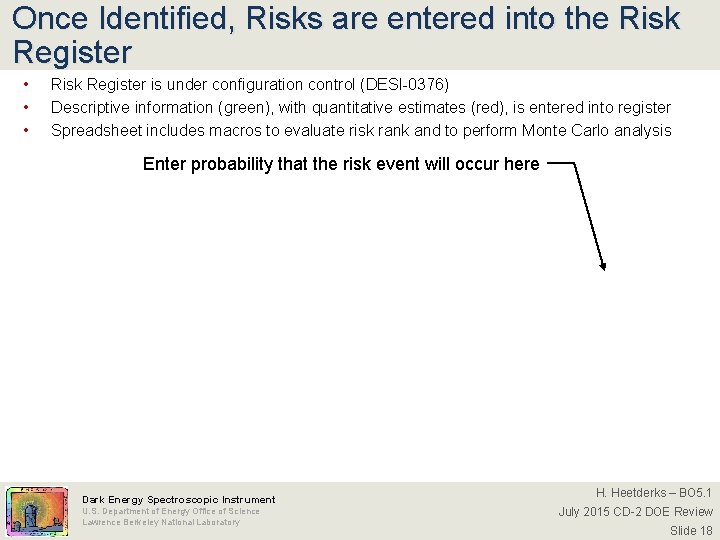
Once Identified, Risks are entered into the Risk Register • • • Risk Register is under configuration control (DESI-0376) Descriptive information (green), with quantitative estimates (red), is entered into register Spreadsheet includes macros to evaluate risk rank and to perform Monte Carlo analysis Enter probability that the risk event will occur here Dark Energy Spectroscopic Instrument U. S. Department of Energy Office of Science Lawrence Berkeley National Laboratory H. Heetderks – BO 5. 1 July 2015 CD-2 DOE Review Slide 18
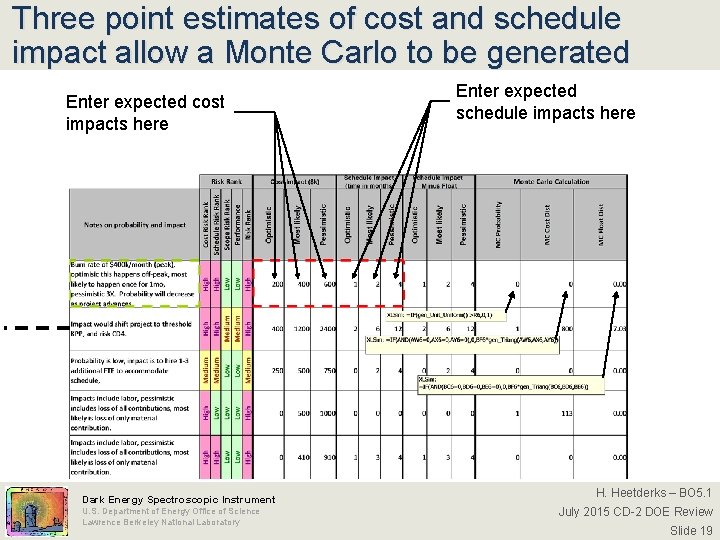
Three point estimates of cost and schedule impact allow a Monte Carlo to be generated Enter expected cost impacts here Dark Energy Spectroscopic Instrument U. S. Department of Energy Office of Science Lawrence Berkeley National Laboratory Enter expected schedule impacts here H. Heetderks – BO 5. 1 July 2015 CD-2 DOE Review Slide 19
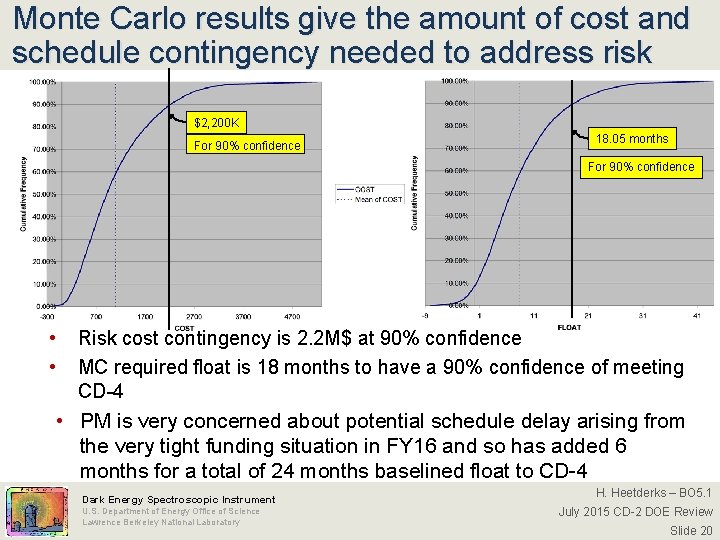
Monte Carlo results give the amount of cost and schedule contingency needed to address risk $2, 200 K For 90% confidence 18. 05 months For 90% confidence • • Risk cost contingency is 2. 2 M$ at 90% confidence MC required float is 18 months to have a 90% confidence of meeting CD-4 • PM is very concerned about potential schedule delay arising from the very tight funding situation in FY 16 and so has added 6 months for a total of 24 months baselined float to CD-4 Dark Energy Spectroscopic Instrument U. S. Department of Energy Office of Science Lawrence Berkeley National Laboratory H. Heetderks – BO 5. 1 July 2015 CD-2 DOE Review Slide 20
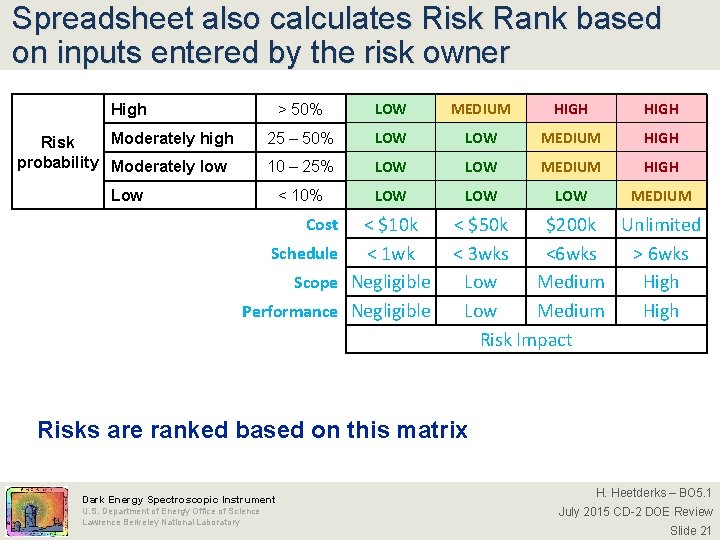
Spreadsheet also calculates Risk Rank based on inputs entered by the risk owner High > 50% LOW MEDIUM HIGH Moderately high Risk probability Moderately low 25 – 50% LOW MEDIUM HIGH 10 – 25% LOW MEDIUM HIGH Low < 10% LOW LOW MEDIUM < $10 k Schedule < 1 wk Scope Negligible Performance Negligible Cost < $50 k $200 k Unlimited < 3 wks <6 wks > 6 wks Low Medium High Risk Impact Risks are ranked based on this matrix Dark Energy Spectroscopic Instrument U. S. Department of Energy Office of Science Lawrence Berkeley National Laboratory H. Heetderks – BO 5. 1 July 2015 CD-2 DOE Review Slide 21
• Management Strategy • Earned Value Management System • Risk Management • Contingency Analysis • Major Procurements • Change Control • EH&S Process • Director’s Review Recommendations • Summary Dark Energy Spectroscopic Instrument U. S. Department of Energy Office of Science Lawrence Berkeley National Laboratory H. Heetderks – BO 5. 1 July 2015 CD-2 DOE Review Slide 22
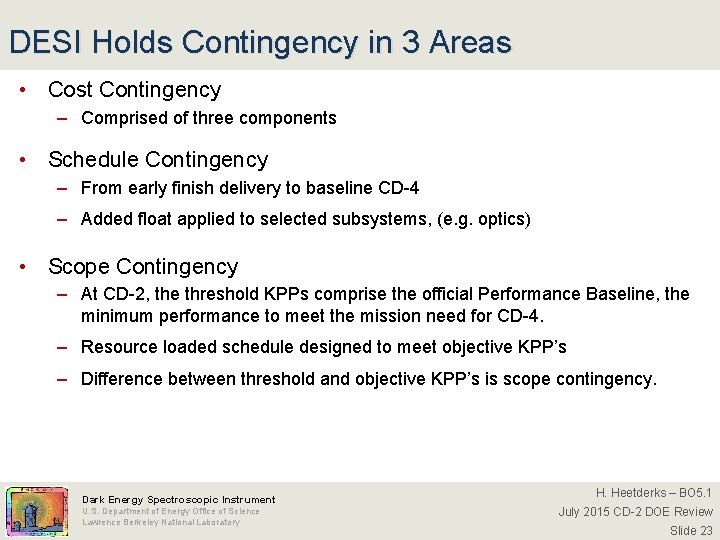
DESI Holds Contingency in 3 Areas • Cost Contingency – Comprised of three components • Schedule Contingency – From early finish delivery to baseline CD-4 – Added float applied to selected subsystems, (e. g. optics) • Scope Contingency – At CD-2, the threshold KPPs comprise the official Performance Baseline, the minimum performance to meet the mission need for CD-4. – Resource loaded schedule designed to meet objective KPP’s – Difference between threshold and objective KPP’s is scope contingency. Dark Energy Spectroscopic Instrument U. S. Department of Energy Office of Science Lawrence Berkeley National Laboratory H. Heetderks – BO 5. 1 July 2015 CD-2 DOE Review Slide 23
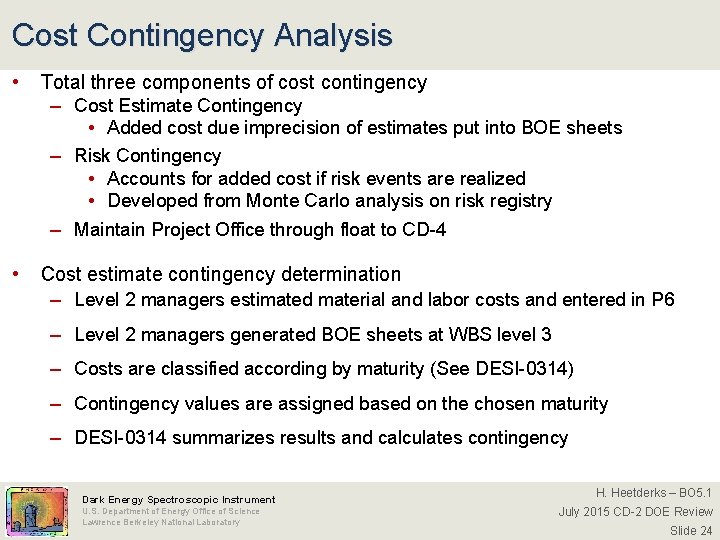
Cost Contingency Analysis • Total three components of cost contingency – Cost Estimate Contingency • Added cost due imprecision of estimates put into BOE sheets – Risk Contingency • Accounts for added cost if risk events are realized • Developed from Monte Carlo analysis on risk registry – Maintain Project Office through float to CD-4 • Cost estimate contingency determination – Level 2 managers estimated material and labor costs and entered in P 6 – Level 2 managers generated BOE sheets at WBS level 3 – Costs are classified according by maturity (See DESI-0314) – Contingency values are assigned based on the chosen maturity – DESI-0314 summarizes results and calculates contingency Dark Energy Spectroscopic Instrument U. S. Department of Energy Office of Science Lawrence Berkeley National Laboratory H. Heetderks – BO 5. 1 July 2015 CD-2 DOE Review Slide 24
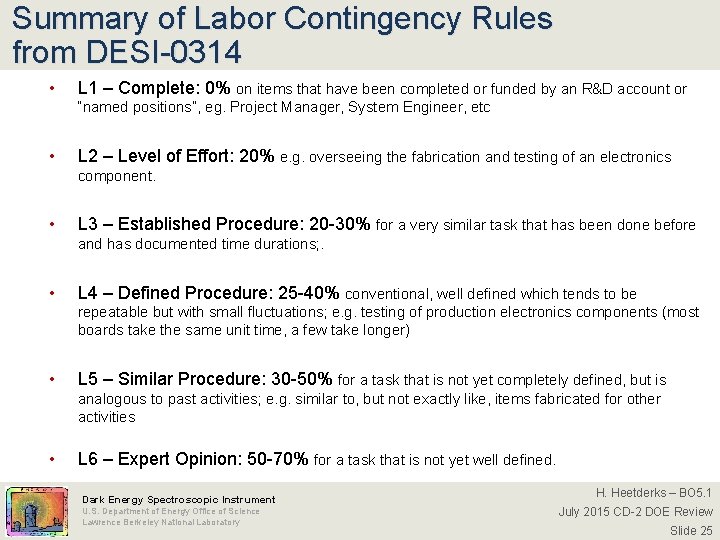
Summary of Labor Contingency Rules from DESI-0314 • L 1 – Complete: 0% on items that have been completed or funded by an R&D account or “named positions”, eg. Project Manager, System Engineer, etc • L 2 – Level of Effort: 20% e. g. overseeing the fabrication and testing of an electronics component. • L 3 – Established Procedure: 20 -30% for a very similar task that has been done before and has documented time durations; . • L 4 – Defined Procedure: 25 -40% conventional, well defined which tends to be repeatable but with small fluctuations; e. g. testing of production electronics components (most boards take the same unit time, a few take longer) • L 5 – Similar Procedure: 30 -50% for a task that is not yet completely defined, but is analogous to past activities; e. g. similar to, but not exactly like, items fabricated for other activities • L 6 – Expert Opinion: 50 -70% for a task that is not yet well defined. Dark Energy Spectroscopic Instrument U. S. Department of Energy Office of Science Lawrence Berkeley National Laboratory H. Heetderks – BO 5. 1 July 2015 CD-2 DOE Review Slide 25
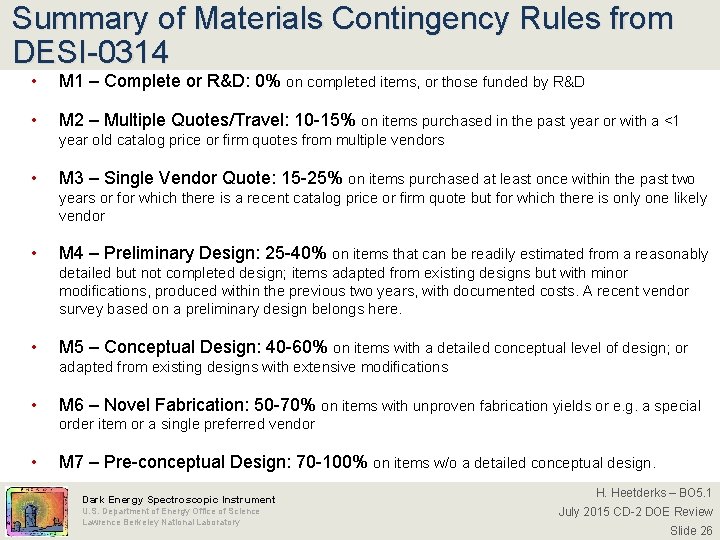
Summary of Materials Contingency Rules from DESI-0314 • M 1 – Complete or R&D: 0% on completed items, or those funded by R&D • M 2 – Multiple Quotes/Travel: 10 -15% on items purchased in the past year or with a <1 year old catalog price or firm quotes from multiple vendors • M 3 – Single Vendor Quote: 15 -25% on items purchased at least once within the past two years or for which there is a recent catalog price or firm quote but for which there is only one likely vendor • M 4 – Preliminary Design: 25 -40% on items that can be readily estimated from a reasonably detailed but not completed design; items adapted from existing designs but with minor modifications, produced within the previous two years, with documented costs. A recent vendor survey based on a preliminary design belongs here. • M 5 – Conceptual Design: 40 -60% on items with a detailed conceptual level of design; or adapted from existing designs with extensive modifications • M 6 – Novel Fabrication: 50 -70% on items with unproven fabrication yields or e. g. a special order item or a single preferred vendor • M 7 – Pre-conceptual Design: 70 -100% on items w/o a detailed conceptual design. Dark Energy Spectroscopic Instrument U. S. Department of Energy Office of Science Lawrence Berkeley National Laboratory H. Heetderks – BO 5. 1 July 2015 CD-2 DOE Review Slide 26
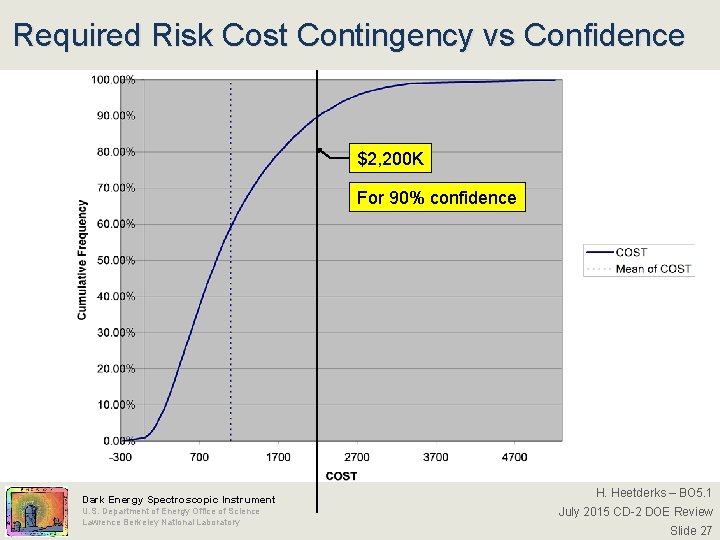
Required Risk Cost Contingency vs Confidence $2, 200 K For 90% confidence Dark Energy Spectroscopic Instrument U. S. Department of Energy Office of Science Lawrence Berkeley National Laboratory H. Heetderks – BO 5. 1 July 2015 CD-2 DOE Review Slide 27
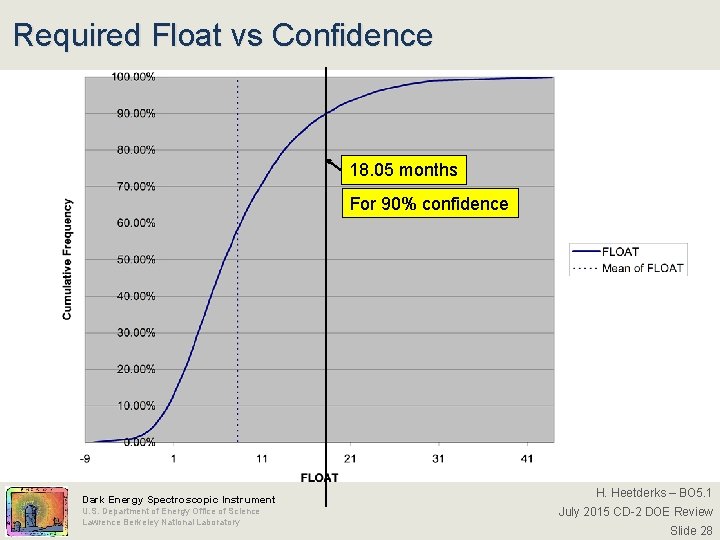
Required Float vs Confidence 18. 05 months For 90% confidence Dark Energy Spectroscopic Instrument U. S. Department of Energy Office of Science Lawrence Berkeley National Laboratory H. Heetderks – BO 5. 1 July 2015 CD-2 DOE Review Slide 28
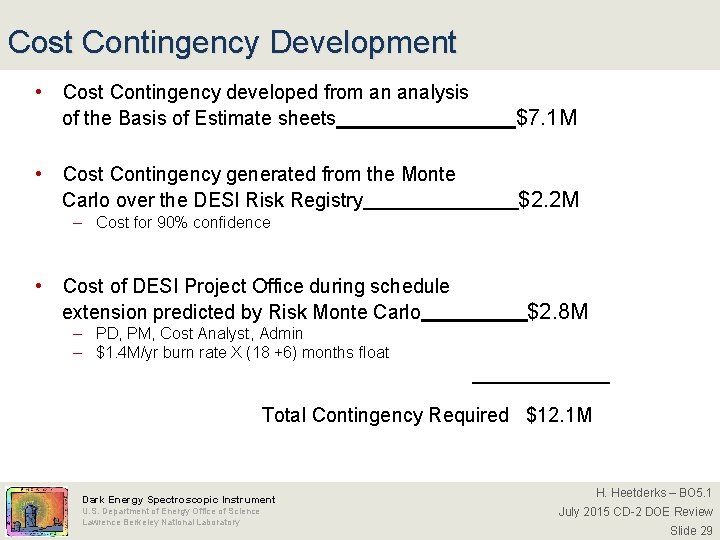
Cost Contingency Development • • Cost Contingency developed from an analysis of the Basis of Estimate sheets $7. 1 M Cost Contingency generated from the Monte Carlo over the DESI Risk Registry $2. 2 M – Cost for 90% confidence • Cost of DESI Project Office during schedule extension predicted by Risk Monte Carlo $2. 8 M – PD, PM, Cost Analyst, Admin – $1. 4 M/yr burn rate X (18 +6) months float _______ Total Contingency Required $12. 1 M Dark Energy Spectroscopic Instrument U. S. Department of Energy Office of Science Lawrence Berkeley National Laboratory H. Heetderks – BO 5. 1 July 2015 CD-2 DOE Review Slide 29
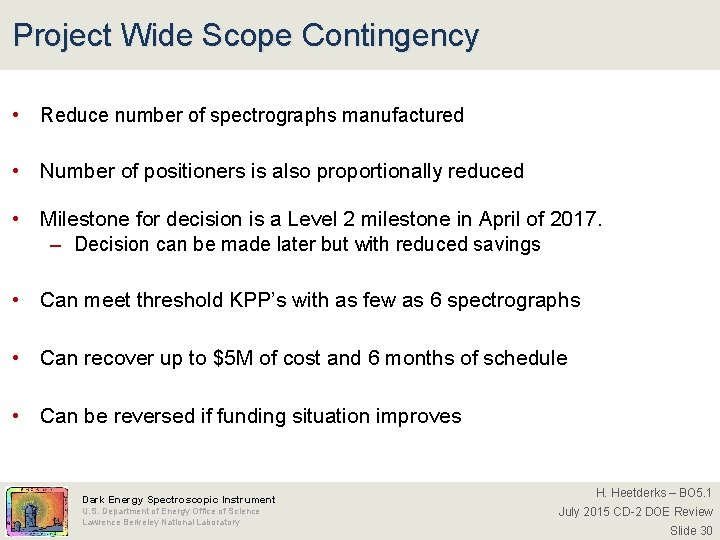
Project Wide Scope Contingency • Reduce number of spectrographs manufactured • Number of positioners is also proportionally reduced • Milestone for decision is a Level 2 milestone in April of 2017. – Decision can be made later but with reduced savings • Can meet threshold KPP’s with as few as 6 spectrographs • Can recover up to $5 M of cost and 6 months of schedule • Can be reversed if funding situation improves Dark Energy Spectroscopic Instrument U. S. Department of Energy Office of Science Lawrence Berkeley National Laboratory H. Heetderks – BO 5. 1 July 2015 CD-2 DOE Review Slide 30
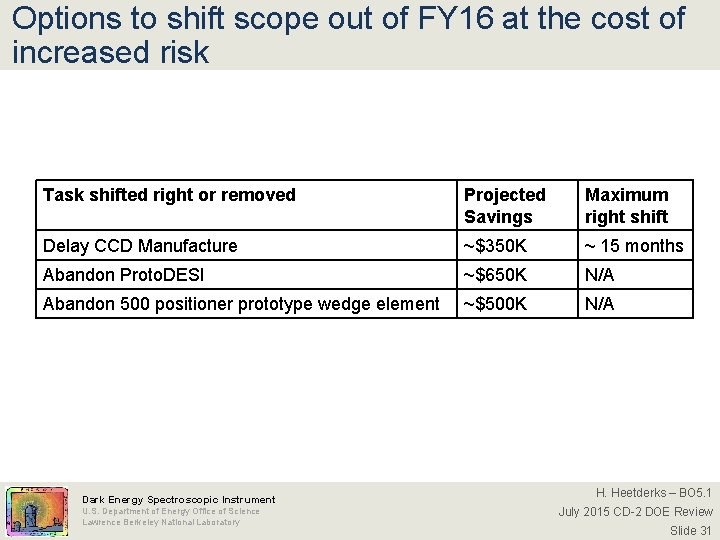
Options to shift scope out of FY 16 at the cost of increased risk Task shifted right or removed Projected Savings Maximum right shift Delay CCD Manufacture ~$350 K ~ 15 months Abandon Proto. DESI ~$650 K N/A Abandon 500 positioner prototype wedge element ~$500 K N/A Dark Energy Spectroscopic Instrument U. S. Department of Energy Office of Science Lawrence Berkeley National Laboratory H. Heetderks – BO 5. 1 July 2015 CD-2 DOE Review Slide 31
• Management Strategy • Earned Value Management System • Contingency Analysis • Major Procurements • Change Control • EH&S Process • Director’s Review Recommendations • Summary Dark Energy Spectroscopic Instrument U. S. Department of Energy Office of Science Lawrence Berkeley National Laboratory H. Heetderks – BO 5. 1 July 2015 CD-2 DOE Review Slide 32
Major Procurements of non-Federally funded equipment are well under way • Foundation, Foreign, and Collaborator funding has allowed DESI to initiate capital equipment fabrication ahead of CD-2 • Virtually all major procurements are either ready to be made or are already in process • Corrector glass boule procurement – Fused Silica blanks for C 1, C 2, C 3, C 4 --- Complete – N-BK 7 Blanks for ADC lenses ---- Fabrication complete; first one in shipment; the second is in test and expect to receive Sept 2015 • Corrector lens grinding and polishing – Grinding complete on C 1, C 2, C 3, C 4; polishing in process – ADC polishing vendor under contract waiting for first blank • Optical Fibre – Ready to purchase following extensive testing of fibre and coupling techniques Dark Energy Spectroscopic Instrument U. S. Department of Energy Office of Science Lawrence Berkeley National Laboratory H. Heetderks – BO 5. 1 July 2015 CD-2 DOE Review Slide 33
Major Procurements of non-Federally funded equipment are well under way • Corrector lens AR coating – RFP complete; in negotiations with apparent awardee complete; PO is imminent • Corrector Barrel Fabrication – Design complete; RFP for fabrication imminent • ADC rotator bearings – Custom bearing design – PO is in place • Hexapod manufacture – Requirements finalized; RFP imminent • Focal plate structure manufacture (petals and ring) – Final design nearly complete • Spectrograph cryostat mechanical fabrication (foreign in-kind contribution) – First prototype complete; on schedule for delivery of three units for the prototype spectrograph in 2016 May Dark Energy Spectroscopic Instrument U. S. Department of Energy Office of Science Lawrence Berkeley National Laboratory H. Heetderks – BO 5. 1 July 2015 CD-2 DOE Review Slide 34
Major Procurements of non-Federally funded equipment are well under way • Robotic fibre positioners (DOE with substantial university and foreign in-kind and cash contribution) – Final design complete and prototypes tested; production tooling in dev’t – DOE with contributions from U. Mich, and EPFL (Switzerland) • Spectrograph camera assemblies – Vendor is in late stages of prototype fabrication; final testing in 2015 October • Spectrograph bench and integration – Vendor under contract to complete prototype spectrograph; completes in 2016 August – Production Spectrograph PO will be placed in 2016 October using $2. 5 M investment from Heising-Simons foundation Dark Energy Spectroscopic Instrument U. S. Department of Energy Office of Science Lawrence Berkeley National Laboratory H. Heetderks – BO 5. 1 July 2015 CD-2 DOE Review Slide 35
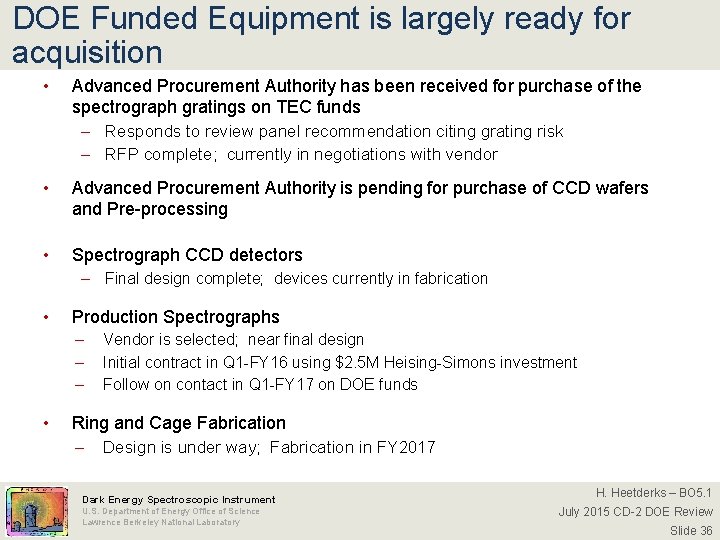
DOE Funded Equipment is largely ready for acquisition • Advanced Procurement Authority has been received for purchase of the spectrograph gratings on TEC funds – Responds to review panel recommendation citing grating risk – RFP complete; currently in negotiations with vendor • Advanced Procurement Authority is pending for purchase of CCD wafers and Pre-processing • Spectrograph CCD detectors – Final design complete; devices currently in fabrication • Production Spectrographs – – – • Vendor is selected; near final design Initial contract in Q 1 -FY 16 using $2. 5 M Heising-Simons investment Follow on contact in Q 1 -FY 17 on DOE funds Ring and Cage Fabrication – Design is under way; Fabrication in FY 2017 Dark Energy Spectroscopic Instrument U. S. Department of Energy Office of Science Lawrence Berkeley National Laboratory H. Heetderks – BO 5. 1 July 2015 CD-2 DOE Review Slide 36
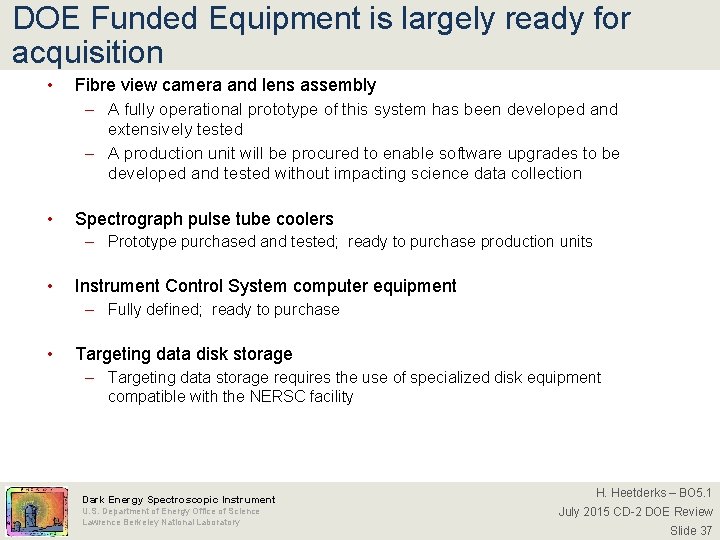
DOE Funded Equipment is largely ready for acquisition • Fibre view camera and lens assembly – A fully operational prototype of this system has been developed and extensively tested – A production unit will be procured to enable software upgrades to be developed and tested without impacting science data collection • Spectrograph pulse tube coolers – Prototype purchased and tested; ready to purchase production units • Instrument Control System computer equipment – Fully defined; ready to purchase • Targeting data disk storage – Targeting data storage requires the use of specialized disk equipment compatible with the NERSC facility Dark Energy Spectroscopic Instrument U. S. Department of Energy Office of Science Lawrence Berkeley National Laboratory H. Heetderks – BO 5. 1 July 2015 CD-2 DOE Review Slide 37
• Management Strategy • Earned Value Management System • Contingency Analysis • Major Procurements • Change Control • EH&S Process • Director’s Review Recommendations • Summary Dark Energy Spectroscopic Instrument U. S. Department of Energy Office of Science Lawrence Berkeley National Laboratory H. Heetderks – BO 5. 1 July 2015 CD-2 DOE Review Slide 38
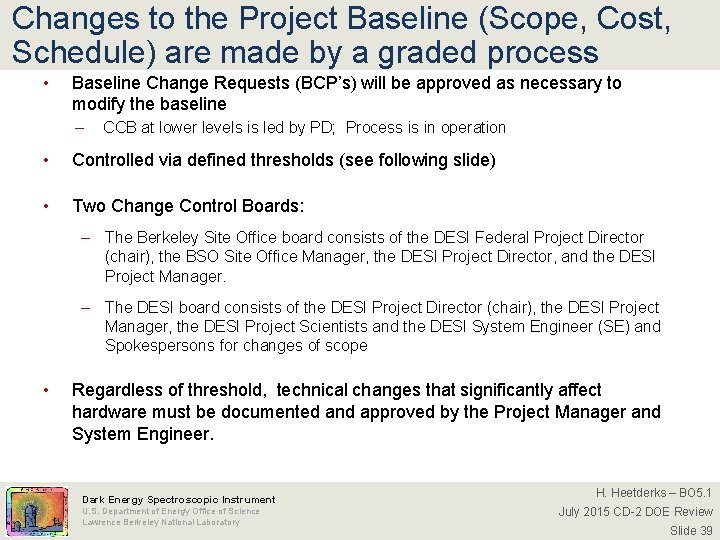
Changes to the Project Baseline (Scope, Cost, Schedule) are made by a graded process • Baseline Change Requests (BCP’s) will be approved as necessary to modify the baseline – CCB at lower levels is led by PD; Process is in operation • Controlled via defined thresholds (see following slide) • Two Change Control Boards: – The Berkeley Site Office board consists of the DESI Federal Project Director (chair), the BSO Site Office Manager, the DESI Project Director, and the DESI Project Manager. – The DESI board consists of the DESI Project Director (chair), the DESI Project Manager, the DESI Project Scientists and the DESI System Engineer (SE) and Spokespersons for changes of scope • Regardless of threshold, technical changes that significantly affect hardware must be documented and approved by the Project Manager and System Engineer. Dark Energy Spectroscopic Instrument U. S. Department of Energy Office of Science Lawrence Berkeley National Laboratory H. Heetderks – BO 5. 1 July 2015 CD-2 DOE Review Slide 39
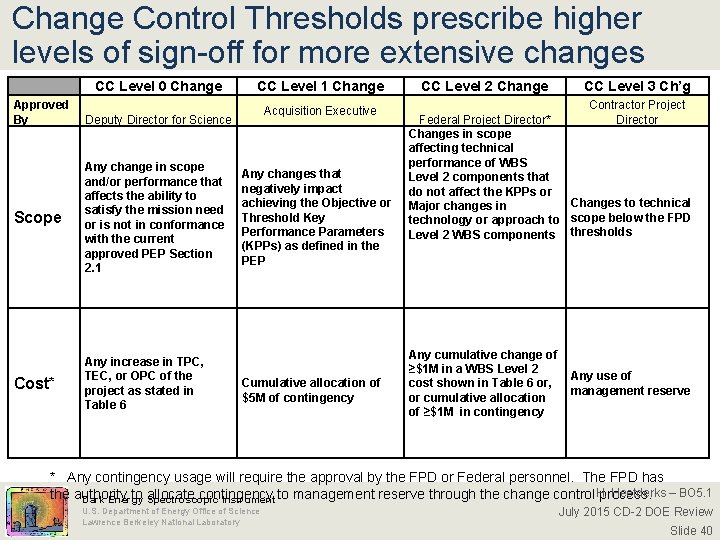
Change Control Thresholds prescribe higher levels of sign-off for more extensive changes CC Level 0 Change Approved By CC Level 1 Change Acquisition Executive Deputy Director for Science Scope Any change in scope and/or performance that affects the ability to satisfy the mission need or is not in conformance with the current approved PEP Section 2. 1 Cost* Any increase in TPC, TEC, or OPC of the project as stated in Table 6 Any changes that negatively impact achieving the Objective or Threshold Key Performance Parameters (KPPs) as defined in the PEP Cumulative allocation of $5 M of contingency CC Level 2 Change CC Level 3 Ch’g Contractor Project Federal Project Director* Director Changes in scope affecting technical performance of WBS Level 2 components that do not affect the KPPs or Changes to technical Major changes in technology or approach to scope below the FPD Level 2 WBS components thresholds Any cumulative change of ≥$1 M in a WBS Level 2 cost shown in Table 6 or, or cumulative allocation of ≥$1 M in contingency Any use of management reserve * Any contingency usage will require the approval by the FPD or Federal personnel. The FPD has H. Heetderks – BO 5. 1 the authority to allocate contingency Dark Energy Spectroscopic Instrument to management reserve through the change control process. U. S. Department of Energy Office of Science Lawrence Berkeley National Laboratory July 2015 CD-2 DOE Review Slide 40
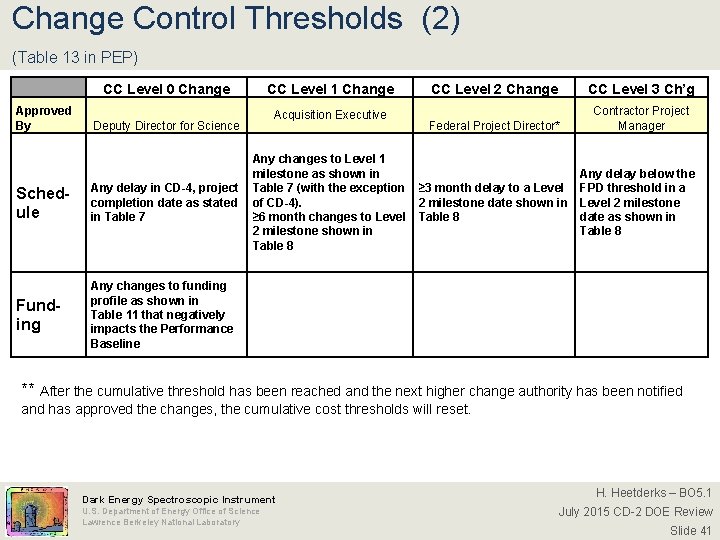
Change Control Thresholds (2) (Table 13 in PEP) CC Level 0 Change Approved By CC Level 1 Change Acquisition Executive Deputy Director for Science Schedule Any delay in CD-4, project completion date as stated in Table 7 Funding Any changes to funding profile as shown in Table 11 that negatively impacts the Performance Baseline Any changes to Level 1 milestone as shown in Table 7 (with the exception of CD-4). ≥ 6 month changes to Level 2 milestone shown in Table 8 CC Level 2 Change CC Level 3 Ch’g Federal Project Director* Contractor Project Manager ≥ 3 month delay to a Level 2 milestone date shown in Table 8 Any delay below the FPD threshold in a Level 2 milestone date as shown in Table 8 ** After the cumulative threshold has been reached and the next higher change authority has been notified and has approved the changes, the cumulative cost thresholds will reset. Dark Energy Spectroscopic Instrument U. S. Department of Energy Office of Science Lawrence Berkeley National Laboratory H. Heetderks – BO 5. 1 July 2015 CD-2 DOE Review Slide 41
• Management Strategy • Earned Value Management System • Risk Management • Contingency Analysis • Major Procurements • Change Control • EH&S Process • Director’s Review Recommendations • Summary Dark Energy Spectroscopic Instrument U. S. Department of Energy Office of Science Lawrence Berkeley National Laboratory H. Heetderks – BO 5. 1 July 2015 CD-2 DOE Review Slide 42
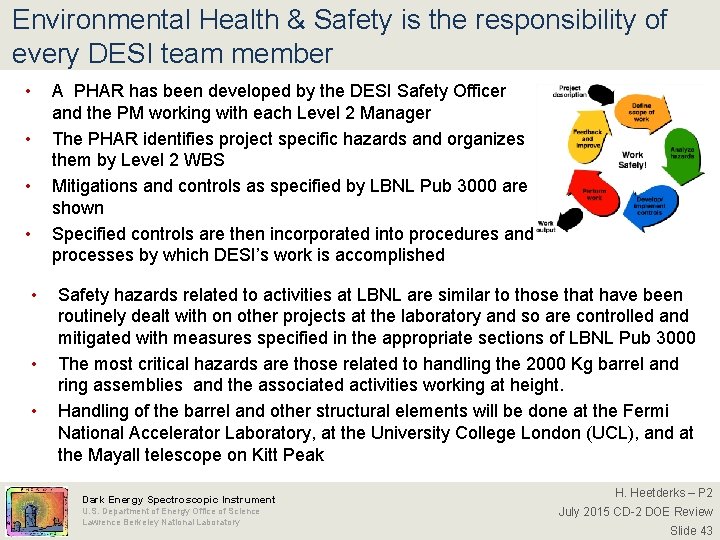
Environmental Health & Safety is the responsibility of every DESI team member • A PHAR has been developed by the DESI Safety Officer and the PM working with each Level 2 Manager The PHAR identifies project specific hazards and organizes them by Level 2 WBS Mitigations and controls as specified by LBNL Pub 3000 are shown Specified controls are then incorporated into procedures and processes by which DESI’s work is accomplished • • • Safety hazards related to activities at LBNL are similar to those that have been routinely dealt with on other projects at the laboratory and so are controlled and mitigated with measures specified in the appropriate sections of LBNL Pub 3000 The most critical hazards are those related to handling the 2000 Kg barrel and ring assemblies and the associated activities working at height. Handling of the barrel and other structural elements will be done at the Fermi National Accelerator Laboratory, at the University College London (UCL), and at the Mayall telescope on Kitt Peak Dark Energy Spectroscopic Instrument U. S. Department of Energy Office of Science Lawrence Berkeley National Laboratory H. Heetderks – P 2 July 2015 CD-2 DOE Review Slide 43
At other venues local safety rules apply • Barrel sections and other structural elements will first be measured and assembled at FNAL. The FNAL safety office works with the FNAL technical management to ensure that proper handling procedures are developed and followed. • Assembly of the barrel sections and installation and alignment of the lenses will occur at UCL. The University has an active safety program with a safety officer assigned to the DESI project. • The completed corrector and other structural elements will be transported to Kitt Peak (KNPO) where they will be installed into the Mayall telescope. • Lifting of the structural elements and the corrector into the telescope is the most hazardous operation that will be performed on the DESI project – Marty White, the LBNL Safety Officer, maintains close relationship with KNPO Safety Officer, Tammie Lavoie (Talk in BO 5. 5) Dark Energy Spectroscopic Instrument U. S. Department of Energy Office of Science Lawrence Berkeley National Laboratory H. Heetderks – P 2 July 2015 CD-2 DOE Review Slide 44
At the LBNL, Personnel Safety and Machine Protection (Equipment Safety) are handled in separate programs • LBNL Pub-3000 is defining document for personnel safety • LBNL Pub-3111 specifies requirements on machine protection • Equipment Safety for Desi is addressed as part of the System Engineering task • DESI-0928 defines the plan for ensuring that DESI equipment is properly protected – Specifies the hazard analysis process – Defines impact definitions – Lists risk reduction and mitigation methods • DESI-1331 contains the Machine Protection Hazard Registry • Level 2 managers will include a discussion of machine protection in their breakout talks Dark Energy Spectroscopic Instrument U. S. Department of Energy Office of Science Lawrence Berkeley National Laboratory H. Heetderks – P 2 July 2015 CD-2 DOE Review Slide 45
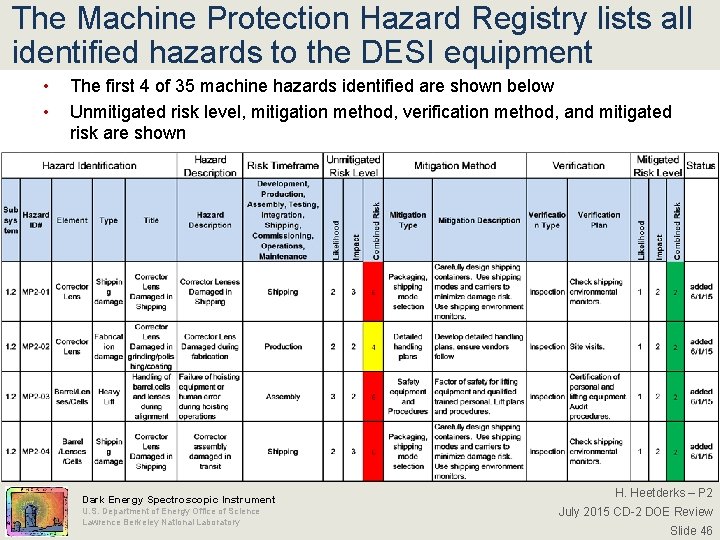
The Machine Protection Hazard Registry lists all identified hazards to the DESI equipment • • The first 4 of 35 machine hazards identified are shown below Unmitigated risk level, mitigation method, verification method, and mitigated risk are shown Dark Energy Spectroscopic Instrument U. S. Department of Energy Office of Science Lawrence Berkeley National Laboratory H. Heetderks – P 2 July 2015 CD-2 DOE Review Slide 46
• Management Strategy • Earned Value Management System • Risk Management • Contingency Analysis • Major Procurements • Change Control • EH&S Process • Director’s Review Recommendations • Summary Dark Energy Spectroscopic Instrument U. S. Department of Energy Office of Science Lawrence Berkeley National Laboratory H. Heetderks – BO 5. 1 July 2015 CD-2 DOE Review Slide 47
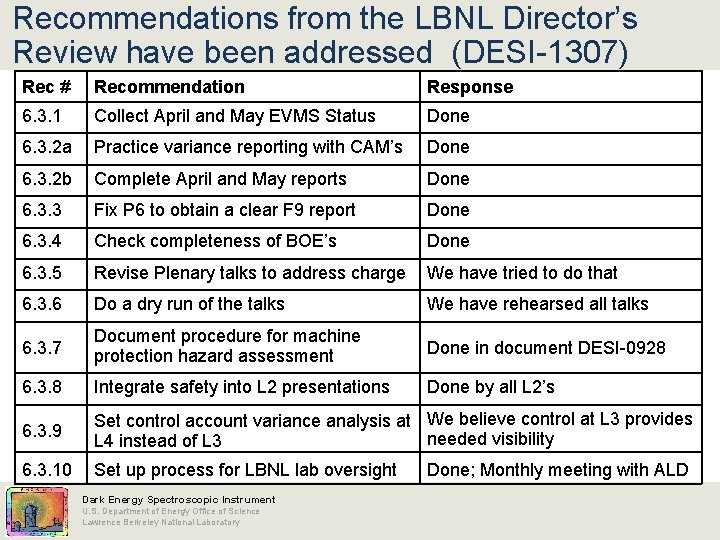
Recommendations from the LBNL Director’s Review have been addressed (DESI-1307) Rec # Recommendation Response 6. 3. 1 Collect April and May EVMS Status Done 6. 3. 2 a Practice variance reporting with CAM’s Done 6. 3. 2 b Complete April and May reports Done 6. 3. 3 Fix P 6 to obtain a clear F 9 report Done 6. 3. 4 Check completeness of BOE’s Done 6. 3. 5 Revise Plenary talks to address charge We have tried to do that 6. 3. 6 Do a dry run of the talks We have rehearsed all talks 6. 3. 7 Document procedure for machine protection hazard assessment Done in document DESI-0928 6. 3. 8 Integrate safety into L 2 presentations Done by all L 2’s 6. 3. 9 Set control account variance analysis at We believe control at L 3 provides needed visibility L 4 instead of L 3 6. 3. 10 Set up process for LBNL lab oversight Dark Energy Spectroscopic Instrument U. S. Department of Energy Office of Science Lawrence Berkeley National Laboratory Done; Monthly meeting with ALD
• Management Strategy • Earned Value Management System • Risk Management • Contingency Analysis • Major Procurements • Change Control • EH&S Process • Director’s Review Recommendations • Summary Dark Energy Spectroscopic Instrument U. S. Department of Energy Office of Science Lawrence Berkeley National Laboratory H. Heetderks – BO 5. 1 July 2015 CD-2 DOE Review Slide 49
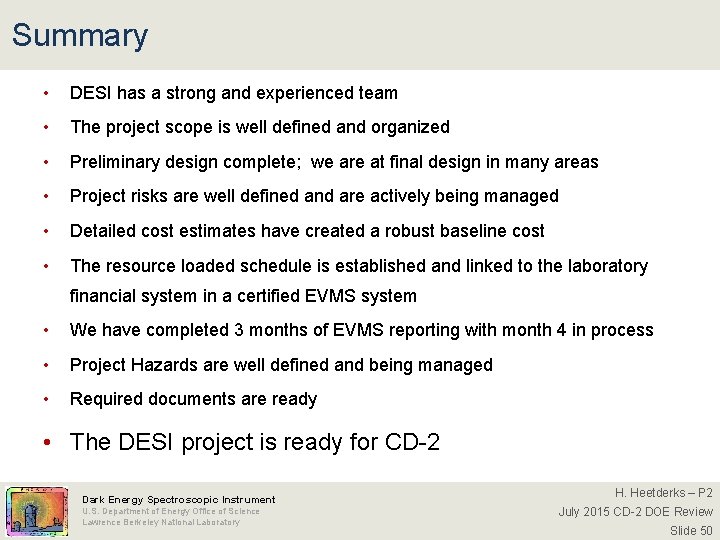
Summary • DESI has a strong and experienced team • The project scope is well defined and organized • Preliminary design complete; we are at final design in many areas • Project risks are well defined and are actively being managed • Detailed cost estimates have created a robust baseline cost • The resource loaded schedule is established and linked to the laboratory financial system in a certified EVMS system • We have completed 3 months of EVMS reporting with month 4 in process • Project Hazards are well defined and being managed • Required documents are ready • The DESI project is ready for CD-2 Dark Energy Spectroscopic Instrument U. S. Department of Energy Office of Science Lawrence Berkeley National Laboratory H. Heetderks – P 2 July 2015 CD-2 DOE Review Slide 50
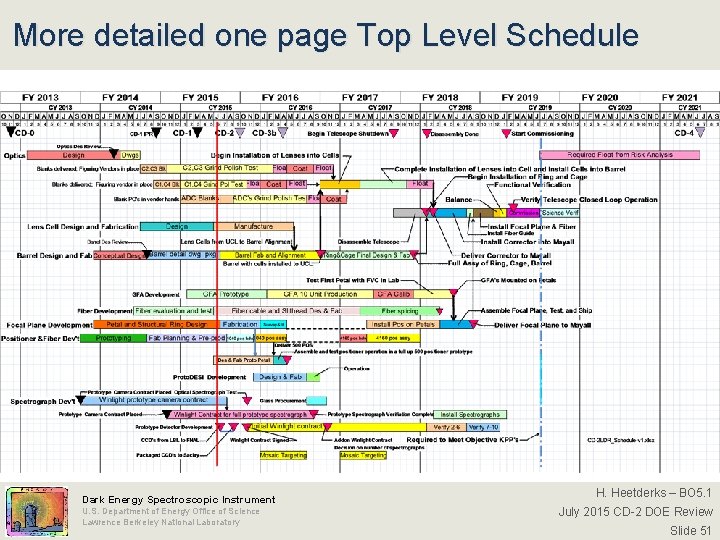
More detailed one page Top Level Schedule Dark Energy Spectroscopic Instrument U. S. Department of Energy Office of Science Lawrence Berkeley National Laboratory H. Heetderks – BO 5. 1 July 2015 CD-2 DOE Review Slide 51
- Slides: 52