
UVVisible Spectroscopy Part 4 Analytical chemistry III B
UV-Visible Spectroscopy Part – 4 Analytical chemistry III B. Sc, semester - 5, paper - 6 Vijaya Lakshmi Sada Guest faculty P. R. Govt. College (A), kakinada
contents ØSingle Beam Spectrophotometer ØDouble Beam Spectrophotometer ØDifference Between Single Beam and Double Beam Spectrophotometer ØSummary – Single Beam vs Double Beam Spectrophotometer ØApplications
Single Beam Spectrophotometer • Single beam spectrophotometer is an analytical instrument in which all the light waves coming from the light source passes through the sample. Therefore, the measurements are taken as the intensity of light before and after the light pass through the sample. These single beam spectrophotometers are more compact and optically simpler than double beam spectrophotometers. And also these instruments are less expensive.
Single Beam Spectrophotometer • The sensitivity of detection of the light beam after it passes through the sample is high since it uses a non-split light beam (therefore, high energy exists throughout). Single beam spectrophotometers are available in analysis at visible and ultraviolet wavelength ranges. • A single beam spectrophotometer measures the concentration of an analyte in a sample by measuring the amount of light absorbed by that analyte. Here, the Beer Lambert Law comes into operation. This law states that the concentration of an analyte is directly proportional to the absorbance.
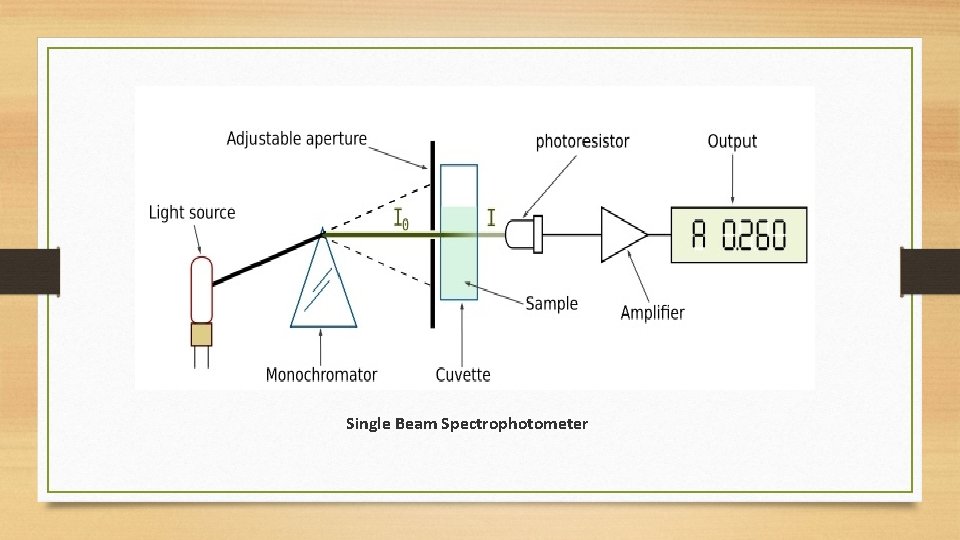
Single Beam Spectrophotometer
Double Beam Spectrophotometer: • Double beam spectrophotometer is an analytical instrument in which the light beam coming from the light source splits into two fractions. One fraction acts as the reference (the reference beam) while the other fraction passes through the sample (sample beam). As a result, the reference beam does not pass through the sample
Double Beam Spectrophotometer: • The sample beam can measure the absorbance of the sample. The reference beam can measure the absorption (the sample beam can be compared with the reference beam). Therefore, the absorption is the ratio between the sample beam (after passing through the sample) and a reference beam. A spectrophotometer has a monochromator that isolates the desired wavelengths from a light beam. The reference beam and sample beam recombine before moving to the monochromator. Consequently, this avoids or compensate the electronic and mechanical effects on both sample and reference beams, equally.
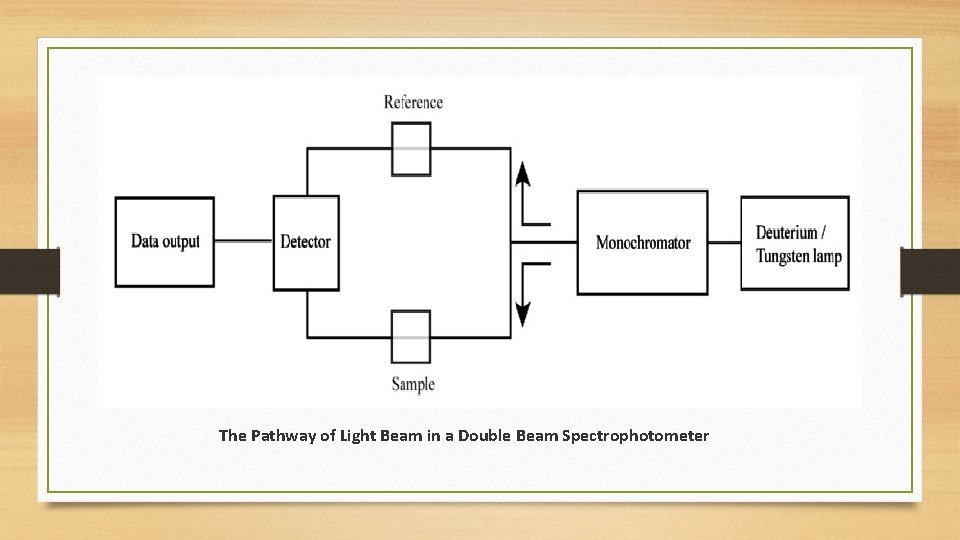
The Pathway of Light Beam in a Double Beam Spectrophotometer

Difference Between Single Beam and Double Beam Spectrophotometer Single Beam vs Double Beam Spectrophotometer Single beam spectrophotometer is an analytical instrument in which all the light waves coming from the light source passes through the sample. Double beam spectrophotometer is an analytical instrument in which the light beam coming from the light source splits into two fractions.

Difference Between Single Beam and Double Beam Spectrophotometer Light Beam Single beam spectrophotometer uses a non-split light beam. Double beam spectrophotometer uses a light beam that is split into two fractions before passing through the sample.

Difference Between Single Beam and Double Beam Spectrophotometer Measurement The measurements taken from The measurements taken double beam from single beam spectrophotometers are highly spectrophotometers are less reproducible because electronic reproducible because a single and mechanical effects on both light beam is used. sample and reference beams are equal.

Summary – Single Beam vs Double Beam Spectrophotometer • A spectrophotometer is an instrument that analyses the components of a solution by observing the capability to absorb light. There are two main types of spectrophotometers; single beam and double beam spectrophotometer. The difference between single beam and double beam spectrophotometer is that, in single beam spectrophotometer, all the light waves pass through the sample whereas, in double beam spectrophotometer, the light beam splits into two parts and only one part passes through the sample.
Applications: 1. Detection of Impurities • It is one of the best methods for determination of impurities in organic molecules. • Additional peaks can be observed due to impurities in the sample and it can be compared with that of standard raw material. • By also measuring the absorbance at specific wavelength, the impurities can be detected.
Applications: 2. Structure elucidation of organic compounds • It is useful in the structure elucidation of organic molecules, such as in detecting the presence or absence of unsaturation, the presence of hetero atoms. 3. UV absorption spectroscopy can be used for the quantitative determination of compounds that absorb UV radiation.
3. UV absorption spectroscopy can characterize those types of compounds which absorbs UV radiation thus used in qualitative determination of compounds. Identification is done by comparing the absorption spectrum with the spectra of known compounds. 4. This technique is used to detect the presence or absence of functional group in the compound. Absence of a band at particular wavelength regarded as an evidence for absence of particular group. 5. Kinetics of reaction can also be studied using UV spectroscopy. The UV radiation is passed through the reaction cell and the absorbance changes can be observed.
6. Kinetics of reaction can also be studied using UV spectroscopy. The UV radiation is passed through the reaction cell and the absorbance changes can be observed. 7. Many drugs are either in the form of raw material or in the form of formulation. They can be assayed by making a suitable solution of the drug in a solvent and measuring the absorbance at specific wavelength. 8. Molecular weights of compounds can be measured spectrophotometrically by preparing the suitable derivatives of these compounds. 9. UV spectrophotometer may be used as a detector for HPLC.

Thank you
- Slides: 17