
UVVisible Spectroscopy Part 2 Analytical chemistry III B
UV-Visible Spectroscopy Part – 2 Analytical chemistry III B. Sc, semester - 5, paper - 6 Vijaya Lakshmi Sada Guest faculty P. R. Govt. College (A), kakinada

content Ø Beer's and Lambert's Law
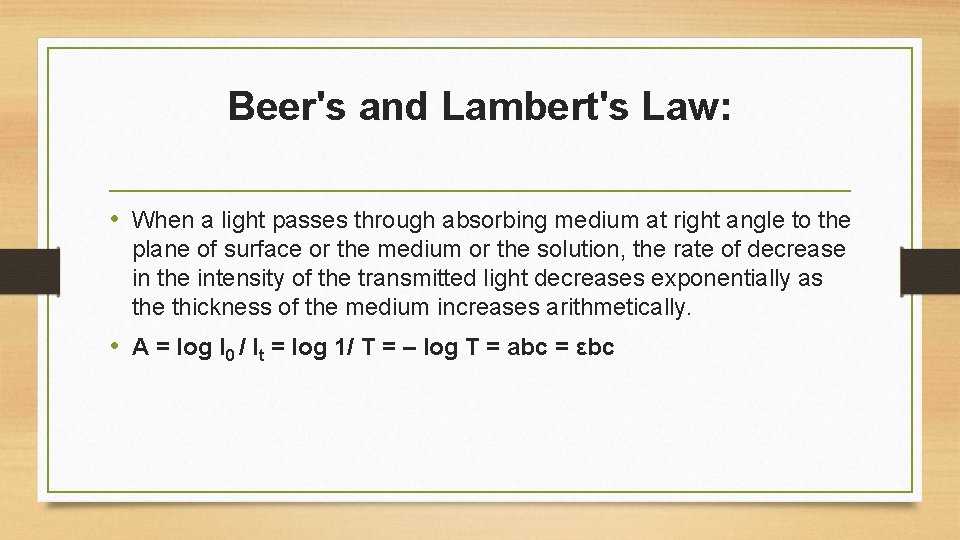
Beer's and Lambert's Law: • When a light passes through absorbing medium at right angle to the plane of surface or the medium or the solution, the rate of decrease in the intensity of the transmitted light decreases exponentially as the thickness of the medium increases arithmetically. • A = log I 0 / It = log 1/ T = – log T = abc = εbc
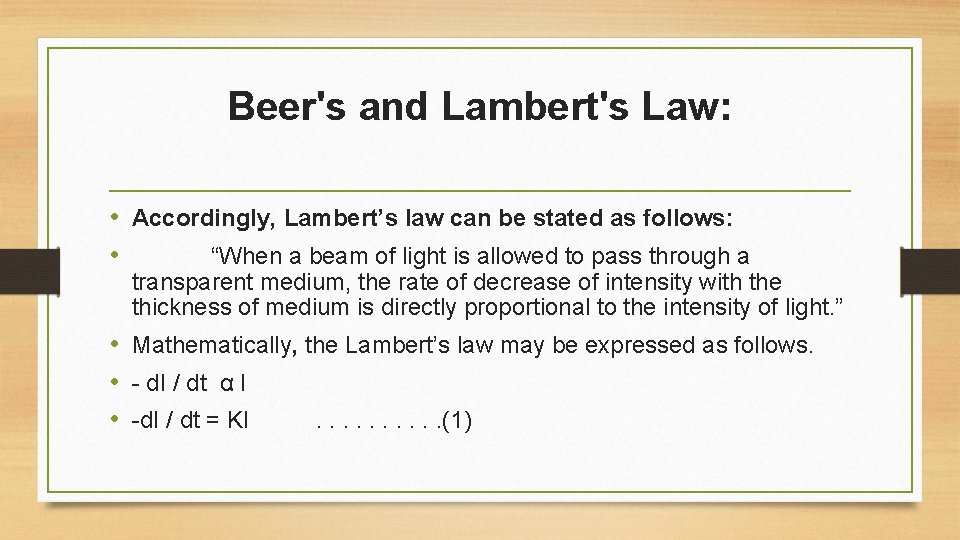
Beer's and Lambert's Law: • Accordingly, Lambert’s law can be stated as follows: • “When a beam of light is allowed to pass through a transparent medium, the rate of decrease of intensity with the thickness of medium is directly proportional to the intensity of light. ” • Mathematically, the Lambert’s law may be expressed as follows. • - d. I / dt α I • -d. I / dt = KI. . (1)
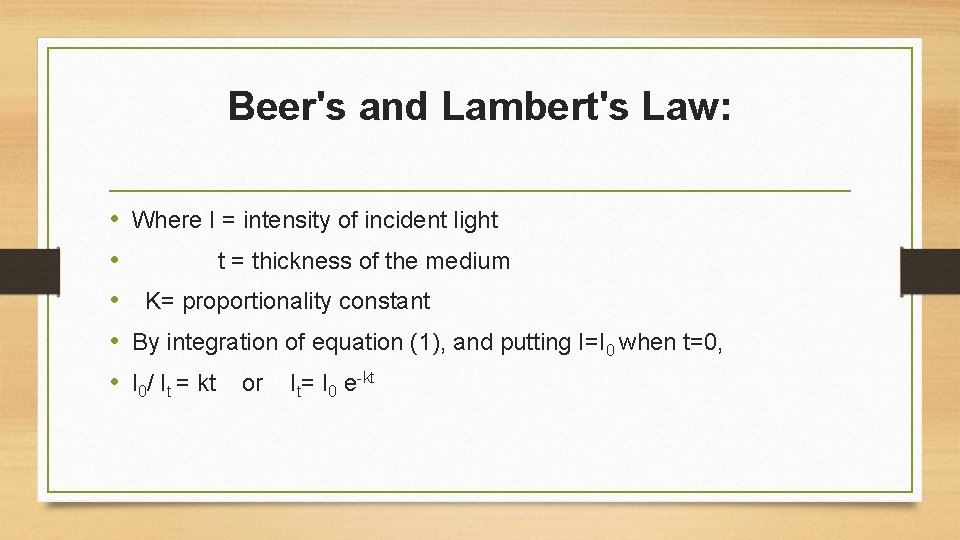
Beer's and Lambert's Law: • • • Where I = intensity of incident light t = thickness of the medium K= proportionality constant By integration of equation (1), and putting I=I 0 when t=0, I 0/ It = kt or It= I 0 e-kt
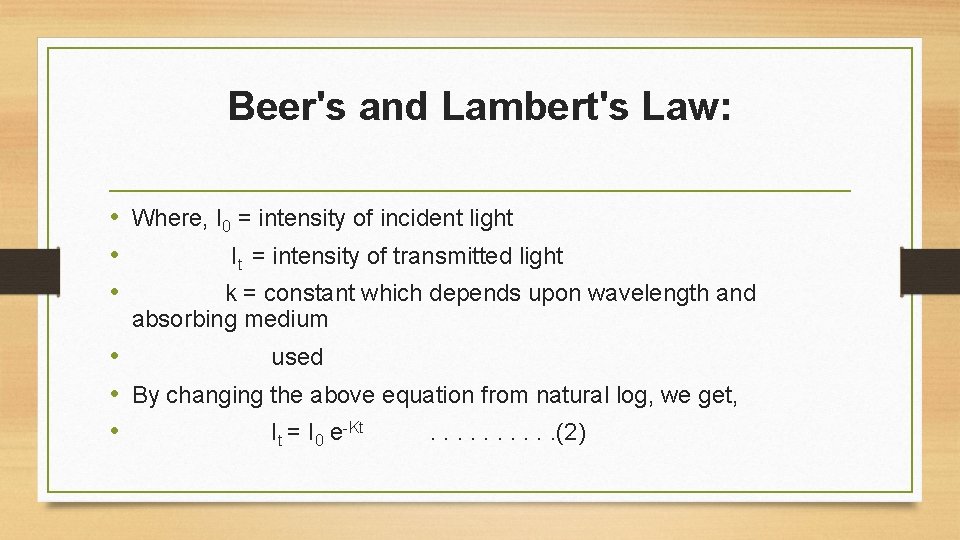
Beer's and Lambert's Law: • Where, I 0 = intensity of incident light • It = intensity of transmitted light • k = constant which depends upon wavelength and absorbing medium • used • By changing the above equation from natural log, we get, • It = I 0 e-Kt. . (2)
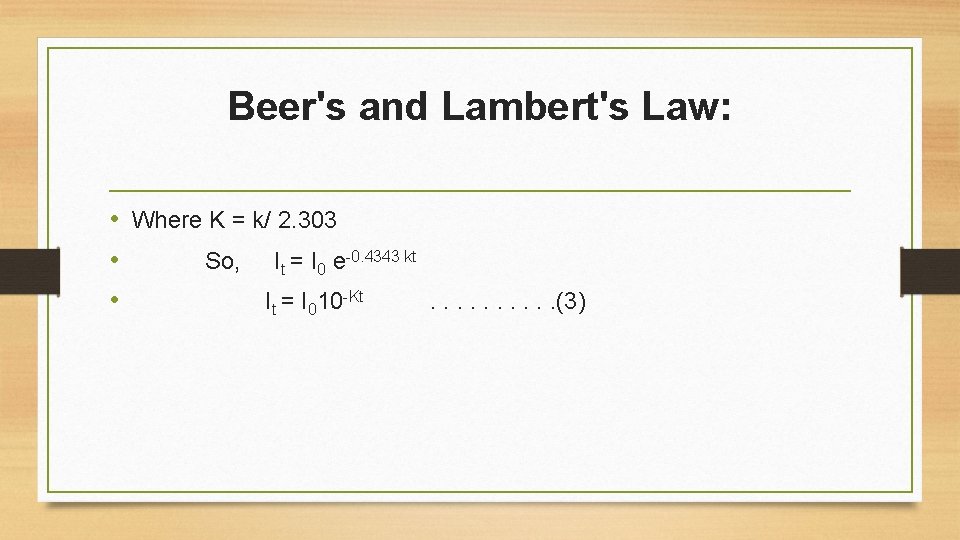
Beer's and Lambert's Law: • Where K = k/ 2. 303 • So, It = I 0 e-0. 4343 kt • It = I 010 -Kt. . (3)
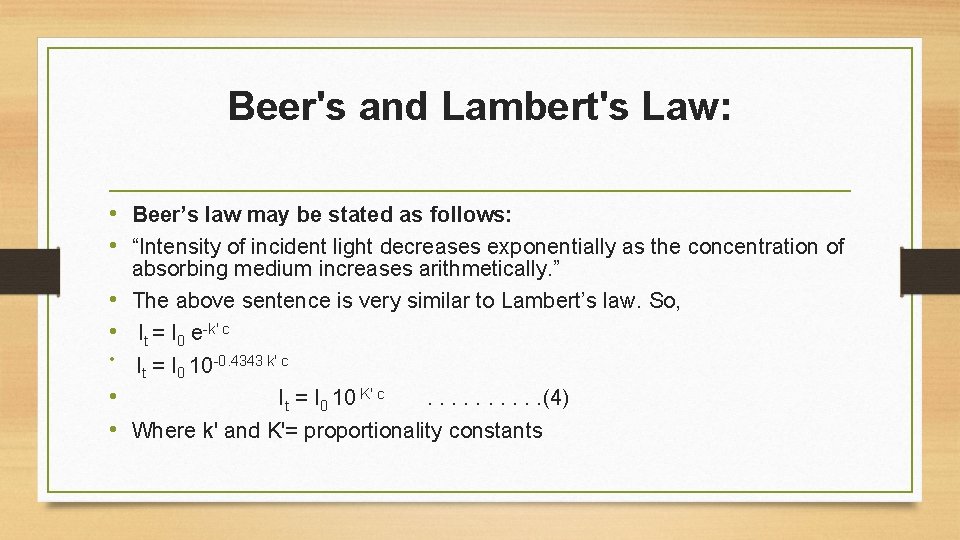
Beer's and Lambert's Law: • Beer’s law may be stated as follows: • “Intensity of incident light decreases exponentially as the concentration of • • • absorbing medium increases arithmetically. ” The above sentence is very similar to Lambert’s law. So, It = I 0 e-k' c It = I 0 10 -0. 4343 k' c It = I 0 10 K' c. . (4) Where k' and K'= proportionality constants
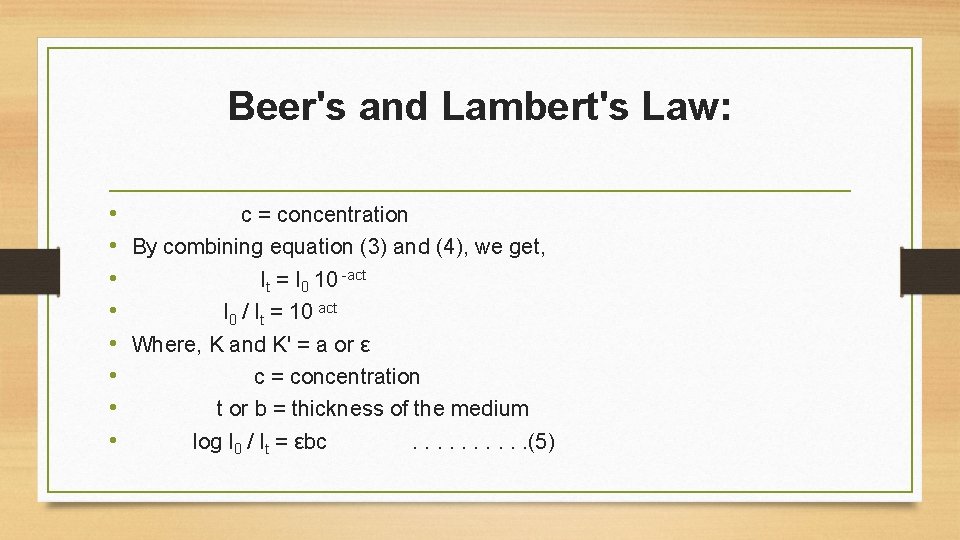
Beer's and Lambert's Law: • c = concentration • By combining equation (3) and (4), we get, • It = I 0 10 -act • I 0 / It = 10 act • Where, K and K' = a or ε • c = concentration • t or b = thickness of the medium • log I 0 / It = εbc. . (5)
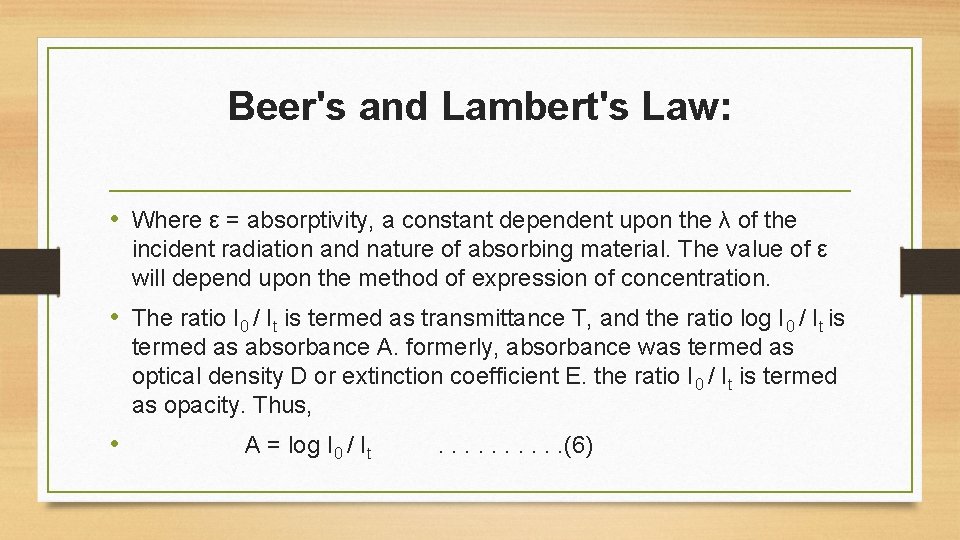
Beer's and Lambert's Law: • Where ε = absorptivity, a constant dependent upon the λ of the incident radiation and nature of absorbing material. The value of ε will depend upon the method of expression of concentration. • The ratio I 0 / It is termed as transmittance T, and the ratio log I 0 / It is termed as absorbance A. formerly, absorbance was termed as optical density D or extinction coefficient E. the ratio I 0 / It is termed as opacity. Thus, • A = log I 0 / It . . (6)

Beer's and Lambert's Law: • From equation (5) and (6), • A = εbc. . (7) • Thus, absorbance is the product of absorptivity, optical path length and the concentration of the solution. • The term E 1%1 cm or A 1%1 cm refers to the absorbance of 1 cm layer of the solution whose concentration is 1 % at a specified λ. • According to equation (7),
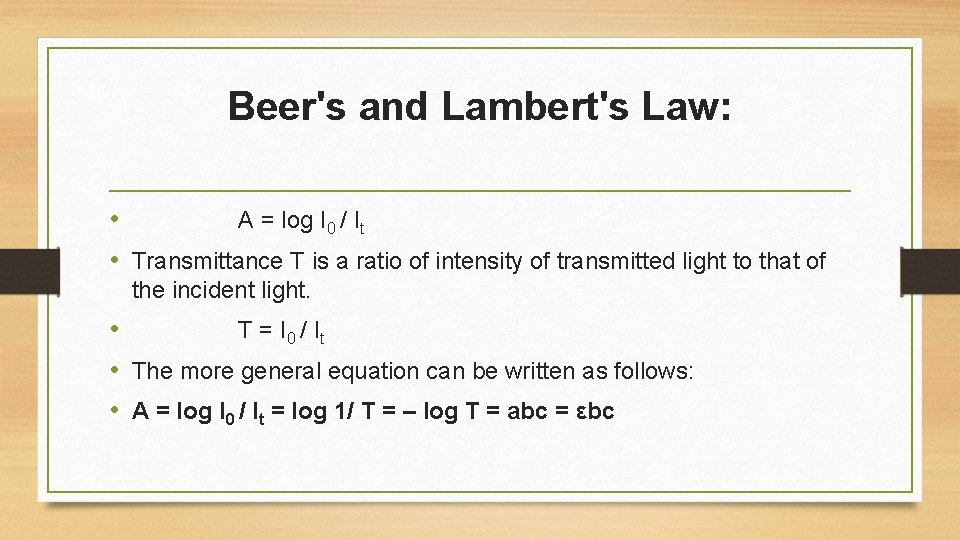
Beer's and Lambert's Law: • A = log I 0 / It • Transmittance T is a ratio of intensity of transmitted light to that of the incident light. • T = I 0 / It • The more general equation can be written as follows: • A = log I 0 / It = log 1/ T = – log T = abc = εbc

Thank you
- Slides: 13