
UVVis remote sensing instruments Retrieval and satellite validation
- Slides: 26
UV-Vis remote sensing instruments - Retrieval and satellite validation M. Van Roozendael (BIRA-IASB)
Content • Passive UV-Vis DOAS instruments • Retrieval methods • Networks • Satellite validation (Sentinel-5 p) • Conclusions and perspectives M. Van Roozendael Second Joint School on Atmospheric Composition - 16 -20 Nov. 2020 2
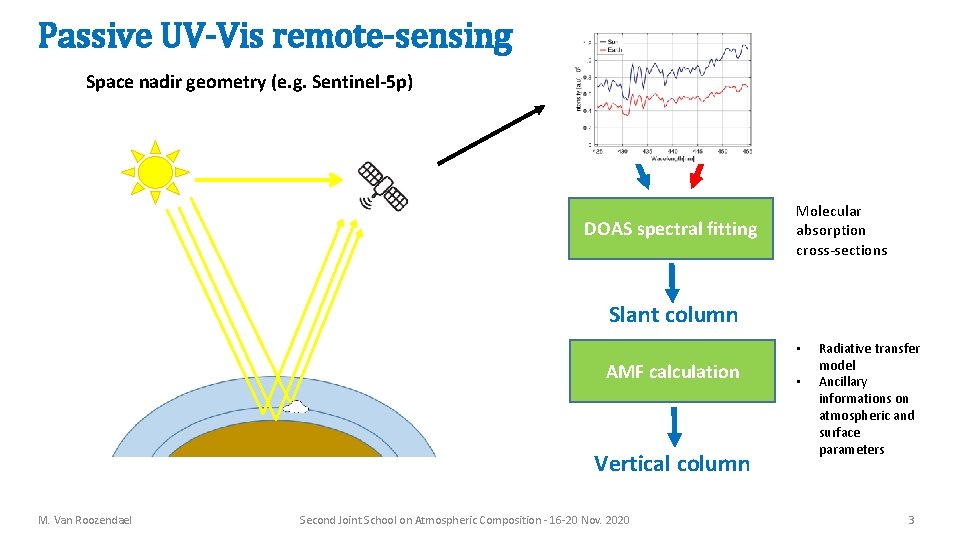
Passive UV-Vis remote-sensing Space nadir geometry (e. g. Sentinel-5 p) DOAS spectral fitting Molecular absorption cross-sections Slant column • AMF calculation Vertical column M. Van Roozendael Second Joint School on Atmospheric Composition - 16 -20 Nov. 2020 • Radiative transfer model Ancillary informations on atmospheric and surface parameters 3
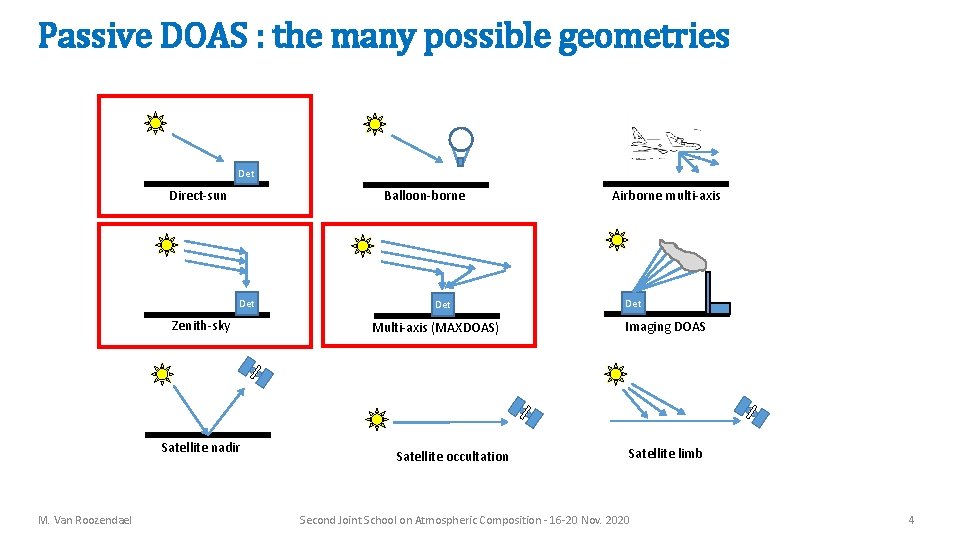
Passive DOAS : the many possible geometries Det Direct-sun Balloon-borne Det Zenith-sky Satellite nadir M. Van Roozendael Det Multi-axis (MAXDOAS) Satellite occultation Airborne multi-axis Det Imaging DOAS Satellite limb Second Joint School on Atmospheric Composition - 16 -20 Nov. 2020 4
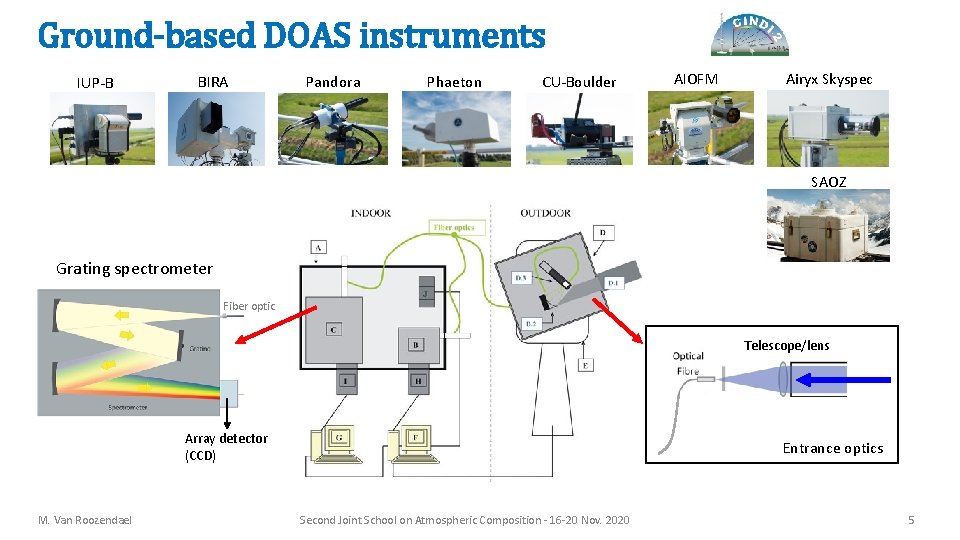
Ground-based DOAS instruments IUP-B BIRA Pandora Phaeton CU-Boulder AIOFM Airyx Skyspec SAOZ Grating spectrometer Fiber optic Telescope/lens Array detector (CCD) M. Van Roozendael Entrance optics Second Joint School on Atmospheric Composition - 16 -20 Nov. 2020 5
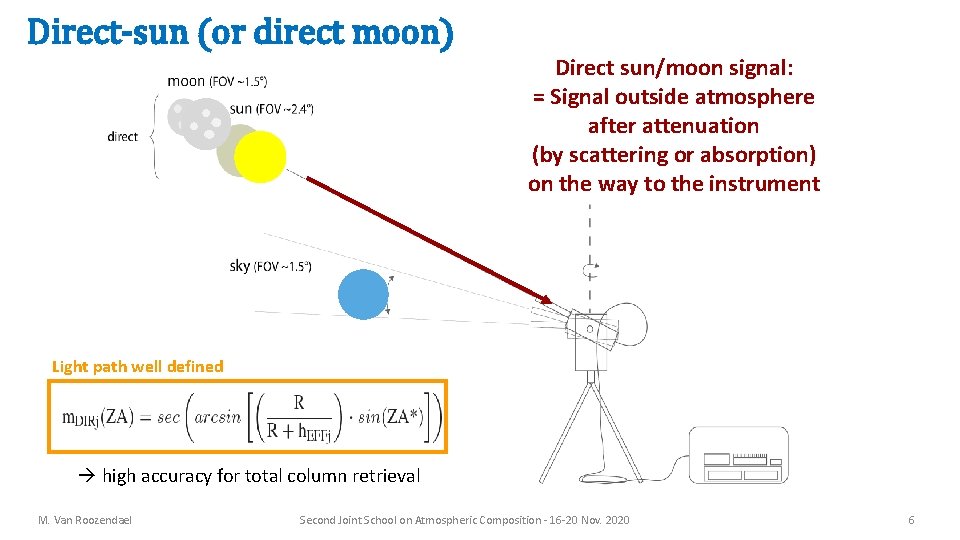
Direct-sun (or direct moon) Direct sun/moon signal: = Signal outside atmosphere after attenuation (by scattering or absorption) on the way to the instrument Light path well defined high accuracy for total column retrieval M. Van Roozendael Second Joint School on Atmospheric Composition - 16 -20 Nov. 2020 6
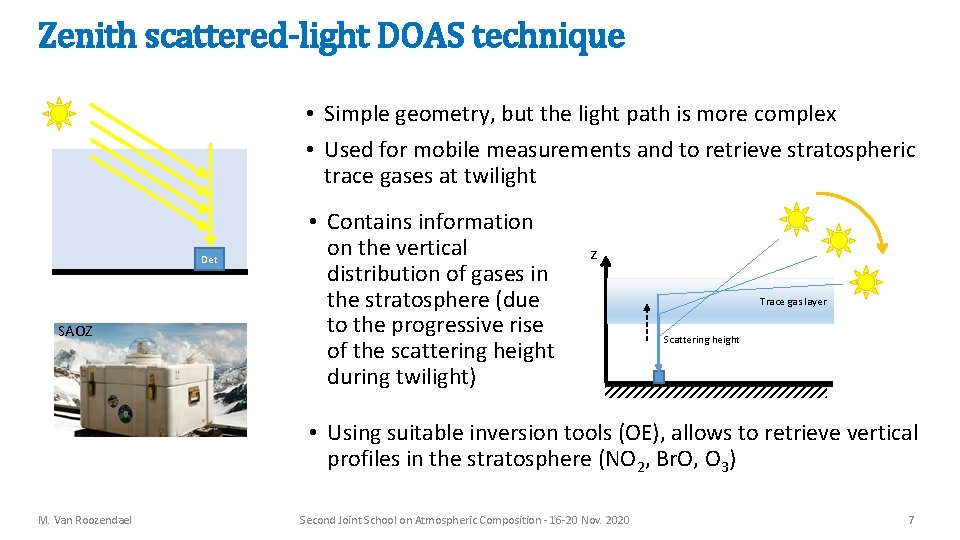
Zenith scattered-light DOAS technique • Simple geometry, but the light path is more complex • Used for mobile measurements and to retrieve stratospheric trace gases at twilight Det SAOZ • Contains information on the vertical distribution of gases in the stratosphere (due to the progressive rise of the scattering height during twilight) z Trace gas layer Scattering height • Using suitable inversion tools (OE), allows to retrieve vertical profiles in the stratosphere (NO 2, Br. O, O 3) M. Van Roozendael Second Joint School on Atmospheric Composition - 16 -20 Nov. 2020 7
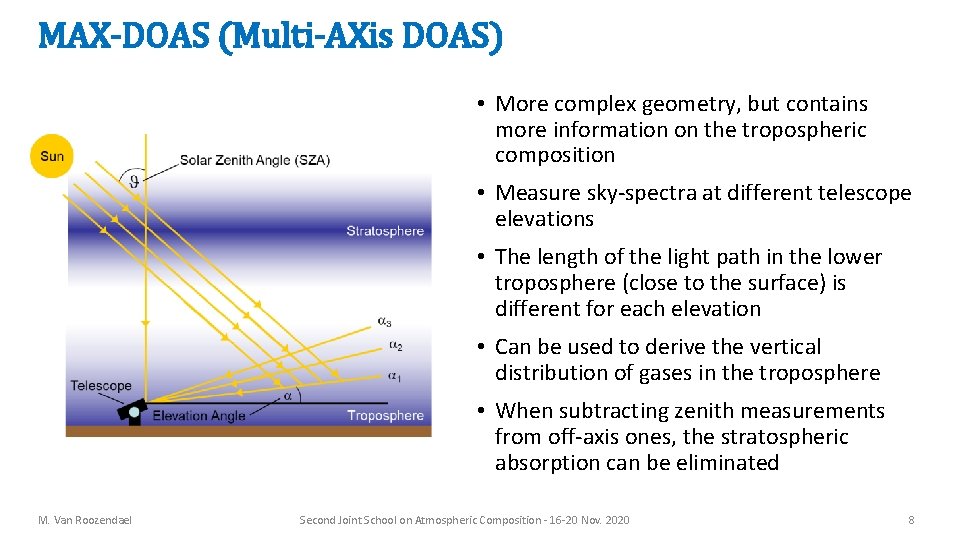
MAX-DOAS (Multi-AXis DOAS) • More complex geometry, but contains more information on the tropospheric composition • Measure sky-spectra at different telescope elevations • The length of the light path in the lower troposphere (close to the surface) is different for each elevation • Can be used to derive the vertical distribution of gases in the troposphere • When subtracting zenith measurements from off-axis ones, the stratospheric absorption can be eliminated M. Van Roozendael Second Joint School on Atmospheric Composition - 16 -20 Nov. 2020 8
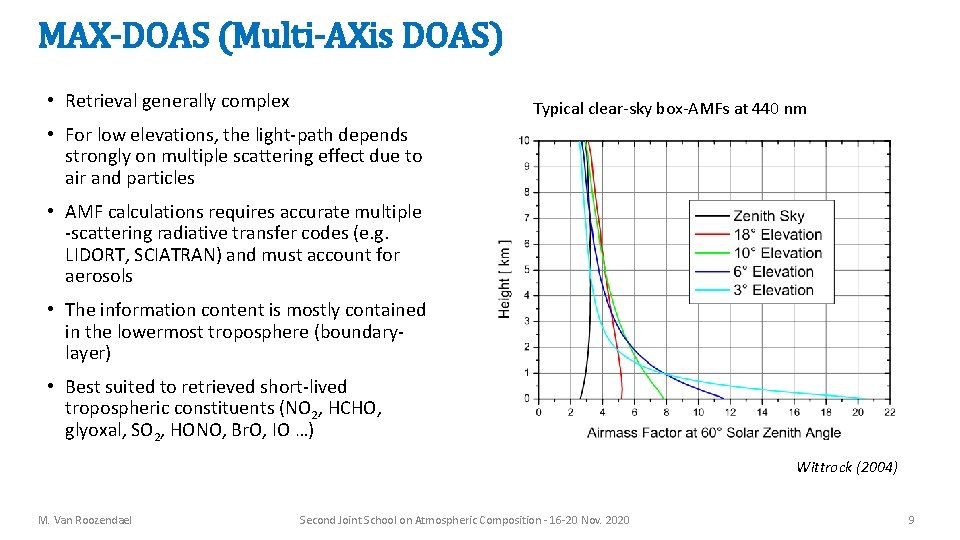
MAX-DOAS (Multi-AXis DOAS) • Retrieval generally complex Typical clear-sky box-AMFs at 440 nm • For low elevations, the light-path depends strongly on multiple scattering effect due to air and particles • AMF calculations requires accurate multiple -scattering radiative transfer codes (e. g. LIDORT, SCIATRAN) and must account for aerosols • The information content is mostly contained in the lowermost troposphere (boundarylayer) • Best suited to retrieved short-lived tropospheric constituents (NO 2, HCHO, glyoxal, SO 2, HONO, Br. O, IO …) Wittrock (2004) M. Van Roozendael Second Joint School on Atmospheric Composition - 16 -20 Nov. 2020 9
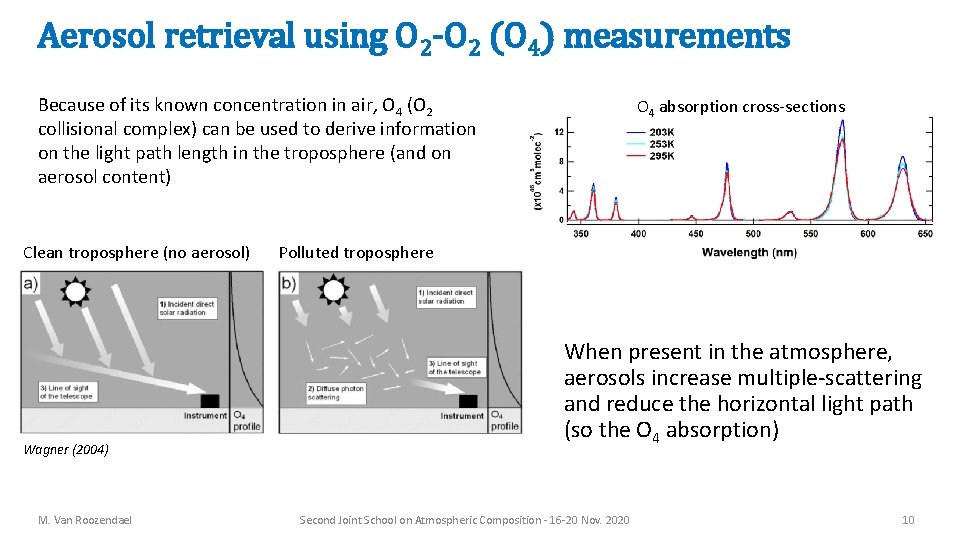
Aerosol retrieval using O 2 -O 2 (O 4) measurements Because of its known concentration in air, O 4 (O 2 collisional complex) can be used to derive information on the light path length in the troposphere (and on aerosol content) Clean troposphere (no aerosol) Wagner (2004) M. Van Roozendael O 4 absorption cross-sections Polluted troposphere When present in the atmosphere, aerosols increase multiple-scattering and reduce the horizontal light path (so the O 4 absorption) Second Joint School on Atmospheric Composition - 16 -20 Nov. 2020 10
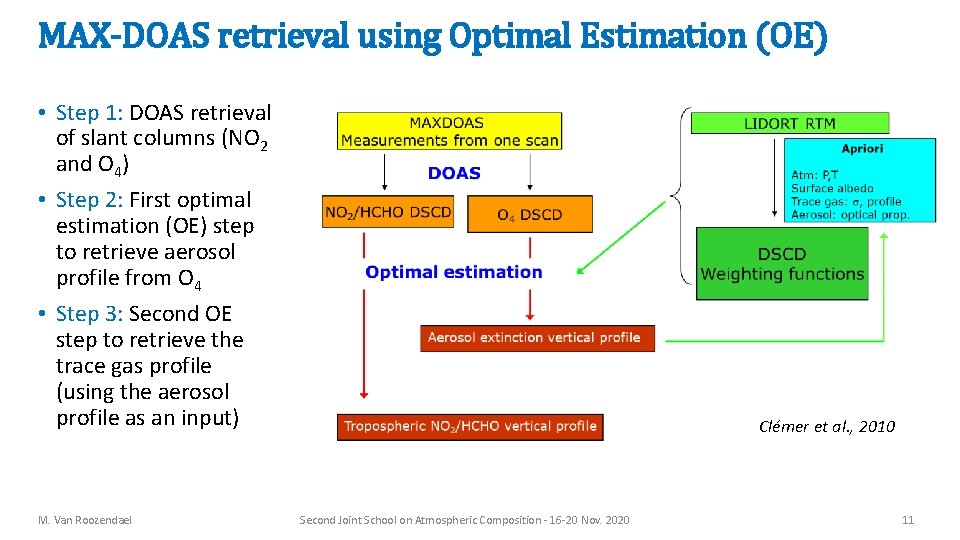
MAX-DOAS retrieval using Optimal Estimation (OE) • Step 1: DOAS retrieval of slant columns (NO 2 and O 4) • Step 2: First optimal estimation (OE) step to retrieve aerosol profile from O 4 • Step 3: Second OE step to retrieve the trace gas profile (using the aerosol profile as an input) M. Van Roozendael Clémer et al. , 2010 Second Joint School on Atmospheric Composition - 16 -20 Nov. 2020 11
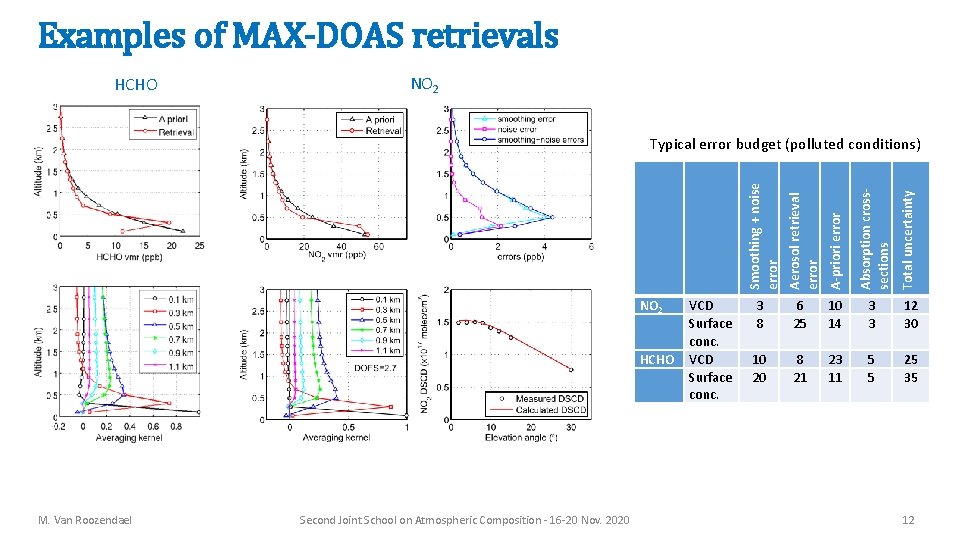
Examples of MAX-DOAS retrievals HCHO NO 2 M. Van Roozendael Second Joint School on Atmospheric Composition - 16 -20 Nov. 2020 Absorption crosssections 3 8 6 25 10 14 3 3 12 30 10 20 8 21 23 11 5 5 25 35 Total uncertainty A-priori error HCHO VCD Surface conc. Aerosol retrieval error NO 2 Smoothing + noise error Typical error budget (polluted conditions) 12
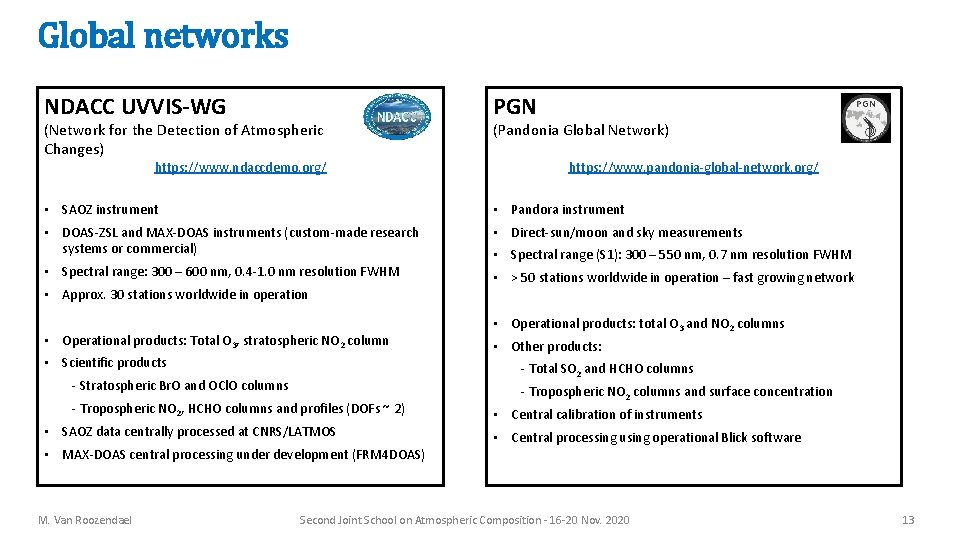
Global networks NDACC UVVIS-WG (Network for the Detection of Atmospheric Changes) https: //www. ndaccdemo. org/ PGN (Pandonia Global Network) https: //www. pandonia-global-network. org/ • SAOZ instrument • Pandora instrument • DOAS-ZSL and MAX-DOAS instruments (custom-made research systems or commercial) • Direct-sun/moon and sky measurements • Spectral range: 300 – 600 nm, 0. 4 -1. 0 nm resolution FWHM • > 50 stations worldwide in operation – fast growing network • Approx. 30 stations worldwide in operation • Operational products: Total O 3, stratospheric NO 2 column • Scientific products • Operational products: total O 3 and NO 2 columns • Other products: - Total SO 2 and HCHO columns - Stratospheric Br. O and OCl. O columns - Tropospheric NO 2, HCHO columns and profiles (DOFs ~ 2) • SAOZ data centrally processed at CNRS/LATMOS • MAX-DOAS central processing under development (FRM 4 DOAS) M. Van Roozendael • Spectral range (S 1): 300 – 550 nm, 0. 7 nm resolution FWHM - Tropospheric NO 2 columns and surface concentration • Central calibration of instruments • Central processing using operational Blick software Second Joint School on Atmospheric Composition - 16 -20 Nov. 2020 13
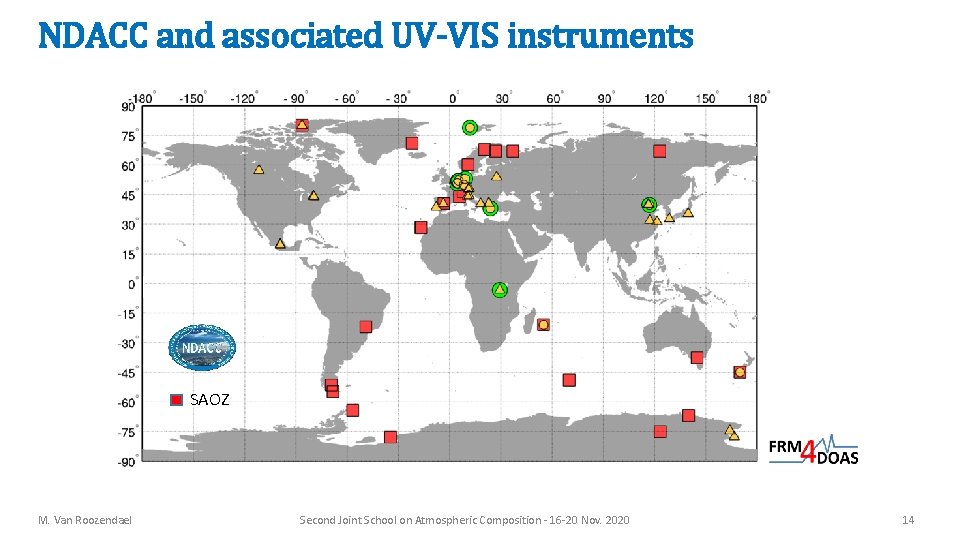
NDACC and associated UV-VIS instruments SAOZ M. Van Roozendael Second Joint School on Atmospheric Composition - 16 -20 Nov. 2020 14
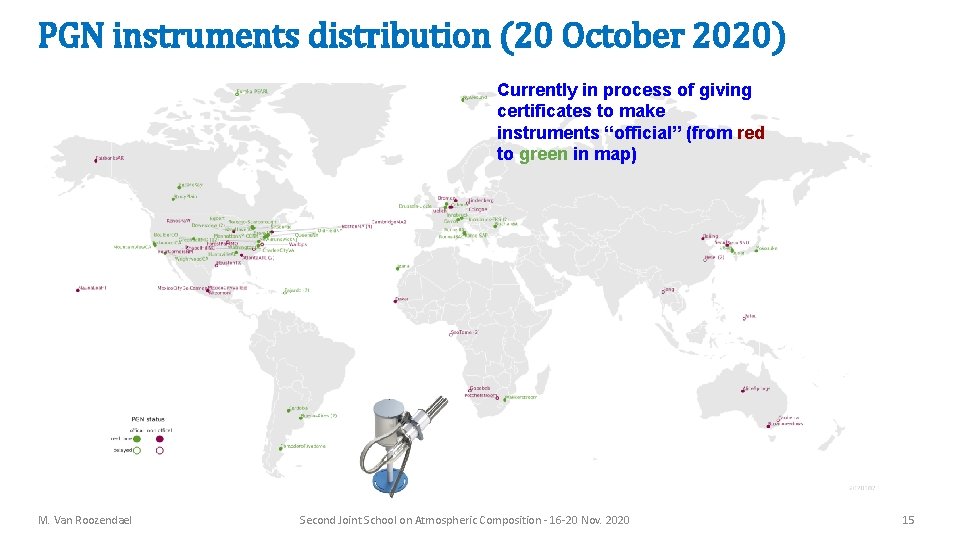
PGN instruments distribution (20 October 2020) Currently in process of giving certificates to make instruments “official” (from red to green in map) M. Van Roozendael Second Joint School on Atmospheric Composition - 16 -20 Nov. 2020 15
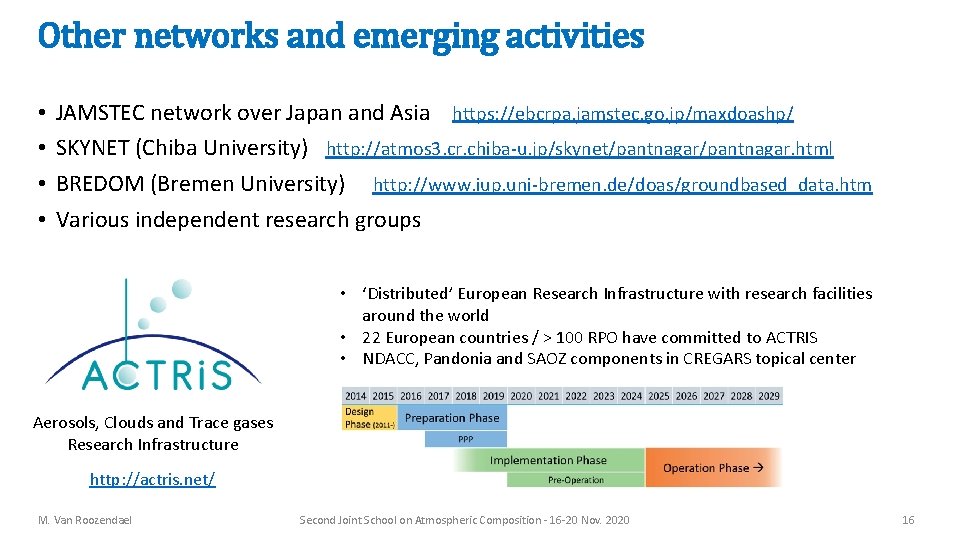
Other networks and emerging activities • • JAMSTEC network over Japan and Asia https: //ebcrpa. jamstec. go. jp/maxdoashp/ SKYNET (Chiba University) http: //atmos 3. cr. chiba-u. jp/skynet/pantnagar. html BREDOM (Bremen University) http: //www. iup. uni-bremen. de/doas/groundbased_data. htm Various independent research groups • ‘Distributed’ European Research Infrastructure with research facilities around the world • 22 European countries / > 100 RPO have committed to ACTRIS • NDACC, Pandonia and SAOZ components in CREGARS topical center Aerosols, Clouds and Trace gases Research Infrastructure http: //actris. net/ M. Van Roozendael Second Joint School on Atmospheric Composition - 16 -20 Nov. 2020 16
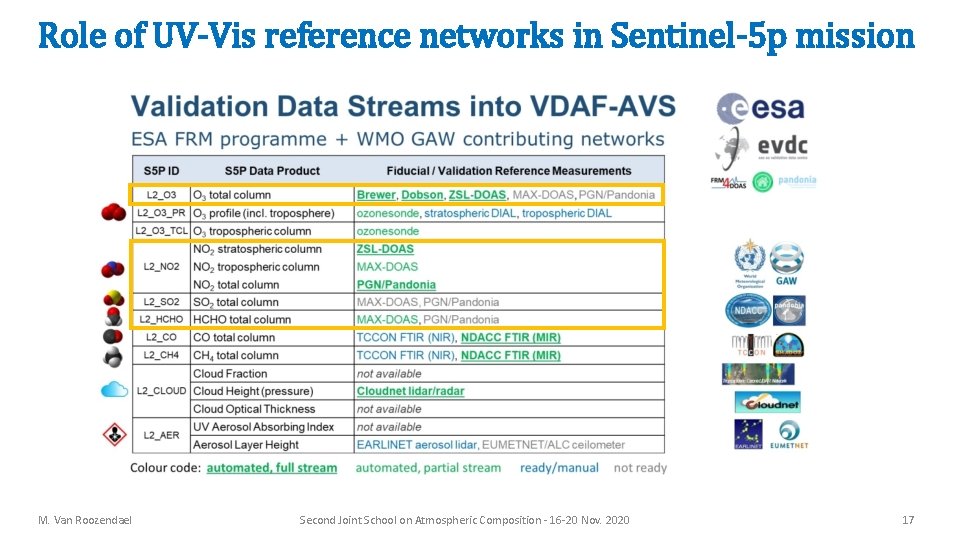
Role of UV-Vis reference networks in Sentinel-5 p mission M. Van Roozendael Second Joint School on Atmospheric Composition - 16 -20 Nov. 2020 17
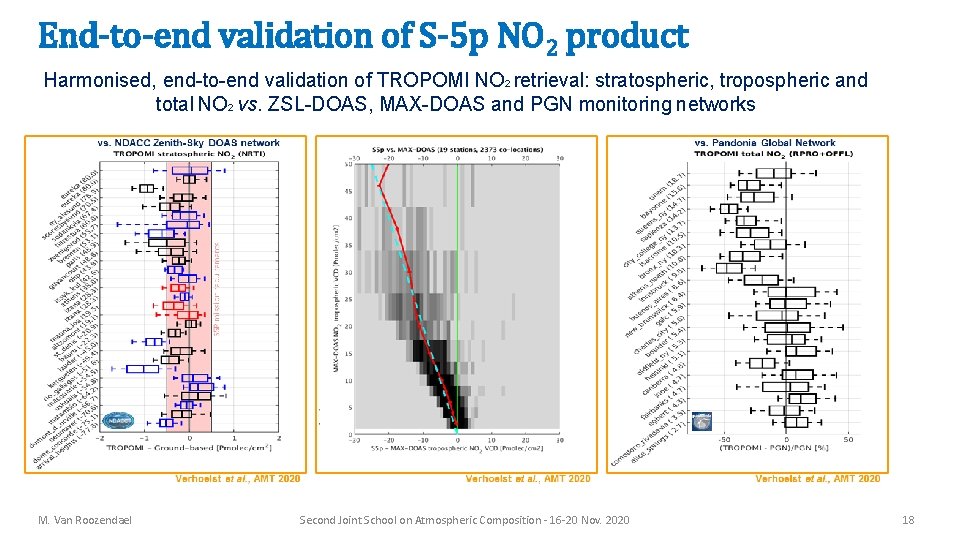
End-to-end validation of S-5 p NO 2 product Harmonised, end-to-end validation of TROPOMI NO 2 retrieval: stratospheric, tropospheric and total NO 2 vs. ZSL-DOAS, MAX-DOAS and PGN monitoring networks M. Van Roozendael Second Joint School on Atmospheric Composition - 16 -20 Nov. 2020 18
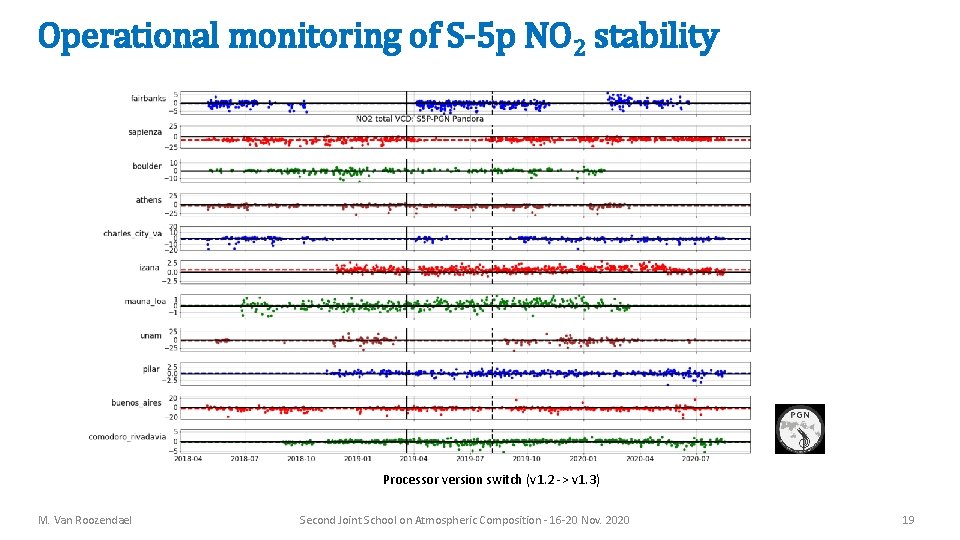
Operational monitoring of S-5 p NO 2 stability Processor version switch (v 1. 2 -> v 1. 3) M. Van Roozendael Second Joint School on Atmospheric Composition - 16 -20 Nov. 2020 19
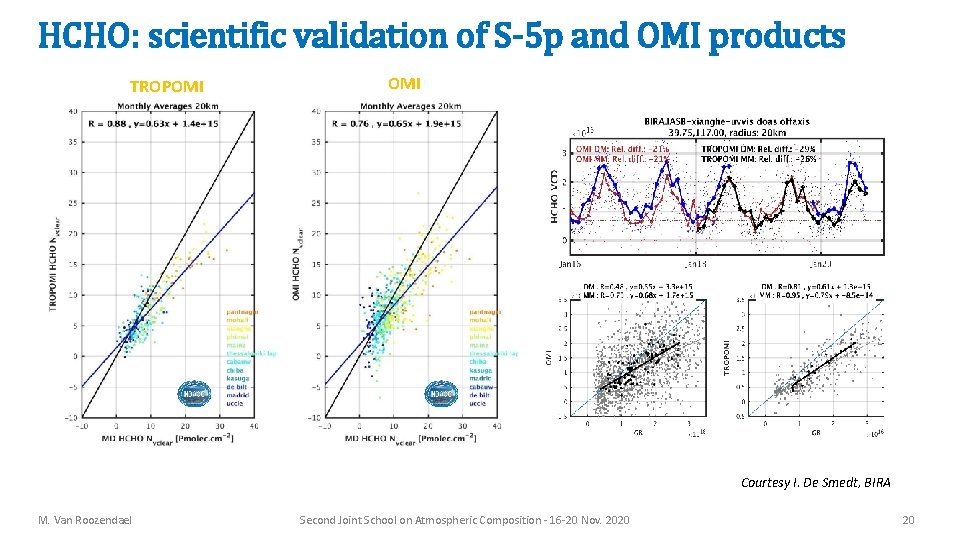
HCHO: scientific validation of S-5 p and OMI products TROPOMI Courtesy I. De Smedt, BIRA M. Van Roozendael Second Joint School on Atmospheric Composition - 16 -20 Nov. 2020 20
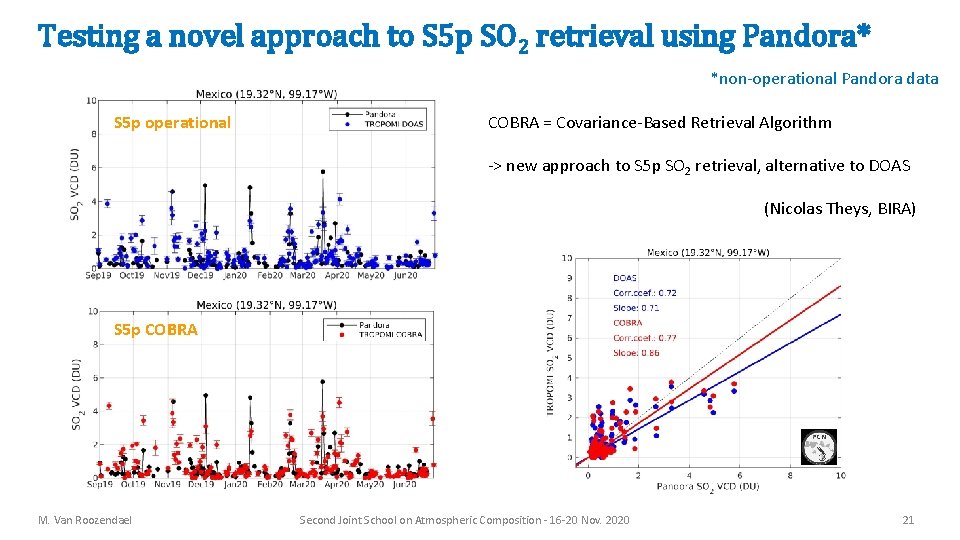
Testing a novel approach to S 5 p SO 2 retrieval using Pandora* *non-operational Pandora data S 5 p operational COBRA = Covariance-Based Retrieval Algorithm -> new approach to S 5 p SO 2 retrieval, alternative to DOAS (Nicolas Theys, BIRA) S 5 p COBRA M. Van Roozendael Second Joint School on Atmospheric Composition - 16 -20 Nov. 2020 21
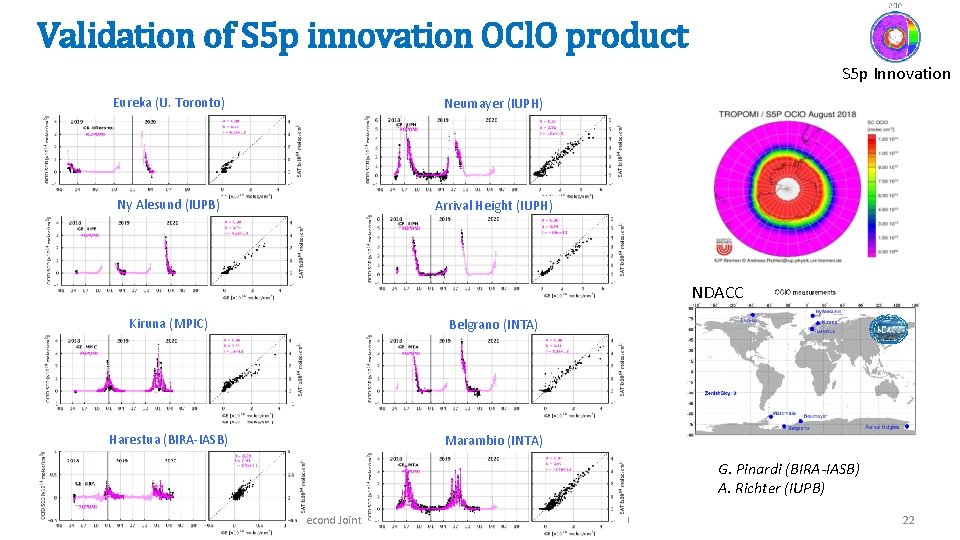
Validation of S 5 p innovation OCl. O product S 5 p Innovation Eureka(U. Toronto) Neumayer (IUPH) Ny Alesund (IUPB) Arrival Height (IUPH) NDACC Kiruna (MPIC) Belgrano (INTA) Harestua (BIRA-IASB) Marambio (INTA) G. Pinardi (BIRA-IASB) A. Richter (IUPB) M. Van Roozendael Second Joint School on Atmospheric Composition - 16 -20 Nov. 2020 22
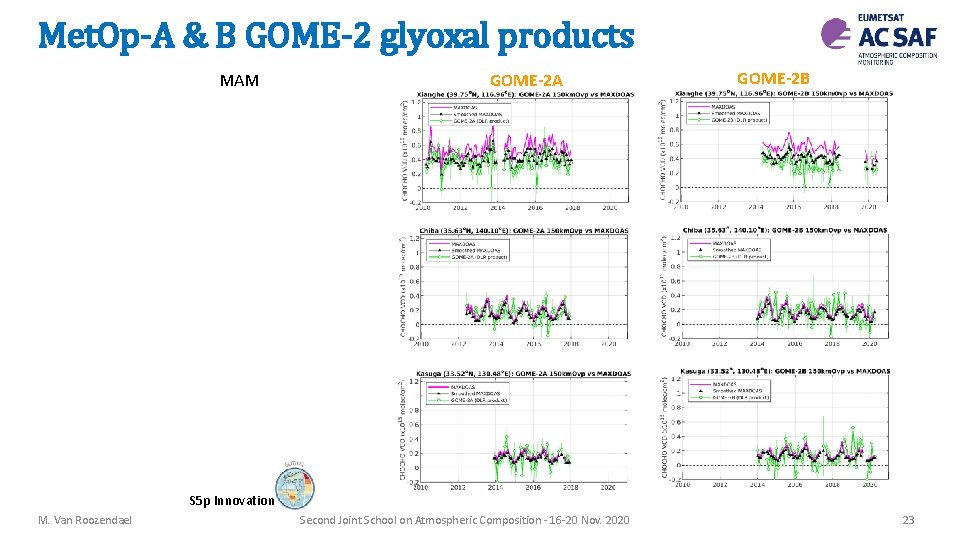
Met. Op-A & B GOME-2 glyoxal products MAM GOME-2 A GOME-2 B S 5 p Innovation M. Van Roozendael Second Joint School on Atmospheric Composition - 16 -20 Nov. 2020 23
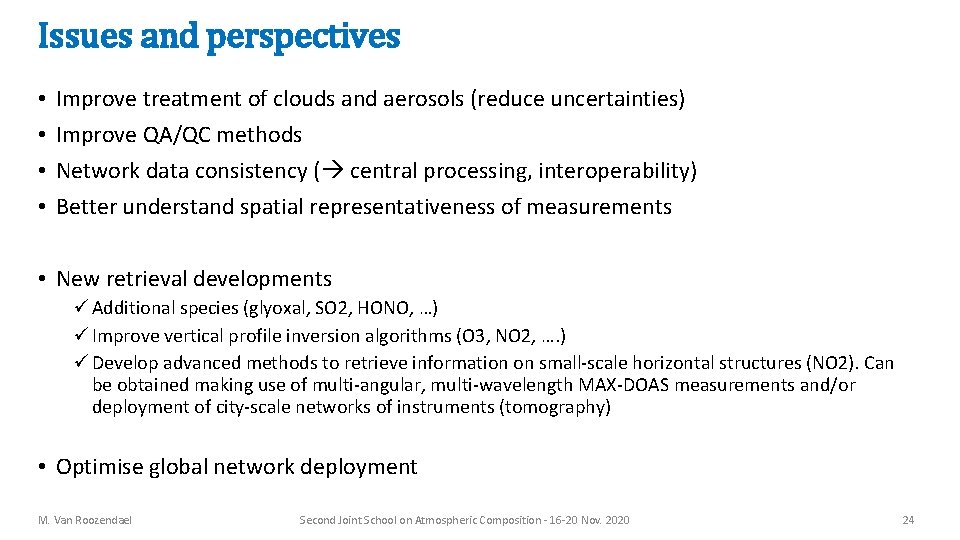
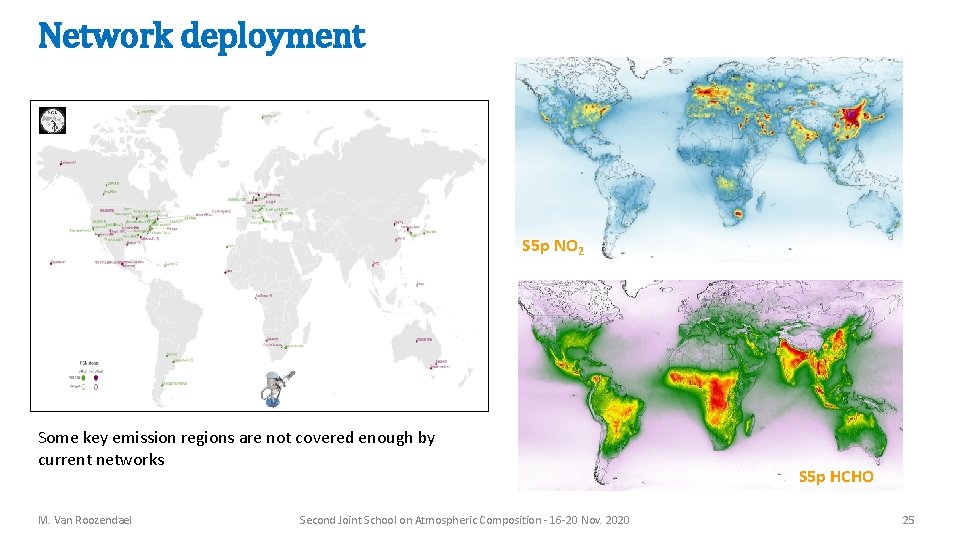
Issues and perspectives • • Improve treatment of clouds and aerosols (reduce uncertainties) Improve QA/QC methods Network data consistency ( central processing, interoperability) Better understand spatial representativeness of measurements • New retrieval developments ü Additional species (glyoxal, SO 2, HONO, …) ü Improve vertical profile inversion algorithms (O 3, NO 2, …. ) ü Develop advanced methods to retrieve information on small-scale horizontal structures (NO 2). Can be obtained making use of multi-angular, multi-wavelength MAX-DOAS measurements and/or deployment of city-scale networks of instruments (tomography) • Optimise global network deployment M. Van Roozendael Second Joint School on Atmospheric Composition - 16 -20 Nov. 2020 24
Network deployment S 5 p NO 2 Some key emission regions are not covered enough by current networks M. Van Roozendael Second Joint School on Atmospheric Composition - 16 -20 Nov. 2020 S 5 p HCHO 25
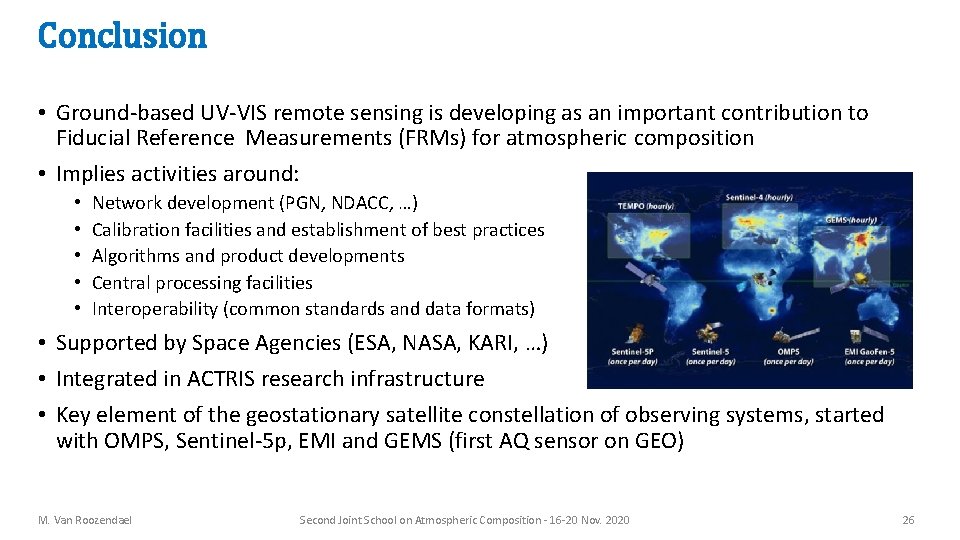
Conclusion • Ground-based UV-VIS remote sensing is developing as an important contribution to Fiducial Reference Measurements (FRMs) for atmospheric composition • Implies activities around: • • • Network development (PGN, NDACC, …) Calibration facilities and establishment of best practices Algorithms and product developments Central processing facilities Interoperability (common standards and data formats) • Supported by Space Agencies (ESA, NASA, KARI, …) • Integrated in ACTRIS research infrastructure • Key element of the geostationary satellite constellation of observing systems, started with OMPS, Sentinel-5 p, EMI and GEMS (first AQ sensor on GEO) M. Van Roozendael Second Joint School on Atmospheric Composition - 16 -20 Nov. 2020 26