
Uvod u PLC PLC esto se zove i
- Slides: 98
Uvod u PLC • PLC često se zove i progamabilni kontroler je tip računara koji se koristi za upravljanje sistemima u industriji, građevinarstvu, infrasktukrurnim objektima • Ima mogućnost memorisanja: o Logičkih instrukcije o Aritmetičkih instrukcije o Sekvencijalnih instrukcije (tajmeri i brojači) o Instrukcija za komunikaciju o Specijalnih matematičke instrukcije o Instrukcija za konverziju podataka o Instrukcija za upravljačke PID strukture
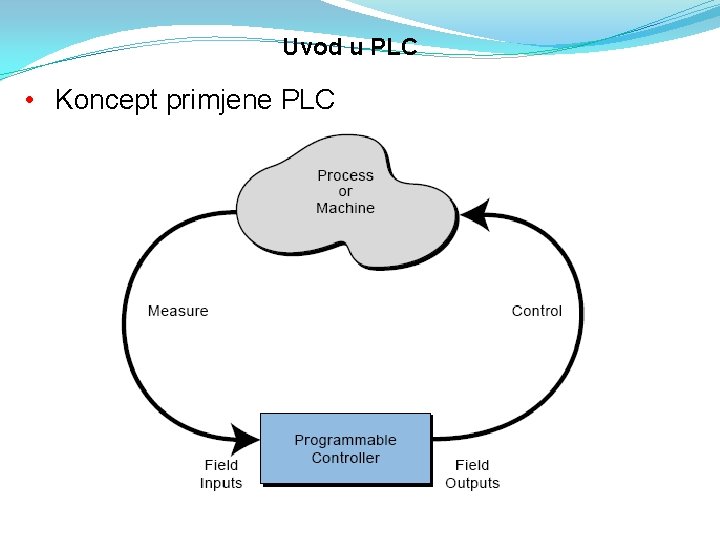
Uvod u PLC • Koncept primjene PLC
Uvod u PLC • PLC imaju više definicija izdvojićemo jednu: Programabilni logički kontroleri (PLC) su industrijski računari čiji su hardver i softver posebno prilagođeni radu u industrijskim uslovima, a koji se mogu lako programirati i ugrađivati u postojeće industrijske sisteme
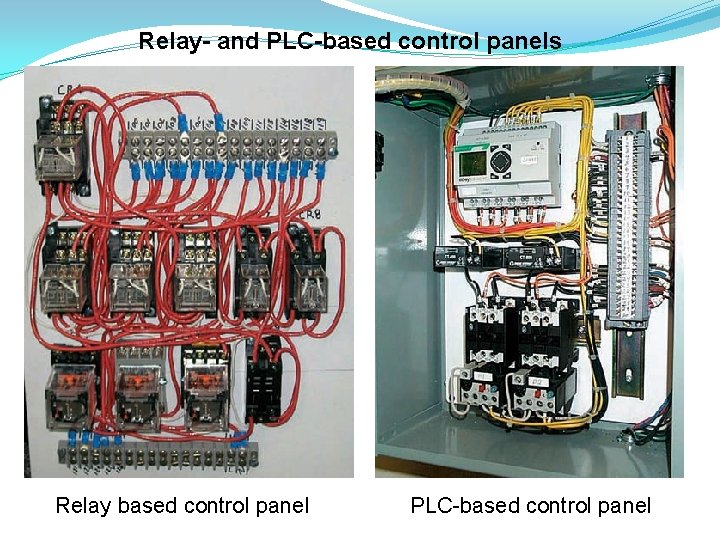
Istorijski razvoj PLC • Prvi zahtijev za razvoj PLC dat je u General Motors Corporation davne 1968. godine • Osnovni cilj koji je PLC trebao da zadovolji odnosi se na smanjenje cijene održavanja skupog nefleksibilnog upravljačkog sistema realizovanog sa elektromehaničkim relejima • Neki zahtijevi koje je elektronski uređaj sa fleksibilnošću računara trebao da zadovolji su: 1. Radi u industrijskom okruženju 2. Da bude lako programabirljiv od strane procesnih inženjera i tehničara 3. Da bude više puta upotrebljiv
Istorijski razvoj PLC Dalji zahtijvi za razvoj PLC odnosili su se na sljedeće: Novi upravljački sistem po cijeni mora biti konkurentan sa starim relejnim sistemom upravljanja • Ulazni i izlazni moduli trebaju biti lako zamjenljivi • Kontroler bi trebao biti modularan tako da se komponente mogu lako zamjeniti dodati ili popraviti • Upravljački sistem trebao je da ima mogućnost razmjene podataka sa centralnim upravljačkim sistemom • Način programiranja kontrolera treba da bude jednostavan i lako razumljiv procesnim inženjerima i tehničarima •
PLC danas – hardverska unapređenja • Tehnološki unapređenja PLC i danas postoje i dešavaju se na dva nivoa: Hardverski (nove komponente) • Softverski ( načini programiranja) • • Neka od hardverskih unapređenja su: • Manje vrijeme skan ciklusa zahvaljujući modernijim mikoprocesorima i ostalim elektronskim komponentama • Velika gustina pakovanja I/O modula smanjuje dimenzije cjelokupnog sistema i cijenu • Intelingentni mikroprocesorski I/O interfejsi nudi mogućnost distribuiranog procesiranja (PID upravljanje, CAN, Fieldbus, LAN)
PLC danas – hardverska unapređenja • Neka od unapređenja su: • Poboljšanja u mehaničkoj konstrukciji I/O modula i njihova integracija sa CPU modulom • Posebni interfejsi koji omogućavaju povezivanje specifičnin senzora na ulaz PLC kao što su: termoparovi, mjerne trake, brzi digitalni ulazi i sl. • Periferna oprema ima unaprijeđeni operatorski interfejs • Dokumentacija je standardni dio sistema
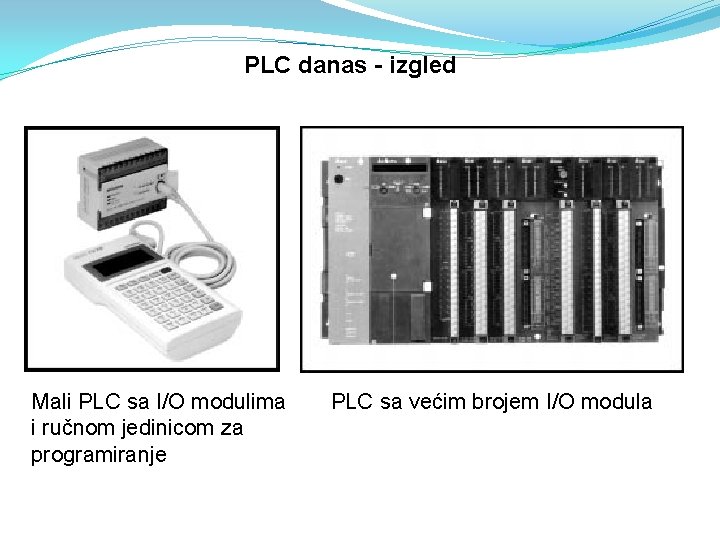
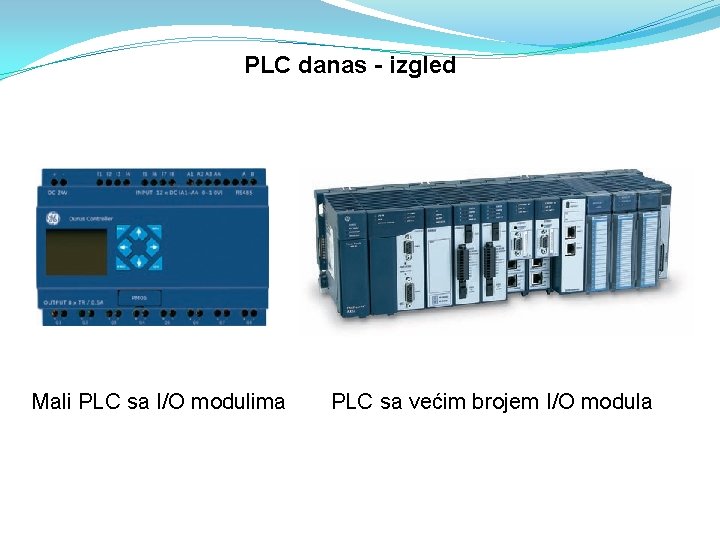
PLC danas - izgled Mali PLC sa I/O modulima i ručnom jedinicom za programiranje PLC sa većim brojem I/O modula
PLC danas - izgled Mali PLC sa I/O modulima PLC sa većim brojem I/O modula
Relay- and PLC-based control panels Relay based control panel PLC-based control panel
PLC danas – softverska unapređenja • Neka od unapređenja su: o PLC se mogu danas programirati objektno – orijentisanim jezicima koji podržavaju IEC 1131 -3 standard o Mali PLC danas podržavaju kompleksnan set instrukcija što proširuje njihovu primjenu o Jezici visokog nivoa kao što su BASIC i C mogu biti implementirani u nekim modulima kontrolera da bi obezbijedili veću fleksibilnost programiranja o Složeni funkcionalni blokovi su ugrađeni u leder programe da bi unaprijedili softverske mogućnosti i pojednostavili način programiranja
PLC danas – softverska unapređenja • Neka od unapređenja su: o Mogućnost jednostavne dijagnostike i otkrivanja grešaka počevši od samog PLC kontrolera preko dijagnostike mašina i procesa kojim PLC upravlja o Primjena matematika u pokretnom zarezu omogućava kompleksna izračunavanja potrebna pri različitim upravljačkim zadacima o Unaprijeđena obrada podataka koja podržava kompleksne upravljačke algoritme i akviziciju podataka koja podrazumjeva smještanje praćenje i pretraživanje velike količine podataka
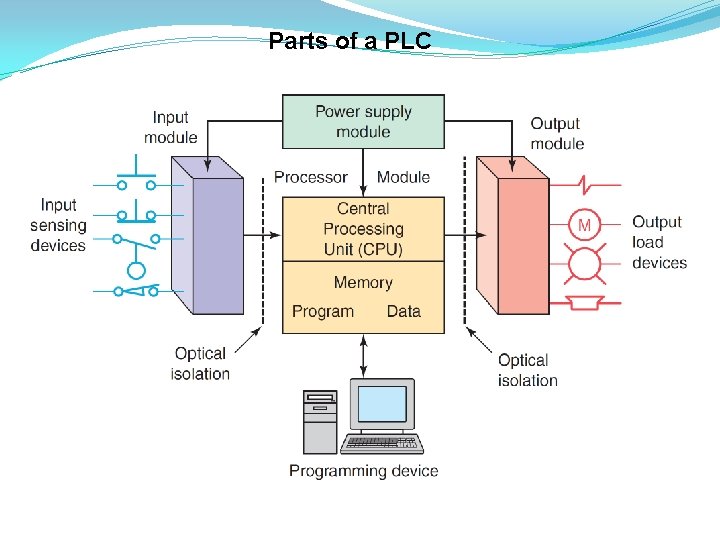
Parts of a PLC
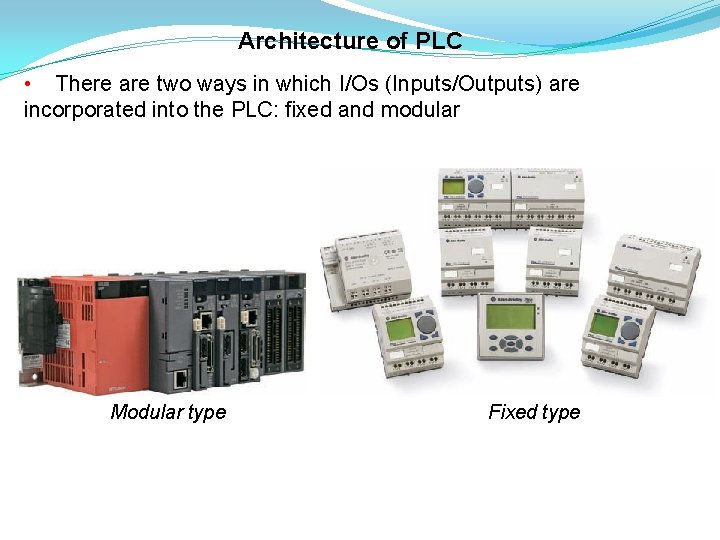
Architecture of PLC • There are two ways in which I/Os (Inputs/Outputs) are incorporated into the PLC: fixed and modular Modular type Fixed type
Architecture of PLC –fixed I/O • The processor and I/O modules are packaged together • I/O terminals have a fixed number of connections built in for inputs and outputs • The main advantage of this type of packaging is lower cost. The number of available I/O points varies and usually can be expanded by buying additional units of fixed I/O • One disadvantage of fixed I/O is its lack of flexibility. There are limitation what we can get in the quantities and types dictated by the packaging • Also, if any part in the unit fails, the whole unit has to be replaced
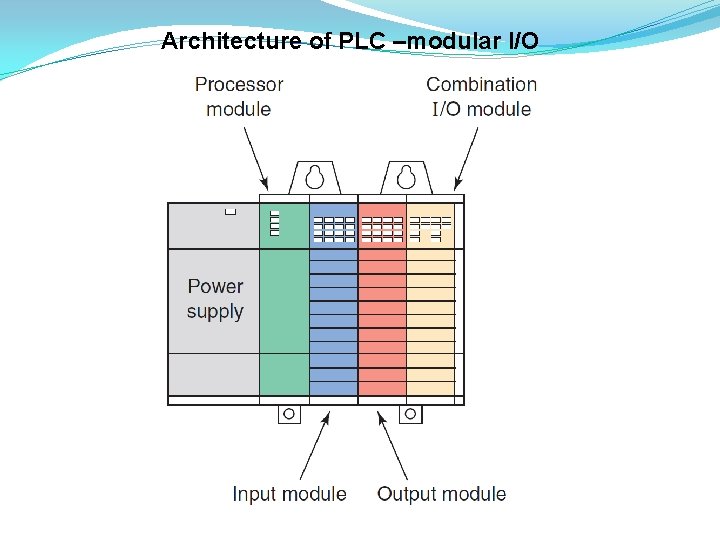
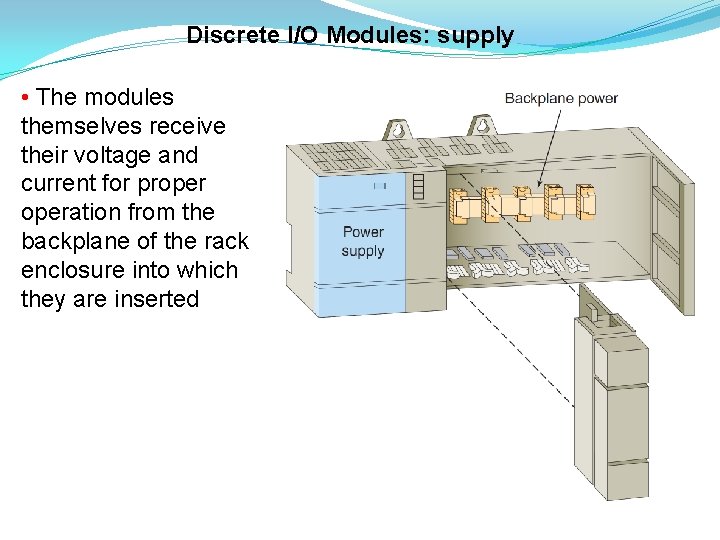
Architecture of PLC –modular I/O • Modular I/O is divided by compartments into which separate modules can be plugged. This feature greatly increases your options and the unit’s flexibility. • The basic modular PLC consists of a rack, power supply, processor module (CPU), input/output (I/O modules), and an operator interface for programming and monitoring. • The modules are plugged into a rack. When a module is slid into the rack, it makes an electrical connection with a series of contacts called the backplane, located at the rear of the rack • The PLC processor is also connected to the backplane and can communicate with all the modules in the rack
Architecture of PLC –modular I/O
Architecture of PLC –modular I/O
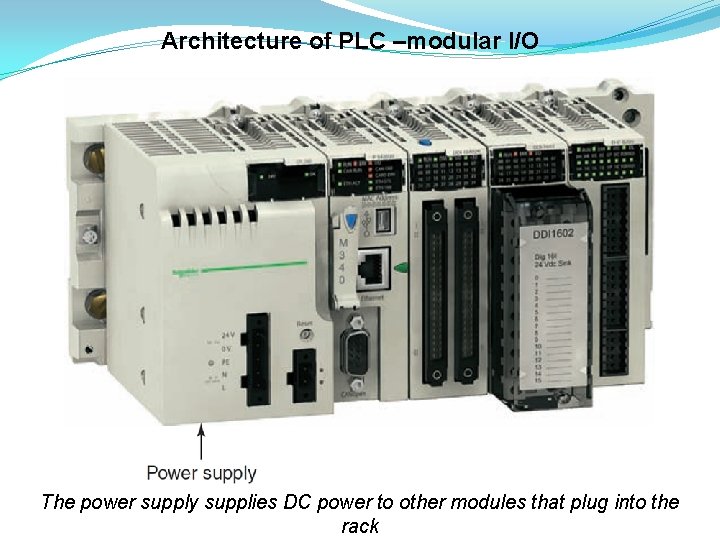
Architecture of PLC –modular I/O: power supply • The power supply supplies DC power to other modules that plug into the rack. • For large PLC systems, this power supply does not normally supply power to the field devices • With larger systems, power to field devices (distributed I/O, sensors, etc) is provided by external alternating current (AC) or direct current (DC) power supplies. • For some small micro PLC systems, the power supply may be used to power field devices
Architecture of PLC –modular I/O The power supply supplies DC power to other modules that plug into the rack
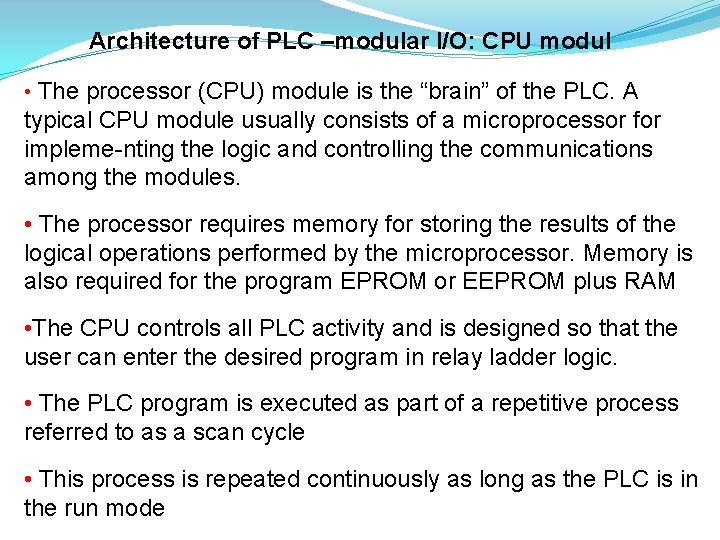
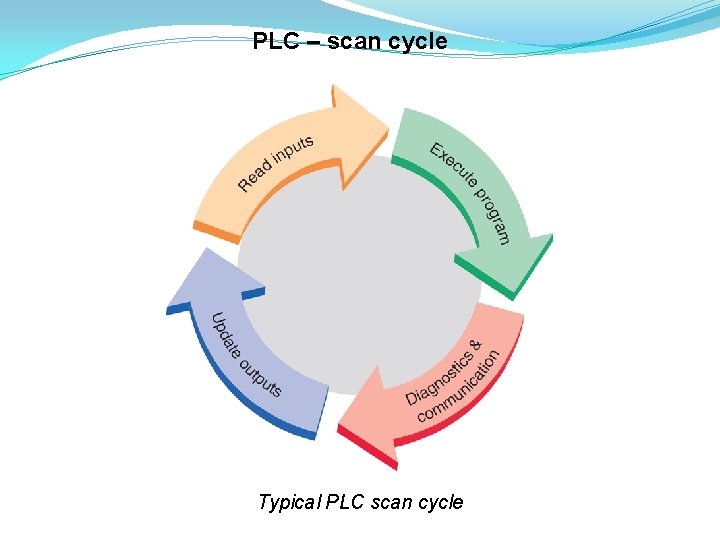
Architecture of PLC –modular I/O: CPU modul • The processor (CPU) module is the “brain” of the PLC. A typical CPU module usually consists of a microprocessor for impleme-nting the logic and controlling the communications among the modules. • The processor requires memory for storing the results of the logical operations performed by the microprocessor. Memory is also required for the program EPROM or EEPROM plus RAM • The CPU controls all PLC activity and is designed so that the user can enter the desired program in relay ladder logic. • The PLC program is executed as part of a repetitive process referred to as a scan cycle • This process is repeated continuously as long as the PLC is in the run mode
PLC – scan cycle Typical PLC scan cycle
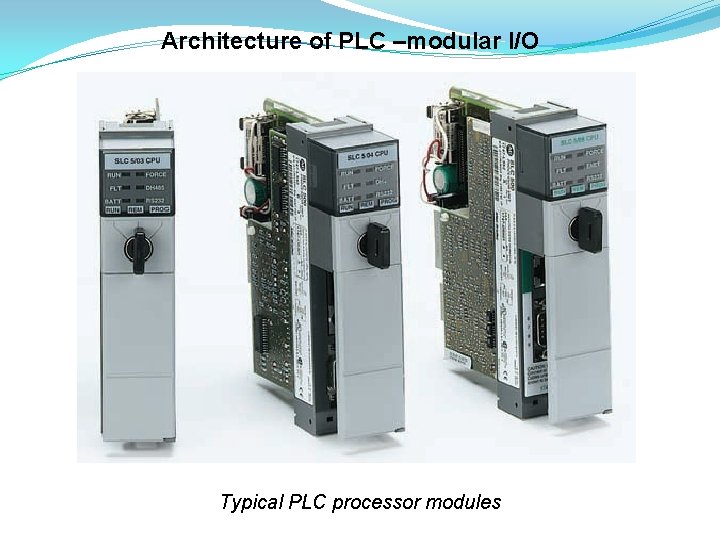
Architecture of PLC –modular I/O Typical PLC processor modules
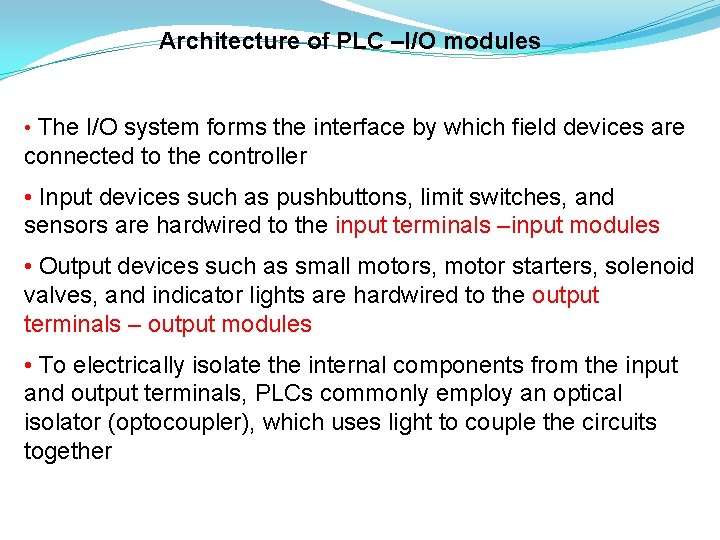
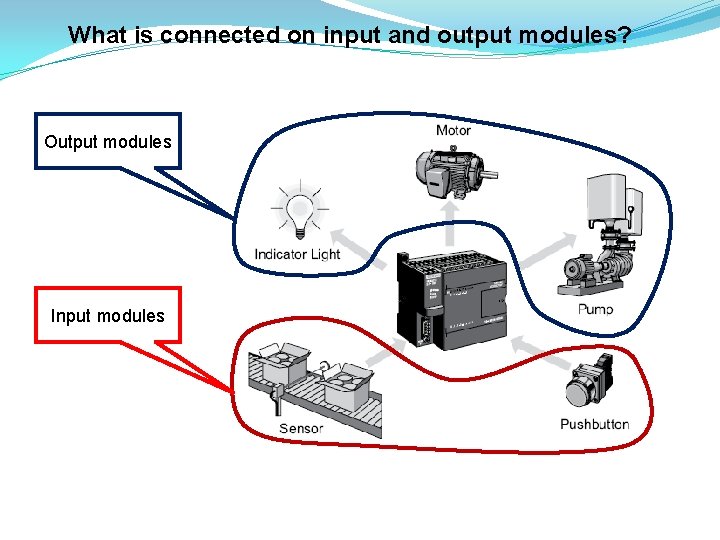
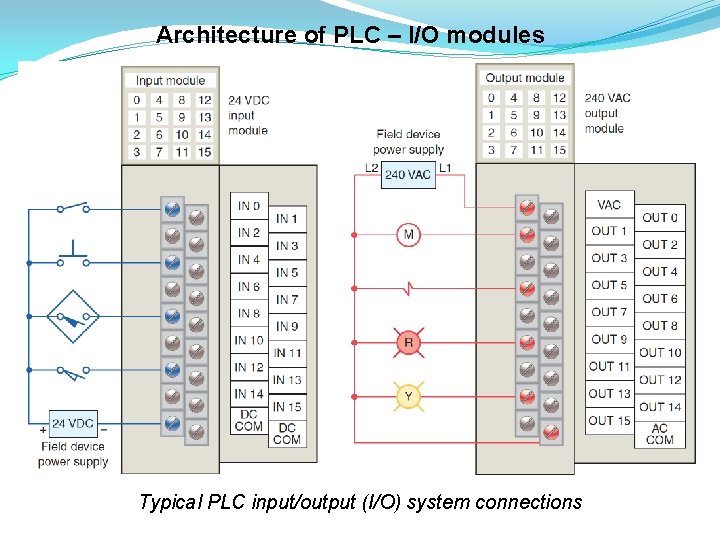
Architecture of PLC –I/O modules • The I/O system forms the interface by which field devices are connected to the controller • Input devices such as pushbuttons, limit switches, and sensors are hardwired to the input terminals –input modules • Output devices such as small motors, motor starters, solenoid valves, and indicator lights are hardwired to the output terminals – output modules • To electrically isolate the internal components from the input and output terminals, PLCs commonly employ an optical isolator (optocoupler), which uses light to couple the circuits together
What is connected on input and output modules? Output modules Input modules
Architecture of PLC – I/O modules Typical PLC input/output (I/O) system connections
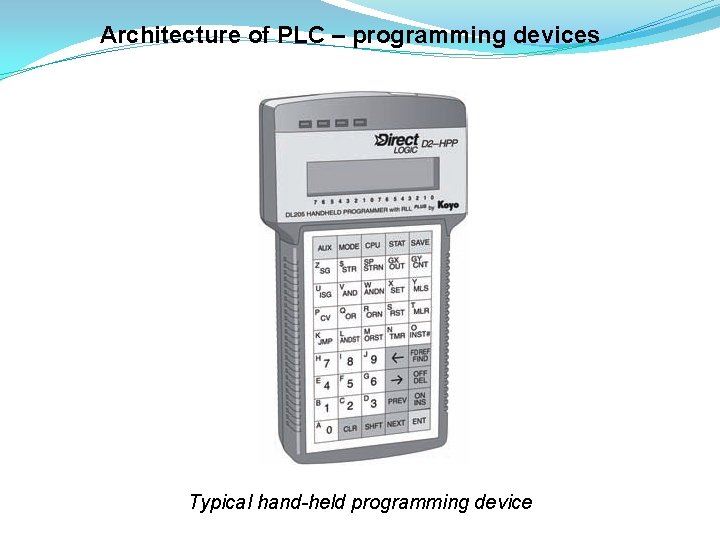
Architecture of PLC – programming devices • A programming device is used to enter the desired program into the memory of the processor • Ladder logic programming language is one of the most popular programming languages which uses graphic symbols to represent control algorithms (program) • A program in ladder logic is similar to a schematic for a relay control circuit and its is easy for people familiar with relay logic control to program the PLC • Hand-held programming devices are sometimes used to program small PLCs because they are inexpensive and easy to use • Both compact hand-held units and laptop computers are frequently used for troubleshooting equipment, modifying programs, and transferring programs to multiple machines
Architecture of PLC – programming devices Typical hand-held programming device
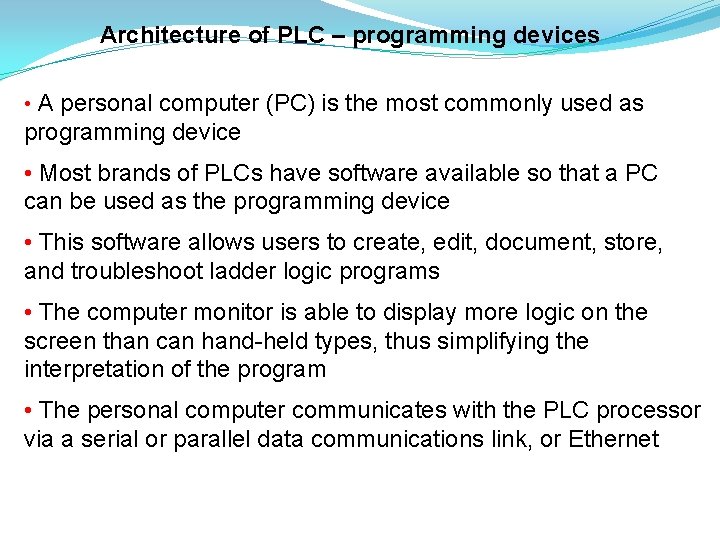
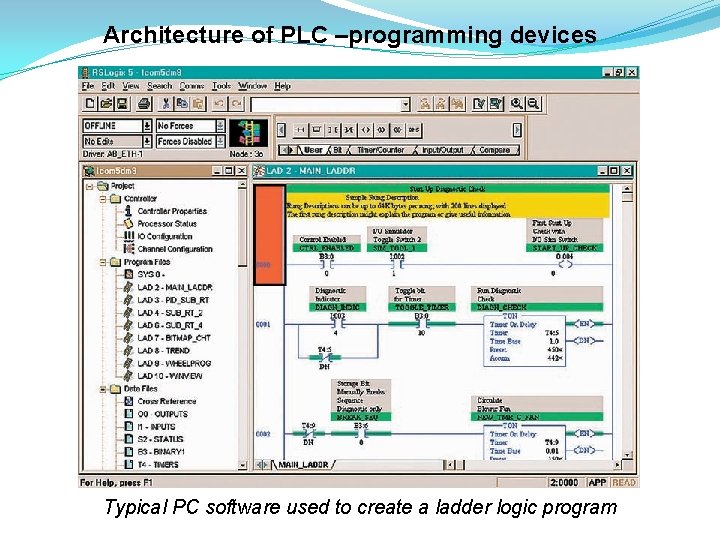
Architecture of PLC – programming devices • A personal computer (PC) is the most commonly used as programming device • Most brands of PLCs have software available so that a PC can be used as the programming device • This software allows users to create, edit, document, store, and troubleshoot ladder logic programs • The computer monitor is able to display more logic on the screen than can hand-held types, thus simplifying the interpretation of the program • The personal computer communicates with the PLC processor via a serial or parallel data communications link, or Ethernet
Architecture of PLC –programming devices Typical PC software used to create a ladder logic program
PLC – programming • A program is a user-developed series of instructions that directs the PLC to execute actions • A programming language provides rules for combining the instructions so that they produce the desired actions • Relay ladder logic (RLL) is the standard programming language usedwith PLCs. Its origin is based on electromechanical relay control • The relay ladder logic program graphically represents rungs of contacts, coils, and special instruction blocks • RLL was originally designed for easy use and understanding for its users and has been modified to keep up with the increasing demands of industry’s control needs
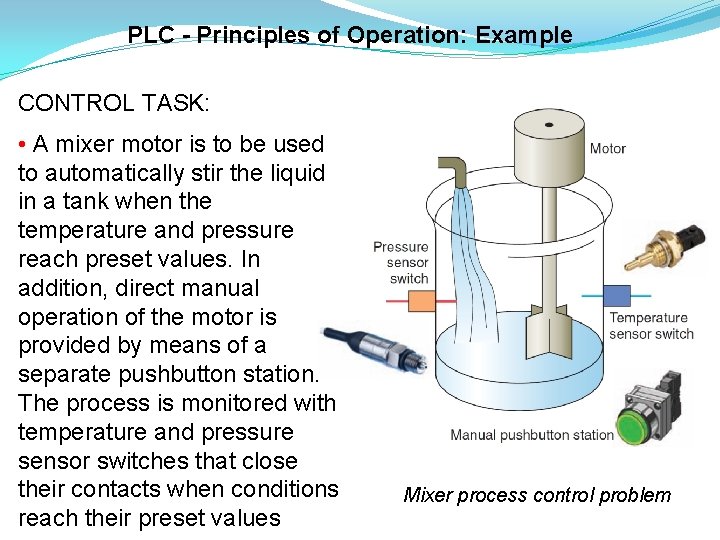
PLC - Principles of Operation: Example CONTROL TASK: • A mixer motor is to be used to automatically stir the liquid in a tank when the temperature and pressure reach preset values. In addition, direct manual operation of the motor is provided by means of a separate pushbutton station. The process is monitored with temperature and pressure sensor switches that close their contacts when conditions reach their preset values Mixer process control problem
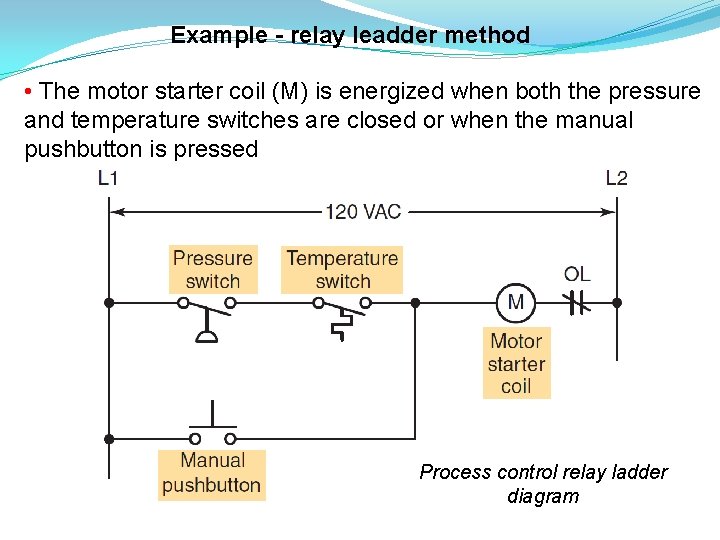
Example - relay leadder method • The motor starter coil (M) is energized when both the pressure and temperature switches are closed or when the manual pushbutton is pressed Process control relay ladder diagram
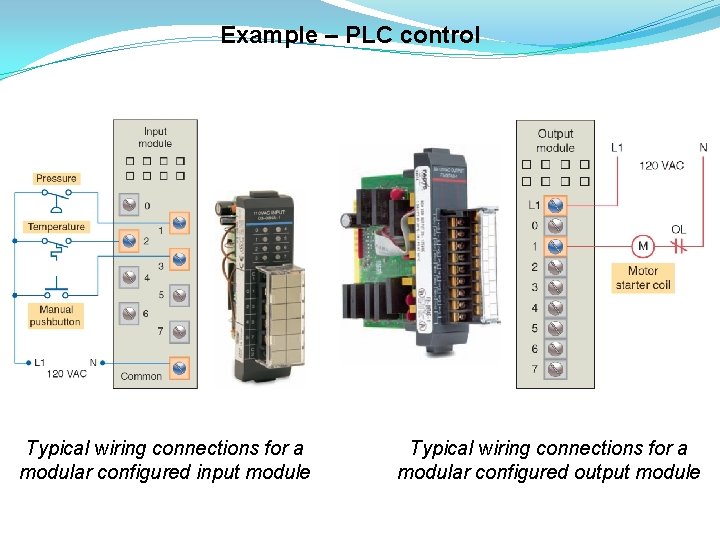
Example – PLC control Typical wiring connections for a modular configured input module Typical wiring connections for a modular configured output module
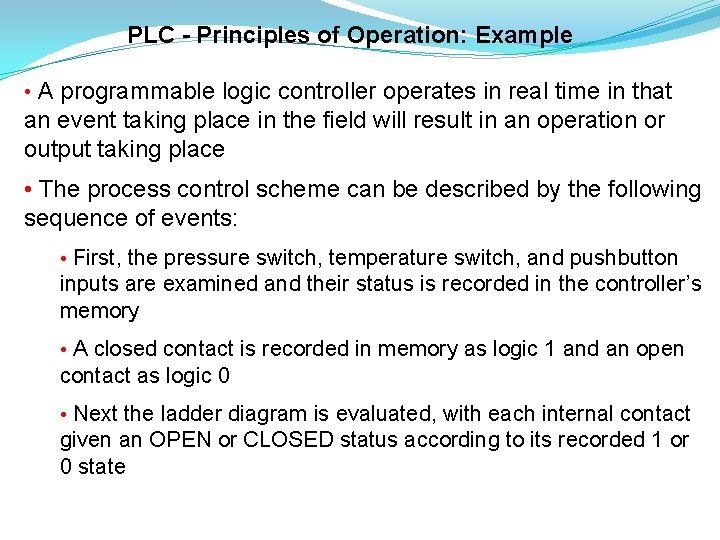
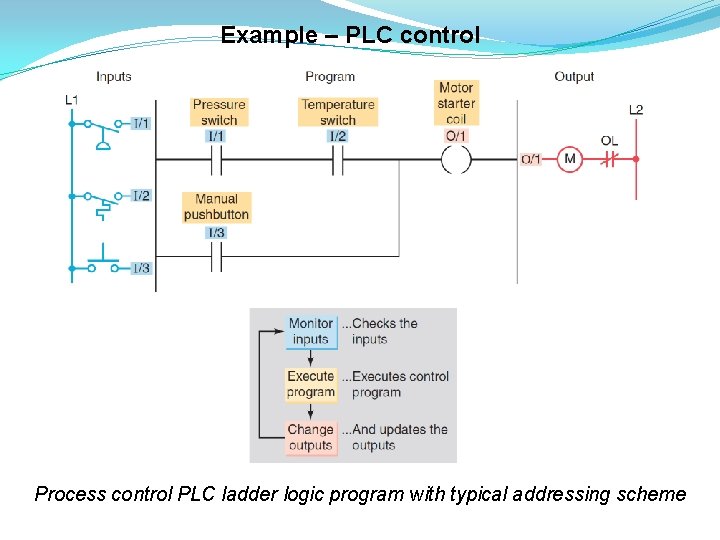
PLC - Principles of Operation: Example • A programmable logic controller operates in real time in that an event taking place in the field will result in an operation or output taking place • The process control scheme can be described by the following sequence of events: • First, the pressure switch, temperature switch, and pushbutton inputs are examined and their status is recorded in the controller’s memory • A closed contact is recorded in memory as logic 1 and an open contact as logic 0 • Next the ladder diagram is evaluated, with each internal contact given an OPEN or CLOSED status according to its recorded 1 or 0 state
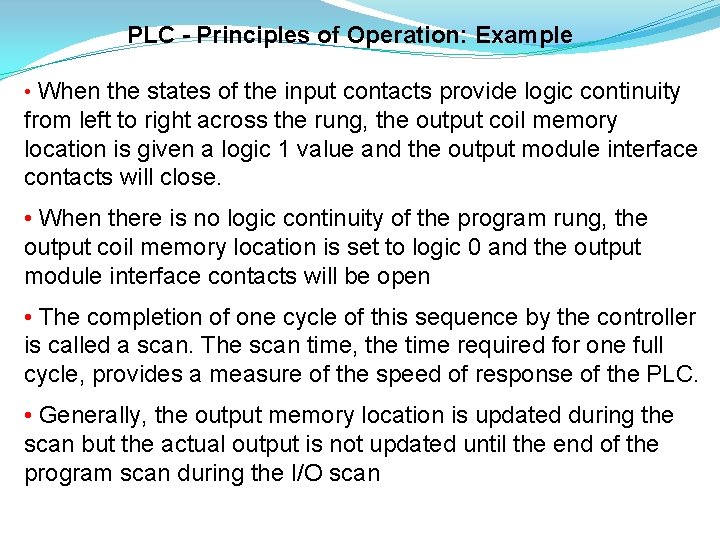
PLC - Principles of Operation: Example • When the states of the input contacts provide logic continuity from left to right across the rung, the output coil memory location is given a logic 1 value and the output module interface contacts will close. • When there is no logic continuity of the program rung, the output coil memory location is set to logic 0 and the output module interface contacts will be open • The completion of one cycle of this sequence by the controller is called a scan. The scan time, the time required for one full cycle, provides a measure of the speed of response of the PLC. • Generally, the output memory location is updated during the scan but the actual output is not updated until the end of the program scan during the I/O scan
Example – PLC control Process control PLC ladder logic program with typical addressing scheme
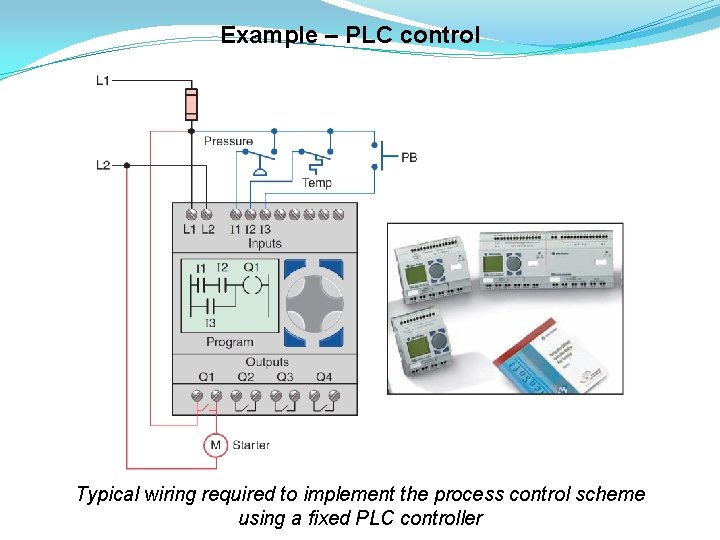
Example – PLC control Typical wiring required to implement the process control scheme using a fixed PLC controller
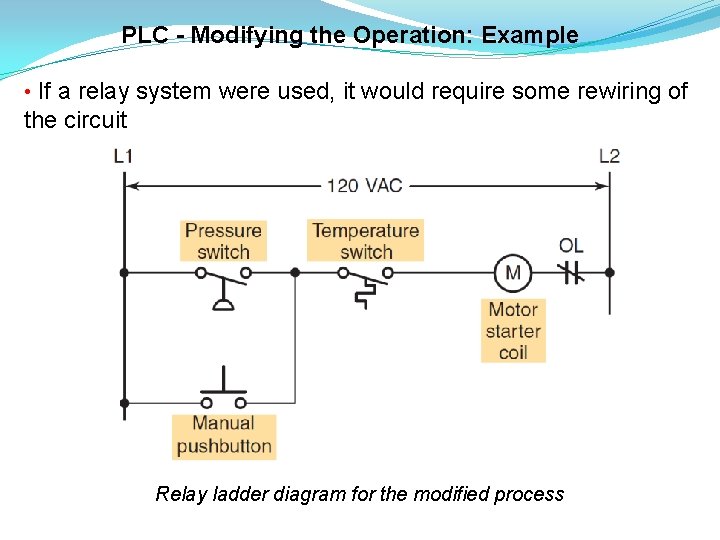
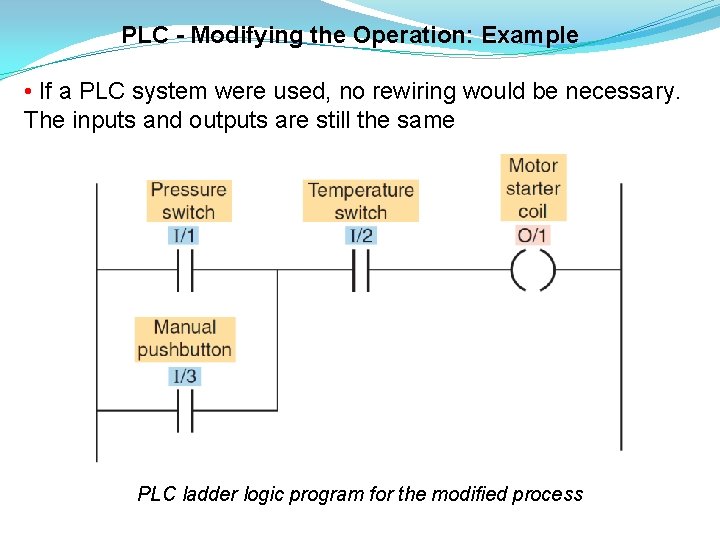
PLC - Modifying the Operation: Example • One of the important features of a PLC is the ease with which the program can be changed • For example, assume that the original process control circuit for the mixing operation must be modified • The change requires that the manual pushbutton control be permitted to operate at any pressure, but not unless the specified temperature setting has been reached
PLC - Modifying the Operation: Example • If a relay system were used, it would require some rewiring of the circuit Relay ladder diagram for the modified process
PLC - Modifying the Operation: Example • If a PLC system were used, no rewiring would be necessary. The inputs and outputs are still the same PLC ladder logic program for the modified process
PLCs versus Computers • Some important characteristics distinguish PLCs from PC: • PLC is designed to operate in the industrial environment with wide ranges of ambient temperature and humidity • The PLC is programmed in relay ladder logic or other easily learned languages • PLCs come equipped with terminals for input and output field devices as well as communication ports • Computers are complex computing machines capable of executing several programs or tasks simultaneously and in any order. Most PLCs, on the other hand, execute a single program in an orderly and sequential fashion from first to last instruction
PLCs versus Computers • PLC control systems have been designed to be easily installed and maintained. Troubleshooting is simplified by the use of fault indicators and messaging displayed on the programmer screen • Input/output modules for connecting the field devices are easily connected and replaced
PLCs versus Computers Software associated with a PLC but written and run on a personal computer falls into the following two broad categories: 1. PLC software that allows the user to program and document gives the user the tools to write a PLC program— using ladder logic or another programming language 2. PLC software that allows the user to monitor and control the process is also called a human machine interface (HMI). It enables the user to view a process—or a graphical representation of a process • Many operator interfaces do not use PLC software. PLCs can be integrated with HMIs but the same software does not program both devices
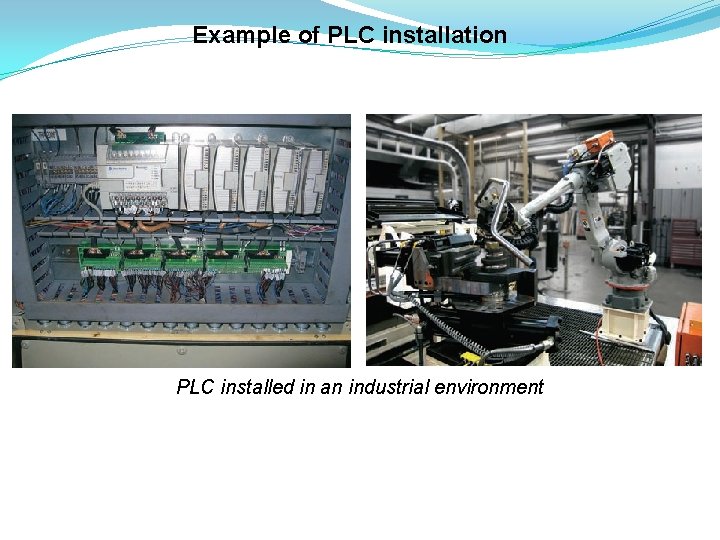
Example of PLC installation PLC installed in an industrial environment
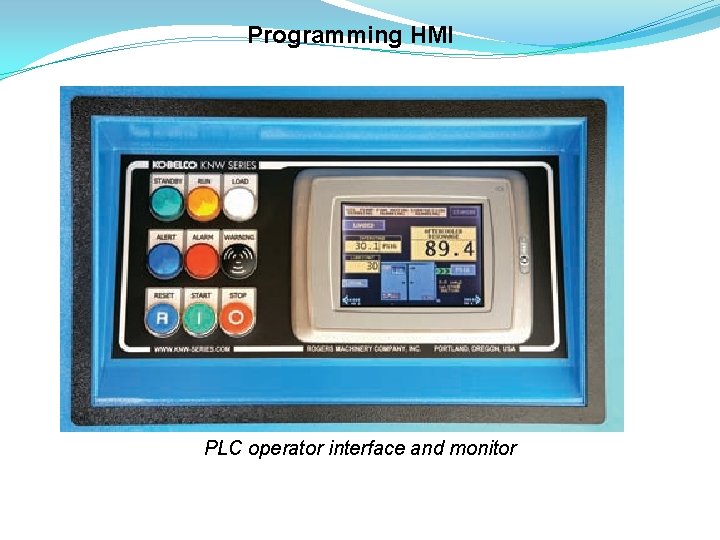
Programming HMI PLC operator interface and monitor
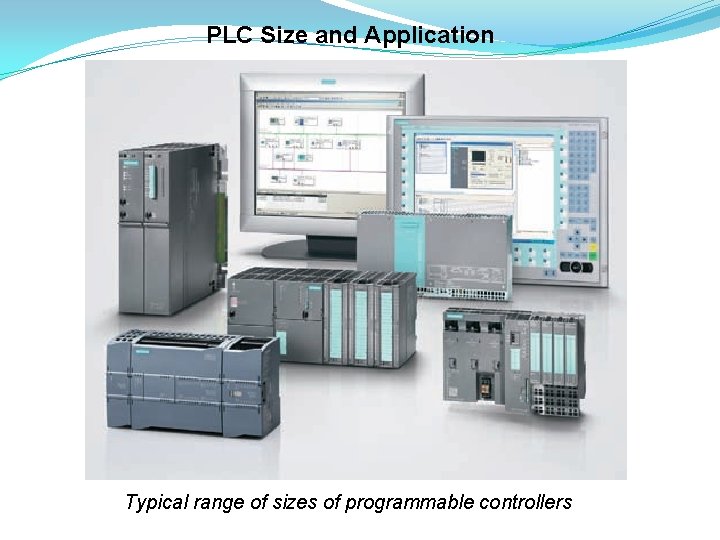
PLC Size and Application • The criteria used in categorizing PLCs include: • Functionality • Number of inputs and outputs • Cost • Physical size
PLC Size and Application • The I/O count is the most important factor for sizing PLC • The nano is the smallest size with less than 15 I/O points • Micro types (15 to 128 I/O points) • Medium types (128 to 512 I/O points) • Large types (over 512 I/O points) • Matching the PLC with the application is a key factor in the selection process
PLC Size and Application Typical range of sizes of programmable controllers
PLC Size and Application • There are three major types of PLC application: • Singleended • Multitask • Control management
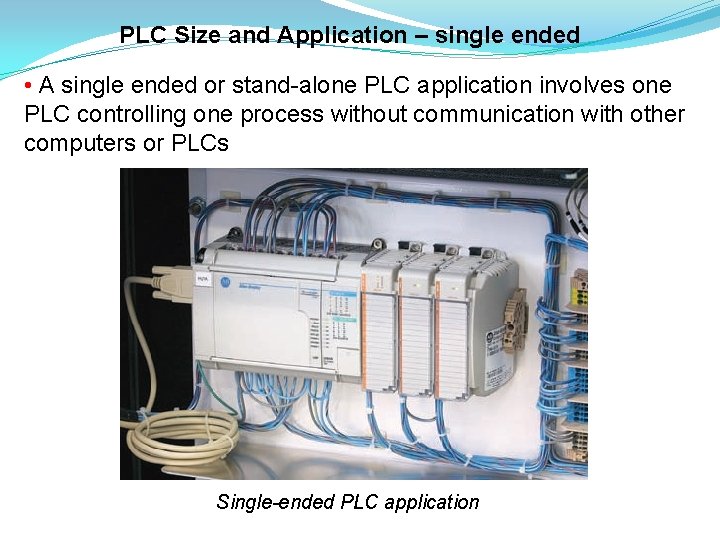
PLC Size and Application – single ended • A single ended or stand-alone PLC application involves one PLC controlling one process without communication with other computers or PLCs Single-ended PLC application
PLC Size and Application - multitasking • A multitask PLC application involves one PLC controlling several processes • Adequate I/O capacity is a significant factor in this type of installation • If the PLC would be a subsystem of a larger process and would have to communicate with a central PLC or computer, provisions for a data communications network are also required
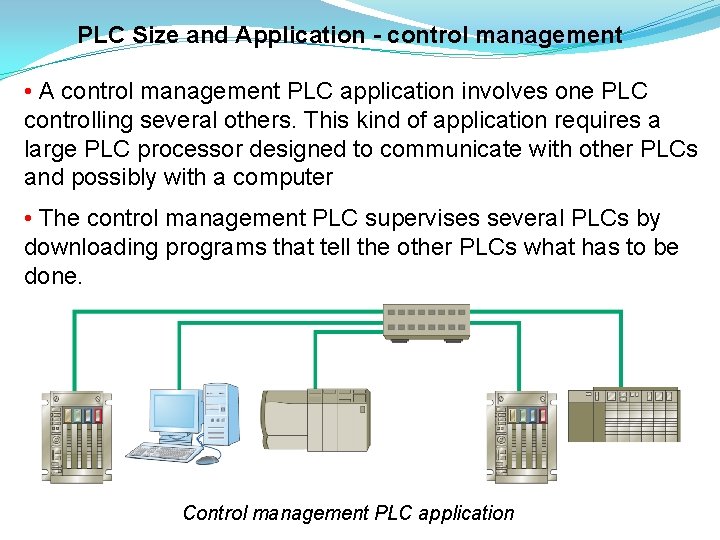
PLC Size and Application - control management • A control management PLC application involves one PLC controlling several others. This kind of application requires a large PLC processor designed to communicate with other PLCs and possibly with a computer • The control management PLC supervises several PLCs by downloading programs that tell the other PLCs what has to be done. Control management PLC application
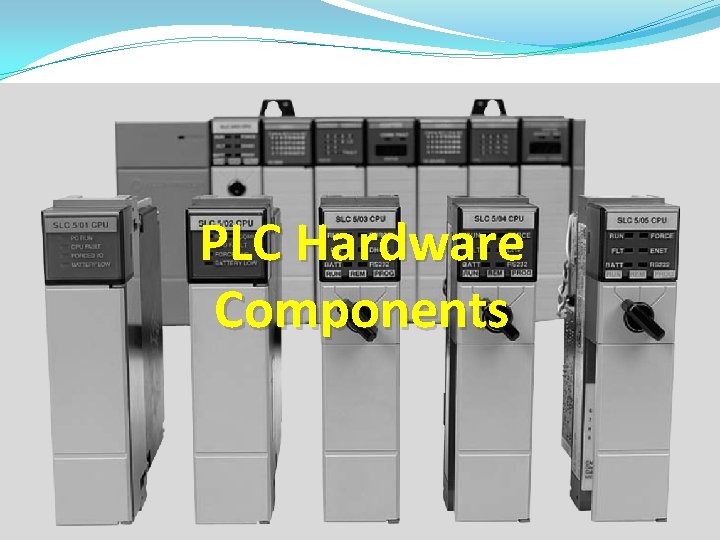
PLC Hardware Components
The I/O Section • The input/output (I/O) section of a PLC is the section to which all field devices are connected and provides the interface between them and the CPU • Input interface modules accept signals from the machine or process devices and convert them into signals that can be used by the controller • Output interface modules convert controller signals into external signals used to control the machine or process • A typical PLC has room for several I/O modules, allowing it to be customized for a particular application by selecting the appropriate modules • Each slot in the rack is capable of accommodating any type of I/O module
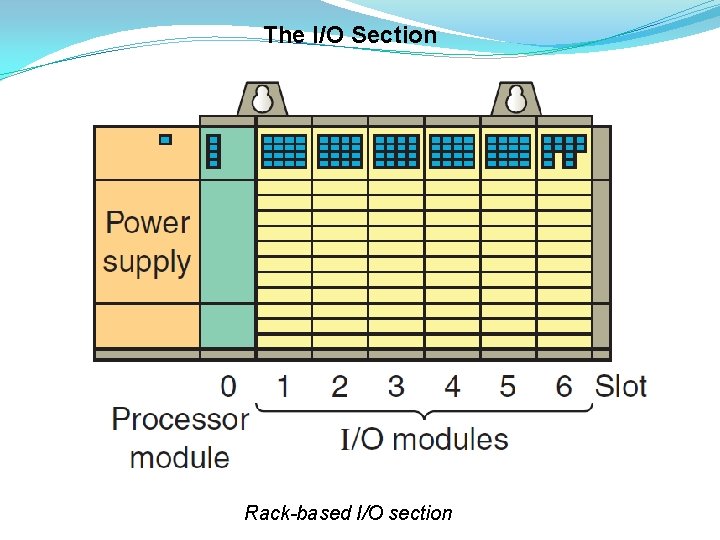
The I/O Section Rack-based I/O section
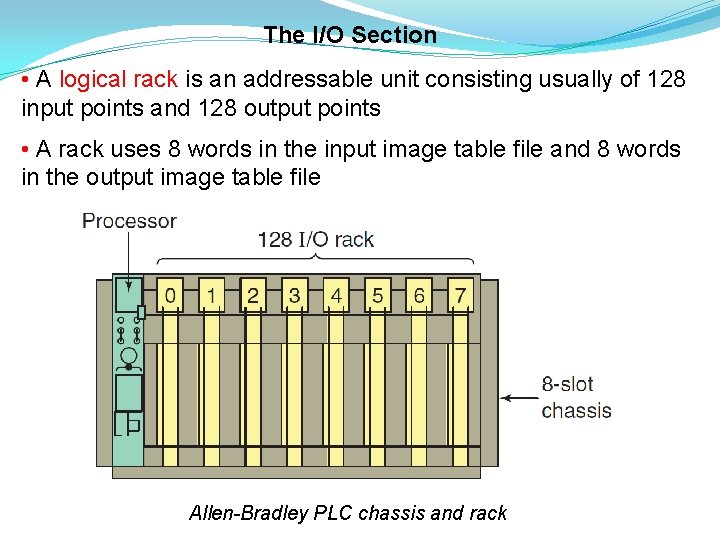
The I/O Section • A logical rack is an addressable unit consisting usually of 128 input points and 128 output points • A rack uses 8 words in the input image table file and 8 words in the output image table file Allen-Bradley PLC chassis and rack
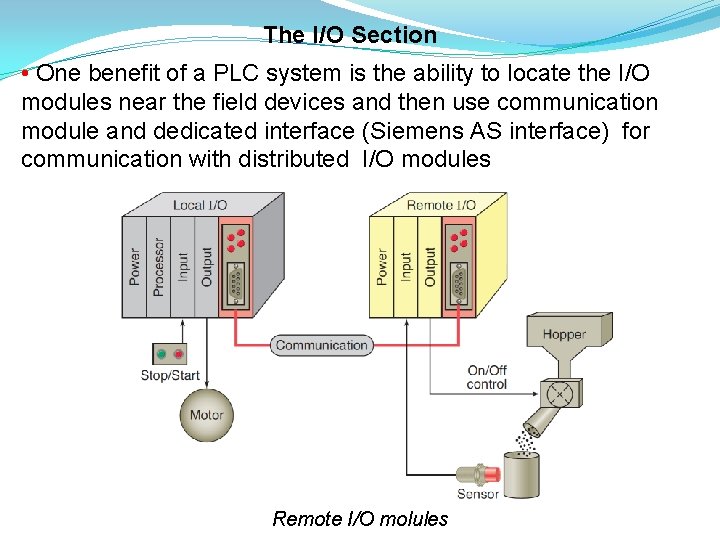
The I/O Section • One benefit of a PLC system is the ability to locate the I/O modules near the field devices and then use communication module and dedicated interface (Siemens AS interface) for communication with distributed I/O modules Remote I/O molules
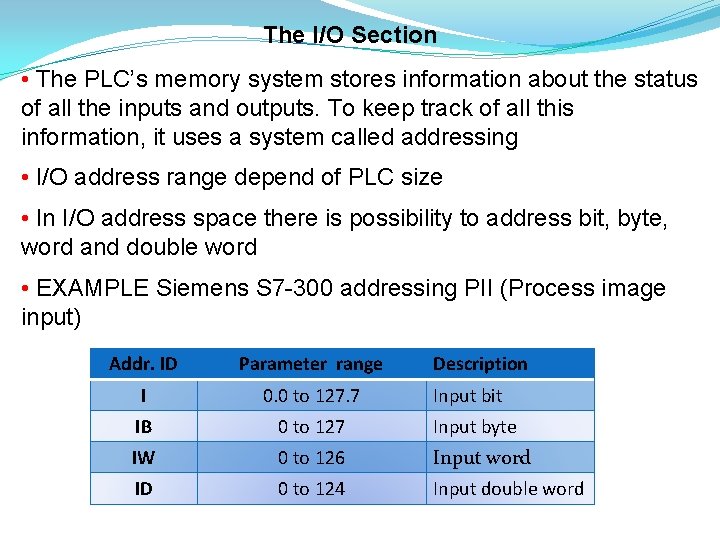
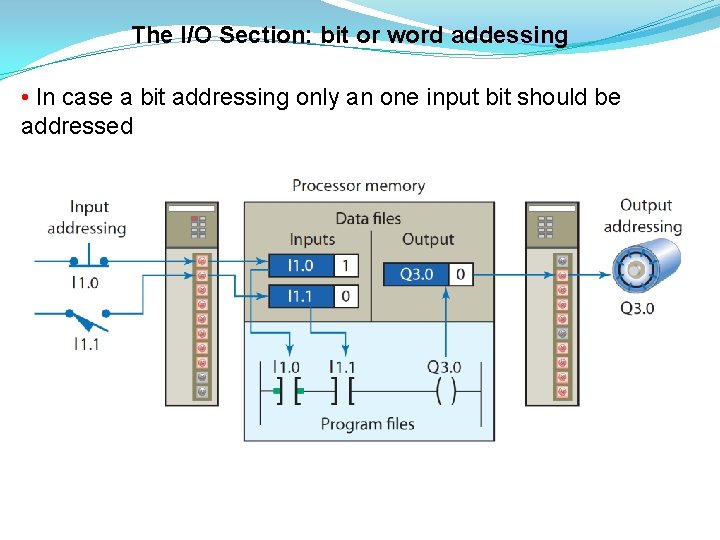
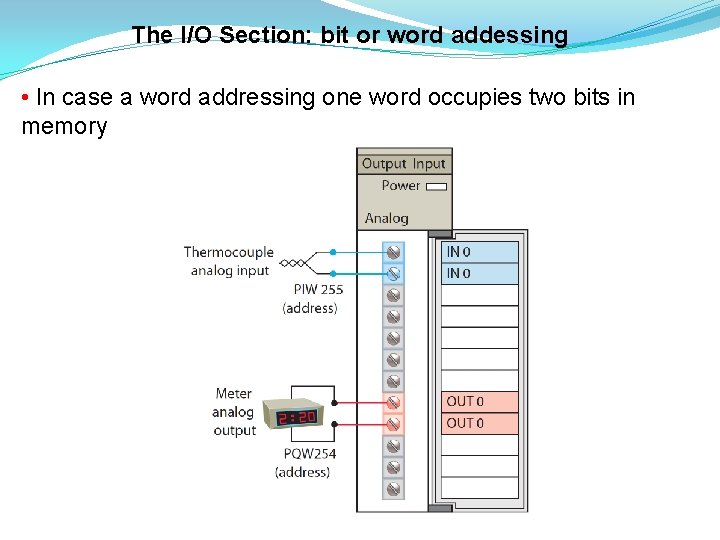
The I/O Section • The PLC’s memory system stores information about the status of all the inputs and outputs. To keep track of all this information, it uses a system called addressing • I/O address range depend of PLC size • In I/O address space there is possibility to address bit, byte, word and double word • EXAMPLE Siemens S 7 -300 addressing PII (Process image input) Addr. ID Parameter range Description I 0. 0 to 127. 7 IB 0 to 127 Input byte IW 0 to 126 Input word ID 0 to 124 Input double word Input bit
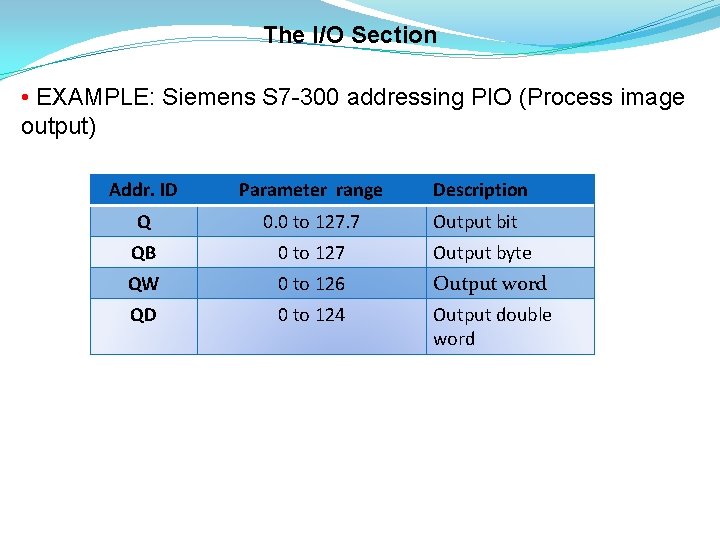
The I/O Section • EXAMPLE: Siemens S 7 -300 addressing PIO (Process image output) Addr. ID Parameter range Description Q 0. 0 to 127. 7 Output bit QB 0 to 127 Output byte QW 0 to 126 Output word QD 0 to 124 Output double word
The I/O Section: bit or word addessing • In case a bit addressing only an one input bit should be addressed
The I/O Section: bit or word addessing • In case a word addressing one word occupies two bits in memory
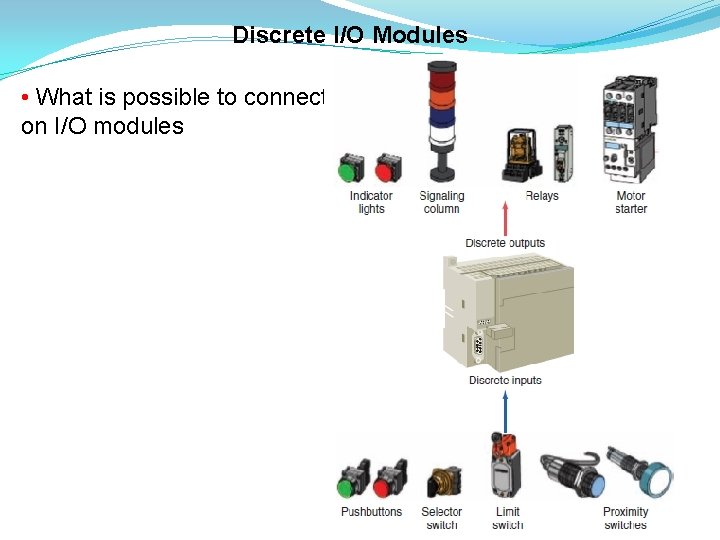
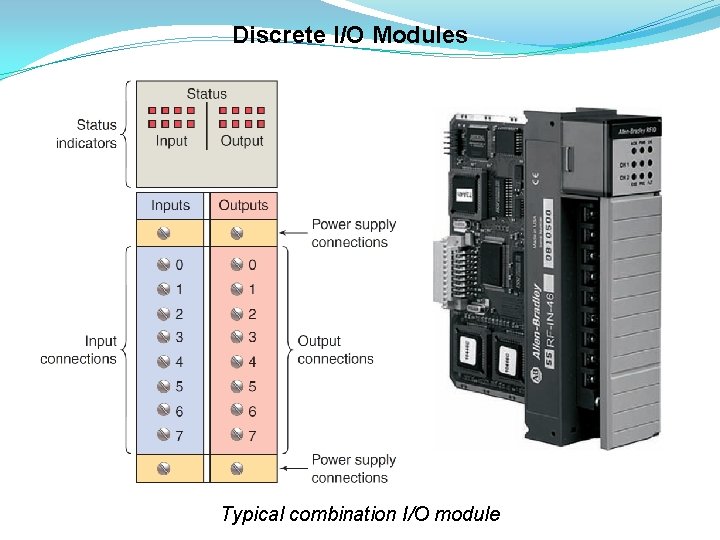
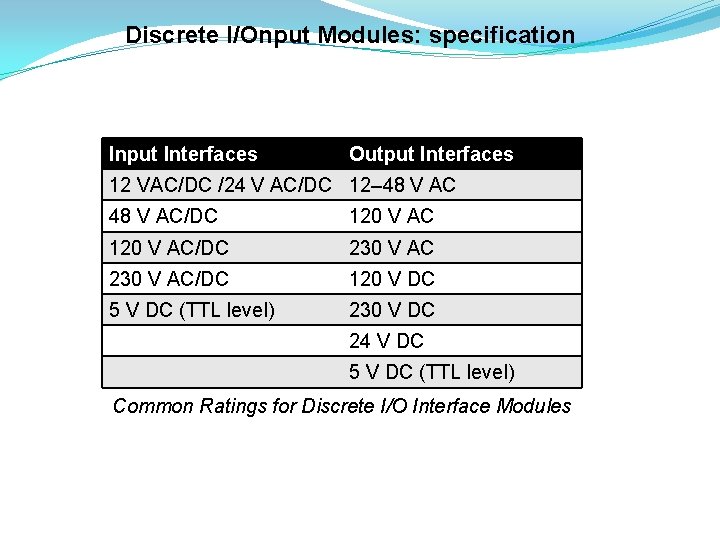
Discrete I/O Modules • The most common type of I/O interface module is the discrete type • Discrete Input modules connects field input devices of the ON/OFF nature such as selector switches, pushbuttons, and limit switches • Discrete Output modules is used for control devices such as lights, relays, solenoids, and motor starters that require simple ON/OFF switching • Each discrete I/O module is powered by some field supplied voltage source • These voltages can be of different magnitude or type, I/O modules are available at various AC and DC voltage ratings
Discrete I/O Modules • What is possible to connect on I/O modules
Discrete I/O Modules Typical combination I/O module
Discrete I/O Modules: supply • The modules themselves receive their voltage and current for properation from the backplane of the rack enclosure into which they are inserted
Discrete I/Onput Modules: specification Input Interfaces Output Interfaces 12 VAC/DC /24 V AC/DC 12– 48 V AC/DC 120 V AC/DC 230 V AC/DC 120 V DC 5 V DC (TTL level) 230 V DC 24 V DC 5 V DC (TTL level) Common Ratings for Discrete I/O Interface Modules
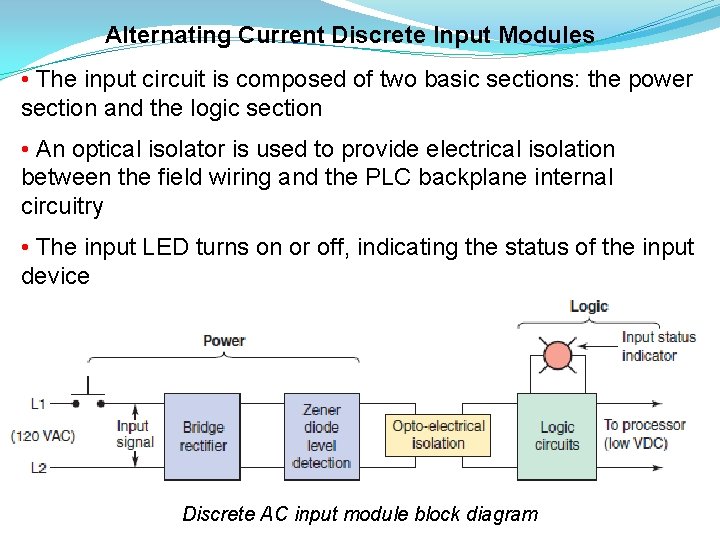
Alternating Current Discrete Input Modules • The input circuit is composed of two basic sections: the power section and the logic section • An optical isolator is used to provide electrical isolation between the field wiring and the PLC backplane internal circuitry • The input LED turns on or off, indicating the status of the input device Discrete AC input module block diagram
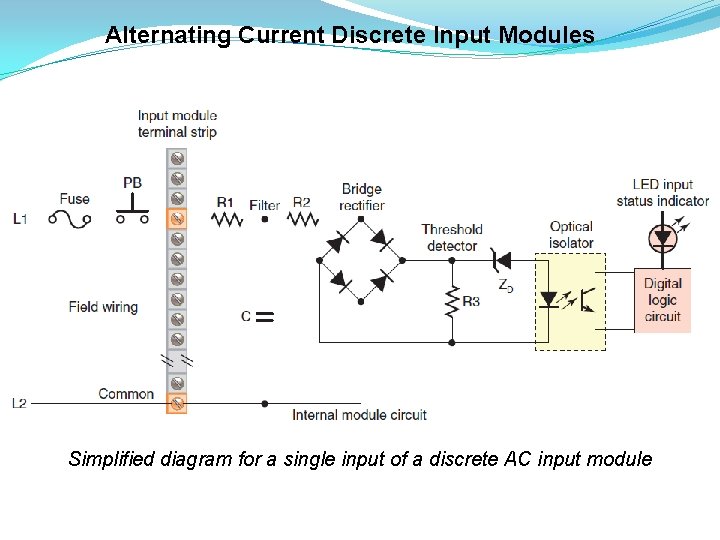
Alternating Current Discrete Input Modules Simplified diagram for a single input of a discrete AC input module
Alternating Current Discrete Input Modules • The input noise filter consisting of the capacitor and resistors R 1 and R 2 removes false signals that are due to contact bounce or electrical interference • When the pushbutton is closed AC voltage is applied to the bridge rectifier input and a low-level DC output voltage that is applied across the LED of the optical isolator • The zener diode (ZD) voltage rating sets the minimum threshold level of input voltage that can be detected • When light from the LED strikes the phototransistor it switches into conduction state and the status of the pushbutton is latched in logic to the processor
Alternating Current Discrete Input Modules • The optical isolator not only separates the higher AC input voltage from the logic circuits but also prevents damage to the processor due to line voltage transients • For fault diagnosis, an input state LED indicator is on when the input pushbutton is closed. This indicator may be wired on either side of the optical isolator • An AC/DC type of input module is used for both AC and DC inputs as the input polarity does not matter
Discrete Input Modules Discrete input modules perform four tasks in the PLC control system: 1. Sense when a signal is received from a field device 2. Convert the input signal to the correct voltage level for the particular PLC 3. Isolate the PLC from fluctuations in the input signal’s voltage or current 4. Send a signal to the processor indicating which sensor originated the signal
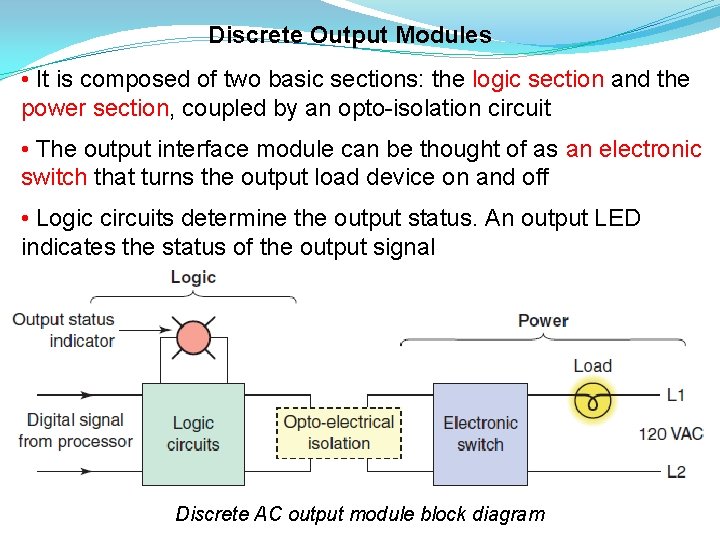
Discrete Output Modules • It is composed of two basic sections: the logic section and the power section, coupled by an opto-isolation circuit • The output interface module can be thought of as an electronic switch that turns the output load device on and off • Logic circuits determine the output status. An output LED indicates the status of the output signal Discrete AC output module block diagram
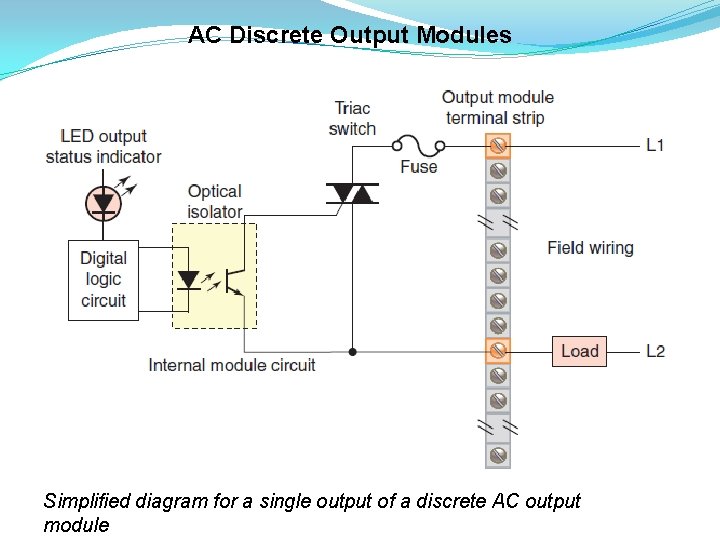
AC Discrete Output Modules Simplified diagram for a single output of a discrete AC output module
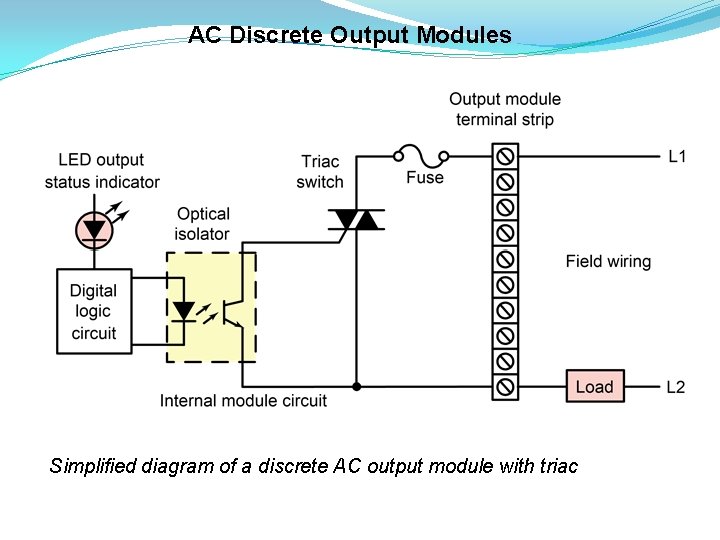
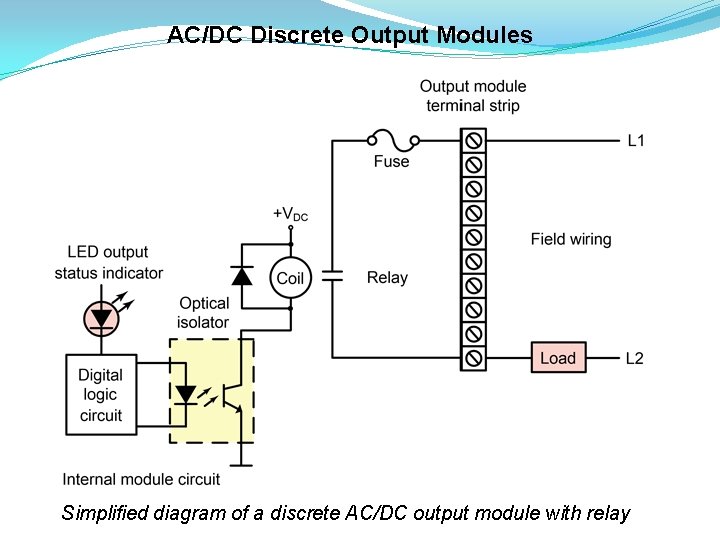
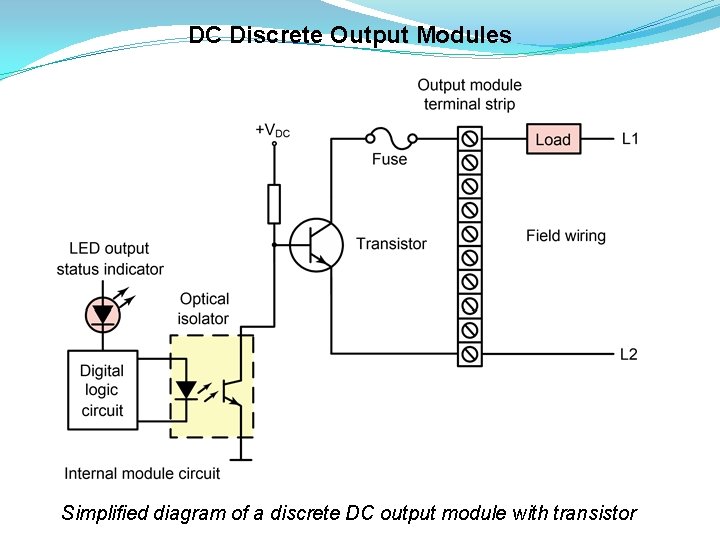
Discrete Output Modules: operation • The processor sets the output status according to the (LADDER) program • When the processor calls for an output load to be energized, a voltage is applied across the LED of the opto-isolator • The LED then emits light, which switches the phototransistor into conduction state • This turn on the TRIAC as AC switch into conduction state allowing current to flow to the output load • The output interface is usually provided with LEDs that indicate the status of each output • Fuses are normally required for the output module allowing circuit to be protected • The triac cannot be used to switch a DC load
AC Discrete Output Modules Simplified diagram of a discrete AC output module with triac
AC/DC Discrete Output Modules Simplified diagram of a discrete AC/DC output module with relay
DC Discrete Output Modules Simplified diagram of a discrete DC output module with transistor
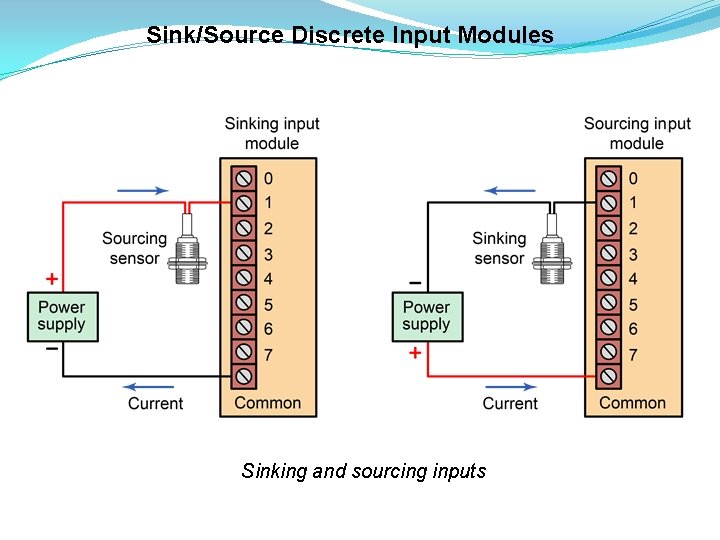
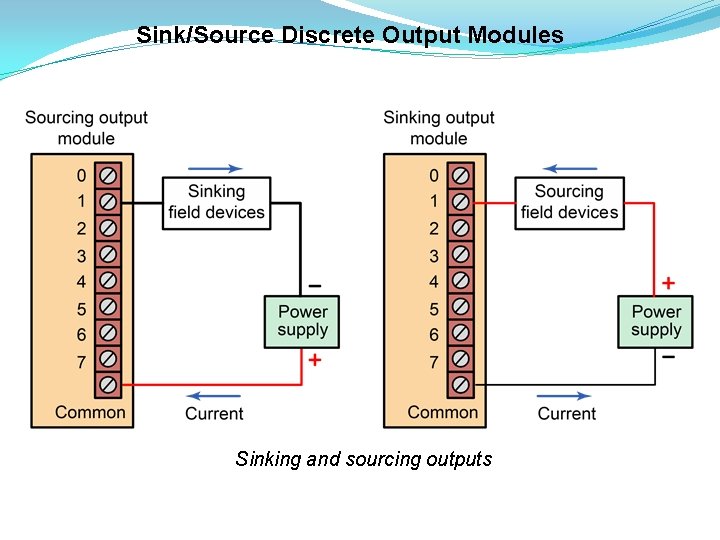
Discrete Output Modules • Certain DC I/O modules specify whether the module is designed for interfacing with current-source or current-sink devices • If the module is a current-sourcing module, then the input or output device must be a current-sinking device • Conversely, if the module is specified as current-sinking, then the connected device must be current-sourcing • In general, sinking (NPN) and sourcing (PNP) are terms used to describe a current signal flow relationship between field input and output devices in a control system and their power supply.
Sink/Source Discrete Input Modules Sinking and sourcing inputs
Sink/Source Discrete Output Modules Sinking and sourcing outputs
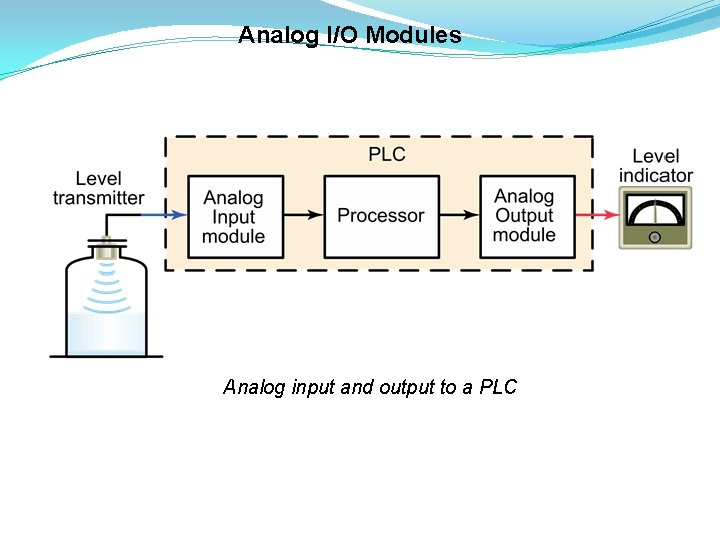
Analog I/O Modules • The analog input interface module accepts an analog voltage or current signal from the analog field devices and convert to digital form (10 or 12 bits) • The analog output module accepts the digital value from the processor and converts it back to an analog signal • Analog input modules normally have multiple input channels that allow 4, 8, or 16 devices to be interface to the PLC • The two basic types of analog input modules are voltage sensing and current sensing • Common physical quantities measured by a PLC analog module include temperature, speed, level, flow, weight, pressure, and position
Analog I/O Modules Analog input and output to a PLC
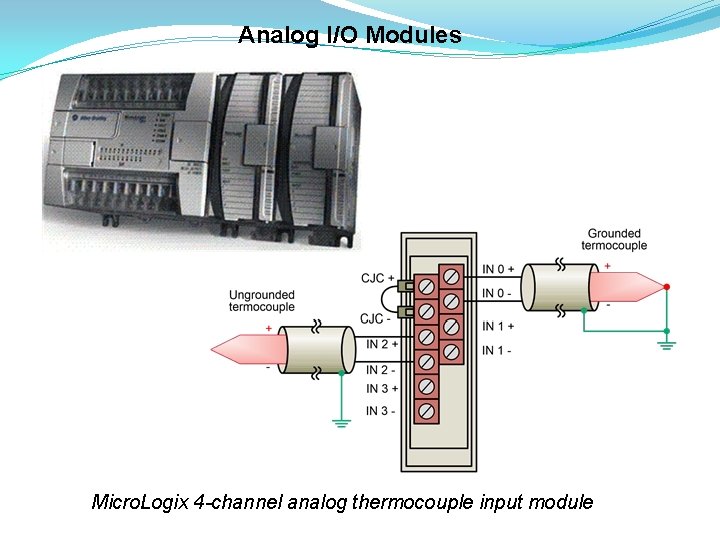
Analog I/O Modules Micro. Logix 4 -channel analog thermocouple input module
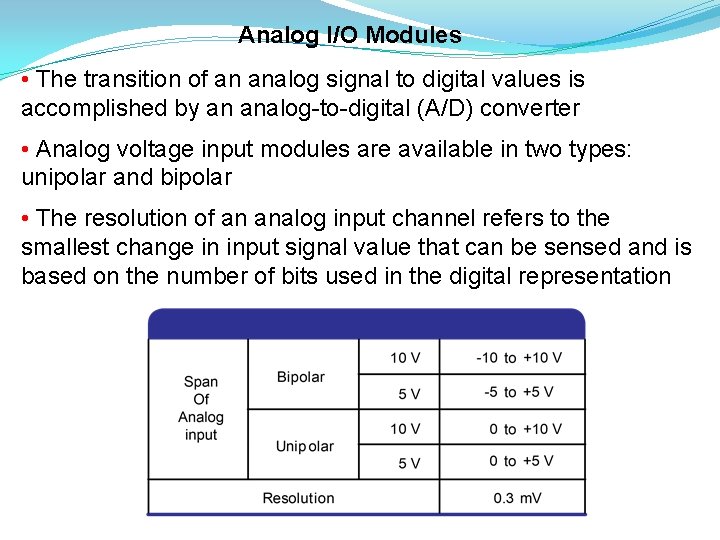
Analog I/O Modules • The transition of an analog signal to digital values is accomplished by an analog-to-digital (A/D) converter • Analog voltage input modules are available in two types: unipolar and bipolar • The resolution of an analog input channel refers to the smallest change in input signal value that can be sensed and is based on the number of bits used in the digital representation
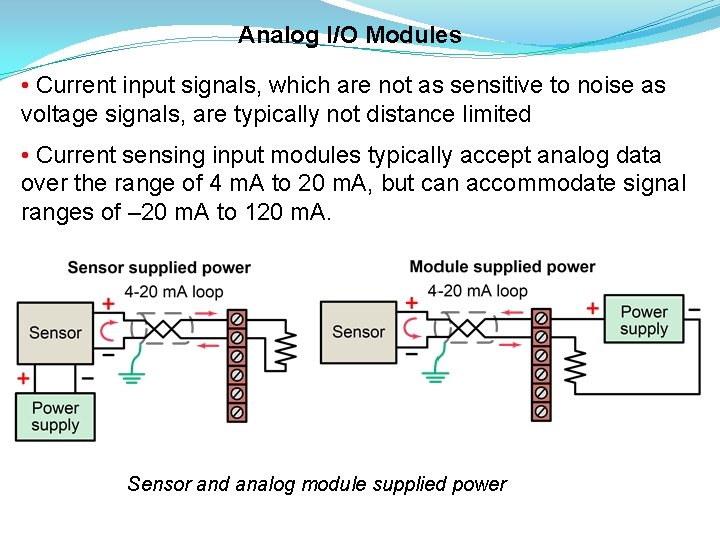
Analog I/O Modules • Current input signals, which are not as sensitive to noise as voltage signals, are typically not distance limited • Current sensing input modules typically accept analog data over the range of 4 m. A to 20 m. A, but can accommodate signal ranges of – 20 m. A to 120 m. A. Sensor and analog module supplied power
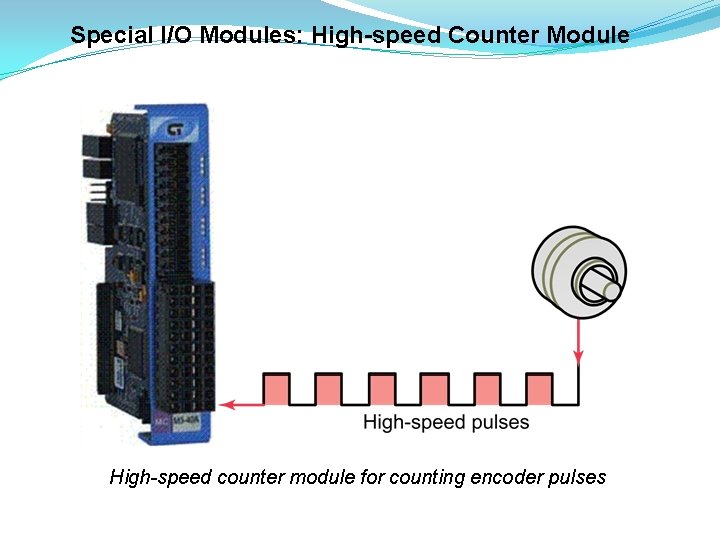
Special I/O Modules: High-speed Counter Module • Is used to provide an interface for applications requiring counter speeds that surpass the capability of the PLC ladder program • High-speed counter modules are used to count pulses from sensors, encoders, and switches that operate at very high speeds • They have the separate electronics needed to count independently of the processor • A typical count rate available is 0 to 100 k. Hz, which means the module would be able to count 100, 000 pulses per second
Special I/O Modules: High-speed Counter Module High-speed counter module for counting encoder pulses
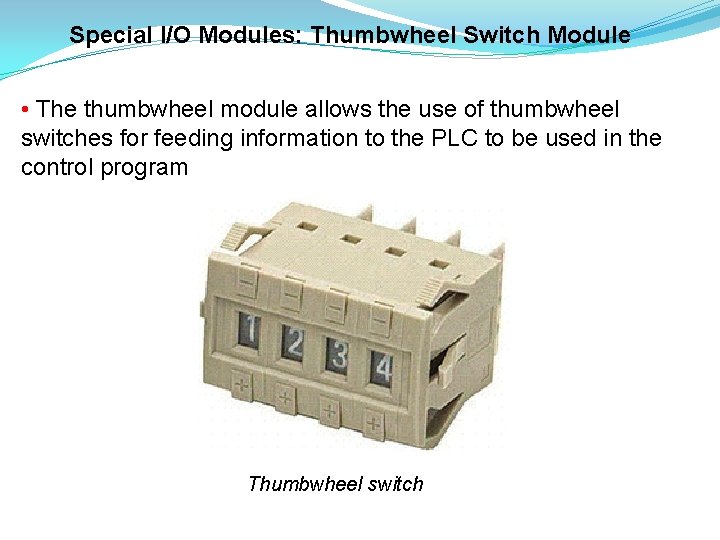
Special I/O Modules: Thumbwheel Switch Module • The thumbwheel module allows the use of thumbwheel switches for feeding information to the PLC to be used in the control program Thumbwheel switch
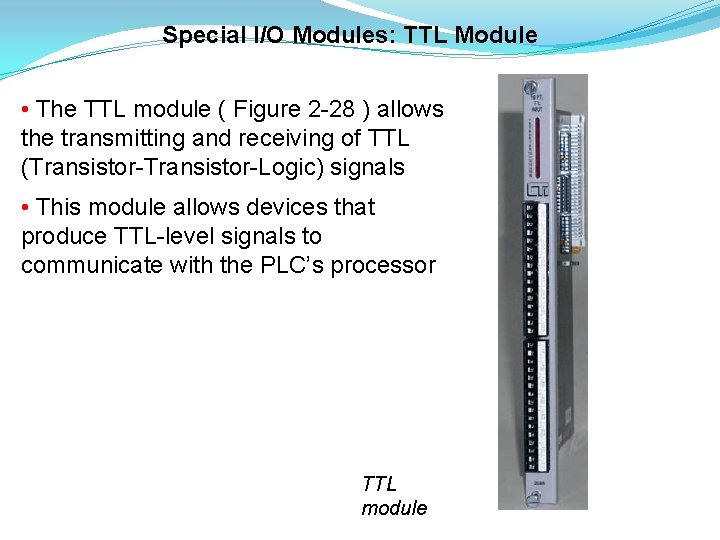
Special I/O Modules: TTL Module • The TTL module ( Figure 2 -28 ) allows the transmitting and receiving of TTL (Transistor-Logic) signals • This module allows devices that produce TTL-level signals to communicate with the PLC’s processor TTL module
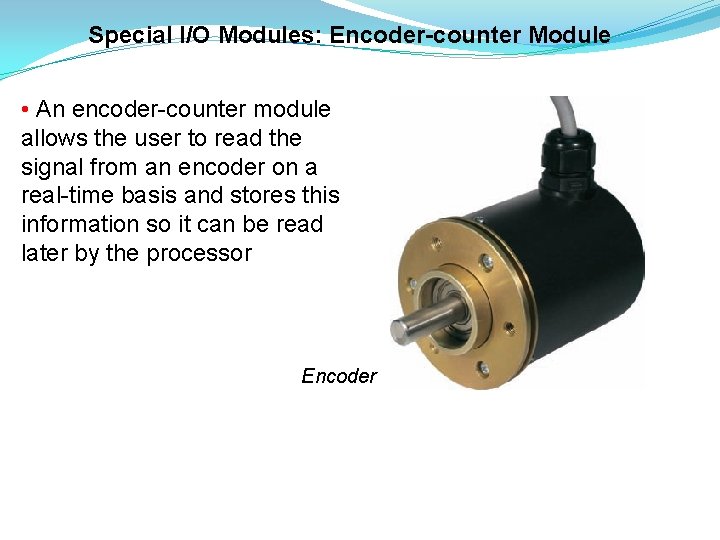
Special I/O Modules: Encoder-counter Module • An encoder-counter module allows the user to read the signal from an encoder on a real-time basis and stores this information so it can be read later by the processor Encoder
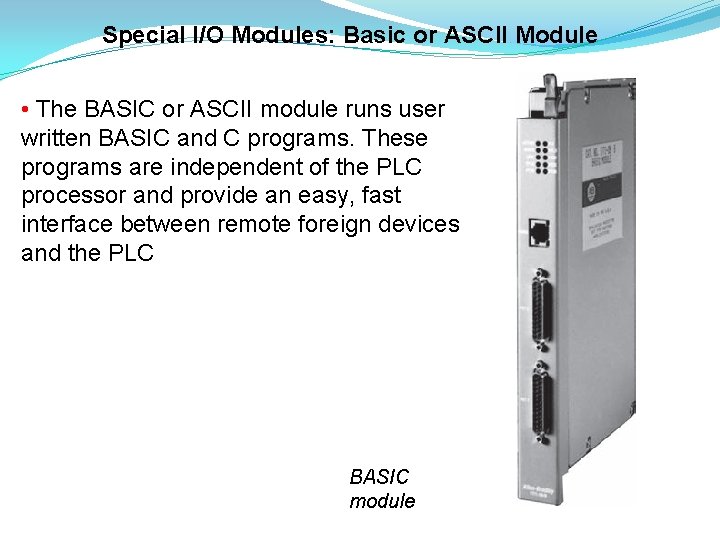
Special I/O Modules: Basic or ASCII Module • The BASIC or ASCII module runs user written BASIC and C programs. These programs are independent of the PLC processor and provide an easy, fast interface between remote foreign devices and the PLC BASIC module
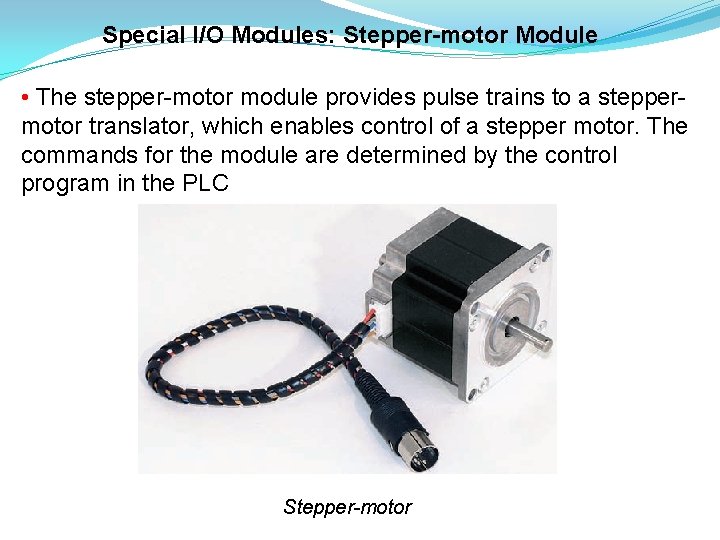
Special I/O Modules: Stepper-motor Module • The stepper-motor module provides pulse trains to a steppermotor translator, which enables control of a stepper motor. The commands for the module are determined by the control program in the PLC Stepper-motor
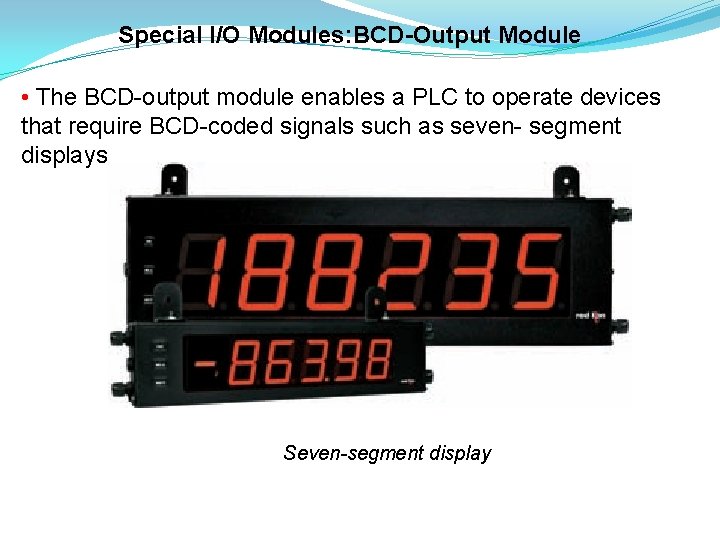
Special I/O Modules: BCD-Output Module • The BCD-output module enables a PLC to operate devices that require BCD-coded signals such as seven- segment displays Seven-segment display
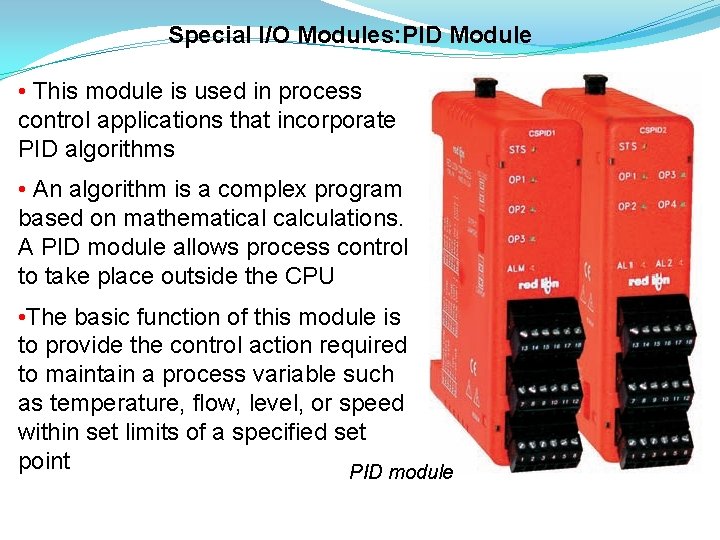
Special I/O Modules: PID Module • This module is used in process control applications that incorporate PID algorithms • An algorithm is a complex program based on mathematical calculations. A PID module allows process control to take place outside the CPU • The basic function of this module is to provide the control action required to maintain a process variable such as temperature, flow, level, or speed within set limits of a specified set point PID module
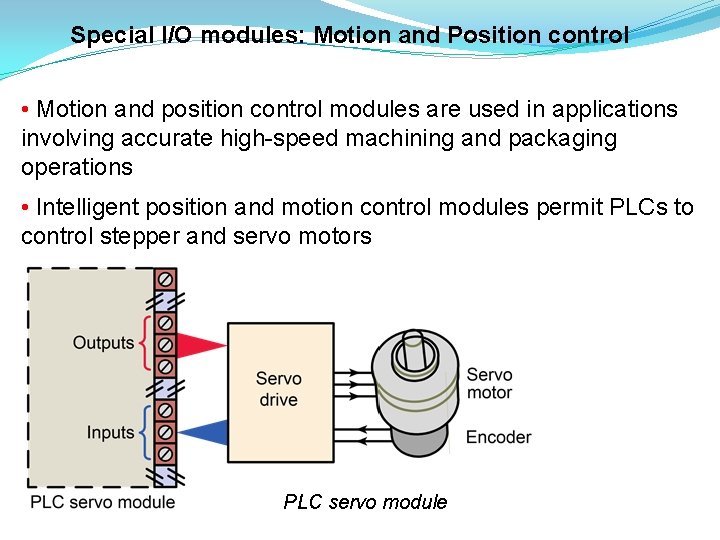
Special I/O modules: Motion and Position control • Motion and position control modules are used in applications involving accurate high-speed machining and packaging operations • Intelligent position and motion control modules permit PLCs to control stepper and servo motors PLC servo module
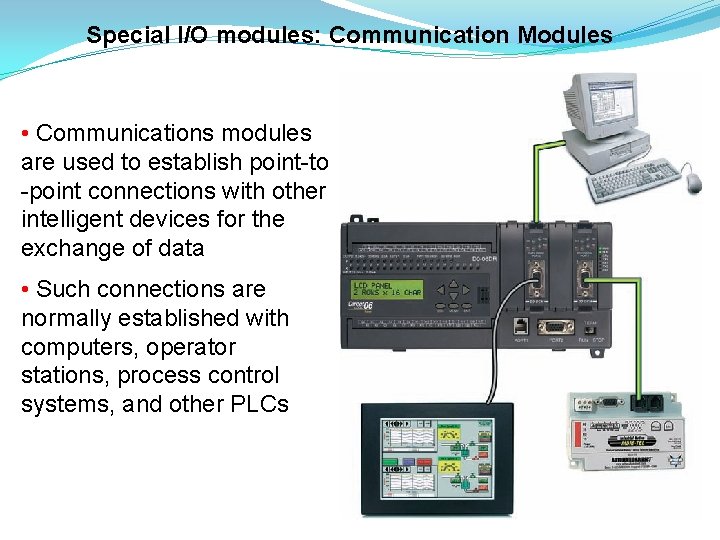
Special I/O modules: Communication Modules • Communications modules are used to establish point-to -point connections with other intelligent devices for the exchange of data • Such connections are normally established with computers, operator stations, process control systems, and other PLCs
I/O modules: Specification