
Uveitis OHS Histo Basics 1 The uveitis is
Uveitis: OHS Histo: Basics 1) The uveitis is profiled 2) The profiled case is meshed 3) A differential diagnosis list is generated 4) Studies are obtained to identify the etiology 5) Treatment appropriate for the etiology is initiated What is the causative organism in ocular histoplasmosis syndrome (OHS)?
Uveitis: OHS Histo: Basics 1) The uveitis is profiled 2) The profiled case is meshed 3) A differential diagnosis list is generated 4) Studies are obtained to identify the etiology 5) Treatment appropriate for the etiology is initiated What is the causative organism in ocular histoplasmosis syndrome (OHS)? Histoplasma capsulatum
Uveitis: OHS Histo: Basics 1) The uveitis is profiled 2) The profiled case is meshed 3) A differential diagnosis list is generated 4) Studies are obtained to identify the etiology 5) Treatment appropriate for the etiology is initiated What is the causative organism in ocular histoplasmosis syndrome (OHS)? Histoplasma capsulatum What are its basic properties (ie, what sort of organism is it in a microbiology sense)?
Uveitis: OHS Histo: Basics 1) The uveitis is profiled 2) The profiled case is meshed 3) A differential diagnosis list is generated 4) Studies are obtained to identify the etiology 5) Treatment appropriate for the etiology is initiated What is the causative organism in ocular histoplasmosis syndrome (OHS)? Histoplasma capsulatum What are its basic properties (ie, what sort of organism is it in a microbiology sense)? It is a dimorphic fungus
Uveitis: OHS Histo: Basics 1) The uveitis is profiled 2) The profiled case is meshed 3) A differential diagnosis list is generated 4) Studies are obtained to identify the etiology 5) Treatment appropriate for the etiology is initiated What is the causative organism in ocular histoplasmosis syndrome (OHS)? Histoplasma capsulatum What are its basic properties (ie, what sort of organism is it in a microbiology sense)? It is a dimorphic fungus What does it mean to say a fungus is ‘dimorphic’?
Uveitis: OHS Histo: Basics 1) The uveitis is profiled 2) The profiled case is meshed 3) A differential diagnosis list is generated 4) Studies are obtained to identify the etiology 5) Treatment appropriate for the etiology is initiated What is the causative organism in ocular histoplasmosis syndrome (OHS)? Histoplasma capsulatum What are its basic properties (ie, what sort of organism is it in a microbiology sense)? It is a dimorphic fungus What does it mean to say a fungus is ‘dimorphic’? It means the organism has both a yeast form and a filamentous (mold) form

Uveitis: OHS H capsulatum: Mold (filamentous) form H capsulatum: Yeast form
Uveitis: OHS Histo: Basics 1) The uveitis is profiled 2) The profiled case is meshed 3) A differential diagnosis list is generated 4) Studies are obtained to identify the etiology 5) Treatment appropriate for the etiology is initiated What is the causative organism in ocular histoplasmosis syndrome (OHS)? Histoplasma capsulatum What are its basic properties (ie, what sort of organism is it in a microbiology sense)? It is a dimorphic fungus What does it mean to say a fungus is ‘dimorphic’? It means the organism has both a yeast form and a filamentous (mold) form How are humans infected?
Uveitis: OHS Histo: Basics 1) The uveitis is profiled 2) The profiled case is meshed 3) A differential diagnosis list is generated 4) Studies are obtained to identify the etiology 5) Treatment appropriate for the etiology is initiated What is the causative organism in ocular histoplasmosis syndrome (OHS)? Histoplasma capsulatum What are its basic properties (ie, what sort of organism is it in a microbiology sense)? It is a dimorphic fungus What does it mean to say a fungus is ‘dimorphic’? It means the organism has both a yeast form and a filamentous (mold) form How are humans infected? Via inhalation of spores (called microconidia , small structures attached to the filaments)
Uveitis: OHS Histo: Basics 1) The uveitis is profiled 2) The profiled case is meshed 3) A differential diagnosis list is generated 4) Studies are obtained to identify the etiology 5) Treatment appropriate for the etiology is initiated What is the causative organism in ocular histoplasmosis syndrome (OHS)? Histoplasma capsulatum What are its basic properties (ie, what sort of organism is it in a microbiology sense)? It is a dimorphic fungus What does it mean to say a fungus is ‘dimorphic’? It means the organism has both a yeast form and a filamentous (mold) form How are humans infected? Via inhalation of spores (called microconidia , small structures attached to the filaments)
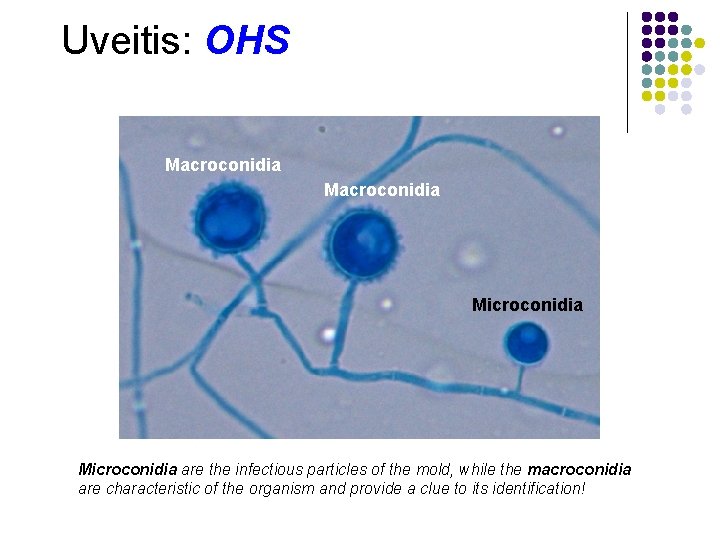
Uveitis: OHS Macroconidia Microconidia are the infectious particles of the mold, while the macroconidia are characteristic of the organism and provide a clue to its identification!
Uveitis: OHS Histo: Basics 1) The uveitis is profiled 2) The profiled case is meshed 3) A differential diagnosis list is generated 4) Studies are obtained to identify the etiology 5) Treatment appropriate for the etiology is initiated What is the causative organism in ocular histoplasmosis syndrome (OHS)? Histoplasma capsulatum What are its basic properties (ie, what sort of organism is it in a microbiology sense)? It is a dimorphic fungus What does it mean to say a fungus is ‘dimorphic’? It means the organism has both a yeast form and a filamentous (mold) form How are humans infected? Via inhalation of spores (called microconidia , small structures attached to the filaments) What animals serve as the reservoir for the disease?
Uveitis: OHS Histo: Basics 1) The uveitis is profiled 2) The profiled case is meshed 3) A differential diagnosis list is generated 4) Studies are obtained to identify the etiology 5) Treatment appropriate for the etiology is initiated What is the causative organism in ocular histoplasmosis syndrome (OHS)? Histoplasma capsulatum What are its basic properties (ie, what sort of organism is it in a microbiology sense)? It is a dimorphic fungus What does it mean to say a fungus is ‘dimorphic’? It means the organism has both a yeast form and a filamentous (mold) form How are humans infected? Via inhalation of spores (called microconidia , small structures attached to the filaments) What animals serve as the reservoir for the disease? Bats, and various species of birds. Microconidia in their droppings become aerosolized.
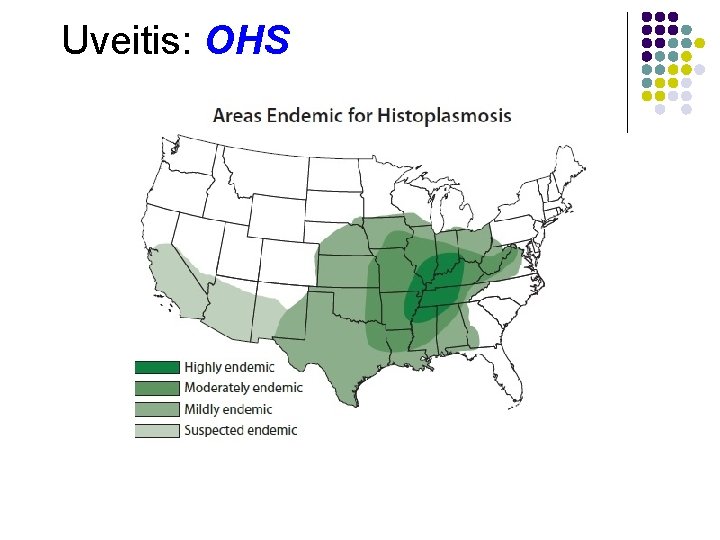
Uveitis: OHS Histo: Basics 1) The uveitis is profiled 2) The profiled case is meshed 3) A differential diagnosis list is generated 4) Studies are obtained to identify the etiology 5) Treatment appropriate for the etiology is initiated What is the causative organism in ocular histoplasmosis syndrome (OHS)? Histoplasma capsulatum What are its basic properties (ie, what sort of organism is it in a microbiology sense)? It is a dimorphic fungus What does it mean to say a fungus is ‘dimorphic’? It means the organism has both a yeast form and a filamentous (mold) form How are humans infected? Via inhalation of spores (called microconidia , small structures attached to the filaments) What animals serve as the reservoir for the disease? Bats, and various species of birds. Microconidia in their droppings become aerosolized. What regions of the US have the highest annual incidence of OHS?
Uveitis: OHS Histo: Basics 1) The uveitis is profiled 2) The profiled case is meshed 3) A differential diagnosis list is generated 4) Studies are obtained to identify the etiology 5) Treatment appropriate for the etiology is initiated What is the causative organism in ocular histoplasmosis syndrome (OHS)? Histoplasma capsulatum What are its basic properties (ie, what sort of organism is it in a microbiology sense)? It is a dimorphic fungus What does it mean to say a fungus is ‘dimorphic’? It means the organism has both a yeast form and a filamentous (mold) form How are humans infected? Via inhalation of spores (called microconidia , small structures attached to the filaments) What animals serve as the reservoir for the disease? Bats, and various species of birds. Microconidia in their droppings become aerosolized. What regions of the US have the highest annual incidence of OHS? The Mississippi and Ohio River valleys
Uveitis: OHS
Uveitis: OHS Histo: Basics 1) The uveitis is profiled 2) The profiled case is meshed 3) A differential diagnosis list is generated 4) Studies are obtained to identify the etiology 5) Treatment appropriate for the etiology is initiated What is the causative organism in ocular histoplasmosis syndrome (OHS)? Histoplasma capsulatum What are its basic properties (ie, what sort of organism is it in a microbiology sense)? It is a dimorphic fungus What does it mean to say a fungus is ‘dimorphic’? It means the organism has both a yeast form and a filamentous (mold) form How are humans infected? Via inhalation of spores (called microconidia , small structures attached to the filaments) What animals serve as the reservoir for the disease? Bats, and various species of birds. Microconidia in their droppings become aerosolized. What regions of the US have the highest annual incidence of OHS? The Mississippi and Ohio River valleys What percent of people living in these regions test positive for histoplasmosis?
Uveitis: OHS Histo: Basics 1) The uveitis is profiled 2) The profiled case is meshed 3) A differential diagnosis list is generated 4) Studies are obtained to identify the etiology 5) Treatment appropriate for the etiology is initiated What is the causative organism in ocular histoplasmosis syndrome (OHS)? Histoplasma capsulatum What are its basic properties (ie, what sort of organism is it in a microbiology sense)? It is a dimorphic fungus What does it mean to say a fungus is ‘dimorphic’? It means the organism has both a yeast form and a filamentous (mold) form How are humans infected? Via inhalation of spores (called microconidia , small structures attached to the filaments) What animals serve as the reservoir for the disease? Bats, and various species of birds. Microconidia in their droppings become aerosolized. What regions of the US have the highest annual incidence of OHS? The Mississippi and Ohio River valleys What percent of people living in these regions test positive for histoplasmosis? About 60
Uveitis: OHS Histo: Basics 1) The uveitis is profiled 2) The profiled case is meshed 3) A differential diagnosis list is generated 4) Studies are obtained to identify the etiology 5) Treatment appropriate for the etiology is initiated What is the causative organism in ocular histoplasmosis syndrome (OHS)? Histoplasma capsulatum What are its basic properties (ie, what sort of organism is it in a microbiology sense)? It is a dimorphic fungus What does it mean to say a fungus is ‘dimorphic’? It means the organism has both a yeast form and a filamentous (mold) form How are humans infected? Via inhalation of spores (called microconidia , small structures attached to the filaments) What animals serve as the reservoir for the disease? Bats, and various species of birds. Microconidia in their droppings become aerosolized. What regions of the US have the highest annual incidence of OHS? The Mississippi and Ohio River valleys What percent of people living in these regions test positive for histoplasmosis? About 60 What percent of people living in these regions have signs of ocular involvement?
Uveitis: OHS Histo: Basics 1) The uveitis is profiled 2) The profiled case is meshed 3) A differential diagnosis list is generated 4) Studies are obtained to identify the etiology 5) Treatment appropriate for the etiology is initiated What is the causative organism in ocular histoplasmosis syndrome (OHS)? Histoplasma capsulatum What are its basic properties (ie, what sort of organism is it in a microbiology sense)? It is a dimorphic fungus What does it mean to say a fungus is ‘dimorphic’? It means the organism has both a yeast form and a filamentous (mold) form How are humans infected? Via inhalation of spores (called microconidia , small structures attached to the filaments) What animals serve as the reservoir for the disease? Bats, and various species of birds. Microconidia in their droppings become aerosolized. What regions of the US have the highest annual incidence of OHS? The Mississippi and Ohio River valleys What percent of people living in these regions test positive for histoplasmosis? About 60 What percent of people living in these regions have signs of ocular involvement? About 1 -2
Uveitis: OHS: Basics Is there a gender predilection in OHS? 1) The uveitis is profiled 2) The profiled case is meshed 3) A differential diagnosis list is generated 4) Studies are obtained to identify the etiology 5) Treatment appropriate for the etiology is initiated
Uveitis: OHS: Basics Is there a gender predilection in OHS? No 1) The uveitis is profiled 2) The profiled case is meshed 3) A differential diagnosis list is generated 4) Studies are obtained to identify the etiology 5) Treatment appropriate for the etiology is initiated
Uveitis: OHS: Basics Is there a gender predilection in OHS? No Is there a racial predilection? 1) The uveitis is profiled 2) The profiled case is meshed 3) A differential diagnosis list is generated 4) Studies are obtained to identify the etiology 5) Treatment appropriate for the etiology is initiated
Uveitis: OHS: Basics 1) The uveitis is profiled 2) The profiled case is meshed 3) A differential diagnosis list is generated 4) Studies are obtained to identify the etiology 5) Treatment appropriate for the etiology is initiated Is there a gender predilection in OHS? No Is there a racial predilection? geographic area Yes, OHS occurs almost exclusively among whites of Northern European heritage ethnicity
Uveitis: OHS: Basics 1) The uveitis is profiled 2) The profiled case is meshed 3) A differential diagnosis list is generated 4) Studies are obtained to identify the etiology 5) Treatment appropriate for the etiology is initiated Is there a gender predilection in OHS? No Is there a racial predilection? Yes, OHS occurs almost exclusively among whites of Northern European heritage
Uveitis: OHS: Basics 1) The uveitis is profiled 2) The profiled case is meshed 3) A differential diagnosis list is generated 4) Studies are obtained to identify the etiology 5) Treatment appropriate for the etiology is initiated Is there a gender predilection in OHS? No Is there a racial predilection? Yes, OHS occurs almost exclusively among whites of Northern European heritage What is the classic triad of OHS? ----
Uveitis: OHS: Basics 1) The uveitis is profiled 2) The profiled case is meshed 3) A differential diagnosis list is generated 4) Studies are obtained to identify the etiology 5) Treatment appropriate for the etiology is initiated Is there a gender predilection in OHS? No Is there a racial predilection? Yes, OHS occurs almost exclusively among whites of Northern European heritage What is the classic triad of OHS? --Histo spots --Peripapillary atrophy --Disciform macular lesion(s)
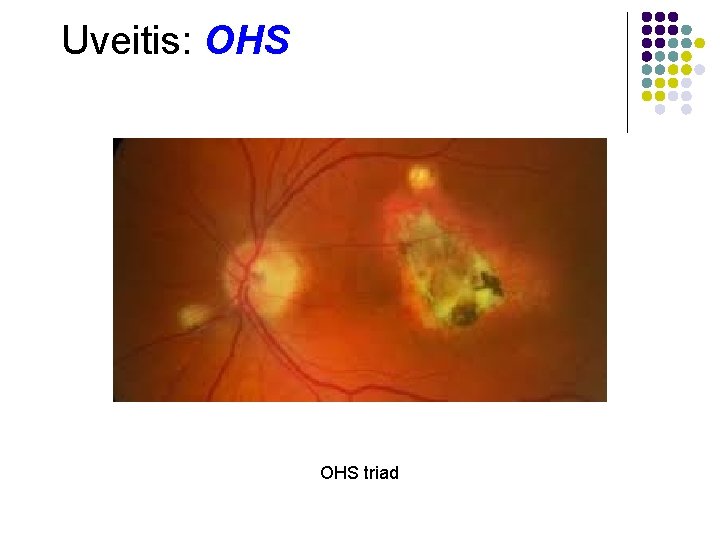
Uveitis: OHS triad
Uveitis: OHS: Basics 1) The uveitis is profiled 2) The profiled case is meshed 3) A differential diagnosis list is generated 4) Studies are obtained to identify the etiology 5) Treatment appropriate for the etiology is initiated Is there a gender predilection in OHS? No Is there a racial predilection? Yes, OHS occurs almost exclusively among whites of Northern European heritage What is the classic triad of OHS? --Histo spots --Peripapillary atrophy --Disciform macular lesion(s) Does OHS manifest unilaterally, or bilaterally?
Uveitis: OHS: Basics 1) The uveitis is profiled 2) The profiled case is meshed 3) A differential diagnosis list is generated 4) Studies are obtained to identify the etiology 5) Treatment appropriate for the etiology is initiated Is there a gender predilection in OHS? No Is there a racial predilection? Yes, OHS occurs almost exclusively among whites of Northern European heritage What is the classic triad of OHS? --Histo spots --Peripapillary atrophy --Disciform macular lesion(s) Does OHS manifest unilaterally, or bilaterally? Bilaterally (although it can be asymmetric)
Uveitis: OHS: Basics 1) The uveitis is profiled 2) The profiled case is meshed 3) A differential diagnosis list is generated 4) Studies are obtained to identify the etiology 5) Treatment appropriate for the etiology is initiated Is there a gender predilection in OHS? No Is there a racial predilection? Yes, OHS occurs almost exclusively among whites of Northern European heritage What is the classic triad of OHS? --Histo spots --Peripapillary atrophy --Disciform macular lesion(s) Does OHS manifest unilaterally, or bilaterally? Bilaterally (although it can be asymmetric) Is OHS associated with vitritis?
Uveitis: OHS: Basics 1) The uveitis is profiled 2) The profiled case is meshed 3) A differential diagnosis list is generated 4) Studies are obtained to identify the etiology 5) Treatment appropriate for the etiology is initiated Is there a gender predilection in OHS? No Is there a racial predilection? Yes, OHS occurs almost exclusively among whites of Northern European heritage What is the classic triad of OHS? --Histo spots --Peripapillary atrophy --Disciform macular lesion(s) Does OHS manifest unilaterally, or bilaterally? Bilaterally (although it can be asymmetric) Is OHS associated with vitritis? Never. If vitritis is present, it’s not OHS.
Uveitis: OHS: Basics 1) The uveitis is profiled 2) The profiled case is meshed 3) A differential diagnosis list is generated 4) Studies are obtained to identify the etiology 5) Treatment appropriate for the etiology is initiated Is there a gender predilection in OHS? No Is there a racial predilection? Yes, OHS occurs almost exclusively among whites of Northern European heritage What is the classic triad of OHS? --Histo spots --Peripapillary atrophy --Disciform macular lesion(s) Does OHS manifest unilaterally, or bilaterally? Bilaterally (although it can be asymmetric) Is OHS associated with vitritis? Never. If vitritis is present, it’s not OHS. What about AC cell?
Uveitis: OHS: Basics 1) The uveitis is profiled 2) The profiled case is meshed 3) A differential diagnosis list is generated 4) Studies are obtained to identify the etiology 5) Treatment appropriate for the etiology is initiated Is there a gender predilection in OHS? No Is there a racial predilection? Yes, OHS occurs almost exclusively among whites of Northern European heritage What is the classic triad of OHS? --Histo spots --Peripapillary atrophy --Disciform macular lesion(s) Does OHS manifest unilaterally, or bilaterally? Bilaterally (although it can be asymmetric) Is OHS associated with vitritis? Never. If vitritis is present, it’s not OHS. What about AC cell? Never. If AC cell is present, it’s not OHS.
Uveitis: OHS: Basics 1) The uveitis is profiled 2) The profiled case is meshed 3) A differential diagnosis list is generated 4) Studies are obtained to identify the etiology 5) Treatment appropriate for the etiology is initiated Is there a gender predilection in OHS? No Is there a racial predilection? Yes, OHS occurs almost exclusively among whites of Northern European heritage What is the classic triad of OHS? --Histo spots --Peripapillary atrophy --Disciform macular lesion(s) Does OHS manifest unilaterally, or bilaterally? Bilaterally (although it can be asymmetric) Is OHS associated with vitritis? Never. If vitritis is present, it’s not OHS. What about AC cell? Never. If AC cell is present, it’s not OHS. If OHS is associated with vision loss, what is the culprit?
Uveitis: OHS: Basics 1) The uveitis is profiled 2) The profiled case is meshed 3) A differential diagnosis list is generated 4) Studies are obtained to identify the etiology 5) Treatment appropriate for the etiology is initiated Is there a gender predilection in OHS? No Is there a racial predilection? Yes, OHS occurs almost exclusively among whites of Northern European heritage What is the classic triad of OHS? --Histo spots --Peripapillary atrophy --Disciform macular lesion(s) Does OHS manifest unilaterally, or bilaterally? Bilaterally (although it can be asymmetric) Is OHS associated with vitritis? Never. If vitritis is present, it’s not OHS. What about AC cell? Never. If AC cell is present, it’s not OHS. If OHS is associated with vision loss, what is the culprit? A subfoveal choroidal neovascular membrane (CNVM)
Uveitis: OHS: Basics 1) The uveitis is profiled 2) The profiled case is meshed 3) A differential diagnosis list is generated 4) Studies are obtained to identify the etiology 5) Treatment appropriate for the etiology is initiated Is there a gender predilection in OHS? No Is there a racial predilection? Yes, OHS occurs almost exclusively among whites of Northern European heritage What is the classic triad of OHS? --Histo spots --Peripapillary atrophy --Disciform macular lesion(s) Does OHS manifest unilaterally, or bilaterally? Bilaterally (although it can be asymmetric) Is OHS associated with vitritis? Never. If vitritis is present, it’s not OHS. What about AC cell? Never. If AC cell is present, it’s not OHS. If OHS is associated with vision loss, what is the culprit? A subfoveal choroidal neovascular membrane (CNVM) Is there an HLA association?
Uveitis: OHS: Basics 1) The uveitis is profiled 2) The profiled case is meshed 3) A differential diagnosis list is generated 4) Studies are obtained to identify the etiology 5) Treatment appropriate for the etiology is initiated Is there a gender predilection in OHS? No Is there a racial predilection? Yes, OHS occurs almost exclusively among whites of Northern European heritage What is the classic triad of OHS? --Histo spots --Peripapillary atrophy --Disciform macular lesion(s) Does OHS manifest unilaterally, or bilaterally? Bilaterally (although it can be asymmetric) Is OHS associated with vitritis? Never. If vitritis is present, it’s not OHS. What about AC cell? Never. If AC cell is present, it’s not OHS. If OHS is associated with vision loss, what is the culprit? A subfoveal choroidal neovascular membrane (CNVM) Is there an HLA association? It seems so. Pts positive for HLA-DRw 2 or HLA-B 7 are much more likely to manifest the condition.
Uveitis: OHS: Basics 1) The uveitis is profiled 2) The profiled case is meshed 3) A differential diagnosis list is generated 4) Studies are obtained to identify the etiology 5) Treatment appropriate for the etiology is initiated Is there a gender predilection in OHS? No Is there a racial predilection? Yes, OHS occurs almost exclusively among whites of Northern European heritage What is the classic triad of OHS? --Histo spots --Peripapillary atrophy --Disciform macular lesion(s) Does OHS manifest unilaterally, or bilaterally? Bilaterally (although it can be asymmetric) Is OHS associated with vitritis? Never. If vitritis is present, it’s not OHS. What about AC cell? Never. If AC cell is present, it’s not OHS. If OHS is associated with vision loss, what is the culprit? A subfoveal choroidal neovascular membrane (CNVM) Is there an HLA association? It seems so. Pts positive for HLA-DRw 2 or HLA-B 7 are much more likely to manifest the condition.
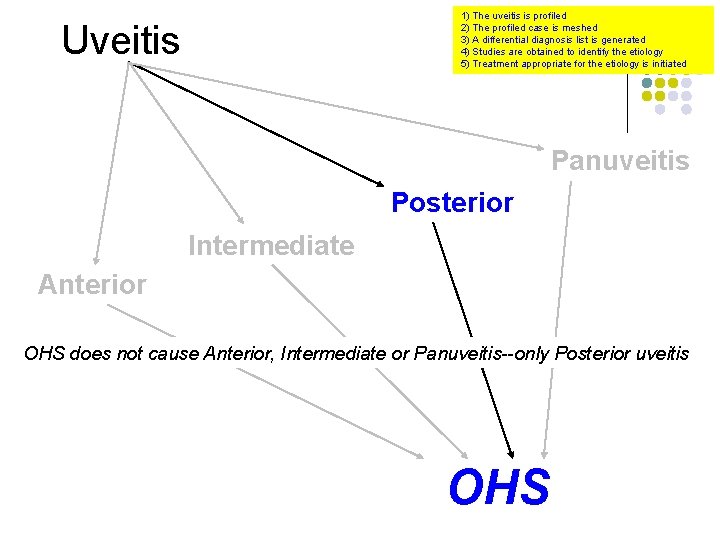
1) The uveitis is profiled 2) The profiled case is meshed 3) A differential diagnosis list is generated 4) Studies are obtained to identify the etiology 5) Treatment appropriate for the etiology is initiated Uveitis Panuveitis Posterior Intermediate Anterior OHS does not cause Anterior, Intermediate or Panuveitis--only Posterior uveitis OHS
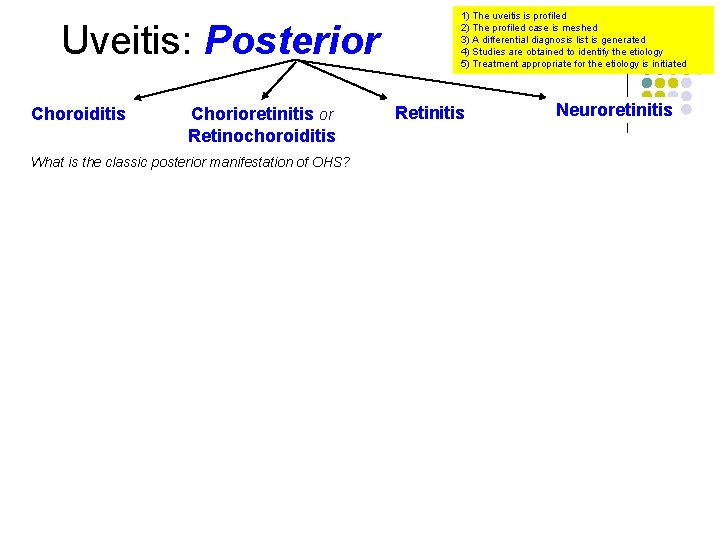
Uveitis: Posterior Choroiditis Chorioretinitis or Retinochoroiditis What is the classic posterior manifestation of OHS? 1) The uveitis is profiled 2) The profiled case is meshed 3) A differential diagnosis list is generated 4) Studies are obtained to identify the etiology 5) Treatment appropriate for the etiology is initiated Retinitis Neuroretinitis
Uveitis: Posterior Choroiditis Chorioretinitis or Retinochoroiditis What is the classic posterior manifestation of OHS? A multifocal chorioretinitis 1) The uveitis is profiled 2) The profiled case is meshed 3) A differential diagnosis list is generated 4) Studies are obtained to identify the etiology 5) Treatment appropriate for the etiology is initiated Retinitis Neuroretinitis
Uveitis: Posterior Choroiditis Chorioretinitis or Retinochoroiditis What is the classic posterior manifestation of OHS? A multifocal chorioretinitis Re three lesions of OHS: Histo spots What specific structure(s) is/are involved? 1) The uveitis is profiled 2) The profiled case is meshed 3) A differential diagnosis list is generated 4) Studies are obtained to identify the etiology 5) Treatment appropriate for the etiology is initiated Retinitis Neuroretinitis
Uveitis: Posterior Choroiditis Chorioretinitis or Retinochoroiditis 1) The uveitis is profiled 2) The profiled case is meshed 3) A differential diagnosis list is generated 4) Studies are obtained to identify the etiology 5) Treatment appropriate for the etiology is initiated Retinitis What is the classic posterior manifestation of OHS? A multifocal chorioretinitis Re three lesions of OHS: Histo spots What specific structure(s) is/are involved? The inner choroid +/- the RPE Neuroretinitis
Uveitis: Posterior Choroiditis Chorioretinitis or Retinochoroiditis 1) The uveitis is profiled 2) The profiled case is meshed 3) A differential diagnosis list is generated 4) Studies are obtained to identify the etiology 5) Treatment appropriate for the etiology is initiated Retinitis What is the classic posterior manifestation of OHS? A multifocal chorioretinitis Re three lesions of OHS: Histo spots What specific structure(s) is/are involved? The inner choroid +/- the RPE In a nutshell, what are they? Neuroretinitis
Uveitis: Posterior Choroiditis Chorioretinitis or Retinochoroiditis 1) The uveitis is profiled 2) The profiled case is meshed 3) A differential diagnosis list is generated 4) Studies are obtained to identify the etiology 5) Treatment appropriate for the etiology is initiated Retinitis What is the classic posterior manifestation of OHS? A multifocal chorioretinitis Re three lesions of OHS: Histo spots What specific structure(s) is/are involved? The inner choroid +/- the RPE In a nutshell, what are they? Discrete, focal, atrophic scars Neuroretinitis
Uveitis: Posterior Choroiditis Chorioretinitis or Retinochoroiditis 1) The uveitis is profiled 2) The profiled case is meshed 3) A differential diagnosis list is generated 4) Studies are obtained to identify the etiology 5) Treatment appropriate for the etiology is initiated Retinitis What is the classic posterior manifestation of OHS? A multifocal chorioretinitis Re three lesions of OHS: Histo spots What specific structure(s) is/are involved? The inner choroid +/- the RPE In a nutshell, what are they? Discrete, focal, atrophic scars Are histo spots larger, or smaller than the ONH? Neuroretinitis
Uveitis: Posterior Choroiditis Chorioretinitis or Retinochoroiditis 1) The uveitis is profiled 2) The profiled case is meshed 3) A differential diagnosis list is generated 4) Studies are obtained to identify the etiology 5) Treatment appropriate for the etiology is initiated Retinitis What is the classic posterior manifestation of OHS? A multifocal chorioretinitis Re three lesions of OHS: Histo spots What specific structure(s) is/are involved? The inner choroid +/- the RPE In a nutshell, what are they? Discrete, focal, atrophic scars Are histo spots larger, or smaller than the ONH? Smaller Neuroretinitis
Uveitis: Posterior Choroiditis Chorioretinitis or Retinochoroiditis 1) The uveitis is profiled 2) The profiled case is meshed 3) A differential diagnosis list is generated 4) Studies are obtained to identify the etiology 5) Treatment appropriate for the etiology is initiated Retinitis What is the classic posterior manifestation of OHS? A multifocal chorioretinitis Re three lesions of OHS: Histo spots What specific structure(s) is/are involved? The inner choroid +/- the RPE In a nutshell, what are they? Discrete, focal, atrophic scars Are histo spots larger, or smaller than the ONH? Smaller What two-word phrase is used to describe them? Neuroretinitis
Uveitis: Posterior Choroiditis Chorioretinitis or Retinochoroiditis 1) The uveitis is profiled 2) The profiled case is meshed 3) A differential diagnosis list is generated 4) Studies are obtained to identify the etiology 5) Treatment appropriate for the etiology is initiated Retinitis What is the classic posterior manifestation of OHS? A multifocal chorioretinitis Re three lesions of OHS: Histo spots What specific structure(s) is/are involved? The inner choroid +/- the RPE In a nutshell, what are they? Discrete, focal, atrophic scars Are histo spots larger, or smaller than the ONH? Smaller What two-word phrase is used to describe them? ‘Punched out’ Neuroretinitis
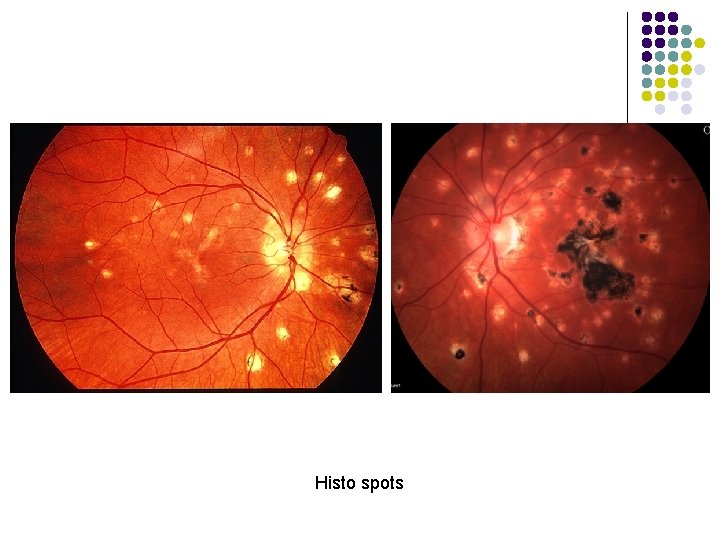
Histo spots
Uveitis: Posterior Choroiditis Chorioretinitis or Retinochoroiditis 1) The uveitis is profiled 2) The profiled case is meshed 3) A differential diagnosis list is generated 4) Studies are obtained to identify the etiology 5) Treatment appropriate for the etiology is initiated Retinitis What is the classic posterior manifestation of OHS? A multifocal chorioretinitis Re three lesions of OHS: Histo spots What specific structure(s) is/are involved? The inner choroid +/- the RPE In a nutshell, what are they? Discrete, focal, atrophic scars Are histo spots larger, or smaller than the ONH? Smaller What two-word phrase is used to describe them? ‘Punched out’ Do they evolve over time? Neuroretinitis
Uveitis: Posterior Choroiditis Chorioretinitis or Retinochoroiditis 1) The uveitis is profiled 2) The profiled case is meshed 3) A differential diagnosis list is generated 4) Studies are obtained to identify the etiology 5) Treatment appropriate for the etiology is initiated Retinitis What is the classic posterior manifestation of OHS? A multifocal chorioretinitis Re three lesions of OHS: Histo spots What specific structure(s) is/are involved? The inner choroid +/- the RPE In a nutshell, what are they? Discrete, focal, atrophic scars Are histo spots larger, or smaller than the ONH? Smaller What two-word phrase is used to describe them? ‘Punched out’ Do they evolve over time? Generally no Neuroretinitis
Uveitis: Posterior Choroiditis Chorioretinitis or Retinochoroiditis 1) The uveitis is profiled 2) The profiled case is meshed 3) A differential diagnosis list is generated 4) Studies are obtained to identify the etiology 5) Treatment appropriate for the etiology is initiated Retinitis Neuroretinitis What is the classic posterior manifestation of OHS? A multifocal chorioretinitis Re three lesions of OHS: Histo spots What specific structure(s) is/are involved? The inner choroid +/- the RPE In a nutshell, what are they? Discrete, focal, atrophic scars With spots regardlarger, to histo a linear Are histo or spots, smallerwhat thanisthe ONH? streak? Smaller straight-line aggregation ofdescribe histo spots; it is‘Punched found in about What. Atwo-word phrase is used to them? out’ 5% of OHS pts Do they evolve over time? Generally no At what location with the globe are linear streaks found? At the equator How is the streak oriented; ie, is it parallel, or perpendicular, to the equator of the globe? Parallel
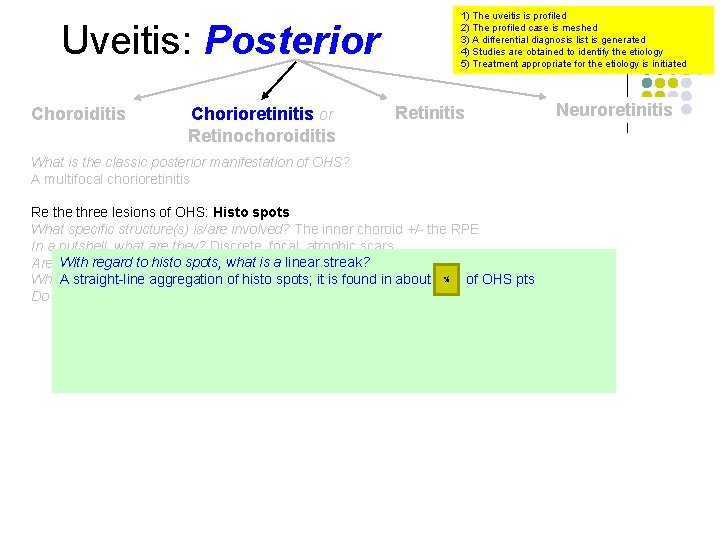
Uveitis: Posterior Choroiditis Chorioretinitis or Retinochoroiditis 1) The uveitis is profiled 2) The profiled case is meshed 3) A differential diagnosis list is generated 4) Studies are obtained to identify the etiology 5) Treatment appropriate for the etiology is initiated Retinitis Neuroretinitis What is the classic posterior manifestation of OHS? A multifocal chorioretinitis Re three lesions of OHS: Histo spots What specific structure(s) is/are involved? The inner choroid +/- the RPE In a nutshell, what are they? Discrete, focal, atrophic scars With spots regardlarger, to histo a linear Are histo or spots, smallerwhat thanisthe ONH? streak? Smaller % straight-line aggregation ofdescribe histo spots; it is‘Punched found in about of OHS pts What. Atwo-word phrase is used to them? out’ 5% Do they evolve over time? Generally no At what location with the globe are linear streaks found? At the equator How is the streak oriented; ie, is it parallel, or perpendicular, to the equator of the globe? Parallel
Uveitis: Posterior Choroiditis Chorioretinitis or Retinochoroiditis 1) The uveitis is profiled 2) The profiled case is meshed 3) A differential diagnosis list is generated 4) Studies are obtained to identify the etiology 5) Treatment appropriate for the etiology is initiated Retinitis Neuroretinitis What is the classic posterior manifestation of OHS? A multifocal chorioretinitis Re three lesions of OHS: Histo spots What specific structure(s) is/are involved? The inner choroid +/- the RPE In a nutshell, what are they? Discrete, focal, atrophic scars With spots regardlarger, to histo a linear Are histo or spots, smallerwhat thanisthe ONH? streak? Smaller straight-line aggregation ofdescribe histo spots; it is‘Punched found in about What. Atwo-word phrase is used to them? out’ 5% of OHS pts Do they evolve over time? Generally no At what location with the globe are linear streaks found? At the equator How is the streak oriented; ie, is it parallel, or perpendicular, to the equator of the globe? Parallel
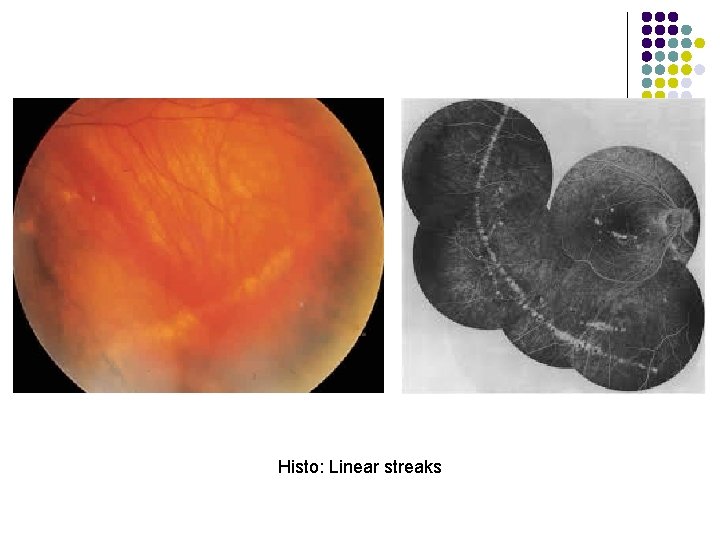
Histo: Linear streaks
Uveitis: Posterior Choroiditis Chorioretinitis or Retinochoroiditis 1) The uveitis is profiled 2) The profiled case is meshed 3) A differential diagnosis list is generated 4) Studies are obtained to identify the etiology 5) Treatment appropriate for the etiology is initiated Retinitis Neuroretinitis What is the classic posterior manifestation of OHS? A multifocal chorioretinitis Re three lesions of OHS: Histo spots What specific structure(s) is/are involved? The inner choroid +/- the RPE In a nutshell, what are they? Discrete, focal, atrophic scars With spots regardlarger, to histo a linear Are histo or spots, smallerwhat thanisthe ONH? streak? Smaller straight-line aggregation ofdescribe histo spots; it is‘Punched found in about What. Atwo-word phrase is used to them? out’ 5% of OHS pts Do they evolve over time? Generally no At what location with the globe are linear streaks found? At the equator How is the streak oriented; ie, is it parallel, or perpendicular, to the equator of the globe? Parallel
Uveitis: Posterior Choroiditis Chorioretinitis or Retinochoroiditis 1) The uveitis is profiled 2) The profiled case is meshed 3) A differential diagnosis list is generated 4) Studies are obtained to identify the etiology 5) Treatment appropriate for the etiology is initiated Retinitis Neuroretinitis What is the classic posterior manifestation of OHS? A multifocal chorioretinitis Re three lesions of OHS: Histo spots What specific structure(s) is/are involved? The inner choroid +/- the RPE In a nutshell, what are they? Discrete, focal, atrophic scars With spots regardlarger, to histo a linear Are histo or spots, smallerwhat thanisthe ONH? streak? Smaller straight-line aggregation ofdescribe histo spots; it is‘Punched found in about What. Atwo-word phrase is used to them? out’ 5% of OHS pts Do they evolve over time? Generally no At what location with the globe are linear streaks found? At the equator How is the streak oriented; ie, is it parallel, or perpendicular, to the equator of the globe? Parallel
Uveitis: Posterior Choroiditis Chorioretinitis or Retinochoroiditis 1) The uveitis is profiled 2) The profiled case is meshed 3) A differential diagnosis list is generated 4) Studies are obtained to identify the etiology 5) Treatment appropriate for the etiology is initiated Retinitis Neuroretinitis What is the classic posterior manifestation of OHS? A multifocal chorioretinitis Re three lesions of OHS: Histo spots What specific structure(s) is/are involved? The inner choroid +/- the RPE In a nutshell, what are they? Discrete, focal, atrophic scars With spots regardlarger, to histo a linear Are histo or spots, smallerwhat thanisthe ONH? streak? Smaller straight-line aggregation ofdescribe histo spots; it is‘Punched found in about What. Atwo-word phrase is used to them? out’ 5% of OHS pts Do they evolve over time? Generally no At what location with the globe are linear streaks found? At the equator How is the streak oriented; ie, is it parallel, or perpendicular, to the equator of the globe? Parallel
Uveitis: Posterior Choroiditis Chorioretinitis or Retinochoroiditis 1) The uveitis is profiled 2) The profiled case is meshed 3) A differential diagnosis list is generated 4) Studies are obtained to identify the etiology 5) Treatment appropriate for the etiology is initiated Retinitis Neuroretinitis What is the classic posterior manifestation of OHS? A multifocal chorioretinitis Re three lesions of OHS: Histo spots What specific structure(s) is/are involved? The inner choroid +/- the RPE In a nutshell, what are they? Discrete, focal, atrophic scars With spots regardlarger, to histo a linear Are histo or spots, smallerwhat thanisthe ONH? streak? Smaller straight-line aggregation ofdescribe histo spots; it is‘Punched found in about What. Atwo-word phrase is used to them? out’ 5% of OHS pts Do they evolve over time? Generally no At what location with the globe are linear streaks found? At the equator How is the streak oriented; ie, is it parallel, or perpendicular, to the equator of the globe? Parallel
Uveitis: Posterior Choroiditis Chorioretinitis or Retinochoroiditis 1) The uveitis is profiled 2) The profiled case is meshed 3) A differential diagnosis list is generated 4) Studies are obtained to identify the etiology 5) Treatment appropriate for the etiology is initiated Retinitis What is the classic posterior manifestation of OHS? A multifocal chorioretinitis Re three lesions of OHS: Histo spots What specific structure(s) is/are involved? The inner choroid +/- the RPE In a nutshell, what are they? Discrete, focal, atrophic scars Are histo spots larger, or smaller than the ONH? Smaller What two-word phrase is used to describe them? ‘Punched out’ Do they evolve over time? Generally no Re three lesions of OHS: Peripapillary atrophy What specific structure(s) is/are involved? Neuroretinitis
Uveitis: Posterior Choroiditis Chorioretinitis or Retinochoroiditis 1) The uveitis is profiled 2) The profiled case is meshed 3) A differential diagnosis list is generated 4) Studies are obtained to identify the etiology 5) Treatment appropriate for the etiology is initiated Retinitis What is the classic posterior manifestation of OHS? A multifocal chorioretinitis Re three lesions of OHS: Histo spots What specific structure(s) is/are involved? The inner choroid +/- the RPE In a nutshell, what are they? Discrete, focal, atrophic scars Are histo spots larger, or smaller than the ONH? Smaller What two-word phrase is used to describe them? ‘Punched out’ Do they evolve over time? Generally no Re three lesions of OHS: Peripapillary atrophy What specific structure(s) is/are involved? The inner choroid, RPE and retina Neuroretinitis
Uveitis: Posterior Choroiditis Chorioretinitis or Retinochoroiditis 1) The uveitis is profiled 2) The profiled case is meshed 3) A differential diagnosis list is generated 4) Studies are obtained to identify the etiology 5) Treatment appropriate for the etiology is initiated Retinitis What is the classic posterior manifestation of OHS? A multifocal chorioretinitis Re three lesions of OHS: Histo spots What specific structure(s) is/are involved? The inner choroid +/- the RPE In a nutshell, what are they? Discrete, focal, atrophic scars Are histo spots larger, or smaller than the ONH? Smaller What two-word phrase is used to describe them? ‘Punched out’ Do they evolve over time? Generally no Re three lesions of OHS: Peripapillary atrophy What specific structure(s) is/are involved? The inner choroid, RPE and retina In a nutshell, what are they? Neuroretinitis
Uveitis: Posterior Choroiditis Chorioretinitis or Retinochoroiditis 1) The uveitis is profiled 2) The profiled case is meshed 3) A differential diagnosis list is generated 4) Studies are obtained to identify the etiology 5) Treatment appropriate for the etiology is initiated Retinitis What is the classic posterior manifestation of OHS? A multifocal chorioretinitis Re three lesions of OHS: Histo spots What specific structure(s) is/are involved? The inner choroid +/- the RPE In a nutshell, what are they? Discrete, focal, atrophic scars Are histo spots larger, or smaller than the ONH? Smaller What two-word phrase is used to describe them? ‘Punched out’ Do they evolve over time? Generally no Re three lesions of OHS: Peripapillary atrophy What specific structure(s) is/are involved? The inner choroid, RPE and retina In a nutshell, what are they? Discrete, focal, atrophic scars Neuroretinitis
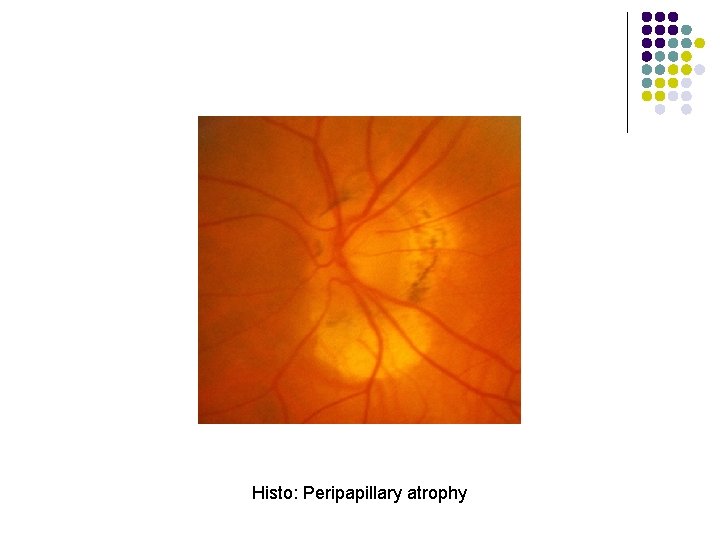
Histo: Peripapillary atrophy
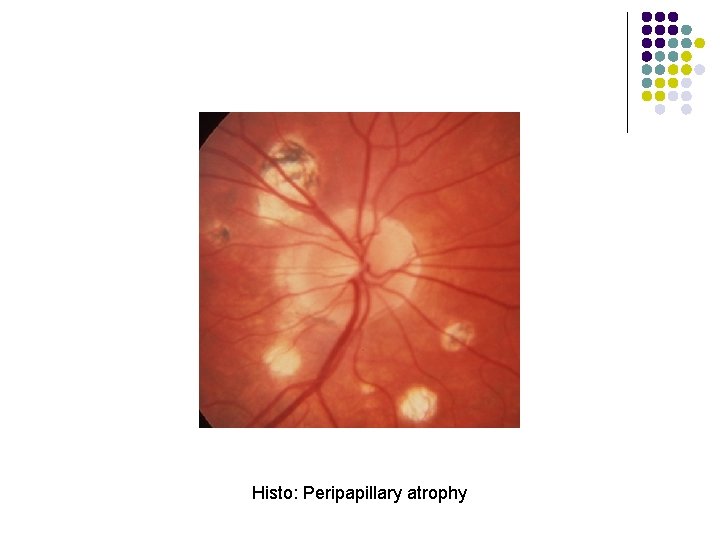
Histo: Peripapillary atrophy
Uveitis: Posterior Choroiditis Chorioretinitis or Retinochoroiditis 1) The uveitis is profiled 2) The profiled case is meshed 3) A differential diagnosis list is generated 4) Studies are obtained to identify the etiology 5) Treatment appropriate for the etiology is initiated Retinitis What is the classic posterior manifestation of OHS? A multifocal chorioretinitis Re three lesions of OHS: Histo spots What specific structure(s) is/are involved? The inner choroid +/- the RPE In a nutshell, what are they? Discrete, focal, atrophic scars Are histo spots larger, or smaller than the ONH? Smaller What two-word phrase is used to describe them? ‘Punched out’ Do they evolve over time? Generally no Re three lesions of OHS: Peripapillary atrophy What specific structure(s) is/are involved? The inner choroid, RPE and retina In a nutshell, what are they? Discrete, focal, atrophic scars Re three lesions of OHS: Macular disciform lesions What specific structure(s) is/are involved? Neuroretinitis
Uveitis: Posterior Choroiditis Chorioretinitis or Retinochoroiditis 1) The uveitis is profiled 2) The profiled case is meshed 3) A differential diagnosis list is generated 4) Studies are obtained to identify the etiology 5) Treatment appropriate for the etiology is initiated Retinitis Neuroretinitis What is the classic posterior manifestation of OHS? A multifocal chorioretinitis Re three lesions of OHS: Histo spots What specific structure(s) is/are involved? The inner choroid +/- the RPE In a nutshell, what are they? Discrete, focal, atrophic scars Are histo spots larger, or smaller than the ONH? Smaller What two-word phrase is used to describe them? ‘Punched out’ Do they evolve over time? Generally no Re three lesions of OHS: Peripapillary atrophy What specific structure(s) is/are involved? The inner choroid, RPE and retina In a nutshell, what are they? Discrete, focal, atrophic scars Re three lesions of OHS: Macular disciform lesions What specific structure(s) is/are involved? Everything, including a defect in Bruch’s membrane
Uveitis: Posterior Choroiditis Chorioretinitis or Retinochoroiditis 1) The uveitis is profiled 2) The profiled case is meshed 3) A differential diagnosis list is generated 4) Studies are obtained to identify the etiology 5) Treatment appropriate for the etiology is initiated Retinitis Neuroretinitis What is the classic posterior manifestation of OHS? A multifocal chorioretinitis Re three lesions of OHS: Histo spots What specific structure(s) is/are involved? The inner choroid +/- the RPE In a nutshell, what are they? Discrete, focal, atrophic scars Are histo spots larger, or smaller than the ONH? Smaller What two-word phrase is used to describe them? ‘Punched out’ Do they evolve over time? Generally no Re three lesions of OHS: Peripapillary atrophy What specific structure(s) is/are involved? The inner choroid, RPE and retina In a nutshell, what are they? Discrete, focal, atrophic scars Re three lesions of OHS: Macular disciform lesions What specific structure(s) is/are involved? Everything, including a defect in Bruch’s membrane In a nutshell, what are they?
Uveitis: Posterior Choroiditis Chorioretinitis or Retinochoroiditis 1) The uveitis is profiled 2) The profiled case is meshed 3) A differential diagnosis list is generated 4) Studies are obtained to identify the etiology 5) Treatment appropriate for the etiology is initiated Retinitis Neuroretinitis What is the classic posterior manifestation of OHS? A multifocal chorioretinitis Re three lesions of OHS: Histo spots What specific structure(s) is/are involved? The inner choroid +/- the RPE In a nutshell, what are they? Discrete, focal, atrophic scars Are histo spots larger, or smaller than the ONH? Smaller What two-word phrase is used to describe them? ‘Punched out’ Do they evolve over time? Generally no Re three lesions of OHS: Peripapillary atrophy What specific structure(s) is/are involved? The inner choroid, RPE and retina In a nutshell, what are they? Discrete, focal, atrophic scars Re three lesions of OHS: Macular disciform lesions What specific structure(s) is/are involved? Everything, including a defect in Bruch’s membrane In a nutshell, what are they? Active lesions represent either the presence of CNVM under the retina, or a hemorrhagic retinal detachment

Histo: Macular disciform lesion
Uveitis: Posterior Choroiditis Chorioretinitis or Retinochoroiditis 1) The uveitis is profiled 2) The profiled case is meshed 3) A differential diagnosis list is generated 4) Studies are obtained to identify the etiology 5) Treatment appropriate for the etiology is initiated Retinitis Neuroretinitis What is the classic posterior manifestation of OHS? A multifocal chorioretinitis Re three lesions of OHS: Histo spots What specific structure(s) is/are involved? The inner choroid +/- the RPE In a nutshell, what are they? Discrete, focal, atrophic scars Are histo spots larger, or smaller than the ONH? Smaller What two-word phrase is used to describe them? ‘Punched out’ Do they evolve over time? Generally no Re three lesions of OHS: Peripapillary atrophy What specific structure(s) is/are involved? The inner choroid, RPE and retina In a nutshell, what are they? Discrete, focal, atrophic scars Re three lesions of OHS: Macular disciform lesions What specific structure(s) is/are involved? Everything, including a defect in Bruch’s membrane In a nutshell, what are they? Active lesions represent either the presence of CNVM under the retina, or a hemorrhagic retinal detachment. Inactive lesions (aka disciform scars) are fibrovascular remnants of previous CNVM and/or subretinal hemorrhage.
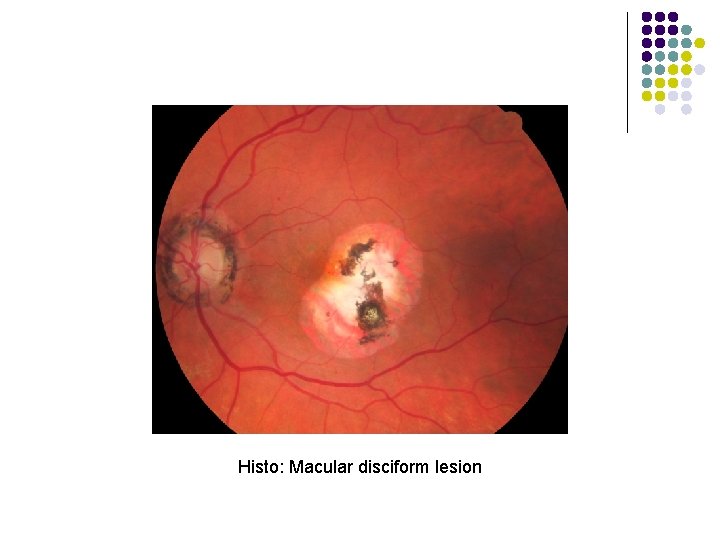
Histo: Macular disciform lesion
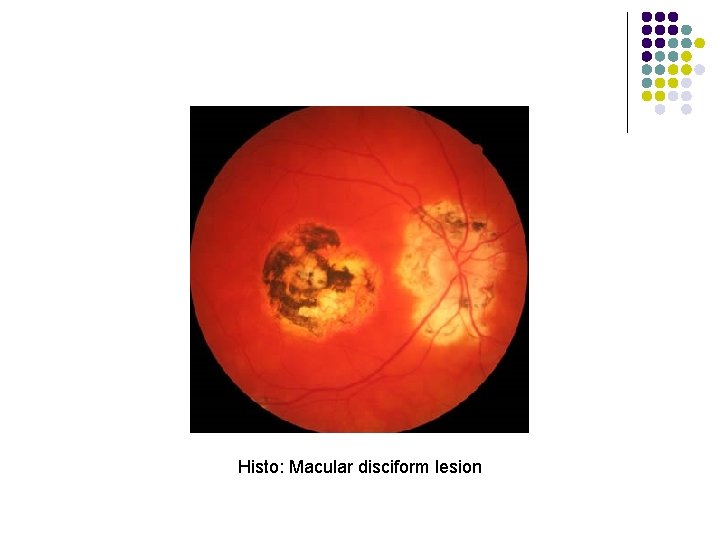
Histo: Macular disciform lesion
Uveitis: OHS Diagnosis How is the diagnosis of OHS made? 1) The uveitis is profiled 2) The profiled case is meshed 3) A differential diagnosis list is generated 4) Studies are obtained to identify the etiology 5) Treatment appropriate for the etiology is initiated
Uveitis: OHS Diagnosis How is the diagnosis of OHS made? It is a clinical diagnosis based on DFE findings 1) The uveitis is profiled 2) The profiled case is meshed 3) A differential diagnosis list is generated 4) Studies are obtained to identify the etiology 5) Treatment appropriate for the etiology is initiated
Uveitis: OHS Diagnosis How is the diagnosis of OHS made? It is a clinical diagnosis based on DFE findings Treatment Which lesion(s) require treatment? 1) The uveitis is profiled 2) The profiled case is meshed 3) A differential diagnosis list is generated 4) Studies are obtained to identify the etiology 5) Treatment appropriate for the etiology is initiated
Uveitis: OHS Diagnosis How is the diagnosis of OHS made? It is a clinical diagnosis based on DFE findings Treatment Which lesion(s) require treatment? Active disciform lesions 1) The uveitis is profiled 2) The profiled case is meshed 3) A differential diagnosis list is generated 4) Studies are obtained to identify the etiology 5) Treatment appropriate for the etiology is initiated
Uveitis: OHS Diagnosis How is the diagnosis of OHS made? It is a clinical diagnosis based on DFE findings Treatment Which lesion(s) require treatment? Active disciform lesions Do antifungals play a role in the treatment? 1) The uveitis is profiled 2) The profiled case is meshed 3) A differential diagnosis list is generated 4) Studies are obtained to identify the etiology 5) Treatment appropriate for the etiology is initiated
Uveitis: OHS Diagnosis How is the diagnosis of OHS made? It is a clinical diagnosis based on DFE findings Treatment Which lesion(s) require treatment? Active disciform lesions Do antifungals play a role in the treatment? No 1) The uveitis is profiled 2) The profiled case is meshed 3) A differential diagnosis list is generated 4) Studies are obtained to identify the etiology 5) Treatment appropriate for the etiology is initiated
Uveitis: OHS Diagnosis How is the diagnosis of OHS made? It is a clinical diagnosis based on DFE findings Treatment Which lesion(s) require treatment? Active disciform lesions Do antifungals play a role in the treatment? No Why no role for antifungals? Because there’s no evidence to indicate live organisms are present (much less actively contributing to the CNVM process) 1) The uveitis is profiled 2) The profiled case is meshed 3) A differential diagnosis list is generated 4) Studies are obtained to identify the etiology 5) Treatment appropriate for the etiology is initiated
Uveitis: OHS Diagnosis How is the diagnosis of OHS made? It is a clinical diagnosis based on DFE findings Treatment Which lesion(s) require treatment? Active disciform lesions Do antifungals play a role in the treatment? No Why no role for antifungals? Because there’s no evidence to indicate live organisms are present (much less actively contributing to the CNVM process) 1) The uveitis is profiled 2) The profiled case is meshed 3) A differential diagnosis list is generated 4) Studies are obtained to identify the etiology 5) Treatment appropriate for the etiology is initiated
Uveitis: OHS Diagnosis 1) The uveitis is profiled 2) The profiled case is meshed 3) A differential diagnosis list is generated 4) Studies are obtained to identify the etiology 5) Treatment appropriate for the etiology is initiated How is the diagnosis of OHS made? It is a clinical diagnosis based on DFE findings Treatment Which lesion(s) require treatment? Active disciform lesions Do antifungals play a role in the treatment? No Is there any treatment known to reduce the risk of developing disciform lesions?
Uveitis: OHS Diagnosis 1) The uveitis is profiled 2) The profiled case is meshed 3) A differential diagnosis list is generated 4) Studies are obtained to identify the etiology 5) Treatment appropriate for the etiology is initiated How is the diagnosis of OHS made? It is a clinical diagnosis based on DFE findings Treatment Which lesion(s) require treatment? Active disciform lesions Do antifungals play a role in the treatment? No Is there any treatment known to reduce the risk of developing disciform lesions? No
Uveitis: OHS Diagnosis 1) The uveitis is profiled 2) The profiled case is meshed 3) A differential diagnosis list is generated 4) Studies are obtained to identify the etiology 5) Treatment appropriate for the etiology is initiated How is the diagnosis of OHS made? It is a clinical diagnosis based on DFE findings Treatment Which lesion(s) require treatment? Active disciform lesions Do antifungals play a role in the treatment? No Is there any treatment known to reduce the risk of developing disciform lesions? No What treatment modalities are used to treat active disciform lesions? -------Combination therapy (of some of the above modalities)
Uveitis: OHS Diagnosis 1) The uveitis is profiled 2) The profiled case is meshed 3) A differential diagnosis list is generated 4) Studies are obtained to identify the etiology 5) Treatment appropriate for the etiology is initiated How is the diagnosis of OHS made? It is a clinical diagnosis based on DFE findings Treatment Which lesion(s) require treatment? Active disciform lesions Do antifungals play a role in the treatment? No Is there any treatment known to reduce the risk of developing disciform lesions? No What treatment modalities are used to treat active disciform lesions? --Thermal laser --Photodynamic therapy (PDT) --Anti-VEGF therapy --Submacular surgery --Intravitreal corticosteroids --Combination therapy (of some of the above modalities)
Uveitis: OHS Diagnosis 1) The uveitis is profiled 2) The profiled case is meshed 3) A differential diagnosis list is generated 4) Studies are obtained to identify the etiology 5) Treatment appropriate for the etiology is initiated How is the diagnosis of OHS made? What clinical study the use of thermal laser for the treatment of CNVM? It is a landmark clinical diagnosis basedevaluated on DFE findings. The Macular Photocoagulation Study (MPS) Treatment What two laser modalities were evaluated? Argon (blue-green) and krypton (red) Do antifungals play a role in the treatment? No was the primary endpoint/outcome variable? What Percent of eyes experiencing severe vision loss (SVL) from baseline Which lesion(s) require treatment? Active were disciform lesions There a number of subgroup analyses in the MPS. Important subgroup analyses were based on: --Lesion location Is there any treatment known to reduce the riskfor of developing disciform lesions? --The specific underlying condition responsible the CNVM occurrence No --Whether the lesion was new, or recurrent What treatment modalities are used to treat active disciform lesions? --Thermal laser --Photodynamic therapy (PDT) --Anti-VEGF therapy --Submacular surgery --Intravitreal corticosteroids --Combination therapy (of some of the above modalities)
Uveitis: OHS Diagnosis 1) The uveitis is profiled 2) The profiled case is meshed 3) A differential diagnosis list is generated 4) Studies are obtained to identify the etiology 5) Treatment appropriate for the etiology is initiated How is the diagnosis of OHS made? What clinical study the use of thermal laser for the treatment of CNVM? It is a landmark clinical diagnosis basedevaluated on DFE findings. The Macular Photocoagulation Study (MPS) Treatment What two laser modalities were evaluated? Argon (blue-green) and krypton (red) Do antifungals play a role in the treatment? No was the primary endpoint/outcome variable? What Percent of eyes experiencing severe vision loss (SVL) from baseline Which lesion(s) require treatment? Active were disciform lesions There a number of subgroup analyses in the MPS. Important subgroup analyses were based on: --Lesion location Is there any treatment known to reduce the riskfor of developing disciform lesions? --The specific underlying condition responsible the CNVM occurrence No --Whether the lesion was new, or recurrent What treatment modalities are used to treat active disciform lesions? --Thermal laser --Photodynamic therapy (PDT) --Anti-VEGF therapy --Submacular surgery --Intravitreal corticosteroids --Combination therapy (of some of the above modalities)
Uveitis: OHS Diagnosis 1) The uveitis is profiled 2) The profiled case is meshed 3) A differential diagnosis list is generated 4) Studies are obtained to identify the etiology 5) Treatment appropriate for the etiology is initiated How is the diagnosis of OHS made? What clinical study the use of thermal laser for the treatment of CNVM? It is a landmark clinical diagnosis basedevaluated on DFE findings. The Macular Photocoagulation Study (MPS) Treatment What two laser modalities were evaluated? Argon (blue-green) and krypton (red) Do antifungals play a role in the treatment? No was the primary endpoint/outcome variable? What Percent of eyes experiencing severe vision loss (SVL) from baseline Which lesion(s) require treatment? Active were disciform lesions There a number of subgroup analyses in the MPS. Important subgroup analyses were based on: --Lesion location Is there any treatment known to reduce the riskfor of developing disciform lesions? --The specific underlying condition responsible the CNVM occurrence No --Whether the lesion was new, or recurrent What treatment modalities are used to treat active disciform lesions? --Thermal laser --Photodynamic therapy (PDT) --Anti-VEGF therapy --Submacular surgery --Intravitreal corticosteroids --Combination therapy (of some of the above modalities)
Uveitis: OHS Diagnosis 1) The uveitis is profiled 2) The profiled case is meshed 3) A differential diagnosis list is generated 4) Studies are obtained to identify the etiology 5) Treatment appropriate for the etiology is initiated How is the diagnosis of OHS made? What clinical study the use of thermal laser for the treatment of CNVM? It is a landmark clinical diagnosis basedevaluated on DFE findings. The Macular Photocoagulation Study (MPS) Treatment What two laser modalities were evaluated? Argon (blue-green) and krypton (red) Do antifungals play a role in the treatment? No was the primary endpoint/outcome variable? What Percent of eyes experiencing severe vision loss (SVL) from baseline Which lesion(s) require treatment? Active were disciform lesions There a number of subgroup analyses in the MPS. Important subgroup analyses were based on: --Lesion location Is there any treatment known to reduce the riskfor of developing disciform lesions? --The specific underlying condition responsible the CNVM occurrence No --Whether the lesion was new, or recurrent What treatment modalities are used to treat active disciform lesions? --Thermal laser --Photodynamic therapy (PDT) --Anti-VEGF therapy --Submacular surgery --Intravitreal corticosteroids --Combination therapy (of some of the above modalities)
Uveitis: OHS Diagnosis 1) The uveitis is profiled 2) The profiled case is meshed 3) A differential diagnosis list is generated 4) Studies are obtained to identify the etiology 5) Treatment appropriate for the etiology is initiated How is the diagnosis of OHS made? What clinical study the use of thermal laser for the treatment of CNVM? It is a landmark clinical diagnosis basedevaluated on DFE findings. The Macular Photocoagulation Study (MPS) Treatment What two laser modalities were evaluated? Argon (blue-green) and krypton (red) Do antifungals play a role in the treatment? Did MPSthe find one modality to be superior Nothewas What primary endpoint/outcome variable? to. Percent the other? of eyes experiencing severe vision loss (SVL) from baseline No Which lesion(s) require treatment? Active were disciform lesions There a number of subgroup analyses in the MPS. Important subgroup analyses were based on: --Lesion location Is there any treatment known to reduce the riskfor of developing disciform lesions? --The specific underlying condition responsible the CNVM occurrence No --Whether the lesion was new, or recurrent What treatment modalities are used to treat active disciform lesions? --Thermal laser --Photodynamic therapy (PDT) --Anti-VEGF therapy --Submacular surgery --Intravitreal corticosteroids --Combination therapy (of some of the above modalities)
Uveitis: OHS Diagnosis 1) The uveitis is profiled 2) The profiled case is meshed 3) A differential diagnosis list is generated 4) Studies are obtained to identify the etiology 5) Treatment appropriate for the etiology is initiated How is the diagnosis of OHS made? What clinical study the use of thermal laser for the treatment of CNVM? It is a landmark clinical diagnosis basedevaluated on DFE findings. The Macular Photocoagulation Study (MPS) Treatment What two laser modalities were evaluated? Argon (blue-green) and krypton (red) Do antifungals play a role in the treatment? Did MPSthe find one modality to be superior Nothewas What primary endpoint/outcome variable? to. Percent the other? of eyes experiencing severe vision loss (SVL) from baseline No Which lesion(s) require treatment? Active were disciform lesions There a number of subgroup analyses in the MPS. Important subgroup analyses were based on: --Lesion location Is there any treatment known to reduce the riskfor of developing disciform lesions? --The specific underlying condition responsible the CNVM occurrence No --Whether the lesion was new, or recurrent What treatment modalities are used to treat active disciform lesions? --Thermal laser --Photodynamic therapy (PDT) --Anti-VEGF therapy --Submacular surgery --Intravitreal corticosteroids --Combination therapy (of some of the above modalities)
Uveitis: OHS Diagnosis 1) The uveitis is profiled 2) The profiled case is meshed 3) A differential diagnosis list is generated 4) Studies are obtained to identify the etiology 5) Treatment appropriate for the etiology is initiated How is the diagnosis of OHS made? What clinical study the use of thermal laser for the treatment of CNVM? It is a landmark clinical diagnosis basedevaluated on DFE findings. The Macular Photocoagulation Study (MPS) Treatment What two laser modalities were evaluated? Argon (blue-green) and krypton (red) Do antifungals play a role in the treatment? No was the primary endpoint/outcome variable? What Percent of eyes experiencing severe vision loss (SVL) from baseline Which lesion(s) require treatment? Active were disciform lesions There a number of subgroup analyses in the MPS. Important subgroup analyses were based on: --Lesion location Is there any treatment known to reduce the riskfor of developing disciform lesions? --The specific underlying condition responsible the CNVM occurrence No --Whether the lesion was new, or recurrent What treatment modalities are used to treat active disciform lesions? --Thermal laser --Photodynamic therapy (PDT) --Anti-VEGF therapy --Submacular surgery --Intravitreal corticosteroids --Combination therapy (of some of the above modalities)
Uveitis: OHS Diagnosis 1) The uveitis is profiled 2) The profiled case is meshed 3) A differential diagnosis list is generated 4) Studies are obtained to identify the etiology 5) Treatment appropriate for the etiology is initiated How is the diagnosis of OHS made? What clinical study the use of thermal laser for the treatment of CNVM? It is a landmark clinical diagnosis basedevaluated on DFE findings. The Macular Photocoagulation Study (MPS) Treatment What two laser modalities were evaluated? Argon (blue-green) and krypton (red) Do antifungals play a role in the treatment? No was the primary endpoint/outcome variable? What Percent of eyes experiencing severe vision loss (SVL) from baseline Which lesion(s) require treatment? Active were disciform lesions There a number of subgroup analyses in the MPS. Important subgroup analyses were based on: --Lesion location Is there any treatment known to reduce the riskfor of developing disciform lesions? --The specific underlying condition responsible the CNVM occurrence No --Whether the lesion was new, or recurrent What treatment modalities are used to treat active disciform lesions? --Thermal laser --Photodynamic therapy (PDT) --Anti-VEGF therapy --Submacular surgery --Intravitreal corticosteroids --Combination therapy (of some of the above modalities)
Uveitis: OHS Diagnosis 1) The uveitis is profiled 2) The profiled case is meshed 3) A differential diagnosis list is generated 4) Studies are obtained to identify the etiology 5) Treatment appropriate for the etiology is initiated How is the diagnosis of OHS made? What clinical study the use of thermal laser for the treatment of CNVM? It is a landmark clinical diagnosis basedevaluated on DFE findings. The Macular Photocoagulation Study (MPS) Treatment What two laser modalities were evaluated? Argon (blue-green) and krypton (red) Do antifungals play a role in the treatment? No was the primary endpoint/outcome variable? What Percent of eyes experiencing severe vision loss (SVL) from baseline Which lesion(s) require treatment? How was SVLofdefined in the MPS? in the MPS. Important subgroup analyses were based on: Active were disciform lesions There a number subgroup analyses As a loss of 6 or more lines from initial presentation --Lesion location Is there any treatment known to reduce the riskfor of developing disciform lesions? --The specific underlying condition responsible the CNVM occurrence No --Whether the lesion was new, or recurrent What treatment modalities are used to treat active disciform lesions? --Thermal laser --Photodynamic therapy (PDT) --Anti-VEGF therapy --Submacular surgery --Intravitreal corticosteroids --Combination therapy (of some of the above modalities)
Uveitis: OHS Diagnosis 1) The uveitis is profiled 2) The profiled case is meshed 3) A differential diagnosis list is generated 4) Studies are obtained to identify the etiology 5) Treatment appropriate for the etiology is initiated How is the diagnosis of OHS made? What clinical study the use of thermal laser for the treatment of CNVM? It is a landmark clinical diagnosis basedevaluated on DFE findings. The Macular Photocoagulation Study (MPS) Treatment What two laser modalities were evaluated? Argon (blue-green) and krypton (red) Do antifungals play a role in the treatment? No was the primary endpoint/outcome variable? What Percent of eyes experiencing severe vision loss (SVL) from baseline Which lesion(s) require treatment? How was SVLofdefined in the MPS? in the MPS. Important subgroup analyses were based on: Active were disciform lesions There a number subgroup analyses As a loss of 6 or more lines from initial presentation --Lesion location Is there any treatment known to reduce the riskfor of developing disciform lesions? --The specific underlying condition responsible the CNVM occurrence No --Whether the lesion was new, or recurrent What treatment modalities are used to treat active disciform lesions? --Thermal laser --Photodynamic therapy (PDT) --Anti-VEGF therapy --Submacular surgery --Intravitreal corticosteroids --Combination therapy (of some of the above modalities)
Uveitis: OHS Diagnosis 1) The uveitis is profiled 2) The profiled case is meshed 3) A differential diagnosis list is generated 4) Studies are obtained to identify the etiology 5) Treatment appropriate for the etiology is initiated How is the diagnosis of OHS made? What clinical study the use of thermal laser for the treatment of CNVM? It is a landmark clinical diagnosis basedevaluated on DFE findings. The Macular Photocoagulation Study (MPS) Treatment What two laser modalities were evaluated? Argon (blue-green) and krypton (red) Do antifungals play a role in the treatment? No was the primary endpoint/outcome variable? What Percent of eyes experiencing severe vision loss (SVL) from baseline Which lesion(s) require treatment? Active were disciform lesions There a number of subgroup analyses in the MPS. Important subgroup analyses were based on: --Lesion location Is there any treatment known to reduce the riskfor of developing disciform lesions? --The specific underlying condition responsible the CNVM occurrence No --Whether the lesion was new, or recurrent What treatment modalities are used to treat active disciform lesions? --Thermal laser --Photodynamic therapy (PDT) --Anti-VEGF therapy --Submacular surgery --Intravitreal corticosteroids --Combination therapy (of some of the above modalities)
Uveitis: OHS Diagnosis 1) The uveitis is profiled 2) The profiled case is meshed 3) A differential diagnosis list is generated 4) Studies are obtained to identify the etiology 5) Treatment appropriate for the etiology is initiated How is the diagnosis of OHS made? What clinical study the use of thermal laser for the treatment of CNVM? It is a landmark clinical diagnosis basedevaluated on DFE findings. The Macular Photocoagulation Study (MPS) Treatment What two laser modalities were evaluated? Argon (blue-green) and krypton (red) Do antifungals play a role in the treatment? No was the primary endpoint/outcome variable? What Percent of eyes experiencing severe vision loss (SVL) from baseline Which lesion(s) require treatment? Active were disciform lesions There a number of subgroup analyses in the MPS. Important subgroup analyses were based on: --Lesion location Is there any treatment known to reduce the riskfor of developing disciform lesions? --The specific underlying condition responsible the CNVM occurrence No --Whether the lesion was new, or recurrent What treatment modalities are used to treat active disciform lesions? --Thermal laser --Photodynamic therapy (PDT) --Anti-VEGF therapy --Submacular surgery --Intravitreal corticosteroids --Combination therapy (of some of the above modalities)
Uveitis: OHS Diagnosis 1) The uveitis is profiled 2) The profiled case is meshed 3) A differential diagnosis list is generated 4) Studies are obtained to identify the etiology 5) Treatment appropriate for the etiology is initiated How is the diagnosis of OHS made? What clinical study the use of thermal laser for the treatment of CNVM? It is a landmark clinical diagnosis basedevaluated on DFE findings. The Macular Photocoagulation Study (MPS) Treatment What two laser modalities were evaluated? Argon (blue-green) and krypton (red) Do antifungals play a role in the treatment? was lesion location defined; ie, in terms of what structure? No was the primary. How What endpoint/outcome variable? With respect to distance from the from foveal center Percent of eyes experiencing severe vision loss (SVL) baseline Which lesion(s) require treatment? Four locationsanalyses were used. What were they? How were they defined? Active were disciform lesions There a number of subgroup in the MPS. Important subgroup analyses were based on: --Extrafoveal: Posterior edge of the CNVM >200 mm from foveal center --Lesion location --Juxtafoveal: Posterior edge 1 -200 mm occurrence from foveal center Is there any treatment known to reduce the risk of developing disciform lesions? --The specific underlying condition responsible for the CNVM --Subfoveal: Some portion of the CNVM was directly below the foveal center No --Whether the lesion was new, or recurrent --Papillomacular bundle: The CNVM was between the fovea and the ONH What treatment modalities are used to treat active disciform lesions? --Thermal laser --Photodynamic therapy (PDT) --Anti-VEGF therapy --Submacular surgery --Intravitreal corticosteroids --Combination therapy (of some of the above modalities)
Uveitis: OHS Diagnosis 1) The uveitis is profiled 2) The profiled case is meshed 3) A differential diagnosis list is generated 4) Studies are obtained to identify the etiology 5) Treatment appropriate for the etiology is initiated How is the diagnosis of OHS made? What clinical study the use of thermal laser for the treatment of CNVM? It is a landmark clinical diagnosis basedevaluated on DFE findings. The Macular Photocoagulation Study (MPS) Treatment What two laser modalities were evaluated? Argon (blue-green) and krypton (red) Do antifungals play a role in the treatment? was lesion location defined; ie, in terms of what structure? No was the primary. How What endpoint/outcome variable? With respect to distance from the from foveal center Percent of eyes experiencing severe vision loss (SVL) baseline Which lesion(s) require treatment? Four locationsanalyses were used. What were they? How were they defined? Active were disciform lesions There a number of subgroup in the MPS. Important subgroup analyses were based on: --Extrafoveal: Posterior edge of the CNVM >200 mm from foveal center --Lesion location --Juxtafoveal: Posterior edge 1 -200 mm occurrence from foveal center Is there any treatment known to reduce the risk of developing disciform lesions? --The specific underlying condition responsible for the CNVM --Subfoveal: Some portion of the CNVM was directly below the foveal center No --Whether the lesion was new, or recurrent --Papillomacular bundle: The CNVM was between the fovea and the ONH What treatment modalities are used to treat active disciform lesions? --Thermal laser --Photodynamic therapy (PDT) --Anti-VEGF therapy --Submacular surgery --Intravitreal corticosteroids --Combination therapy (of some of the above modalities)
Uveitis: OHS Diagnosis 1) The uveitis is profiled 2) The profiled case is meshed 3) A differential diagnosis list is generated 4) Studies are obtained to identify the etiology 5) Treatment appropriate for the etiology is initiated How is the diagnosis of OHS made? What clinical study the use of thermal laser for the treatment of CNVM? It is a landmark clinical diagnosis basedevaluated on DFE findings. The Macular Photocoagulation Study (MPS) Treatment What two laser modalities were evaluated? Argon (blue-green) and krypton (red) Do antifungals play a role in the treatment? was lesion location defined; ie, in terms of what structure? No was the primary. How What endpoint/outcome variable? With respect to distance from the from foveal center Percent of eyes experiencing severe vision loss (SVL) baseline Which lesion(s) require treatment? Four locationsanalyses were used. What were they? How were they defined? Active were disciform lesions There a number of subgroup in the MPS. Important subgroup analyses were based on: --Extrafoveal: Posterior edge of the CNVM >200 mm from foveal center --Lesion location --Juxtafoveal: Posterior edge 1 -200 mm occurrence from foveal center Is there any treatment known to reduce the risk of developing disciform lesions? --The specific underlying condition responsible for the CNVM --Subfoveal: Some portion of the CNVM was directly below the foveal center No --Whether the lesion was new, or recurrent --Papillomacular bundle: The CNVM was between the fovea and the ONH What treatment modalities are used to treat active disciform lesions? --Thermal laser --Photodynamic therapy (PDT) --Anti-VEGF therapy --Submacular surgery --Intravitreal corticosteroids --Combination therapy (of some of the above modalities)
Uveitis: OHS Diagnosis 1) The uveitis is profiled 2) The profiled case is meshed 3) A differential diagnosis list is generated 4) Studies are obtained to identify the etiology 5) Treatment appropriate for the etiology is initiated How is the diagnosis of OHS made? What clinical study the use of thermal laser for the treatment of CNVM? It is a landmark clinical diagnosis basedevaluated on DFE findings. The Macular Photocoagulation Study (MPS) Treatment What two laser modalities were evaluated? Argon (blue-green) and krypton (red) Do antifungals play a role in the treatment? was lesion location defined; ie, in terms of what structure? No was the primary. How What endpoint/outcome variable? With respect to distance from the from foveal center Percent of eyes experiencing severe vision loss (SVL) baseline Which lesion(s) require treatment? Four locationsanalyses were used. What were they? How were they defined? Active were disciform lesions There a number of subgroup in the MPS. Important subgroup analyses were based on: --Extrafoveal: Posterior edge of the CNVM >200 mm from foveal center --Lesion location --Juxtafoveal: Posterior edge 1 -200 mm occurrence from foveal center Is there any treatment known to reduce the risk of developing disciform lesions? --The specific underlying condition responsible for the CNVM --Subfoveal: Some portion of the CNVM was directly below the foveal center No --Whether the lesion was new, or recurrent --Papillomacular bundle: The CNVM was between the fovea and the ONH What treatment modalities are used to treat active disciform lesions? --Thermal laser --Photodynamic therapy (PDT) --Anti-VEGF therapy --Submacular surgery --Intravitreal corticosteroids --Combination therapy (of some of the above modalities)
Uveitis: OHS Diagnosis 1) The uveitis is profiled 2) The profiled case is meshed 3) A differential diagnosis list is generated 4) Studies are obtained to identify the etiology 5) Treatment appropriate for the etiology is initiated How is the diagnosis of OHS made? What clinical study the use of thermal laser for the treatment of CNVM? It is a landmark clinical diagnosis basedevaluated on DFE findings. The Macular Photocoagulation Study (MPS) Treatment What two laser modalities were evaluated? Argon (blue-green) and krypton (red) Do antifungals play a role in the treatment? was lesion location defined; ie, in terms of what structure? No was the primary. How What endpoint/outcome variable? With respect to distance from the from foveal center Percent of eyes experiencing severe vision loss (SVL) baseline Which lesion(s) require treatment? Four locationsanalyses were used. What were they? How were they defined? Active were disciform lesions There a number of subgroup in the MPS. Important subgroup analyses were based on: --Extrafoveal: Posterior edge of the CNVM >200 mm from foveal center --Lesion location --Juxtafoveal: Posterior edge 1 -200 mm occurrence from foveal center Is there any treatment known to reduce the risk of developing disciform lesions? --The specific underlying condition responsible for the CNVM --Subfoveal: Some portion of the CNVM was directly below the foveal center No --Whether the lesion was new, or recurrent --Papillomacular bundle: The CNVM was between the fovea and the ONH What treatment modalities are used to treat active disciform lesions? --Thermal laser --Photodynamic therapy (PDT) --Anti-VEGF therapy --Submacular surgery --Intravitreal corticosteroids --Combination therapy (of some of the above modalities)
Uveitis: OHS Diagnosis 1) The uveitis is profiled 2) The profiled case is meshed 3) A differential diagnosis list is generated 4) Studies are obtained to identify the etiology 5) Treatment appropriate for the etiology is initiated How is the diagnosis of OHS made? What clinical study the use of thermal laser for the treatment of CNVM? It is a landmark clinical diagnosis basedevaluated on DFE findings. The Macular Photocoagulation Study (MPS) Treatment What two laser modalities were evaluated? Argon (blue-green) and krypton (red) Do antifungals play a role in the treatment? was lesion location defined; ie, in terms of what structure? No was the primary. How What endpoint/outcome variable? With respect to distance from the from foveal center Percent of eyes experiencing severe vision loss (SVL) baseline Which lesion(s) require treatment? Four locationsanalyses were used. What were they? How were they defined? Active were disciform lesions There a number of subgroup in the MPS. Important subgroup analyses were based on: --Extrafoveal: Posterior edge of the CNVM >200 mm from foveal center --Lesion location --Juxtafoveal: Posterior edge 1 -200 mm occurrence from foveal center Is there any treatment known to reduce the risk of developing disciform lesions? --The specific underlying condition responsible for the CNVM --Subfoveal: Some portion of the CNVM was directly below the foveal center No --Whether the lesion was new, or recurrent --Papillomacular bundle: The CNVM was between the fovea and the ONH What treatment modalities are used to treat active disciform lesions? --Thermal laser --Photodynamic therapy (PDT) --Anti-VEGF therapy --Submacular surgery --Intravitreal corticosteroids --Combination therapy (of some of the above modalities)
Uveitis: OHS Diagnosis 1) The uveitis is profiled 2) The profiled case is meshed 3) A differential diagnosis list is generated 4) Studies are obtained to identify the etiology 5) Treatment appropriate for the etiology is initiated How is the diagnosis of OHS made? What clinical study the use of thermal laser for the treatment of CNVM? It is a landmark clinical diagnosis basedevaluated on DFE findings. The Macular Photocoagulation Study (MPS) Treatment What two laser modalities were evaluated? Argon (blue-green) and krypton (red) Do antifungals play a role in the treatment? was lesion location defined; ie, in terms of what structure? No was the primary. How What endpoint/outcome variable? With respect to distance from the from foveal center Percent of eyes experiencing severe vision loss (SVL) baseline Which lesion(s) require treatment? Four locationsanalyses were used. What were they? How were they defined? Active were disciform lesions There a number of subgroup in the MPS. Important subgroup analyses were based on: --Extrafoveal: Posterior edge of the CNVM >200 mm from foveal center --Lesion location --Juxtafoveal: Posterior edge 1 -200 mm occurrence from foveal center Is there any treatment known to reduce the risk of developing disciform lesions? --The specific underlying condition responsible for the CNVM --Subfoveal: Some portion of the CNVM was directly below the foveal center No --Whether the lesion was new, or recurrent --Papillomacular bundle: The CNVM was between the fovea and the ONH What treatment modalities are used to treat active disciform lesions? --Thermal laser --Photodynamic therapy (PDT) --Anti-VEGF therapy --Submacular surgery --Intravitreal corticosteroids --Combination therapy (of some of the above modalities)
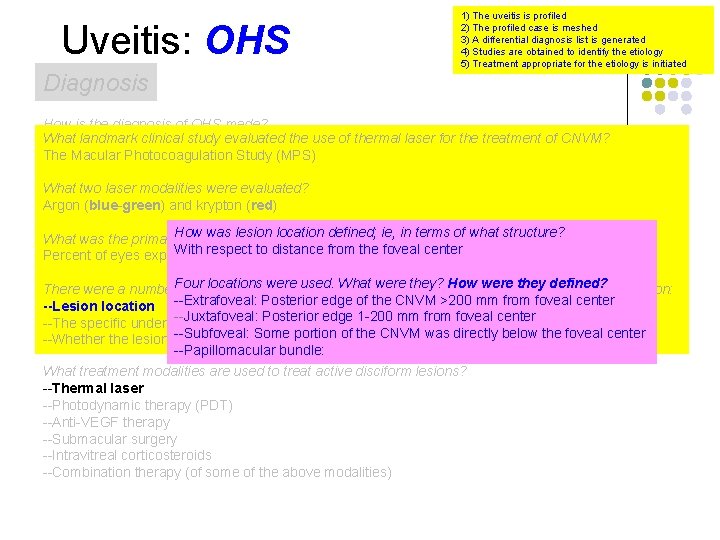
Uveitis: OHS Diagnosis 1) The uveitis is profiled 2) The profiled case is meshed 3) A differential diagnosis list is generated 4) Studies are obtained to identify the etiology 5) Treatment appropriate for the etiology is initiated How is the diagnosis of OHS made? What clinical study the use of thermal laser for the treatment of CNVM? It is a landmark clinical diagnosis basedevaluated on DFE findings. The Macular Photocoagulation Study (MPS) Treatment What two laser modalities were evaluated? Argon (blue-green) and krypton (red) Do antifungals play a role in the treatment? was lesion location defined; ie, in terms of what structure? No was the primary. How What endpoint/outcome variable? With respect to distance from the from foveal center Percent of eyes experiencing severe vision loss (SVL) baseline Which lesion(s) require treatment? Four locationsanalyses were used. What were they? How were they defined? Active were disciform lesions There a number of subgroup in the MPS. Important subgroup analyses were based on: --Extrafoveal: Posterior edge of the CNVM >200 mm from foveal center --Lesion location --Juxtafoveal: Posterior edge 1 -200 mm occurrence from foveal center Is there any treatment known to reduce the risk of developing disciform lesions? --The specific underlying condition responsible for the CNVM --Subfoveal: Some portion of the CNVM was directly below the foveal center No --Whether the lesion was new, or recurrent --Papillomacular bundle: The CNVM was between the fovea and the ONH What treatment modalities are used to treat active disciform lesions? --Thermal laser --Photodynamic therapy (PDT) --Anti-VEGF therapy --Submacular surgery --Intravitreal corticosteroids --Combination therapy (of some of the above modalities)
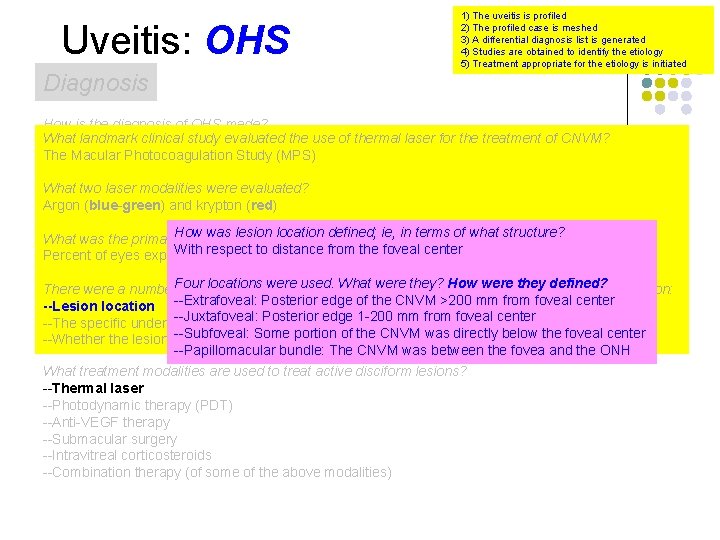
Uveitis: OHS Diagnosis 1) The uveitis is profiled 2) The profiled case is meshed 3) A differential diagnosis list is generated 4) Studies are obtained to identify the etiology 5) Treatment appropriate for the etiology is initiated How is the diagnosis of OHS made? What clinical study the use of thermal laser for the treatment of CNVM? It is a landmark clinical diagnosis basedevaluated on DFE findings. The Macular Photocoagulation Study (MPS) Treatment What two laser modalities were evaluated? Argon (blue-green) and krypton (red) Do antifungals play a role in the treatment? was lesion location defined; ie, in terms of what structure? No was the primary. How What endpoint/outcome variable? With respect to distance from the from foveal center Percent of eyes experiencing severe vision loss (SVL) baseline Which lesion(s) require treatment? Four locationsanalyses were used. What were they? How were they defined? Active were disciform lesions There a number of subgroup in the MPS. Important subgroup analyses were based on: --Extrafoveal: Posterior edge of the CNVM >200 mm from foveal center --Lesion location --Juxtafoveal: Posterior edge 1 -200 mm occurrence from foveal center Is there any treatment known to reduce the risk of developing disciform lesions? --The specific underlying condition responsible for the CNVM --Subfoveal: Some portion of the CNVM was directly below the foveal center No --Whether the lesion was new, or recurrent --Papillomacular bundle: The CNVM was between the fovea and the ONH What treatment modalities are used to treat active disciform lesions? --Thermal laser --Photodynamic therapy (PDT) --Anti-VEGF therapy --Submacular surgery --Intravitreal corticosteroids --Combination therapy (of some of the above modalities)
Uveitis: OHS Diagnosis 1) The uveitis is profiled 2) The profiled case is meshed 3) A differential diagnosis list is generated 4) Studies are obtained to identify the etiology 5) Treatment appropriate for the etiology is initiated How is the diagnosis of OHS made? What clinical study the use of thermal laser for the treatment of CNVM? It is a landmark clinical diagnosis basedevaluated on DFE findings. The Macular Photocoagulation Study (MPS) Treatment What two laser modalities were evaluated? Argon (blue-green) and krypton (red) Do antifungals play a role in the treatment? No was the primary endpoint/outcome variable? What Percent of eyes experiencing severe vision loss (SVL) from baseline Which lesion(s) require treatment? Active were disciform lesions There a number of subgroup analyses in the MPS. Important subgroup analyses were based on: --Lesion location Is there any treatment known to reduceresponsible the risk of developing disciform lesions? --The specific underlying condition for the CNVM occurrence No --Whether the lesion was new, or recurrent Was OHS one of the CNVM-causing conditions in the disciform MPS? What treatment modalities are usedincluded to treat active lesions? Yes --Thermal laser --Photodynamic therapy (PDT) --Anti-VEGF therapy --Submacular surgery --Intravitreal corticosteroids --Combination therapy (of some of the above modalities)
Uveitis: OHS Diagnosis 1) The uveitis is profiled 2) The profiled case is meshed 3) A differential diagnosis list is generated 4) Studies are obtained to identify the etiology 5) Treatment appropriate for the etiology is initiated How is the diagnosis of OHS made? What clinical study the use of thermal laser for the treatment of CNVM? It is a landmark clinical diagnosis basedevaluated on DFE findings. The Macular Photocoagulation Study (MPS) Treatment What two laser modalities were evaluated? Argon (blue-green) and krypton (red) Do antifungals play a role in the treatment? No was the primary endpoint/outcome variable? What Percent of eyes experiencing severe vision loss (SVL) from baseline Which lesion(s) require treatment? Active were disciform lesions There a number of subgroup analyses in the MPS. Important subgroup analyses were based on: --Lesion location Is there any treatment known to reduceresponsible the risk of developing disciform lesions? --The specific underlying condition for the CNVM occurrence No --Whether the lesion was new, or recurrent Was OHS one of the CNVM-causing conditions in the disciform MPS? What treatment modalities are usedincluded to treat active lesions? Yes --Thermal laser --Photodynamic therapy (PDT) --Anti-VEGF therapy --Submacular surgery --Intravitreal corticosteroids --Combination therapy (of some of the above modalities)
Uveitis: OHS Diagnosis 1) The uveitis is profiled 2) The profiled case is meshed 3) A differential diagnosis list is generated 4) Studies are obtained to identify the etiology 5) Treatment appropriate for the etiology is initiated How is the diagnosis of OHS made? What clinical study the use of thermal laser for the treatment of CNVM? It is a landmark clinical diagnosis basedevaluated on DFE findings. The Macular Photocoagulation Study (MPS) Treatment What did thelaser MPSmodalities reveal about using thermal laser to treat CNVM in OHS? What two were evaluated? It Argon found that thermal laser (blue-green) and significantly krypton (red)reduced the risk of SVL in extrafoveal and juxtafoveal lesions. Treatment of subfoveal lesions provided a small long-term benefit, Do antifungals play a role in the treatment? but associated with endpoint/outcome an immediate, dramatic decrease in acuity. (Newsflash: If you Nowaswas What the primary variable? laser the fovea, vision suffers. ) Further, thermal laser treatment was associated with a Percent of eyes experiencing severe vision loss (SVL) from baseline high recurrence Which lesion(s)rate. require treatment? Active were disciform lesions There a number of subgroup analyses in the MPS. Important subgroup analyses were based on: Is--Lesion thermal laser still an acceptable treatment for CNVM associated with OHS? location In--The pts, If a pt has extrafoveal (or juxtafoveal) disease, thermal laser is Isselect there anyyes. treatment known to reduce theeven riskfor of developing disciform lesions? specific underlying condition responsible the CNVM occurrence a --Whether reasonablethe option. especially the case if the pt is not a good candidate for No lesion. This wasisnew, or recurrent other treatment modalities. What treatment modalities are used to treat active disciform lesions? --Thermal laser --Photodynamic therapy (PDT) --Anti-VEGF therapy --Submacular surgery --Intravitreal corticosteroids --Combination therapy (of some of the above modalities)
Uveitis: OHS Diagnosis 1) The uveitis is profiled 2) The profiled case is meshed 3) A differential diagnosis list is generated 4) Studies are obtained to identify the etiology 5) Treatment appropriate for the etiology is initiated How is the diagnosis of OHS made? What clinical study the use of thermal laser for the treatment of CNVM? It is a landmark clinical diagnosis basedevaluated on DFE findings. The Macular Photocoagulation Study (MPS) Treatment What did thelaser MPSmodalities reveal about using thermal laser to treat CNVM in OHS? What two were evaluated? It Argon found that thermal laser (blue-green) and significantly krypton (red)reduced the risk of SVL in extrafoveal and juxtafoveal lesions. Treatment of subfoveal lesions provided a small long-term benefit, Do antifungals play a role in the treatment? but associated with endpoint/outcome an immediate, dramatic decrease in acuity. (Newsflash: If you Nowaswas What the primary variable? laser the fovea, vision suffers. ) Further, thermal laser treatment was associated with a Percent of eyes experiencing severe vision loss (SVL) from baseline high CNVM recurrence rate. Which lesion(s) require treatment? Active were disciform lesions There a number of subgroup analyses in the MPS. Important subgroup analyses were based on: Is--Lesion thermal laser still an acceptable treatment for CNVM associated with OHS? location In--The pts, If a pt has extrafoveal (or juxtafoveal) disease, thermal laser is Isselect there anyyes. treatment known to reduce theeven riskfor of developing disciform lesions? specific underlying condition responsible the CNVM occurrence a --Whether reasonablethe option. especially the case if the pt is not a good candidate for No lesion. This wasisnew, or recurrent other treatment modalities. What treatment modalities are used to treat active disciform lesions? --Thermal laser --Photodynamic therapy (PDT) --Anti-VEGF therapy --Submacular surgery --Intravitreal corticosteroids --Combination therapy (of some of the above modalities)
Uveitis: OHS Diagnosis 1) The uveitis is profiled 2) The profiled case is meshed 3) A differential diagnosis list is generated 4) Studies are obtained to identify the etiology 5) Treatment appropriate for the etiology is initiated How is the diagnosis of OHS made? What clinical study the use of thermal laser for the treatment of CNVM? It is a landmark clinical diagnosis basedevaluated on DFE findings. The Macular Photocoagulation Study (MPS) Treatment What did thelaser MPSmodalities reveal about using thermal laser to treat CNVM in OHS? What two were evaluated? It Argon found that thermal laser (blue-green) and significantly krypton (red)reduced the risk of SVL in extrafoveal and juxtafoveal lesions. Treatment of subfoveal lesions provided a small long-term benefit, Do antifungals play a role in the treatment? but associated with endpoint/outcome an immediate, dramatic decrease in acuity. (Newsflash: If you Nowaswas What the primary variable? laser the fovea, vision suffers. ) Further, thermal laser treatment was associated with a Percent of eyes experiencing severe vision loss (SVL) from baseline high CNVM recurrence rate. Which lesion(s) require treatment? Active were disciform lesions There a number of subgroup analyses in the MPS. Important subgroup analyses were based on: Is--Lesion thermal laser still an acceptable treatment for CNVM associated with OHS? location In--The pts, If a pt has extrafoveal (or juxtafoveal) disease, thermal laser is Isselect there anyyes. treatment known to reduce theeven riskfor of developing disciform lesions? specific underlying condition responsible the CNVM occurrence a --Whether reasonablethe option. especially the case if the pt is not a good candidate for No lesion. This wasisnew, or recurrent other treatment modalities. What treatment modalities are used to treat active disciform lesions? --Thermal laser --Photodynamic therapy (PDT) --Anti-VEGF therapy --Submacular surgery --Intravitreal corticosteroids --Combination therapy (of some of the above modalities)
Uveitis: OHS Diagnosis 1) The uveitis is profiled 2) The profiled case is meshed 3) A differential diagnosis list is generated 4) Studies are obtained to identify the etiology 5) Treatment appropriate for the etiology is initiated How is the diagnosis of OHS made? What clinical study the use of thermal laser for the treatment of CNVM? It is a landmark clinical diagnosis basedevaluated on DFE findings. The Macular Photocoagulation Study (MPS) Treatment What did thelaser MPSmodalities reveal about using thermal laser to treat CNVM in OHS? What two were evaluated? It Argon found that thermal laser (blue-green) and significantly krypton (red)reduced the risk of SVL in extrafoveal and juxtafoveal lesions. Treatment of subfoveal lesions provided a small long-term benefit, Do antifungals play a role in the treatment? but associated with endpoint/outcome an immediate, dramatic decrease in acuity. (Newsflash: If you Nowaswas What the primary variable? laser the fovea, vision suffers. ) Further, thermal laser treatment was associated with a Percent of eyes experiencing severe vision loss (SVL) from baseline high CNVM recurrence rate. Which lesion(s) require treatment? Active were disciform lesions There a number of subgroup analyses in the MPS. Important subgroup analyses were based on: Is--Lesion thermal laser still an acceptable treatment for CNVM associated with OHS? location In--The pts, If a pt has extrafoveal (or juxtafoveal) disease, thermal laser is Isselect there anyyes. treatment known to reduce theeven riskfor of developing disciform lesions? specific underlying condition responsible the CNVM occurrence a --Whether reasonablethe option. especially the case if the pt is not a good candidate for No lesion. This wasisnew, or recurrent other treatment modalities. What treatment modalities are used to treat active disciform lesions? --Thermal laser --Photodynamic therapy (PDT) --Anti-VEGF therapy --Submacular surgery --Intravitreal corticosteroids --Combination therapy (of some of the above modalities)
Uveitis: OHS Diagnosis 1) The uveitis is profiled 2) The profiled case is meshed 3) A differential diagnosis list is generated 4) Studies are obtained to identify the etiology 5) Treatment appropriate for the etiology is initiated How is the diagnosis of OHS made? It is a clinical diagnosis based on DFE findings What is the basic mechanism of PDT? How is it performed; how does it work? PDT destroys the CNVM net ‘from the inside. ’ A light-sensitive chemical is injected intravascularly (note: NOT intravitreally). Time enough for the chemical to accumulate in the net is allowed to pass, then the net is Do antifungals play a role in the treatment? illuminated with a low-power laser tuned to the specific wavelength the chemical is sensitive to. When No activated by the light, the chemical reacts with nearby oxygen molecules to produce highly volatile oxygen/hydroxyl free radicals. These free radicals induce intralesional platelet aggregation, which in turn leads Which lesion(s) require treatment? to thrombosis of the pathologic vasculature. In this way, the abnormal vasculature of the CNVM can be Active disciform lesions targeted in a relatively selective manner (in sharp contrast to the indiscriminate destruction produced by a thermal laser). Is there any treatment known to reduce the risk of developing disciform lesions? No Is PDT still an acceptable treatment for CNVM associated with OHS? Yes, although it is probably best utilized as an adjunctive therapy in concert with anti-VEGF meds What treatment modalities are used to treat active disciform lesions? --Thermal laser --Photodynamic therapy (PDT) --Anti-VEGF therapy --Submacular surgery --Intravitreal corticosteroids --Combination therapy (of some of the above modalities) Treatment
Uveitis: OHS Diagnosis 1) The uveitis is profiled 2) The profiled case is meshed 3) A differential diagnosis list is generated 4) Studies are obtained to identify the etiology 5) Treatment appropriate for the etiology is initiated How is the diagnosis of OHS made? It is a clinical diagnosis based on DFE findings What is the basic mechanism of PDT? How is it performed; how does it work? PDT destroys the CNVM net ‘from the inside. ’ A light-sensitive chemical is injected intravascularly (note: NOT intravitreally). Time enough for the chemical to accumulate in the net is allowed to pass, then the net is Do antifungals play a role in the treatment? illuminated with a low-power laser tuned to the specific wavelength the chemical is sensitive to. When No activated by the light, the chemical reacts with nearby oxygen molecules to produce highly volatile oxygen/hydroxyl free radicals. These free radicals induce intralesional platelet aggregation, which in turn leads Which lesion(s) require treatment? to thrombosis of the pathologic vasculature. In this way, the abnormal vasculature of the CNVM can be Active disciform lesions targeted in a relatively selective manner (in sharp contrast to the indiscriminate destruction produced by a thermal laser). Is there any treatment known to reduce the risk of developing disciform lesions? No Is PDT still an acceptable treatment for CNVM associated with OHS? Yes, although it is probably best utilized as an adjunctive therapy in concert with anti-VEGF meds What treatment modalities are used to treat active disciform lesions? --Thermal laser --Photodynamic therapy (PDT) --Anti-VEGF therapy --Submacular surgery --Intravitreal corticosteroids --Combination therapy (of some of the above modalities) Treatment
Uveitis: OHS Diagnosis 1) The uveitis is profiled 2) The profiled case is meshed 3) A differential diagnosis list is generated 4) Studies are obtained to identify the etiology 5) Treatment appropriate for the etiology is initiated How is the diagnosis of OHS made? It is a clinical diagnosis based on DFE findings What is the basic mechanism of PDT? How is it performed; how does it work? PDT destroys the CNVM net ‘from the inside. ’ A light-sensitive chemical is injected intravascularly (note: NOT intravitreally). Time enough for the chemical to accumulate in the net is allowed to pass, then the net is Do antifungals play a role in the treatment? illuminated with a low-power laser tuned to the specific wavelength the chemical is sensitive to. When No activated by the light, the chemical reacts with nearby oxygen molecules to produce highly volatile oxygen/hydroxyl free radicals. These free radicals induce intralesional platelet aggregation, which in turn leads Which lesion(s) require treatment? to thrombosis of the pathologic vasculature. In this way, the abnormal vasculature of the CNVM can be Active disciform lesions targeted in a relatively selective manner (in sharp contrast to the indiscriminate destruction produced by a thermal laser). Is there any treatment known to reduce the risk of developing disciform lesions? No Is PDT still an acceptable treatment for CNVM associated with OHS? Yes, although it is probably best utilized as an adjunctive therapy in concert with anti-VEGF meds What treatment modalities are used to treat active disciform lesions? --Thermal laser --Photodynamic therapy (PDT) --Anti-VEGF therapy --Submacular surgery --Intravitreal corticosteroids --Combination therapy (of some of the above modalities) Treatment
Uveitis: OHS Diagnosis 1) The uveitis is profiled 2) The profiled case is meshed 3) A differential diagnosis list is generated 4) Studies are obtained to identify the etiology 5) Treatment appropriate for the etiology is initiated How is the diagnosis of OHS made? It is a clinical diagnosis based on DFE findings What is the basic mechanism of PDT? How is it performed; how does it work? PDT destroys the CNVM net ‘from the inside. ’ A light-sensitive chemical is injected intravascularly (note: NOT intravitreally). Time enough for the chemical to accumulate in the net is allowed to pass, then the net is Do antifungals play a role in the treatment? illuminated with a low-power laser tuned to the specific wavelength the chemical is sensitive to. When No activated by the light, the chemical reacts with nearby oxygen molecules to produce highly volatile oxygen/hydroxyl free radicals. These free radicals induce intralesional platelet aggregation, which in turn leads Which lesion(s) require treatment? to thrombosis of the pathologic vasculature. In this way, the abnormal vasculature of the CNVM can be Active disciform lesions targeted in a relatively selective manner (in sharp contrast to the indiscriminate destruction produced by a thermal laser). Is there any treatment known to reduce the risk of developing disciform lesions? No Is PDT still an acceptable treatment for CNVM associated with OHS? Yes, although it is probably best utilized as an adjunctive therapy in concert with anti-VEGF meds What treatment modalities are used to treat active disciform lesions? --Thermal laser --Photodynamic therapy (PDT) --Anti-VEGF therapy --Submacular surgery --Intravitreal corticosteroids --Combination therapy (of some of the above modalities) Treatment
Uveitis: OHS Diagnosis 1) The uveitis is profiled 2) The profiled case is meshed 3) A differential diagnosis list is generated 4) Studies are obtained to identify the etiology 5) Treatment appropriate for the etiology is initiated How is the diagnosis of OHS made? It is a clinical diagnosis based on DFE findings What is the basic mechanism of PDT? How is it performed; how does it work? PDT destroys the CNVM net ‘from the inside. ’ A light-sensitive chemical is injected intravascularly (note: NOT intravitreally). Time enough for the chemical to accumulate in the net is allowed to pass, then the net is Do antifungals play a role in the treatment? illuminated with a low-power laser tuned to the specific wavelength the chemical is sensitive to. When No activated by the light, the chemical reacts with nearby oxygen molecules to produce highly volatile oxygen/hydroxyl free radicals. These free radicals induce intralesional platelet aggregation, which in turn leads Which lesion(s) require treatment? to thrombosis of the pathologic vasculature. In this way, the abnormal vasculature of the CNVM can be Active disciform lesions targeted in a relatively selective manner (in sharp contrast to the indiscriminate destruction produced by a thermal laser). Is there any treatment known to reduce the risk of developing disciform lesions? No Is PDT still an acceptable treatment for CNVM associated with OHS? Yes, although it is probably best utilized as an adjunctive therapy in concert with anti-VEGF meds What treatment modalities are used to treat active disciform lesions? --Thermal laser --Photodynamic therapy (PDT) --Anti-VEGF therapy --Submacular surgery --Intravitreal corticosteroids --Combination therapy (of some of the above modalities) Treatment
Uveitis: OHS Diagnosis 1) The uveitis is profiled 2) The profiled case is meshed 3) A differential diagnosis list is generated 4) Studies are obtained to identify the etiology 5) Treatment appropriate for the etiology is initiated How is the diagnosis of OHS made? It is a clinical diagnosis based on DFE findings What is the basic mechanism of PDT? How is it performed; how does it work? PDT destroys the CNVM net ‘from the inside. ’ A light-sensitive chemical is injected intravascularly (note: NOT intravitreally). Time enough for the chemical to accumulate in the net is allowed to pass, then the net is Do antifungals play a role in the treatment? illuminated with a low-power laser tuned to the specific wavelength the chemical is sensitive to. When No activated by the light, the chemical reacts with nearby oxygen molecules to produce highly volatile oxygen/hydroxyl free radicals. These free radicals induce intralesional platelet aggregation, which in turn leads Which lesion(s) require treatment? to thrombosis of the pathologic vasculature. In this way, the abnormal vasculature of the CNVM can be Active disciform lesions targeted in a relatively selective manner (in sharp contrast to the indiscriminate destruction produced by a thermal laser). Is there any treatment known to reduce the risk of developing disciform lesions? No Is PDT still an acceptable treatment for CNVM associated with OHS? Yes, although it is probably best utilized as an adjunctive therapy in concert with anti-VEGF meds What treatment modalities are used to treat active disciform lesions? --Thermal laser --Photodynamic therapy (PDT) --Anti-VEGF therapy --Submacular surgery --Intravitreal corticosteroids --Combination therapy (of some of the above modalities) Treatment
Uveitis: OHS Diagnosis 1) The uveitis is profiled 2) The profiled case is meshed 3) A differential diagnosis list is generated 4) Studies are obtained to identify the etiology 5) Treatment appropriate for the etiology is initiated How is the diagnosis of OHS made? It is a clinical diagnosis based on DFE findings What is the basic mechanism of PDT? How is it performed; how does it work? PDT destroys the CNVM net ‘from the inside. ’ A light-sensitive chemical is injected intravascularly (note: NOT intravitreally). Time enough for the chemical to accumulate in the net is allowed to pass, then the net is Do antifungals play a role in the treatment? illuminated with a low-power laser tuned to the specific wavelength the chemical is sensitive to. When No activated by the light, the chemical reacts with nearby oxygen molecules to produce highly volatile oxygen/hydroxyl free radicals. These free radicals induce intralesional platelet aggregation, which in turn leads Which lesion(s) require treatment? to thrombosis of the pathologic vasculature. In this way, the abnormal vasculature of the CNVM can be Active disciform lesions targeted in a relatively selective manner (in sharp contrast to the indiscriminate destruction produced by a thermal laser). Is there any treatment known to reduce the risk of developing disciform lesions? No Is PDT still an acceptable treatment for CNVM associated with OHS? the important side effects of PDT? Yes, although it is probably best utilized What as anare adjunctive therapy in concert with anti-VEGF meds What treatment modalities are used--Transient to treat active disciform lesions? two words vision disturbances --Thermal laser -- Injection-site adverse effects (eg rash; extravasation) --Photodynamic therapy (PDT) --Transient skin photosensitivity (pts should avoid --Anti-VEGF therapy sunlight for 5 days post-PDT) --Submacular surgery --Infusion-related low-back pain --Intravitreal corticosteroids --Combination therapy (of some of the above modalities) Treatment
Uveitis: OHS Diagnosis 1) The uveitis is profiled 2) The profiled case is meshed 3) A differential diagnosis list is generated 4) Studies are obtained to identify the etiology 5) Treatment appropriate for the etiology is initiated How is the diagnosis of OHS made? It is a clinical diagnosis based on DFE findings What is the basic mechanism of PDT? How is it performed; how does it work? PDT destroys the CNVM net ‘from the inside. ’ A light-sensitive chemical is injected intravascularly (note: NOT intravitreally). Time enough for the chemical to accumulate in the net is allowed to pass, then the net is Do antifungals play a role in the treatment? illuminated with a low-power laser tuned to the specific wavelength the chemical is sensitive to. When No activated by the light, the chemical reacts with nearby oxygen molecules to produce highly volatile oxygen/hydroxyl free radicals. These free radicals induce intralesional platelet aggregation, which in turn leads Which lesion(s) require treatment? to thrombosis of the pathologic vasculature. In this way, the abnormal vasculature of the CNVM can be Active disciform lesions targeted in a relatively selective manner (in sharp contrast to the indiscriminate destruction produced by a thermal laser). Is there any treatment known to reduce the risk of developing disciform lesions? No Is PDT still an acceptable treatment for CNVM associated with OHS? the important side effects of PDT? Yes, although it is probably best utilized What as anare adjunctive therapy in concert with anti-VEGF meds What treatment modalities are used--Transient to treat active disciform lesions? vision disturbances --Thermal laser -- Injection-site adverse effects (eg rash; extravasation) --Photodynamic therapy (PDT) --Transient skin photosensitivity (pts should avoid --Anti-VEGF therapy sunlight for 5 days post-PDT) --Submacular surgery --Infusion-related low-back pain --Intravitreal corticosteroids --Combination therapy (of some of the above modalities) Treatment
Uveitis: OHS Diagnosis 1) The uveitis is profiled 2) The profiled case is meshed 3) A differential diagnosis list is generated 4) Studies are obtained to identify the etiology 5) Treatment appropriate for the etiology is initiated How is the diagnosis of OHS made? It is a clinical diagnosis based on DFE findings What is the basic mechanism of PDT? How is it performed; how does it work? PDT destroys the CNVM net ‘from the inside. ’ A light-sensitive chemical is injected intravascularly (note: NOT intravitreally). Time enough for the chemical to accumulate in the net is allowed to pass, then the net is Do antifungals play a role in the treatment? illuminated with a low-power laser tuned to the specific wavelength the chemical is sensitive to. When No activated by the light, the chemical reacts with nearby oxygen molecules to produce highly volatile oxygen/hydroxyl free radicals. These free radicals induce intralesional platelet aggregation, which in turn leads Which lesion(s) require treatment? to thrombosis of the pathologic vasculature. In this way, the abnormal vasculature of the CNVM can be Active disciform lesions targeted in a relatively selective manner (in sharp contrast to the indiscriminate destruction produced by a thermal laser). Is there any treatment known to reduce the risk of developing disciform lesions? No Is PDT still an acceptable treatment for CNVM associated with OHS? the important side effects of PDT? Yes, although it is probably best utilized What as anare adjunctive therapy in concert with anti-VEGF meds What treatment modalities are used--Transient to treat active disciform lesions? vision disturbances --Thermal laser two words -- Injection-site adverse effects (eg rash; extravasation) --Photodynamic therapy (PDT) --Transient skin photosensitivity (pts should avoid --Anti-VEGF therapy sunlight for 5 days post-PDT) --Submacular surgery --Infusion-related low-back pain --Intravitreal corticosteroids --Combination therapy (of some of the above modalities) Treatment
Uveitis: OHS Diagnosis 1) The uveitis is profiled 2) The profiled case is meshed 3) A differential diagnosis list is generated 4) Studies are obtained to identify the etiology 5) Treatment appropriate for the etiology is initiated How is the diagnosis of OHS made? It is a clinical diagnosis based on DFE findings What is the basic mechanism of PDT? How is it performed; how does it work? PDT destroys the CNVM net ‘from the inside. ’ A light-sensitive chemical is injected intravascularly (note: NOT intravitreally). Time enough for the chemical to accumulate in the net is allowed to pass, then the net is Do antifungals play a role in the treatment? illuminated with a low-power laser tuned to the specific wavelength the chemical is sensitive to. When No activated by the light, the chemical reacts with nearby oxygen molecules to produce highly volatile oxygen/hydroxyl free radicals. These free radicals induce intralesional platelet aggregation, which in turn leads Which lesion(s) require treatment? to thrombosis of the pathologic vasculature. In this way, the abnormal vasculature of the CNVM can be Active disciform lesions targeted in a relatively selective manner (in sharp contrast to the indiscriminate destruction produced by a thermal laser). Is there any treatment known to reduce the risk of developing disciform lesions? No Is PDT still an acceptable treatment for CNVM associated with OHS? the important side effects of PDT? Yes, although it is probably best utilized What as anare adjunctive therapy in concert with anti-VEGF meds What treatment modalities are used--Transient to treat active disciform lesions? vision disturbances --Thermal laser -- Injection-site adverse effects (eg rash; extravasation) --Photodynamic therapy (PDT) --Transient skin photosensitivity (pts should avoid --Anti-VEGF therapy sunlight for 5 days post-PDT) --Submacular surgery --Infusion-related low-back pain --Intravitreal corticosteroids --Combination therapy (of some of the above modalities) Treatment
Uveitis: OHS Diagnosis 1) The uveitis is profiled 2) The profiled case is meshed 3) A differential diagnosis list is generated 4) Studies are obtained to identify the etiology 5) Treatment appropriate for the etiology is initiated How is the diagnosis of OHS made? It is a clinical diagnosis based on DFE findings What is the basic mechanism of PDT? How is it performed; how does it work? PDT destroys the CNVM net ‘from the inside. ’ A light-sensitive chemical is injected intravascularly (note: NOT intravitreally). Time enough for the chemical to accumulate in the net is allowed to pass, then the net is Do antifungals play a role in the treatment? illuminated with a low-power laser tuned to the specific wavelength the chemical is sensitive to. When No activated by the light, the chemical reacts with nearby oxygen molecules to produce highly volatile oxygen/hydroxyl free radicals. These free radicals induce intralesional platelet aggregation, which in turn leads Which lesion(s) require treatment? to thrombosis of the pathologic vasculature. In this way, the abnormal vasculature of the CNVM can be Active disciform lesions targeted in a relatively selective manner (in sharp contrast to the indiscriminate destruction produced by a thermal laser). Is there any treatment known to reduce the risk of developing disciform lesions? No Is PDT still an acceptable treatment for CNVM associated with OHS? the important side effects of PDT? Yes, although it is probably best utilized What as anare adjunctive therapy in concert with anti-VEGF meds What treatment modalities are used--Transient to treat active disciform lesions? vision disturbances --Thermal laser -- Injection-site adverse effects (eg rash; extravasation) --Photodynamic therapy (PDT) --Transient skin photosensitivity two words (pts should avoid --Anti-VEGF therapy sunlight for 5 days post-PDT) --Submacular surgery --Infusion-related low-back pain --Intravitreal corticosteroids --Combination therapy (of some of the above modalities) Treatment
Uveitis: OHS Diagnosis 1) The uveitis is profiled 2) The profiled case is meshed 3) A differential diagnosis list is generated 4) Studies are obtained to identify the etiology 5) Treatment appropriate for the etiology is initiated How is the diagnosis of OHS made? It is a clinical diagnosis based on DFE findings What is the basic mechanism of PDT? How is it performed; how does it work? PDT destroys the CNVM net ‘from the inside. ’ A light-sensitive chemical is injected intravascularly (note: NOT intravitreally). Time enough for the chemical to accumulate in the net is allowed to pass, then the net is Do antifungals play a role in the treatment? illuminated with a low-power laser tuned to the specific wavelength the chemical is sensitive to. When No activated by the light, the chemical reacts with nearby oxygen molecules to produce highly volatile oxygen/hydroxyl free radicals. These free radicals induce intralesional platelet aggregation, which in turn leads Which lesion(s) require treatment? to thrombosis of the pathologic vasculature. In this way, the abnormal vasculature of the CNVM can be Active disciform lesions targeted in a relatively selective manner (in sharp contrast to the indiscriminate destruction produced by a thermal laser). Is there any treatment known to reduce the risk of developing disciform lesions? No Is PDT still an acceptable treatment for CNVM associated with OHS? the important side effects of PDT? Yes, although it is probably best utilized What as anare adjunctive therapy in concert with anti-VEGF meds What treatment modalities are used--Transient to treat active disciform lesions? vision disturbances --Thermal laser -- Injection-site adverse effects (eg rash; extravasation) --Photodynamic therapy (PDT) --Transient skin photosensitivity (pts should avoid --Anti-VEGF therapy sunlight for 5 days post-PDT) --Submacular surgery --Infusion-related low-back pain --Intravitreal corticosteroids --Combination therapy (of some of the above modalities) Treatment
Uveitis: OHS Diagnosis 1) The uveitis is profiled 2) The profiled case is meshed 3) A differential diagnosis list is generated 4) Studies are obtained to identify the etiology 5) Treatment appropriate for the etiology is initiated How is the diagnosis of OHS made? It is a clinical diagnosis based on DFE findings What is the basic mechanism of PDT? How is it performed; how does it work? PDT destroys the CNVM net ‘from the inside. ’ A light-sensitive chemical is injected intravascularly (note: NOT intravitreally). Time enough for the chemical to accumulate in the net is allowed to pass, then the net is Do antifungals play a role in the treatment? illuminated with a low-power laser tuned to the specific wavelength the chemical is sensitive to. When No activated by the light, the chemical reacts with nearby oxygen molecules to produce highly volatile oxygen/hydroxyl free radicals. These free radicals induce intralesional platelet aggregation, which in turn leads Which lesion(s) require treatment? to thrombosis of the pathologic vasculature. In this way, the abnormal vasculature of the CNVM can be Active disciform lesions targeted in a relatively selective manner (in sharp contrast to the indiscriminate destruction produced by a thermal laser). Is there any treatment known to reduce the risk of developing disciform lesions? No Is PDT still an acceptable treatment for CNVM associated with OHS? the important side effects of PDT? Yes, although it is probably best utilized What as anare adjunctive therapy in concert with anti-VEGF meds What treatment modalities are used--Transient to treat active disciform lesions? vision disturbances --Thermal laser -- Injection-site adverse effects (eg rash; extravasation) --Photodynamic therapy (PDT) --Transient skin photosensitivity (pts should avoid --Anti-VEGF therapy sunlight for 5 days post-PDT) --Submacular surgery --Infusion-related low-back pain --Intravitreal corticosteroids --Combination therapy (of some of the above modalities) Treatment
Uveitis: OHS Diagnosis 1) The uveitis is profiled 2) The profiled case is meshed 3) A differential diagnosis list is generated 4) Studies are obtained to identify the etiology 5) Treatment appropriate for the etiology is initiated How is the diagnosis of OHS made? It is a clinical diagnosis based on DFE findings What is the basic mechanism of PDT? How is it performed; how does it work? PDT destroys the CNVM net ‘from the inside. ’ A light-sensitive chemical is injected intravascularly (note: NOT intravitreally). Time enough for the chemical to accumulate in the net is allowed to pass, then the net is Do antifungals play a role in the treatment? illuminated with a low-power laser tuned to the specific wavelength the chemical is sensitive to. When No activated by the light, the chemical reacts with nearby oxygen molecules to produce highly volatile oxygen/hydroxyl free radicals. These free radicals induce intralesional platelet aggregation, which in turn leads Which lesion(s) require treatment? to thrombosis of the pathologic vasculature. In this way, the abnormal vasculature of the CNVM can be Active disciform lesions targeted in a relatively selective manner (in sharp contrast to the indiscriminate destruction produced by a thermal laser). Is there any treatment known to reduce the risk of developing disciform lesions? No Is PDT still an acceptable treatment for CNVM associated with OHS? the important side effects of PDT? Yes, although it is probably best utilized What as anare adjunctive therapy in concert with anti-VEGF meds What treatment modalities are used--Transient to treat active disciform lesions? vision disturbances --Thermal laser -- Injection-site adverse effects (eg rash; extravasation) --Photodynamic therapy (PDT) --Transient skin photosensitivity (pts should avoid --Anti-VEGF therapy sunlight for 5 days post-PDT) --Submacular surgery two words --Infusion-related low-back pain --Intravitreal corticosteroids --Combination therapy (of some of the above modalities) Treatment
Uveitis: OHS Diagnosis 1) The uveitis is profiled 2) The profiled case is meshed 3) A differential diagnosis list is generated 4) Studies are obtained to identify the etiology 5) Treatment appropriate for the etiology is initiated How is the diagnosis of OHS made? It is a clinical diagnosis based on DFE findings What is the basic mechanism of PDT? How is it performed; how does it work? PDT destroys the CNVM net ‘from the inside. ’ A light-sensitive chemical is injected intravascularly (note: NOT intravitreally). Time enough for the chemical to accumulate in the net is allowed to pass, then the net is Do antifungals play a role in the treatment? illuminated with a low-power laser tuned to the specific wavelength the chemical is sensitive to. When No activated by the light, the chemical reacts with nearby oxygen molecules to produce highly volatile oxygen/hydroxyl free radicals. These free radicals induce intralesional platelet aggregation, which in turn leads Which lesion(s) require treatment? to thrombosis of the pathologic vasculature. In this way, the abnormal vasculature of the CNVM can be Active disciform lesions targeted in a relatively selective manner (in sharp contrast to the indiscriminate destruction produced by a thermal laser). Is there any treatment known to reduce the risk of developing disciform lesions? No Is PDT still an acceptable treatment for CNVM associated with OHS? the important side effects of PDT? Yes, although it is probably best utilized What as anare adjunctive therapy in concert with anti-VEGF meds What treatment modalities are used--Transient to treat active disciform lesions? vision disturbances --Thermal laser -- Injection-site adverse effects (eg rash; extravasation) --Photodynamic therapy (PDT) --Transient skin photosensitivity (pts should avoid --Anti-VEGF therapy sunlight for 5 days post-PDT) --Submacular surgery --Infusion-related low-back pain --Intravitreal corticosteroids --Combination therapy (of some of the above modalities) Treatment
Uveitis: OHS What does VEGF stand for? Vascular endothelial growth factor Diagnosis 1) The uveitis is profiled 2) The profiled case is meshed 3) A differential diagnosis list is generated 4) Studies are obtained to identify the etiology 5) Treatment appropriate for the etiology is initiated Broadly, what it? How is the is diagnosis of OHS made? A signaling molecule that promotes It is a clinical diagnosis based onangiogenesis DFE findings. What does VEGF have to do with CNVM formation? It appears to play a vital role in initiation of the CNVM process, and thus provides a target for clinical intervention to interrupt the development of CNVM Do antifungals play a role in the treatment? Nois the basic premise underlying anti-VEGF therapy? What A molecule is introduced into the eye that binds VEGF, thereby preventing it from binding its receptors in the Which lesion(s) require treatment? budding CNVM complex Active disciform lesions The currently-employed anti-VEGF meds work by one of two techniques for binding it--what are they? Is there any treatment known to reduce risk ofofdeveloping --Some meds are Anti-VEGF antibodies (or the portions antibodies)disciform lesions? No meds are decoy receptor proteins --Some Treatment What treatment modalities are used to treatfor active disciform lesions? Is anti-VEGF therapy an acceptable treatment CNVM associated with OHS? --Thermal laser Yes--in fact, most clinicians probably consider it their first-line treatment --Photodynamic therapy (PDT) --Anti-VEGF therapy --Submacular surgery --Intravitreal corticosteroids --Combination therapy (of some of the above modalities)
Uveitis: OHS What does VEGF stand for? Vascular endothelial growth factor Diagnosis 1) The uveitis is profiled 2) The profiled case is meshed 3) A differential diagnosis list is generated 4) Studies are obtained to identify the etiology 5) Treatment appropriate for the etiology is initiated Broadly, what it? How is the is diagnosis of OHS made? A signaling molecule that promotes It is a clinical diagnosis based onangiogenesis DFE findings. What does VEGF have to do with CNVM formation? It appears to play a vital role in initiation of the CNVM process, and thus provides a target for clinical intervention to interrupt the development of CNVM Do antifungals play a role in the treatment? Nois the basic premise underlying anti-VEGF therapy? What A molecule is introduced into the eye that binds VEGF, thereby preventing it from binding its receptors in the Which lesion(s) require treatment? budding CNVM complex Active disciform lesions The currently-employed anti-VEGF meds work by one of two techniques for binding it--what are they? Is there any treatment known to reduce risk ofofdeveloping --Some meds are Anti-VEGF antibodies (or the portions antibodies)disciform lesions? No meds are decoy receptor proteins --Some Treatment What treatment modalities are used to treatfor active disciform lesions? Is anti-VEGF therapy an acceptable treatment CNVM associated with OHS? --Thermal laser Yes--in fact, most clinicians probably consider it their first-line treatment --Photodynamic therapy (PDT) --Anti-VEGF therapy --Submacular surgery --Intravitreal corticosteroids --Combination therapy (of some of the above modalities)
Uveitis: OHS What does VEGF stand for? Vascular endothelial growth factor Diagnosis 1) The uveitis is profiled 2) The profiled case is meshed 3) A differential diagnosis list is generated 4) Studies are obtained to identify the etiology 5) Treatment appropriate for the etiology is initiated Broadly, what it? How is the is diagnosis of OHS made? A signaling molecule that promotes It is a clinical diagnosis based onangiogenesis DFE findings. What does VEGF have to do with CNVM formation? It appears to play a vital role in initiation of the CNVM process, and thus provides a target for clinical intervention to interrupt the development of CNVM Do antifungals play a role in the treatment? Nois the basic premise underlying anti-VEGF therapy? What A molecule is introduced into the eye that binds VEGF, thereby preventing it from binding its receptors in the Which lesion(s) require treatment? budding CNVM complex Active disciform lesions The currently-employed anti-VEGF meds work by one of two techniques for binding it--what are they? Is there any treatment known to reduce risk ofofdeveloping --Some meds are Anti-VEGF antibodies (or the portions antibodies)disciform lesions? No meds are decoy receptor proteins --Some Treatment What treatment modalities are used to treatfor active disciform lesions? Is anti-VEGF therapy an acceptable treatment CNVM associated with OHS? --Thermal laser Yes--in fact, most clinicians probably consider it their first-line treatment --Photodynamic therapy (PDT) --Anti-VEGF therapy --Submacular surgery --Intravitreal corticosteroids --Combination therapy (of some of the above modalities)
Uveitis: OHS What does VEGF stand for? Vascular endothelial growth factor Diagnosis 1) The uveitis is profiled 2) The profiled case is meshed 3) A differential diagnosis list is generated 4) Studies are obtained to identify the etiology 5) Treatment appropriate for the etiology is initiated Broadly, what it? How is the is diagnosis of OHS made? A signaling molecule that promotes It is a clinical diagnosis based onangiogenesis DFE findings. What does VEGF have to do with CNVM formation? It appears to play a vital role in initiation of the CNVM process, and thus provides a target for clinical intervention to interrupt the development of CNVM Do antifungals play a role in the treatment? Nois the basic premise underlying anti-VEGF therapy? What A molecule is introduced into the eye that binds VEGF, thereby preventing it from binding its receptors in the Which lesion(s) require treatment? budding CNVM complex Active disciform lesions The currently-employed anti-VEGF meds work by one of two techniques for binding it--what are they? Is there any treatment known to reduce risk ofofdeveloping --Some meds are Anti-VEGF antibodies (or the portions antibodies)disciform lesions? No meds are decoy receptor proteins --Some Treatment What treatment modalities are used to treatfor active disciform lesions? Is anti-VEGF therapy an acceptable treatment CNVM associated with OHS? --Thermal laser Yes--in fact, most clinicians probably consider it their first-line treatment --Photodynamic therapy (PDT) --Anti-VEGF therapy --Submacular surgery --Intravitreal corticosteroids --Combination therapy (of some of the above modalities)
Uveitis: OHS What does VEGF stand for? Vascular endothelial growth factor Diagnosis 1) The uveitis is profiled 2) The profiled case is meshed 3) A differential diagnosis list is generated 4) Studies are obtained to identify the etiology 5) Treatment appropriate for the etiology is initiated Broadly, what it? How is the is diagnosis of OHS made? A signaling molecule that promotes It is a clinical diagnosis based onangiogenesis DFE findings. What does VEGF have to do with CNVM formation? It appears to play a vital role in initiation of the CNVM process, and thus provides a target for clinical intervention to interrupt the development of CNVM Do antifungals play a role in the treatment? Nois the basic premise underlying anti-VEGF therapy? What A molecule is introduced into the eye that binds VEGF, thereby preventing it from binding its receptors in the Which lesion(s) require treatment? budding CNVM complex Active disciform lesions The currently-employed anti-VEGF meds work by one of two techniques for binding it--what are they? Is there any treatment known to reduce risk ofofdeveloping --Some meds are Anti-VEGF antibodies (or the portions antibodies)disciform lesions? No meds are decoy receptor proteins --Some Treatment What treatment modalities are used to treatfor active disciform lesions? Is anti-VEGF therapy an acceptable treatment CNVM associated with OHS? --Thermal laser Yes--in fact, most clinicians probably consider it their first-line treatment --Photodynamic therapy (PDT) --Anti-VEGF therapy --Submacular surgery --Intravitreal corticosteroids --Combination therapy (of some of the above modalities)
Uveitis: OHS What does VEGF stand for? Vascular endothelial growth factor Diagnosis 1) The uveitis is profiled 2) The profiled case is meshed 3) A differential diagnosis list is generated 4) Studies are obtained to identify the etiology 5) Treatment appropriate for the etiology is initiated Broadly, what it? How is the is diagnosis of OHS made? A signaling molecule that promotes It is a clinical diagnosis based onangiogenesis DFE findings. What does VEGF have to do with CNVM formation? It appears to play a vital role in initiation of the CNVM process, and thus provides a target for clinical intervention to interrupt the development of CNVM Do antifungals play a role in the treatment? Nois the basic premise underlying anti-VEGF therapy? What A molecule is introduced into the eye that binds VEGF, thereby preventing it from binding its receptors in the Which lesion(s) require treatment? budding CNVM complex Active disciform lesions The currently-employed anti-VEGF meds work by one of two techniques for binding it--what are they? Is there any treatment known to reduce risk ofofdeveloping --Some meds are Anti-VEGF antibodies (or the portions antibodies)disciform lesions? No meds are decoy receptor proteins --Some Treatment What treatment modalities are used to treatfor active disciform lesions? Is anti-VEGF therapy an acceptable treatment CNVM associated with OHS? --Thermal laser Yes--in fact, most clinicians probably consider it their first-line treatment --Photodynamic therapy (PDT) --Anti-VEGF therapy --Submacular surgery --Intravitreal corticosteroids --Combination therapy (of some of the above modalities)
Uveitis: OHS What does VEGF stand for? Vascular endothelial growth factor Diagnosis 1) The uveitis is profiled 2) The profiled case is meshed 3) A differential diagnosis list is generated 4) Studies are obtained to identify the etiology 5) Treatment appropriate for the etiology is initiated Broadly, what it? How is the is diagnosis of OHS made? A signaling molecule that promotes It is a clinical diagnosis based onangiogenesis DFE findings. What does VEGF have to do with CNVM formation? It appears to play a vital role in initiation of the CNVM process, and thus provides a target for clinical intervention to interrupt the development of CNVM Do antifungals play a role in the treatment? Nois the basic premise underlying anti-VEGF therapy? What A molecule is introduced into the eye that binds VEGF, thereby preventing it from binding its receptors in the Which lesion(s) require treatment? budding CNVM complex Active disciform lesions The currently-employed anti-VEGF meds work by one of two techniques for binding it--what are they? Is there any treatment known to reduce risk ofofdeveloping --Some meds are Anti-VEGF antibodies (or the portions antibodies)disciform lesions? No meds are decoy receptor proteins --Some Treatment What treatment modalities are used to treatfor active disciform lesions? Is anti-VEGF therapy an acceptable treatment CNVM associated with OHS? --Thermal laser Yes--in fact, most clinicians probably consider it their first-line treatment --Photodynamic therapy (PDT) --Anti-VEGF therapy --Submacular surgery --Intravitreal corticosteroids --Combination therapy (of some of the above modalities)
Uveitis: OHS What does VEGF stand for? Vascular endothelial growth factor Diagnosis 1) The uveitis is profiled 2) The profiled case is meshed 3) A differential diagnosis list is generated 4) Studies are obtained to identify the etiology 5) Treatment appropriate for the etiology is initiated Broadly, what it? How is the is diagnosis of OHS made? A signaling molecule that promotes It is a clinical diagnosis based onangiogenesis DFE findings. What does VEGF have to do with CNVM formation? It appears to play a vital role in initiation of the CNVM process, and thus provides a target for clinical intervention to interrupt the development of CNVM Do antifungals play a role in the treatment? Nois the basic premise underlying anti-VEGF therapy? What A molecule is introduced into the eye that binds VEGF, thereby preventing it from binding its receptors in the Which lesion(s) require treatment? budding CNVM complex Active disciform lesions The currently-employed anti-VEGF meds work by one of two techniques for binding it--what are they? Is there any treatment known to reduce risk ofofdeveloping --Some meds are Anti-VEGF antibodies (or the portions antibodies)disciform lesions? No meds are decoy receptor proteins --Some Treatment What treatment modalities are used to treatfor active disciform lesions? Is anti-VEGF therapy an acceptable treatment CNVM associated with OHS? --Thermal laser Yes--in fact, most clinicians probably consider it their first-line treatment --Photodynamic therapy (PDT) --Anti-VEGF therapy --Submacular surgery --Intravitreal corticosteroids --Combination therapy (of some of the above modalities)
Uveitis: OHS What does VEGF stand for? Vascular endothelial growth factor Diagnosis 1) The uveitis is profiled 2) The profiled case is meshed 3) A differential diagnosis list is generated 4) Studies are obtained to identify the etiology 5) Treatment appropriate for the etiology is initiated Broadly, what it? How is the is diagnosis of OHS made? A signaling molecule that promotes It is a clinical diagnosis based onangiogenesis DFE findings. What does VEGF have to do with CNVM formation? It appears to play a vital role in initiation of the CNVM process, and thus provides a target for clinical intervention to interrupt the development of CNVM Do antifungals play a role in the treatment? Nois the basic premise underlying anti-VEGF therapy? What A molecule is introduced into the eye that binds VEGF, thereby preventing it from binding its receptors in the Which lesion(s) require treatment? budding CNVM complex Active disciform lesions The currently-employed anti-VEGF meds work by one of two techniques for binding it--what are they? -- Is there any treatment known to reduce the risk of developing disciform lesions? No meds are decoy receptor proteins --Some Treatment What treatment modalities are used to treatfor active disciform lesions? Is anti-VEGF therapy an acceptable treatment CNVM associated with OHS? --Thermal laser Yes--in fact, most clinicians probably consider it their first-line treatment --Photodynamic therapy (PDT) --Anti-VEGF therapy --Submacular surgery --Intravitreal corticosteroids --Combination therapy (of some of the above modalities)
Uveitis: OHS What does VEGF stand for? Vascular endothelial growth factor Diagnosis 1) The uveitis is profiled 2) The profiled case is meshed 3) A differential diagnosis list is generated 4) Studies are obtained to identify the etiology 5) Treatment appropriate for the etiology is initiated Broadly, what it? How is the is diagnosis of OHS made? A signaling molecule that promotes It is a clinical diagnosis based onangiogenesis DFE findings. What does VEGF have to do with CNVM formation? It appears to play a vital role in initiation of the CNVM process, and thus provides a target for clinical intervention to interrupt the development of CNVM Do antifungals play a role in the treatment? Nois the basic premise underlying anti-VEGF therapy? What A molecule is introduced into the eye that binds VEGF, thereby preventing it from binding its receptors in the Which lesion(s) require treatment? budding CNVM complex Active disciform lesions The currently-employed anti-VEGF meds work by one of two techniques for binding it--what are they? Is there any treatment known to reduce risk of developing lesions? --Some meds are antibodies (or portions of the antibodies) against thedisciform VEGF molecule No meds are decoy receptor proteins --Some Treatment What treatment modalities are used to treatfor active disciform lesions? Is anti-VEGF therapy an acceptable treatment CNVM associated with OHS? --Thermal laser Yes--in fact, most clinicians probably consider it their first-line treatment --Photodynamic therapy (PDT) --Anti-VEGF therapy --Submacular surgery --Intravitreal corticosteroids --Combination therapy (of some of the above modalities)
Uveitis: OHS What does VEGF stand for? Vascular endothelial growth factor Diagnosis 1) The uveitis is profiled 2) The profiled case is meshed 3) A differential diagnosis list is generated 4) Studies are obtained to identify the etiology 5) Treatment appropriate for the etiology is initiated Broadly, what it? How is the is diagnosis of OHS made? A signaling molecule that promotes It is a clinical diagnosis based onangiogenesis DFE findings. What does VEGF have to do with CNVM formation? It appears to play a vital role in initiation of the CNVM process, and thus provides a target for clinical intervention to interrupt the development of CNVM Do antifungals play a role in the treatment? Nois the basic premise underlying anti-VEGF therapy? What A molecule is introduced into the eye that binds VEGF, thereby preventing it from binding its receptors in the Which lesion(s) require treatment? budding CNVM complex Active disciform lesions The currently-employed anti-VEGF meds work by one of two techniques for binding it--what are they? Is there anyare treatment known reduce the risk of developing disciform lesions? --Some meds antibodies (ortoportions of antibodies) against the VEGF molecule No --Some meds are decoy receptor proteins What two VEGF-Ab drugs currently dominate the market? Bevacizumab andfor ranibizumab (Lucentis) What treatment modalities are(Avastin) used to treat active disciform lesions? Is anti-VEGF therapy an acceptable treatment CNVM associated with OHS? --Thermal laser Yes--in fact, most clinicians probably consider it their first-line treatment --Photodynamic therapy (PDT) --Anti-VEGF therapy --Submacular surgery --Intravitreal corticosteroids --Combination therapy (of some of the above modalities) Treatment
Uveitis: OHS What does VEGF stand for? Vascular endothelial growth factor Diagnosis 1) The uveitis is profiled 2) The profiled case is meshed 3) A differential diagnosis list is generated 4) Studies are obtained to identify the etiology 5) Treatment appropriate for the etiology is initiated Broadly, what it? How is the is diagnosis of OHS made? A signaling molecule that promotes It is a clinical diagnosis based onangiogenesis DFE findings. What does VEGF have to do with CNVM formation? It appears to play a vital role in initiation of the CNVM process, and thus provides a target for clinical intervention to interrupt the development of CNVM Do antifungals play a role in the treatment? Nois the basic premise underlying anti-VEGF therapy? What A molecule is introduced into the eye that binds VEGF, thereby preventing it from binding its receptors in the Which lesion(s) require treatment? budding CNVM complex Active disciform lesions The currently-employed anti-VEGF meds work by one of two techniques for binding it--what are they? Is there anyare treatment known reduce the risk of developing disciform lesions? --Some meds antibodies (ortoportions of antibodies) against the VEGF molecule No --Some meds are decoy receptor proteins What two VEGF-Ab drugs currently dominate the market? Bevacizumab andfor ranibizumab (Lucentis) What treatment modalities are(Avastin) used to treat active disciform lesions? Is anti-VEGF therapy an acceptable treatment CNVM associated with OHS? --Thermal laser Yes--in fact, most clinicians probably consider it their first-line treatment --Photodynamic therapy (PDT) --Anti-VEGF therapy --Submacular surgery --Intravitreal corticosteroids --Combination therapy (of some of the above modalities) Treatment
Uveitis: OHS What does VEGF stand for? Vascular endothelial growth factor Diagnosis 1) The uveitis is profiled 2) The profiled case is meshed 3) A differential diagnosis list is generated 4) Studies are obtained to identify the etiology 5) Treatment appropriate for the etiology is initiated Broadly, what it? How is the is diagnosis of OHS made? A signaling molecule that promotes It is a clinical diagnosis based onangiogenesis DFE findings. What does VEGF have to do with CNVM formation? It appears to play a vital role in initiation of the CNVM process, and thus provides a target for clinical intervention to interrupt the development of CNVM Do antifungals play a role in the treatment? Nois the basic premise underlying anti-VEGF therapy? What A molecule is introduced into the eye that binds VEGF, thereby preventing it from binding its receptors in the Which lesion(s) require treatment? budding CNVM complex Active disciform lesions The currently-employed anti-VEGF meds work by one of two techniques for binding it--what are they? Is there any treatment known to reduce risk of developing lesions? --Some meds are antibodies (or portions of the antibodies) against thedisciform VEGF molecule No meds are decoy receptor proteins --Some Treatment By name is this strategy known? What treatment modalities arewhat used to treat active disciform lesions? Is anti-VEGF therapy an acceptable treatment for CNVM associated with OHS? ‘VEGF Trap’ --Thermal laser Yes--in fact, most clinicians probably consider it their first-line treatment --Photodynamic therapy (PDT) What VEGF-Trap drug is currently available in the US? --Anti-VEGF therapy Aflibercept --Submacular surgery --Intravitreal corticosteroids --Combination therapy (of some of the above modalities)
Uveitis: OHS What does VEGF stand for? Vascular endothelial growth factor Diagnosis 1) The uveitis is profiled 2) The profiled case is meshed 3) A differential diagnosis list is generated 4) Studies are obtained to identify the etiology 5) Treatment appropriate for the etiology is initiated Broadly, what it? How is the is diagnosis of OHS made? A signaling molecule that promotes It is a clinical diagnosis based onangiogenesis DFE findings. What does VEGF have to do with CNVM formation? It appears to play a vital role in initiation of the CNVM process, and thus provides a target for clinical intervention to interrupt the development of CNVM Do antifungals play a role in the treatment? Nois the basic premise underlying anti-VEGF therapy? What A molecule is introduced into the eye that binds VEGF, thereby preventing it from binding its receptors in the Which lesion(s) require treatment? budding CNVM complex Active disciform lesions The currently-employed anti-VEGF meds work by one of two techniques for binding it--what are they? Is there any treatment known to reduce risk of developing lesions? --Some meds are antibodies (or portions of the antibodies) against thedisciform VEGF molecule No meds are decoy receptor proteins --Some Treatment By name is this strategy known? What treatment modalities arewhat used to treat active disciform lesions? Is anti-VEGF therapy an acceptable treatment for CNVM associated with OHS? ‘VEGF Trap’ --Thermal laser Yes--in fact, most clinicians probably consider it their first-line treatment --Photodynamic therapy (PDT) What VEGF-Trap drug is currently available in the US? --Anti-VEGF therapy Aflibercept --Submacular surgery --Intravitreal corticosteroids --Combination therapy (of some of the above modalities)
Uveitis: OHS What does VEGF stand for? Vascular endothelial growth factor Diagnosis 1) The uveitis is profiled 2) The profiled case is meshed 3) A differential diagnosis list is generated 4) Studies are obtained to identify the etiology 5) Treatment appropriate for the etiology is initiated Broadly, what it? How is the is diagnosis of OHS made? A signaling molecule that promotes It is a clinical diagnosis based onangiogenesis DFE findings. What does VEGF have to do with CNVM formation? It appears to play a vital role in initiation of the CNVM process, and thus provides a target for clinical intervention to interrupt the development of CNVM Do antifungals play a role in the treatment? Nois the basic premise underlying anti-VEGF therapy? What A molecule is introduced into the eye that binds VEGF, thereby preventing it from binding its receptors in the Which lesion(s) require treatment? budding CNVM complex Active disciform lesions The currently-employed anti-VEGF meds work by one of two techniques for binding it--what are they? Is there any treatment known to reduce risk of developing lesions? --Some meds are antibodies (or portions of the antibodies) against thedisciform VEGF molecule No meds are decoy receptor proteins --Some Treatment By name is this strategy known? What treatment modalities arewhat used to treat active disciform lesions? Is anti-VEGF therapy an acceptable treatment for CNVM associated with OHS? ‘VEGF Trap’ --Thermal laser Yes--in fact, most clinicians probably consider it their first-line treatment --Photodynamic therapy (PDT) What VEGF-Trap drug is currently available in the US? --Anti-VEGF therapy Aflibercept --Submacular surgery --Intravitreal corticosteroids --Combination therapy (of some of the above modalities)
Uveitis: OHS What does VEGF stand for? Vascular endothelial growth factor Diagnosis 1) The uveitis is profiled 2) The profiled case is meshed 3) A differential diagnosis list is generated 4) Studies are obtained to identify the etiology 5) Treatment appropriate for the etiology is initiated Broadly, what it? How is the is diagnosis of OHS made? A signaling molecule that promotes It is a clinical diagnosis based onangiogenesis DFE findings. What does VEGF have to do with CNVM formation? It appears to play a vital role in initiation of the CNVM process, and thus provides a target for clinical intervention to interrupt the development of CNVM Do antifungals play a role in the treatment? Nois the basic premise underlying anti-VEGF therapy? What A molecule is introduced into the eye that binds VEGF, thereby preventing it from binding its receptors in the Which lesion(s) require treatment? budding CNVM complex Active disciform lesions The currently-employed anti-VEGF meds work by one of two techniques for binding it--what are they? Is there any treatment known to reduce risk of developing lesions? --Some meds are antibodies (or portions of the antibodies) against thedisciform VEGF molecule No meds are decoy receptor proteins --Some Treatment By name is this strategy known? What treatment modalities arewhat used to treat active disciform lesions? Is anti-VEGF therapy an acceptable treatment for CNVM associated with OHS? ‘VEGF Trap’ --Thermal laser Yes--in fact, most clinicians probably consider it their first-line treatment --Photodynamic therapy (PDT) What VEGF-Trap drug is currently available in the US? --Anti-VEGF therapy Aflibercept --Submacular surgery --Intravitreal corticosteroids --Combination therapy (of some of the above modalities)
Uveitis: OHS What does VEGF stand for? Vascular endothelial growth factor Diagnosis 1) The uveitis is profiled 2) The profiled case is meshed 3) A differential diagnosis list is generated 4) Studies are obtained to identify the etiology 5) Treatment appropriate for the etiology is initiated Broadly, what it? How is the is diagnosis of OHS made? A signaling molecule that promotes It is a clinical diagnosis based onangiogenesis DFE findings. What does VEGF have to do with CNVM formation? It appears to play a vital role in initiation of the CNVM process, and thus provides a target for clinical intervention to interrupt the development of CNVM Do antifungals play a role in the treatment? Nois the basic premise underlying anti-VEGF therapy? What A molecule is introduced into the eye that binds VEGF, thereby preventing it from binding its receptors in the Which lesion(s) require treatment? budding CNVM complex Active disciform lesions The currently-employed anti-VEGF meds work by one of two techniques for binding it--what are they? Is there any treatment known to reduce risk of developing lesions? --Some meds are antibodies (or portions of the antibodies) against thedisciform VEGF molecule No meds are decoy receptor proteins --Some Treatment What treatment modalities are used to treatfor active disciform lesions? Is anti-VEGF therapy an acceptable treatment CNVM associated with OHS? --Thermal laser Yes--in fact, most clinicians probably consider it their first-line treatment --Photodynamic therapy (PDT) --Anti-VEGF therapy --Submacular surgery --Intravitreal corticosteroids --Combination therapy (of some of the above modalities)
Uveitis: OHS What does VEGF stand for? Vascular endothelial growth factor Diagnosis 1) The uveitis is profiled 2) The profiled case is meshed 3) A differential diagnosis list is generated 4) Studies are obtained to identify the etiology 5) Treatment appropriate for the etiology is initiated Broadly, what it? How is the is diagnosis of OHS made? A signaling molecule that promotes It is a clinical diagnosis based onangiogenesis DFE findings. What does VEGF have to do with CNVM formation? It appears to play a vital role in initiation of the CNVM process, and thus provides a target for clinical intervention to interrupt the development of CNVM Do antifungals play a role in the treatment? Nois the basic premise underlying anti-VEGF therapy? What A molecule is introduced into the eye that binds VEGF, thereby preventing it from binding its receptors in the Which lesion(s) require treatment? budding CNVM complex Active disciform lesions The currently-employed anti-VEGF meds work by one of two techniques for binding it--what are they? Is there any treatment known to reduce risk of developing lesions? --Some meds are antibodies (or portions of the antibodies) against thedisciform VEGF molecule No meds are decoy receptor proteins --Some Treatment What treatment modalities are used to treatfor active disciform lesions? Is anti-VEGF therapy an acceptable treatment CNVM associated with OHS? --Thermal laser Yes--in fact, most clinicians probably consider it their first-line treatment --Photodynamic therapy (PDT) --Anti-VEGF therapy --Submacular surgery --Intravitreal corticosteroids --Combination therapy (of some of the above modalities)
Uveitis: OHS Diagnosis 1) The uveitis is profiled 2) The profiled case is meshed 3) A differential diagnosis list is generated 4) Studies are obtained to identify the etiology 5) Treatment appropriate for the etiology is initiated How is the diagnosis of OHS made? It is a clinical diagnosis based on DFE findings What important clinical trial evaluated submacular surgery for the treatment of disciform lesions? The Submacular Surgery Trial (SST) Treatment Do antifungals play a role in the treatment? With respect to CNVM in OHS, what did the SST find? No Submacular surgery provided modest benefit to pts who had poorer vision at presentation. Unfortunately, recurrence and complication rates were both quite high. Which lesion(s) require treatment? Active disciform lesions Is submacular surgery an acceptable treatment for CNVM associated with OHS? At one time, submacular surgery was the only alternative to thermal laser, and thus a more compelling Is there any treatment known to reduce the risk of developing disciform lesions? case could be made for its risk/benefit profile (especially with regard to subfoveal lesions). However, the No advent of PDT and the development of anti-VEGF therapies have rendered submacular surgery considerably less popular. What treatment modalities are used to treat active disciform lesions? That said, in certain very select clinical situations (eg, a large peripapillary CNVM), and if other treatment --Thermal laser modalities have proven ineffective, submacular surgery would be a reasonable option to consider. --Photodynamic therapy (PDT) --Anti-VEGF therapy --Submacular surgery --Intravitreal corticosteroids --Combination therapy (of some of the above modalities)
Uveitis: OHS Diagnosis 1) The uveitis is profiled 2) The profiled case is meshed 3) A differential diagnosis list is generated 4) Studies are obtained to identify the etiology 5) Treatment appropriate for the etiology is initiated How is the diagnosis of OHS made? It is a clinical diagnosis based on DFE findings What important clinical trial evaluated submacular surgery for the treatment of disciform lesions? The Submacular Surgery Trial (SST) Treatment Do antifungals play a role in the treatment? With respect to CNVM in OHS, what did the SST find? No Submacular surgery provided modest benefit to pts who had poorer vision at presentation. Unfortunately, recurrence and complication rates were both quite high. Which lesion(s) require treatment? Active disciform lesions Is submacular surgery an acceptable treatment for CNVM associated with OHS? At one time, submacular surgery was the only alternative to thermal laser, and thus a more compelling Is there any treatment known to reduce the risk of developing disciform lesions? case could be made for its risk/benefit profile (especially with regard to subfoveal lesions). However, the No advent of PDT and the development of anti-VEGF therapies have rendered submacular surgery considerably less popular. What treatment modalities are used to treat active disciform lesions? That said, in certain very select clinical situations (eg, a large peripapillary CNVM), and if other treatment --Thermal laser modalities have proven ineffective, submacular surgery would be a reasonable option to consider. --Photodynamic therapy (PDT) --Anti-VEGF therapy --Submacular surgery --Intravitreal corticosteroids --Combination therapy (of some of the above modalities)
Uveitis: OHS Diagnosis 1) The uveitis is profiled 2) The profiled case is meshed 3) A differential diagnosis list is generated 4) Studies are obtained to identify the etiology 5) Treatment appropriate for the etiology is initiated How is the diagnosis of OHS made? It is a clinical diagnosis based on DFE findings What important clinical trial evaluated submacular surgery for the treatment of disciform lesions? The Submacular Surgery Trial (SST) Treatment Do antifungals play a role in the treatment? With respect to CNVM in OHS, what did the SST find? No Submacular surgery provided modest benefit to pts who had poorer vision at presentation. Unfortunately, recurrence and complication rates were both quite high. Which lesion(s) require treatment? Active disciform lesions Is submacular surgery an acceptable treatment for CNVM associated with OHS? At one time, submacular surgery was the only alternative to thermal laser, and thus a more compelling Is there any treatment known to reduce the risk of developing disciform lesions? case could be made for its risk/benefit profile (especially with regard to subfoveal lesions). However, the No advent of PDT and the development of anti-VEGF therapies have rendered submacular surgery considerably less popular. What treatment modalities are used to treat active disciform lesions? That said, in certain very select clinical situations (eg, a large peripapillary CNVM), and if other treatment --Thermal laser modalities have proven ineffective, submacular surgery would be a reasonable option to consider. --Photodynamic therapy (PDT) --Anti-VEGF therapy --Submacular surgery --Intravitreal corticosteroids --Combination therapy (of some of the above modalities)
Uveitis: OHS Diagnosis 1) The uveitis is profiled 2) The profiled case is meshed 3) A differential diagnosis list is generated 4) Studies are obtained to identify the etiology 5) Treatment appropriate for the etiology is initiated How is the diagnosis of OHS made? It is a clinical diagnosis based on DFE findings What important clinical trial evaluated submacular surgery for the treatment of disciform lesions? The Submacular Surgery Trial (SST) Treatment Do antifungals play a role in the treatment? With respect to CNVM in OHS, what did the SST find? No Submacular surgery provided modest benefit to pts who had poorer vision at presentation. Unfortunately, recurrence and complication rates were both quite high. Which lesion(s) require treatment? Active disciform lesions Is submacular surgery an acceptable treatment for CNVM associated with OHS? At one time, submacular surgery was the only alternative to thermal laser, and thus a more compelling Is there any treatment known to reduce the risk of developing disciform lesions? case could be made for its risk/benefit profile (especially with regard to subfoveal lesions). However, the No advent of PDT and the development of anti-VEGF therapies have rendered submacular surgery considerably less popular. What treatment modalities are used to treat active disciform lesions? That said, in certain very select clinical situations (eg, a large peripapillary CNVM), and if other treatment --Thermal laser modalities have proven ineffective, submacular surgery would be a reasonable option to consider. --Photodynamic therapy (PDT) --Anti-VEGF therapy --Submacular surgery --Intravitreal corticosteroids --Combination therapy (of some of the above modalities)
Uveitis: OHS Diagnosis 1) The uveitis is profiled 2) The profiled case is meshed 3) A differential diagnosis list is generated 4) Studies are obtained to identify the etiology 5) Treatment appropriate for the etiology is initiated How is the diagnosis of OHS made? It is a clinical diagnosis based on DFE findings What important clinical trial evaluated submacular surgery for the treatment of disciform lesions? The Submacular Surgery Trial (SST) Treatment Do antifungals play a role in the treatment? With respect to CNVM in OHS, what did the SST find? No Submacular surgery provided modest benefit to pts who had poorer vision at presentation. Unfortunately, recurrence and complication rates were both quite high. Which lesion(s) require treatment? Active disciform lesions Is submacular surgery an acceptable treatment for CNVM associated with OHS? At one time, submacular surgery was the only alternative to thermal laser, and thus a more compelling Is there any treatment known to reduce the risk of developing disciform lesions? case could be made for its risk/benefit profile (especially with regard to subfoveal lesions). However, the No advent of PDT and the development of anti-VEGF therapies have rendered submacular surgery considerably less popular. What treatment modalities are used to treat active disciform lesions? That said, in certain very select clinical situations (eg, a large peripapillary CNVM), and if other treatment --Thermal laser modalities have proven ineffective, submacular surgery would be a reasonable option to consider. --Photodynamic therapy (PDT) --Anti-VEGF therapy --Submacular surgery --Intravitreal corticosteroids --Combination therapy (of some of the above modalities)
Uveitis: OHS Diagnosis 1) The uveitis is profiled 2) The profiled case is meshed 3) A differential diagnosis list is generated 4) Studies are obtained to identify the etiology 5) Treatment appropriate for the etiology is initiated How is the diagnosis of OHS made? It is a clinical diagnosis based on DFE findings What important clinical trial evaluated submacular surgery for the treatment of disciform lesions? The Submacular Surgery Trial (SST) Treatment Do antifungals play a role in the treatment? With respect to CNVM in OHS, what did the SST find? No Submacular surgery provided modest benefit to pts who had poorer vision at presentation. Unfortunately, recurrence and complication rates were both quite high. Which lesion(s) require treatment? Active disciform lesions Is submacular surgery an acceptable treatment for CNVM associated with OHS? At one time, submacular surgery was the only alternative to thermal laser, and thus a more compelling Is there any treatment known to reduce the risk of developing disciform lesions? case could be made for its risk/benefit profile (especially with regard to subfoveal lesions). However, the No advent of PDT and the development of anti-VEGF therapies have rendered submacular surgery considerably less popular. What treatment modalities are used to treat active disciform lesions? That said, in certain very select clinical situations (eg, a large peripapillary CNVM), and if other treatment --Thermal laser modalities have proven ineffective, submacular surgery would be a reasonable option to consider. --Photodynamic therapy (PDT) --Anti-VEGF therapy --Submacular surgery --Intravitreal corticosteroids --Combination therapy (of some of the above modalities)
Uveitis: OHS Diagnosis 1) The uveitis is profiled 2) The profiled case is meshed 3) A differential diagnosis list is generated 4) Studies are obtained to identify the etiology 5) Treatment appropriate for the etiology is initiated How is the diagnosis of OHS made? It is a clinical diagnosis based on DFE findings What important clinical trial evaluated submacular surgery for the treatment of disciform lesions? The Submacular Surgery Trial (SST) Treatment Do antifungals play a role in the treatment? With respect to CNVM in OHS, what did the SST find? No Submacular surgery provided modest benefit to pts who had poorer vision at presentation. Unfortunately, recurrence and complication rates were both quite high. Which lesion(s) require treatment? Active disciform lesions Is submacular surgery an acceptable treatment for CNVM associated with OHS? At one time, submacular surgery was the only alternative to thermal laser, and thus a more compelling Is there any treatment known to reduce the risk of developing disciform lesions? case could be made for its risk/benefit profile (especially with regard to subfoveal lesions). However, the No advent of PDT and the development of anti-VEGF therapies have rendered submacular surgery considerably less popular. What treatment modalities are used to treat active disciform lesions? That said, in certain very select clinical situations (eg, a large peripapillary CNVM), and if other treatment --Thermal laser modalities have proven ineffective, submacular surgery would be a reasonable option to consider. --Photodynamic therapy (PDT) --Anti-VEGF therapy --Submacular surgery --Intravitreal corticosteroids --Combination therapy (of some of the above modalities)
Uveitis: OHS Diagnosis 1) The uveitis is profiled 2) The profiled case is meshed 3) A differential diagnosis list is generated 4) Studies are obtained to identify the etiology 5) Treatment appropriate for the etiology is initiated How is the diagnosis of OHS made? It is a clinical diagnosis based on DFE findings Corticosteroids are anti-inflammatory meds. What role does inflammation play in CNVM? Fundamentally, CNVM formation is a wound-healing response. And like all wound-healing responses, it is subject to modulation by inflammatory mediators. Do antifungals play a role in the treatment? No meds have been used, and how are they delivered? Which Treatment Intravitreal injections of dexamethasone and triamcinolone have been employed Which lesion(s) require treatment? Active disciform lesions Is there clinical evidence indicating the effectiveness of steroids in treating CNVM in OHS? Yes (although not of the prospective, RCT sort) Is there any treatment known to reduce the risk of developing disciform lesions? Nois the main drawback to using intravitreal steroids to treat CNVM in OHS? What The same drawbacks that apply to using them to treat anything--cataract formation, and ocular hypertension What treatment modalities are used to treat active disciform lesions? --Thermal laser Is corticosteroid therapy an acceptable treatment for CNVM associated with OHS? --Photodynamic therapycircumstances, (PDT) Absent highly extenuating few if any clinicians would advocate for using steroids as a first-line --Anti-VEGF therapy treatment. However, they do have a role as an adjunctive therapy in combination with other treatments. --Submacular surgery --Intravitreal corticosteroids --Combination therapy (of some of the above modalities)
Uveitis: OHS Diagnosis 1) The uveitis is profiled 2) The profiled case is meshed 3) A differential diagnosis list is generated 4) Studies are obtained to identify the etiology 5) Treatment appropriate for the etiology is initiated How is the diagnosis of OHS made? It is a clinical diagnosis based on DFE findings Corticosteroids are anti-inflammatory meds. What role does inflammation play in CNVM? Fundamentally, CNVM formation is a wound-healing response. And like all wound-healing responses, it is subject to modulation by inflammatory mediators. Do antifungals play a role in the treatment? No meds have been used, and how are they delivered? Which Treatment Intravitreal injections of dexamethasone and triamcinolone have been employed Which lesion(s) require treatment? Active disciform lesions Is there clinical evidence indicating the effectiveness of steroids in treating CNVM in OHS? Yes (although not of the prospective, RCT sort) Is there any treatment known to reduce the risk of developing disciform lesions? Nois the main drawback to using intravitreal steroids to treat CNVM in OHS? What The same drawbacks that apply to using them to treat anything--cataract formation, and ocular hypertension What treatment modalities are used to treat active disciform lesions? --Thermal laser Is corticosteroid therapy an acceptable treatment for CNVM associated with OHS? --Photodynamic therapycircumstances, (PDT) Absent highly extenuating few if any clinicians would advocate for using steroids as a first-line --Anti-VEGF therapy treatment. However, they do have a role as an adjunctive therapy in combination with other treatments. --Submacular surgery --Intravitreal corticosteroids --Combination therapy (of some of the above modalities)
Uveitis: OHS Diagnosis 1) The uveitis is profiled 2) The profiled case is meshed 3) A differential diagnosis list is generated 4) Studies are obtained to identify the etiology 5) Treatment appropriate for the etiology is initiated How is the diagnosis of OHS made? It is a clinical diagnosis based on DFE findings Corticosteroids are anti-inflammatory meds. What role does inflammation play in CNVM? Fundamentally, CNVM formation is a wound-healing response. And like all wound-healing responses, it is subject to modulation by inflammatory mediators. Do antifungals play a role in the treatment? No meds have been used, and how are they delivered? Which Treatment Intravitreal injections of dexamethasone and triamcinolone have been employed Which lesion(s) require treatment? Active disciform lesions Is there clinical evidence indicating the effectiveness of steroids in treating CNVM in OHS? Yes (although not of the prospective, RCT sort) Is there any treatment known to reduce the risk of developing disciform lesions? Nois the main drawback to using intravitreal steroids to treat CNVM in OHS? What The same drawbacks that apply to using them to treat anything--cataract formation, and ocular hypertension What treatment modalities are used to treat active disciform lesions? --Thermal laser Is corticosteroid therapy an acceptable treatment for CNVM associated with OHS? --Photodynamic therapycircumstances, (PDT) Absent highly extenuating few if any clinicians would advocate for using steroids as a first-line --Anti-VEGF therapy treatment. However, they do have a role as an adjunctive therapy in combination with other treatments. --Submacular surgery --Intravitreal corticosteroids --Combination therapy (of some of the above modalities)
Uveitis: OHS Diagnosis 1) The uveitis is profiled 2) The profiled case is meshed 3) A differential diagnosis list is generated 4) Studies are obtained to identify the etiology 5) Treatment appropriate for the etiology is initiated How is the diagnosis of OHS made? It is a clinical diagnosis based on DFE findings Corticosteroids are anti-inflammatory meds. What role does inflammation play in CNVM? Fundamentally, CNVM formation is a wound-healing response. And like all wound-healing responses, it is subject to modulation by inflammatory mediators. Do antifungals play a role in the treatment? No meds have been used, and how are they delivered? Which Treatment Intravitreal injections of dexamethasone and triamcinolone have been employed Which lesion(s) require treatment? Active disciform lesions Is there clinical evidence indicating the effectiveness of steroids in treating CNVM in OHS? Yes (although not of the prospective, RCT sort) Is there any treatment known to reduce the risk of developing disciform lesions? Nois the main drawback to using intravitreal steroids to treat CNVM in OHS? What The same drawbacks that apply to using them to treat anything--cataract formation, and ocular hypertension What treatment modalities are used to treat active disciform lesions? --Thermal laser Is corticosteroid therapy an acceptable treatment for CNVM associated with OHS? --Photodynamic therapycircumstances, (PDT) Absent highly extenuating few if any clinicians would advocate for using steroids as a first-line --Anti-VEGF therapy treatment. However, they do have a role as an adjunctive therapy in combination with other treatments. --Submacular surgery --Intravitreal corticosteroids --Combination therapy (of some of the above modalities)
Uveitis: OHS Diagnosis 1) The uveitis is profiled 2) The profiled case is meshed 3) A differential diagnosis list is generated 4) Studies are obtained to identify the etiology 5) Treatment appropriate for the etiology is initiated How is the diagnosis of OHS made? It is a clinical diagnosis based on DFE findings Corticosteroids are anti-inflammatory meds. What role does inflammation play in CNVM? Fundamentally, CNVM formation is a wound-healing response. And like all wound-healing responses, it is subject to modulation by inflammatory mediators. Do antifungals play a role in the treatment? No meds have been used, and how are they delivered? Which Treatment Intravitreal injections of dexamethasone and triamcinolone have been employed Which lesion(s) require treatment? Active disciform lesions Is there clinical evidence indicating the effectiveness of steroids in treating CNVM in OHS? Yes (although not of the prospective, RCT sort) Is there any treatment known to reduce the risk of developing disciform lesions? Nois the main drawback to using intravitreal steroids to treat CNVM in OHS? What The same drawbacks that apply to using them to treat anything--cataract formation, and ocular hypertension What treatment modalities are used to treat active disciform lesions? --Thermal laser Is corticosteroid therapy an acceptable treatment for CNVM associated with OHS? --Photodynamic therapycircumstances, (PDT) Absent highly extenuating few if any clinicians would advocate for using steroids as a first-line --Anti-VEGF therapy treatment. However, they do have a role as an adjunctive therapy in combination with other treatments. --Submacular surgery --Intravitreal corticosteroids --Combination therapy (of some of the above modalities)
Uveitis: OHS Diagnosis 1) The uveitis is profiled 2) The profiled case is meshed 3) A differential diagnosis list is generated 4) Studies are obtained to identify the etiology 5) Treatment appropriate for the etiology is initiated How is the diagnosis of OHS made? It is a clinical diagnosis based on DFE findings Corticosteroids are anti-inflammatory meds. What role does inflammation play in CNVM? Fundamentally, CNVM formation is a wound-healing response. And like all wound-healing responses, it is subject to modulation by inflammatory mediators. Do antifungals play a role in the treatment? No meds have been used, and how are they delivered? Which Treatment Intravitreal injections of dexamethasone and triamcinolone have been employed Which lesion(s) require treatment? Active disciform lesions Is there clinical evidence indicating the effectiveness of steroids in treating CNVM in OHS? Yes (although not of the prospective, RCT sort) Is there any treatment known to reduce the risk of developing disciform lesions? Nois the main drawback to using intravitreal steroids to treat CNVM in OHS? What The same drawbacks that apply to using them to treat anything--cataract formation, and ocular hypertension What treatment modalities are used to treat active disciform lesions? --Thermal laser Is corticosteroid therapy an acceptable treatment for CNVM associated with OHS? --Photodynamic therapycircumstances, (PDT) Absent highly extenuating few if any clinicians would advocate for using steroids as a first-line --Anti-VEGF therapy treatment. However, they do have a role as an adjunctive therapy in combination with other treatments. --Submacular surgery --Intravitreal corticosteroids --Combination therapy (of some of the above modalities)
Uveitis: OHS Diagnosis 1) The uveitis is profiled 2) The profiled case is meshed 3) A differential diagnosis list is generated 4) Studies are obtained to identify the etiology 5) Treatment appropriate for the etiology is initiated How is the diagnosis of OHS made? It is a clinical diagnosis based on DFE findings Corticosteroids are anti-inflammatory meds. What role does inflammation play in CNVM? Fundamentally, CNVM formation is a wound-healing response. And like all wound-healing responses, it is subject to modulation by inflammatory mediators. Do antifungals play a role in the treatment? No meds have been used, and how are they delivered? Which Treatment Intravitreal injections of dexamethasone and triamcinolone have been employed Which lesion(s) require treatment? Active disciform lesions Is there clinical evidence indicating the effectiveness of steroids in treating CNVM in OHS? Yes (although not of the prospective, RCT sort) Is there any treatment known to reduce the risk of developing disciform lesions? Nois the main drawback to using intravitreal steroids to treat CNVM in OHS? What The same drawbacks that apply to using them to treat anything--cataract formation, and ocular hypertension What treatment modalities are used to treat active disciform lesions? --Thermal laser Is corticosteroid therapy an acceptable treatment for CNVM associated with OHS? --Photodynamic therapycircumstances, (PDT) Absent highly extenuating few if any clinicians would advocate for using steroids as a first-line --Anti-VEGF therapy treatment. However, they do have a role as an adjunctive therapy in combination with other treatments. --Submacular surgery --Intravitreal corticosteroids --Combination therapy (of some of the above modalities)
Uveitis: OHS Diagnosis 1) The uveitis is profiled 2) The profiled case is meshed 3) A differential diagnosis list is generated 4) Studies are obtained to identify the etiology 5) Treatment appropriate for the etiology is initiated How is the diagnosis of OHS made? It is a clinical diagnosis based on DFE findings Corticosteroids are anti-inflammatory meds. What role does inflammation play in CNVM? Fundamentally, CNVM formation is a wound-healing response. And like all wound-healing responses, it is subject to modulation by inflammatory mediators. Do antifungals play a role in the treatment? No meds have been used, and how are they delivered? Which Treatment Intravitreal injections of dexamethasone and triamcinolone have been employed Which lesion(s) require treatment? Active disciform lesions Is there clinical evidence indicating the effectiveness of steroids in treating CNVM in OHS? Yes (although not of the prospective, RCT sort) Is there any treatment known to reduce the risk of developing disciform lesions? Nois the main drawback to using intravitreal steroids to treat CNVM in OHS? What The same drawbacks that apply to using them to treat anything--cataract formation, and ocular hypertension What treatment modalities are used to treat active disciform lesions? --Thermal laser Is corticosteroid therapy an acceptable treatment for CNVM associated with OHS? --Photodynamic therapycircumstances, (PDT) Absent highly extenuating few if any clinicians would advocate for using steroids as a first-line --Anti-VEGF therapy treatment. However, they do have a role as an adjunctive therapy in combination with other treatments. --Submacular surgery --Intravitreal corticosteroids --Combination therapy (of some of the above modalities)
Uveitis: OHS Diagnosis 1) The uveitis is profiled 2) The profiled case is meshed 3) A differential diagnosis list is generated 4) Studies are obtained to identify the etiology 5) Treatment appropriate for the etiology is initiated How is the diagnosis of OHS made? It is a clinical diagnosis based on DFE findings Corticosteroids are anti-inflammatory meds. What role does inflammation play in CNVM? Fundamentally, CNVM formation is a wound-healing response. And like all wound-healing responses, it is subject to modulation by inflammatory mediators. Do antifungals play a role in the treatment? No meds have been used, and how are they delivered? Which Treatment Intravitreal injections of dexamethasone and triamcinolone have been employed Which lesion(s) require treatment? Active disciform lesions Is there clinical evidence indicating the effectiveness of steroids in treating CNVM in OHS? Yes (although not of the prospective, RCT sort) Is there any treatment known to reduce the risk of developing disciform lesions? Nois the main drawback to using intravitreal steroids to treat CNVM in OHS? What The same drawbacks that apply to using them to treat anything--cataract formation, and ocular hypertension What treatment modalities are used to treat active disciform lesions? --Thermal laser Is corticosteroid therapy an acceptable treatment for CNVM associated with OHS? --Photodynamic therapycircumstances, (PDT) Absent highly extenuating few if any clinicians would advocate for using steroids as a first-line --Anti-VEGF therapy treatment. However, they do have a role as an adjunctive therapy in combination with other treatments. --Submacular surgery --Intravitreal corticosteroids --Combination therapy (of some of the above modalities)
Uveitis: OHS Diagnosis 1) The uveitis is profiled 2) The profiled case is meshed 3) A differential diagnosis list is generated 4) Studies are obtained to identify the etiology 5) Treatment appropriate for the etiology is initiated How is the diagnosis of OHS made? It is a clinical diagnosis based on DFE findings Corticosteroids are anti-inflammatory meds. What role does inflammation play in CNVM? Fundamentally, CNVM formation is a wound-healing response. And like all wound-healing responses, it is subject to modulation by inflammatory mediators. Do antifungals play a role in the treatment? No meds have been used, and how are they delivered? Which Treatment Intravitreal injections of dexamethasone and triamcinolone have been employed Which lesion(s) require treatment? Active disciform lesions Is there clinical evidence indicating the effectiveness of steroids in treating CNVM in OHS? Yes (although not of the prospective, RCT sort) Is there any treatment known to reduce the risk of developing disciform lesions? Nois the main drawback to using intravitreal steroids to treat CNVM in OHS? What The same drawbacks that apply to using them to treat anything--cataract formation, and ocular hypertension What treatment modalities are used to treat active disciform lesions? --Thermal laser Is corticosteroid therapy an acceptable treatment for CNVM associated with OHS? --Photodynamic therapycircumstances, (PDT) Absent highly extenuating few if any clinicians would advocate for using steroids as a first-line --Anti-VEGF therapy treatment. However, they do have a role as an adjunctive therapy in combination with other treatments. --Submacular surgery --Intravitreal corticosteroids --Combination therapy (of some of the above modalities)
Uveitis: OHS Diagnosis 1) The uveitis is profiled 2) The profiled case is meshed 3) A differential diagnosis list is generated 4) Studies are obtained to identify the etiology 5) Treatment appropriate for the etiology is initiated How is the diagnosis of OHS made? It is a clinical diagnosis based on DFE findings Treatment Which lesion(s) require treatment? Active disciform lesions Do antifungals play a role in the treatment? No Is there any treatment known to reduce the risk of developing disciform lesions? No What treatment modalities are used to treat active disciform lesions? Which combinations seem to show particular promise? --Thermal laser --Anti-VEGF +therapy PDT (PDT) --Photodynamic --Anti-VEGF + thermal laser --Anti-VEGF therapy --PDT + corticosteroids --Submacular surgery --Intravitreal corticosteroids --Combination therapy (of some of the above modalities)
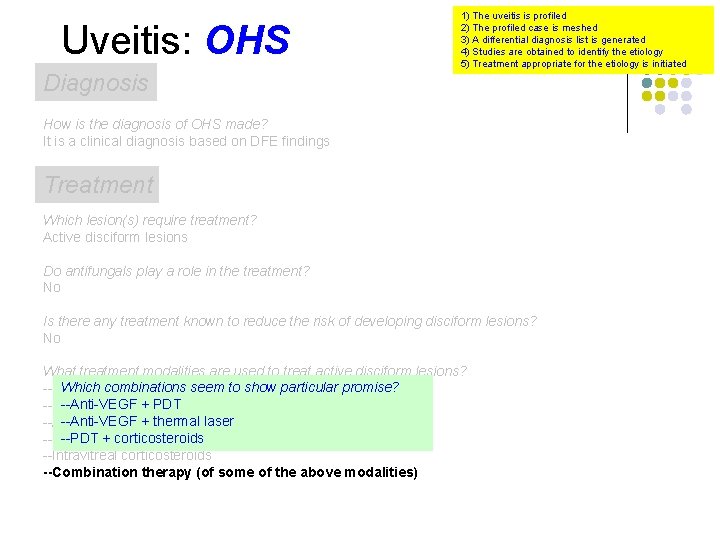
Uveitis: OHS Diagnosis 1) The uveitis is profiled 2) The profiled case is meshed 3) A differential diagnosis list is generated 4) Studies are obtained to identify the etiology 5) Treatment appropriate for the etiology is initiated How is the diagnosis of OHS made? It is a clinical diagnosis based on DFE findings Treatment Which lesion(s) require treatment? Active disciform lesions Do antifungals play a role in the treatment? No Is there any treatment known to reduce the risk of developing disciform lesions? No What treatment modalities are used to treat active disciform lesions? Which combinations seem to show particular promise? --Thermal laser --Anti-VEGF +therapy PDT (PDT) --Photodynamic --Anti-VEGF + thermal laser --Anti-VEGF therapy --PDT + corticosteroids --Submacular surgery --Intravitreal corticosteroids --Combination therapy (of some of the above modalities)
- Slides: 166