
Uveitis Lyme Basics What is the causative organism
Uveitis: Lyme Basics What is the causative organism in Lyme dz? 1) The uveitis is profiled 2) The profiled case is meshed 3) A differential diagnosis list is generated 4) Studies are obtained to identify the etiology 5) Treatment appropriate for the etiology is initiated
Uveitis: Lyme Basics What is the causative organism in Lyme dz? Borrelia burgdorferi 1) The uveitis is profiled 2) The profiled case is meshed 3) A differential diagnosis list is generated 4) Studies are obtained to identify the etiology 5) Treatment appropriate for the etiology is initiated
Uveitis: Lyme Basics 1) The uveitis is profiled 2) The profiled case is meshed 3) A differential diagnosis list is generated 4) Studies are obtained to identify the etiology 5) Treatment appropriate for the etiology is initiated What is the causative organism in Lyme dz? Borrelia burgdorferi What are its basic properties (ie, what sort of organism is it in a microbiology sense)?
Uveitis: Lyme Basics 1) The uveitis is profiled 2) The profiled case is meshed 3) A differential diagnosis list is generated 4) Studies are obtained to identify the etiology 5) Treatment appropriate for the etiology is initiated What is the causative organism in Lyme dz? Borrelia burgdorferi What are its basic properties (ie, what sort of organism is it in a microbiology sense)? It is a spirochete
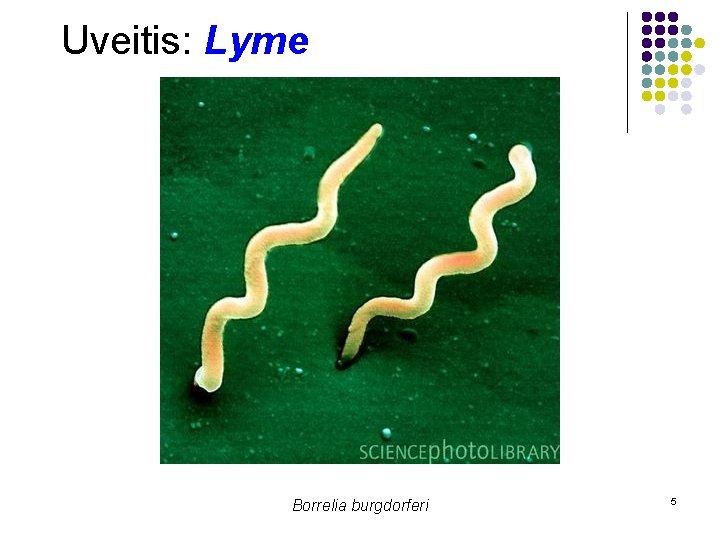
Uveitis: Lyme Borrelia burgdorferi 5
Uveitis: Lyme Basics 1) The uveitis is profiled 2) The profiled case is meshed 3) A differential diagnosis list is generated 4) Studies are obtained to identify the etiology 5) Treatment appropriate for the etiology is initiated What is the causative organism in Lyme dz? Borrelia burgdorferi What are its basic properties (ie, what sort of organism is it in a microbiology sense)? It is a spirochete Is it Gram positive, or Gram negative?
Uveitis: Lyme Basics 1) The uveitis is profiled 2) The profiled case is meshed 3) A differential diagnosis list is generated 4) Studies are obtained to identify the etiology 5) Treatment appropriate for the etiology is initiated What is the causative organism in Lyme dz? Borrelia burgdorferi What are its basic properties (ie, what sort of organism is it in a microbiology sense)? It is a spirochete Is it Gram positive, or Gram negative? It is neither
Uveitis: Lyme Basics 1) The uveitis is profiled 2) The profiled case is meshed 3) A differential diagnosis list is generated 4) Studies are obtained to identify the etiology 5) Treatment appropriate for the etiology is initiated What is the causative organism in Lyme dz? Borrelia burgdorferi What are its basic properties (ie, what sort of organism is it in a microbiology sense)? It is a spirochete Is it Gram positive, or Gram negative? It is neither How are humans infected?
Uveitis: Lyme Basics 1) The uveitis is profiled 2) The profiled case is meshed 3) A differential diagnosis list is generated 4) Studies are obtained to identify the etiology 5) Treatment appropriate for the etiology is initiated What is the causative organism in Lyme dz? Borrelia burgdorferi What are its basic properties (ie, what sort of organism is it in a microbiology sense)? It is a spirochete Is it Gram positive, or Gram negative? It is neither How are humans infected? Via a bite from a tick of the Ixodes genus
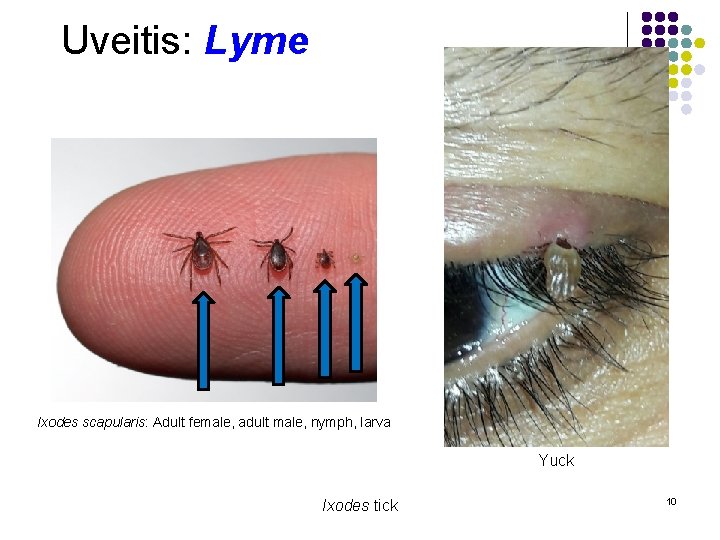
Uveitis: Lyme Ixodes scapularis: Adult female, adult male, nymph, larva Yuck Ixodes tick 10
Uveitis: Lyme Basics 1) The uveitis is profiled 2) The profiled case is meshed 3) A differential diagnosis list is generated 4) Studies are obtained to identify the etiology 5) Treatment appropriate for the etiology is initiated What is the causative organism in Lyme dz? Borrelia burgdorferi What are its basic properties (ie, what sort of organism is it in a microbiology sense)? It is a spirochete Is it Gram positive, or Gram negative? It is neither How are humans infected? Via a bite from a tick of the Ixodes genus What animals serve as the reservoir for the disease?
Uveitis: Lyme Basics 1) The uveitis is profiled 2) The profiled case is meshed 3) A differential diagnosis list is generated 4) Studies are obtained to identify the etiology 5) Treatment appropriate for the etiology is initiated What is the causative organism in Lyme dz? Borrelia burgdorferi What are its basic properties (ie, what sort of organism is it in a microbiology sense)? It is a spirochete Is it Gram positive, or Gram negative? It is neither How are humans infected? Via a bite from a tick of the Ixodes genus What animals serve as the reservoir for the disease? Chiefly deer
Uveitis: Lyme Basics 1) The uveitis is profiled 2) The profiled case is meshed 3) A differential diagnosis list is generated 4) Studies are obtained to identify the etiology 5) Treatment appropriate for the etiology is initiated What is the causative organism in Lyme dz? Borrelia burgdorferi What are its basic properties (ie, what sort of organism is it in a microbiology sense)? It is a spirochete Is it Gram positive, or Gram negative? It is neither How are humans infected? Via a bite from a tick of the Ixodes genus What animals serve as the reservoir for the disease? Chiefly deer, but horses, cows, rodents, cats and dogs, and certain bird species do as well
Uveitis: Lyme Basics 1) The uveitis is profiled 2) The profiled case is meshed 3) A differential diagnosis list is generated 4) Studies are obtained to identify the etiology 5) Treatment appropriate for the etiology is initiated What is the causative organism in Lyme dz? Borrelia burgdorferi What are its basic properties (ie, what sort of organism is it in a microbiology sense)? It is a spirochete Is it Gram positive, or Gram negative? It is neither How are humans infected? Via a bite from a tick of the Ixodes genus What animals serve as the reservoir for the disease? Chiefly deer, but horses, cows, rodents, cats and dogs, and certain bird species do as well What regions of the US have the highest annual incidence of Lyme disease (LD)? ---
Uveitis: Lyme Basics 1) The uveitis is profiled 2) The profiled case is meshed 3) A differential diagnosis list is generated 4) Studies are obtained to identify the etiology 5) Treatment appropriate for the etiology is initiated What is the causative organism in Lyme dz? Borrelia burgdorferi What are its basic properties (ie, what sort of organism is it in a microbiology sense)? It is a spirochete Is it Gram positive, or Gram negative? It is neither How are humans infected? Via a bite from a tick of the Ixodes genus What animals serve as the reservoir for the disease? Chiefly deer, but horses, cows, rodents, cats and dogs, and certain bird species do as well What regions of the US have the highest annual incidence of Lyme disease (LD)? --The Northeast, especially Connecticut --The Minnesota/Wisconsin region
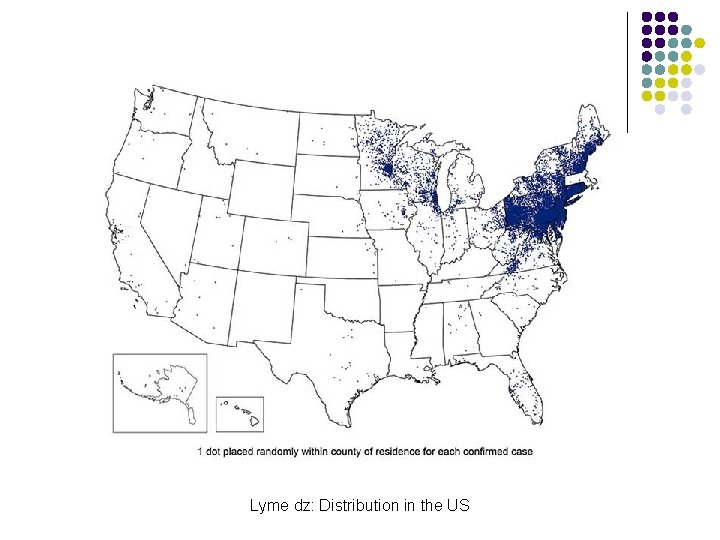
Lyme dz: Distribution in the US
Uveitis: Lyme Basics 1) The uveitis is profiled 2) The profiled case is meshed 3) A differential diagnosis list is generated 4) Studies are obtained to identify the etiology 5) Treatment appropriate for the etiology is initiated What is the causative organism in Lyme dz? Borrelia burgdorferi What are its basic properties (ie, what sort of organism is it in a microbiology sense)? It is a spirochete Is it Gram positive, or Gram negative? It is neither How are humans infected? Via a bite from a tick of the Ixodes genus What animals serve as the reservoir for the disease? Chiefly deer, but horses, cows, rodents, cats and dogs, and certain bird species do as well What regions of the US have the highest annual incidence of Lyme disease (LD)? --The Northeast, especially Connecticut --The Minnesota/Wisconsin region What time of year is LD most likely to occur?
Uveitis: Lyme Basics 1) The uveitis is profiled 2) The profiled case is meshed 3) A differential diagnosis list is generated 4) Studies are obtained to identify the etiology 5) Treatment appropriate for the etiology is initiated What is the causative organism in Lyme dz? Borrelia burgdorferi What are its basic properties (ie, what sort of organism is it in a microbiology sense)? It is a spirochete Is it Gram positive, or Gram negative? It is neither How are humans infected? Via a bite from a tick of the Ixodes genus What animals serve as the reservoir for the disease? Chiefly deer, but horses, cows, rodents, cats and dogs, and certain bird species do as well What regions of the US have the highest annual incidence of Lyme disease (LD)? --The Northeast, especially Connecticut --The Minnesota/Wisconsin region What time of year is LD most likely to occur? Summertime—May to August
Uveitis: Lyme Basics 1) The uveitis is profiled 2) The profiled case is meshed 3) A differential diagnosis list is generated 4) Studies are obtained to identify the etiology 5) Treatment appropriate for the etiology is initiated What is the causative organism in Lyme dz? Borrelia burgdorferi What are its basic properties (ie, what sort of organism is it in a microbiology sense)? It is a spirochete Is it Gram positive, or Gram negative? It is neither How are humans infected? Via a bite from a tick of the Ixodes genus What animals serve as the reservoir for the disease? Chiefly deer, but horses, cows, rodents, cats and dogs, and certain bird species do as well What regions of the US have the highest annual incidence of Lyme disease (LD)? --The Northeast, especially Connecticut --The Minnesota/Wisconsin region What time of year is LD most likely to occur? Summertime—May to August What age group(s) is/are most likely to be affected?
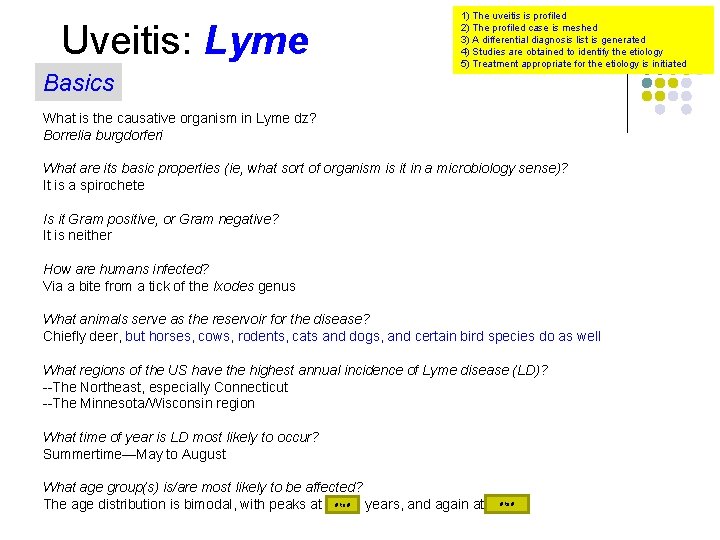
Uveitis: Lyme Basics 1) The uveitis is profiled 2) The profiled case is meshed 3) A differential diagnosis list is generated 4) Studies are obtained to identify the etiology 5) Treatment appropriate for the etiology is initiated What is the causative organism in Lyme dz? Borrelia burgdorferi What are its basic properties (ie, what sort of organism is it in a microbiology sense)? It is a spirochete Is it Gram positive, or Gram negative? It is neither How are humans infected? Via a bite from a tick of the Ixodes genus What animals serve as the reservoir for the disease? Chiefly deer, but horses, cows, rodents, cats and dogs, and certain bird species do as well What regions of the US have the highest annual incidence of Lyme disease (LD)? --The Northeast, especially Connecticut --The Minnesota/Wisconsin region What time of year is LD most likely to occur? Summertime—May to August What age group(s) is/are most likely to be affected? # to # The age distribution is bimodal, with peaks at 5 -15 years, and again at 50 -60
Uveitis: Lyme Basics 1) The uveitis is profiled 2) The profiled case is meshed 3) A differential diagnosis list is generated 4) Studies are obtained to identify the etiology 5) Treatment appropriate for the etiology is initiated What is the causative organism in Lyme dz? Borrelia burgdorferi What are its basic properties (ie, what sort of organism is it in a microbiology sense)? It is a spirochete Is it Gram positive, or Gram negative? It is neither How are humans infected? Via a bite from a tick of the Ixodes genus What animals serve as the reservoir for the disease? Chiefly deer, but horses, cows, rodents, cats and dogs, and certain bird species do as well What regions of the US have the highest annual incidence of Lyme disease (LD)? --The Northeast, especially Connecticut --The Minnesota/Wisconsin region What time of year is LD most likely to occur? Summertime—May to August What age group(s) is/are most likely to be affected? The age distribution is bimodal, with peaks at 5 -15 years, and again at 50 -60
Uveitis: Lyme Basics 1) The uveitis is profiled 2) The profiled case is meshed 3) A differential diagnosis list is generated 4) Studies are obtained to identify the etiology 5) Treatment appropriate for the etiology is initiated LD passes through three stages--what are they? How do they manifest? (2 -28 days post-inoculation) --The Local disease stage is characterized by…the appearance of erythema chronicum migrans at the bite site (1 -4 months post-inoculation) --The Disseminated disease stage is characterized by…hematogenous spread to different sites, including: --The skin --The heart --The CNS --The joints --The eye (5+ months post-inoculation) --
Uveitis: Lyme Basics 1) The uveitis is profiled 2) The profiled case is meshed 3) A differential diagnosis list is generated 4) Studies are obtained to identify the etiology 5) Treatment appropriate for the etiology is initiated LD passes through three stages--what are they? How do they manifest? (2 -28 days post-inoculation) --The Local disease stage is characterized by…the appearance of erythema chronicum migrans at the bite site (1 -4 months post-inoculation) --The Disseminated disease stage is characterized by…hematogenous spread to different sites, including: --The skin --The heart --The CNS --The joints --The eye (5+ months post-inoculation) --The Persistent disease stage
Uveitis: Lyme Basics 1) The uveitis is profiled 2) The profiled case is meshed 3) A differential diagnosis list is generated 4) Studies are obtained to identify the etiology 5) Treatment appropriate for the etiology is initiated LD passes through three stages--what are they? How do they manifest? (2 -28 days post-inoculation) What eye manifestations are --The Local disease stage: is? characterized by…the appearance of erythema chronicum migrans at associated with this stage? the bite site (1 -4 months post-inoculation) --The Disseminated disease stage is characterized by…hematogenous spread to different sites, including: --The skin --The heart --The CNS --The joints --The eye (5+ months post-inoculation) --The Persistent disease stage
Uveitis: Lyme Basics 1) The uveitis is profiled 2) The profiled case is meshed 3) A differential diagnosis list is generated 4) Studies are obtained to identify the etiology 5) Treatment appropriate for the etiology is initiated LD passes through three stages--what are they? How do they manifest? (2 -28 days post-inoculation) What eye manifestations are --The Local disease stage: is. Follicular characterized by…the appearance of erythema chronicum migrans at conjunctivitis associated with this stage? the bite site (1 -4 months post-inoculation) --The Disseminated disease stage is characterized by…hematogenous spread to different sites, including: --The skin --The heart --The CNS --The joints --The eye (5+ months post-inoculation) --The Persistent disease stage
Uveitis: Lyme Basics 1) The uveitis is profiled 2) The profiled case is meshed 3) A differential diagnosis list is generated 4) Studies are obtained to identify the etiology 5) Treatment appropriate for the etiology is initiated LD passes through three stages--what are they? How do they manifest? (2 -28 days post-inoculation) --The Local disease stage: is. Follicular characterized by…the appearance of erythema chronicum migrans at conjunctivitis the bite site (1 -4 months post-inoculation) What eye manifestations are --The Disseminated disease stage: is ? characterized by…hematogenous spread to different sites, associated with this stage? including: --The skin --The heart --The CNS --The joints --The eye (5+ months post-inoculation) --The Persistent disease stage
Uveitis: Lyme Basics 1) The uveitis is profiled 2) The profiled case is meshed 3) A differential diagnosis list is generated 4) Studies are obtained to identify the etiology 5) Treatment appropriate for the etiology is initiated LD passes through three stages--what are they? How do they manifest? (2 -28 days post-inoculation) --The Local disease stage: is. Follicular characterized by…the appearance of erythema chronicum migrans at conjunctivitis the bite site (1 -4 months post-inoculation) What eye manifestations are --The Disseminated disease stage: is characterized by…hematogenous spread to different sites, Intraocular inflammatory dz associated with this stage? including: --The skin --The heart --The CNS --The joints --The eye (5+ months post-inoculation) --The Persistent disease stage
Uveitis: Lyme Basics 1) The uveitis is profiled 2) The profiled case is meshed 3) A differential diagnosis list is generated 4) Studies are obtained to identify the etiology 5) Treatment appropriate for the etiology is initiated LD passes through three stages--what are they? How do they manifest? (2 -28 days post-inoculation) --The Local disease stage: is. Follicular characterized by…the appearance of erythema chronicum migrans at conjunctivitis the bite site (1 -4 months post-inoculation) --The Disseminated disease stage: is characterized by…hematogenous spread to different sites, Intraocular inflammatory dz including: --The skin --The heart --The CNS --The joints --The eye (5+ months post-inoculation) What eye manifestations are --The Persistent disease stage: is ? characterized by one of three patterns: associated with this stage? ----Benign tertiary syphilis ----Cardiovascular syphilis ----Neurosyphilis
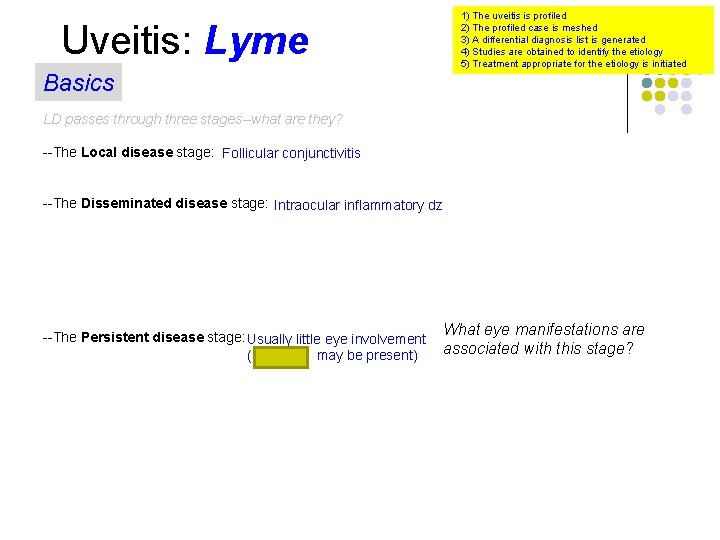
Uveitis: Lyme Basics 1) The uveitis is profiled 2) The profiled case is meshed 3) A differential diagnosis list is generated 4) Studies are obtained to identify the etiology 5) Treatment appropriate for the etiology is initiated LD passes through three stages--what are they? How do they manifest? (2 -28 days post-inoculation) --The Local disease stage: is. Follicular characterized by…the appearance of erythema chronicum migrans at conjunctivitis the bite site (1 -4 months post-inoculation) --The Disseminated disease stage: is characterized by…hematogenous spread to different sites, Intraocular inflammatory dz including: --The skin --The heart --The CNS --The joints --The eye (5+ months post-inoculation) eye manifestations are --The Persistent disease stage: Usually is characterized one of three. What patterns: little eye by involvement associated with this stage? ----Benign tertiary syphilis ( keratitis may be present) ----Cardiovascular syphilis ----Neurosyphilis
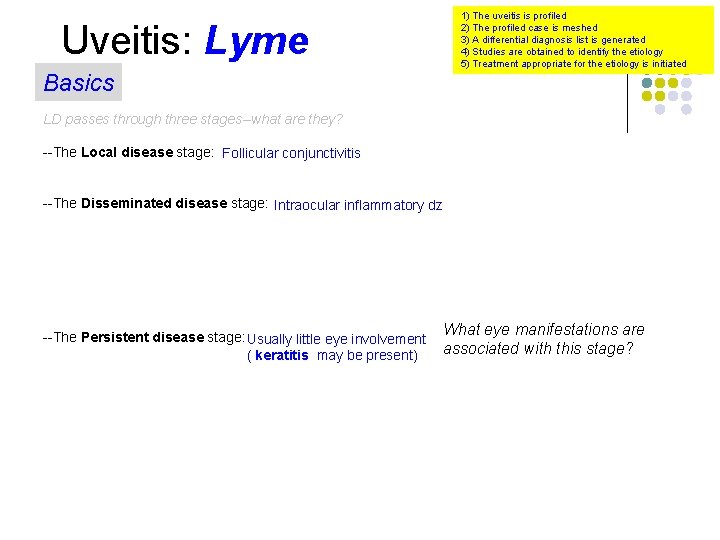
Uveitis: Lyme Basics 1) The uveitis is profiled 2) The profiled case is meshed 3) A differential diagnosis list is generated 4) Studies are obtained to identify the etiology 5) Treatment appropriate for the etiology is initiated LD passes through three stages--what are they? How do they manifest? (2 -28 days post-inoculation) --The Local disease stage: is. Follicular characterized by…the appearance of erythema chronicum migrans at conjunctivitis the bite site (1 -4 months post-inoculation) --The Disseminated disease stage: is characterized by…hematogenous spread to different sites, Intraocular inflammatory dz including: --The skin --The heart --The CNS --The joints --The eye (5+ months post-inoculation) eye manifestations are --The Persistent disease stage: Usually is characterized one of three. What patterns: little eye by involvement associated with this stage? ----Benign tertiary syphilis ( keratitis may be present) ----Cardiovascular syphilis ----Neurosyphilis
Uveitis: Lyme Basics 1) The uveitis is profiled 2) The profiled case is meshed 3) A differential diagnosis list is generated 4) Studies are obtained to identify the etiology 5) Treatment appropriate for the etiology is initiated LD passes through three stages--what are they? How do they manifest? (2 -28 much daystime post-inoculation) How typically passes between the bite and the onset of Local disease? --The Local disease stage is characterized by…the appearance of erythema chronicum migrans at the bite site N (1 -4 months post-inoculation) e --The Disseminated disease stage is characterized by…hematogenous spread to different sites, including: x --The skin t --The heart --The CNS Q --The joints --The eye (5+ months post-inoculation) --The Persistent disease stage is characterized by one of three patterns: ----Benign tertiary syphilis ----Cardiovascular syphilis ----Neurosyphilis
Uveitis: Lyme Basics 1) The uveitis is profiled 2) The profiled case is meshed 3) A differential diagnosis list is generated 4) Studies are obtained to identify the etiology 5) Treatment appropriate for the etiology is initiated LD passes through three stages--what are they? How do they manifest? (2 -28 days post-inoculation) The answer --The Local disease stage is characterized by…the appearance of erythema chronicum migrans at the bite site (1 -4 months post-inoculation) --The Disseminated disease stage is characterized by…hematogenous spread to different sites, including: --The skin --The heart --The CNS --The joints --The eye (5+ months post-inoculation) --The Persistent disease stage is characterized by one of three patterns: ----Benign tertiary syphilis ----Cardiovascular syphilis ----Neurosyphilis
Uveitis: Lyme Basics 1) The uveitis is profiled 2) The profiled case is meshed 3) A differential diagnosis list is generated 4) Studies are obtained to identify the etiology 5) Treatment appropriate for the etiology is initiated LD passes through three stages--what are they? How do they manifest? (2 -28 days post-inoculation) --The Local disease stage is characterized by…the appearance of erythema chronicum migrans at the bite site (1 -4 months post-inoculation) N --The Disseminated disease stage is characterized by…hematogenous spread to different sites, e including: --The skin x --The heart t --The CNS --The joints Q --The eye (5+ months post-inoculation) --The Persistent disease stage is characterized by one of three patterns: ----Benign tertiary syphilis ----Cardiovascular syphilis ----Neurosyphilis
Uveitis: Lyme Basics 1) The uveitis is profiled 2) The profiled case is meshed 3) A differential diagnosis list is generated 4) Studies are obtained to identify the etiology 5) Treatment appropriate for the etiology is initiated LD passes through three stages--what are they? How do they manifest? (2 -28 days post-inoculation) Latin words migrans at --The Local disease stage is characterized by…the appearance of erythemathree chronicum the bite site (1 -4 months post-inoculation) --The Disseminated disease stage is characterized by…hematogenous spread to different sites, including: --The skin --The heart --The CNS --The joints --The eye (5+ months post-inoculation) --The Persistent disease stage is characterized by one of three patterns: ----Benign tertiary syphilis ----Cardiovascular syphilis ----Neurosyphilis
Uveitis: Lyme Basics 1) The uveitis is profiled 2) The profiled case is meshed 3) A differential diagnosis list is generated 4) Studies are obtained to identify the etiology 5) Treatment appropriate for the etiology is initiated LD passes through three stages--what are they? How do they manifest? (2 -28 days post-inoculation) --The Local disease stage is characterized by…the appearance of erythema chronicum migrans at the bite site (1 -4 months post-inoculation) --The Disseminated disease stage is characterized by…hematogenous spread to different sites, including: --The skin --The heart --The CNS --The joints --The eye (5+ months post-inoculation) --The Persistent disease stage is characterized by one of three patterns: ----Benign tertiary syphilis ----Cardiovascular syphilis ----Neurosyphilis
Uveitis: Lyme Basics 1) The uveitis is profiled 2) The profiled case is meshed 3) A differential diagnosis list is generated 4) Studies are obtained to identify the etiology 5) Treatment appropriate for the etiology is initiated LD passes through three stages--what are they? How do they manifest? (2 -28 days post-inoculation) --The Local disease stage is characterized by…the appearance of erythema chronicum migrans at the bite site (1 -4 months post-inoculation) What is the classic appearance of the ECM rash? --The Disseminated disease stage is characterized by…hematogenous spread to different sites, That of a ‘bull’s eye’ including: --The skin Is it macular, papular, or maculopapular? --The heart Macular --The CNS --The joints --The eye (5+ months post-inoculation) --The Persistent disease stage is characterized by one of three patterns: ----Benign tertiary syphilis ----Cardiovascular syphilis ----Neurosyphilis
Uveitis: Lyme Basics 1) The uveitis is profiled 2) The profiled case is meshed 3) A differential diagnosis list is generated 4) Studies are obtained to identify the etiology 5) Treatment appropriate for the etiology is initiated LD passes through three stages--what are they? How do they manifest? (2 -28 days post-inoculation) --The Local disease stage is characterized by…the appearance of erythema chronicum migrans at the bite site (1 -4 months post-inoculation) What is the classic appearance of the ECM rash? --The Disseminated disease stage is characterized by…hematogenous spread to different sites, That of a ‘bull’s eye’ including: --The skin Is it macular, papular, or maculopapular? --The heart Macular --The CNS --The joints --The eye (5+ months post-inoculation) --The Persistent disease stage is characterized by one of three patterns: ----Benign tertiary syphilis ----Cardiovascular syphilis ----Neurosyphilis
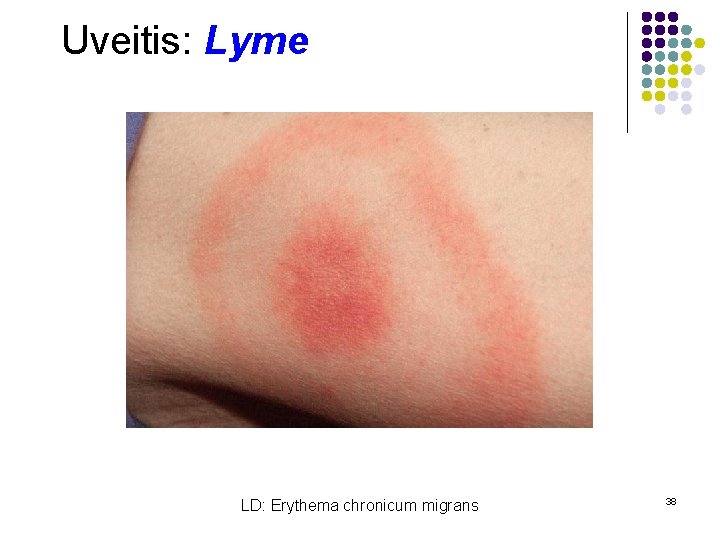
Uveitis: Lyme LD: Erythema chronicum migrans 38
Uveitis: Lyme Basics 1) The uveitis is profiled 2) The profiled case is meshed 3) A differential diagnosis list is generated 4) Studies are obtained to identify the etiology 5) Treatment appropriate for the etiology is initiated LD passes through three stages--what are they? How do they manifest? (2 -28 days post-inoculation) --The Local disease stage is characterized by…the appearance of erythema chronicum migrans at the bite site (1 -4 months post-inoculation) What is the classic appearance of the ECM rash? --The Disseminated disease stage is characterized by…hematogenous spread to different sites, That of a ‘bull’s eye’ including: --The skin Is it macular, papular, or maculopapular? --The heart Macular --The CNS --The joints --The eye (5+ months post-inoculation) --The Persistent disease stage is characterized by one of three patterns: ----Benign tertiary syphilis ----Cardiovascular syphilis ----Neurosyphilis
Uveitis: Lyme Basics 1) The uveitis is profiled 2) The profiled case is meshed 3) A differential diagnosis list is generated 4) Studies are obtained to identify the etiology 5) Treatment appropriate for the etiology is initiated LD passes through three stages--what are they? How do they manifest? (2 -28 days post-inoculation) --The Local disease stage is characterized by…the appearance of erythema chronicum migrans at the bite site (1 -4 months post-inoculation) What is the classic appearance of the ECM rash? --The Disseminated disease stage is characterized by…hematogenous spread to different sites, That of a ‘bull’s eye’ including: --The skin Is it macular, papular, or maculopapular? --The heart Macular --The CNS --The joints --The eye (5+ months post-inoculation) --The Persistent disease stage is characterized by one of three patterns: ----Benign tertiary syphilis ----Cardiovascular syphilis ----Neurosyphilis
Uveitis: Lyme Basics 1) The uveitis is profiled 2) The profiled case is meshed 3) A differential diagnosis list is generated 4) Studies are obtained to identify the etiology 5) Treatment appropriate for the etiology is initiated LD passes through three stages--what are they? How do they manifest? (2 -28 days post-inoculation) --The Local disease stage is characterized by…the appearance of erythema chronicum migrans at the bite site (1 -4 months post-inoculation) In addition to the ECM rash, what other signs/symptoms characterize this stage? --The Disseminated disease stage is characterized by…hematogenous spread malaise to different So-called ‘constitutional’ findings such as fever, fatigue, andsites, body aches including: --The skin --The heart --The CNS --The joints --The eye (5+ months post-inoculation) --The Persistent disease stage is characterized by one of three patterns: ----Benign tertiary syphilis ----Cardiovascular syphilis ----Neurosyphilis
Uveitis: Lyme Basics 1) The uveitis is profiled 2) The profiled case is meshed 3) A differential diagnosis list is generated 4) Studies are obtained to identify the etiology 5) Treatment appropriate for the etiology is initiated LD passes through three stages--what are they? How do they manifest? (2 -28 days post-inoculation) --The Local disease stage is characterized by…the appearance of erythema chronicum migrans at the bite site (1 -4 months post-inoculation) In addition to the ECM rash, what other signs/symptoms characterize this stage? --The Disseminated disease stage is characterized by…hematogenous spread malaise to different So-called ‘constitutional’ findings such as fever, fatigue, andsites, body aches including: --The skin --The heart --The CNS --The joints --The eye (5+ months post-inoculation) --The Persistent disease stage is characterized by one of three patterns: ----Benign tertiary syphilis ----Cardiovascular syphilis ----Neurosyphilis
Uveitis: Lyme Basics 1) The uveitis is profiled 2) The profiled case is meshed 3) A differential diagnosis list is generated 4) Studies are obtained to identify the etiology 5) Treatment appropriate for the etiology is initiated LD passes through three stages--what are they? How do they manifest? (2 -28 days post-inoculation) --The Local disease stage is characterized by…the appearance of erythema chronicum migrans at the bite site (1 -4 months post-inoculation) How much time typically passes between the bite and the Disseminated disease stage? --The Disseminated disease stage is characterized by…hematogenous spread to different sites, including: N --The skin e --The heart --The CNS x --The joints t --The eye (5+ months post-inoculation) Q patterns: --The Persistent disease stage is characterized by one of three ----Benign tertiary syphilis ----Cardiovascular syphilis ----Neurosyphilis
Uveitis: Lyme Basics 1) The uveitis is profiled 2) The profiled case is meshed 3) A differential diagnosis list is generated 4) Studies are obtained to identify the etiology 5) Treatment appropriate for the etiology is initiated LD passes through three stages--what are they? How do they manifest? (2 -28 days post-inoculation) --The Local disease stage is characterized by…the appearance of erythema chronicum migrans at the bite site (1 -4 months post-inoculation) The answer --The Disseminated disease stage is characterized by…hematogenous spread to different sites, including: --The skin --The heart --The CNS --The joints --The eye (5+ months post-inoculation) --The Persistent disease stage is characterized by one of three patterns: ----Benign tertiary syphilis ----Cardiovascular syphilis ----Neurosyphilis
Uveitis: Lyme Basics 1) The uveitis is profiled 2) The profiled case is meshed 3) A differential diagnosis list is generated 4) Studies are obtained to identify the etiology 5) Treatment appropriate for the etiology is initiated LD passes through three stages--what are they? How do they manifest? (2 -28 days post-inoculation) --The Local disease stage is characterized by…the appearance of erythema chronicum migrans at the bite site (1 -4 months post-inoculation) --The Disseminated disease stage is characterized by…hematogenous spread to different sites, including: --The skin N --The heart e --The CNS x --The joints --The eye t (5+ months post-inoculation) --The Persistent disease stage is characterized Q by one of three patterns: ----Benign tertiary syphilis ----Cardiovascular syphilis ----Neurosyphilis
Uveitis: Lyme Basics 1) The uveitis is profiled 2) The profiled case is meshed 3) A differential diagnosis list is generated 4) Studies are obtained to identify the etiology 5) Treatment appropriate for the etiology is initiated LD passes through three stages--what are they? How do they manifest? (2 -28 days post-inoculation) --The Local disease stage is characterized by…the appearance of erythema chronicum migrans at the bite site (1 -4 months post-inoculation) --The Disseminated disease stage is characterized by…hematogenous spread to different sites, including: --The skin --The heart --The CNS --The joints --The eye (5+ months post-inoculation) --The Persistent disease stage is characterized by one of three patterns: ----Benign tertiary syphilis ----Cardiovascular syphilis ----Neurosyphilis
Uveitis: Lyme Basics 1) The uveitis is profiled 2) The profiled case is meshed 3) A differential diagnosis list is generated 4) Studies are obtained to identify the etiology 5) Treatment appropriate for the etiology is initiated LD passes through three stages--what are they? How do they manifest? (2 -28 days post-inoculation) --The Local disease stage is characterized by…the appearance of erythema chronicum migrans at the bite site (1 -4 months post-inoculation) --The Disseminated disease stage is characterized by…hematogenous spread to different sites, including: --The skin --The heart --The CNS --The joints --The eye (5+ months post-inoculation) --The Persistent disease stage is characterized by one of three patterns: ----Benign tertiary syphilis ----Cardiovascular syphilis ----Neurosyphilis
Uveitis: Lyme Basics 1) The uveitis is profiled 2) The profiled case is meshed 3) A differential diagnosis list is generated 4) Studies are obtained to identify the etiology 5) Treatment appropriate for the etiology is initiated LD passes through three stages--what are they? How do they manifest? (2 -28 days post-inoculation) --The Local disease stage is characterized by…the appearance of erythema chronicum migrans at the bite site (1 -4 months post-inoculation) --The Disseminated disease stage is characterized by…hematogenous spread to different sites, including: What skin finding is typical at this stage? --The skin The appearance of ECM rash at locations remote from the bite site --The heart --The CNS --The joints --The eye (5+ months post-inoculation) --The Persistent disease stage is characterized by one of three patterns: ----Benign tertiary syphilis ----Cardiovascular syphilis ----Neurosyphilis
Uveitis: Lyme Basics 1) The uveitis is profiled 2) The profiled case is meshed 3) A differential diagnosis list is generated 4) Studies are obtained to identify the etiology 5) Treatment appropriate for the etiology is initiated LD passes through three stages--what are they? How do they manifest? (2 -28 days post-inoculation) --The Local disease stage is characterized by…the appearance of erythema chronicum migrans at the bite site (1 -4 months post-inoculation) --The Disseminated disease stage is characterized by…hematogenous spread to different sites, including: What skin finding is typical at this stage? --The skin The appearance of ECM rash at locations remote from the bite site --The heart --The CNS --The joints --The eye (5+ months post-inoculation) --The Persistent disease stage is characterized by one of three patterns: ----Benign tertiary syphilis ----Cardiovascular syphilis ----Neurosyphilis
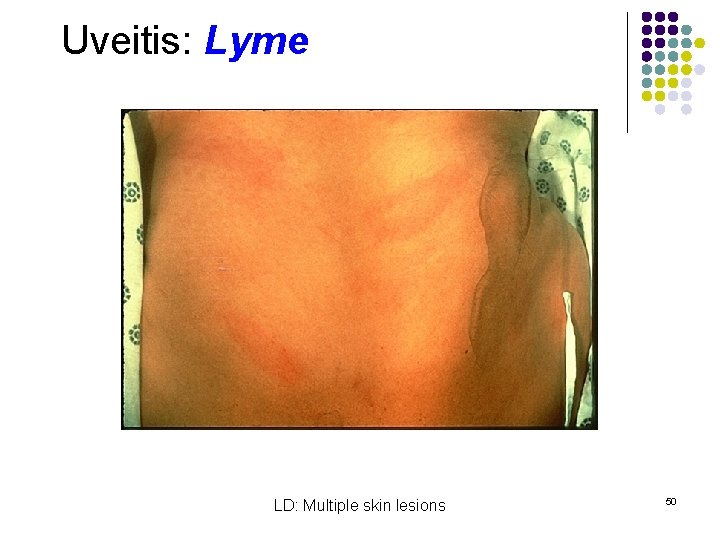
Uveitis: Lyme LD: Multiple skin lesions 50
Uveitis: Lyme Basics 1) The uveitis is profiled 2) The profiled case is meshed 3) A differential diagnosis list is generated 4) Studies are obtained to identify the etiology 5) Treatment appropriate for the etiology is initiated LD passes through three stages--what are they? How do they manifest? (2 -28 days post-inoculation) --The Local disease stage is characterized by…the appearance of erythema chronicum migrans at the bite site (1 -4 months post-inoculation) --The Disseminated disease stage is characterized by…hematogenous spread to different sites, including: How does cardiac involvement manifest? --The skin As a conduction problem --The heart --The CNS What should the OKAP/Boards examinee be on the lookout for? --The joints Signs/symptoms suggestive of conduction issues--syncope, irregular heartbeat, SOB --The eye (5+ months post-inoculation) If the examinee suspects cardiac involvement, what is the correct response? --The Persistent. Hospitalization disease stageon is characterized by(with one appropriate of three patterns: a telemetry unit consultations of course) ----Benign tertiary syphilis ----Cardiovascular syphilis ----Neurosyphilis
Uveitis: Lyme Basics 1) The uveitis is profiled 2) The profiled case is meshed 3) A differential diagnosis list is generated 4) Studies are obtained to identify the etiology 5) Treatment appropriate for the etiology is initiated LD passes through three stages--what are they? How do they manifest? (2 -28 days post-inoculation) --The Local disease stage is characterized by…the appearance of erythema chronicum migrans at the bite site (1 -4 months post-inoculation) --The Disseminated disease stage is characterized by…hematogenous spread to different sites, including: How does cardiac involvement manifest? --The skin As a conduction problem --The heart --The CNS What should the OKAP/Boards examinee be on the lookout for? --The joints Signs/symptoms suggestive of conduction issues--syncope, irregular heartbeat, SOB --The eye (5+ months post-inoculation) If the examinee suspects cardiac involvement, what is the correct response? --The Persistent. Hospitalization disease stageon is characterized by(with one appropriate of three patterns: a telemetry unit consultations of course) ----Benign tertiary syphilis ----Cardiovascular syphilis ----Neurosyphilis
Uveitis: Lyme Basics 1) The uveitis is profiled 2) The profiled case is meshed 3) A differential diagnosis list is generated 4) Studies are obtained to identify the etiology 5) Treatment appropriate for the etiology is initiated LD passes through three stages--what are they? How do they manifest? (2 -28 days post-inoculation) --The Local disease stage is characterized by…the appearance of erythema chronicum migrans at the bite site (1 -4 months post-inoculation) --The Disseminated disease stage is characterized by…hematogenous spread to different sites, including: How does cardiac involvement manifest? --The skin As a conduction problem --The heart --The CNS What should the OKAP/Boards examinee be on the lookout for? --The joints Signs/symptoms suggestive of conduction issues--syncope, irregular heartbeat, SOB --The eye (5+ months post-inoculation) If the examinee suspects cardiac involvement, what is the correct response? --The Persistent. Hospitalization disease stageon is characterized by(with one appropriate of three patterns: a telemetry unit consultations of course) ----Benign tertiary syphilis ----Cardiovascular syphilis ----Neurosyphilis
Uveitis: Lyme Basics 1) The uveitis is profiled 2) The profiled case is meshed 3) A differential diagnosis list is generated 4) Studies are obtained to identify the etiology 5) Treatment appropriate for the etiology is initiated LD passes through three stages--what are they? How do they manifest? (2 -28 days post-inoculation) --The Local disease stage is characterized by…the appearance of erythema chronicum migrans at the bite site (1 -4 months post-inoculation) --The Disseminated disease stage is characterized by…hematogenous spread to different sites, including: How does cardiac involvement manifest? --The skin As a conduction problem --The heart --The CNS What should the OKAP/Boards examinee be on the lookout for? --The joints Signs/symptoms suggestive of conduction issues--syncope, irregular heartbeat, SOB --The eye (5+ months post-inoculation) If the examinee suspects cardiac involvement, what is the correct response? --The Persistent. Hospitalization disease stageon is characterized by(with one appropriate of three patterns: a telemetry unit consultations of course) ----Benign tertiary syphilis ----Cardiovascular syphilis ----Neurosyphilis
Uveitis: Lyme Basics 1) The uveitis is profiled 2) The profiled case is meshed 3) A differential diagnosis list is generated 4) Studies are obtained to identify the etiology 5) Treatment appropriate for the etiology is initiated LD passes through three stages--what are they? How do they manifest? (2 -28 days post-inoculation) --The Local disease stage is characterized by…the appearance of erythema chronicum migrans at the bite site (1 -4 months post-inoculation) --The Disseminated disease stage is characterized by…hematogenous spread to different sites, including: How does cardiac involvement manifest? --The skin As a conduction problem --The heart --The CNS What should the OKAP/Boards examinee be on the lookout for? --The joints Signs/symptoms suggestive of conduction issues--syncope, irregular heartbeat, SOB --The eye (5+ months post-inoculation) If the examinee suspects cardiac involvement, what is the correct response? --The Persistent. Hospitalization disease stageon is characterized by(with one appropriate of three patterns: a telemetry unit consultations of course) ----Benign tertiary syphilis ----Cardiovascular syphilis ----Neurosyphilis
Uveitis: Lyme Basics 1) The uveitis is profiled 2) The profiled case is meshed 3) A differential diagnosis list is generated 4) Studies are obtained to identify the etiology 5) Treatment appropriate for the etiology is initiated LD passes through three stages--what are they? How do they manifest? (2 -28 days post-inoculation) --The Local disease stage is characterized by…the appearance of erythema chronicum migrans at the bite site (1 -4 months post-inoculation) --The Disseminated disease stage is characterized by…hematogenous spread to different sites, including: How does cardiac involvement manifest? --The skin As a conduction problem --The heart --The CNS What should the OKAP/Boards examinee be on the lookout for? --The joints Signs/symptoms suggestive of conduction issues--syncope, irregular heartbeat, SOB --The eye (5+ months post-inoculation) If the examinee suspects cardiac involvement, what is the correct response? --The Persistent. Hospitalization disease stageon is characterized by(with one appropriate of three patterns: a telemetry unit consultations of course) ----Benign tertiary syphilis ----Cardiovascular syphilis ----Neurosyphilis
Uveitis: Lyme Basics 1) The uveitis is profiled 2) The profiled case is meshed 3) A differential diagnosis list is generated 4) Studies are obtained to identify the etiology 5) Treatment appropriate for the etiology is initiated LD passes through three stages--what are they? How do they manifest? (2 -28 days post-inoculation) --The Local disease stage is characterized by…the appearance of erythema chronicum migrans at the bite site (1 -4 months post-inoculation) --The Disseminated disease stage is characterized by…hematogenous spread to different sites, including: Is CNS involvement common? --The skin Yes; as many as 40 % of LD pts will manifest neurologic findings --The heart --The CNS What neurologic findings are typical at this stage? --The joints --Meningitis --The eye --Encephalitis (5+ months post-inoculation) --Cranial nerve palsies --The Persistent disease stage is characterized by one of three patterns: ----Benign tertiary syphilis ----Cardiovascular syphilis ----Neurosyphilis
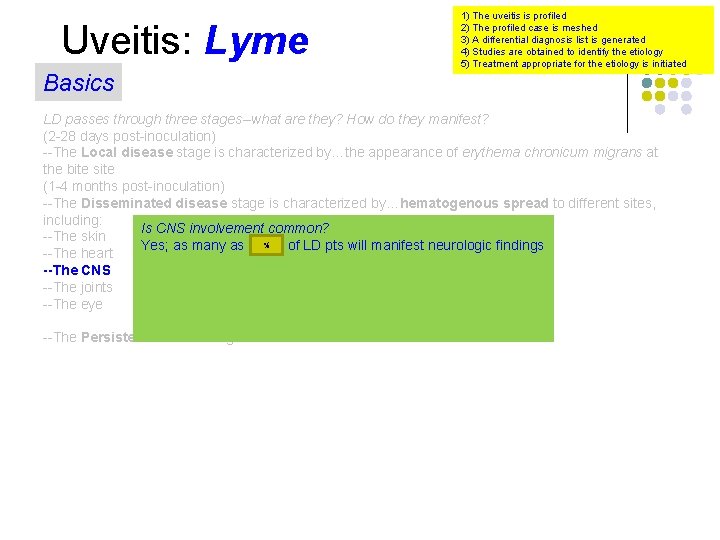
Uveitis: Lyme Basics 1) The uveitis is profiled 2) The profiled case is meshed 3) A differential diagnosis list is generated 4) Studies are obtained to identify the etiology 5) Treatment appropriate for the etiology is initiated LD passes through three stages--what are they? How do they manifest? (2 -28 days post-inoculation) --The Local disease stage is characterized by…the appearance of erythema chronicum migrans at the bite site (1 -4 months post-inoculation) --The Disseminated disease stage is characterized by…hematogenous spread to different sites, including: Is CNS involvement common? --The skin % Yes; as many as 40% of LD pts will manifest neurologic findings --The heart --The CNS What neurologic findings are typical at this stage? --The joints --Meningitis --The eye --Encephalitis (5+ months post-inoculation) --Cranial nerve palsies --The Persistent disease stage is characterized by one of three patterns: ----Benign tertiary syphilis ----Cardiovascular syphilis ----Neurosyphilis
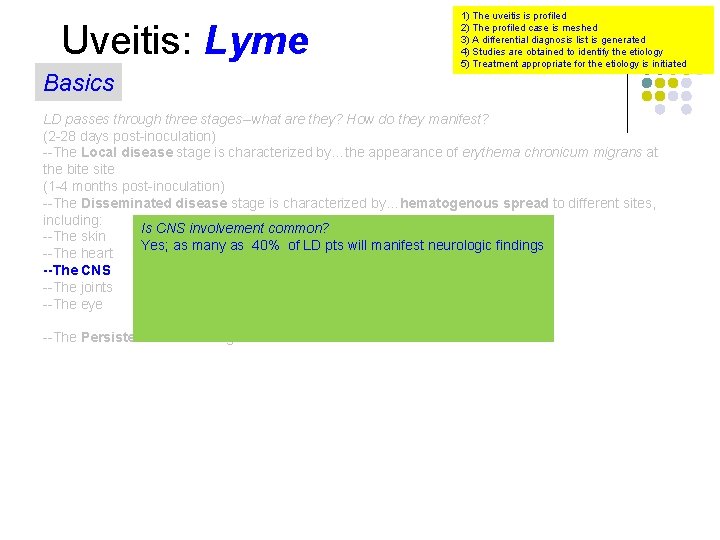
Uveitis: Lyme Basics 1) The uveitis is profiled 2) The profiled case is meshed 3) A differential diagnosis list is generated 4) Studies are obtained to identify the etiology 5) Treatment appropriate for the etiology is initiated LD passes through three stages--what are they? How do they manifest? (2 -28 days post-inoculation) --The Local disease stage is characterized by…the appearance of erythema chronicum migrans at the bite site (1 -4 months post-inoculation) --The Disseminated disease stage is characterized by…hematogenous spread to different sites, including: Is CNS involvement common? --The skin Yes; as many as 40% of LD pts will manifest neurologic findings --The heart --The CNS What neurologic findings are typical at this stage? --The joints --Meningitis --The eye --Encephalitis (5+ months post-inoculation) --Cranial nerve palsies --The Persistent disease stage is characterized by one of three patterns: ----Benign tertiary syphilis ----Cardiovascular syphilis ----Neurosyphilis
Uveitis: Lyme Basics 1) The uveitis is profiled 2) The profiled case is meshed 3) A differential diagnosis list is generated 4) Studies are obtained to identify the etiology 5) Treatment appropriate for the etiology is initiated LD passes through three stages--what are they? How do they manifest? (2 -28 days post-inoculation) --The Local disease stage is characterized by…the appearance of erythema chronicum migrans at the bite site (1 -4 months post-inoculation) --The Disseminated disease stage is characterized by…hematogenous spread to different sites, including: Is CNS involvement common? --The skin Yes; as many as 40% of LD pts will manifest neurologic findings --The heart --The CNS What neurologic findings are typical at this stage? --The joints --Meningitis --The eye --Encephalitis (5+ months post-inoculation) ----Cranial nerve palsies --The Persistent disease stage is characterized by one of three patterns: ----Benign tertiary syphilis ----Cardiovascular syphilis ----Neurosyphilis
Uveitis: Lyme Basics 1) The uveitis is profiled 2) The profiled case is meshed 3) A differential diagnosis list is generated 4) Studies are obtained to identify the etiology 5) Treatment appropriate for the etiology is initiated LD passes through three stages--what are they? How do they manifest? (2 -28 days post-inoculation) --The Local disease stage is characterized by…the appearance of erythema chronicum migrans at the bite site (1 -4 months post-inoculation) --The Disseminated disease stage is characterized by…hematogenous spread to different sites, including: Is CNS involvement common? --The skin Yes; as many as 40% of LD pts will manifest neurologic findings --The heart --The CNS What neurologic findings are typical at this stage? --The joints --Meningitis --The eye --Encephalitis (5+ months post-inoculation) --Cranial nerve palsies --The Persistent disease stage is characterized by one of three patterns: ----Benign tertiary syphilis ----Cardiovascular syphilis ----Neurosyphilis
Uveitis: Lyme Basics 1) The uveitis is profiled 2) The profiled case is meshed 3) A differential diagnosis list is generated 4) Studies are obtained to identify the etiology 5) Treatment appropriate for the etiology is initiated LD passes through three stages--what are they? How do they manifest? (2 -28 days post-inoculation) --The Local disease stage is characterized by…the appearance of erythema chronicum migrans at the bite site (1 -4 months post-inoculation) --The Disseminated disease stage is characterized by…hematogenous spread to different sites, including: Is joint involvement common? --The skin Yes; if left untreated, as many as 80% of LD pts will develop joint issues --The heart --The CNS Does LD tend to affect large joints, or small? --The joints Large --The eye (5+ months post-inoculation) Does it tend to affect multiple joints, or only a few? --The Persistent disease is characterized by one of three patterns: Few; in fact, stage it is often a monoarthritis ----Benign tertiary syphilis ----Cardiovascular syphilis Which joint is its ‘favorite’? ----Neurosyphilis The knee
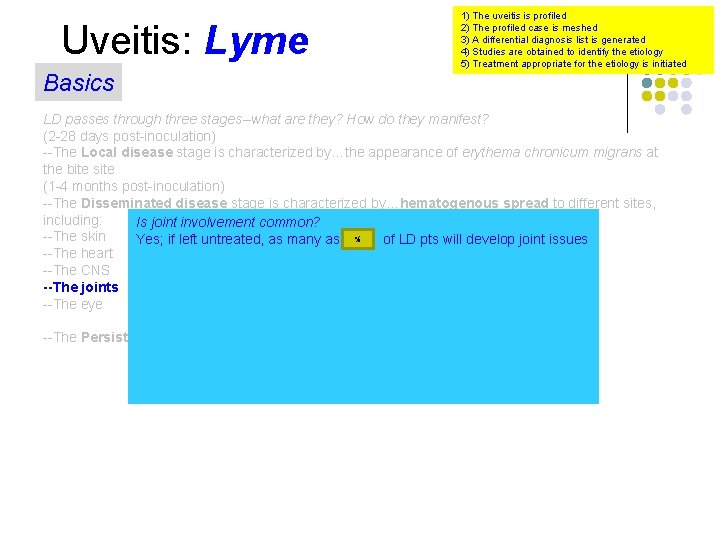
Uveitis: Lyme Basics 1) The uveitis is profiled 2) The profiled case is meshed 3) A differential diagnosis list is generated 4) Studies are obtained to identify the etiology 5) Treatment appropriate for the etiology is initiated LD passes through three stages--what are they? How do they manifest? (2 -28 days post-inoculation) --The Local disease stage is characterized by…the appearance of erythema chronicum migrans at the bite site (1 -4 months post-inoculation) --The Disseminated disease stage is characterized by…hematogenous spread to different sites, including: Is joint involvement common? --The skin % Yes; if left untreated, as many as 80% of LD pts will develop joint issues --The heart --The CNS Does LD tend to affect large joints, or small? --The joints Large --The eye (5+ months post-inoculation) Does it tend to affect multiple joints, or only a few? --The Persistent disease is characterized by one of three patterns: Few; in fact, stage it is often a monoarthritis ----Benign tertiary syphilis ----Cardiovascular syphilis Which joint is its ‘favorite’? ----Neurosyphilis The knee
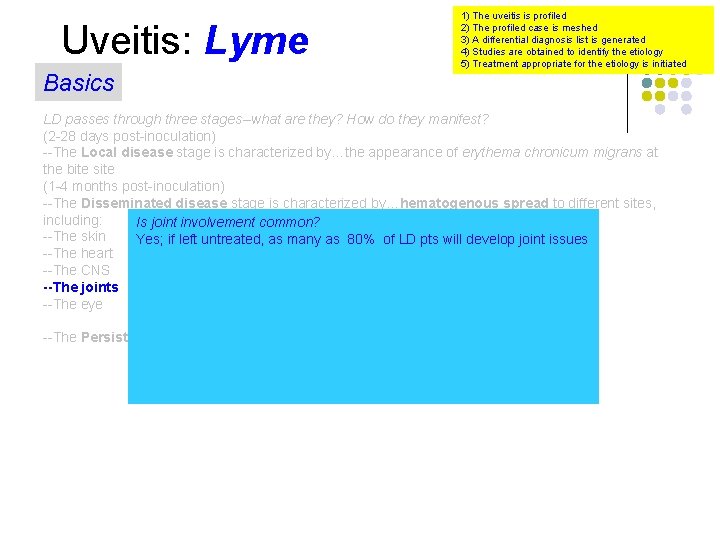
Uveitis: Lyme Basics 1) The uveitis is profiled 2) The profiled case is meshed 3) A differential diagnosis list is generated 4) Studies are obtained to identify the etiology 5) Treatment appropriate for the etiology is initiated LD passes through three stages--what are they? How do they manifest? (2 -28 days post-inoculation) --The Local disease stage is characterized by…the appearance of erythema chronicum migrans at the bite site (1 -4 months post-inoculation) --The Disseminated disease stage is characterized by…hematogenous spread to different sites, including: Is joint involvement common? --The skin Yes; if left untreated, as many as 80% of LD pts will develop joint issues --The heart --The CNS Does LD tend to affect large joints, or small? --The joints Large --The eye (5+ months post-inoculation) Does it tend to affect multiple joints, or only a few? --The Persistent disease is characterized by one of three patterns: Few; in fact, stage it is often a monoarthritis ----Benign tertiary syphilis ----Cardiovascular syphilis Which joint is its ‘favorite’? ----Neurosyphilis The knee
Uveitis: Lyme Basics 1) The uveitis is profiled 2) The profiled case is meshed 3) A differential diagnosis list is generated 4) Studies are obtained to identify the etiology 5) Treatment appropriate for the etiology is initiated LD passes through three stages--what are they? How do they manifest? (2 -28 days post-inoculation) --The Local disease stage is characterized by…the appearance of erythema chronicum migrans at the bite site (1 -4 months post-inoculation) --The Disseminated disease stage is characterized by…hematogenous spread to different sites, including: Is joint involvement common? --The skin Yes; if left untreated, as many as 80% of LD pts will develop joint issues --The heart --The CNS Does LD tend to affect large joints, or small? --The joints Large --The eye (5+ months post-inoculation) Does it tend to affect multiple joints, or only a few? --The Persistent disease is characterized by one of three patterns: Few; in fact, stage it is often a monoarthritis ----Benign tertiary syphilis ----Cardiovascular syphilis Which joint is its ‘favorite’? ----Neurosyphilis The knee
Uveitis: Lyme Basics 1) The uveitis is profiled 2) The profiled case is meshed 3) A differential diagnosis list is generated 4) Studies are obtained to identify the etiology 5) Treatment appropriate for the etiology is initiated LD passes through three stages--what are they? How do they manifest? (2 -28 days post-inoculation) --The Local disease stage is characterized by…the appearance of erythema chronicum migrans at the bite site (1 -4 months post-inoculation) --The Disseminated disease stage is characterized by…hematogenous spread to different sites, including: Is joint involvement common? --The skin Yes; if left untreated, as many as 80% of LD pts will develop joint issues --The heart --The CNS Does LD tend to affect large joints, or small? --The joints Large --The eye (5+ months post-inoculation) Does it tend to affect multiple joints, or only a few? --The Persistent disease is characterized by one of three patterns: Few; in fact, stage it is often a monoarthritis ----Benign tertiary syphilis ----Cardiovascular syphilis Which joint is its ‘favorite’? ----Neurosyphilis The knee
Uveitis: Lyme Basics 1) The uveitis is profiled 2) The profiled case is meshed 3) A differential diagnosis list is generated 4) Studies are obtained to identify the etiology 5) Treatment appropriate for the etiology is initiated LD passes through three stages--what are they? How do they manifest? (2 -28 days post-inoculation) --The Local disease stage is characterized by…the appearance of erythema chronicum migrans at the bite site (1 -4 months post-inoculation) --The Disseminated disease stage is characterized by…hematogenous spread to different sites, including: Is joint involvement common? --The skin Yes; if left untreated, as many as 80% of LD pts will develop joint issues --The heart --The CNS Does LD tend to affect large joints, or small? --The joints Large --The eye (5+ months post-inoculation) Does it tend to affect multiple joints, or only a few? --The Persistent disease is characterized by one of three patterns: Few; in fact, stage it is often a monoarthritis ----Benign tertiary syphilis ----Cardiovascular syphilis Which joint is its ‘favorite’? ----Neurosyphilis The knee
Uveitis: Lyme Basics 1) The uveitis is profiled 2) The profiled case is meshed 3) A differential diagnosis list is generated 4) Studies are obtained to identify the etiology 5) Treatment appropriate for the etiology is initiated LD passes through three stages--what are they? How do they manifest? (2 -28 days post-inoculation) --The Local disease stage is characterized by…the appearance of erythema chronicum migrans at the bite site (1 -4 months post-inoculation) --The Disseminated disease stage is characterized by…hematogenous spread to different sites, including: Is joint involvement common? --The skin Yes; if left untreated, as many as 80% of LD pts will develop joint issues --The heart --The CNS Does LD tend to affect large joints, or small? --The joints Large --The eye (5+ months post-inoculation) Does it tend to affect multiple joints, or only a few? --The Persistent disease is characterized by one of three patterns: Few; in fact, stage it is often a monoarthritis ----Benign tertiary syphilis ----Cardiovascular syphilis Which joint is its ‘favorite’? ----Neurosyphilis The knee
Uveitis: Lyme Basics 1) The uveitis is profiled 2) The profiled case is meshed 3) A differential diagnosis list is generated 4) Studies are obtained to identify the etiology 5) Treatment appropriate for the etiology is initiated LD passes through three stages--what are they? How do they manifest? (2 -28 days post-inoculation) --The Local disease stage is characterized by…the appearance of erythema chronicum migrans at the bite site (1 -4 months post-inoculation) --The Disseminated disease stage is characterized by…hematogenous spread to different sites, including: Is joint involvement common? --The skin Yes; if left untreated, as many as 80% of LD pts will develop joint issues --The heart --The CNS Does LD tend to affect large joints, or small? --The joints Large --The eye (5+ months post-inoculation) Does it tend to affect multiple joints, or only a few? --The Persistent disease is characterized by one of three patterns: Few; in fact, stage it is often a monoarthritis ----Benign tertiary syphilis ----Cardiovascular syphilis Which joint is its ‘favorite’? ----Neurosyphilis The knee
Uveitis: Lyme Basics 1) The uveitis is profiled 2) The profiled case is meshed 3) A differential diagnosis list is generated 4) Studies are obtained to identify the etiology 5) Treatment appropriate for the etiology is initiated LD passes through three stages--what are they? How do they manifest? (2 -28 days post-inoculation) --The Local disease stage is characterized by…the appearance of erythema chronicum migrans at the bite site (1 -4 months post-inoculation) --The Disseminated disease stage is characterized by…hematogenous spread to different sites, including: Is joint involvement common? --The skin Yes; if left untreated, as many as 80% of LD pts will develop joint issues --The heart --The CNS Does LD tend to affect large joints, or small? --The joints Large --The eye (5+ months post-inoculation) Does it tend to affect multiple joints, or only a few? --The Persistent disease is characterized by one of three patterns: Few; in fact, stage it is often a monoarthritis ----Benign tertiary syphilis ----Cardiovascular syphilis Which joint is its ‘favorite’? ----Neurosyphilis The knee
Uveitis: Lyme Basics 1) The uveitis is profiled 2) The profiled case is meshed 3) A differential diagnosis list is generated 4) Studies are obtained to identify the etiology 5) Treatment appropriate for the etiology is initiated LD passes through three stages--what are they? How do they manifest? (2 -28 days post-inoculation) --The Local disease stage is characterized by…the appearance of erythema chronicum migrans at the bite site (1 -4 months post-inoculation) --The Disseminated disease stage is characterized by…hematogenous spread to different sites, including: --The skin --The heart --The CNS --The joints --The eye in LD will be discussed in detail later in this slide-set! (5+ months post-inoculation) --The Persistent disease stage
1) The uveitis is profiled 2) The profiled case is meshed 3) A differential diagnosis list is generated 4) Studies are obtained to identify the etiology 5) Treatment appropriate for the etiology is initiated Uveitis: Lyme Basics LD passes through three stages--what are they? How do they manifest? (2 -28 days post-inoculation) --The Local disease stage is characterized by…the appearance of erythema chronicum migrans at the bite site (1 -4 months post-inoculation) --The Disseminated disease stage is characterized by…hematogenous spread to different sites, including: --The skin --The heart --The CNS --The joints --The eye How much time typically passes between the bite and the Persistent disease stage? (5+ months post-inoculation) --The Persistent disease stage N e x t Q
Uveitis: Lyme Basics 1) The uveitis is profiled 2) The profiled case is meshed 3) A differential diagnosis list is generated 4) Studies are obtained to identify the etiology 5) Treatment appropriate for the etiology is initiated LD passes through three stages--what are they? How do they manifest? (2 -28 days post-inoculation) --The Local disease stage is characterized by…the appearance of erythema chronicum migrans at the bite site (1 -4 months post-inoculation) --The Disseminated disease stage is characterized by…hematogenous spread to different sites, including: --The skin --The heart --The CNS --The joints --The eye (5+ months post-inoculation) The answer --The Persistent disease stage
1) The uveitis is profiled 2) The profiled case is meshed 3) A differential diagnosis list is generated 4) Studies are obtained to identify the etiology 5) Treatment appropriate for the etiology is initiated Uveitis: Lyme Basics LD passes through three stages--what are they? How do they manifest? (2 -28 days post-inoculation) --The Local disease stage is characterized by…the appearance of erythema chronicum migrans at the bite site (1 -4 months post-inoculation) --The Disseminated disease stage is characterized by…hematogenous spread to different sites, including: --The skin --The heart --The CNS --The joints --The eye (5+ months post-inoculation) --The Persistent disease stage is characterized by… N e x t Q
Uveitis: Lyme Basics 1) The uveitis is profiled 2) The profiled case is meshed 3) A differential diagnosis list is generated 4) Studies are obtained to identify the etiology 5) Treatment appropriate for the etiology is initiated LD passes through three stages--what are they? How do they manifest? (2 -28 days post-inoculation) --The Local disease stage is characterized by…the appearance of erythema chronicum migrans at the bite site (1 -4 months post-inoculation) --The Disseminated disease stage is characterized by…hematogenous spread to different sites, including: --The skin --The heart --The CNS --The joints --The eye (5+ months post-inoculation) --The Persistent disease stage is characterized by…episodic or even chronic arthritis.
Uveitis: Lyme Basics 1) The uveitis is profiled 2) The profiled case is meshed 3) A differential diagnosis list is generated 4) Studies are obtained to identify the etiology 5) Treatment appropriate for the etiology is initiated LD passes through three stages--what are they? How do they manifest? (2 -28 days post-inoculation) --The Local disease stage is characterized by…the appearance of erythema chronicum migrans at the bite site (1 -4 months post-inoculation) --The Disseminated disease stage is characterized by…hematogenous spread to different sites, including: --The skin --The heart --The CNS --The joints --The eye (5+ months post-inoculation) --The Persistent disease stage is characterized by…episodic or even chronic arthritis
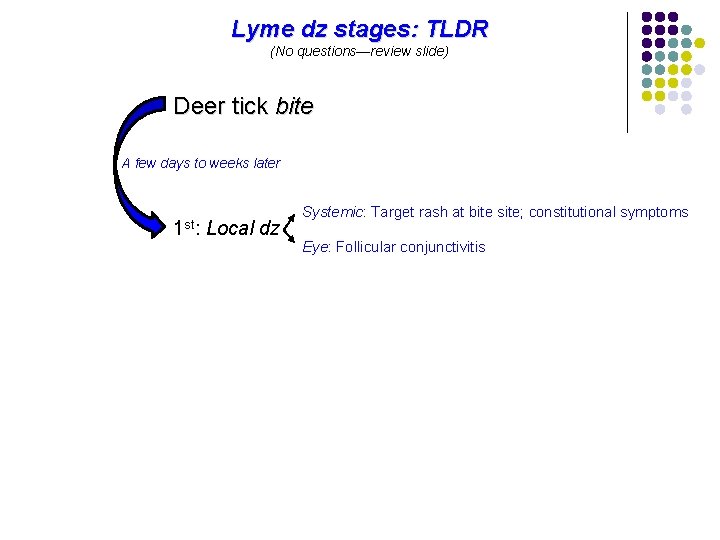
Lyme dz stages: TLDR (No questions—review slide) Deer tick bite A few days to weeks later 1 st: Local dz Systemic: Target rash at bite site; constitutional symptoms Eye: Follicular conjunctivitis
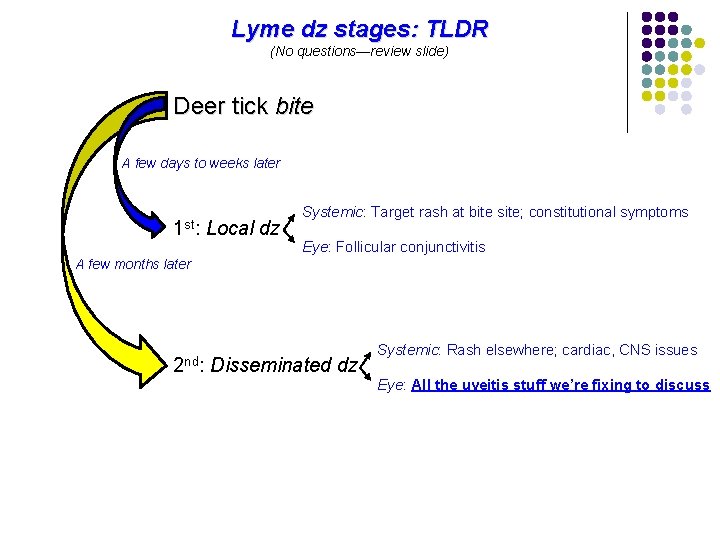
Lyme dz stages: TLDR (No questions—review slide) Deer tick bite A few days to weeks later 1 st: Local dz Systemic: Target rash at bite site; constitutional symptoms Eye: Follicular conjunctivitis A few months later 2 nd: Disseminated dz Systemic: Rash elsewhere; cardiac, CNS issues Eye: All the uveitis stuff we’re fixing to discuss
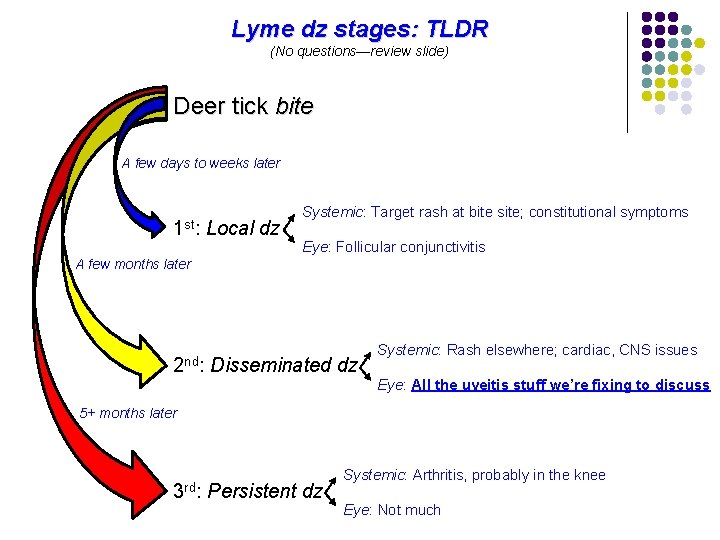
Lyme dz stages: TLDR (No questions—review slide) Deer tick bite A few days to weeks later 1 st: Local dz Systemic: Target rash at bite site; constitutional symptoms Eye: Follicular conjunctivitis A few months later 2 nd: Disseminated dz Systemic: Rash elsewhere; cardiac, CNS issues Eye: All the uveitis stuff we’re fixing to discuss 5+ months later 3 rd: Persistent dz Systemic: Arthritis, probably in the knee Eye: Not much
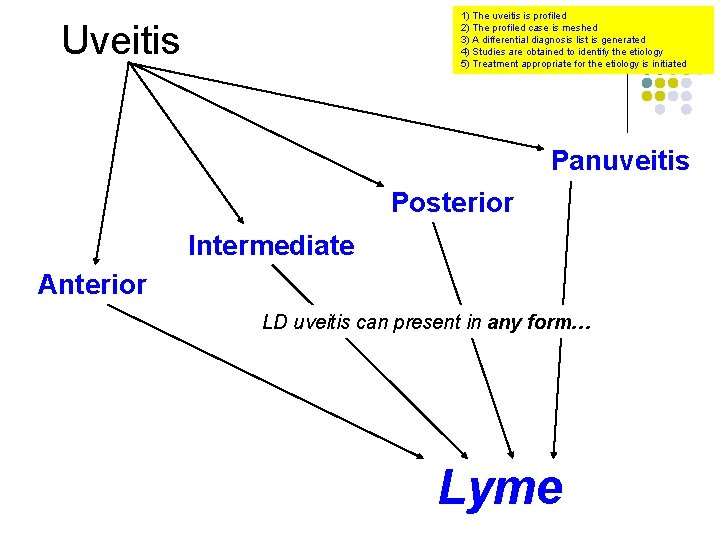
1) The uveitis is profiled 2) The profiled case is meshed 3) A differential diagnosis list is generated 4) Studies are obtained to identify the etiology 5) Treatment appropriate for the etiology is initiated Uveitis Panuveitis Posterior Intermediate Anterior LD uveitis can present in any form… Lyme
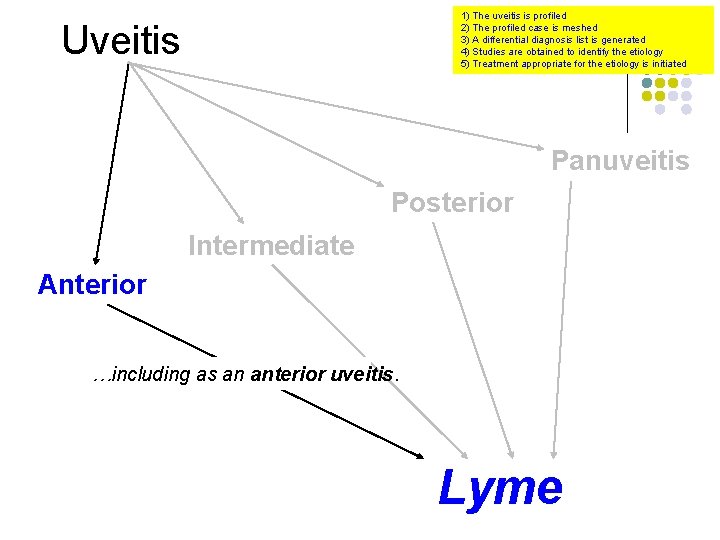
1) The uveitis is profiled 2) The profiled case is meshed 3) A differential diagnosis list is generated 4) Studies are obtained to identify the etiology 5) Treatment appropriate for the etiology is initiated Uveitis Panuveitis Posterior Intermediate Anterior …including as an anterior uveitis. Lyme
1) The uveitis is profiled 2) The profiled case is meshed 3) A differential diagnosis list is generated 4) Studies are obtained to identify the etiology 5) Treatment appropriate for the etiology is initiated Uveitis: Anterior ? ?
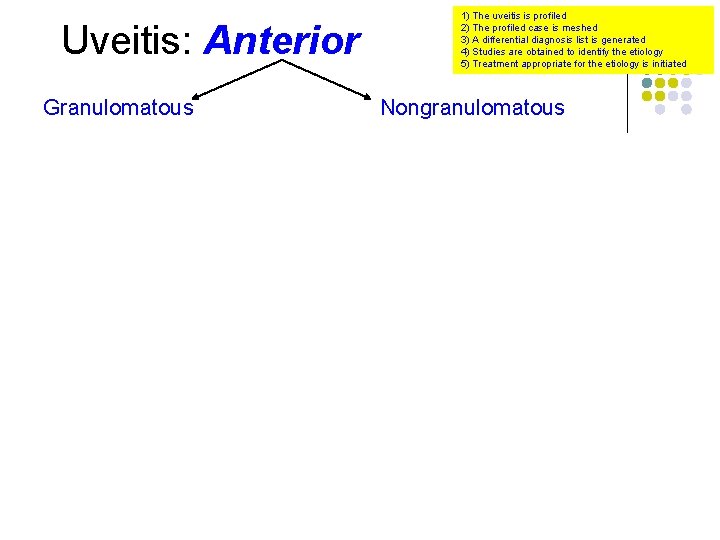
Uveitis: Anterior Granulomatous 1) The uveitis is profiled 2) The profiled case is meshed 3) A differential diagnosis list is generated 4) Studies are obtained to identify the etiology 5) Treatment appropriate for the etiology is initiated Nongranulomatous
Uveitis: Anterior Granulomatous 1) The uveitis is profiled 2) The profiled case is meshed 3) A differential diagnosis list is generated 4) Studies are obtained to identify the etiology 5) Treatment appropriate for the etiology is initiated Nongranulomatous ? ?
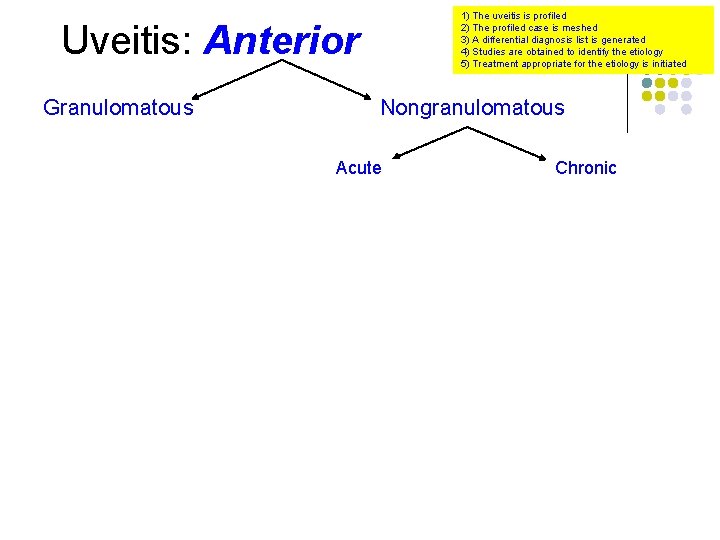
1) The uveitis is profiled 2) The profiled case is meshed 3) A differential diagnosis list is generated 4) Studies are obtained to identify the etiology 5) Treatment appropriate for the etiology is initiated Uveitis: Anterior Granulomatous Nongranulomatous Acute Chronic
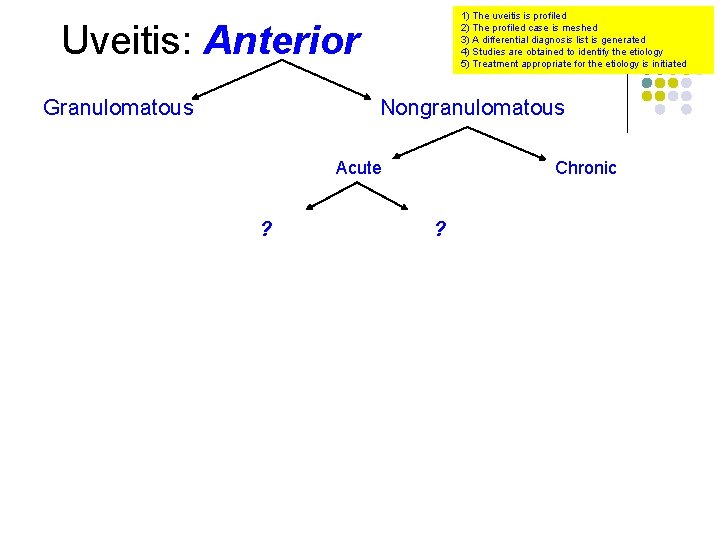
1) The uveitis is profiled 2) The profiled case is meshed 3) A differential diagnosis list is generated 4) Studies are obtained to identify the etiology 5) Treatment appropriate for the etiology is initiated Uveitis: Anterior Granulomatous Nongranulomatous Acute ? Chronic ?
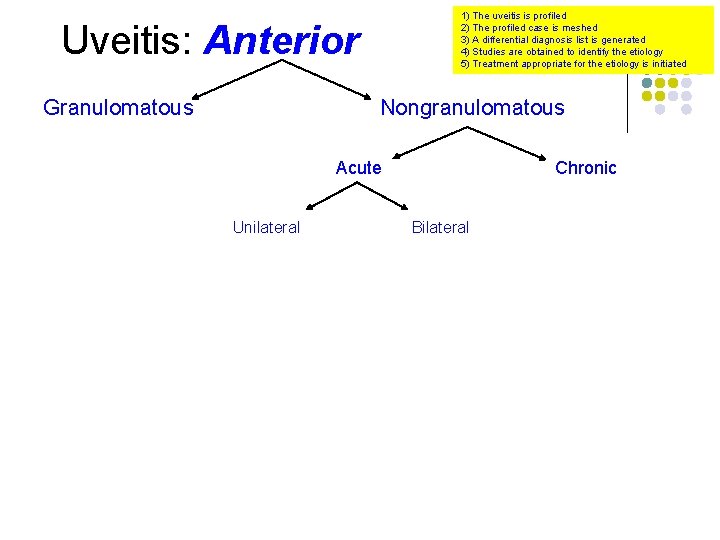
1) The uveitis is profiled 2) The profiled case is meshed 3) A differential diagnosis list is generated 4) Studies are obtained to identify the etiology 5) Treatment appropriate for the etiology is initiated Uveitis: Anterior Granulomatous Nongranulomatous Acute Unilateral Chronic Bilateral
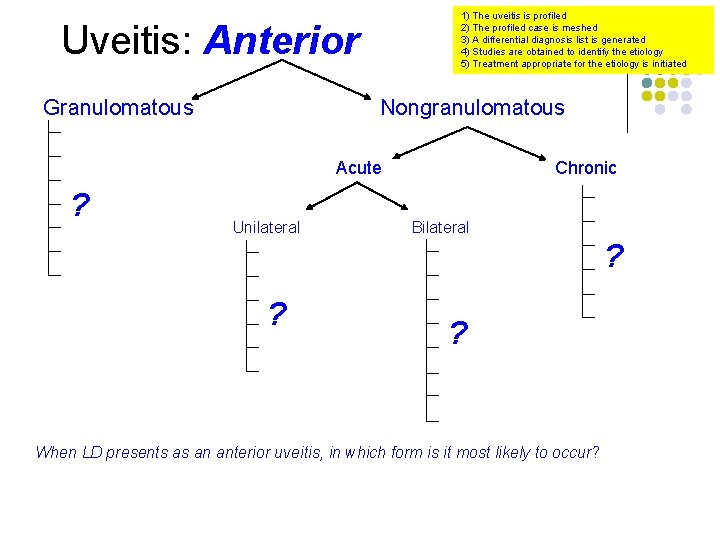
1) The uveitis is profiled 2) The profiled case is meshed 3) A differential diagnosis list is generated 4) Studies are obtained to identify the etiology 5) Treatment appropriate for the etiology is initiated Uveitis: Anterior Granulomatous Nongranulomatous Acute ? Unilateral Chronic Bilateral ? ? ? When LD presents as an anterior uveitis, in which form is it most likely to occur?
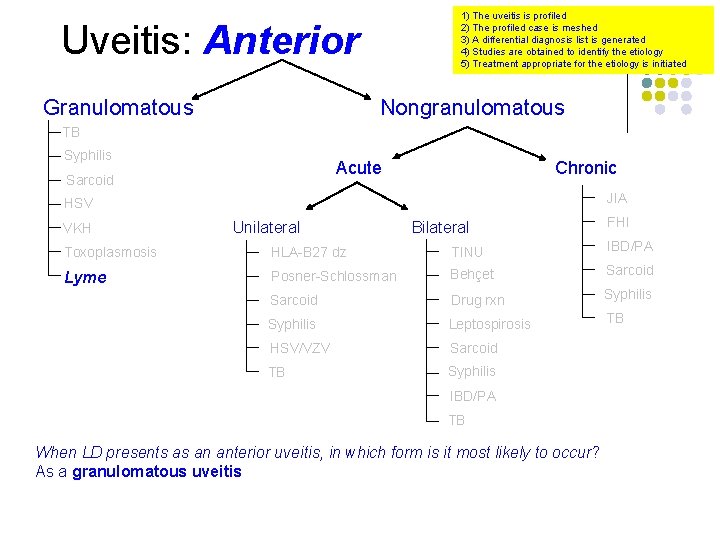
1) The uveitis is profiled 2) The profiled case is meshed 3) A differential diagnosis list is generated 4) Studies are obtained to identify the etiology 5) Treatment appropriate for the etiology is initiated Uveitis: Anterior Granulomatous Nongranulomatous TB Syphilis Acute Sarcoid Chronic JIA HSV VKH Unilateral Bilateral FHI Toxoplasmosis HLA-B 27 dz TINU IBD/PA Lyme Posner-Schlossman Behçet Sarcoid Drug rxn Syphilis Leptospirosis TB HSV/VZV Sarcoid TB Syphilis IBD/PA TB When LD presents as an anterior uveitis, in which form is it most likely to occur? As a granulomatous uveitis
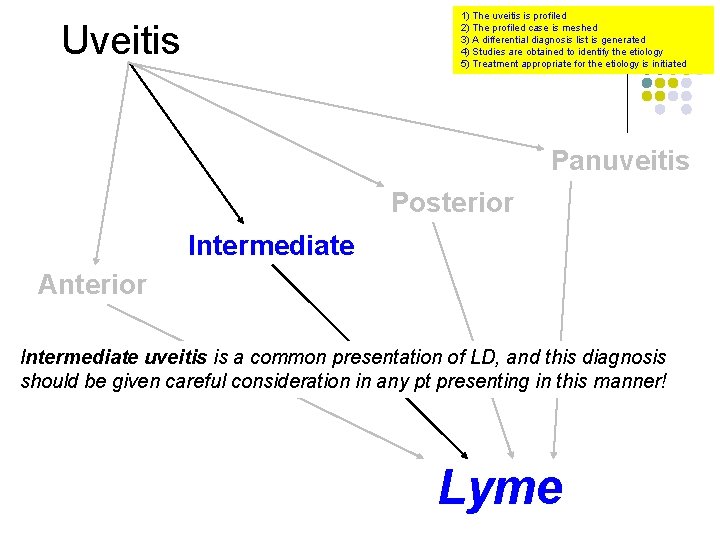
1) The uveitis is profiled 2) The profiled case is meshed 3) A differential diagnosis list is generated 4) Studies are obtained to identify the etiology 5) Treatment appropriate for the etiology is initiated Uveitis Panuveitis Posterior Intermediate Anterior Intermediate uveitis is a common presentation of LD, and this diagnosis should be given careful consideration in any pt presenting in this manner! Lyme
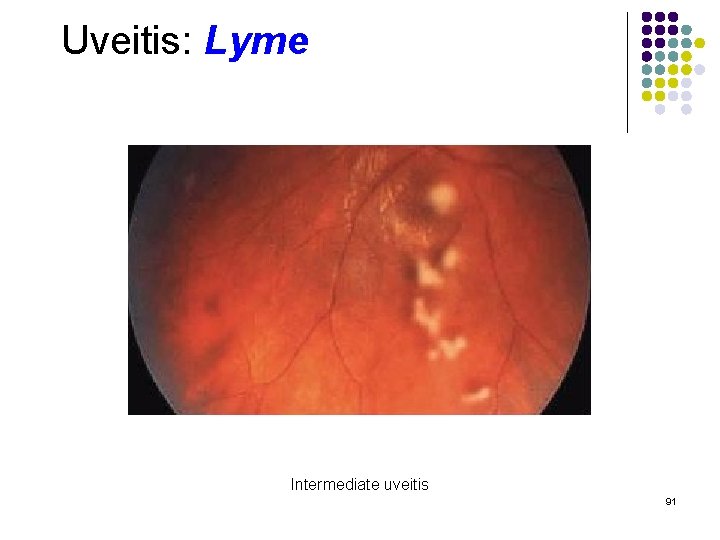
Uveitis: Lyme Intermediate uveitis 91
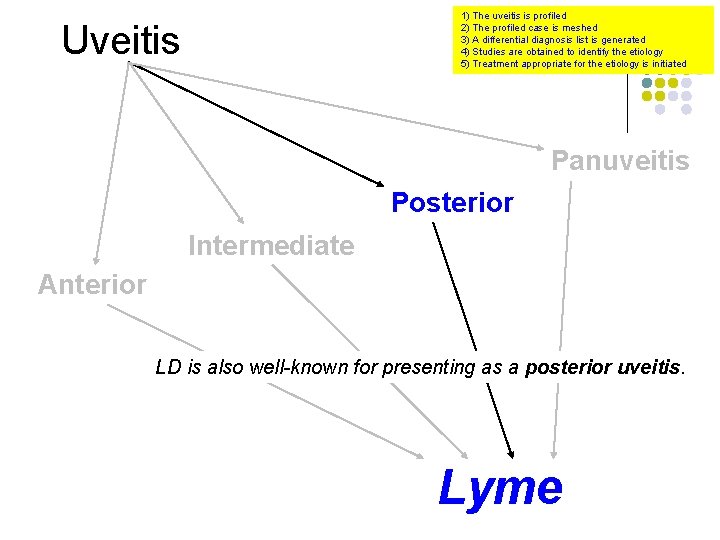
1) The uveitis is profiled 2) The profiled case is meshed 3) A differential diagnosis list is generated 4) Studies are obtained to identify the etiology 5) Treatment appropriate for the etiology is initiated Uveitis Panuveitis Posterior Intermediate Anterior LD is also well-known for presenting as a posterior uveitis. Lyme
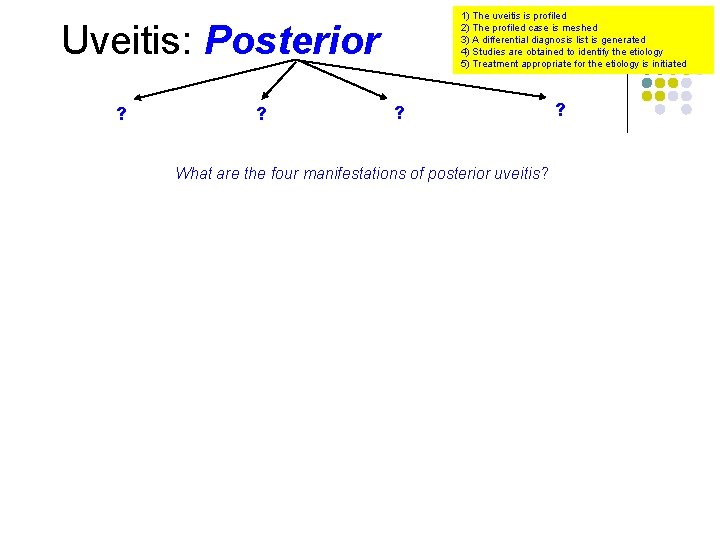
1) The uveitis is profiled 2) The profiled case is meshed 3) A differential diagnosis list is generated 4) Studies are obtained to identify the etiology 5) Treatment appropriate for the etiology is initiated Uveitis: Posterior ? ? ? What are the four manifestations of posterior uveitis? ?
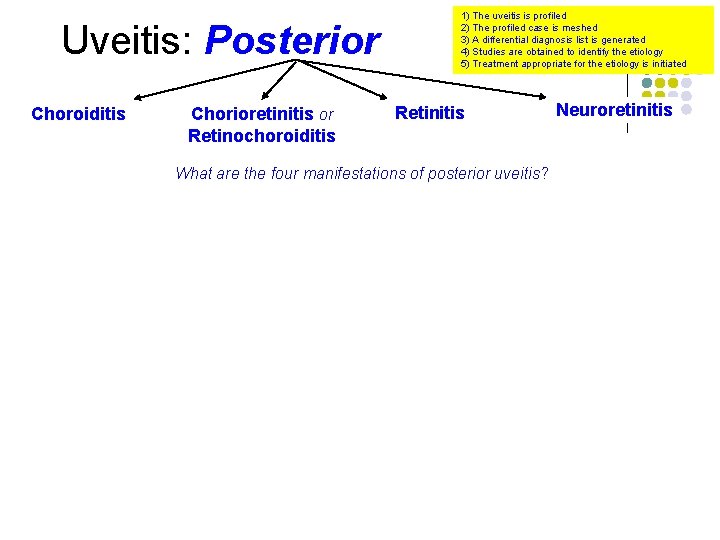
Uveitis: Posterior Choroiditis Chorioretinitis or Retinochoroiditis 1) The uveitis is profiled 2) The profiled case is meshed 3) A differential diagnosis list is generated 4) Studies are obtained to identify the etiology 5) Treatment appropriate for the etiology is initiated Retinitis What are the four manifestations of posterior uveitis? Neuroretinitis
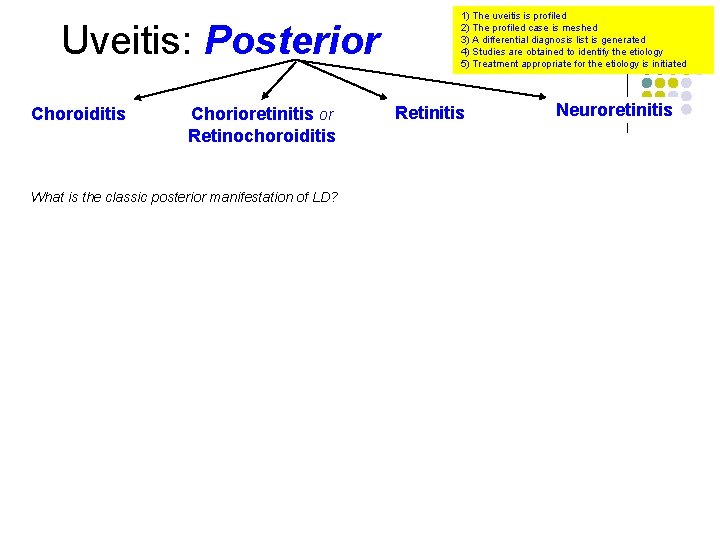
Uveitis: Posterior Choroiditis Chorioretinitis or Retinochoroiditis What is the classic posterior manifestation of LD? 1) The uveitis is profiled 2) The profiled case is meshed 3) A differential diagnosis list is generated 4) Studies are obtained to identify the etiology 5) Treatment appropriate for the etiology is initiated Retinitis Neuroretinitis
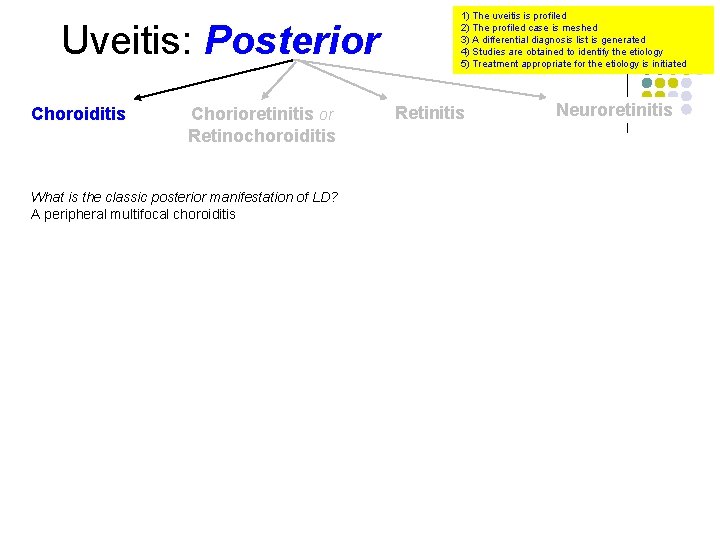
Uveitis: Posterior Choroiditis Chorioretinitis or Retinochoroiditis What is the classic posterior manifestation of LD? A peripheral multifocal choroiditis 1) The uveitis is profiled 2) The profiled case is meshed 3) A differential diagnosis list is generated 4) Studies are obtained to identify the etiology 5) Treatment appropriate for the etiology is initiated Retinitis Neuroretinitis
Uveitis: Posterior Choroiditis Chorioretinitis or Retinochoroiditis What is the classic posterior manifestation of LD? A peripheral multifocal choroiditis Are the lesions… …large, or small? 1) The uveitis is profiled 2) The profiled case is meshed 3) A differential diagnosis list is generated 4) Studies are obtained to identify the etiology 5) Treatment appropriate for the etiology is initiated Retinitis Neuroretinitis
Uveitis: Posterior Choroiditis Chorioretinitis or Retinochoroiditis What is the classic posterior manifestation of LD? A peripheral multifocal choroiditis Are the lesions… …large, or small? Small 1) The uveitis is profiled 2) The profiled case is meshed 3) A differential diagnosis list is generated 4) Studies are obtained to identify the etiology 5) Treatment appropriate for the etiology is initiated Retinitis Neuroretinitis
Uveitis: Posterior Choroiditis Chorioretinitis or Retinochoroiditis What is the classic posterior manifestation of LD? A peripheral multifocal choroiditis Are the lesions… …large, or small? Small …round, or irregular in shape? 1) The uveitis is profiled 2) The profiled case is meshed 3) A differential diagnosis list is generated 4) Studies are obtained to identify the etiology 5) Treatment appropriate for the etiology is initiated Retinitis Neuroretinitis
Uveitis: Posterior Choroiditis Chorioretinitis or Retinochoroiditis What is the classic posterior manifestation of LD? A peripheral multifocal choroiditis Are the lesions… …large, or small? Small …round, or irregular in shape? Round 1) The uveitis is profiled 2) The profiled case is meshed 3) A differential diagnosis list is generated 4) Studies are obtained to identify the etiology 5) Treatment appropriate for the etiology is initiated Retinitis Neuroretinitis
Uveitis: Posterior Choroiditis Chorioretinitis or Retinochoroiditis What is the classic posterior manifestation of LD? A peripheral multifocal choroiditis Are the lesions… …large, or small? Small …round, or irregular in shape? Round …intact, or ‘punched out’ in appearance? 1) The uveitis is profiled 2) The profiled case is meshed 3) A differential diagnosis list is generated 4) Studies are obtained to identify the etiology 5) Treatment appropriate for the etiology is initiated Retinitis Neuroretinitis
Uveitis: Posterior Choroiditis Chorioretinitis or Retinochoroiditis What is the classic posterior manifestation of LD? A peripheral multifocal choroiditis Are the lesions… …large, or small? Small …round, or irregular in shape? Round …intact, or ‘punched out’ in appearance? Punched out 1) The uveitis is profiled 2) The profiled case is meshed 3) A differential diagnosis list is generated 4) Studies are obtained to identify the etiology 5) Treatment appropriate for the etiology is initiated Retinitis Neuroretinitis
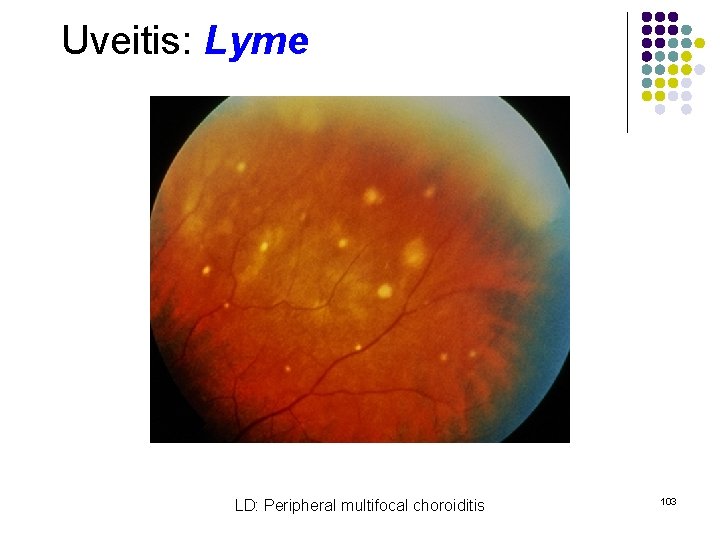
Uveitis: Lyme LD: Peripheral multifocal choroiditis 103
Uveitis: Posterior Choroiditis Chorioretinitis or Retinochoroiditis 1) The uveitis is profiled 2) The profiled case is meshed 3) A differential diagnosis list is generated 4) Studies are obtained to identify the etiology 5) Treatment appropriate for the etiology is initiated Retinitis Neuroretinitis What is the classic posterior manifestation of LD? A peripheral multifocal choroiditis Are the lesions… …large, or small? Small …round, or irregular in shape? Round …intact, or ‘punched out’ in appearance? Punched out In addition to choroiditis, in what other manner does LD posterior uveitis often manifest?
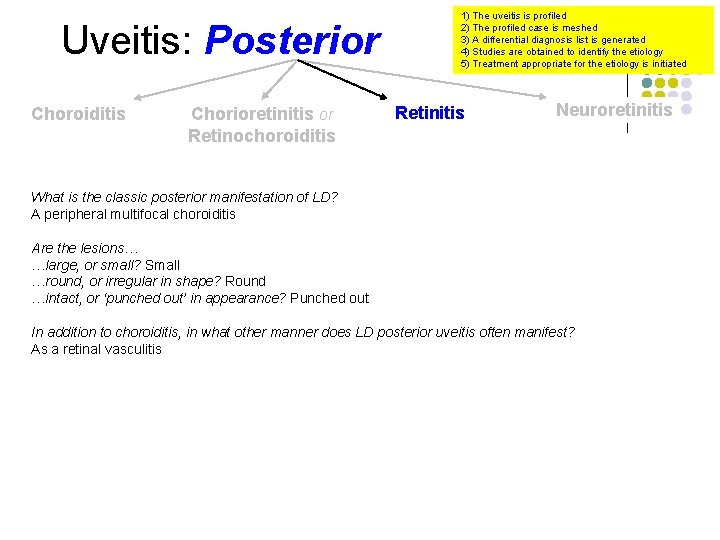
Uveitis: Posterior Choroiditis Chorioretinitis or Retinochoroiditis 1) The uveitis is profiled 2) The profiled case is meshed 3) A differential diagnosis list is generated 4) Studies are obtained to identify the etiology 5) Treatment appropriate for the etiology is initiated Retinitis Neuroretinitis What is the classic posterior manifestation of LD? A peripheral multifocal choroiditis Are the lesions… …large, or small? Small …round, or irregular in shape? Round …intact, or ‘punched out’ in appearance? Punched out In addition to choroiditis, in what other manner does LD posterior uveitis often manifest? As a retinal vasculitis
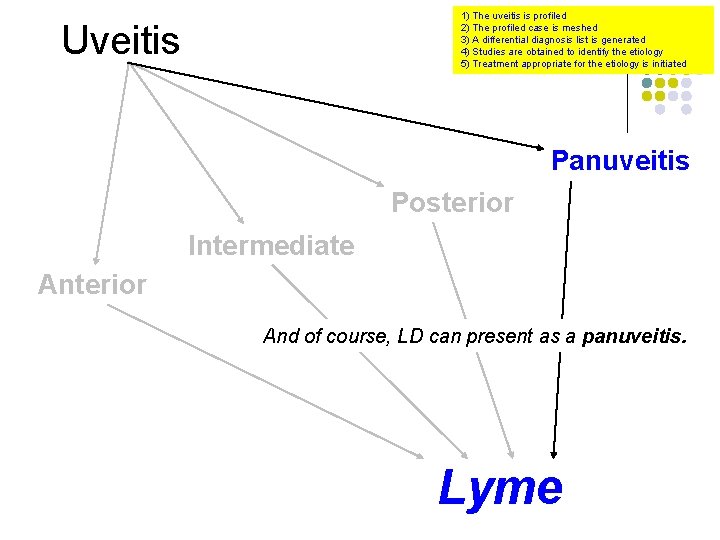
1) The uveitis is profiled 2) The profiled case is meshed 3) A differential diagnosis list is generated 4) Studies are obtained to identify the etiology 5) Treatment appropriate for the etiology is initiated Uveitis Panuveitis Posterior Intermediate Anterior And of course, LD can present as a panuveitis. Lyme
Uveitis: Lyme Neuro-Ophthalmic Manifestations 1) The uveitis is profiled 2) The profiled case is meshed 3) A differential diagnosis list is generated 4) Studies are obtained to identify the etiology 5) Treatment appropriate for the etiology is initiated What neuro-ophthalmic condition is LD notorious for (it was alluded to an earlier)?
Uveitis: Lyme Neuro-Ophthalmic Manifestations 1) The uveitis is profiled 2) The profiled case is meshed 3) A differential diagnosis list is generated 4) Studies are obtained to identify the etiology 5) Treatment appropriate for the etiology is initiated What neuro-ophthalmic condition is LD notorious for (it was alluded to an earlier)? Cranial nerve (CN) palsies
Uveitis: Lyme Neuro-Ophthalmic Manifestations 1) The uveitis is profiled 2) The profiled case is meshed 3) A differential diagnosis list is generated 4) Studies are obtained to identify the etiology 5) Treatment appropriate for the etiology is initiated What neuro-ophthalmic condition is LD notorious for (it was alluded to an earlier)? Cranial nerve (CN) palsies Of the CNs affecting the eye (ie, II - VII), which can be involved?
Uveitis: Lyme Neuro-Ophthalmic Manifestations 1) The uveitis is profiled 2) The profiled case is meshed 3) A differential diagnosis list is generated 4) Studies are obtained to identify the etiology 5) Treatment appropriate for the etiology is initiated What neuro-ophthalmic condition is LD notorious for (it was alluded to an earlier)? Cranial nerve (CN) palsies Of the CNs affecting the eye (ie, II - VII), which can be involved? Any/all of them
Uveitis: Lyme Neuro-Ophthalmic Manifestations 1) The uveitis is profiled 2) The profiled case is meshed 3) A differential diagnosis list is generated 4) Studies are obtained to identify the etiology 5) Treatment appropriate for the etiology is initiated What neuro-ophthalmic condition is LD notorious for (it was alluded to an earlier)? Cranial nerve (CN) palsies Of the CNs affecting the eye (ie, II - VII), which can be involved? Any/all of them Of CNs II - VII, which is most likely to be affected?
Uveitis: Lyme Neuro-Ophthalmic Manifestations 1) The uveitis is profiled 2) The profiled case is meshed 3) A differential diagnosis list is generated 4) Studies are obtained to identify the etiology 5) Treatment appropriate for the etiology is initiated What neuro-ophthalmic condition is LD notorious for (it was alluded to an earlier)? Cranial nerve (CN) palsies Of the CNs affecting the eye (ie, II - VII), which can be involved? Any/all of them Of CNs II - VII, which is most likely to be affected? CN VII
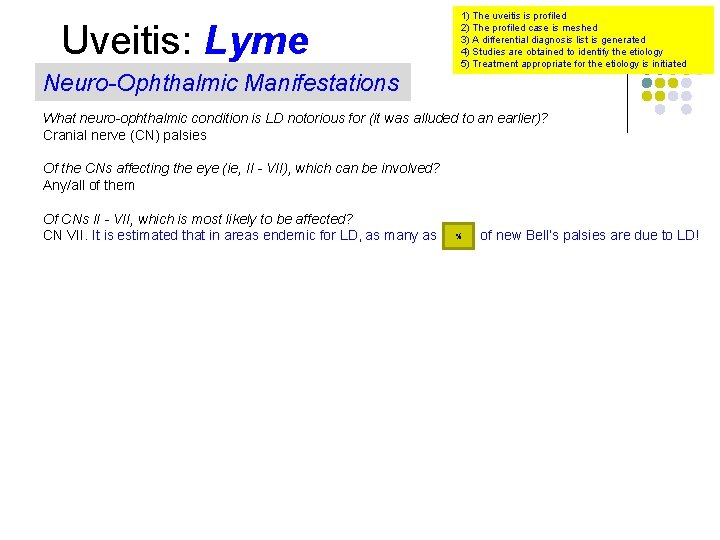
Uveitis: Lyme Neuro-Ophthalmic Manifestations 1) The uveitis is profiled 2) The profiled case is meshed 3) A differential diagnosis list is generated 4) Studies are obtained to identify the etiology 5) Treatment appropriate for the etiology is initiated What neuro-ophthalmic condition is LD notorious for (it was alluded to an earlier)? Cranial nerve (CN) palsies Of the CNs affecting the eye (ie, II - VII), which can be involved? Any/all of them Of CNs II - VII, which is most likely to be affected? % CN VII. It is estimated that in areas endemic for LD, as many as 25% of new Bell’s palsies are due to LD!
Uveitis: Lyme Neuro-Ophthalmic Manifestations 1) The uveitis is profiled 2) The profiled case is meshed 3) A differential diagnosis list is generated 4) Studies are obtained to identify the etiology 5) Treatment appropriate for the etiology is initiated What neuro-ophthalmic condition is LD notorious for (it was alluded to an earlier)? Cranial nerve (CN) palsies Of the CNs affecting the eye (ie, II - VII), which can be involved? Any/all of them Of CNs II - VII, which is most likely to be affected? CN VII. It is estimated that in areas endemic for LD, as many as 25% of new Bell’s palsies are due to LD!
Uveitis: Lyme Neuro-Ophthalmic Manifestations 1) The uveitis is profiled 2) The profiled case is meshed 3) A differential diagnosis list is generated 4) Studies are obtained to identify the etiology 5) Treatment appropriate for the etiology is initiated What neuro-ophthalmic condition is LD notorious for (it was alluded to an earlier)? Cranial nerve (CN) palsies Of the CNs affecting the eye (ie, II - VII), which can be involved? Any/all of them Of CNs II - VII, which is most likely to be affected? CN VII. It is estimated that in areas endemic for LD, as many as 25% of new Bell’s palsies are due to LD! Does LD Bell’s palsy present unilaterally, or bilaterally?
Uveitis: Lyme Neuro-Ophthalmic Manifestations 1) The uveitis is profiled 2) The profiled case is meshed 3) A differential diagnosis list is generated 4) Studies are obtained to identify the etiology 5) Treatment appropriate for the etiology is initiated What neuro-ophthalmic condition is LD notorious for (it was alluded to an earlier)? Cranial nerve (CN) palsies Of the CNs affecting the eye (ie, II - VII), which can be involved? Any/all of them Of CNs II - VII, which is most likely to be affected? CN VII. It is estimated that in areas endemic for LD, as many as 25% of new Bell’s palsies are due to LD! Does LD Bell’s palsy present unilaterally, or bilaterally? It can present either way
Uveitis: Lyme Neuro-Ophthalmic Manifestations 1) The uveitis is profiled 2) The profiled case is meshed 3) A differential diagnosis list is generated 4) Studies are obtained to identify the etiology 5) Treatment appropriate for the etiology is initiated What neuro-ophthalmic condition is LD notorious for (it was alluded to an earlier)? Cranial nerve (CN) palsies Of the CNs affecting the eye (ie, II - VII), which can be involved? Any/all of them Of CNs II - VII, which is most likely to be affected? CN VII. It is estimated that in areas endemic for LD, as many as 25% of new Bell’s palsies are due to LD! Does LD Bell’s palsy present unilaterally, or bilaterally? It can present either way In what ways can the optic nerve be affected? ---
Uveitis: Lyme Neuro-Ophthalmic Manifestations 1) The uveitis is profiled 2) The profiled case is meshed 3) A differential diagnosis list is generated 4) Studies are obtained to identify the etiology 5) Treatment appropriate for the etiology is initiated What neuro-ophthalmic condition is LD notorious for (it was alluded to an earlier)? Cranial nerve (CN) palsies Of the CNs affecting the eye (ie, II - VII), which can be involved? Any/all of them Of CNs II - VII, which is most likely to be affected? CN VII. It is estimated that in areas endemic for LD, as many as 25% of new Bell’s palsies are due to LD! Does LD Bell’s palsy present unilaterally, or bilaterally? It can present either way In what ways can the optic nerve be affected? --An optic neuritis can occur --If ICP increases because of a meningitic/encephalitic process, papilledema may be present
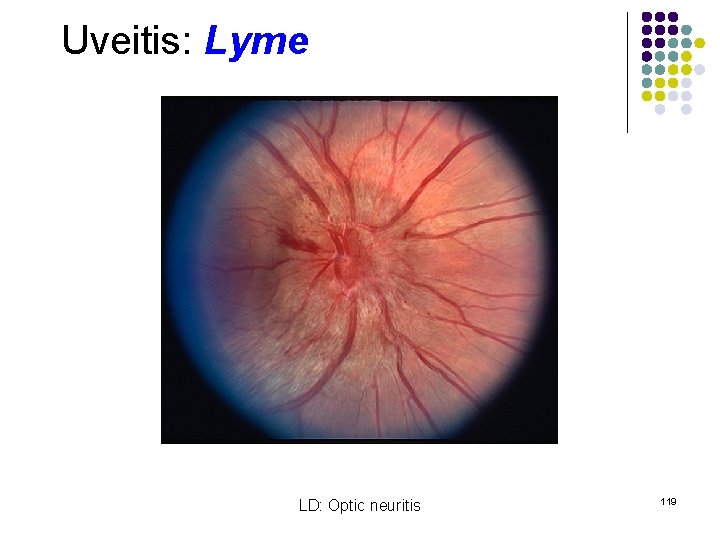
Uveitis: Lyme LD: Optic neuritis 119
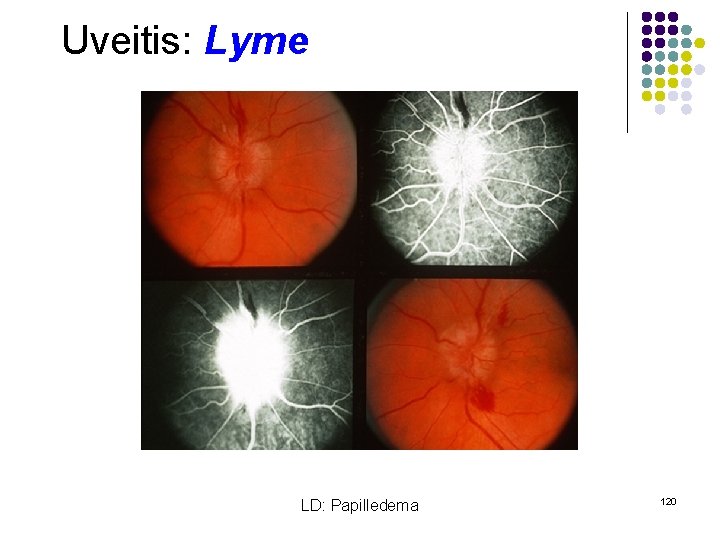
Uveitis: Lyme LD: Papilledema 120
Uveitis: Lyme Diagnosis How is the diagnosis of LD made? 1) The uveitis is profiled 2) The profiled case is meshed 3) A differential diagnosis list is generated 4) Studies are obtained to identify the etiology 5) Treatment appropriate for the etiology is initiated
Uveitis: Lyme Diagnosis 1) The uveitis is profiled 2) The profiled case is meshed 3) A differential diagnosis list is generated 4) Studies are obtained to identify the etiology 5) Treatment appropriate for the etiology is initiated How is the diagnosis of LD made? The diagnosis can be made clinically (eg, the presence of ECM is considered diagnostic in the proper clinical setting). The diagnosis can also be made serologically, but this can be challenging, as there is a lack of consensus concerning what lab values should be considered positive.
Uveitis: Lyme Diagnosis 1) The uveitis is profiled 2) The profiled case is meshed 3) A differential diagnosis list is generated 4) Studies are obtained to identify the etiology 5) Treatment appropriate for the etiology is initiated How is the diagnosis of LD made? The diagnosis can be made clinically (eg, the presence of ECM is considered diagnostic in the proper clinical setting). The diagnosis can also be made serologically, but this can be challenging, as there is a lack of consensus concerning what lab values should be considered positive. The CDC recommends ELISA testing for Ig levels, followed by Western blot testing.
Uveitis: Lyme Diagnosis 1) The uveitis is profiled 2) The profiled case is meshed 3) A differential diagnosis list is generated 4) Studies are obtained to identify the etiology 5) Treatment appropriate for the etiology is initiated How is the diagnosis of LD made? The diagnosis can be made clinically (eg, the presence of ECM is considered diagnostic in the proper clinical setting). The diagnosis can also be made serologically, but this can be challenging, as there is a lack of consensus concerning what lab values should be considered positive. The CDC recommends ELISA testing for Ig levels, followed by Western blot testing. Treatment How is LD treated?
Uveitis: Lyme Diagnosis 1) The uveitis is profiled 2) The profiled case is meshed 3) A differential diagnosis list is generated 4) Studies are obtained to identify the etiology 5) Treatment appropriate for the etiology is initiated How is the diagnosis of LD made? The diagnosis can be made clinically (eg, the presence of ECM is considered diagnostic in the proper clinical setting). The diagnosis can also be made serologically, but this can be challenging, as there is a lack of consensus concerning what lab values should be considered positive. The CDC recommends ELISA testing for Ig levels, followed by Western blot testing. Treatment How is LD treated? Treatment depends upon the stage of disease, and what organ-systems are involved
Uveitis: Lyme Diagnosis 1) The uveitis is profiled 2) The profiled case is meshed 3) A differential diagnosis list is generated 4) Studies are obtained to identify the etiology 5) Treatment appropriate for the etiology is initiated How is the diagnosis of LD made? The diagnosis can be made clinically (eg, the presence of ECM is considered diagnostic in the proper clinical setting). The diagnosis can also be made serologically, but this can be challenging, as there is a lack of consensus concerning what lab values should be considered positive. The CDC recommends ELISA testing for Ig levels, followed by Western blot testing. Treatment How is LD treated? Treatment depends upon the stage of disease, and what organ-systems are involved OK, how should LD uveitis be treated?
Uveitis: Lyme Diagnosis 1) The uveitis is profiled 2) The profiled case is meshed 3) A differential diagnosis list is generated 4) Studies are obtained to identify the etiology 5) Treatment appropriate for the etiology is initiated How is the diagnosis of LD made? The diagnosis can be made clinically (eg, the presence of ECM is considered diagnostic in the proper clinical setting). The diagnosis can also be made serologically, but this can be challenging, as there is a lack of consensus concerning what lab values should be considered positive. The CDC recommends ELISA testing for Ig levels, followed by Western blot testing. Treatment How is LD treated? Treatment depends upon the stage of disease, and what organ-systems are involved OK, how should LD uveitis be treated? As with syphilitic uveitis, the presence of intraocular inflammation in the context of LD should be considered presumptive evidence of CNS involvement, and thus LD uveitis should be managed as suspected CNS LD
Uveitis: Lyme Diagnosis 1) The uveitis is profiled 2) The profiled case is meshed 3) A differential diagnosis list is generated 4) Studies are obtained to identify the etiology 5) Treatment appropriate for the etiology is initiated How is the diagnosis of LD made? The diagnosis can be made clinically (eg, the presence of ECM is considered diagnostic in the proper clinical setting). The diagnosis can also be made serologically, but this can be challenging, as there is a lack of consensus concerning what lab values should be considered positive. The CDC recommends ELISA testing for Ig levels, followed by Western blot testing. Treatment How is LD treated? Treatment depends upon the stage of disease, and what organ-systems are involved OK, how should LD uveitis be treated? As with syphilitic uveitis, the presence of intraocular inflammation in the context of LD should be considered presumptive evidence of CNS involvement, and thus LD uveitis should be managed as suspected CNS LD How is suspected CNS LD managed?
Uveitis: Lyme Diagnosis 1) The uveitis is profiled 2) The profiled case is meshed 3) A differential diagnosis list is generated 4) Studies are obtained to identify the etiology 5) Treatment appropriate for the etiology is initiated How is the diagnosis of LD made? The diagnosis can be made clinically (eg, the presence of ECM is considered diagnostic in the proper clinical setting). The diagnosis can also be made serologically, but this can be challenging, as there is a lack of consensus concerning what lab values should be considered positive. The CDC recommends ELISA testing for Ig levels, followed by Western blot testing. Treatment How is LD treated? Treatment depends upon the stage of disease, and what organ-systems are involved OK, how should LD uveitis be treated? As with syphilitic uveitis, the presence of intraocular inflammation in the context of LD should be considered presumptive evidence of CNS involvement, and thus LD uveitis should be managed as suspected CNS LD How is suspected CNS LD managed? LP with CSF studies should be performed to confirm the diagnosis. If CNS involvement is confirmed, IV ceftriaxone should be administered per protocol
Uveitis: Lyme Diagnosis 1) The uveitis is profiled 2) The profiled case is meshed 3) A differential diagnosis list is generated 4) Studies are obtained to identify the etiology 5) Treatment appropriate for the etiology is initiated How is the diagnosis of LD made? The diagnosis can be made clinically (eg, the presence of ECM is considered diagnostic in the proper clinical setting). The diagnosis can also be made serologically, but this can be challenging, as there is a lack of consensus concerning what lab values should be considered positive. The CDC recommends ELISA testing for Ig levels, followed by Western blot testing. Treatment How is LD treated? Treatment depends upon the stage of disease, and what organ-systems are involved OK, how should LD uveitis be treated? As with syphilitic uveitis, the presence of intraocular inflammation in the context of LD should be considered presumptive evidence of CNS involvement, and thus LD uveitis should be managed as suspected CNS LD How is suspected CNS LD managed? LP with CSF studies should be performed to confirm the diagnosis. If CNS involvement is confirmed, IV ceftriaxone should be administered per protocol What if CSF analysis fails to confirm the presence of CNS LD?
Uveitis: Lyme Diagnosis 1) The uveitis is profiled 2) The profiled case is meshed 3) A differential diagnosis list is generated 4) Studies are obtained to identify the etiology 5) Treatment appropriate for the etiology is initiated How is the diagnosis of LD made? The diagnosis can be made clinically (eg, the presence of ECM is considered diagnostic in the proper clinical setting). The diagnosis can also be made serologically, but this can be challenging, as there is a lack of consensus concerning what lab values should be considered positive. The CDC recommends ELISA testing for Ig levels, followed by Western blot testing. Treatment How is LD treated? Treatment depends upon the stage of disease, and what organ-systems are involved OK, how should LD uveitis be treated? As with syphilitic uveitis, the presence of intraocular inflammation in the context of LD should be considered presumptive evidence of CNS involvement, and thus LD uveitis should be managed as suspected CNS LD How is suspected CNS LD managed? LP with CSF studies should be performed to confirm the diagnosis. If CNS involvement is confirmed, IV ceftriaxone should be administered per protocol What if CSF analysis fails to confirm the presence of CNS LD? In this case, treatment of LD uveitis is a function of the severity of the dz. Less-severe uveitis can be managed with PO antibiotics (first line: doxycycline; if pediatric or pregnant/lactating, amoxicillin or cefuroxime).
Uveitis: Lyme Diagnosis 1) The uveitis is profiled 2) The profiled case is meshed 3) A differential diagnosis list is generated 4) Studies are obtained to identify the etiology 5) Treatment appropriate for the etiology is initiated How is the diagnosis of LD made? The diagnosis can be made clinically (eg, the presence of ECM is considered diagnostic in the proper clinical setting). The diagnosis can also be made serologically, but this can be challenging, as there is a lack of consensus concerning what lab values should be considered positive. The CDC recommends ELISA testing for Ig levels, followed by Western blot testing. Treatment How is LD treated? Treatment depends upon the stage of disease, and what organ-systems are involved OK, how should LD uveitis be treated? As with syphilitic uveitis, the presence of intraocular inflammation in the context of LD should be considered presumptive evidence of CNS involvement, and thus LD uveitis should be managed as suspected CNS LD How is suspected CNS LD managed? LP with CSF studies should be performed to confirm the diagnosis. If CNS involvement is confirmed, IV ceftriaxone should be administered per protocol What if CSF analysis fails to confirm the presence of CNS LD? In this case, treatment of LD uveitis is a function of the severity of the dz. Less-severe uveitis can be managed with PO antibiotics (first line: doxycycline; if pediatric or pregnant/lactating, amoxicillin or cefuroxime). On the other hand, severe posterior-segment LD uveitis should be treated with IV antibiotics regardless of the outcome of CSF studies.
- Slides: 132