
UV Light Therapy in Dermatology and Psoriasis Day
- Slides: 37
UV Light Therapy in Dermatology and Psoriasis Day Care Program Po-Han Huang, M. D. , F. A. A. D. Department of Dermatology Chang Gung Memorial Hospital-Kaohsiung, Taiwan
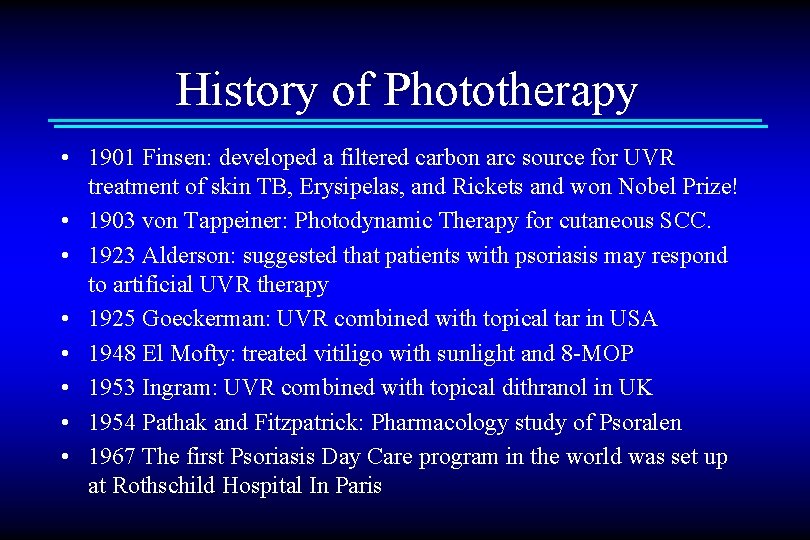
History of Phototherapy • 1901 Finsen: developed a filtered carbon arc source for UVR treatment of skin TB, Erysipelas, and Rickets and won Nobel Prize! • 1903 von Tappeiner: Photodynamic Therapy for cutaneous SCC. • 1923 Alderson: suggested that patients with psoriasis may respond to artificial UVR therapy • 1925 Goeckerman: UVR combined with topical tar in USA • 1948 El Mofty: treated vitiligo with sunlight and 8 -MOP • 1953 Ingram: UVR combined with topical dithranol in UK • 1954 Pathak and Fitzpatrick: Pharmacology study of Psoralen • 1967 The first Psoriasis Day Care program in the world was set up at Rothschild Hospital In Paris
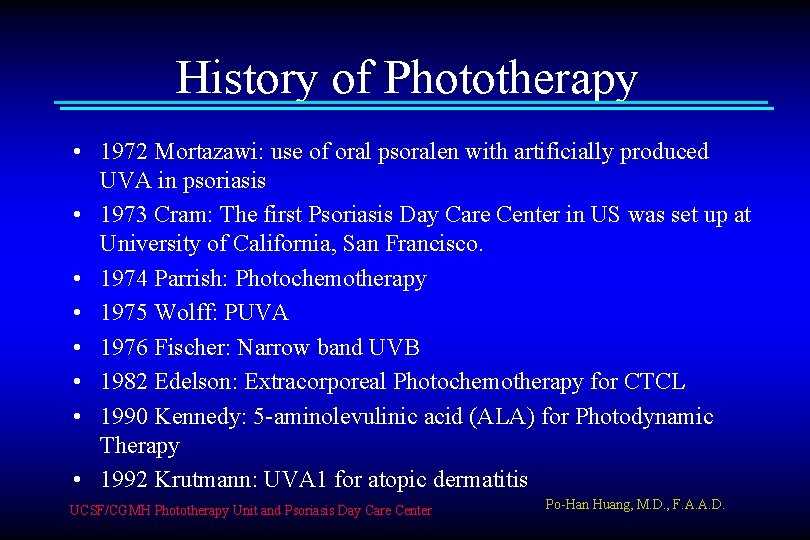
History of Phototherapy • 1972 Mortazawi: use of oral psoralen with artificially produced UVA in psoriasis • 1973 Cram: The first Psoriasis Day Care Center in US was set up at University of California, San Francisco. • 1974 Parrish: Photochemotherapy • 1975 Wolff: PUVA • 1976 Fischer: Narrow band UVB • 1982 Edelson: Extracorporeal Photochemotherapy for CTCL • 1990 Kennedy: 5 -aminolevulinic acid (ALA) for Photodynamic Therapy • 1992 Krutmann: UVA 1 for atopic dermatitis UCSF/CGMH Phototherapy Unit and Psoriasis Day Care Center Po-Han Huang, M. D. , F. A. A. D.
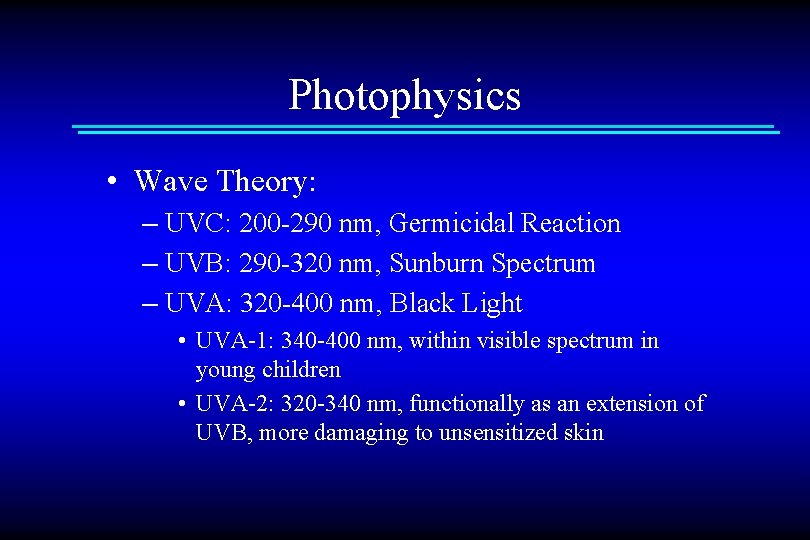
Photophysics • Wave Theory: – UVC: 200 -290 nm, Germicidal Reaction – UVB: 290 -320 nm, Sunburn Spectrum – UVA: 320 -400 nm, Black Light • UVA-1: 340 -400 nm, within visible spectrum in young children • UVA-2: 320 -340 nm, functionally as an extension of UVB, more damaging to unsensitized skin
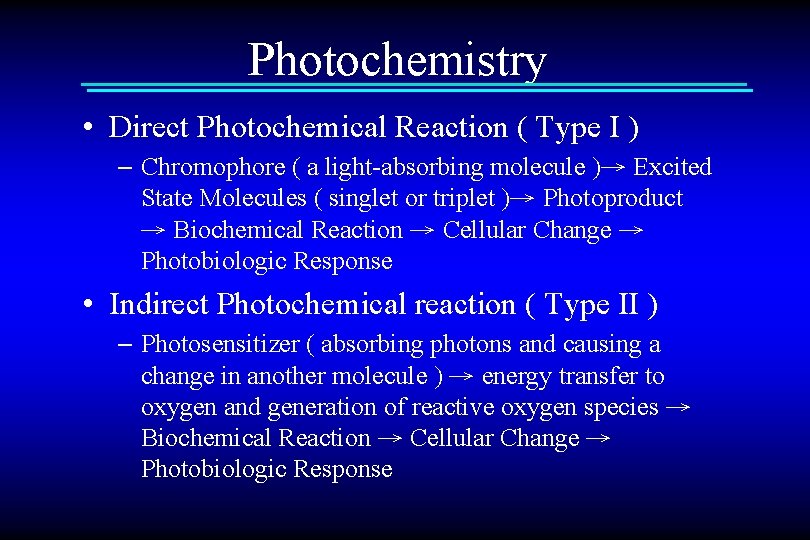
Photochemistry • Direct Photochemical Reaction ( Type I ) – Chromophore ( a light-absorbing molecule )→ Excited State Molecules ( singlet or triplet )→ Photoproduct → Biochemical Reaction → Cellular Change → Photobiologic Response • Indirect Photochemical reaction ( Type II ) – Photosensitizer ( absorbing photons and causing a change in another molecule ) → energy transfer to oxygen and generation of reactive oxygen species → Biochemical Reaction → Cellular Change → Photobiologic Response
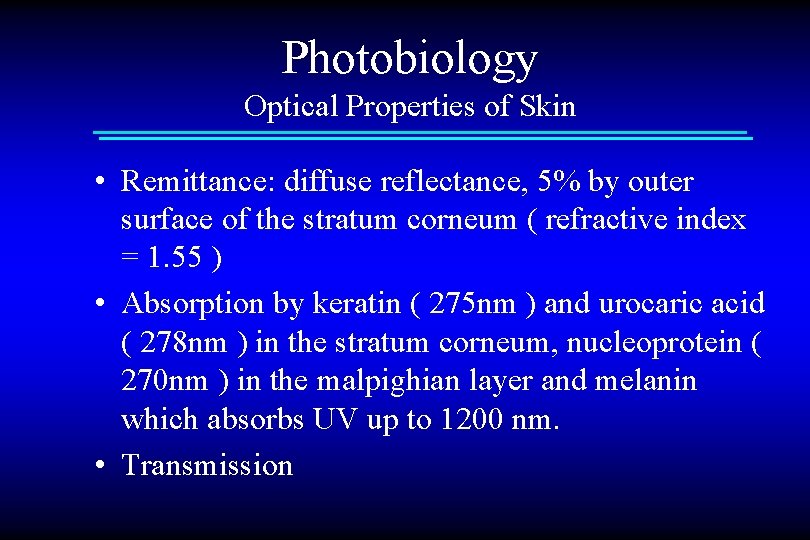
Photobiology Optical Properties of Skin • Remittance: diffuse reflectance, 5% by outer surface of the stratum corneum ( refractive index = 1. 55 ) • Absorption by keratin ( 275 nm ) and urocaric acid ( 278 nm ) in the stratum corneum, nucleoprotein ( 270 nm ) in the malpighian layer and melanin which absorbs UV up to 1200 nm. • Transmission
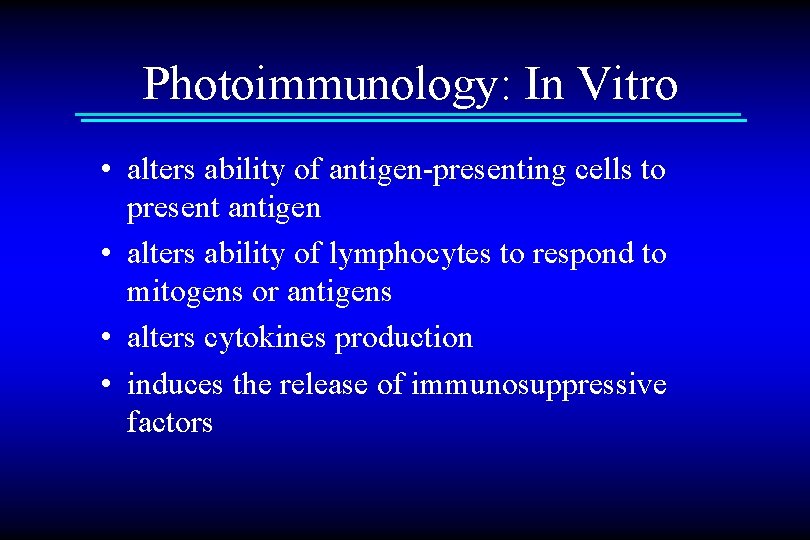
Photoimmunology: In Vitro • alters ability of antigen-presenting cells to present antigen • alters ability of lymphocytes to respond to mitogens or antigens • alters cytokines production • induces the release of immunosuppressive factors
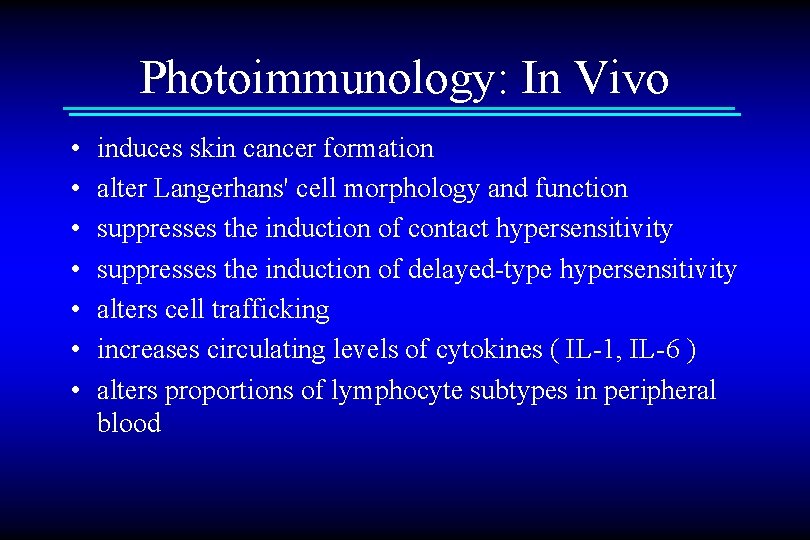
Photoimmunology: In Vivo • • induces skin cancer formation alter Langerhans' cell morphology and function suppresses the induction of contact hypersensitivity suppresses the induction of delayed-type hypersensitivity alters cell trafficking increases circulating levels of cytokines ( IL-1, IL-6 ) alters proportions of lymphocyte subtypes in peripheral blood
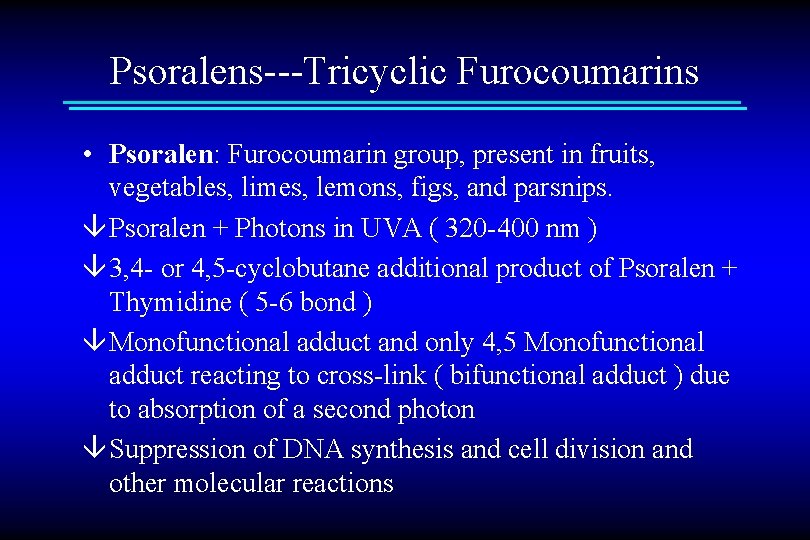
Psoralens---Tricyclic Furocoumarins • Psoralen: Furocoumarin group, present in fruits, vegetables, limes, lemons, figs, and parsnips. â Psoralen + Photons in UVA ( 320 -400 nm ) â 3, 4 - or 4, 5 -cyclobutane additional product of Psoralen + Thymidine ( 5 -6 bond ) â Monofunctional adduct and only 4, 5 Monofunctional adduct reacting to cross-link ( bifunctional adduct ) due to absorption of a second photon â Suppression of DNA synthesis and cell division and other molecular reactions
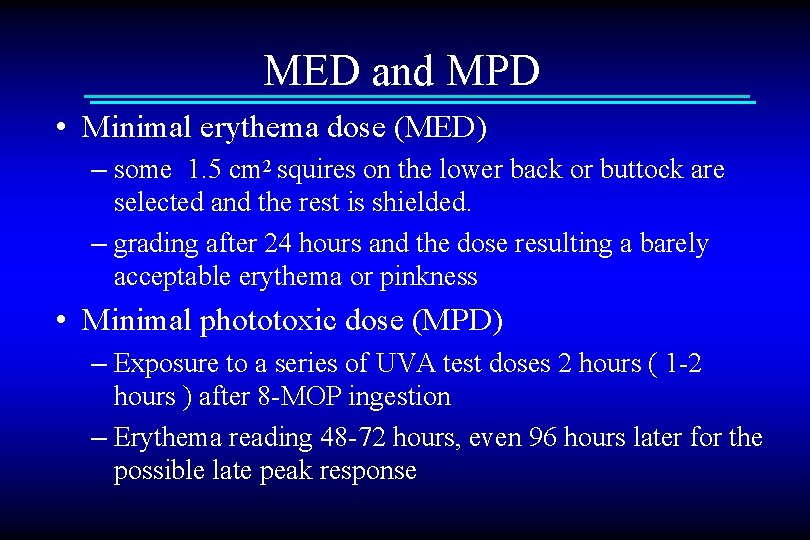
MED and MPD • Minimal erythema dose (MED) – some 1. 5 cm 2 squires on the lower back or buttock are selected and the rest is shielded. – grading after 24 hours and the dose resulting a barely acceptable erythema or pinkness • Minimal phototoxic dose (MPD) – Exposure to a series of UVA test doses 2 hours ( 1 -2 hours ) after 8 -MOP ingestion – Erythema reading 48 -72 hours, even 96 hours later for the possible late peak response
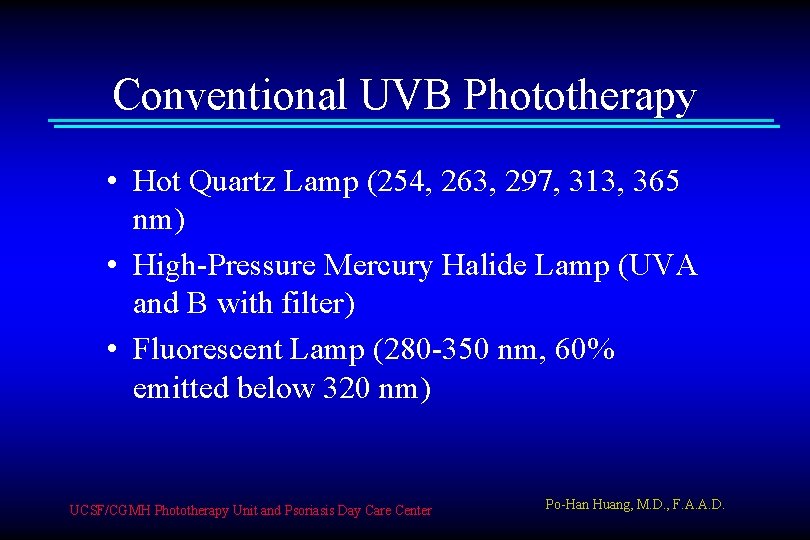
Conventional UVB Phototherapy • Hot Quartz Lamp (254, 263, 297, 313, 365 nm) • High-Pressure Mercury Halide Lamp (UVA and B with filter) • Fluorescent Lamp (280 -350 nm, 60% emitted below 320 nm) UCSF/CGMH Phototherapy Unit and Psoriasis Day Care Center Po-Han Huang, M. D. , F. A. A. D.
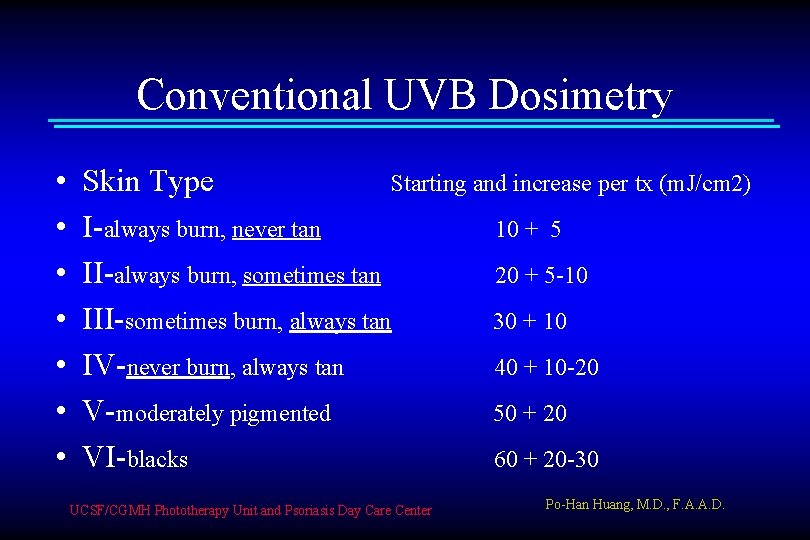
Conventional UVB Dosimetry • • Skin Type Starting and increase per tx (m. J/cm 2) I-always burn, never tan 10 + 5 II-always burn, sometimes tan 20 + 5 -10 III-sometimes burn, always tan 30 + 10 IV-never burn, always tan 40 + 10 -20 V-moderately pigmented 50 + 20 VI-blacks 60 + 20 -30 UCSF/CGMH Phototherapy Unit and Psoriasis Day Care Center Po-Han Huang, M. D. , F. A. A. D.
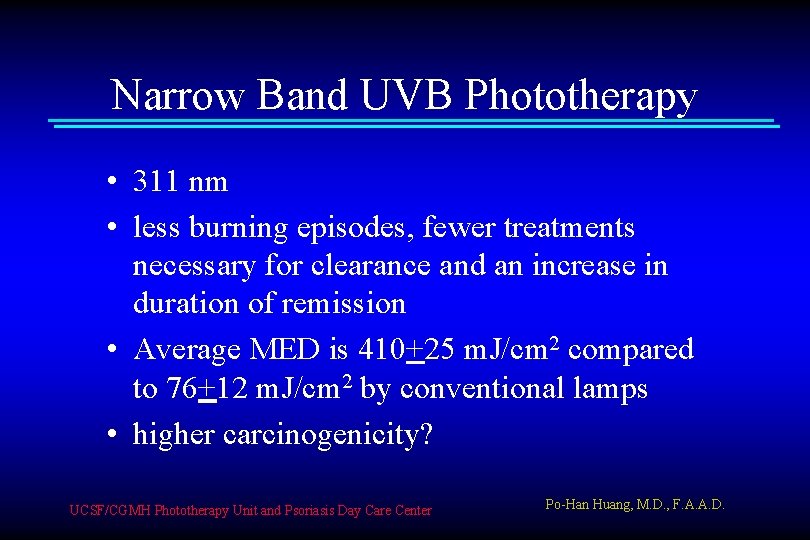
Narrow Band UVB Phototherapy • 311 nm • less burning episodes, fewer treatments necessary for clearance and an increase in duration of remission • Average MED is 410+25 m. J/cm 2 compared to 76+12 m. J/cm 2 by conventional lamps • higher carcinogenicity? UCSF/CGMH Phototherapy Unit and Psoriasis Day Care Center Po-Han Huang, M. D. , F. A. A. D.
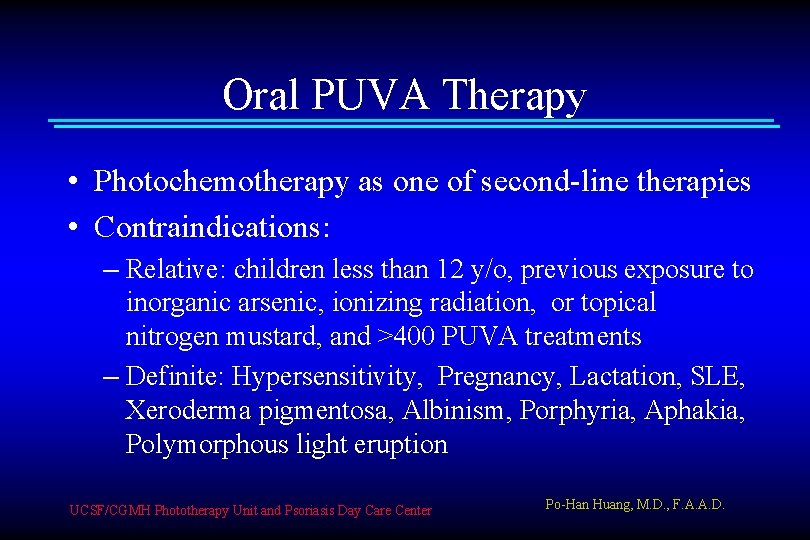
Oral PUVA Therapy • Photochemotherapy as one of second-line therapies • Contraindications: – Relative: children less than 12 y/o, previous exposure to inorganic arsenic, ionizing radiation, or topical nitrogen mustard, and >400 PUVA treatments – Definite: Hypersensitivity, Pregnancy, Lactation, SLE, Xeroderma pigmentosa, Albinism, Porphyria, Aphakia, Polymorphous light eruption UCSF/CGMH Phototherapy Unit and Psoriasis Day Care Center Po-Han Huang, M. D. , F. A. A. D.
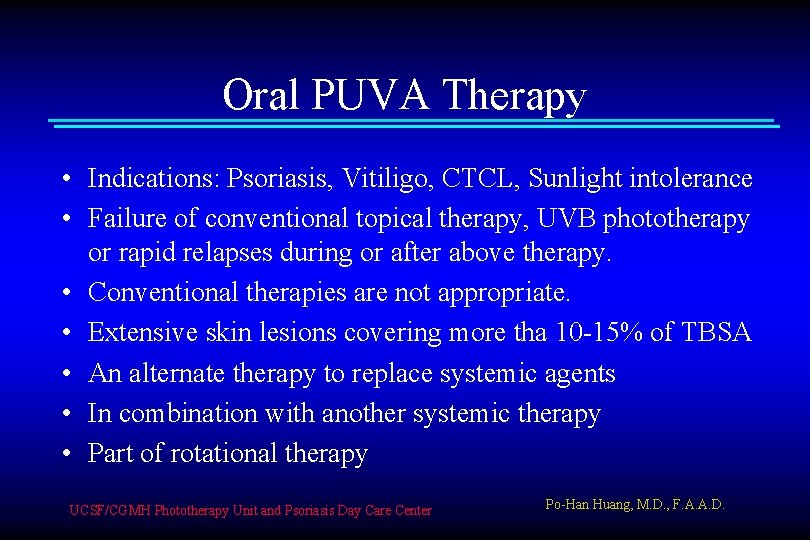
Oral PUVA Therapy • Indications: Psoriasis, Vitiligo, CTCL, Sunlight intolerance • Failure of conventional topical therapy, UVB phototherapy or rapid relapses during or after above therapy. • Conventional therapies are not appropriate. • Extensive skin lesions covering more tha 10 -15% of TBSA • An alternate therapy to replace systemic agents • In combination with another systemic therapy • Part of rotational therapy UCSF/CGMH Phototherapy Unit and Psoriasis Day Care Center Po-Han Huang, M. D. , F. A. A. D.
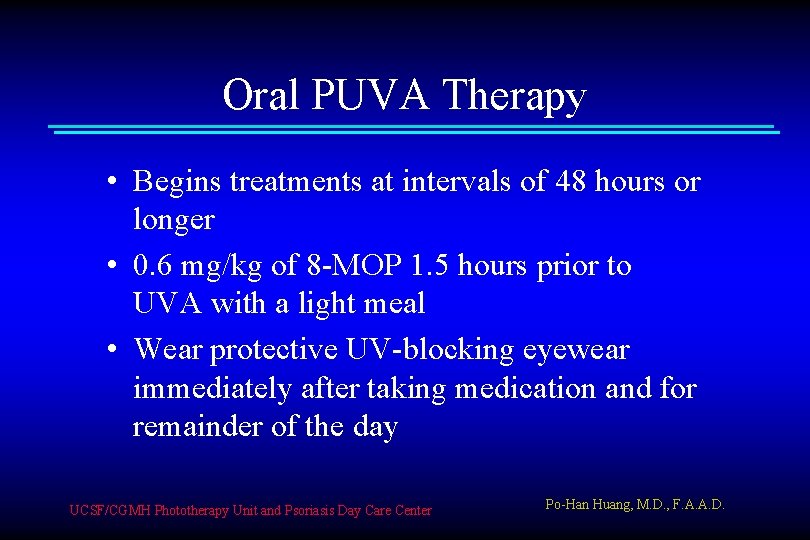
Oral PUVA Therapy • Begins treatments at intervals of 48 hours or longer • 0. 6 mg/kg of 8 -MOP 1. 5 hours prior to UVA with a light meal • Wear protective UV-blocking eyewear immediately after taking medication and for remainder of the day UCSF/CGMH Phototherapy Unit and Psoriasis Day Care Center Po-Han Huang, M. D. , F. A. A. D.
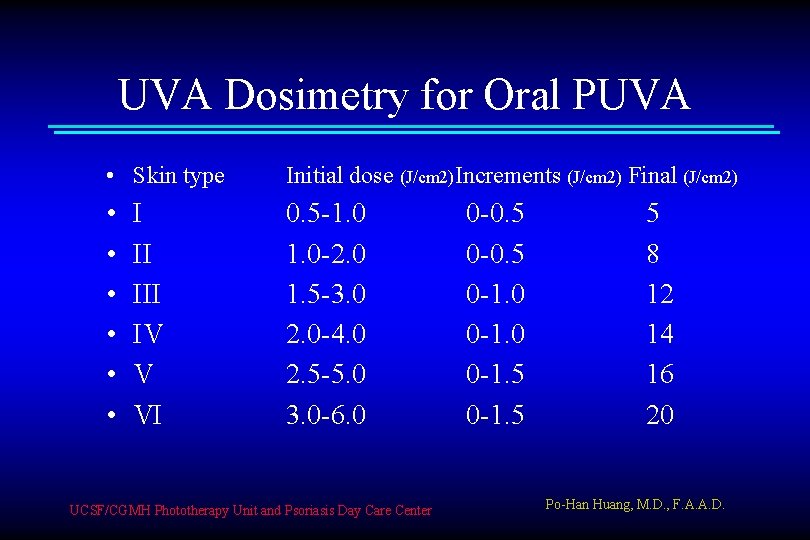
UVA Dosimetry for Oral PUVA • Skin type Initial dose (J/cm 2)Increments (J/cm 2) Final (J/cm 2) • • • 0. 5 -1. 0 -2. 0 1. 5 -3. 0 2. 0 -4. 0 2. 5 -5. 0 3. 0 -6. 0 I II IV V VI UCSF/CGMH Phototherapy Unit and Psoriasis Day Care Center 0 -0. 5 0 -1. 0 0 -1. 5 5 8 12 14 16 20 Po-Han Huang, M. D. , F. A. A. D.
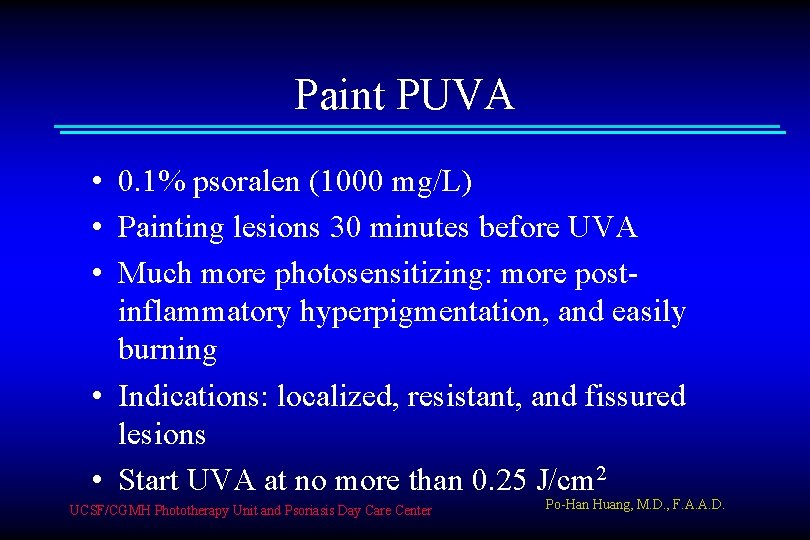
Paint PUVA • 0. 1% psoralen (1000 mg/L) • Painting lesions 30 minutes before UVA • Much more photosensitizing: more postinflammatory hyperpigmentation, and easily burning • Indications: localized, resistant, and fissured lesions • Start UVA at no more than 0. 25 J/cm 2 UCSF/CGMH Phototherapy Unit and Psoriasis Day Care Center Po-Han Huang, M. D. , F. A. A. D.
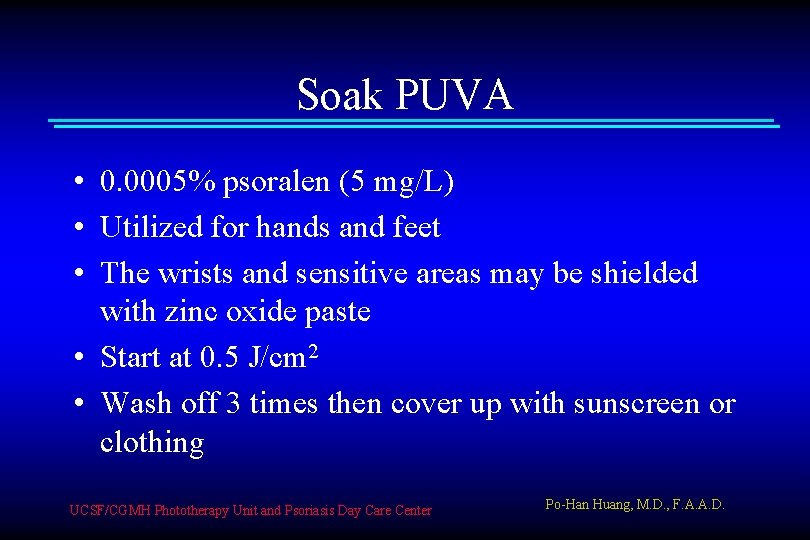
Soak PUVA • 0. 0005% psoralen (5 mg/L) • Utilized for hands and feet • The wrists and sensitive areas may be shielded with zinc oxide paste • Start at 0. 5 J/cm 2 • Wash off 3 times then cover up with sunscreen or clothing UCSF/CGMH Phototherapy Unit and Psoriasis Day Care Center Po-Han Huang, M. D. , F. A. A. D.
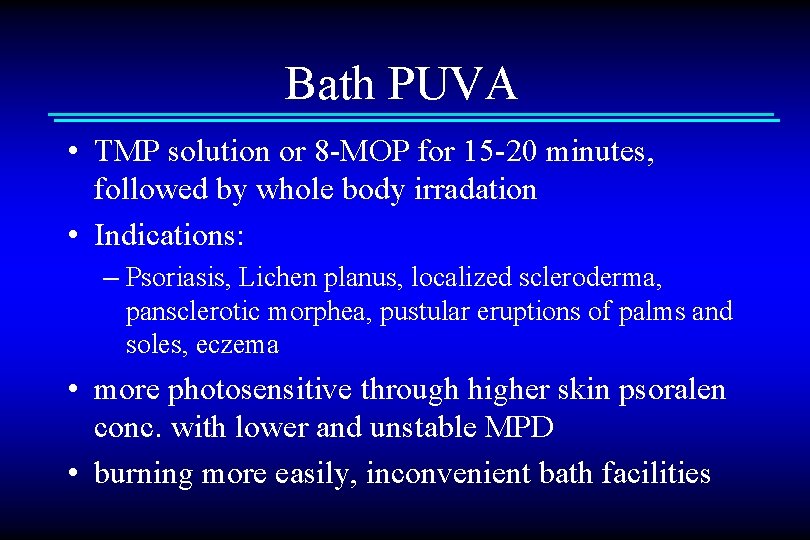
Bath PUVA • TMP solution or 8 -MOP for 15 -20 minutes, followed by whole body irradation • Indications: – Psoriasis, Lichen planus, localized scleroderma, pansclerotic morphea, pustular eruptions of palms and soles, eczema • more photosensitive through higher skin psoralen conc. with lower and unstable MPD • burning more easily, inconvenient bath facilities
Oral vs. Bath PUVA • Oral PUVA: low incidence of treatment failures and overdose episodes • Bath PUVA: equal clearing rates with lower numbers of exposures. – Higher penetration of psoralens through the abnormal stratum corneum – secondary erythema and pruritus: similar or lower – no systemic intolerance such as nausea and vomiting UCSF/CGMH Phototherapy Unit and Psoriasis Day Care Center Po-Han Huang, M. D. , F. A. A. D.
Bath PUVA and Carcinogenesis • Enhanced risk of SCC with oral PUVA but no increased risk with bath-PUVA (Lindeloef, 1992; Hannuksela, 1996) • Higher epidermal psoralen conc. and lower UVA dose may induce an equal or even higher number of mutagenic DNA lesions? UCSF/CGMH Phototherapy Unit and Psoriasis Day Care Center Po-Han Huang, M. D. , F. A. A. D.
Limiting Factors in PUVA • Erythema ( Delayed Phototoxic Erythema ) – Related to the dose of drug, dose of UVA and individual's sensitivity – Onset: 24 -36 h ( UVB: 4 -6 h ); Peak: 48 -72 even 96 h ( UVB: 12 -24 h ); Persistence: more than 1 week. • Pigmentation – Presence before erythema if oral TMP or 5 -MOP – Importance: Treatment of vitiligo and prevention therapy of photodermatoses – Dose-response curve: much steeper
UVA 1 Phototherapy • 340 -400 nm; less severe adverse reaction • Indication: atopic dermatitis, scleroderma, urticaria pigmentosa • UVA 1 high dose therapy: – Acute exacerbated atopic dermatitis can be controlled by 15 single daily doses of 130 J/cm 2 or 50 J/cm 2 given 10 times • UVA 1 cold light (no infrared and heat) therapy: – below 25 -48 J/cm 2 for atopic patients UCSF/CGMH Phototherapy Unit and Psoriasis Day Care Center Po-Han Huang, M. D. , F. A. A. D.
Acute Side Effects of Phototherapy • Thermal Effect: high photon densitysaturated chromophore molecules → heat → tissue damage. • Itching: in 15 -25% of PUVA, in the first two weeks, esp severely overdosed • Skin pain: end stage of clearing
Risks of Phototherapy on the Skin • Skin Cancer: Non-melanoma skin cancer, esp SCC – If PUVA > 200 treatments, 10 folds increase in risk. – Latency of malignant transformation: 10 -15 years – No correlation between UVB phototherapy and skin cancer • Photoaging: – thinned, wrinkled, inelastic leathery, irregular pigmentation, solar elastosis, and freckles. – Epidermal change due to UVB? – Dermal change due to UVA?
Eye Damage of Phototherapy • Keratitis by UVB absorbed by cornea • Cataract by PUVA: 8 -MOP can be dected in the ocular lens for at least 12 hours – Susceptibility is probably low! – Protective glasses can't be defined because no known action spectrum for PUVA cataract induction.
Psoriasis Day Care Program • Disease criteria – more than 25% of total body surface – affecting areas such as the face, scalp, hands, feet, and genital areas – Recalcitrant psoriasis experiencing complications from previous therapy – Illness that the use of systemic therapy is contraindicated – Old age UCSF/CGMH Phototherapy Unit and Psoriasis Day Care Center Po-Han Huang, M. D. , F. A. A. D.
Psoriasis Day Care Program • Advantages: – Availability of comprehensive facilities with appropriately trained nursing staff and medical staff – Social functions: Patient interaction with other patients; the patients can return home and families each day with less disruption in their personal lives. – Patient education: educational materials and discussion groups; development of skills necessary for self-care UCSF/CGMH Phototherapy Unit and Psoriasis Day Care Center Po-Han Huang, M. D. , F. A. A. D.
Psoriasis Day Care Program • Physical Units: – Phototherapy rooms – Examining rooms for new patients – Dressing rooms for application of medication – Lounge area after their topical therapy applied for daytime activities, including a kitchen – Rooms for patient education video and appropriate entertainment – Bathing and showering rooms UCSF/CGMH Phototherapy Unit and Psoriasis Day Care Center Po-Han Huang, M. D. , F. A. A. D.
Psoriasis Day Care Program • Therapeutic equipments – A phototherapy unit • UVA, UVB light boxes • portable UVB and UVA units for hands and feet • Dermalite – Scalp treatment machine – Tub for bath PUVA – Whirlpool for debriding scaling and for relief of joint pain UCSF/CGMH Phototherapy Unit and Psoriasis Day Care Center Po-Han Huang, M. D. , F. A. A. D.
Psoriasis Day Care Program • Staffing: – An attending physician and a full-time day care phototherapy resident or fellow – A registered nurse and additional nurses depending on the daily census (one nurse for every 3 -4 patients in average in U. S. ) – Psychological, and psychiatric consultative services and social service – Supporting systems: patient education, group therapy, and a self-help clinic UCSF/CGMH Phototherapy Unit and Psoriasis Day Care Center Po-Han Huang, M. D. , F. A. A. D.
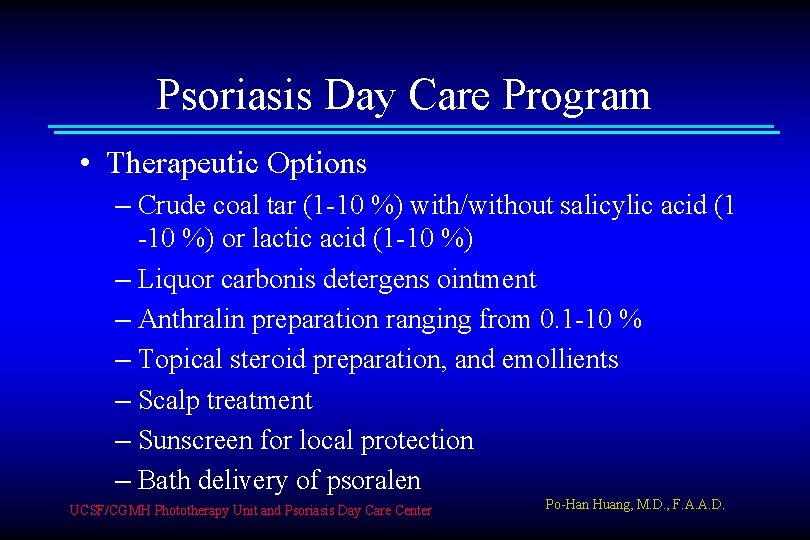
Psoriasis Day Care Program • Therapeutic Options – Crude coal tar (1 -10 %) with/without salicylic acid (1 -10 %) or lactic acid (1 -10 %) – Liquor carbonis detergens ointment – Anthralin preparation ranging from 0. 1 -10 % – Topical steroid preparation, and emollients – Scalp treatment – Sunscreen for local protection – Bath delivery of psoralen UCSF/CGMH Phototherapy Unit and Psoriasis Day Care Center Po-Han Huang, M. D. , F. A. A. D.
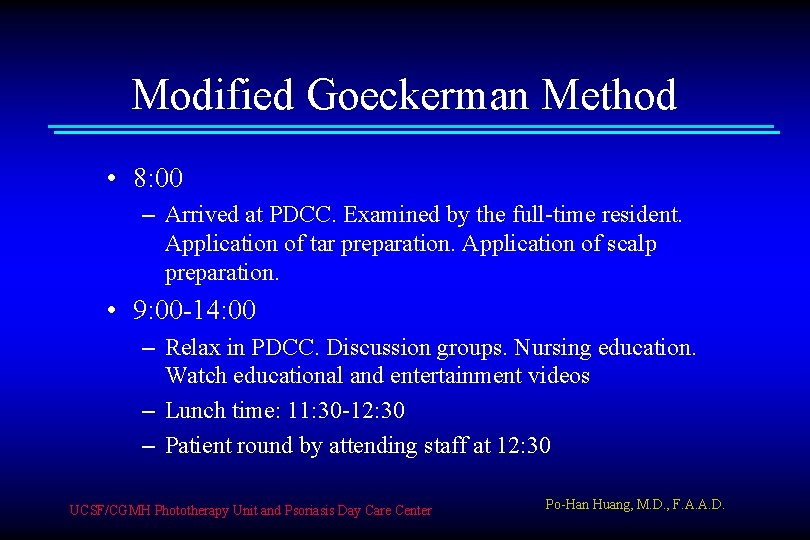
Modified Goeckerman Method • 8: 00 – Arrived at PDCC. Examined by the full-time resident. Application of tar preparation. Application of scalp preparation. • 9: 00 -14: 00 – Relax in PDCC. Discussion groups. Nursing education. Watch educational and entertainment videos – Lunch time: 11: 30 -12: 30 – Patient round by attending staff at 12: 30 UCSF/CGMH Phototherapy Unit and Psoriasis Day Care Center Po-Han Huang, M. D. , F. A. A. D.
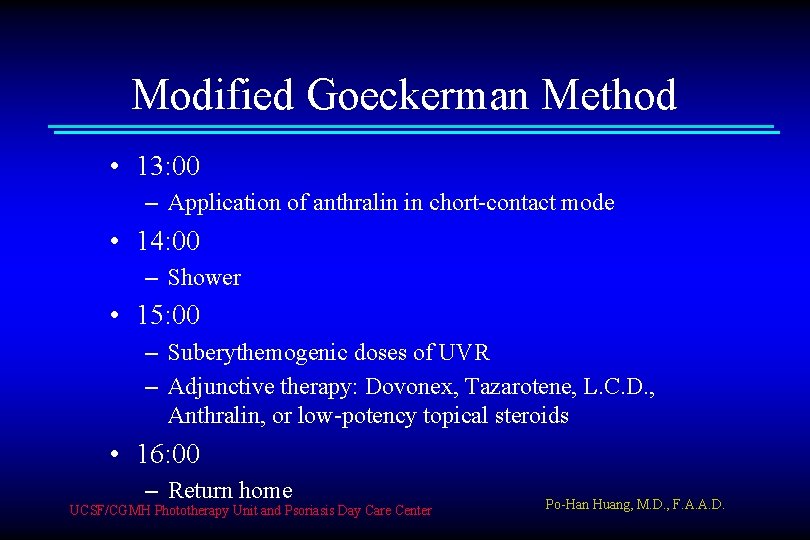
Modified Goeckerman Method • 13: 00 – Application of anthralin in chort-contact mode • 14: 00 – Shower • 15: 00 – Suberythemogenic doses of UVR – Adjunctive therapy: Dovonex, Tazarotene, L. C. D. , Anthralin, or low-potency topical steroids • 16: 00 – Return home UCSF/CGMH Phototherapy Unit and Psoriasis Day Care Center Po-Han Huang, M. D. , F. A. A. D.
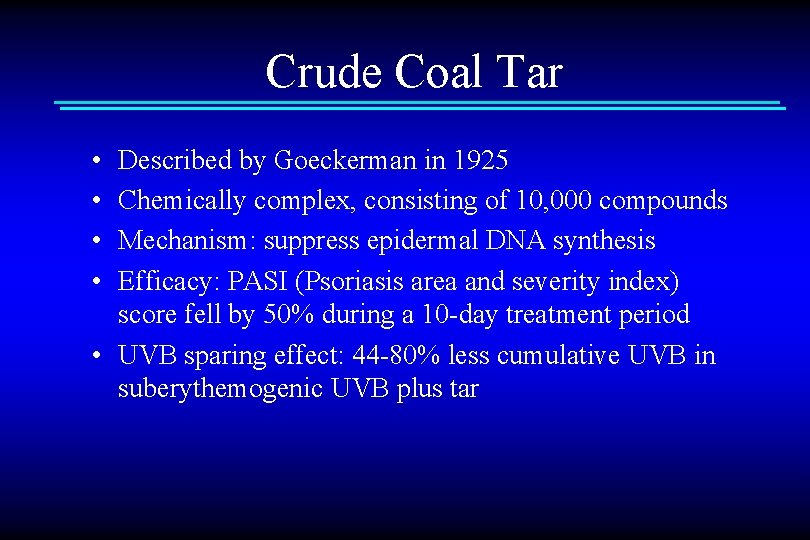
Crude Coal Tar • • Described by Goeckerman in 1925 Chemically complex, consisting of 10, 000 compounds Mechanism: suppress epidermal DNA synthesis Efficacy: PASI (Psoriasis area and severity index) score fell by 50% during a 10 -day treatment period • UVB sparing effect: 44 -80% less cumulative UVB in suberythemogenic UVB plus tar
Psoriasis Day Care Program • TOTAL CARE: – Exemplary skin care treatment – Assessment of allied medical problems – Highly skilled dermatology nurses – Individualized treatment – Stress reduction – Patient education – Self-help workshop UCSF/CGMH Phototherapy Unit and Psoriasis Day Care Center Po-Han Huang, M. D. , F. A. A. D.