
Utterance classification with discriminative language modeling Murat Saraclar


- Slides: 15
Utterance classification with discriminative language modeling Murat Saraclar , Brian Roark Speech Communciation, 2006 Bang-Xuan Huang Department of Computer Science & Information Engineering National Taiwan Normal University
Outline • Introduction • Method • Experimental results • Discussion 2
Introduction • Reductions in WER are critical for applications making use of automatic speech recognition (ASR), but the key objective of a particular application may be different. • In this paper, we perform a range of experiments investigating the benefit of simultaneous optimization of parameters for both WER and class-error rate (CER) reductions. • We demonstrate that simultaneously optimizing parameter weights for both ngram and class features provides significant reductions in both WER and CER. 3
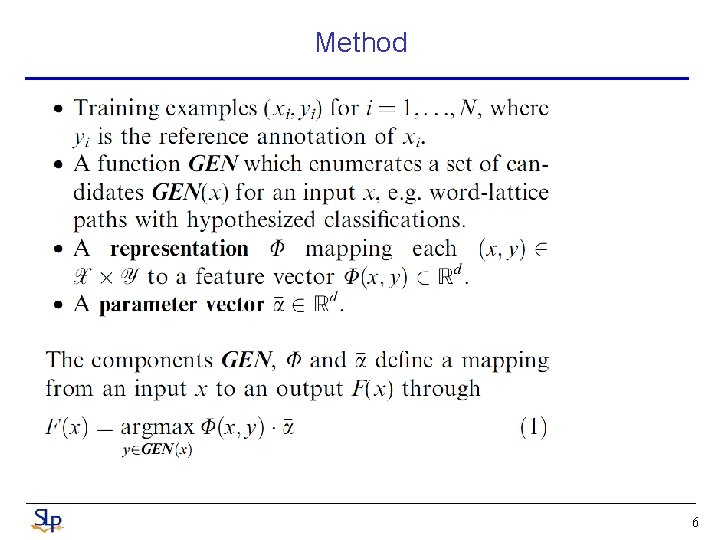
Method 6
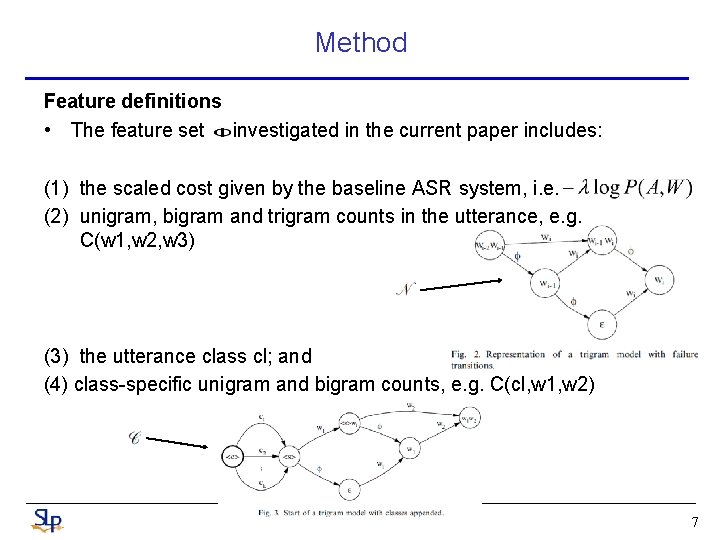
Method Feature definitions • The feature set investigated in the current paper includes: (1) the scaled cost given by the baseline ASR system, i. e. (2) unigram, bigram and trigram counts in the utterance, e. g. C(w 1, w 2, w 3) (3) the utterance class cl; and (4) class-specific unigram and bigram counts, e. g. C(cl, w 1, w 2) 7
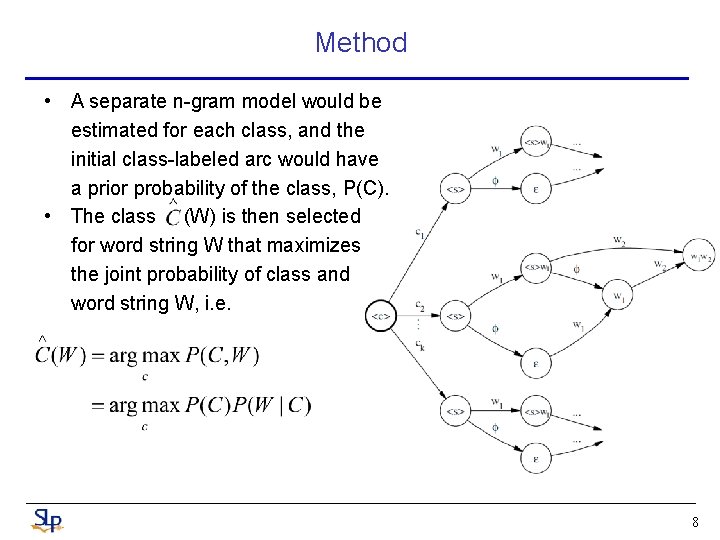
Method • A separate n-gram model would be estimated for each class, and the initial class-labeled arc would have a prior probability of the class, P(C). • The class (W) is then selected for word string W that maximizes the joint probability of class and word string W, i. e. 8
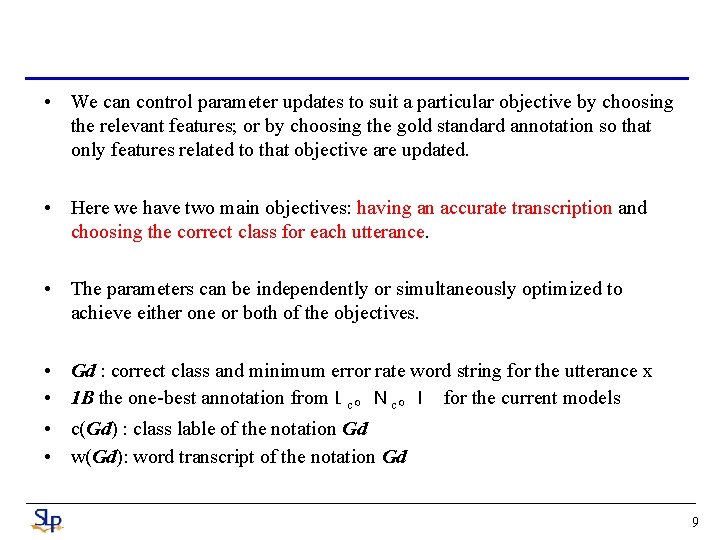
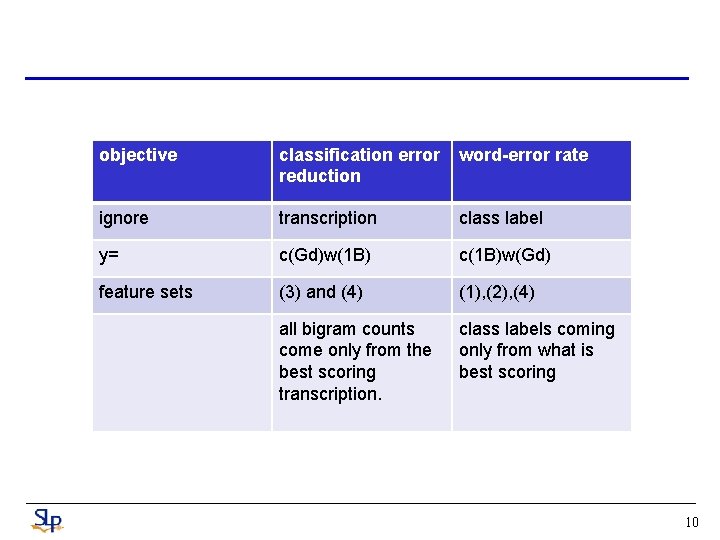
• We can control parameter updates to suit a particular objective by choosing the relevant features; or by choosing the gold standard annotation so that only features related to that objective are updated. • Here we have two main objectives: having an accurate transcription and choosing the correct class for each utterance. • The parameters can be independently or simultaneously optimized to achieve either one or both of the objectives. • Gd : correct class and minimum error rate word string for the utterance x • 1 B the one-best annotation from L c。N c。l for the current models • c(Gd) : class lable of the notation Gd • w(Gd): word transcript of the notation Gd 9
objective classification error reduction word-error rate ignore transcription class label y= c(Gd)w(1 B) c(1 B)w(Gd) feature sets (3) and (4) (1), (2), (4) all bigram counts come only from the best scoring transcription. class labels coming only from what is best scoring 10
Perceptron 對 偏微 11
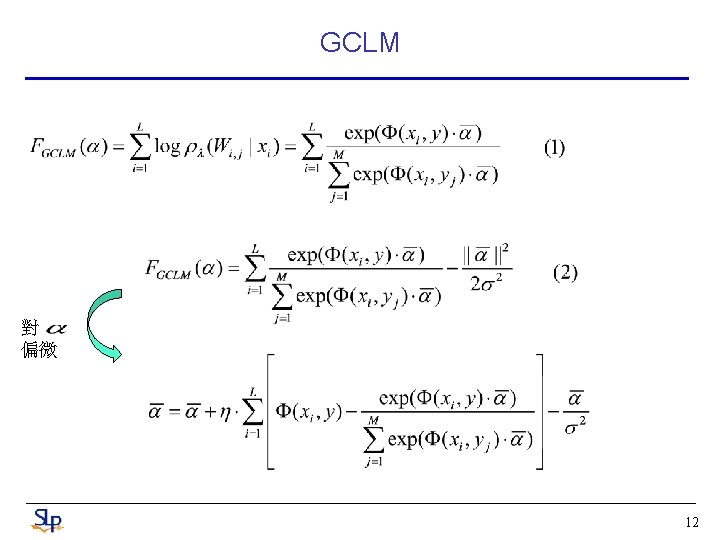
GCLM 對 偏微 12
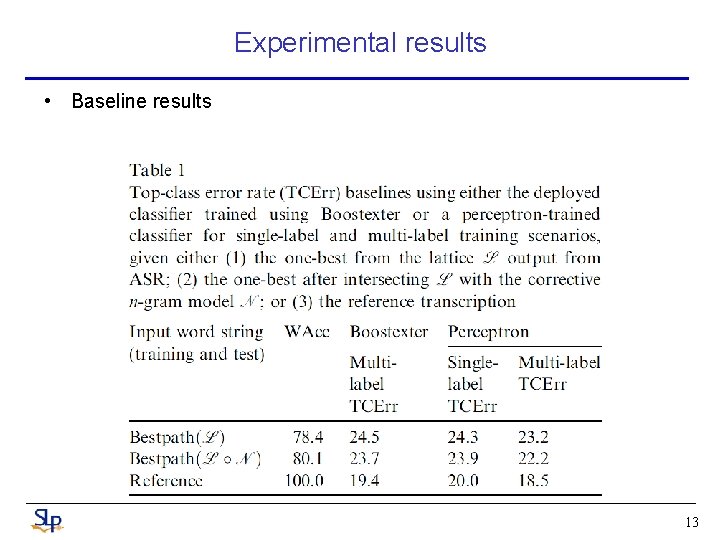
Experimental results • Baseline results 13
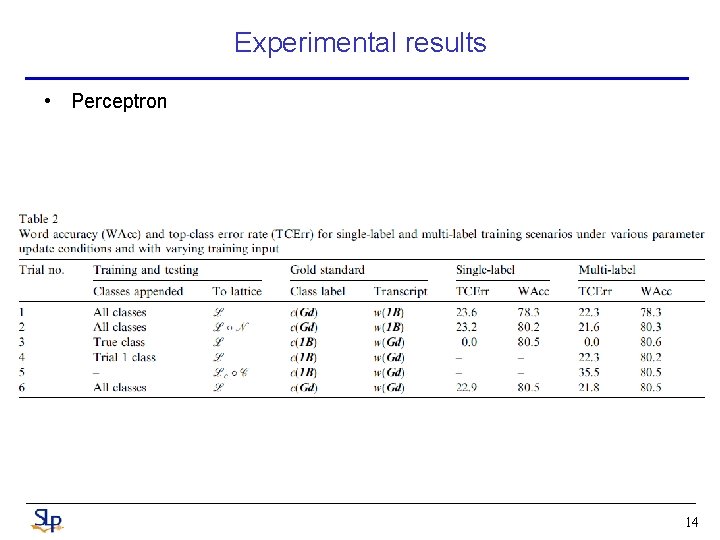
Experimental results • Perceptron 14
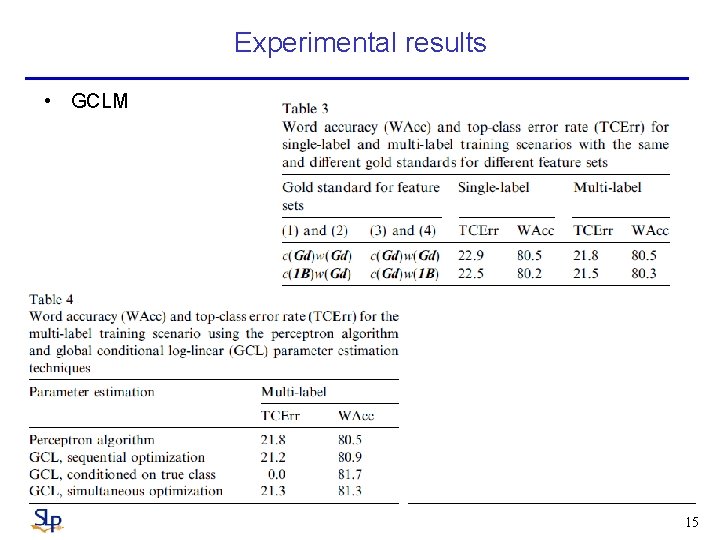
Experimental results • GCLM 15
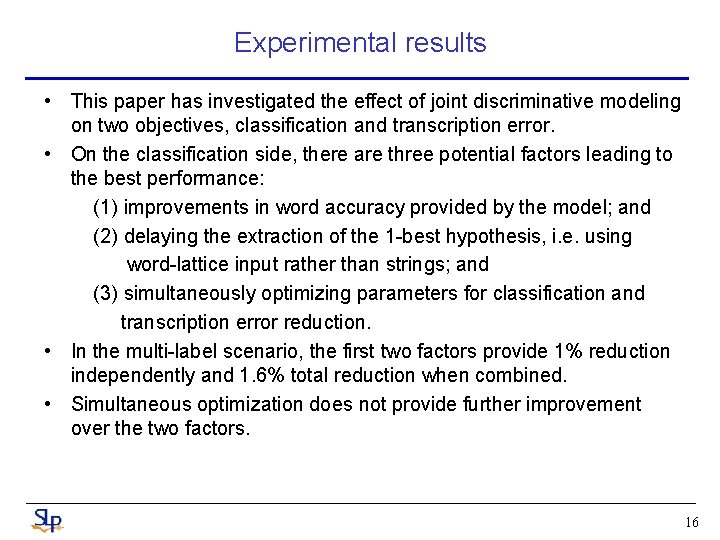
Experimental results • This paper has investigated the effect of joint discriminative modeling on two objectives, classification and transcription error. • On the classification side, there are three potential factors leading to the best performance: (1) improvements in word accuracy provided by the model; and (2) delaying the extraction of the 1 -best hypothesis, i. e. using word-lattice input rather than strings; and (3) simultaneously optimizing parameters for classification and transcription error reduction. • In the multi-label scenario, the first two factors provide 1% reduction independently and 1. 6% total reduction when combined. • Simultaneous optimization does not provide further improvement over the two factors. 16
Experimental results • simultaneous optimization of the parameters gives us as much improvement in word accuracy as we could get knowing the true class of the utterance, without penalizing TCErr. • Using global conditional log-linear models further improved the performance. • Independently optimizing the parameters yielded a 0. 5% improvement in word accuracy and a 0. 8% improvement in classification error over the perceptron algorithm. 17