
Utilizing the Ohio Teacher Evaluation System OTES Property

- Slides: 25
Utilizing the Ohio Teacher Evaluation System (OTES) Property of: https: //mypaperhub. com/ 801 North 34 th Street, 3 rd floor Seattle, WA 98103 DISCLAIMER This Sample paper SHOULD NOT BE USED XXX, Ed. D candidate Concordia University of Chicago Educational Leadership Program November 12, 2014 Dissertation Defense
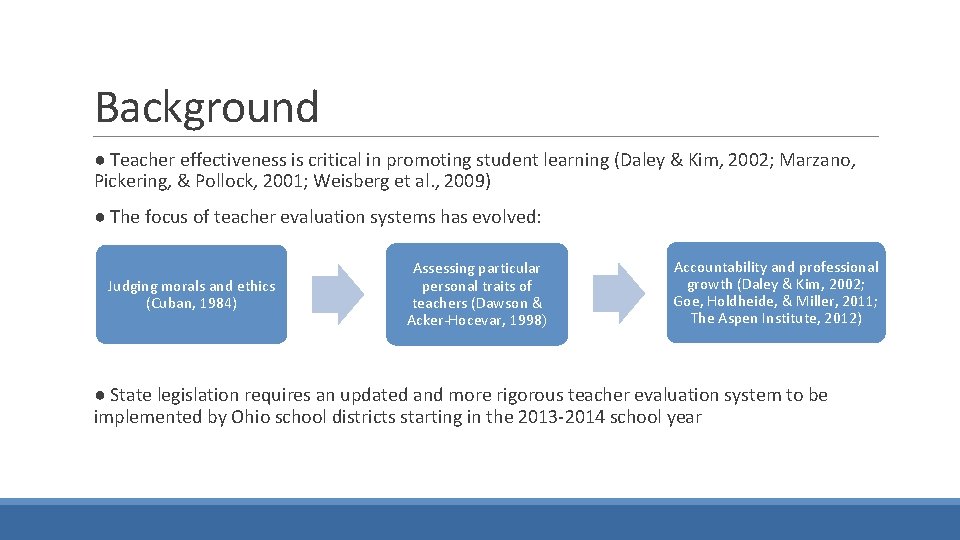
Background ● Teacher effectiveness is critical in promoting student learning (Daley & Kim, 2002; Marzano, Pickering, & Pollock, 2001; Weisberg et al. , 2009) ● The focus of teacher evaluation systems has evolved: Judging morals and ethics (Cuban, 1984) Assessing particular personal traits of teachers (Dawson & Acker-Hocevar, 1998) Accountability and professional growth (Daley & Kim, 2002; Goe, Holdheide, & Miller, 2011; The Aspen Institute, 2012) ● State legislation requires an updated and more rigorous teacher evaluation system to be implemented by Ohio school districts starting in the 2013 -2014 school year
Problem Statement and Purpose ● OTES requires significant changes for educators and an increased level of accountability through the use of walkthroughs, a professional growth plan, observations, student growth measures, a performance rubric, and a tiered rating system. ● The research fulfilled two purposes: (a) to understand provide a voice to the experiences of the teachers and administrators who are utilizing the OTES process, and (b) to provide recommendations for the improved utilization of evaluation systems in the future.
Research Questions RQ 1: What are the experiences of teachers and administrators at Forks High School as they utilize OTES? RQ 2: How do teachers and administrators perceive the various interactions (including written or email communications, conversations, meetings, or conferences) regarding OTES? SQ 1: How do the teachers and administrators perceive the discussions centered on the OTES Performance Evaluation Rubric? RQ 3: What are recommendations for the improved utilization of the OTES evaluation system based on the Forks High School teachers’ and administrators’ experiences?
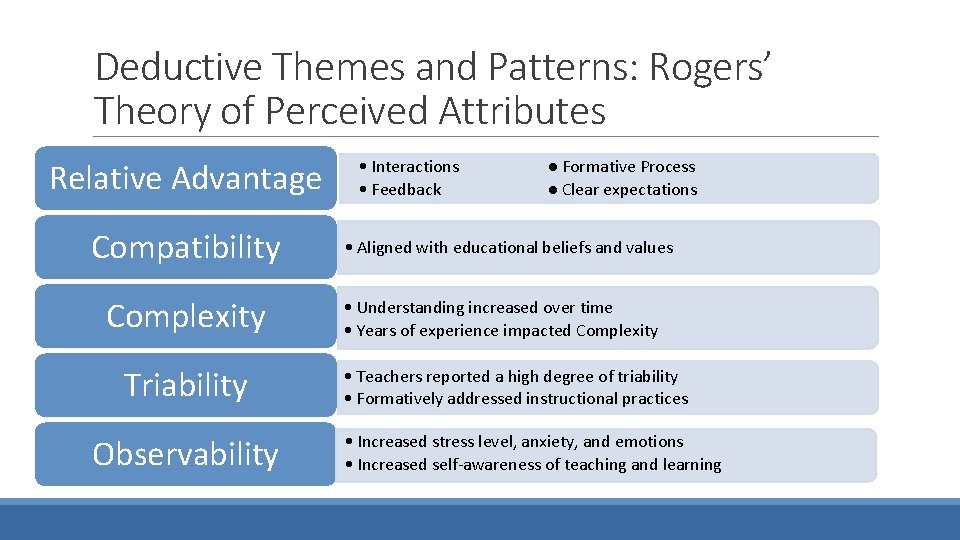
Theoretical Framework Rogers’ (2003) Theory of Perceived Attributes: the rate at which changes are adopted are impacted by 5 Perceived Attributes ● Relative advantage ● Compatibility ● Complexity ● Triability ● Observability
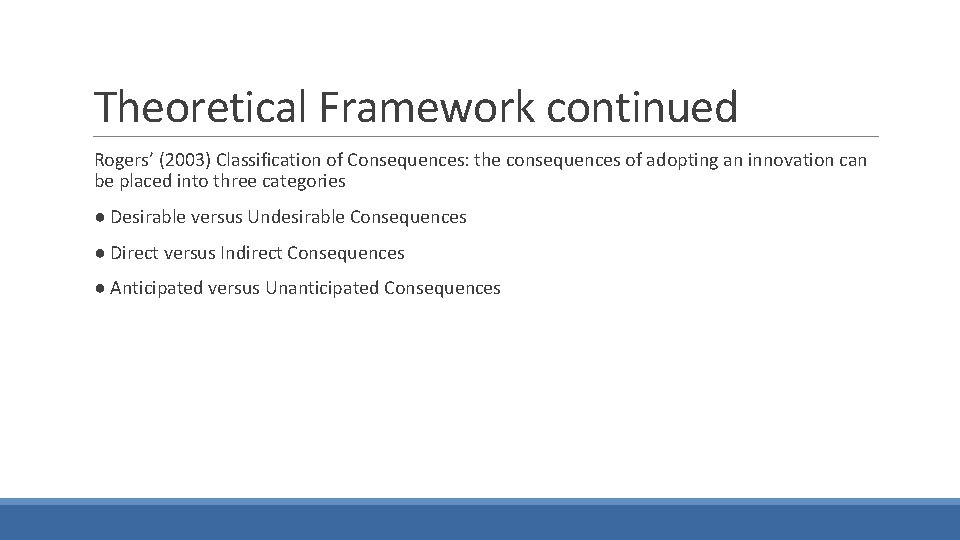
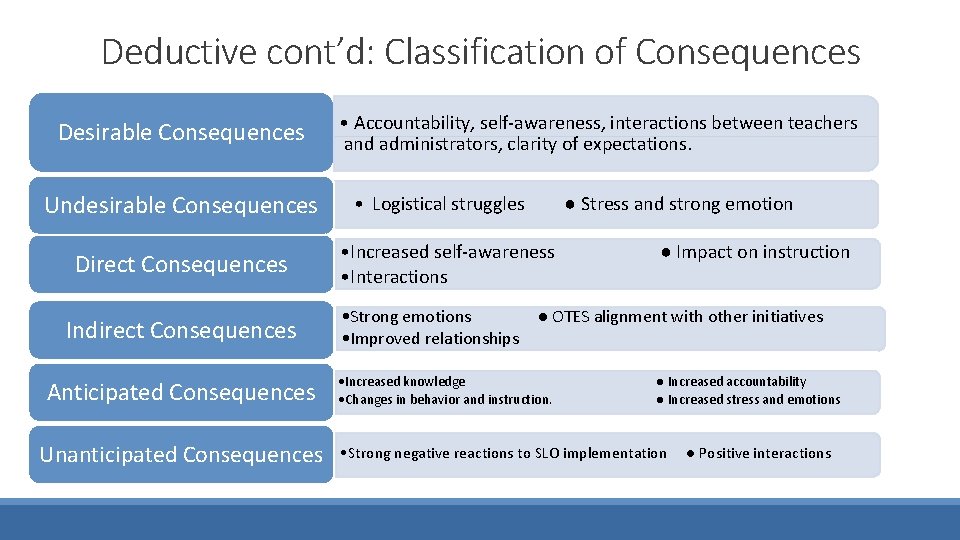
Theoretical Framework continued Rogers’ (2003) Classification of Consequences: the consequences of adopting an innovation can be placed into three categories ● Desirable versus Undesirable Consequences ● Direct versus Indirect Consequences ● Anticipated versus Unanticipated Consequences
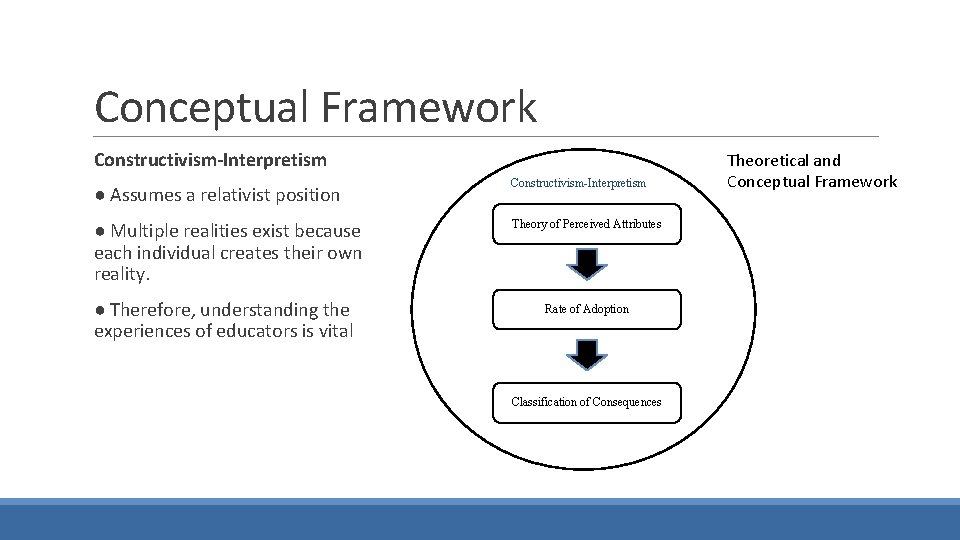
Conceptual Framework Constructivism-Interpretism ● Assumes a relativist position Constructivism-Interpretism ● Multiple realities exist because each individual creates their own reality. Theory of Perceived Attributes ● Therefore, understanding the experiences of educators is vital Rate of Adoption Classification of Consequences Theoretical and Conceptual Framework
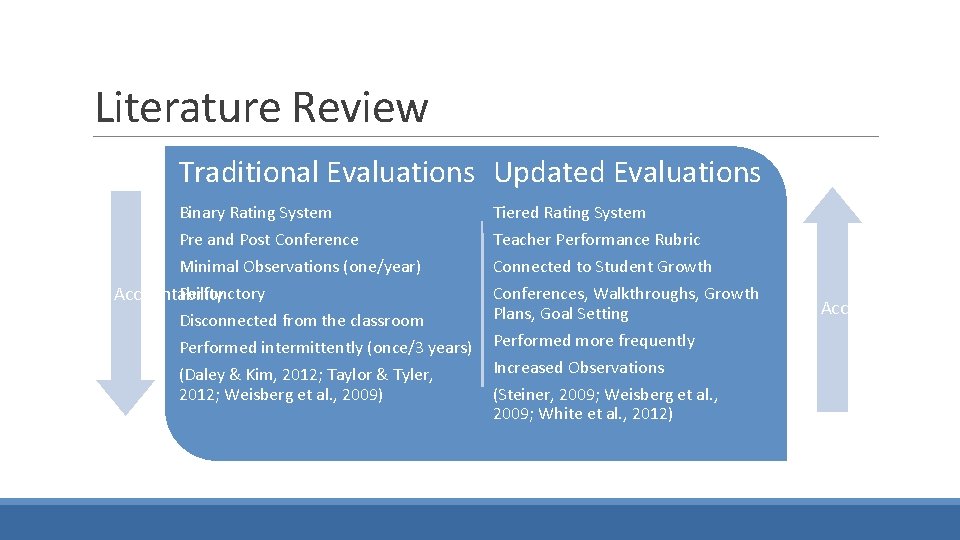
Literature Review Traditional Evaluations Updated Evaluations Binary Rating System Pre and Post Conference Minimal Observations (one/year) Perfunctory Accountability Disconnected from the classroom Performed intermittently (once/3 years) (Daley & Kim, 2012; Taylor & Tyler, 2012; Weisberg et al. , 2009) Tiered Rating System Teacher Performance Rubric Connected to Student Growth Conferences, Walkthroughs, Growth Plans, Goal Setting Performed more frequently Increased Observations (Steiner, 2009; Weisberg et al. , 2009; White et al. , 2012) Accountability
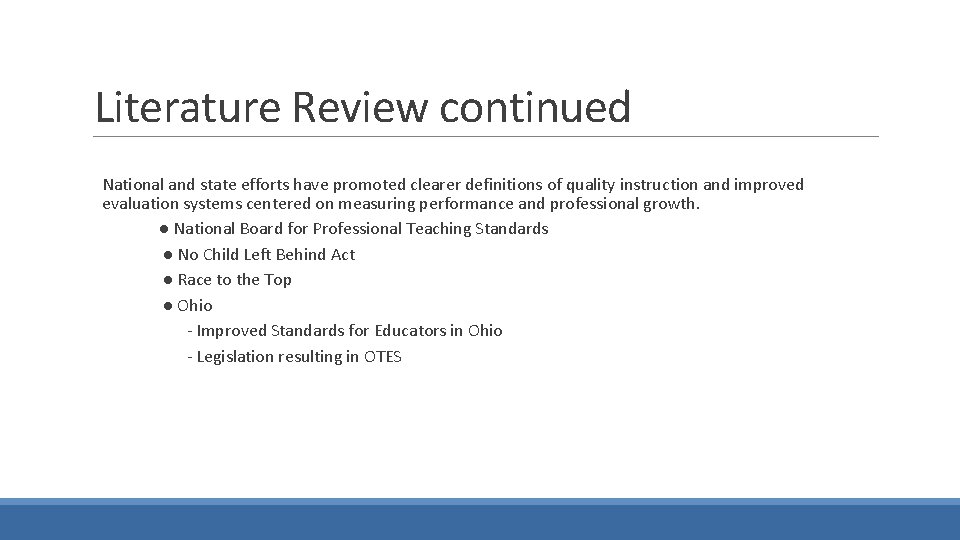
Literature Review continued National and state efforts have promoted clearer definitions of quality instruction and improved evaluation systems centered on measuring performance and professional growth. ● National Board for Professional Teaching Standards ● No Child Left Behind Act ● Race to the Top ● Ohio - Improved Standards for Educators in Ohio - Legislation resulting in OTES
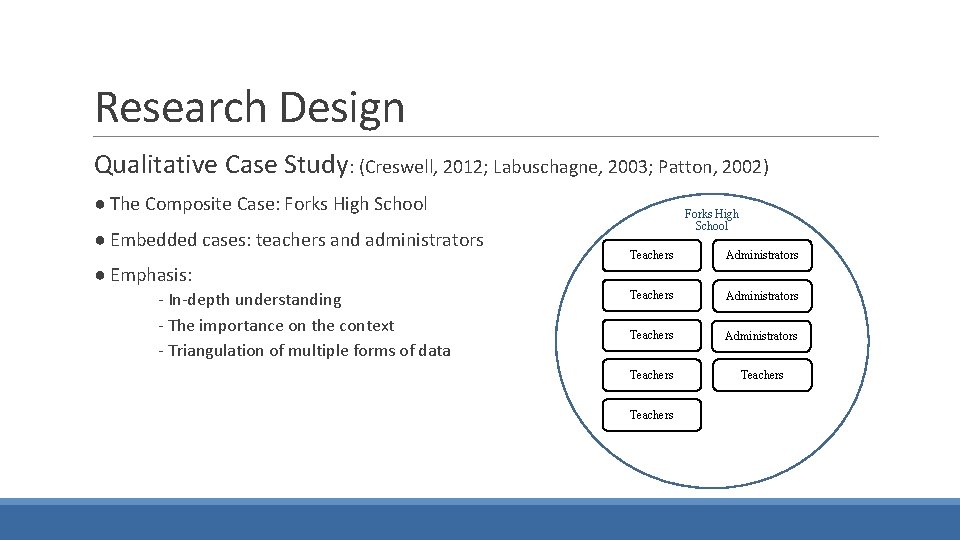
Research Design Qualitative Case Study: (Creswell, 2012; Labuschagne, 2003; Patton, 2002) ● The Composite Case: Forks High School ● Embedded cases: teachers and administrators Forks High School Teachers Administrators Teachers ● Emphasis: - In-depth understanding - The importance on the context - Triangulation of multiple forms of data Teachers
Sample Critical Case Sampling: cases which will provide the most insight Typical Case Sampling: average or typical cases in regard to OTES Literal replication: Critical Cases and Typical Cases are predicted to provide similar results, respectively Sample Size: 6 teachers (three critical cases and three typical cases) and 3 administrators
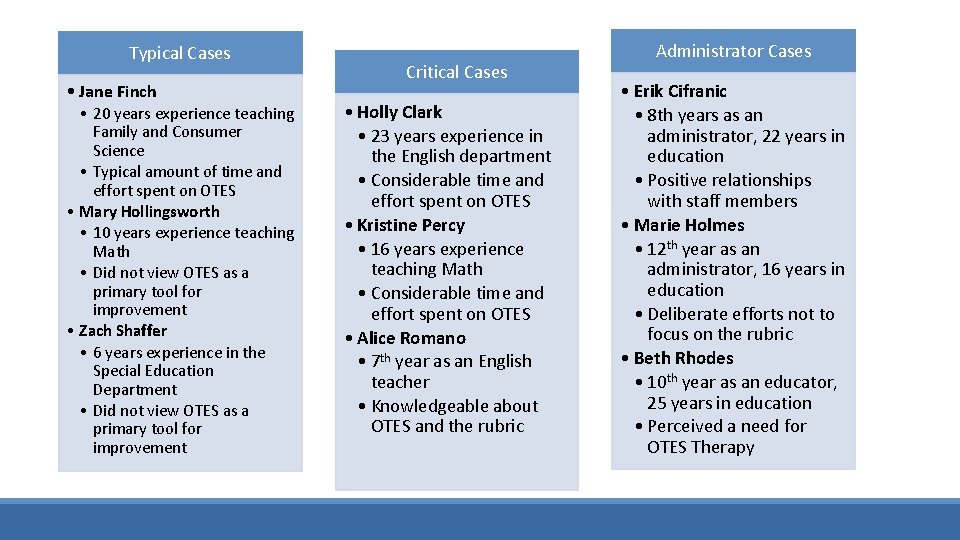
Typical Cases • Jane Finch • 20 years experience teaching Family and Consumer Science • Typical amount of time and effort spent on OTES • Mary Hollingsworth • 10 years experience teaching Math • Did not view OTES as a primary tool for improvement • Zach Shaffer • 6 years experience in the Special Education Department • Did not view OTES as a primary tool for improvement Critical Cases • Holly Clark • 23 years experience in the English department • Considerable time and effort spent on OTES • Kristine Percy • 16 years experience teaching Math • Considerable time and effort spent on OTES • Alice Romano • 7 th year as an English teacher • Knowledgeable about OTES and the rubric Administrator Cases • Erik Cifranic • 8 th years as an administrator, 22 years in education • Positive relationships with staff members • Marie Holmes • 12 th year as an administrator, 16 years in education • Deliberate efforts not to focus on the rubric • Beth Rhodes • 10 th year as an educator, 25 years in education • Perceived a need for OTES Therapy
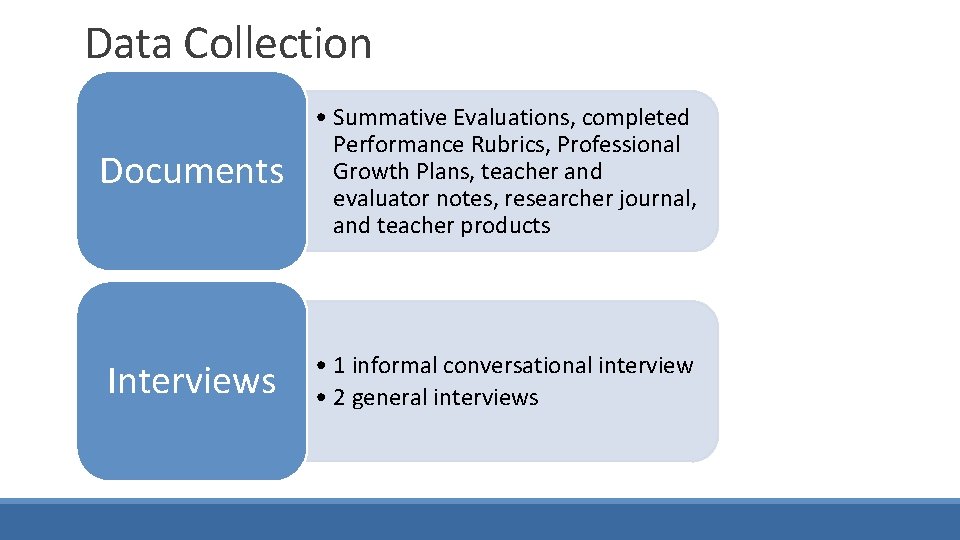
Data Collection Documents • Summative Evaluations, completed Performance Rubrics, Professional Growth Plans, teacher and evaluator notes, researcher journal, and teacher products Interviews • 1 informal conversational interview • 2 general interviews
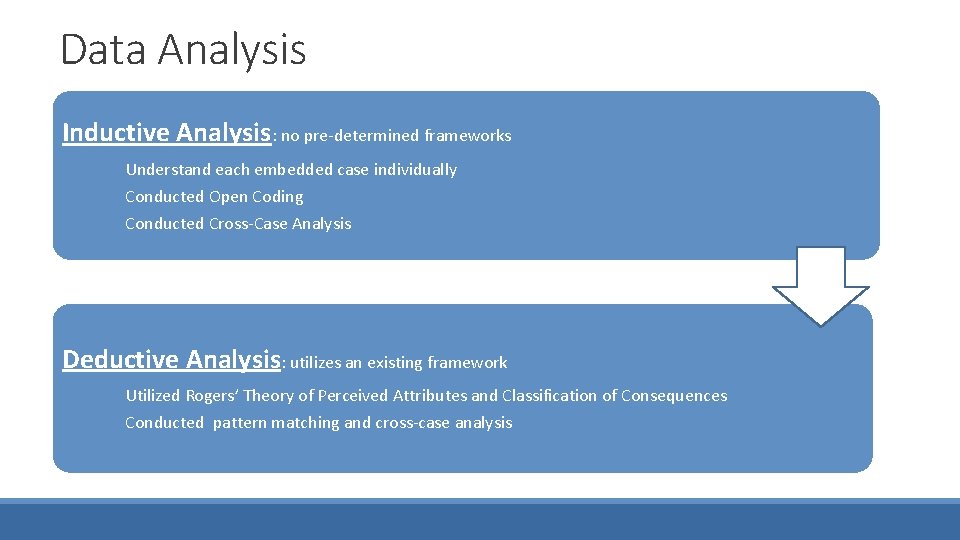
Data Analysis Inductive Analysis: no pre-determined frameworks Understand each embedded case individually Conducted Open Coding Conducted Cross-Case Analysis Deductive Analysis: utilizes an existing framework Utilized Rogers’ Theory of Perceived Attributes and Classification of Consequences Conducted pattern matching and cross-case analysis
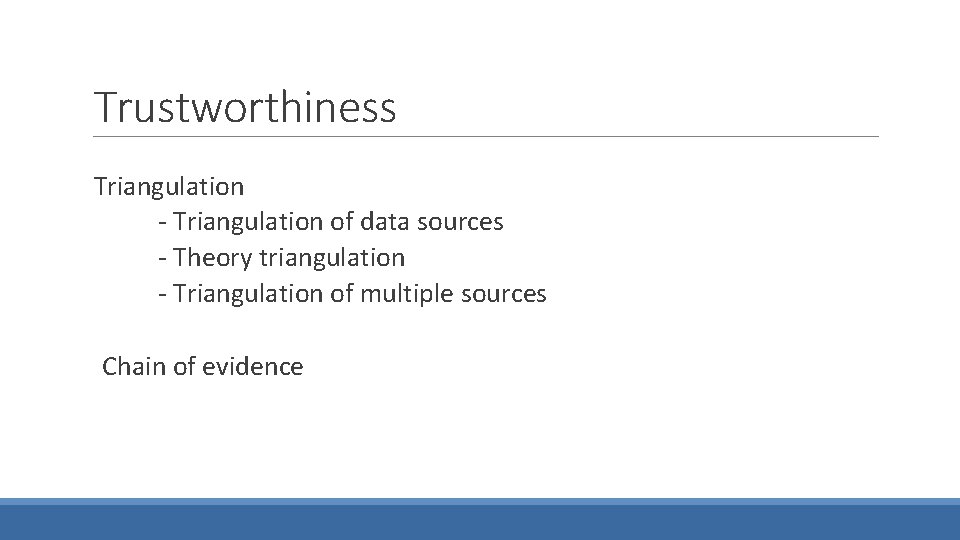
Trustworthiness Triangulation - Triangulation of data sources - Theory triangulation - Triangulation of multiple sources Chain of evidence
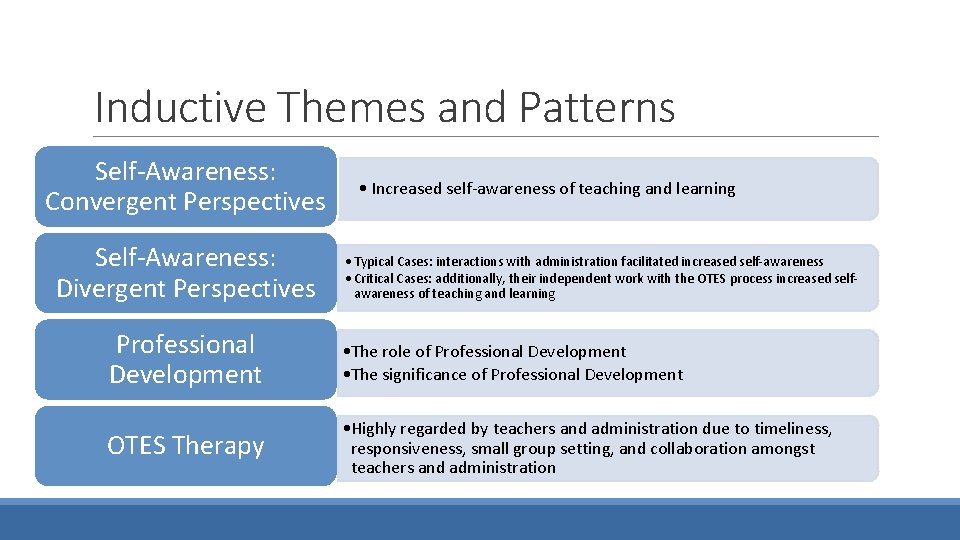
Inductive Themes and Patterns Self-Awareness: Convergent Perspectives Self-Awareness: Divergent Perspectives • Increased self-awareness of teaching and learning • Typical Cases: interactions with administration facilitated increased self-awareness • Critical Cases: additionally, their independent work with the OTES process increased selfawareness of teaching and learning Professional Development • The role of Professional Development • The significance of Professional Development OTES Therapy • Highly regarded by teachers and administration due to timeliness, responsiveness, small group setting, and collaboration amongst teachers and administration
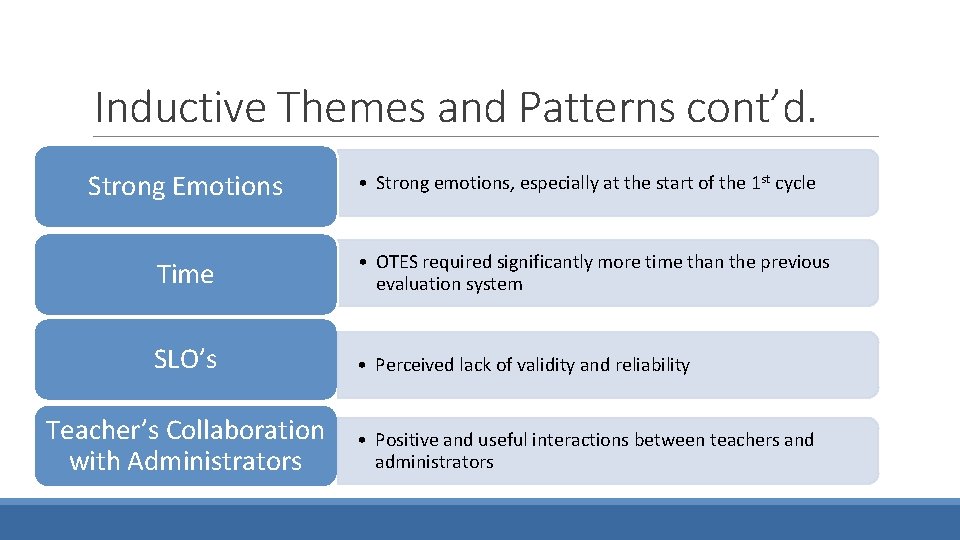
Inductive Themes and Patterns cont’d. Strong Emotions • Strong emotions, especially at the start of the 1 st cycle Time • OTES required significantly more time than the previous evaluation system SLO’s • Perceived lack of validity and reliability Teacher’s Collaboration with Administrators • Positive and useful interactions between teachers and administrators
Deductive Themes and Patterns: Rogers’ Theory of Perceived Attributes Relative Advantage Compatibility Complexity Triability Observability • Interactions • Feedback ● Formative Process ● Clear expectations • Aligned with educational beliefs and values • Understanding increased over time • Years of experience impacted Complexity • Teachers reported a high degree of triability • Formatively addressed instructional practices • Increased stress level, anxiety, and emotions • Increased self-awareness of teaching and learning
Deductive cont’d: Classification of Consequences Desirable Consequences Undesirable Consequences Direct Consequences Indirect Consequences Anticipated Consequences Unanticipated Consequences • Accountability, self-awareness, interactions between teachers and administrators, clarity of expectations. • Logistical struggles • Increased self-awareness • Interactions ● Stress and strong emotion ● Impact on instruction • Strong emotions ● OTES alignment with other initiatives • Improved relationships • Increased knowledge • Changes in behavior and instruction. ● Increased accountability ● Increased stress and emotions • Strong negative reactions to SLO implementation ● Positive interactions
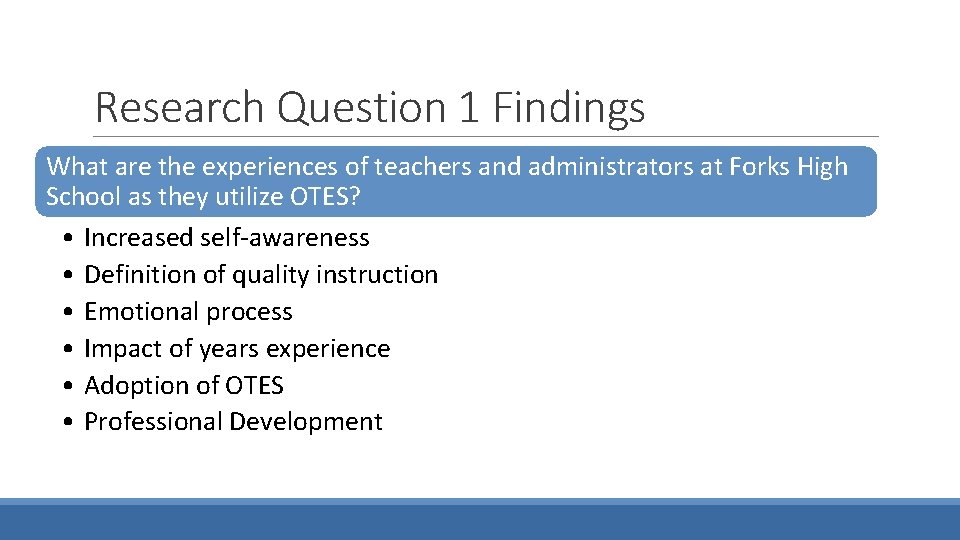
Research Question 1 Findings What are the experiences of teachers and administrators at Forks High School as they utilize OTES? • Increased self-awareness • Definition of quality instruction • Emotional process • Impact of years experience • Adoption of OTES • Professional Development
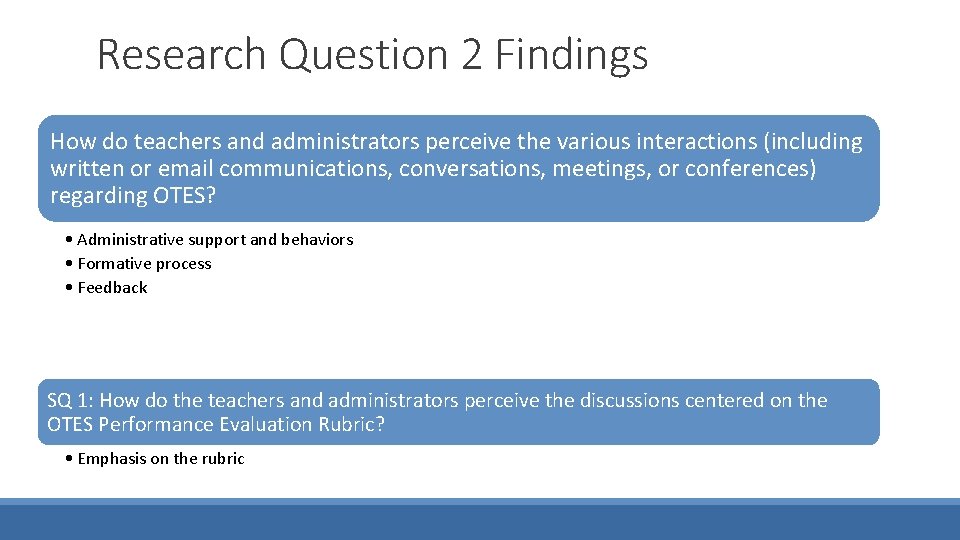
Research Question 2 Findings How do teachers and administrators perceive the various interactions (including written or email communications, conversations, meetings, or conferences) regarding OTES? • Administrative support and behaviors • Formative process • Feedback SQ 1: How do the teachers and administrators perceive the discussions centered on the OTES Performance Evaluation Rubric? • Emphasis on the rubric
Implications • Identify teacher’s needs and respond • Connect OTES with TBT’s • Address SLO implementation
Recommendations for Future Research • Determine how the experiences of teachers relate to increased teacher and student performance • Compare practices of Forks School District with other districts • Creation and implementation of SLO assessments
Recommendations for Practice • Conferences • Provide conference questions to teachers in advance • Focus conversations on instruction, as opposed to evidence or the rubric • Professional Development for administrators about conducting evaluation conferences and facilitating conversations to improve instruction • Address SLO implementation • Professional Development in regard to SLO assessment creation • Systematically ensure all teachers help create, review, and improve SLO assessments • Continue OTES Therapy (site based, interactive Professional Development) as needed • Connect OTES with TBT’s
References Creswell, J. W. (2012). Educational research: Planning, conducting, and evaluating quantitative and qualitative research. (4 th ed. ). Upper Saddle River, NJ: Merrill Prentice Hall. Daley, G. , & Kim, L. (2010). A teacher evaluation system that works. Retrieved from the National Institute for Excellence in Teaching website: http: //www. tapsystem. org/publications/wp_eval. pdf Labuschagne, A. (2003). Qualitative research-Airy fairy or fundamental? The Qualitative Report, 8(1). Retrieved 5/14/2013, from http: //www. nova. edu/ssss/QR/QR 8 -1/. html Marzano, R. , Pickering, D. , & Pollock, J. (2001). Classroom instruction that works: Research-based strategies for increasing student achievement. Alexandria, VA: ASCD. Patton, M. (2002). Qualitative research and evaluation methods (3 rd ed. ). Thousand Oaks, CA: Sage Publications. Rogers, E. (2003). Diffusion of innovations (5 th ed. ). New York, NY: Free Press Weisberg, D. , Sexton, S. , Mulhern, J. , & Keeling, D. (2009). The widget effect: Our national failure to acknowledge and act on differences in teacher effectiveness. The New Teacher Project.