
Utilizing of TGA and DSC analysis in testing
- Slides: 1
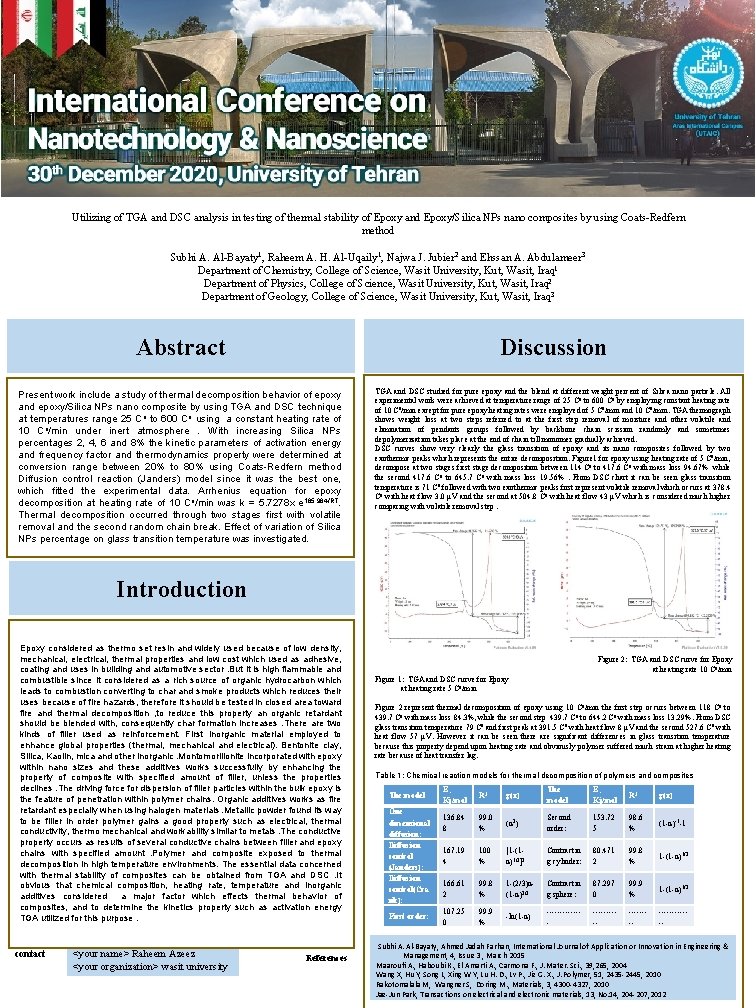
Utilizing of TGA and DSC analysis in testing of thermal stability of Epoxy and Epoxy/Silica NPs nano composites by using Coats-Redfern method Subhi A. Al-Bayaty 1, Raheem A. H. Al-Uqaily 1, Najwa J. Jubier 2 and Ehssan A. Abdulameer 3 Department of Chemistry, College of Science, Wasit University, Kut, Wasit, Iraq 1 Department of Physics, College of Science, Wasit University, Kut, Wasit, Iraq 2 Department of Geology, College of Science, Wasit University, Kut, Wasit, Iraq 3 Abstract Discussion Present work include a study of thermal decomposition behavior of epoxy and epoxy/Silica NPs nano composite by using TGA and DSC technique at temperatures range 25 Co to 600 Co using a constant heating rate of 10 Co/min under inert atmosphere. With increasing Silica NPs percentages 2, 4, 6 and 8% the kinetic parameters of activation energy and frequency factor and thermodynamics property were determined at conversion range between 20% to 80% using Coats-Redfern method Diffusion control reaction (Janders) model since it was the best one, which fitted the experimental data. Arrhenius equation for epoxy decomposition at heating rate of 10 Co/min was k = 5. 7278 x e 185. 984/RT. Thermal decomposition occurred through two stages first with volatile removal and the second random chain break. Effect of variation of Silica NPs percentage on glass transition temperature was investigated. TGA and DSC studied for pure epoxy and the blend at different weight percent of Silica nano particle. All experimental work were achieved at temperature range of 25 Co to 600 Co by employing constant heating rate of 10 Co/min except for pure epoxy heating rates were employed of 5 Co/min and 10 Co/min. TGA thermograph shows weight loss at two steps referred to at the first step removal of moisture and other volatile and elimination of pendants groups followed by backbone chain scission randomly and sometimes depolymerization takes place at the end of chain till monomer gradually achieved. DSC curves show very clearly the glass transition of epoxy and its nano composites followed by two exothermic peaks which represents the entire decomposition. Figure 1 for epoxy using heating rate of 5 Co/min, decompose at two stages first stage decomposition between 114 Co to 417. 6 Co with mass loss 94. 67% while the second 417. 6 Co to 645. 7 Co with mass loss 19. 56%. From DSC chart it can be seen glass transition temperature is 71 Co followed with two exothermic peaks first represent volatile removal which occurs at 378. 4 Co with heat flow 3. 0 µV and the second at 504. 8 Co with heat flow 43 µV which is considered much higher comparing with volatile removal step. Introduction Epoxy considered as thermo set resin and widely used because of low density, mechanical, electrical, thermal properties and low cost which used as adhesive, coating and uses in building and automotive sector. But it is high flammable and combustible since it considered as a rich source of organic hydrocarbon which leads to combustion converting to char and smoke products which reduces their uses because of fire hazards, therefore it should be tested in closed area toward fire and thermal decomposition , to reduce this property an organic retardant should be blended with, consequently char formation increases. There are two kinds of filler used as reinforcement. First Inorganic material employed to enhance global properties (thermal, mechanical and electrical). Bentonite clay, Silica, Kaolin, mica and other inorganic. Montomorillonite incorporated with epoxy within nano sizes and these additives works successfully by enhancing the property of composite with specified amount of filler, unless the properties declines. The driving force for dispersion of filler particles within the bulk epoxy is the feature of penetration within polymer chains. Organic additives works as fire retardant especially when using halogen materials. Metallic powder found its way to be filler in order polymer gains a good property such as electrical, thermal conductivity, thermo mechanical and workability similar to metals. The conductive property occurs as results of several conductive chains between filler and epoxy chains with specified amount. Polymer and composite exposed to thermal decomposition in high temperature environments. The essential data concerned with thermal stability of composites can be obtained from TGA and DSC. It obvious that chemical composition, heating rate, temperature and inorganic additives considered a major factor which effects thermal behavior of composites, and to determine the kinetics property such as activation energy TGA utilized for this purpose. contact <your name> Raheem Azeez <your organization> wasit university References Figure 2: TGA and DSC curve for Epoxy at heating rate 10 Co/min Figure 1: TGA and DSC curve for Epoxy at heating rate 5 Co/min Figure 2 represent thermal decomposition of epoxy using 10 Co/min the first step occurs between 118 Co to 439. 7 Co with mass loss 84. 3%, while the second step 439. 7 Co to 644. 2 Co with mass loss 13. 29%. From DSC glass transition temperature 79 Co and first peak at 391. 5 Co with heat flow 8 µV and the second 527. 6 Co with heat flow 57 µV. However it can be seen there are significant differences in glass transition temperature because this property depend upon heating rate and obviously polymer suffered much strain at higher heating rate because of heat transfer lag. Table 1: Chemical reaction models for thermal decomposition of polymers and composites The model One dimensional diffusion: Diffusion control (Janders): Diffusion control(Cra nk): First order: E, Kj/mol R 2 g(x) The model E, Kj/mol R 2 g(x) 136. 84 8 99. 0 % (α 2) Second order: 153. 72 5 98. 6 % (1 -α)-1 -1 167. 19 4 100 % [1 -(1α)1/3]2 Contractin g cylinder: 80. 471 2 99. 8 % 1 -(1 -α)1/2 166. 61 2 99. 8 % 1 -(2/3)α(1 -α)2/3 Contractin g sphere: 87. 297 0 99. 9 % 1 -(1 -α)1/3 107. 25 0 99. 9 % -ln(1 -α) ------- ------------ Subhi A. Al-Bayaty, Ahmed Jadah Farhan, International Journal of Application or Innovation in Engineering & Management, 4, Issue 3 , March 2015 Maaroufi A. , Haboubi K. , El Amarti A. , Carmona F. , J. Mater. Sci. , 39, 265, 2004 Wang X, Hu Y, Song L, Xing W Y, Lu H. D. , Lv P. , Jie G. X. , J. Polymer, 51, 2435 -2445, 2010 Rakotomalala M, Wangner S, Doring M. , Materials, 3, 4300 -4327, 2010 Jae-Jun Park, Transactions on electrical and electronic materials, 13, No. 14, 204 -207, 2012