
Utilizing NASA and ESA Earth Observations to Monitor
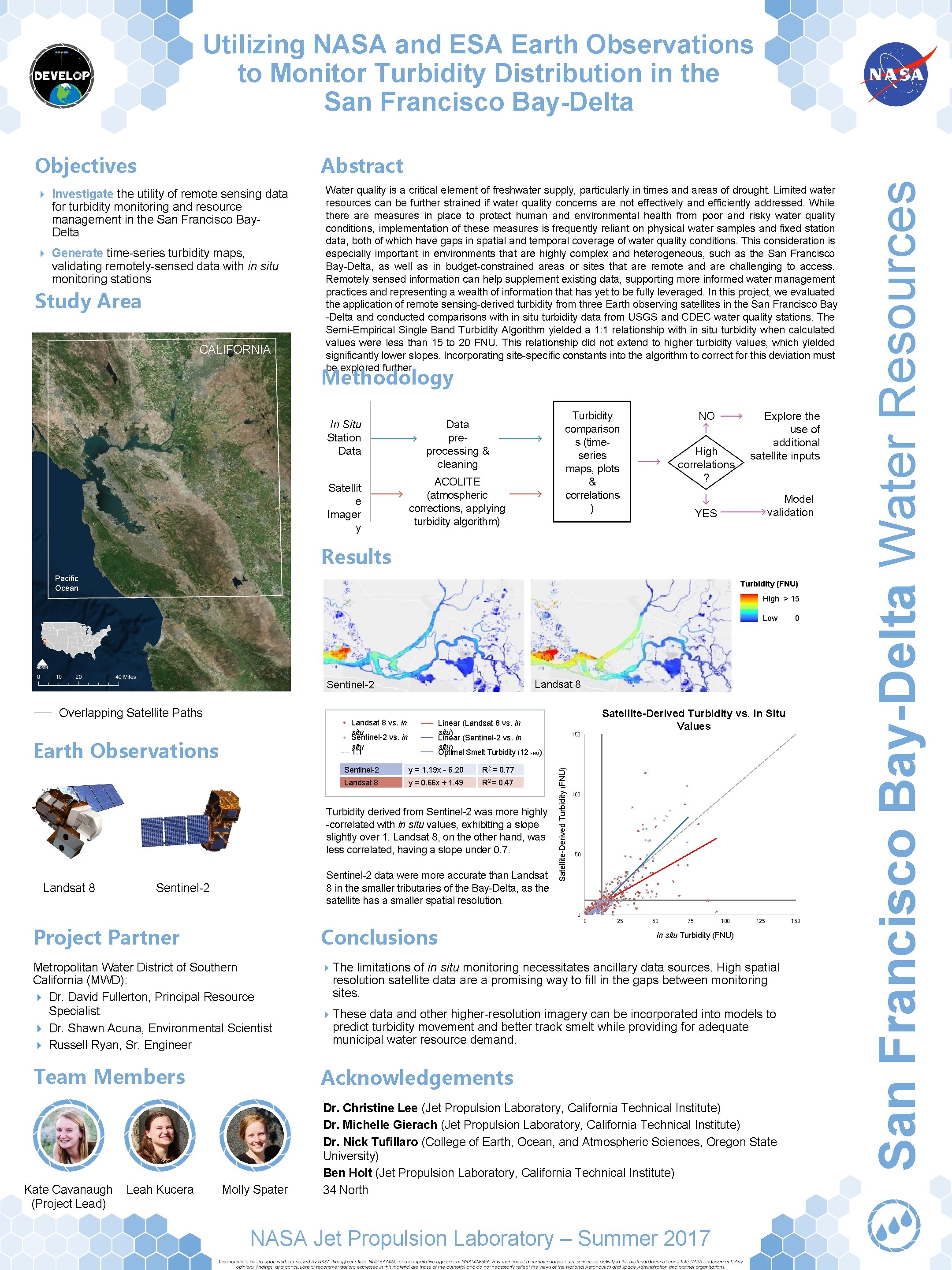
Utilizing NASA and ESA Earth Observations to Monitor Turbidity Distribution in the San Francisco Bay-Delta Abstract 4 Investigate the utility of remote sensing data for turbidity monitoring and resource management in the San Francisco Bay. Delta 4 Generate time-series turbidity maps, validating remotely-sensed data with in situ monitoring stations Study Area CALIFORNIA Water quality is a critical element of freshwater supply, particularly in times and areas of drought. Limited water resources can be further strained if water quality concerns are not effectively and efficiently addressed. While there are measures in place to protect human and environmental health from poor and risky water quality conditions, implementation of these measures is frequently reliant on physical water samples and fixed station data, both of which have gaps in spatial and temporal coverage of water quality conditions. This consideration is especially important in environments that are highly complex and heterogeneous, such as the San Francisco Bay-Delta, as well as in budget-constrained areas or sites that are remote and are challenging to access. Remotely sensed information can help supplement existing data, supporting more informed water management practices and representing a wealth of information that has yet to be fully leveraged. In this project, we evaluated the application of remote sensing-derived turbidity from three Earth observing satellites in the San Francisco Bay -Delta and conducted comparisons with in situ turbidity data from USGS and CDEC water quality stations. The Semi-Empirical Single Band Turbidity Algorithm yielded a 1: 1 relationship with in situ turbidity when calculated values were less than 15 to 20 FNU. This relationship did not extend to higher turbidity values, which yielded significantly lower slopes. Incorporating site-specific constants into the algorithm to correct for this deviation must be explored further. Methodology In Situ Station Data Satellit e Imager y Turbidity comparison s (timeseries maps, plots & correlations ) Data preprocessing & cleaning ACOLITE (atmospheric corrections, applying turbidity algorithm) NO High correlations ? Explore the use of additional satellite inputs Model validation YES Results Pacific Ocean Turbidity (FNU) High > 15 Low Landsat 8 Sentinel-2 Landsat 8 vs. in situ Sentinel-2 vs. in situ 1: 1 Earth Observations Linear (Landsat 8 vs. in situ) Linear (Sentinel-2 vs. in situ) Optimal Smelt Turbidity (12 FNU) Sentinel-2 y = 1. 19 x - 6. 20 R 2 = 0. 77 Landsat 8 y = 0. 66 x + 1. 49 R 2 = 0. 47 Turbidity derived from Sentinel-2 was more highly -correlated with in situ values, exhibiting a slope slightly over 1. Landsat 8, on the other hand, was less correlated, having a slope under 0. 7. Landsat 8 Sentinel-2 data were more accurate than Landsat 8 in the smaller tributaries of the Bay-Delta, as the satellite has a smaller spatial resolution. Sentinel-2 Satellite-Derived Turbidity vs. In Situ Values 150 Satellite-Derived Turbidity (FNU) Overlapping Satellite Paths 0 100 50 0 0 25 50 75 100 125 Project Partner Conclusions Metropolitan Water District of Southern California (MWD): 4 Dr. David Fullerton, Principal Resource Specialist 4 Dr. Shawn Acuna, Environmental Scientist 4 Russell Ryan, Sr. Engineer 4 The limitations of in situ monitoring necessitates ancillary data sources. High spatial resolution satellite data are a promising way to fill in the gaps between monitoring sites. Team Members Acknowledgements Kate Cavanaugh (Project Lead) Leah Kucera Molly Spater In situ Turbidity (FNU) 4 These data and other higher-resolution imagery can be incorporated into models to predict turbidity movement and better track smelt while providing for adequate municipal water resource demand. Dr. Christine Lee (Jet Propulsion Laboratory, California Technical Institute) Dr. Michelle Gierach (Jet Propulsion Laboratory, California Technical Institute) Dr. Nick Tufillaro (College of Earth, Ocean, and Atmospheric Sciences, Oregon State University) Ben Holt (Jet Propulsion Laboratory, California Technical Institute) 34 North NASA Jet Propulsion Laboratory – Summer 2017 150 San Francisco Bay-Delta Water Resources Objectives
- Slides: 1