
Utilizing Internal Audit Metrics to Advance Your Department
- Slides: 14
Utilizing Internal Audit Metrics to Advance Your Department May 17, 2018
A little about me…. • • 22 years of experience in public accounting performing a wide variety of audit, compliance, and consulting services Since 2009 have led or been a subject matter expert on more than 30 External Quality Assessments (EQAs) mainly focusing on Fortune 500 companies Developed Pw. C’s updated methodology, tools, and training for performing strategic assessments (Generation 2, firm is now on Generation 3) Developed the firm’s practice aids for developing metrics and KPIs for Internal Audit functions 2
The Struggle with Metrics and KPIs Most audit departments struggle with metrics and KPIs Only look at them when its time to do your quarterly Audit Committee reporting Ø Always worried that what they are reporting is not enough or telling a relevant story Ø Little or no discussion with Audit Committee and Stakeholders about metrics for performance Lack the planning to identify, track and develop metrics that are meaningful Ø Extreme focus on completing audits, leaving departmental improvement actions for “available” time Ø Disagree on what is impactful for the department and its employees 3
Why Such a Struggle? • Few Audit Committees focus on metrics. Use them to make sure things are progressing, but spend little or no time discussing what story the metrics truly convey. • Stakeholders are more focused on impact of the audit function, not on how efficient or well run the department operates (they assume it already is) • CAEs and other Internal Audit leaders focus on value provided by Internal Audit, although this value typically is not quantifiable. 4
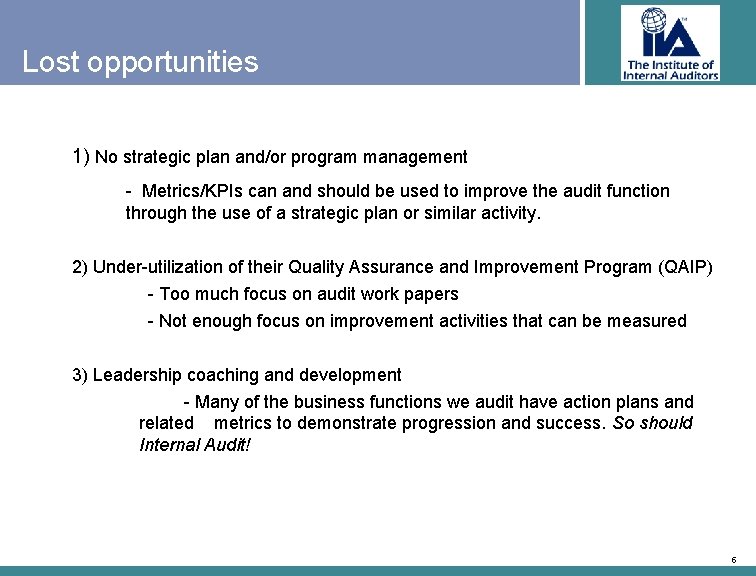
Lost opportunities 1) No strategic plan and/or program management - Metrics/KPIs can and should be used to improve the audit function through the use of a strategic plan or similar activity. 2) Under-utilization of their Quality Assurance and Improvement Program (QAIP) - Too much focus on audit work papers - Not enough focus on improvement activities that can be measured 3) Leadership coaching and development - Many of the business functions we audit have action plans and related metrics to demonstrate progression and success. So should Internal Audit! 5
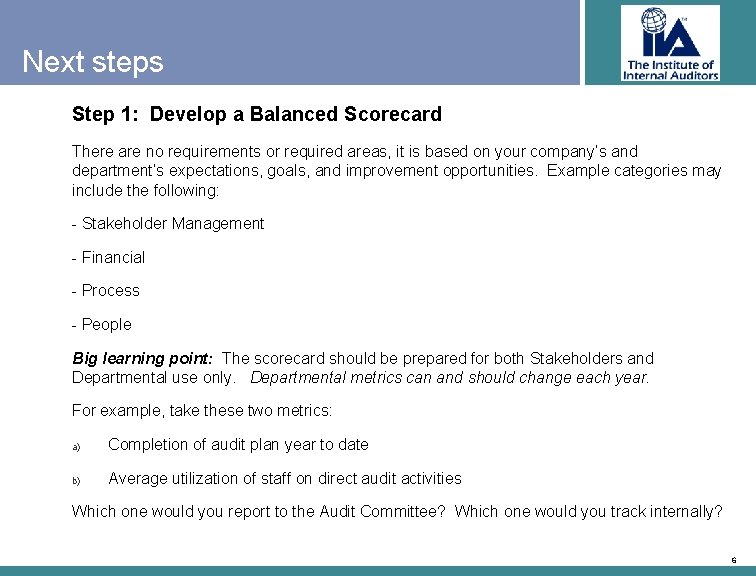
Next steps Step 1: Develop a Balanced Scorecard There are no requirements or required areas, it is based on your company’s and department’s expectations, goals, and improvement opportunities. Example categories may include the following: - Stakeholder Management - Financial - Process - People Big learning point: The scorecard should be prepared for both Stakeholders and Departmental use only. Departmental metrics can and should change each year. For example, take these two metrics: a) Completion of audit plan year to date b) Average utilization of staff on direct audit activities Which one would you report to the Audit Committee? Which one would you track internally? 6
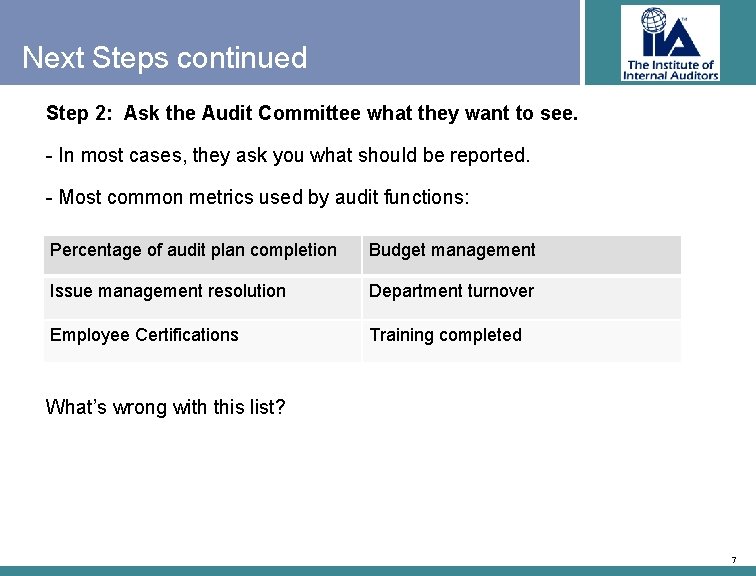
Next Steps continued Step 2: Ask the Audit Committee what they want to see. - In most cases, they ask you what should be reported. - Most common metrics used by audit functions: Percentage of audit plan completion Budget management Issue management resolution Department turnover Employee Certifications Training completed What’s wrong with this list? 7
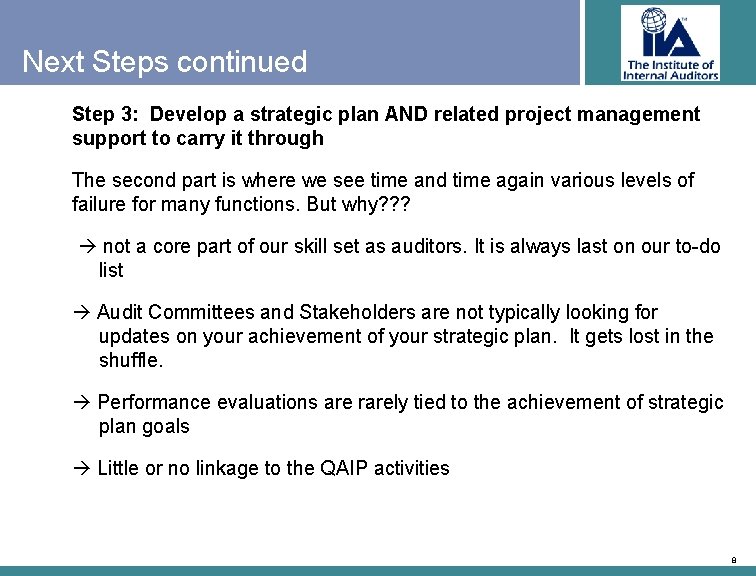
Next Steps continued Step 3: Develop a strategic plan AND related project management support to carry it through The second part is where we see time and time again various levels of failure for many functions. But why? ? ? not a core part of our skill set as auditors. It is always last on our to-do list Audit Committees and Stakeholders are not typically looking for updates on your achievement of your strategic plan. It gets lost in the shuffle. Performance evaluations are rarely tied to the achievement of strategic plan goals Little or no linkage to the QAIP activities 8
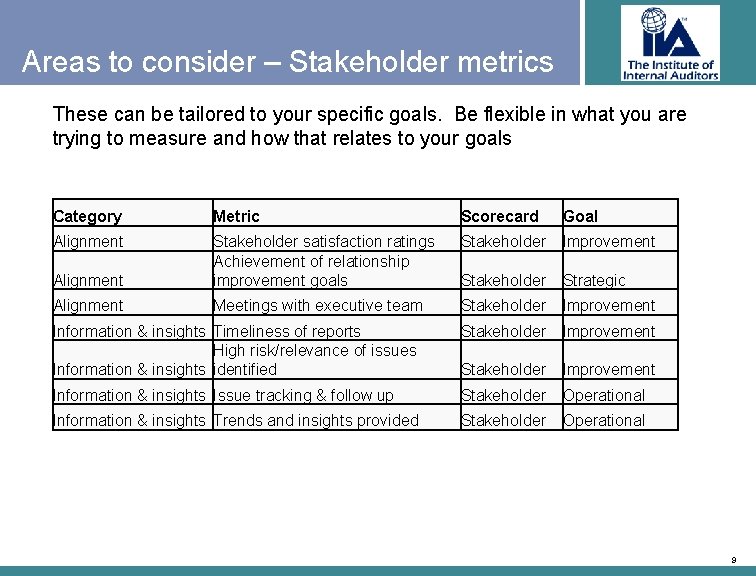
Areas to consider – Stakeholder metrics These can be tailored to your specific goals. Be flexible in what you are trying to measure and how that relates to your goals Category Metric Scorecard Goal Alignment Stakeholder Improvement Alignment Stakeholder satisfaction ratings Achievement of relationship improvement goals Stakeholder Strategic Alignment Meetings with executive team Stakeholder Improvement Information & insights Timeliness of reports High risk/relevance of issues Information & insights identified Stakeholder Improvement Information & insights Issue tracking & follow up Stakeholder Operational Information & insights Trends and insights provided Stakeholder Operational 9
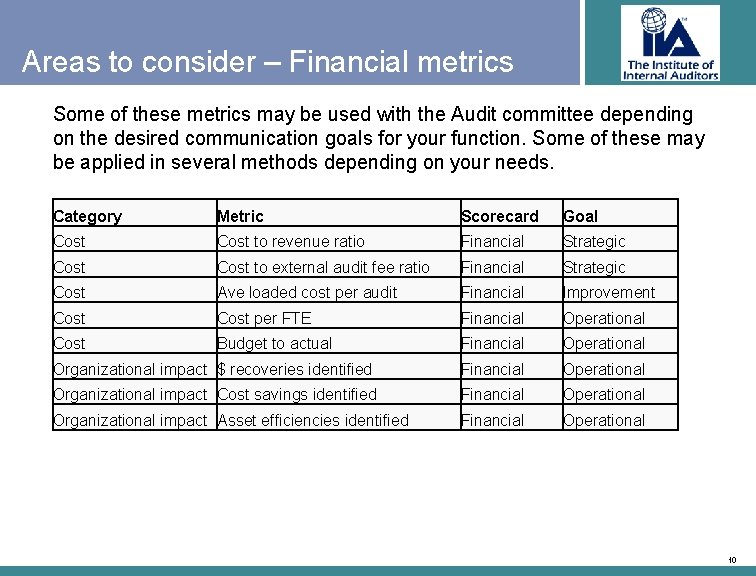
Areas to consider – Financial metrics Some of these metrics may be used with the Audit committee depending on the desired communication goals for your function. Some of these may be applied in several methods depending on your needs. Category Metric Scorecard Goal Cost to revenue ratio Financial Strategic Cost to external audit fee ratio Financial Strategic Cost Ave loaded cost per audit Financial Improvement Cost per FTE Financial Operational Cost Budget to actual Financial Operational Organizational impact $ recoveries identified Financial Operational Organizational impact Cost savings identified Financial Operational Organizational impact Asset efficiencies identified Financial Operational 10
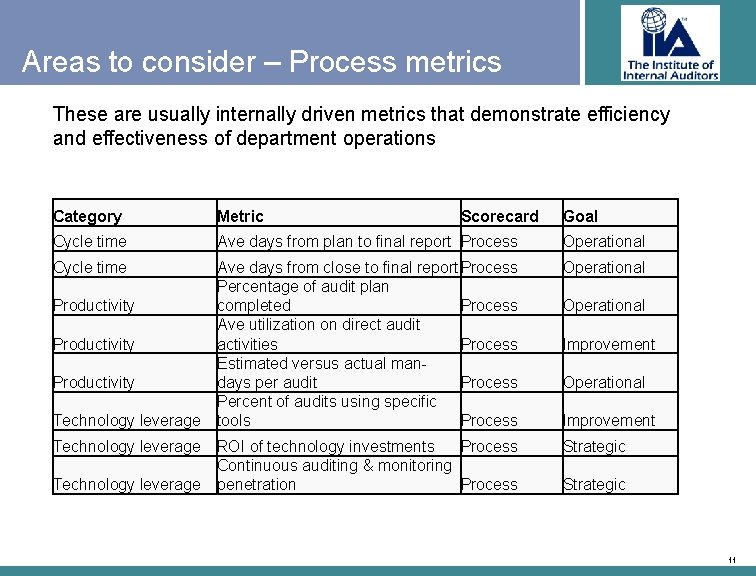
Areas to consider – Process metrics These are usually internally driven metrics that demonstrate efficiency and effectiveness of department operations Category Metric Scorecard Cycle time Ave days from plan to final report Process Operational Ave days from close to final report Process Percentage of audit plan Productivity completed Process Ave utilization on direct audit Productivity activities Process Estimated versus actual man. Productivity days per audit Process Percent of audits using specific Technology leverage tools Process Operational Technology leverage ROI of technology investments Process Continuous auditing & monitoring Technology leverage penetration Process Strategic Cycle time Goal Operational Improvement Strategic 11
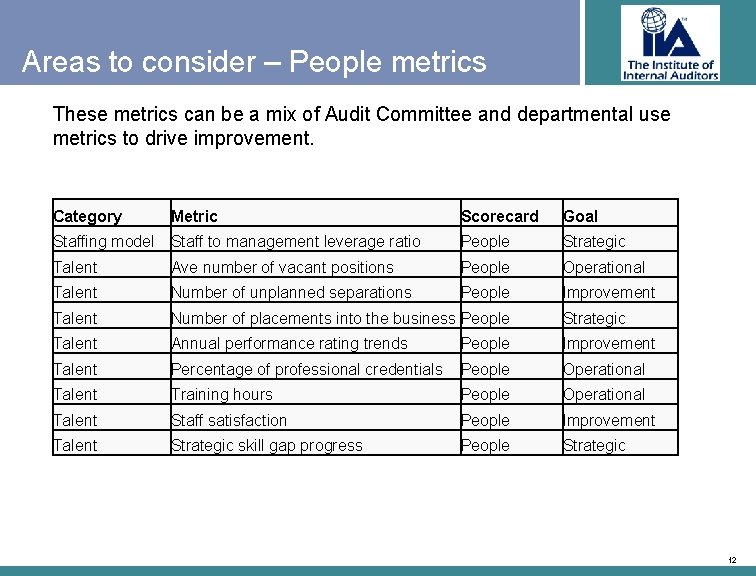
Areas to consider – People metrics These metrics can be a mix of Audit Committee and departmental use metrics to drive improvement. Category Metric Scorecard Goal Staffing model Staff to management leverage ratio People Strategic Talent Ave number of vacant positions People Operational Talent Number of unplanned separations People Improvement Talent Number of placements into the business People Strategic Talent Annual performance rating trends People Improvement Talent Percentage of professional credentials People Operational Talent Training hours People Operational Talent Staff satisfaction People Improvement Talent Strategic skill gap progress People Strategic 12
Pulling it together Once you know what you are measuring, • Use your QAIP activities as the process to manage these metrics • Communicate these consistently based on your rhythm of reporting • • Add/remove department only metrics as needed based on your goals and plan Make sure everyone in the department knows what is being measured Be willing to change your plans if your goals or demands of your business change Reevaluate metrics at least yearly to make sure they are relevant 13
Thank you! Questions? 14