
Utilization of Microsatellite Instability Testing and Associated Factors

Utilization of Microsatellite Instability Testing and Associated Factors among Colorectal Cancer Patients Xiao-Cheng Wu, Mary Anne Lynch, Lili Bao, Bent Mumphrey, Meijiao Zhou, Meichin Hsieh, Jordan Kalitz 2019 NAACCR Annual Conference June 13, 2019
Background • Microsatellite Instability (MSI) test is used to diagnose Lynch syndrome and predict prognosis and responses of colorectal cancer (CRC) to chemotherapy 1. • In 2015, the NCCN Clinical Practice Guidelines - Genetic/ Familial High-Risk Assessment: Colorectal have recommended MSI test for all CRC patients under age 70. • Although this test has been a data item collected by hospital and central cancer registries in the US since 2010, its completeness is uncertain, which 1 Clin Advuses limits MSI 2018 data at the population level. Hematolof Oncol. Nov; 16(11): 735 -745.
Background • As MSI test is performed on CRC tumors removed at surgery or on colonoscopy biopsy, pathology reports are the primary source of this data. • Currently, electronic pathology (e-path) reports including subsequent addendums, cover 95% of cancer cases in Louisiana. • Large coverage of e-path reporting makes it possible to assess and enhance the completeness of the MSI data.
Background • The following facts further triggered our interest in MSI data: o Our recent study 1 identified significantly higher early-onset CRC incidence rates in the Cajuns area than the US, leading to speculation of a possible founder effect of hereditary CRC in the population. o The new initiation “Taking Aim at Cancer in Louisiana” targets CRC cancer to improve early detection and reduce mortality rates. o We are interested in identifying patients with 2 to help hospitals with genetic hereditary cancers 1 Clin Transl Gastroenterol. 2014 Oct; 5(10): e 60. 2 Gut Liver. 2016 Mar; referrals for cancer patients and their relatives.
• To assess the completeness of MSI data routinely collected for microscopically confirmed CRC cases. • To evaluate the role of e-path reports in supplementing MSI data. • To describe the use of MSI test among CRC patients in clinical practice and identify sociodemographic factors related to its use.
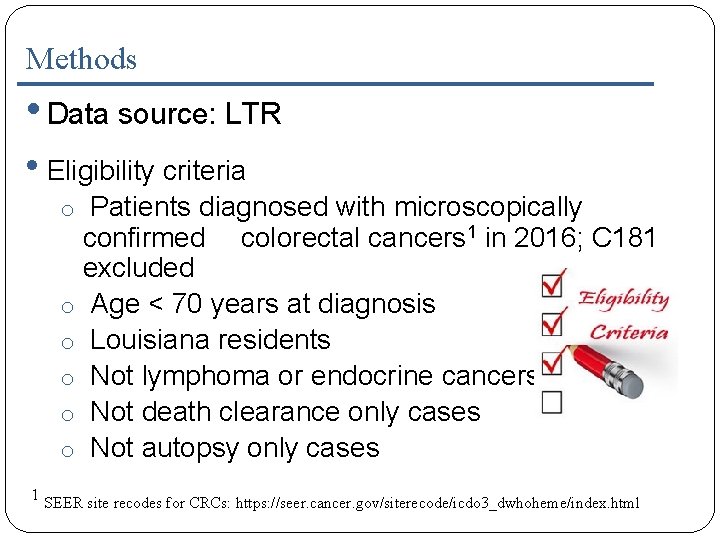
Methods • Data source: LTR • Eligibility criteria o Patients diagnosed with microscopically confirmed colorectal cancers 1 in 2016; C 181 excluded o Age < 70 years at diagnosis o Louisiana residents o Not lymphoma or endocrine cancers o Not death clearance only cases o Not autopsy only cases 1 SEER site recodes for CRCs: https: //seer. cancer. gov/siterecode/icdo 3_dwhoheme/index. html
Methods • MSI test: o 4 different mismatch repair genes are responsible for correcting mutations in the DNA. o If one of these genes is mutated, small errors in the DNA remains unrepaired leading to an expansion/ reduction in repetitive sequences in the DNA, which is termed MSI. • IHC (immunohistochemical staining) o The MSI test has now largely been replaced by IHC on the tumor tissue, which detects the presence/absence of the 4 protein
Methods • Electronic pathology reports (E-path) of reportable cancer cases routinely transmitted to LTR: imported into SEER*DMS and linked to the corresponding cancer records as source records. • E-path reports with no mention of reportable cancer but matched to prior cancer patients routinely transmitted to LTR named “e-path forwarding”: stored
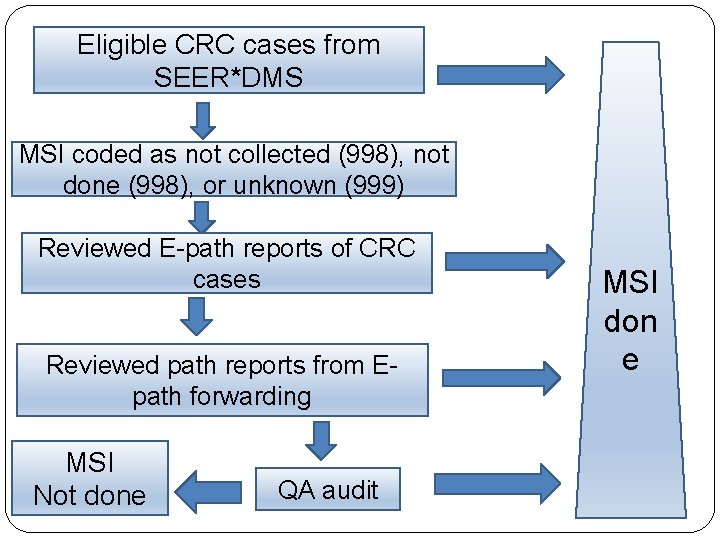
Eligible CRC cases from SEER*DMS MSI coded as not collected (998), not done (998), or unknown (999) Reviewed E-path reports of CRC cases Reviewed path reports from Epath forwarding MSI Not done QA audit MSI don e
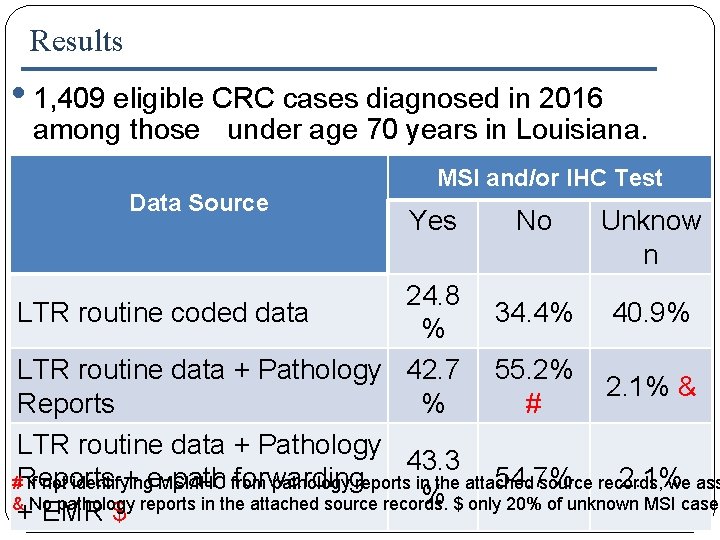
Results • 1, 409 eligible CRC cases diagnosed in 2016 among those under age 70 years in Louisiana. Data Source MSI and/or IHC Test Yes No Unknow n 24. 8 LTR routine coded data 34. 4% 40. 9% % LTR routine data + Pathology 42. 7 55. 2% 2. 1% & Reports % # * LTR routine data + Pathology 43. 3 + e-path forwarding 54. 7% 2. 1% #Reports If not identifying MSI/IHC from pathology reports in the attached source records, we ass % $ only 20% of unknown MSI cases & No pathology reports in the attached source records. + EMR $
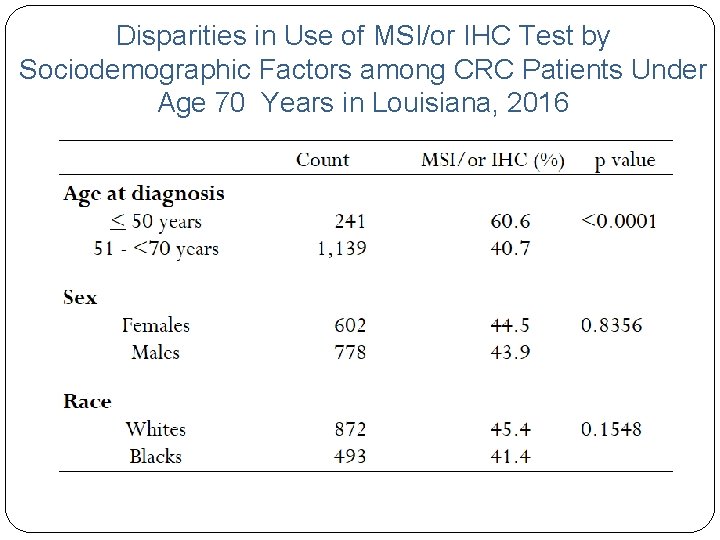
Disparities in Use of MSI/or IHC Test by Sociodemographic Factors among CRC Patients Under Age 70 Years in Louisiana, 2016

Disparities in Use of MSI/or IHC Test by Sociodemographic Factors among CRC Patients Under Age 70 Years in Louisiana, 2016
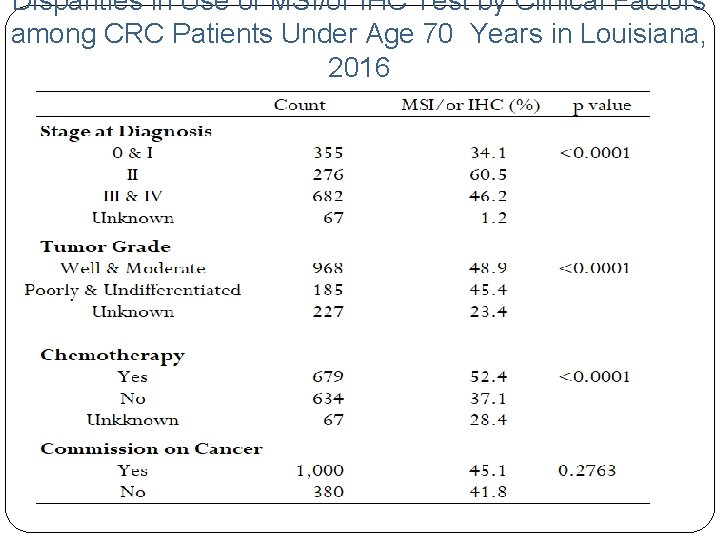
Disparities in Use of MSI/or IHC Test by Clinical Factors among CRC Patients Under Age 70 Years in Louisiana, 2016
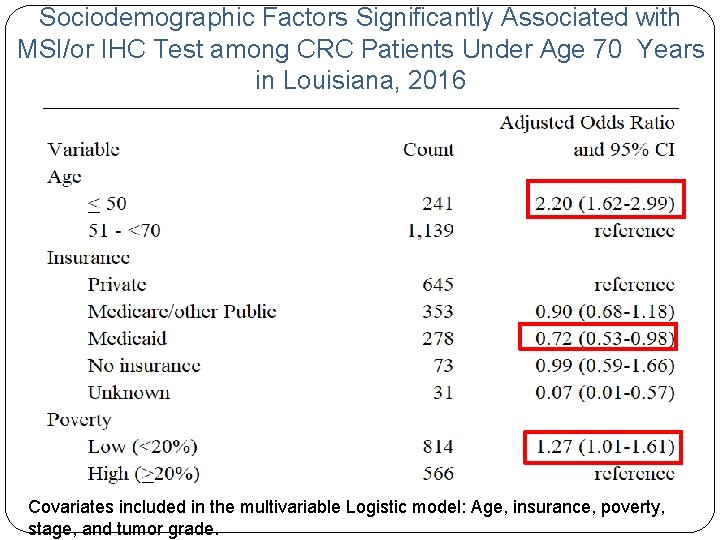
Sociodemographic Factors Significantly Associated with MSI/or IHC Test among CRC Patients Under Age 70 Years in Louisiana, 2016 Covariates included in the multivariable Logistic model: Age, insurance, poverty, stage, and tumor grade.
Discussions/Conclusions • As MSI is not required data field, it is incomplete in the registry routine database. • The completeness of MSI data can be significantly improved after supplementing such data from path reports, especially for registries with large coverage of e-path reporting. • The MSI result is most likely found from addendums of path reports; sometimes, the result is found from subsequent path reports with no mention of cancer, indicating the importance of addendums and the e-path forwarding.
Discussions/Conclusions • Manually reviewed electronic medical records for sub-set of cases with MSI/or IHC coded as unknown and found we missed the path reports of MSI test for a small proportion of cases. • Need to work with E-path vendors to identify root causes of missing reporting as all the MSI/or IHC test requests go through path labs to send specimens. • Our data show low SES patients are less likely (p<0. 01) to receive the guidelinerecommended MSI test than their high SES counterparts, indicating the intervention needs
Implication and Future Direction • As medical care is marching into the precision medicine era, tumor markers play a more and more essential role in diagnosing and treating cancer patients. • To keep up with the pace of medical advancement, cancer registries need to identify methods to collect biomarker data completely and effectively. • E-path reporting has opened a door for registries to achieve higher goals. Developing innovative means to extract such data semi-automatically or automatically from e- path reports is a direction to go, which will enhance registries’
Acknowledgement NCI-SEER and CDC-NPCR for their funding and technical support on our registry operations and implementation of electronic pathology reporting.

Thank You!

Frequencies of MSI/or IHC Test by Months from Diagnosis CRC Patients Under Age 70 Years in Louisiana, 2016
- Slides: 20