
Utilization of bio ash based adsorbent materials in
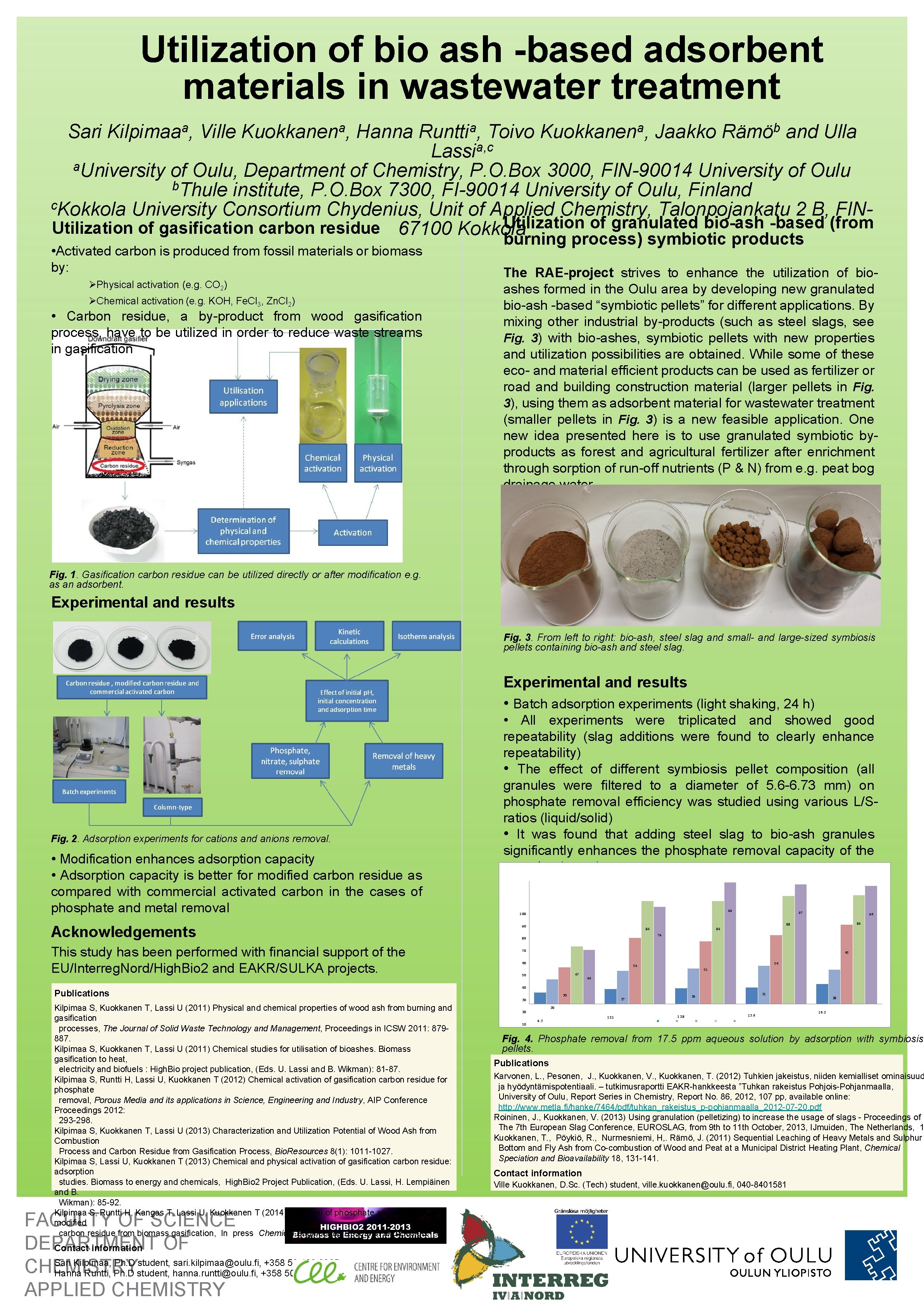
Utilization of bio ash -based adsorbent materials in wastewater treatment Sari Kilpimaaa, Ville Kuokkanena, Hanna Runttia, Toivo Kuokkanena, Jaakko Rämöb and Ulla a, c Lassi a. University of Oulu, Department of Chemistry, P. O. Box 3000, FIN-90014 University of Oulu b. Thule institute, P. O. Box 7300, FI-90014 University of Oulu, Finland c. Kokkola University Consortium Chydenius, Unit of Applied Chemistry, Talonpojankatu 2 B, FINUtilization of granulated bio-ash -based (from Utilization of gasification carbon residue 67100 Kokkola • Activated carbon is produced from fossil materials or biomass by: ØPhysical activation (e. g. CO 2) ØChemical activation (e. g. KOH, Fe. Cl 3, Zn. Cl 2) • Carbon residue, a by-product from wood gasification process, have to be utilized in order to reduce waste streams in gasification burning process) symbiotic products The RAE-project strives to enhance the utilization of bioashes formed in the Oulu area by developing new granulated bio-ash -based “symbiotic pellets” for different applications. By mixing other industrial by-products (such as steel slags, see Fig. 3) with bio-ashes, symbiotic pellets with new properties and utilization possibilities are obtained. While some of these eco- and material efficient products can be used as fertilizer or road and building construction material (larger pellets in Fig. 3), using them as adsorbent material for wastewater treatment (smaller pellets in Fig. 3) is a new feasible application. One new idea presented here is to use granulated symbiotic byproducts as forest and agricultural fertilizer after enrichment through sorption of run-off nutrients (P & N) from e. g. peat bog drainage water. Fig. 1. Gasification carbon residue can be utilized directly or after modification e. g. as an adsorbent. Experimental and results Fig. 3. From left to right: bio-ash, steel slag and small- and large-sized symbiosis pellets containing bio-ash and steel slag. Experimental and results • Batch adsorption experiments (light shaking, 24 h) • Modification enhances adsorption capacity • Adsorption capacity is better for modified carbon residue as compared with commercial activated carbon in the cases of phosphate and metal removal Acknowledgements This study has been performed with financial support of the EU/Interreg. Nord/High. Bio 2 and EAKR/SULKA projects. Publications Kilpimaa S, Kuokkanen T, Lassi U (2011) Physical and chemical properties of wood ash from burning and gasification processes, The Journal of Solid Waste Technology and Management, Proceedings in ICSW 2011: 879887. Kilpimaa S, Kuokkanen T, Lassi U (2011) Chemical studies for utilisation of bioashes. Biomass gasification to heat, electricity and biofuels : High. Bio project publication, (Eds. U. Lassi and B. Wikman): 81 -87. Kilpimaa S, Runtti H, Lassi U, Kuokkanen T (2012) Chemical activation of gasification carbon residue for phosphate removal, Porous Media and its applications in Science, Engineering and Industry, AIP Conference Proceedings 2012: 293 -298. Kilpimaa S, Kuokkanen T, Lassi U (2013) Characterization and Utilization Potential of Wood Ash from Combustion Process and Carbon Residue from Gasification Process, Bio. Resources 8(1): 1011 -1027. Kilpimaa S, Lassi U, Kuokkanen T (2013) Chemical and physical activation of gasification carbon residue: adsorption studies. Biomass to energy and chemicals, High. Bio 2 Project Publication, (Eds. U. Lassi, H. Lempiäinen and B. Wikman): 85 -92. Kilpimaa S, Runtti H, Kangas T, Lassi U, Kuokkanen T (2014) Removal of phosphate and nitrate over a modified carbon residue from biomass gasification, In press Chemical Engineering Research and Design. FACULTY OF SCIENCE DEPARTMENT OF Contact information Sari Kilpimaa, Ph. D student, sari. kilpimaa@oulu. fi, +358 50 428 8295 CHEMISTRY Hanna Runtti, Ph. D student, hanna. runtti@oulu. fi, +358 50 562 8369 APPLIED CHEMISTRY 99 100 90 80 70 60 Phosphate reduction [%] Fig. 2. Adsorption experiments for cations and anions removal. • All experiments were triplicated and showed good repeatability (slag additions were found to clearly enhance repeatability) • The effect of different symbiosis pellet composition (all granules were filtered to a diameter of 5. 6 -6. 73 mm) on phosphate removal efficiency was studied using various L/Sratios (liquid/solid) • It was found that adding steel slag to bio-ash granules significantly enhances the phosphate removal capacity of the granules (Fig. 4) • The results also showed that the dissolution of chemical elements from the granules was significantly decreased by slag additions and the granules were clearly harder and stronger 84 97 96 89 88 84 79 65 56 54 47 50 51 44 40 30 30 20 20 10 31 29 27 9. 3 12. 1 12. 8 13. 6 28 16. 2 Fig. 4. Phosphate removal. Slagfrom 17. 5 ppm. Slag 20 aqueous solution Bio-ash 10 % % Slag 30 % by adsorption Slag 40 % with symbiosis pellets. LS 450 LS 300 LS 150 LS 100 LS 50 0 Publications Karvonen, L. , Pesonen, J. , Kuokkanen, V. , Kuokkanen, T. (2012) Tuhkien jakeistus, niiden kemialliset ominaisuud ja hyödyntämispotentiaali. – tutkimusraportti EAKR-hankkeesta ”Tuhkan rakeistus Pohjois-Pohjanmaalla, University of Oulu, Report Series in Chemistry, Report No. 86, 2012, 107 pp, available online: http: //www. metla. fi/hanke/7464/pdf/tuhkan_rakeistus_p-pohjanmaalla_2012 -07 -20. pdf Roininen, J. , Kuokkanen, V. (2013) Using granulation (pelletizing) to increase the usage of slags - Proceedings of The 7 th European Slag Conference, EUROSLAG, from 9 th to 11 th October, 2013, IJmuiden, The Netherlands, 1 Kuokkanen, T. , Pöykiö, R. , Nurmesniemi, H, . Rämö, J. (2011) Sequential Leaching of Heavy Metals and Sulphur Bottom and Fly Ash from Co-combustion of Wood and Peat at a Municipal District Heating Plant, Chemical Speciation and Bioavailability 18, 131 -141. Contact information Ville Kuokkanen, D. Sc. (Tech) student, ville. kuokkanen@oulu. fi, 040 -8401581
- Slides: 1